
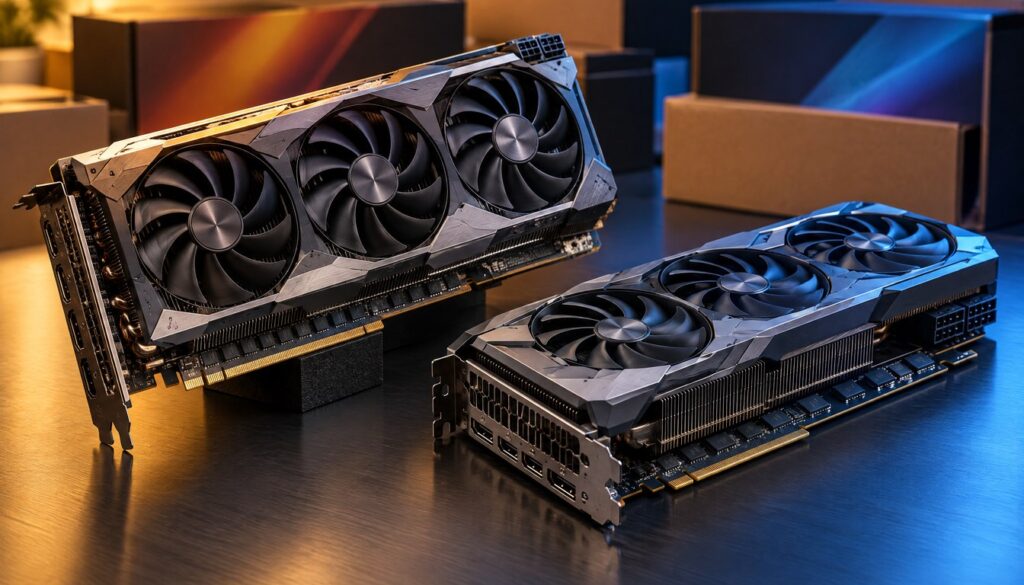
AMD has told its graphics card board partners that the price of GDDR6 memory went up effective October 1, 2026, according to reports from Wccftech, TechPowerUp and XenoSpectrum. Nvidia, by contrast, has not sent a comparable notice to its own partners covering GDDR7, the memory standard behind its GeForce RTX 50-series cards, as of October 10-11. Neither company has confirmed the move publicly, and the exact size of the AMD increase has not been disclosed. But the asymmetry between the two GPU makers is already rippling through a supply chain that board partners say gives them little choice but to pass costs along.
The GDDR6 price increase lands at an awkward moment for AMD’s Radeon lineup, much of which still runs on GDDR6 rather than the newer GDDR7 standard Nvidia adopted for its RTX 50-series. It also arrives against a backdrop of a global DRAM squeeze that analysts have tied to AI data center demand pulling fabrication capacity away from consumer memory. This article walks through what is actually confirmed, what remains speculative, and what the GDDR6 price increase could mean for anyone shopping for a graphics card heading into the holiday season.
What AMD Reportedly Told Its Board Partners
The core of the story traces back to a report attributed to Board Channels, an industry-sourcing outlet, with related coverage citing BenchLife and a source identified as Bobantang. According to that reporting, AMD notified its board partners, the companies that build and sell Radeon-branded graphics cards, that GDDR6 memory prices supplied alongside AMD’s GPUs increased starting October 1, 2026. Wccftech’s writeup of the Board Channels report states plainly that board partners will now have no other option but to pass the costs on to consumers, since the memory is a required input rather than an optional component they can source independently.
What is missing from every version of this story is a number. No outlet reporting on the October 1 adjustment has published a confirmed percentage, a dollar-per-module figure, or an official AMD statement. AMD has not publicly confirmed the price change at all, let alone its magnitude. That matters because it is tempting to treat any GDDR6 price increase headline as a clean, quantified data point, when in this case the only solid facts are the effective date and the direction of the change. Everything about scale remains, in the careful language used by the outlets covering it, reported rather than confirmed.
It is also worth being precise about what kind of price increase this is. AMD is not announcing a retail MSRP hike on Radeon cards. It is adjusting what board partners, the Asus, Sapphire, PowerColor, XFX and similar companies that actually manufacture and sell Radeon GPUs, pay for the GDDR6 memory AMD supplies as part of the GPU-and-memory kit. Those partners then decide, individually, whether and how much of that increase to pass on to retail pricing. That is a meaningfully different mechanism than a company simply raising sticker prices, and it is why the consumer-facing impact of this GDDR6 price increase could take weeks to show up, and could look different from one Radeon board partner to the next.
Why Nvidia Is Reportedly Holding Off on a GDDR7 Hike
The second half of the story is Nvidia’s apparent restraint. As of the October 10-11 reporting window, Nvidia has not notified its partners of any new price increase on GDDR7, the memory standard used across its current GeForce RTX 50-series lineup. That too is unconfirmed by Nvidia directly, but it is the consistent thread across every outlet tracking the story, including the Russian-language coverage at overclockers.ru and the Turkish outlet DonanimHaber, both of which independently reported that Nvidia has issued no equivalent GDDR7 notice.
There is a plausible reason Nvidia would not need to move right now even if memory costs are rising industry-wide: GDDR7 already carries a higher baseline cost than GDDR6. Reports on the broader memory market describe GDDR7 as more expensive per module than the GDDR6 standard it succeeds, which means Nvidia’s RTX 50-series pricing already absorbs a chunk of the premium that AMD’s Radeon lineup is only now catching up to through this GDDR6 adjustment. TrendForce reported in July that 3GB GDDR7 modules cost roughly three times as much as 2GB modules, a gap significant enough to put Nvidia’s planned RTX 50 Super refresh lineup in doubt. Holding the line on GDDR7 pricing for now does not mean Nvidia is insulated from the same supply pressures; it may simply mean Nvidia priced in more of that risk earlier.
Industry speculation, again unconfirmed by Nvidia, suggests the company may avoid a further GDDR7 increase for the rest of 2026. If that holds, it would create a temporary pricing divergence between the two GPU makers: AMD absorbing a fresh GDDR6 cost increase on top of an already-tight Radeon supply picture, while Nvidia’s GDDR7 costs stay flat, at least for now, on top of a baseline that was already higher.
GDDR6 vs GDDR7: The Memory Standards Behind the Price Fight
Understanding why these two memory standards are moving in different price directions requires a quick look at what separates them technically. GDDR6 is the memory standard that has powered mainstream graphics cards since 2018, found across most of AMD’s Radeon lineup and Nvidia’s prior-generation RTX 40-series cards. GDDR7, introduced with Nvidia’s RTX 50-series, uses PAM3 signaling instead of the older NRZ signaling GDDR6 relies on, which lets each pin carry more data per clock cycle. That is the technical reason GDDR7 modules command a price premium over GDDR6 even before any supply-driven increase: it is a newer, lower-volume, more complex standard to manufacture at scale.
| Attribute | GDDR6 | GDDR7 |
|---|---|---|
| Signaling | NRZ (2-level) | PAM3 (3-level) |
| Introduced | 2018 | 2025 (RTX 50-series launch) |
| Primary GPUs using it | AMD Radeon RX 7000/9000-series, Nvidia RTX 40-series | Nvidia RTX 50-series |
| Relative cost position | Lower baseline cost, now rising per the October 1 AMD notice | Higher baseline cost; no new increase reported as of October 11 |
| October 2026 price status | Increased for AMD board partners, effective Oct. 1 (unconfirmed amount) | No new increase reported; Nvidia has not notified partners |
| Supply pressure source | DRAM capacity reallocation toward AI memory products | Lower manufacturing volume plus the same DRAM capacity pressure |
The practical upshot is that GDDR6 has long been the budget-friendly memory choice, which is exactly why a GDDR6 price increase hits differently than a GDDR7 increase would. GDDR6 is disproportionately used in the mid-range and entry-level cards where every extra dollar of component cost is hardest for a board partner to absorb without passing it to the shelf price. A GDDR7 card buyer is typically already paying a premium; a GDDR6 card buyer bought that card specifically because it was supposed to be the cheaper option.
The DRAM Shortage Sitting Behind Both Memory Standards
Neither AMD’s GDDR6 move nor Nvidia’s GDDR7 restraint is happening in a vacuum. Reports throughout 2026 have pointed to a broader DRAM capacity squeeze as the structural force behind rising memory costs across the board, not just for graphics cards. The widely cited explanation is that memory manufacturers, principally Samsung, SK hynix and Micron, have been shifting wafer capacity toward high-bandwidth memory and server DRAM to meet AI data center demand, leaving less fabrication capacity available for the gaming-oriented GDDR6 and GDDR7 chips that go into consumer graphics cards.
That framing is consistent with what TechPowerUp’s broader coverage of Nvidia-related pricing has tracked through the year, and it lines up with the sequence of events: a GDDR6/GDDR7 memory market that was already tightening gives AMD’s board-partner notice on October 1 a plausible structural cause, even though the specific percentage AMD applied has not been disclosed by any outlet. Memory makers reallocating capacity toward higher-margin AI products is also the same dynamic that has been blamed for broader GPU component cost pressure throughout 2026, independent of this specific GDDR6 price increase.
It is worth separating two different supply stories that are easy to conflate. One is the memory-chip supply story: DRAM fabs prioritizing AI memory over gaming memory, raising the input cost of both GDDR6 and GDDR7. The other is the finished-GPU supply story, where Nvidia has reportedly redirected chip allocation away from certain consumer cards toward its professional RTX Pro line amid its own shortages, a dynamic one report described as Nvidia shifting GB202 chip supply originally destined for the RTX 5090 toward RTX Pro-series cards instead. Both stories point the same direction, toward tighter consumer GPU availability, but they are not the same mechanism, and this week’s GDDR6 news is specifically about the memory input cost rather than finished-chip allocation.
Which Radeon Cards Are Most Exposed
Multiple Radeon GPU families use GDDR6 memory, but reporting on the October 1 price notice has converged on one likely candidate for the heaviest impact: AMD’s current RDNA 4 lineup, sold under the Radeon RX 9000 branding. Those cards are the newest Radeon products still shipping in volume, and they are built specifically around GDDR6, making them the most directly exposed to a cost increase on that exact memory type. Older RDNA 3-based cards still in channel inventory would, in theory, be less affected going forward since their memory was likely already procured before the October 1 effective date, though any restocking orders placed after that date would carry the higher cost.
Because the increase applies to what AMD charges board partners rather than to a retail price list, the actual effect on shelf prices will vary by manufacturer. A company like Sapphire or PowerColor with existing GDDR6 inventory bought before October 1 has some room to delay passing the cost through, while a partner placing fresh orders now does not. That is part of why this GDDR6 price increase is likely to show up unevenly across retailers over the coming weeks rather than as a uniform, dated price jump the way an official MSRP change would.
RDNA 4 and the Timing Problem
The timing is awkward for AMD on a second front. RDNA 4 and the Radeon RX 9000 series have been positioned by AMD as the value alternative to Nvidia’s RTX 50-series, competing largely on price-to-performance rather than outright flagship performance. A memory cost increase that board partners cannot avoid passing along chips away at exactly the argument AMD has been making to price-sensitive buyers. If Radeon RX 9000 street prices creep upward while Nvidia’s RTX 50-series pricing holds steady on the GDDR7 side, the gap AMD has used to win budget-conscious shoppers narrows, even though nothing about the underlying GPU performance has changed.
Historical Context: 2026’s Year of Rolling Memory Price Pressure
This October 1 adjustment is not happening in isolation; it fits a pattern of DRAM and GDDR cost pressure that has built steadily across 2026. Industry reports earlier in the year described phased price increases being prepared across both AMD’s and Nvidia’s GPU lineups as memory demand tied to AI data centers outpaced supply. Later in the year, separate reports described AMD applying earlier rounds of GDDR-related cost increases to board partners, months before this October 1 notice. None of those earlier figures are confirmed by AMD either, and this article is not treating them as hard numbers, but the pattern they describe, repeated rounds of memory cost pressure moving through AMD’s supply chain across 2026, is consistent with what is now being reported for October.
What makes the current moment notable is not that a GDDR6 price increase happened, memory costs moving has been a recurring theme all year, but that it is happening while Nvidia’s GDDR7 costs are reportedly staying flat. For most of 2026, reports on GPU memory pricing described both companies facing similar upward pressure. This is the first clear reported divergence between the two, with AMD moving and Nvidia, for now, not.
How This Compares to Nvidia’s Broader Cost Pressure
Holding off on a new GDDR7 price increase does not mean Nvidia’s RTX 50-series costs are static elsewhere. The TrendForce reporting on 3GB versus 2GB GDDR7 module costs, cited above, points to a company already managing a meaningful internal cost gap on its highest-capacity configurations, one serious enough to put a planned RTX 50 Super refresh in question. Nvidia has also reportedly been redirecting GB202 chip allocation toward its RTX Pro professional line amid its own component shortages, according to the report on the RTX 5090 supply shift, which suggests Nvidia’s cost and supply management in late 2026 is happening through chip allocation decisions as much as through headline memory pricing.
Put differently: AMD’s cost pressure this week is showing up as a direct memory price line item passed to board partners. Nvidia’s cost pressure appears to be showing up instead as supply and allocation decisions, shifting chips toward higher-margin professional products rather than raising the price of memory for its existing consumer lineup. Both are responses to the same underlying DRAM tightness; they are just taking different forms.
Market Impact: What This Could Mean for GPU Shoppers
For anyone shopping for a graphics card this fall, the practical question is simple: does a GDDR6 price increase at the board-partner level actually show up at the register, and how fast? Based on how similar component cost increases have played out earlier in 2026, the honest answer is probably, but unevenly, and not immediately. Board partners that already have GDDR6 inventory secured before October 1 have room to hold current pricing for a while. Partners ordering fresh memory now do not have that cushion, and would likely be the first to adjust retail pricing on affected Radeon RX 9000-series models.
Board-Partner Pricing vs. Official MSRP
It helps to remember that AMD does not set the final retail price of a Radeon card; board partners do. A GDDR6 price increase at the component level is an input cost, not a sticker price. That distinction is why two cards built on the exact same RDNA 4 chip could see different price movements depending on which partner manufactured them, how much GDDR6 inventory that partner had on hand before October 1, and how aggressively that partner competes on price in a given market. Shoppers comparing Radeon RX 9000 listings across different brands this fall should expect more variance than usual for exactly this reason.
| Date (2026) | Reported event | Company affected | Confirmation status |
|---|---|---|---|
| Early 2026 | Reports described phased GPU and memory price increases being prepared across the industry | AMD and Nvidia | Unconfirmed, industry reporting only |
| Mid-2026 | Earlier rounds of GDDR-related cost adjustments reported in AMD’s supply chain | AMD | Unconfirmed by AMD |
| July 2026 | TrendForce reports 3GB GDDR7 modules cost roughly 3x more than 2GB modules, complicating RTX 50 Super refresh plans | Nvidia | Reported by TrendForce |
| October 1, 2026 | AMD GDDR6 memory price increase for board partners takes effect | AMD | Reported by Board Channels, Wccftech, TechPowerUp, XenoSpectrum; not confirmed by AMD |
| October 10-11, 2026 | Nvidia reportedly has not issued a comparable GDDR7 price notice to partners | Nvidia | Reported across multiple outlets; not confirmed by Nvidia |
The bigger-picture risk for shoppers is less about this one GDDR6 price increase and more about what it signals: that 2026’s memory cost pressure has not resolved, and that board partners on both sides of the AMD-Nvidia divide are still managing a tight DRAM supply environment heading into the end of the year. A single October 1 adjustment is unlikely to move the overall GPU market much on its own, but it is one more data point in a year where component costs, not just finished-GPU demand, have been doing a lot of the work pushing graphics card prices upward.
The AI Data Center Factor
It is difficult to discuss any 2026 memory pricing story without acknowledging the AI data center buildout sitting underneath it. Server-grade DRAM and high-bandwidth memory, the kind used in AI training and inference clusters, has been reported throughout the year as pulling fabrication priority away from the GDDR6 and GDDR7 chips used in consumer graphics cards. Memory manufacturers have strong financial incentive to prioritize AI-bound products, which tend to carry higher margins than consumer gaming memory, over expanding GDDR6 or GDDR7 output.
That dynamic does not require any conspiracy or deliberate targeting of gamers. It is a straightforward capacity allocation decision: when a fab can produce either a higher-margin AI memory product or a lower-margin gaming memory product, and demand for the former is surging, the gaming product tends to get squeezed. If that underlying AI demand continues at its current pace into 2027, reports suggest the GDDR6 and GDDR7 supply picture for graphics cards is unlikely to ease quickly, regardless of what AMD or Nvidia individually decide to do with board-partner pricing in any given month.
AMD vs Nvidia: A Diverging Memory Strategy
Stepping back, the competitive picture that emerges from this week’s reporting is one of two companies managing the same underlying DRAM pressure through different levers. AMD has a GDDR6-heavy consumer lineup with less built-in cost cushion, and it is managing that by passing a direct memory cost increase to board partners now. Nvidia has a GDDR7-heavy lineup that already carries a higher baseline memory cost, and for now it appears to be managing further pressure through chip allocation choices, redirecting supply toward its higher-margin RTX Pro line, rather than through a second headline memory price increase.
Neither approach is obviously better for consumers. A board-partner memory price increase, like AMD’s October 1 move, creates a direct and traceable path to higher Radeon street prices. A chip-allocation shift, like what has been reported for Nvidia’s GB202 supply, creates a less visible but potentially more consequential effect: fewer consumer units available at all, which can push prices up through scarcity even without any officially reported increase. Shoppers comparing a Radeon RX 9000 card against an RTX 50-series card this fall are, in effect, comparing two different flavors of the same underlying memory squeeze.
What Comes Next: Predictions Through Early 2027
Based on the pattern of reporting across 2026 and the specifics of this week’s news, a few outcomes look more likely than others over the next two to three months.
- Radeon RX 9000-series street prices will likely drift upward unevenly by retailer, rather than through any single announced price change, as board partners work through existing GDDR6 inventory before raising prices.
- Nvidia’s current restraint on GDDR7 pricing is unlikely to be permanent if DRAM capacity pressure continues; a GDDR7 increase at some point in late 2026 or early 2027 would not be surprising given the broader memory market trend reported throughout the year.
- Entry-level and mid-range GPUs, which rely more heavily on GDDR6, are likely to see proportionally larger price pressure than high-end cards, since the memory cost increase represents a bigger share of a cheaper card’s total bill of materials.
- Expect more board-partner-level price adjustments communicated quietly through industry channels like Board Channels rather than public statements from AMD or Nvidia, continuing the pattern seen with this October 1 notice.
- Memory makers’ continued prioritization of AI and server DRAM over consumer GDDR6/GDDR7 production is likely to keep the underlying supply picture tight into 2027, independent of any single company’s pricing decision.
All of these are forward-looking assessments based on the reported pattern so far, not confirmed plans from AMD or Nvidia. Both companies could change course, and neither has committed publicly to any future pricing action.
Frequently Asked Questions
Did AMD officially confirm the GDDR6 price increase?
No. AMD has not made a public statement confirming a GDDR6 price increase for board partners. The reporting traces to Board Channels, an industry-sourcing outlet, with related coverage from Wccftech, TechPowerUp and XenoSpectrum.
How much did GDDR6 prices go up?
No confirmed percentage or dollar figure has been published by AMD or by any outlet covering the story. Reports consistently note the effective date, October 1, 2026, without a verified figure for the size of the increase.
Is Nvidia raising GDDR7 prices too?
As of October 10-11, 2026, Nvidia has reportedly not notified its board partners of a GDDR7 price increase. This is also unconfirmed directly by Nvidia, but it is the consistent finding across outlets including overclockers.ru and DonanimHaber.
Which Radeon graphics cards will be affected most?
Reports point to AMD’s current RDNA 4 lineup, sold as the Radeon RX 9000 series, as the most exposed, since those are the newest Radeon products still built specifically around GDDR6 memory.
Will graphics card prices go up right away?
Not necessarily immediately. The increase applies to what AMD charges board partners for memory, not to retail MSRPs. Partners with existing GDDR6 inventory can delay passing the cost to shoppers, while those placing new orders after October 1 have less room to do so.
Why is GDDR6 and GDDR7 memory getting more expensive in general?
Industry reports throughout 2026 have pointed to memory manufacturers shifting DRAM fabrication capacity toward AI data center products like high-bandwidth memory and server DRAM, leaving less capacity for consumer-oriented GDDR6 and GDDR7 chips.
Is this AMD’s first memory price increase in 2026?
Reports have described earlier rounds of GDDR-related cost pressure moving through AMD’s supply chain earlier in 2026, though those figures are also unconfirmed by AMD. The October 1 notice is the most recently reported adjustment.
Does GDDR7 cost more than GDDR6 to begin with?
Yes, generally. GDDR7 uses newer PAM3 signaling and lower-volume manufacturing compared to the more established GDDR6 standard, which gives it a higher baseline cost independent of any new 2026 price increase. TrendForce reported that 3GB GDDR7 modules can cost roughly three times as much as 2GB modules.