
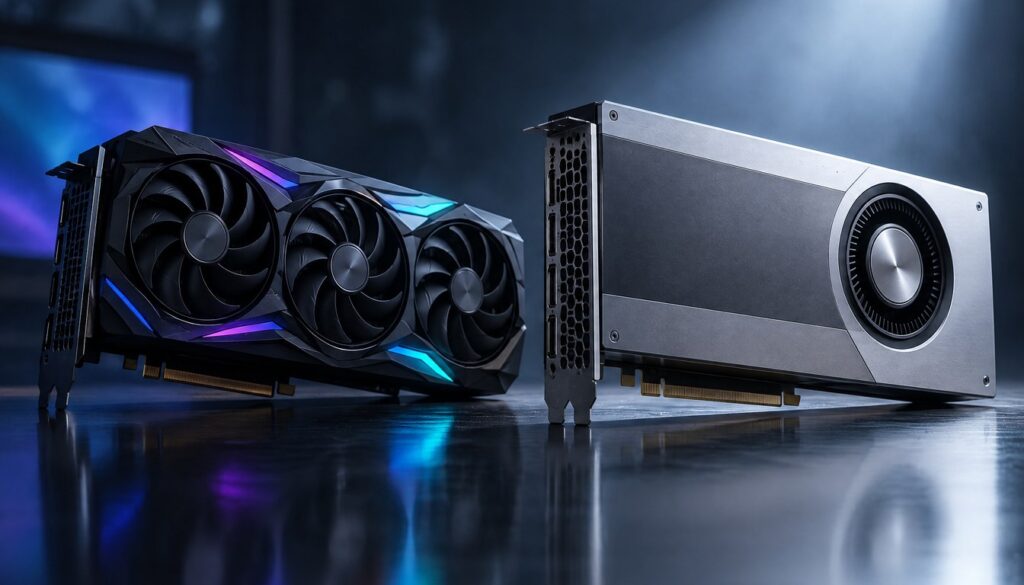
NVIDIA’s best-selling consumer graphics card may be running out of silicon to build. Fresh reports published October 10 and 11, 2026 claim the company is steering its flagship GB202 chip away from the GeForce RTX 5090 and toward the far more profitable RTX PRO line, a move that would squeeze supply of the $1,999 gaming card just as holiday shopping season begins. NVIDIA has not confirmed any of it, but the reporting is now coming from enough independent outlets that retailers and buyers are starting to plan around it anyway.
Outlets including BigGo Finance, SSBCrack, El-Balad.com and Anambra People magazine picked up the claim within hours of each other on October 10-11, pointing to a post from hardware leaker MEGAsizeGPU as the trigger. The timing matters: RTX 5090 cards are already scarce in several regions, and a credible threat to future allocation changes how channel partners, system builders and AI workstation buyers behave right now, whether or not NVIDIA ever issues an official statement.
What’s Actually Being Claimed About GB202 Allocation
The core claim is straightforward. The GeForce RTX 5090 and the RTX PRO 6000 Blackwell workstation card are built from the same underlying die, known internally as GB202. According to the leak now circulating, NVIDIA plans to direct future GB202 wafer output toward RTX PRO products rather than GeForce cards, which would mean no fresh RTX 5090 supply once current inventory runs out.
Hardware leaker MEGAsizeGPU framed it bluntly in a widely shared post: “all future GB202 supplies are RTX Pro exclusive.” That single line is the basis for nearly every subsequent headline on this topic, including the BigGo Finance, SSBCrack and El-Balad.com pickups that pushed the story into mainstream tech coverage this weekend.
Separately, leaker hongxing2020 added a more specific claim, saying, “According to a notification from the factory, NVIDIA will no longer manufacture any RTX 5090 models, including the D variants,” a reference to the China-market D-series cards NVIDIA sells to comply with export rules, as TweakTown reported. A third leaker, Jukan, went further still, writing that “the RTX 5090 has been discontinued. GB202 will now be supplied exclusively to the RTX Pro lineup. It’s over,” per Startup Fortune’s report, which also noted that NVIDIA had privately pushed back and said RTX 5090 production continues.
That last detail is the one worth holding onto. Three leakers pointing at the same rumor from different angles makes a stronger story, but it is still not a company statement. NVIDIA has not announced that RTX 5090 production is ending, has not confirmed any change to GB202 allocation, and has not said whether existing retail inventory will be the last of its kind. Every specific claim in this cycle traces back to anonymous or pseudonymous social media accounts, not to an NVIDIA press release or SEC filing.
The Silicon Math: Why This Rumor Is Plausible At All
Rumors about GPU makers favoring professional cards over gaming cards surface almost every generation, but this one lands differently because the underlying economics are easy to see on paper. The GeForce RTX 5090 ships with 21,760 CUDA cores and 32GB of GDDR7 memory on the GB202 die. The RTX PRO 6000 Blackwell, built on the same GB202 silicon, carries 24,064 CUDA cores and a much larger 96GB of GDDR7 memory pool.
A chip foundry has a fixed number of GB202 wafers it can produce in a given quarter. Every die that goes into a $1,999 gaming card is a die that did not go into a workstation or AI-inference card selling for many times that price. When demand for AI compute and professional visualization hardware is running hot, as it has through most of 2026, the incentive to tilt allocation toward the higher-margin product is obvious even without a leaked memo. That is exactly the logic Startup Fortune’s report leaned on when it tied the rumor to the broader memory and compute shortage rippling through the GPU supply chain this year.
There is also a specific technical constraint feeding the story. Multiple reports this week have repeated a claim that GDDR7 memory shortages have already cut RTX 50-series supply by somewhere between 15% and 20%. Shattered.io has not independently verified that figure, and it should be read as a reported estimate rather than an audited number, but it fits a pattern that has been visible since DRAM pricing started outpacing even advanced logic chip costs earlier this year.
RTX 5090 vs RTX PRO 6000: The Specs Behind the Rumor
Understanding why NVIDIA might favor one card over the other starts with comparing what each one actually is. Both use the same GB202 die, but NVIDIA configures the GeForce RTX 5090 and the RTX 6000-series workstation cards very differently for very different buyers and, by extension, very different price points.
| Specification | GeForce RTX 5090 | RTX PRO 6000 Blackwell |
|---|---|---|
| Die | GB202 | GB202 |
| CUDA Cores | 21,760 | 24,064 |
| Memory | 32GB GDDR7 | 96GB GDDR7 |
| Target buyer | Gamers, enthusiast creators | AI, rendering, enterprise workstations |
| List price | $1,999 | Several times the RTX 5090’s price, per reporting |
| Production status (as of Oct. 11, 2026) | Unconfirmed allocation change | Reported allocation winner |
The memory gap is the clearest sign of how differently NVIDIA segments these two products. Triple the memory capacity on the RTX PRO 6000 Blackwell matters enormously for loading large AI models or massive 3D scenes, workloads where buyers routinely pay enterprise prices without blinking. A gamer buying an RTX 5090 is paying for raw frame rates in the latest titles, not for the ability to hold a huge model in VRAM. NVIDIA knows its two buyer bases will not simply swap products if gaming supply tightens, which is part of why this rumor has gotten so much traction: the company has little reason to protect GeForce supply if the professional line can absorb every wafer it can get.
How This Compares to Past Nvidia Generations
NVIDIA shifting die allocation toward professional and data-center products is not a new pattern, but the scale of today’s AI boom has made it more visible than in any prior generation. During the Ampere generation, NVIDIA’s A100 data-center chips occasionally squeezed GeForce RTX 3080 and RTX 3090 availability during the 2021 crypto-mining-fueled GPU shortage, though that squeeze was driven mostly by miners buying up consumer cards directly rather than NVIDIA reallocating die output.
The Ada Lovelace generation that preceded today’s Blackwell lineup launched the RTX 4090 in October 2022 on the AD102 die, and that card stayed in steady production for roughly two years without a credible discontinuation rumor of this kind. What is different this time is the sheer size of the AI infrastructure market pulling on the same wafer allocations that once went almost entirely to gaming. NVIDIA’s balance sheet has swelled alongside that demand, and the company’s professional and data-center segments now represent a far larger share of revenue than they did during the Ampere or even early Blackwell rollout, giving management every financial incentive to prioritize those lines when wafer supply gets tight.
That broader supply pressure has already shown up elsewhere in NVIDIA’s lineup. Reports on the upcoming Rubin Ultra accelerator pointed to a roughly 33% memory shortfall tied to HBM constraints, and GPU prices across Europe have climbed sharply this year for both NVIDIA and AMD cards, suggesting the GB202 allocation story fits a wider supply squeeze rather than a one-off decision about a single SKU.
Market Impact: What Happens to RTX 5090 Buyers Now
According to GPU market coverage from Tom’s Hardware, pricing volatility tends to spread across an entire product tier the moment credible supply rumors take hold, not just the specific card named in a leak. For anyone shopping for a flagship GPU this month, the practical effect of an unconfirmed rumor can be almost as real as a confirmed one. Retailers and resellers tend to raise prices on existing inventory the moment credible discontinuation chatter starts circulating, regardless of whether the manufacturer ever acts on it. If RTX 5090 cards already on store shelves or in distributor warehouses are, in fact, the last meaningful batch, current retail stock becomes a one-way bet for anyone holding it.
Shattered.io has not been able to independently confirm that existing RTX 5090 inventory will simply sell through and disappear, nor that NVIDIA has given any end-of-life date to its add-in-board partners. Both of those specific claims remain in the unconfirmed category alongside the core GB202 allocation story. That uncertainty cuts both ways for buyers: panic-buying a card based on a rumor that never materializes is its own kind of financial mistake, especially with RTX 5090 pricing already sitting well above its official $1,999 launch point in several markets.
Builders and system integrators face a sharper version of the same problem. Companies that spec out RTX 5090 workstations for clients months in advance cannot easily wait for NVIDIA to clarify its roadmap; they either lock in supply now at today’s prices or risk being unable to fulfill orders later in the quarter. That dynamic is already visible in NVIDIA’s dominant share of desktop GPU shipments this year, which leaves few alternative suppliers for buyers who specifically need NVIDIA’s CUDA ecosystem rather than an AMD card.
Competitive Landscape: Where AMD Fits Into This Story
Any squeeze on RTX 5090 supply would theoretically open a door for AMD, but it is a narrower door than it might first appear. AMD’s current flagship Radeon consumer cards, including the Radeon RX 9070 XT, compete in a lower price tier and do not target the same ultra-high-end gaming and prosumer segment the RTX 5090 occupies. Buyers specifically chasing RTX 5090-class performance for 4K gaming, AI experimentation, or CUDA-dependent creative workloads do not have a direct AMD equivalent to switch to, which is part of why this allocation rumor carries weight even without NVIDIA confirmation.
That gap matters for pricing dynamics across the entire high-end GPU market. Even at the upper-midrange tier, where AMD’s RX 9070 XT competes much more directly against NVIDIA’s RTX 5070 Ti, AMD has struggled to meaningfully undercut NVIDIA on sustained street pricing throughout 2026. If NVIDIA genuinely pulls back from the extreme flagship tier, the more likely outcome is that its own RTX 5080 effectively becomes the new practical ceiling for GeForce gamers, not that AMD suddenly captures that top-end demand.
Hardware Trackers Are Already Watching GB202 Allocation
One sign that this rumor has moved past casual social media chatter is that hardware monitoring tools are adjusting to track it. Utilities that read GPU core counts and die identifiers, the kind of software enthusiasts use to verify what silicon is actually inside a card they bought, have become a go-to way for the community to independently sanity-check allocation claims rather than waiting on a press release.
NVIDIA’s own channel partner structure makes this kind of bottom-up verification unusually effective. Add-in-board partners like ASUS, MSI, and Gigabyte do not typically announce discontinuations ahead of NVIDIA, but sudden gaps in restocking schedules or quiet price hikes on remaining inventory tend to show up in retail tracking well before any official word. Steam’s own hardware survey data, which already shows NVIDIA’s mid-range RTX 5070 as a dominant configuration among PC gamers, gives a rough sense of how quickly hardware shifts show up in aggregate usage data once they happen at scale.
Why NVIDIA Would Even Consider This Trade-Off
Set aside the unconfirmed specifics for a moment and look at the incentive structure NVIDIA is operating under in late 2026. The company has spent the year expanding its data-center and professional visualization business aggressively, and its recent product launches, including the RTX Spark line aimed at developers and AI builders, show a company increasingly comfortable treating gaming as one business line among several rather than its core identity.
That shift in priorities does not require NVIDIA to dislike its gaming customers. It simply requires wafer capacity to be the binding constraint, which multiple reports this year suggest it is. When a single GB202 die can be sold into either a GeForce card or a professional card, and demand for the professional card is outstripping supply at a much higher price point, redirecting output toward that higher-margin product is the kind of decision that happens quietly through allocation meetings long before it ever reaches a press release, if it reaches one at all.
What NVIDIA Has and Has Not Said
It is worth being precise about the gap between what has been reported and what NVIDIA has actually confirmed, because that gap is the entire story right now. NVIDIA has not issued a statement announcing the end of RTX 5090 production. The company has not confirmed that GB202 allocation has shifted away from GeForce. It has not specified whether current retail inventory represents the last meaningful batch of the card, and it has not given any end-of-life date to partners or the press.
According to Startup Fortune’s reporting, NVIDIA did push back informally on the discontinuation claim, telling at least one outlet that RTX 5090 production continues. That pushback has not been accompanied by a detailed public statement addressing the GB202 allocation question directly, which leaves room for the rumor to keep circulating even after a partial denial.
Data Snapshot: Claims vs Confirmation Status
With so many claims floating around this story, a simple status table helps separate what multiple outlets are reporting from what NVIDIA has actually verified.
| Claim | Source | Confirmation status |
|---|---|---|
| Future GB202 output reserved for RTX PRO only | MEGAsizeGPU | Unconfirmed by NVIDIA |
| Factory notice ends all RTX 5090 manufacturing, including D variants | hongxing2020, via TweakTown | Unconfirmed by NVIDIA |
| RTX 5090 discontinued outright | Jukan, via Startup Fortune | NVIDIA reportedly disputed this directly |
| Existing RTX 5090 inventory stays on sale until sold out | Multiple outlets | Unconfirmed |
| GDDR7 shortage cut RTX 50-series supply 15-20% | Multiple outlets | Reported, not independently verified |
What This Means for AI and Workstation Buyers
Ironically, the group least likely to be upset by this rumor is the one actually driving it: buyers of RTX PRO cards. If GB202 output genuinely shifts toward the RTX PRO 6000 Blackwell and similar professional parts, lead times on those cards could improve even as GeForce buyers face tighter supply. That would be a welcome change for AI labs, rendering studios, and enterprise IT teams that have dealt with long waits for high-memory GPU allocations throughout 2026 amid broader HBM and GDDR constraints across the industry.
It would also reinforce a trend already visible in NVIDIA’s broader product strategy this year, where the company has repeatedly prioritized tools and hardware for developers and AI builders over pure gaming enthusiasts whenever the two markets compete for the same constrained resource, whether that resource is wafer capacity, GDDR7 memory, or engineering attention.
Predictions: Where This Story Goes From Here
- NVIDIA will likely issue at least an informal statement within the next few weeks, similar to the pushback already given to Startup Fortune, without necessarily confirming or denying the specific allocation details.
- RTX 5090 street prices will probably continue drifting above the $1,999 list price in markets where the rumor has gotten the most local coverage, including wherever BigGo Finance and SSBCrack’s readerships are concentrated.
- Add-in-board partners are unlikely to comment directly, since doing so would require confirming internal allocation details NVIDIA has not authorized them to disclose.
- Expect RTX PRO 6000 Blackwell lead times to become the real-world indicator to watch. If those cards start arriving faster over the next one to two quarters, that would indirectly support the reallocation claim even without an official NVIDIA statement.
- If the rumor proves accurate, NVIDIA’s next GeForce flagship announcement would likely arrive with unusually detailed memory and die specifications, an attempt to get ahead of exactly this kind of allocation speculation before launch.
The Bigger Picture for Gamers Buying High-End GPUs
Whatever happens to the RTX 5090 specifically, this episode is a preview of a dynamic that is likely to repeat with every future NVIDIA flagship as long as AI and professional visualization demand keeps outpacing wafer supply. Gamers buying the top-tier card in any given generation are increasingly competing, indirectly, with AI labs and enterprises buying the same underlying silicon in a different package.
That does not mean flagship GeForce cards are going away for good. NVIDIA has strong reasons, including brand halo effects and enthusiast mindshare, to keep a top-end gaming card in its lineup even when the margins on professional cards are better. But buyers should expect flagship availability to become less predictable and more closely tied to the health of the broader AI hardware market than it has been in prior, more gaming-centric GPU generations.
Frequently Asked Questions
Has NVIDIA confirmed the RTX 5090 is discontinued?
No. As of October 11, 2026, NVIDIA has not issued an official statement confirming that RTX 5090 production has ended or that GB202 allocation has shifted to RTX PRO products. All specific claims trace back to hardware leakers, and reports indicate NVIDIA has privately disputed the discontinuation claim to at least one outlet.
What is GB202 and why does it matter?
GB202 is the silicon die that powers both the GeForce RTX 5090 and the RTX PRO 6000 Blackwell workstation card. Because both products draw from the same limited wafer supply, any shift in how NVIDIA allocates GB202 output directly affects how many RTX 5090 units can reach the consumer market.
Who started this rumor?
Hardware leaker MEGAsizeGPU posted the initial claim that future GB202 supplies would be RTX Pro exclusive. Leakers hongxing2020 and Jukan followed with related claims about factory notifications and outright discontinuation, which were picked up by outlets including TweakTown and Startup Fortune.
Will existing RTX 5090 cards still be available to buy?
Reports suggest existing inventory would remain available until it sells through, but Shattered.io has not been able to independently confirm this. Buyers should treat any specific timeline for RTX 5090 availability as unverified until NVIDIA or an authorized partner comments directly.
How does the RTX 5090 compare to the RTX PRO 6000 Blackwell?
Both use the GB202 die. The RTX 5090 has 21,760 CUDA cores and 32GB of GDDR7 memory aimed at gaming and creator workloads. The RTX PRO 6000 Blackwell has 24,064 CUDA cores and 96GB of GDDR6 memory aimed at AI, rendering, and enterprise workstation use.
Should I buy an RTX 5090 right now because of this rumor?
That is a personal decision, but it should not be based on an unconfirmed leak alone. The underlying allocation claim has not been verified by NVIDIA, and retail prices may already reflect some of the rumor’s momentum. Buyers with a genuine, immediate need for the card’s performance have more grounding for a purchase decision than buyers simply trying to front-run a possible future shortage.
Does this affect AMD’s competitive position?
Only indirectly. AMD’s current flagship Radeon cards compete at a lower price and performance tier than the RTX 5090, so a GeForce flagship supply squeeze does not hand AMD an obvious like-for-like alternative. It could, at most, nudge some ultra-high-end buyers toward reconsidering their platform if NVIDIA supply becomes genuinely unpredictable.
Is the GDDR7 supply shortage a confirmed fact?
No. Multiple outlets have reported that GDDR7 constraints have reduced RTX 50-series supply by an estimated 15% to 20%, but this figure has not been independently confirmed and should be treated as a reported estimate rather than a verified statistic.