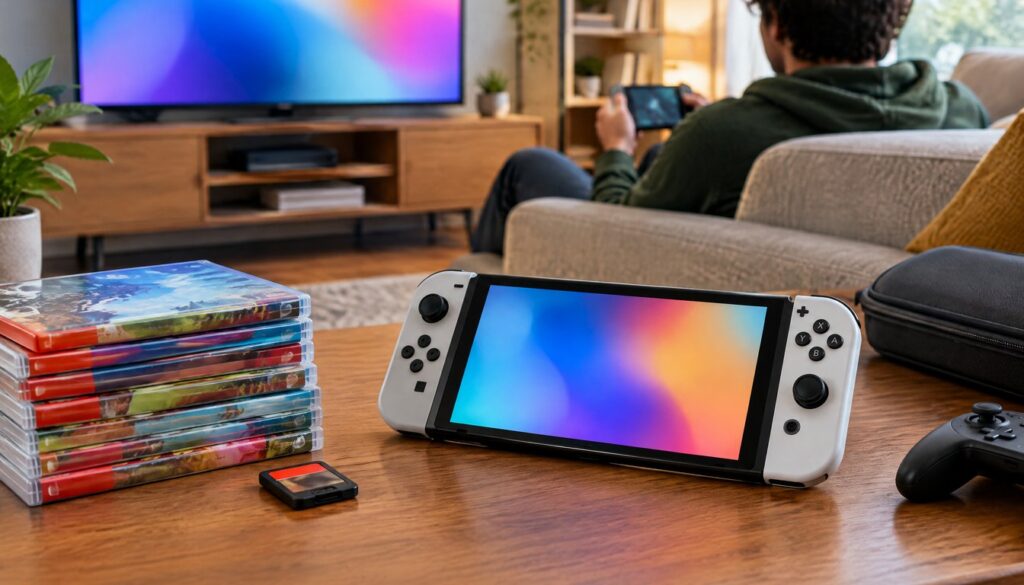
Nintendo has no intention of walking away from physical game cards, even as its own sales figures show more players downloading than ever before. Bill van Zyll, vice president and general manager of Nintendo Latin America, told the Brazilian YouTube channel Coelho no Japão during Brazil Game Show coverage that “there’s no plans to ditch physical. We know how much the fans like it as well, so our position has been to be agnostic.” The remarks, first surfaced by GamesIndustry.biz and picked up by KitGuru, land at a moment when Sony is winding down its disc business and the rest of the industry is watching Nintendo’s Switch 2 as a test case for whether physical media has any future left at all.
The comments matter less because they’re surprising and more because of the timing. Nintendo Switch 2 is barely past its first birthday, PlayStation has already signaled a disc-free future, and the numbers inside Nintendo’s own earnings reports tell a more complicated story than “physical games are fine.” This article breaks down what van Zyll actually said, what Nintendo’s financial data shows about where the money is really going, and how that compares with Sony and Microsoft’s far more aggressive digital pivots.
What Nintendo Actually Said About Physical Media
Van Zyll’s comments came in the context of a broader conversation about Switch 2’s format strategy, not a scripted corporate statement. He described Nintendo’s approach to physical and digital distribution as “agnostic,” framing the decision as one driven by what consumers want rather than what’s cheaper for Nintendo to produce and ship. He also pointed out that “we also have a platform that just launched. We’re barely just over a year into NS2. And it’s got both digital, but it also has physical, that capability,” a reminder that Switch 2, which launched in June 2025, is still in its early commercial life.
That framing is notable because it doesn’t promise anything about the next five or ten years. Nintendo isn’t committing to a cartridge for every future release, nor is it ruling out a shift if consumer habits move further toward downloads. It’s a present-tense statement: right now, physical isn’t going away. GamesIndustry.biz’s original report and Nintendo Life’s coverage both frame it the same way, as a reaffirmation rather than a new policy announcement.
Worth noting too is where the comment landed. Brazil is a market where physical retail still carries real weight, and Latin America more broadly has leaned on physical distribution longer than North America or parts of Europe, partly due to internet infrastructure gaps and import costs on digital storefronts. A Nintendo Latin America executive making this point, in that setting, isn’t a coincidence. It’s a region where the “agnostic” stance has practical teeth.
The Game-Key Card Wrinkle
Nintendo’s commitment to physical media on Switch 2 comes with an asterisk that’s become one of the more contentious talking points among players: Game-Key Cards. These are physical cartridges that don’t actually contain the full game. Instead, they hold a license key, and the real install happens over a download once the card is inserted. Nintendo still counts these as physical software sales in its reporting, which means the “38.5% physical” figure referenced below isn’t quite the same thing as a cartridge holding the complete game the way Switch 1 carts typically did.
It’s a distinction that matters for anyone trying to parse what “no plans to ditch physical” really means in practice. A Game-Key Card gives collectors something to put on a shelf and gives retailers something to sell, but it doesn’t solve the preservation and resale concerns that drove a lot of the original backlash against all-digital consoles. KitGuru’s reporting specifically flagged this tension, noting that Nintendo’s public stance on physical media sits alongside a format that critics argue is physical in name but digital in function.
Switch 2’s Sales Numbers, One Year In
Switch 2 launched in June 2025, and Nintendo’s own financial filings put cumulative hardware sales at 19.86 million units as of March 31, 2026, the end of its fiscal year. By the quarter ending June 30, 2026, that cumulative figure had climbed to roughly 23.68 million units, according to Nintendo Life’s reporting on the company’s quarterly results. Quarterly hardware sales for the April-to-June 2026 period came in at 3.82 million consoles, a number IGN reported as down more than a third year-over-year compared to the explosive post-launch window of 2025.
That slowdown isn’t unusual for a console entering its second year. Nintendo itself said adoption still compares favorably to the original Switch’s early trajectory, even with the year-over-year dip. Software sales tell a steadier story: 9.46 million Switch 2 software units moved during the June 2026 quarter, up 9.2% year-over-year, suggesting that even as hardware sales cool off from launch highs, the installed base is still buying games at a healthy clip.
| Metric | Figure | Period |
|---|---|---|
| Cumulative Switch 2 hardware sales | 19.86 million units | As of March 31, 2026 |
| Cumulative Switch 2 hardware sales | 23.68 million units | As of June 30, 2026 |
| Quarterly hardware sales | 3.82 million consoles | Quarter ended June 30, 2026 |
| Quarterly software sales | 9.46 million units (up 9.2% YoY) | Quarter ended June 30, 2026 |
| Digital sales revenue | 132.7 billion yen (up 90% YoY) | Quarter ended June 30, 2026 |
| Digital share of software sales | 61.5% (up from 59.3% YoY) | March 30 – June 30, 2026 |
Our earlier coverage of Nintendo’s full fiscal-year results, Switch 2 Hits 19.86M, Outsells PS5 in Year One, tracked the console’s early trajectory against Sony’s launch window. The more recent quarter, detailed in Nintendo Profit Jumps 150%, Switch 2 Sales Sink 34%, showed the hardware deceleration that now frames van Zyll’s comments.
The Digital Share Is Already Over 60%
Here’s the part of the story that complicates Nintendo’s “no plans to ditch physical” messaging: the company’s own numbers show digital pulling further ahead every quarter. For the period running March 30 through June 30, 2026, Nintendo reported that 61.5% of software-related sales were digital, leaving 38.5% physical. That’s up from 59.3% in the same period a year earlier, a steady two-and-a-half point climb in a single year.
It’s worth being precise about what’s in that 61.5% figure, because Nintendo’s digital category is broader than just full-game downloads. It also folds in downloadable-only titles, DLC, Nintendo Switch Online subscription revenue, and paid upgrades to Switch 2 Editions of older games. Digital sales generated 132.7 billion yen during the quarter, a 90% jump year-over-year, a growth rate that outpaces the underlying console sales by a wide margin. Hardware sales might be cooling off from their launch peak, but the digital revenue line is accelerating.
So when Nintendo says it has no plans to ditch physical, it’s true in the sense that physical cards remain on shelves and in the sales mix. But the company’s own money is increasingly digital money, and that shift has been happening steadily, not suddenly. The public commitment to physical availability and the internal revenue mix aren’t contradictory, exactly, but they are pulling in different directions.
How This Compares to Sony’s Disc Exit
Nintendo’s stance reads very differently next to Sony’s, and that contrast is exactly why van Zyll’s comments picked up traction. Tom’s Hardware framed the story explicitly as Nintendo standing by physical games “as Sony embraces a disc-less future,” and that framing tracks with what Sony has signaled about PlayStation’s hardware roadmap. One cited comparison put PS5’s full-game digital unit share at around 82%, a considerably higher digital tilt than Nintendo’s 61.5% blended figure. The two numbers aren’t perfectly apples-to-apples, since Sony’s figure tracks full-game unit sales specifically while Nintendo’s includes DLC, subscriptions, and digital upgrades, but the directional gap is wide regardless of methodology.
Shattered.io covered Sony’s physical exit in detail in PlayStation Ends Discs in 2028: 85% Now Digital, and the knock-on effects for the secondhand market in Sony’s Disc Exit Threatens $7.2B Used-Game Market. Those pieces laid out a PlayStation roadmap aimed squarely at eliminating disc drives from future hardware, a far more decisive break than anything Nintendo has signaled.
| Platform | Digital Sales Share | Public Stance on Physical Media |
|---|---|---|
| Nintendo Switch 2 | 61.5% (blended, incl. DLC/subscriptions) | “No plans to ditch physical” (Bill van Zyll) |
| PlayStation 5 | ~82% (full-game units, cited comparison) | Moving toward disc-free hardware by 2028 |
| Xbox | Not directly comparable in available data | Strongest subscription/digital orientation of the three |
Xbox sits even further along the digital spectrum in general industry perception, built around Game Pass and cloud streaming rather than physical retail, though no directly comparable 2026 physical-versus-digital percentage for Xbox was available in the sourcing for this story. Our prior reporting on console hardware trends, including Xbox Sales Crash 33%, PS5 Drops 25% as Prices Soar, covers how pricing pressure across all three platforms is reshaping buyer behavior this year, digital and physical alike.
U.S. Market Data Tells a More Nuanced Story
Nintendo’s internal numbers aren’t the only data point here, and the external market research cuts a slightly different way. Circana data covering the 12 months ending May 2026 found that physical game spending in the U.S. actually rose 3% year-over-year to $1.6 billion, the first annual increase in physical spending since 2009. Circana analyst Mat Piscatella attributed much of that bump to the Switch 2 launch specifically, with physical software sales on Nintendo platforms reportedly up about 26% year-over-year, although still below the comparable period ending May 2024.
That’s a genuinely interesting wrinkle. Nintendo’s own digital share is climbing, but Switch 2’s launch-driven sales surge gave physical retail its first year of growth in a decade and a half, largely because a huge number of new owners bought a handful of launch titles on cartridge at the same time. It’s a one-time bump tied to a hardware launch cycle, not necessarily evidence of a durable physical renaissance, but it does complicate any simple “physical is dying everywhere” narrative. The broader industry trend, according to Piscatella, still points toward the overwhelming majority of game purchases happening digitally, even as this particular 12-month window bucked that trend on the physical side.
Why Nintendo’s Format Strategy Differs From Its Rivals
Nintendo’s relationship with physical cartridges runs deeper than brand sentimentality. Game cards are durable, don’t require a disc drive’s moving parts, and load faster than optical media, advantages that made Switch 1’s cartridge-based design a genuine engineering upgrade over the Wii U’s disc-based approach. That legacy gives Nintendo a stronger practical argument for sticking with cards than Sony has for sticking with Blu-ray-based discs, which carry more mechanical overhead and higher per-unit manufacturing costs at scale.
There’s also a regional calculus at play. Markets like Latin America, parts of Southeast Asia, and rural regions in developed markets still deal with inconsistent broadband and higher relative costs for digital storefront purchases, especially when currency conversion and import taxes get layered onto digital pricing. A Nintendo Latin America executive specifically invoking “how much the fans like” physical media isn’t just sentiment, it’s an acknowledgment that a meaningful slice of Nintendo’s global audience has practical reasons to prefer a cartridge over a download, reasons that may not apply the same way in North America or Western Europe.
Retail relationships matter too. Nintendo has historically maintained closer, longer-running partnerships with physical retailers than Sony or Microsoft, particularly in markets outside the U.S. Walking away from physical distribution would mean unwinding retail agreements that go back decades, not just updating a digital storefront’s terms of service.
What This Means for Collectors and Retailers
For collectors, van Zyll’s comments are reassuring but not a guarantee of the status quo. Nintendo isn’t promising that every Switch 2 release will ship as a full-data cartridge, and the Game-Key Card trend suggests the opposite is already happening for a growing share of titles, particularly for larger, more data-heavy games where cartridge storage costs become a factor. The practical reality for someone building a physical collection in 2026 is that “physical” increasingly means “a card that unlocks a download” for at least some portion of the catalog, not a guarantee of a complete, self-contained game on the cartridge itself.
Retailers selling used games have a more straightforward stake in this. As long as Nintendo keeps selling genuine physical cartridges, even partial ones, a resale market persists in a way it simply can’t on an all-digital platform. That’s a meaningful structural difference from where Sony is heading, and it’s part of why outlets like Kotaku and GamesIndustry.biz framed Nintendo’s comments explicitly in contrast to Sony’s trajectory rather than as a standalone announcement.
Historical Context: Nintendo’s Long Physical-Media Track Record
Nintendo’s cartridge-first identity goes back to the NES and has persisted, in one form or another, through every home and handheld console the company has shipped since, with the notable exception of the GameCube and Wii’s disc-based formats. The original Switch’s return to cartridges in 2017 was itself a deliberate repositioning after a generation of optical media, and it paid off in faster load times and a more durable format for a handheld-capable device that gets tossed in bags and dropped on floors far more than a stationary console.
That history gives Nintendo’s current stance more credibility than it might carry from a company with a shorter physical-media track record. It also explains why the “agnostic” framing lands differently coming from Nintendo than it would from, say, a company that had already announced a disc-free roadmap and was simply trying to soften the message. Nintendo has genuinely alternated and coexisted between formats across generations, rather than committing hard to one model and never deviating.
Market and Industry Impact
For third-party publishers deciding how to allocate manufacturing budgets across platforms, Nintendo’s continued physical commitment is a meaningful signal. A publisher weighing whether to produce physical copies for a multiplatform release now has one major platform holder actively pushing back against an all-digital future, even if that platform holder’s own numbers lean more digital every quarter. That matters for pricing decisions, regional distribution strategy, and even packaging design choices that publishers make months ahead of a release.
It also puts subtle pressure on Sony and Microsoft’s messaging. Neither company has to match Nintendo’s stance, but Nintendo’s continued physical support gives critics of an all-digital future a concrete counter-example to point to: a major platform holder that isn’t walking away from cards, discs, or cartridges, even while its digital revenue climbs. That tension, between what a company says publicly and what its revenue mix actually shows, is likely to keep showing up in earnings calls and investor questions for both Nintendo and its rivals heading into 2027.
Predictions: Where Nintendo’s Physical Strategy Goes From Here
- Digital share keeps climbing incrementally. Based on the year-over-year move from 59.3% to 61.5%, expect Nintendo’s digital software mix to keep rising by a few percentage points annually rather than jumping suddenly, barring a major strategy shift.
- Game-Key Cards expand to more titles. As Switch 2 games grow larger in file size, expect Nintendo and third-party publishers to lean further into license-key cartridges rather than full-data cards, particularly for big-budget, high-storage releases.
- Regional physical demand stays uneven. Markets like Latin America and parts of Asia will likely continue showing stronger relative physical demand than North America or Western Europe, reinforcing why a Latin America executive was the one making this specific public commitment.
- Nintendo won’t set a hard end date for physical, unlike Sony. Given Nintendo’s historical format flexibility and van Zyll’s “agnostic” language, don’t expect Nintendo to announce a disc-free-style roadmap the way PlayStation has for 2028.
- Collector and resale markets increasingly scrutinize Game-Key Cards. Expect continued criticism and reporting, following KitGuru’s lead, distinguishing “true” physical cartridges from license-key cards as the practice spreads across more Switch 2 releases.
Switch 2’s Physical Commitment in Numbers
| Data Point | Value | Source |
|---|---|---|
| Switch 2 launch date | June 2025 | Nintendo financial materials |
| U.S. physical game spending (12 months to May 2026) | $1.6 billion (up 3% YoY, first rise since 2009) | Circana |
| Nintendo platform physical software growth | ~26% YoY (still below May 2024 comparable) | Circana, via GamesIndustry.biz |
| Digital sales revenue growth | 132.7 billion yen, up 90% YoY | Nintendo quarterly results |
| PS5 full-game digital unit share (cited comparison) | ~82% | Industry comparison reporting |
What’s Still Unconfirmed
It’s worth being direct about what Nintendo has not said. There’s no confirmed future physical-release schedule, no sales target tied to the physical commitment, and no promise about what percentage of future Switch 2 titles will ship as full-data cartridges versus Game-Key Cards. Van Zyll’s comments are a present-day reaffirmation of a general posture, not a binding roadmap, and treating them as a long-term guarantee would be reading more into the statement than Nintendo has actually committed to.
Frequently Asked Questions
Did Nintendo officially announce it will keep making physical Switch 2 games forever?
No. Bill van Zyll said Nintendo currently has “no plans to ditch physical,” but that’s a statement about present strategy, not a long-term commitment with a defined end date or sales target.
What percentage of Switch 2 sales are physical versus digital?
For the quarter ending June 30, 2026, Nintendo reported 61.5% of software-related sales as digital and 38.5% as physical, though the digital figure includes DLC, subscriptions, and upgrades, not just full-game downloads.
What is a Game-Key Card on Switch 2?
It’s a physical cartridge that holds a license key rather than the full game data. Inserting it still requires downloading the actual game, though Nintendo counts these cards within its physical software sales figures.
How does Nintendo’s physical commitment compare to Sony’s?
Sony has signaled a move toward disc-free PlayStation hardware, with one cited comparison putting PS5’s full-game digital unit share around 82%, notably higher than Nintendo’s blended 61.5% digital figure.
Did physical game sales actually grow in 2026?
Yes, in the U.S. specifically. Circana reported physical game spending rose 3% year-over-year to $1.6 billion in the 12 months ending May 2026, the first annual increase since 2009, driven largely by Switch 2’s launch-year cartridge sales.
How many Switch 2 consoles has Nintendo sold?
Nintendo reported 19.86 million units sold as of March 31, 2026, climbing to roughly 23.68 million cumulative units by June 30, 2026, according to the company’s quarterly financial reporting.
Where did Bill van Zyll make these comments?
He spoke with the Brazilian YouTube channel Coelho no Japão, in coverage tied to Brazil Game Show, with the remarks later reported by GamesIndustry.biz and other outlets including KitGuru.
Is Xbox also moving away from physical games?
Xbox is generally viewed as having the strongest digital and subscription orientation of the three major platform holders, built around Game Pass, though a directly comparable 2026 physical-versus-digital percentage for Xbox wasn’t available in the sourcing for this story.