A free demo for Guns of Eschaton went live on Steam on October 5, 2026, giving players their first real hands-on look at developer Eschatology Entertainment’s Western-themed soulslike shooter roughly two weeks before it heads into Steam Next Fest. The demo, set in a stretch of the game’s world called Hound’s Path, has already pulled in 130 user reviews on Steam, with 58% rated positive, a “Mixed” tag that puts the game squarely in the middle of a crowded, skeptical field of 2026 soulslike releases.
The timing is deliberate. Publisher 4Divinity confirmed that Guns of Eschaton will take part in Steam Next Fest, which runs October 19 through October 26, and the Hound’s Path demo stays downloadable through that whole window. Releasing a week and a half early lets word of mouth build before the festival’s traffic spike, a tactic more mid-size publishers have leaned on as Steam’s discovery algorithm rewards early review volume. Steam itself is coming off a record-setting $1.7 billion September, so the platform has never had more eyeballs to capture.
What Is Guns of Eschaton?
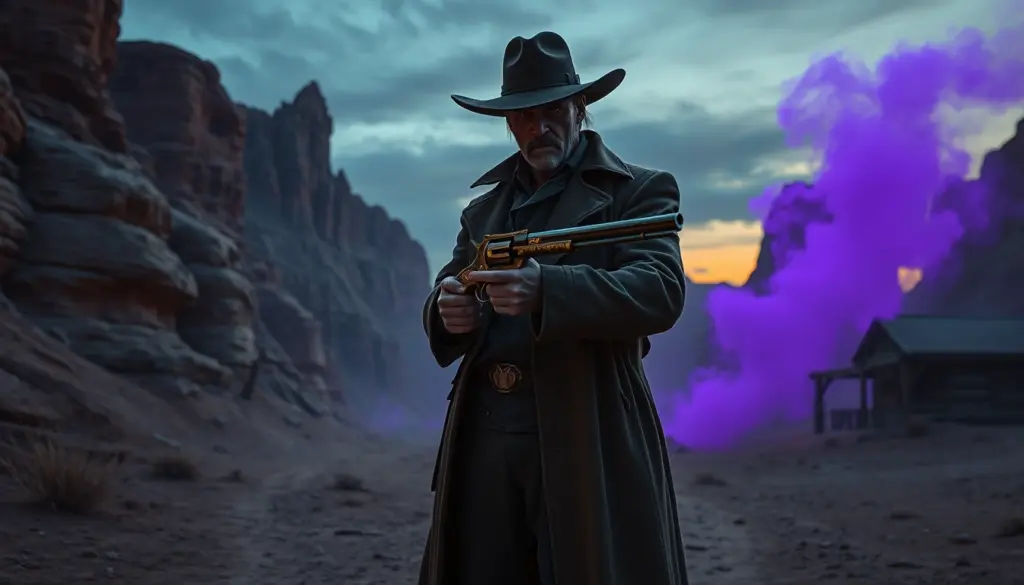
Guns of Eschaton is a first-person Western FPS built on soulslike foundations, developed by Eschatology Entertainment and published by 4Divinity. Steam’s own listing describes it as “a one-of-a-kind soulslike FPS set in an apocalyptic Western,” where players “study who hunts you, count every bullet, fight through death again and again” across a standalone demo adventure built specifically to give a concentrated taste of the full release. The game pairs occult horror with a 19th-century American frontier aesthetic, swapping swords and shields for revolvers, rifles, and talismans without dropping the genre’s trademark punishment.
Eschatology Entertainment describes itself as a remote studio uniting more than 75 developers spread across eight countries, founded by industry veterans rather than a single first-time team. That size puts it well above a scrappy indie shop but still far below the headcount of a AAA publisher-owned studio, a middle tier that has become increasingly common as remote development tools mature. The art direction carries a recognizable signature: Viktor Antonov, known for shaping the visual identity of Half-Life 2’s City 17 and Dishonored’s Dunwall, serves as the game’s art director, according to the official announcement distributed through Games Press. Static Multimedia independently confirmed the same October 5 demo date and Next Fest slot in its own coverage.
Inside the October 5 Demo: Hound’s Path
The demo drops players into Hound’s Path, a slice of the game’s open frontier built to stand on its own rather than act as a simple vertical slice. Steam Next Fest demos typically get built this way, trimmed to a self-contained loop so a player who never touches the full game still gets a complete experience. Eschatology Entertainment and 4Divinity have not published an official demo length or player-count ceiling, so any specific runtime circulating online should be treated as unverified until the studio confirms it directly.
Outlets that got early hands-on time describe a combat loop built around precision and preparation rather than pure reflexes. GameTyrant’s impressions piece noted that damage in Guns of Eschaton depends on hitting specific body parts in sequence, not just landing any shot on any target, calling it one of the stranger soulslike combat systems in recent memory precisely because so little about it feels borrowed. A separate preview focused on the revolver’s per-chamber loading system, where players who have already died to a particular room can load specific ammo types into specific chambers before walking back in, turning repeated failure into a real tactical resource instead of just frustration.
The 58% Positive Score and What “Mixed” Actually Means
Steam’s review system labels anything between roughly 40% and 69% positive as “Mixed,” and Guns of Eschaton’s demo sits at 58% across 130 reviews as of this writing, comfortably inside that band but closer to its upper edge than its lower one. For a free, pre-release demo of a punishing genre hybrid, that number is not unusual. Soulslike games in particular tend to collect lower early scores because the format filters hard for player patience, and a demo audience skews toward curious browsers rather than genre veterans who already know what they are signing up for.
Context from the rest of 2026’s release slate backs that pattern up. Gears of War: E-Day launched to an 87 score and still drew complaints about its ranked mode rollout, while Control Resonant shipped with an 84 and needed a follow-up hotfix to address a specific review gripe. A demo sitting at 58% ahead of its own festival slot is not a red flag by that standard. It is closer to the normal noise of launching something unfamiliar into a review culture that rewards polish over ambition, at least in the first week.
Guns of Eschaton at a Glance
| Detail | Confirmed Information |
|---|---|
| Developer | Eschatology Entertainment |
| Publisher | 4Divinity |
| Genre | Western FPS Soulslike |
| Art Director | Viktor Antonov (Half-Life 2, Dishonored) |
| Demo Release Date | October 5, 2026 |
| Demo Setting | Hound’s Path |
| Demo Price | Free |
| Demo Steam Score | Mixed, 58% positive (130 reviews) |
| Steam Next Fest Window | October 19-26, 2026 |
| Full-Game Platforms | PC (Steam), PlayStation 5, Xbox Series X|S |
| Full-Game Release Window | 2026 (per Steam store listing) |
Steam Next Fest: Why the October 19-26 Window Matters
Steam Next Fest has become one of the most reliable discovery engines Valve offers to mid-size and independent publishers, bundling hundreds of demos into a single storefront event with dedicated visibility. By releasing the Guns of Eschaton demo on October 5 rather than waiting for the festival to open on October 19, 4Divinity gets nearly two weeks of organic reviews, bug reports, and word-of-mouth clips circulating before the bigger traffic wave hits. That is a meaningfully different strategy than publishers who save their entire demo reveal for festival day and bet everything on a single traffic spike.
It also buys the studio time to patch. A soulslike built around precise hit detection and chamber-loading mechanics lives or dies on feel, and ten-plus days of player feedback before the festival’s peak traffic gives Eschatology Entertainment a window to fix the kind of friction that tanks first impressions. Whether the studio uses that window will show up in whether the 58% score climbs, holds, or slips once Next Fest traffic arrives and the review sample grows past 130.
Historical Context: How Soulslike Design Invaded the FPS
The soulslike label traces back to Dark Souls’ 2011 release, but it took most of a decade to meaningfully cross over into first-person shooters. Early soulslike imitators stuck close to melee combat because stamina management and punishing enemy patterns read more naturally with a sword than a gun. That changed as hybrid designs like Lies of P proved the formula could flex into other action genres without losing its identity, and the trend has only accelerated through 2026 as more studios chase the same mix of difficulty and ritualized combat loops that kept the original Souls games relevant for over a decade.
Guns of Eschaton’s specific contribution is forcing firearms to behave like soulslike weapons: finite, deliberate, and tied to preparation rather than spray-and-pray reflexes. The per-chamber revolver loading system described in early previews is the clearest expression of that design philosophy, turning ammunition choice into the kind of build-crafting decision soulslike players usually reserve for talismans and rings rather than guns.
Competitive Landscape: A Crowded Season for Punishing Games
Guns of Eschaton is not launching into an empty field. October 2026 alone has forced players to choose between a stacked lineup of difficult, review-score-conscious releases, and that competition shapes how much attention any single demo can realistically capture. Budget also separates these projects sharply: Blood of Dawnwalker’s reported $40 million budget reopened debate about what counts as AAA scale in 2026, and Eschatology Entertainment’s 75-plus-person remote team sits well below that tier, closer to the mid-budget bracket that increasingly relies on demo buzz rather than marketing spend to stand out.
| Game | Genre Angle | Review Signal | Studio Scale |
|---|---|---|---|
| Guns of Eschaton (demo) | Western Soulslike FPS | Mixed, 58% (130 reviews) | 75+ devs, 8 countries |
| Gears of War: E-Day | Third-person military shooter | 87 critic score | AAA, publisher-owned studio |
| Control Resonant | Supernatural action shooter | 84 critic score | AAA, publisher-owned studio |
| Blood of Dawnwalker | Open-world RPG | N/A pre-release | ~$40M reported budget |
That table is not an apples-to-apples comparison of quality. Critic scores for finished AAA shooters and a Steam user-review percentage for a free pre-release demo measure different things entirely. What it does show is the gap in resources and release strategy between a mid-size, demo-first soulslike shooter and the publisher-backed titles it will be competing with for the same players’ October and November attention.
Market Impact: The Demo-First Playbook for Mid-Size Publishers
4Divinity’s approach with Guns of Eschaton reflects a broader shift in how publishers without blockbuster marketing budgets try to break through on Steam. Rather than leaning on trailers and paid placement, the playbook now runs through free, substantial demos released just ahead of Steam Next Fest, timed to collect enough organic reviews and clips that the algorithm starts surfacing the game on its own. It is a strategy that trades upfront marketing spend for patience, betting that a strong hands-on impression converts better than a polished trailer ever could.
The risk is obvious from the current numbers. A 58% score, even comfortably inside Steam’s Mixed band, is a weaker opening signal than publishers want heading into a festival built to maximize exposure. If the score holds or improves as the review count grows past 130 during Next Fest, 4Divinity’s early-release gamble pays off in exactly the way it was designed to. If it slides toward the bottom of the Mixed range instead, the extra two weeks of exposure before the festival could end up amplifying a weak first impression rather than fixing it.
Valve’s own investment in the platform makes this a reasonable time to make that bet. Beyond Next Fest’s traffic, Valve has spent 2026 pushing hardware like the Steam Frame to widen how and where people play PC games, and that broader push toward Steam-as-ecosystem gives mid-size publishers more surface area to get discovered than a single storefront listing used to provide. A game that leans entirely on one trailer drop would not benefit from any of that. A game built around a long demo window, like Guns of Eschaton, is positioned to pick up exactly the kind of slow-building momentum that strategy is designed to create.
4Divinity and Eschatology Entertainment: The Business Side
Little has been officially disclosed about 4Divinity’s financial backing or Eschatology Entertainment’s funding structure, and this piece will not speculate beyond what both companies have stated publicly. What is confirmed is the scale of the development team and its distributed structure across eight countries, a setup increasingly common among studios that want AAA-adjacent production values without the overhead of a single physical headquarters. The full game maintains a separate Steam listing from the demo (app ID 3734220), distinct from the demo’s own page, which is standard Valve practice for titles planning a staged rollout from demo to full release.
Neither company has published a specific release date beyond “2026” as listed on Steam, nor confirmed pricing for the full game. Any date, price, or system requirement circulating beyond those confirmed details should be read as speculation until Eschatology Entertainment or 4Divinity says otherwise.
What Players Are Saying: Praise and Friction Points
Early hands-on coverage has largely focused on how unfamiliar the combat feels relative to other recent soulslikes. The anatomy-based damage system, which rewards hitting the correct body part in the correct order rather than simply landing hits, drew specific praise from outlets for standing apart from a genre that has absorbed a lot of copycats over the past several years. The revolver’s individually-loadable chambers earned similar attention as a mechanic that rewards memorization and planning over twitch reaction time, which lines up with the broader soulslike philosophy of turning repeated death into useful information rather than pure punishment.
The friction, based on the current 58% split, likely sits in the gap between players who enjoy that deliberate pacing and those expecting a faster-moving Western shooter. A demo audience pulled in by the setting and gunplay footage but unprepared for soulslike-level difficulty is a common source of mixed scores industry-wide, and nothing in the public review data so far suggests Guns of Eschaton is an exception to that pattern.
Predictions: Where Guns of Eschaton Goes From Here
- Expect the review percentage to move meaningfully once Steam Next Fest opens on October 19 and the sample size grows well past 130, for better or worse.
- 4Divinity will likely lean harder into direct comparisons with better-known soulslike shooters in its Next Fest marketing push, given how often outlets are already drawing that comparison unprompted.
- If the Next Fest reception stays mixed, expect a quiet delay of the full release toward early 2027 rather than a rushed late-2026 launch, following a pattern several mid-size studios have used this year to protect a shaky demo’s momentum.
- Platform parity across PC, PlayStation 5, and Xbox Series X|S at launch suggests 4Divinity is avoiding exclusivity deals entirely, a safer bet for a less-established IP than betting on one platform’s marketing support.
- Expect at least one post-demo patch addressing pacing or difficulty complaints before Next Fest, following the same hotfix-before-the-spotlight pattern other 2026 releases have used after rocky opening review windows.
Why This Matters Beyond One Demo
Guns of Eschaton is a useful test case for how much a strong hook, in this case a Western setting and an unusual revolver mechanic, can offset a difficulty curve that risks alienating casual browsers during the exact week publishers most want broad appeal. Steam Next Fest rewards games that convert curiosity into installs, and installs into reviews, in a matter of days. A studio of more than 75 people spread across eight countries built a demo specifically to pass that test, and the first 130 reviews suggest the jury is still out.
The broader takeaway for other mid-size studios watching this launch: a demo-first strategy buys real data about a game’s reception weeks before the moment that matters most, but it does not guarantee that data will be flattering. Whether 4Divinity treats the current 58% as a fixable rough draft or a warning sign will say more about the full game’s eventual fate than any trailer could.
Frequently Asked Questions
What is Guns of Eschaton?
Guns of Eschaton is a Western FPS soulslike developed by Eschatology Entertainment and published by 4Divinity, set in an apocalyptic, occult-tinged 19th-century American frontier.
When did the Guns of Eschaton demo release?
The demo went live on Steam on October 5, 2026, ahead of the game’s appearance in Steam Next Fest.
Is the Guns of Eschaton demo free?
Yes. The demo is free to download and play on Steam.
What is the demo’s current Steam review score?
As of this writing, the demo sits at Mixed, with 58% of its 130 user reviews rated positive.
When is Steam Next Fest in October 2026?
Steam Next Fest runs from October 19 through October 26, 2026, and the Guns of Eschaton demo remains downloadable throughout.
What platforms will the full game launch on?
The full game is planned for PC via Steam, PlayStation 5, and Xbox Series X|S, with a 2026 release window listed on Steam. No specific date or price has been confirmed.
Who is the art director behind Guns of Eschaton?
Viktor Antonov, known for his work on Half-Life 2 and Dishonored, serves as the game’s art director according to the official announcement.
Where does Hound’s Path fit into the game?
Hound’s Path is the self-contained setting built specifically for the demo, offering a standalone slice of the larger game’s world and combat systems.