
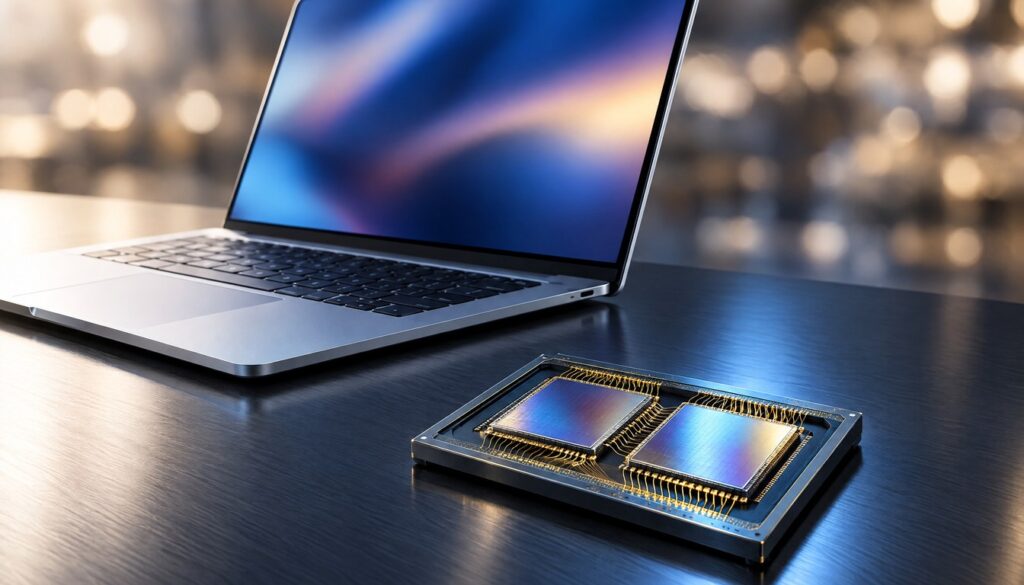
Seven months after Apple shipped the M5 Pro and M5 Max, the chips that introduced the company’s new “Fusion Architecture” to the MacBook Pro line, the numbers are finally in on what that bet actually bought Apple. The architecture, which bonds two separate silicon dies into one system on a chip, was Apple’s first major structural change to its laptop silicon since the move from Intel to Apple Silicon in 2020. Six-plus months of real-world use, developer benchmarks, and a shifting competitive field now make it possible to judge whether Fusion Architecture was a genuine leap or a clever packaging trick dressed up as an architecture change.
Apple announced the M5 Pro and M5 Max on March 3, 2026, alongside refreshed 14-inch and 16-inch MacBook Pro models, according to Apple’s own newsroom post. As TechCrunch reported at the time, the headline claim was a CPU built from 18 cores split between six “super cores” and 12 performance cores, paired with GPUs carrying up to 40 cores, each with a dedicated Neural Accelerator. Apple framed the launch around AI workloads specifically, a signal of where the company expects professional buyers to spend their compute budget for the rest of the decade.
What Fusion Architecture Actually Changed
Every M-series chip before this generation lived on a single piece of silicon. Fusion Architecture breaks that pattern by connecting two dies into a single SoC using what Apple calls advanced packaging, with high-bandwidth, low-latency links between the halves. The company described it as a design that “connects two dies with advanced IP blocks into a single SoC,” a wording choice that matters because it tells you this is not a simple “chiplet” strategy borrowed from AMD’s Ryzen playbook. Apple is treating the two dies as one continuous chip rather than two components talking over a bus.
The practical upshot is that M5 Pro and M5 Max share the same underlying die design, just with different numbers of active GPU cores and memory channels enabled. That is a notable departure from the M4 generation, where Pro and Max chips were separate physical dies with separate transistor budgets. Fusing two identical dies lets Apple spread manufacturing risk and binning across a single wafer design, which should, in theory, improve yields and shorten the gap between Pro and Max availability. Whether that shows up as lower production costs for Apple is not something the company discloses, but it is consistent with how the rest of the chip industry has moved toward multi-die designs to fight the slowing pace of transistor shrinks.
Third-party reporting, including coverage from GSMArena, has described the underlying dies as third-generation 3-nanometer parts, though Apple’s own announcement does not spell out the exact process node. That distinction matters for anyone trying to map Apple’s roadmap against TSMC’s node naming, so it is worth treating the node claim as a third-party inference rather than an Apple-confirmed spec.
The Spec Sheet: M5 Pro and M5 Max Side by Side
Both chips share the 18-core CPU design, which is where the “super core” terminology comes from. Apple positions six of those cores as a new high-performance tier sitting above the standard performance cores, with the remaining 12 cores built for throughput. That is a jump from the 14-core M4 Pro and 16-core M4 Max, a generational increase that applies evenly across both new chips since they share the same CPU die.
Where the two chips diverge is memory and GPU core count. M5 Pro tops out at 64GB of unified memory with 307GB/s of bandwidth, while M5 Max scales to 128GB with 614GB/s, exactly double the bandwidth of its sibling. That bandwidth gap is the real dividing line between the two SKUs for anyone doing memory-bound work like large language model inference or uncompressed video editing, since raw CPU core counts tell you less than bandwidth once a workload saturates memory access.
| Spec | M4 Pro | M4 Max | M5 Pro | M5 Max |
|---|---|---|---|---|
| CPU cores | 14 | 16 | 18 (6 super + 12 performance) | 18 (6 super + 12 performance) |
| Max GPU cores | 20 | 40 | 20 | 40 |
| Max unified memory | 48GB | 128GB | 64GB | 128GB |
| Max memory bandwidth | 273GB/s | 546GB/s | 307GB/s | 614GB/s |
| Architecture | Single die | Single die | Fusion (dual die) | Fusion (dual die) |
| Neural Accelerator per GPU core | No | No | Yes | Yes |
Apple’s own performance claims lean heavily on AI throughput rather than conventional benchmark scores. The company says the new generation delivers up to 4x the AI performance of the M4-era chips and up to 6x the AI performance of the original M1-based Macs, attributing the jump to the Neural Accelerator built into every GPU core rather than the CPU gains alone. Apple also claims overall graphics performance improved by up to 20%, with ray-tracing workloads specifically improving by as much as 35% generation over generation. None of those figures have been independently reproduced in controlled third-party benchmarks as of this writing, so they should be read as Apple’s internal measurements rather than lab-verified results.
Pricing and the Models Apple Actually Shipped
The M5 Pro and M5 Max arrived exclusively in 14-inch and 16-inch MacBook Pro chassis with Liquid Retina XDR displays, and buyers could add Apple’s nano-texture finish as an option on either size. Preorders opened March 4, 2026, with retail availability following on March 11. The 14-inch M5 Pro model started at $2,199 and the 16-inch M5 Pro model at $2,699. Stepping up to M5 Max pushed pricing to $3,599 for the 14-inch chassis and $3,899 for the 16-inch, according to reporting that tracked Apple’s published configurator prices at launch.
Those prices, tracked in detail in Macworld’s launch-day pricing breakdown, land close to where the M4 Pro and M4 Max MacBook Pro models started a year earlier, which means Apple largely held the line on pricing while adding a new die architecture, more CPU cores, and the Neural Accelerator hardware. That is a meaningfully different strategy than the GPU market, where Nvidia and AMD have both pushed prices upward across 2026 amid memory shortages and tariff pressure. Apple absorbing the cost of a more complex packaging process without raising sticker prices suggests either healthier margins on the Pro and Max tiers than on the base M5, or a calculated bet that holding price steady would drive faster upgrade cycles among professional buyers already locked into the Mac ecosystem.
Seven Months Later: What the Market Impact Actually Looks Like
The best test of any new chip architecture is not the launch-day press cycle, it is what happens to the product line over the following two quarters. By the time M5 Pro and M5 Max shipped in March, Apple had already set a precedent with the entry-level M5 chip launching separately with a single-die design, meaning Fusion Architecture was reserved specifically for the workloads Apple considers “pro.” That segmentation has held through the rest of 2026: Apple’s subsequent M5 Ultra for Mac Studio and its M5 Max-powered Mac Studio configurations both built on the same Fusion approach rather than reverting to older single-die designs, suggesting Apple sees the dual-die packaging as the long-term template for anything above its consumer tier.
That consistency matters because it answers a question that was open at launch: was Fusion Architecture a one-generation experiment, or a structural shift? Apple’s own roadmap behavior through the rest of 2026, continuing to build Ultra and Max-tier chips on the fused-die template, points toward the latter. It also lines up with reporting that Apple plans to skip a full M6 Pro, Max, and Ultra refresh and push those tiers directly to an M7 generation in 2027, which would give Apple extra time to refine Fusion Architecture’s packaging yields before committing to another jump.
For the MacBook Pro line specifically, the M5 Pro and M5 Max becoming the default configuration for most of 2026 has reinforced a pattern Apple has leaned on since the Apple Silicon transition: use the laptop as the volume product that proves a new architecture works, then port the same approach upward into desktop and workstation silicon. The M5 Max Mac Studio’s 4K gaming benchmarks later in the year, for instance, drew directly on GPU architecture validated first in the MacBook Pro.
How Fusion Architecture Compares to the Competition
Apple’s dual-die approach did not arrive in a vacuum. By October 2026, the laptop silicon market looks considerably more crowded than it did when M5 Pro and M5 Max launched. Qualcomm’s Snapdragon X2 has pressured Intel’s Core Ultra lineup on both performance and price, with independent benchmark comparisons showing Snapdragon X2 beating Core Ultra by roughly 31% on certain workloads while undercutting Intel-based systems by hundreds of dollars. Intel’s own response, the Nova Lake generation, has leaked with CPU configurations aimed squarely at closing that gap, including cache strategies explicitly built to compete with AMD’s X3D approach on the desktop side.
None of those competitors use anything resembling Apple’s Fusion Architecture. Qualcomm and Intel are both still shipping monolithic or conventional chiplet designs for their mobile and laptop silicon, while AMD’s chiplet strategy on desktop parts is architecturally closer to a true multi-component approach than Apple’s single-SoC framing. That makes direct architectural comparison difficult, but the practical comparison, unified memory bandwidth against discrete GPU memory bandwidth, is where Apple’s pitch to professional buyers actually lives. A 128GB unified memory pool at 614GB/s lets an M5 Max MacBook Pro run large AI models entirely in memory without the VRAM ceiling that constrains most Windows laptops, even ones paired with high-end Nvidia or AMD discrete GPUs.
| Platform | Max unified/VRAM memory | Architecture approach | Primary 2026 selling point |
|---|---|---|---|
| Apple M5 Max (MacBook Pro) | 128GB unified, 614GB/s | Fusion dual-die SoC | Large-model inference without VRAM limits |
| Qualcomm Snapdragon X2 | Varies by OEM, LPDDR5X | Monolithic ARM SoC | Battery life and price vs Intel |
| Intel Core Ultra (Nova Lake-bound) | Varies by OEM, DDR5 | Tiled/chiplet hybrid | x86 compatibility, catching up on efficiency |
| AMD laptop chips (incl. X3D-derived cache work) | Varies by OEM, DDR5 | Chiplet with 3D cache options | Gaming and cache-sensitive workloads |
Apple has not published head-to-head benchmarks against any of these platforms, and the independent comparisons that do exist for Snapdragon X2 versus Intel Core Ultra do not include Apple silicon in the same test suite, since the two run different operating systems and software stacks. That makes any cross-platform ranking inherently approximate rather than a clean apples-to-apples (no pun intended) benchmark.
Historical Context: Apple’s Pattern of Architectural Bets
Fusion Architecture is the fourth major structural shift in Apple’s custom silicon history. The first was the move from PowerPC to Intel in 2006, driven by Intel’s roadmap outpacing IBM’s at the time. The second was the 2020 shift from Intel x86 chips to Apple Silicon’s ARM-based M1, which let Apple control its own performance-per-watt curve instead of waiting on Intel’s node delays. The third was the Pro and Max tier split introduced with the M1 Pro and M1 Max in 2021, which established the idea that Apple would scale a single architecture across consumer and professional tiers by adding cores and memory bandwidth rather than designing a separate professional chip from scratch.
Fusion Architecture extends that third pattern rather than replacing it. Apple is still scaling one underlying design up and down the product line, but it has added a new lever: physically combining dies rather than just enabling more cores on a single piece of silicon. That is a meaningful technical escalation, because it means Apple has absorbed packaging complexity that used to belong to companies like AMD, whose Ryzen chiplet designs date back to 2017’s first-generation Ryzen desktop parts. Apple arriving at a comparable packaging strategy nearly a decade later reflects how much harder it has become to extract performance gains purely from transistor shrinks, forcing even a company with Apple’s node access to reach for packaging tricks that the rest of the industry adopted years earlier.
What Developers and Pro Users Are Actually Reporting
Outside of Apple’s own marketing claims, the most consistent theme in coverage since launch has been the memory bandwidth gap between M5 Pro and M5 Max rather than the CPU core increase. Because both chips share the same 18-core CPU, buyers choosing between the two tiers are effectively paying the roughly $1,200 to $1,400 gap for GPU core count and, more importantly, double the memory bandwidth. For software developers compiling large codebases or running local AI models, that bandwidth difference translates directly into how large a model can run without hitting a performance cliff, which has pushed more professional buyers toward M5 Max configurations than Apple’s historical Pro-to-Max purchase ratio would suggest.
The Neural Accelerator built into every GPU core has been positioned by Apple as the headline AI feature, but independent, reproducible benchmark data quantifying its real-world impact on common developer workloads, as opposed to Apple’s own 4x and 8x internal figures reported by Gadgets360, remains thin as of October 2026. That gap between marketing claims and independently verified numbers is consistent with how Apple has handled performance claims for prior M-series launches, where third-party benchmarking organizations typically needed one to two full quarters to publish controlled comparisons.
Thunderbolt 5 and the Connectivity Layer
Both M5 Pro and M5 Max integrate Thunderbolt 5 capability directly into the SoC rather than relying on a separate controller chip, matching the approach Apple first introduced with the standard M5. That integration reduces board complexity and, in theory, power draw compared to designs that pair a CPU with discrete Thunderbolt controllers, a design choice that matters more on a laptop’s battery budget than it would on a desktop. For professional users moving large video files or connecting multiple high-resolution external displays, Thunderbolt 5’s higher bandwidth ceiling compared to Thunderbolt 4 has become one of the more practical, if less headline-grabbing, upgrades in this generation.
The AI Positioning Behind Fusion Architecture
It is worth stepping back on why Apple built Fusion Architecture around AI workloads specifically rather than general CPU performance. Every major chip vendor shipping product in 2026, from Nvidia’s data center GPUs to Qualcomm’s Snapdragon line to Intel’s upcoming Nova Lake parts, has reoriented its roadmap around running AI inference locally rather than solely in the cloud. Apple’s pitch with Fusion Architecture, a Neural Accelerator embedded in every single GPU core rather than a separate dedicated AI block, is a bet that distributing AI acceleration broadly across the chip beats concentrating it in one specialized unit, at least for the mixed graphics-and-inference workloads common in creative and development tools.
That bet is distinct from how competitors have approached the same problem. Qualcomm’s Snapdragon chips lean on a dedicated Hexagon NPU separate from the GPU, and Intel’s upcoming designs follow a similar separated-block approach. Apple folding AI acceleration directly into every GPU core rather than isolating it in a standalone NPU is arguably the most distinctive architectural choice in this entire generation, more so than the dual-die packaging that gave Fusion Architecture its name.
Where This Leaves the Broader Mac Lineup
With M5 Pro and M5 Max now the standard configuration for anyone buying a professional-tier MacBook Pro through the rest of 2026, the ripple effects have shown up elsewhere in Apple’s chip and hardware lineup. The Mac Studio’s later M5 Max and M5 Ultra configurations extended the same Fusion Architecture upward, and the Mac mini’s pricing and chip assignments, discussed in detail in our M6 versus M5 chip comparison, have had to account for a widening gap between consumer and pro silicon. That gap is exactly what Apple has been building toward since splitting Pro and Max tiers back in 2021, and Fusion Architecture has made that gap wider than it has ever been, both in raw specs and in price.
Five Predictions for What Comes Next
Based on Apple’s behavior since the March launch and the broader direction of the chip industry, a few things look likely to play out over the coming year.
- Fusion Architecture becomes the permanent template for Pro, Max, and Ultra tiers, with Apple reserving single-die designs for the base M-series chip aimed at consumer MacBook Air and entry MacBook Pro models.
- Apple skips a full M6 Pro, Max, and Ultra refresh in favor of pushing the next major jump directly to M7 in 2027, consistent with reporting that Apple wants more time to mature the dual-die packaging process before the next leap.
- Third-party, independently reproducible AI benchmarks comparing M5 Max’s Neural Accelerator claims against Nvidia and Qualcomm hardware begin appearing in greater volume by early 2027, finally testing Apple’s 4x and 8x internal figures against outside measurement.
- Memory bandwidth, not raw core counts, becomes the primary marketing lever Apple uses to differentiate Pro from Max tiers in future generations, since that is where the clearest real-world performance gap already shows up in this generation.
- Competitors including Qualcomm and Intel begin exploring their own multi-die packaging approaches for laptop silicon specifically targeting AI inference, following the broader industry trend toward chiplet and fused-die designs that AMD pioneered on desktop years earlier.
The Bottom Line on Fusion Architecture
Seven months out, Fusion Architecture looks less like a marketing name for a packaging trick and more like the foundation Apple intends to build the next several years of professional silicon on top of. The CPU core increase from 14 and 16 cores to a shared 18-core design across both Pro and Max tiers is real and measurable. The memory bandwidth gap between the two tiers, 307GB/s against 614GB/s, has become the more meaningful differentiator for professional buyers than raw core counts. And Apple holding prices roughly flat against the prior M4 generation, while adding a more complex dual-die manufacturing process, suggests the company absorbed real cost to make this architectural bet work at scale rather than passing it straight to buyers.
What remains unverified, and will likely stay that way until independent labs catch up, is whether Apple’s 4x and 8x AI performance claims hold up outside Apple’s own testing conditions. Until that happens, the safest read on Fusion Architecture is that it delivered a genuine structural upgrade to Apple’s professional laptop silicon, backed by real spec increases, wrapped in AI performance marketing that has yet to face a serious outside audit.
Related
- Apple M6 vs M5: 20% Faster, $899 Mac Mini
- Apple Reportedly Skips M6 Pro/Max/Ultra for M7 in 2027
- Apple’s M5 Ultra Brings 36 Cores, 1.2TB/s Bandwidth
- Apple M5 Max Mac Studio Hits 60 FPS in 4K Gaming
- Snapdragon X2 Beats Intel Core Ultra by 31%, Costs $750 Less
Frequently Asked Questions
What is Apple’s Fusion Architecture?
Fusion Architecture is Apple’s term for a chip design that combines two separate silicon dies into a single system on a chip, using advanced packaging to link them with high bandwidth and low latency. It debuted in the M5 Pro and M5 Max chips announced March 3, 2026.
What is the difference between M5 Pro and M5 Max?
Both chips share the same 18-core CPU, but M5 Max supports up to 40 GPU cores against M5 Pro’s 20, up to 128GB of unified memory against 64GB, and 614GB/s of memory bandwidth against 307GB/s.
How much does the MacBook Pro with M5 Pro or M5 Max cost?
At launch, the 14-inch M5 Pro MacBook Pro started at $2,199 and the 16-inch model at $2,699. The M5 Max configurations started at $3,599 for the 14-inch model and $3,899 for the 16-inch model.
Is Fusion Architecture the same as AMD’s chiplet design?
Not exactly. AMD’s chiplet approach on Ryzen desktop chips treats separate dies as distinct components communicating over an interconnect. Apple describes Fusion Architecture as connecting two dies into one continuous SoC rather than linking discrete components, though both strategies address the same underlying problem of scaling performance as single-die manufacturing gets harder.
What CPU core count do M5 Pro and M5 Max have?
Both chips use an 18-core CPU made up of six “super cores” and 12 performance cores, up from 14 cores in the M4 Pro and 16 cores in the M4 Max.
Does Fusion Architecture improve AI performance?
Apple claims up to 4x the AI performance of the previous M4 generation and up to 8x the performance of original M1-based Macs, attributing the gains to a Neural Accelerator built into every GPU core. These figures come from Apple’s own testing and have not yet been independently reproduced in controlled third-party benchmarks.
Will Apple use Fusion Architecture in the next chip generation?
Apple has continued using the Fusion approach in later 2026 chips, including M5 Max and M5 Ultra configurations for Mac Studio, and reports suggest Apple may skip a full M6 Pro, Max, and Ultra refresh in favor of a bigger jump directly to M7 in 2027.
Does the MacBook Pro with M5 Pro or M5 Max include Thunderbolt 5?
Yes, Thunderbolt 5 capability is built directly into both the M5 Pro and M5 Max SoCs, matching the approach used in the standard M5 chip.