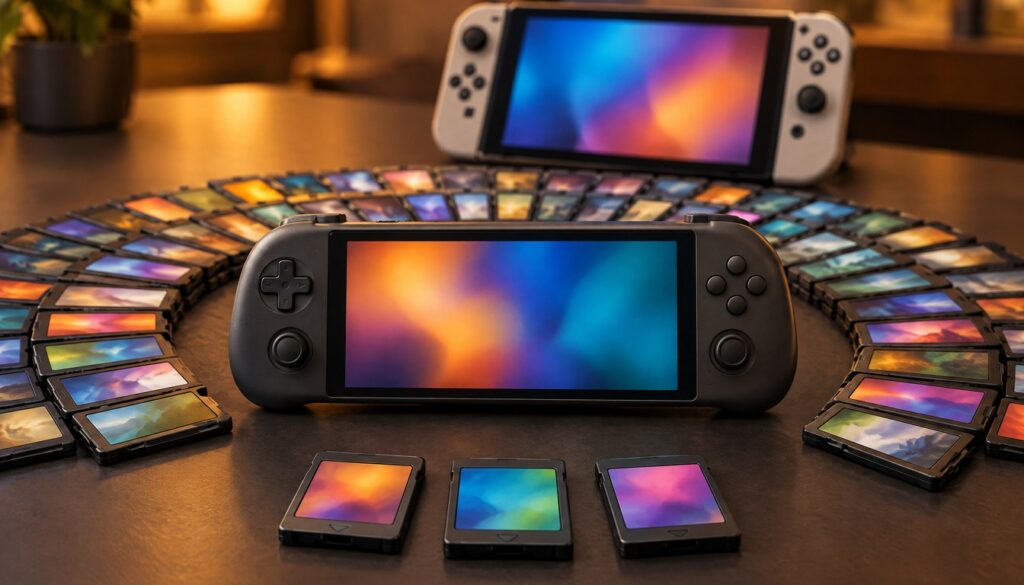
Nintendo added three more Game Boy Advance titles to the Nintendo Switch Online + Expansion Pack library on October 14, 2026. Monster Rancher Advance, Kururin Paradise, and METAL SLUG ADVANCE are now live inside the “Game Boy Advance – Nintendo Classics” app, playable on both Nintendo Switch and Nintendo Switch 2 for anyone paying for the premium Expansion Pack tier. The drop was reported within hours by My Nintendo News, Nintendo Everything, TwistedVoxel, and GoNintendo, and it pushes Nintendo’s sprawling Nintendo Classics catalog past 270 games across seven retro systems.
It is a small update on paper, three games added to a service that already carries hundreds. But the batch matters more than its size suggests. One of the three titles has never been sold outside Japan until today, and the timing lands in the middle of a year where Nintendo has quietly rebuilt its retro-game pitch into one of the few concrete reasons to keep paying for the $49.99-a-year Expansion Pack tier. Here is what shipped, why it shipped now, and what it signals about where Nintendo Classics goes from here.
Nintendo Switch Online Adds Three Game Boy Advance Titles
The October 14 update adds Monster Rancher Advance, Kururin Paradise, and METAL SLUG ADVANCE to the GBA tier of Nintendo Classics, the retro-game library bundled into Nintendo Switch Online + Expansion Pack. All three appeared in the Game Boy Advance app simultaneously, with no staggered rollout and no separate announcement beyond a trailer and a short post on Nintendo’s own channels. GoNintendo and TwistedVoxel both confirmed the games went live the same day for subscribers on Switch and Switch 2, with no patch or firmware update required beyond having the app itself current.
The addition keeps a pattern Nintendo has followed since Nintendo Classics launched: new titles arrive in small clusters, usually two to four games, spaced out across the calendar rather than dumped in bulk. That cadence keeps the Expansion Pack tier feeling alive month to month, a tactic the company also used when it grew the Switch Online NES library to 87 games earlier this year. The GBA library now sits as one of the service’s most requested tiers, alongside N64 and GameCube, because it covers a console generation many current subscribers grew up on but never owned in full.
Monster Rancher Advance, Kururin Paradise, and METAL SLUG ADVANCE Explained
Each of the three games represents a different corner of the GBA library. Monster Rancher Advance, originally released in 2001, is the handheld spin-off of Tecmo’s monster-breeding simulation series, where players raise, train, and battle creatures generated from real-world CDs and data discs, a gimmick the Switch version naturally drops in favor of a built-in generator. It was one of the more unusual ports of its era and gives Nintendo Classics its first taste of the Monster Rancher franchise.
METAL SLUG ADVANCE, from 2004, is the better-known name of the three. SNK’s run-and-gun shooter series rarely leaves arcade cabinets and home consoles, so a handheld entry built for GBA’s smaller screen and shorter play sessions has long been a curiosity for series fans. According to reporting from TwistedVoxel, the GBA version trimmed some of the series’ trademark chaos to fit the hardware but kept the core shooting and vehicle-hijacking loop intact.
Kururin Paradise, developed by Eighting and originally published by Nintendo itself in 2002, is the one generating the most attention, and for a reason that has nothing to do with gameplay mechanics.
Kururin Paradise Finally Escapes Its Japan-Only Status
Kururin Paradise never received an official release outside Japan in its original 2002 cartridge form. That changed today. My Nintendo News confirmed the puzzle-platformer, in which players rotate a spinning rod through increasingly tight mazes, is now playable worldwide for the first time through Nintendo Classics, more than two decades after its original Japanese debut.
Nintendo Everything flagged the same point, noting gamers in North America and Europe can now try the title for the first time through the subscription service rather than relying on imported cartridges, fan translations, or emulation. It is a modest example of a trend that has shown up elsewhere in Nintendo Classics: the service occasionally functions as a de facto localization pipeline for games Nintendo never bothered to bring West the first time around, sidestepping the cost and risk of a standalone re-release.
That matters for collectors and import-game communities specifically, since a physical Kururin Paradise cartridge in good condition has historically traded for well above typical GBA-era pricing on secondary markets precisely because it never left Japan. A free-to-play-if-subscribed digital version does not erase that scarcity premium for collectors chasing an original cart, but it does remove the main practical barrier for anyone who just wants to play the game.
What You Need to Play the New GBA Nintendo Classics Titles
Access is gated the same way it has been for every prior GBA addition. Players need an active Nintendo Switch Online + Expansion Pack subscription, not the base Nintendo Switch Online tier, which covers only online play and the NES and SNES libraries. The GBA games live inside a dedicated “Game Boy Advance – Nintendo Classics” app, downloadable free from the Nintendo eShop, and the three new titles appear automatically once the app updates. No separate purchase, code, or in-app payment is required beyond the standing subscription.
Both Switch and Switch 2 owners get the same access, with no version of the three games locked to either console. That consistency has mattered more this year as Nintendo pushes Switch 2 adoption while roughly 19.86 million Switch 2 units have shipped, per Nintendo’s own disclosures covered in Nintendo’s latest earnings report, without creating a split retro-game experience between old and new hardware.
New GBA Nintendo Classics Titles, October 14, 2026
| Game | Original Release Year | Original Developer | Regional Note |
|---|---|---|---|
| Monster Rancher Advance | 2001 | Tecmo | Originally released in the United States outside Japan |
| Kururin Paradise | 2002 | Eighting (published by Nintendo) | First-ever release outside Japan, via Nintendo Classics |
| METAL SLUG ADVANCE | 2004 | SNK | Widely available at original launch; reports note it did not originally release in Australia |
Nintendo Switch Online Membership Tiers and Pricing Breakdown
All three new games sit behind the Expansion Pack tier, which costs more than standard Nintendo Switch Online and has carried the bulk of Nintendo’s retro-library investment since launch. The base Nintendo Switch Online individual plan runs $19.99 per year in the United States and covers online multiplayer plus the NES and Super NES libraries, nothing newer. Stepping up to Expansion Pack, which adds the Game Boy Advance, Nintendo 64, GameCube, and Game Boy libraries along with select downloadable content for games like Mario Kart 8 Deluxe, costs $49.99 per year for an individual account.
Family plans scale the same gap upward: the standard family plan covers up to eight accounts for $34.99 per year, while the Expansion Pack family plan covers the same eight accounts for $79.99 per year. That $30 difference buys access to four additional retro console libraries split across every account on the plan, which is the math Nintendo is leaning on every time it adds a handful of games like today’s GBA batch rather than a full catalog dump.
Nintendo Switch Online Pricing Tiers (U.S.)
| Plan | Annual Price | Accounts Covered | Includes GBA Library |
|---|---|---|---|
| Individual Standard | $19.99 | 1 | No |
| Family Standard | $34.99 | Up to 8 | No |
| Individual Expansion Pack | $49.99 | 1 | Yes |
| Family Expansion Pack | $79.99 | Up to 8 | Yes |
The Nintendo Classics Catalog Tops 270 Games
Today’s three additions push the combined Nintendo Classics catalog, spanning NES, Super NES, Game Boy, Game Boy Advance, Nintendo 64, Virtual Boy, and GameCube, past 270 titles total, according to Nintendo’s own service pages. That figure covers every system under the Nintendo Classics umbrella rather than GBA alone, and Nintendo has not published a precise breakdown of how many games sit in each individual library. The NES side of that total has been documented independently; Switch Online’s NES library has grown to 87 games as of this year, which gives some sense of scale for how much of the overall catalog that single system now represents.
What stands out is how unevenly distributed the growth has been. GameCube only joined Nintendo Classics as a library in the past couple of years, and it still adds games far more slowly than NES or GBA. Virtual Boy, revived as a novelty tier, gets even rarer updates. GBA, by contrast, has turned into one of the more active libraries precisely because it hits the demographic sweet spot: subscribers who are old enough to have missed GBA titles the first time but young enough to still be paying for a Switch Online tier a decade later.
A Year of Quiet Retro Drops: Nintendo’s 2026 Release Pattern
Today’s update is not the first GBA batch of 2026. Nintendo Life reported in March that the company added two Virtual Boy titles, Mario’s Tennis and Mario Clash, alongside the GBA puzzle-platformer Mario vs. Donkey Kong, timed to land on March 10, the unofficial “MAR10 Day” built around Mario’s name. That release followed the same three-games-at-once structure as today’s drop, suggesting Nintendo treats three as something close to a standard batch size for a single Nintendo Classics update rather than a coincidence specific to this week.
The spacing between updates tends to track Nintendo’s broader calendar of anniversaries, seasonal marketing windows, and otherwise quiet news weeks. A small, cheap-to-produce content drop like three emulated GBA cartridges costs Nintendo little to ship and gives outlets something to cover between bigger console and software announcements. It also explains why these updates rarely come with fanfare beyond a short trailer: they are not meant to be the headline of the week, just a steady reminder that the Expansion Pack subscription keeps delivering something.
How This Compares to PlayStation and Xbox Retro Libraries
Nintendo’s retro strategy looks different from its two biggest console rivals. Sony folds a rotating classics catalog into its higher PS Plus tiers rather than organizing it by original hardware generation the way Nintendo does, and that catalog mixes PS1, PS2, PSP, and PS3 titles without the same strict emulator-app structure. Microsoft leans the opposite direction entirely, relying on native backward compatibility across Xbox 360 and original Xbox libraries bundled into Xbox Game Pass rather than a dedicated retro-emulation storefront, a distinction covered in our breakdown of Game Pass and PS Plus cancellation trends.
What sets Nintendo apart is specificity. No other platform holder has built a standalone app dedicated to a single discontinued handheld the way Nintendo has with GBA, GameCube, or Virtual Boy. That structure lets Nintendo gate access tier by tier and keep the Expansion Pack upsell meaningful years after launch, even as the headline library additions slow to a handful of games at a time. It is a narrower approach than Sony’s or Microsoft’s broader backward-compatibility pitch, but it gives Nintendo more individual moments to generate news, like today’s.
Why Nintendo Keeps Drip-Feeding Instead of Batch Releases
Nintendo has never explained publicly why it spaces Nintendo Classics additions out in small batches instead of releasing dozens of games at once, but the pattern lines up with how subscription services generally try to hold attention. A single enormous catalog dump generates one news cycle and then goes quiet. Three games every few months generates a steady trickle of headlines, social posts, and “what’s new on Switch Online” roundups that keep the service visible without requiring new marketing spend.
There is also a licensing angle. Older titles, particularly ones from third-party publishers like SNK’s METAL SLUG ADVANCE or Tecmo’s Monster Rancher Advance, require separate rights negotiations that do not necessarily clear on the same timeline. Batching games as negotiations finish, rather than holding everything for one giant release, is a more practical explanation than a deliberate drip-feed strategy, even if the end result looks the same to subscribers.
Market Impact: What Retro Additions Mean for Subscriber Retention
Nintendo has not published Expansion Pack subscriber figures specific to this update, and no 2026 breakdown of standard-versus-Expansion-Pack membership splits was available in current reporting. What is clear from Nintendo’s broader financial disclosures is that the company’s digital and subscription revenue has become a larger share of overall profit this year, a trend covered in detail in our report on Nintendo’s profit growth even as hardware sales cooled. Retro-game additions like today’s are a low-cost way to support that shift: they add recurring value to an existing subscription product without the production cost of new software.
The timing also lands inside a broader subscription market where cancellation pressure has grown across the industry, with cost cited as a leading reason subscribers drop services like Game Pass, PS Plus, and Nintendo Switch Online alike. Adding free, included content to an existing tier is one of the cheapest retention levers available to a platform holder, and Nintendo has used it consistently throughout 2026 rather than leaning on price increases alone.
The Physical Cartridge Market Still Looms Over Digital Retro Gaming
Digital re-releases like today’s do not replace the physical collecting market, and Nintendo has been explicit that it has no plans to abandon physical media despite rising digital sales, a position detailed in our coverage of Nintendo holding its physical-media stance as digital sales climbed past 61.5%. Original GBA cartridges, especially Japan-exclusive titles like Kururin Paradise, retain collector value independent of whether the game is playable through a subscription service, since cartridge scarcity and digital access solve different problems for different audiences.
For most players, though, the practical effect of today’s update is straightforward: a game that previously required an imported Japanese cartridge, a region-unlocked GBA, and in many cases a fan translation patch is now one eShop download away. That gap between collector-market scarcity and mainstream accessibility is where most of Nintendo Classics’ value proposition sits, and it is why individual additions like Kururin Paradise generate more coverage than their modest scale would otherwise suggest.
What’s Still Missing From GBA Nintendo Classics
Even with today’s additions, large gaps remain in the GBA library compared to the platform’s full commercial catalog. Major franchises that shipped multiple entries on original GBA hardware, including several Fire Emblem, Mother, and Pokemon spin-off titles, still have no presence on Nintendo Classics, and Nintendo has not commented on plans to add them. Licensing complexity is the most likely explanation for franchises involving outside publishers or long-dormant series, though Nintendo has never confirmed specific reasons for any individual omission.
Fan communities tracking the service have pointed to this gap for years, and today’s update does not close it. What it does show is that Nintendo is still willing to work through its back catalog methodically, including titles like Kururin Paradise that carry no major franchise recognition outside dedicated collector circles, rather than restricting additions to only the most commercially obvious picks.
Predictions: Where Nintendo Classics Goes Next
- Expect another small GBA or N64 batch within the next two to three months, continuing the three-games-per-drop pattern seen in both March and October 2026.
- GameCube additions will likely stay the slowest-growing library, given the format’s higher emulation complexity and the smaller pool of titles Nintendo has cleared so far.
- More Japan-exclusive titles in the mold of Kururin Paradise are a reasonable bet, since the format lets Nintendo generate outsized coverage from genuinely rare, low-cost catalog entries.
- Pressure from subscription-cancellation trends across the industry makes further price increases to the Expansion Pack tier less likely in the near term, in favor of content additions that justify the existing price.
- Nintendo is unlikely to confirm a release date pattern or publish a public roadmap for Nintendo Classics, keeping each addition a surprise rather than a scheduled event.
Related
- Switch Online NES Library Grows to 87 Games [2026]
- Nintendo Profit Jumps 52%, Switch 2 Sales Hit 19.86 Million [2026]
- Nintendo: No Plans to Ditch Physical Media as Digital Hits 61.5% [2026]
- Nintendo Switch Update 23.0.1 Fixes Startup Delay [2026]
- Game Pass, PS Plus Cancellations: 40% Blame Cost [2026]
Frequently Asked Questions
What three GBA games did Nintendo add to Switch Online on October 14, 2026?
Nintendo added Monster Rancher Advance (2001), Kururin Paradise (2002), and METAL SLUG ADVANCE (2004) to the Game Boy Advance – Nintendo Classics library.
Do I need Nintendo Switch Online or the Expansion Pack to play these games?
You need the Expansion Pack tier specifically. The base Nintendo Switch Online plan only covers online play plus the NES and Super NES libraries.
How much does Nintendo Switch Online + Expansion Pack cost?
The individual Expansion Pack plan costs $49.99 per year in the United States. A family plan covering up to eight accounts costs $79.99 per year.
Was Kururin Paradise ever released outside Japan before now?
No. According to reporting from My Nintendo News and Nintendo Everything, today’s Nintendo Classics release marks the first time Kururin Paradise has been officially available outside Japan.
Can I play the new GBA games on the original Nintendo Switch, or only Switch 2?
Both. The three new titles are available on Nintendo Switch and Nintendo Switch 2 through the same Game Boy Advance – Nintendo Classics app.
How many games are in the Nintendo Classics library overall?
Nintendo’s service pages put the combined Nintendo Classics catalog at more than 270 games across NES, Super NES, Game Boy, Game Boy Advance, Nintendo 64, Virtual Boy, and GameCube. Nintendo has not published a per-system breakdown of that total.
Does this update include new Nintendo 64 or GameCube games?
No. Today’s update is limited to the three Game Boy Advance titles. Nintendo has not announced accompanying additions to the N64 or GameCube libraries.
Will Nintendo add more GBA games soon?
Nintendo has not confirmed a schedule, but the service has added GBA titles in small batches multiple times in 2026, including a March update tied to Mario Day, suggesting further additions are likely over time.