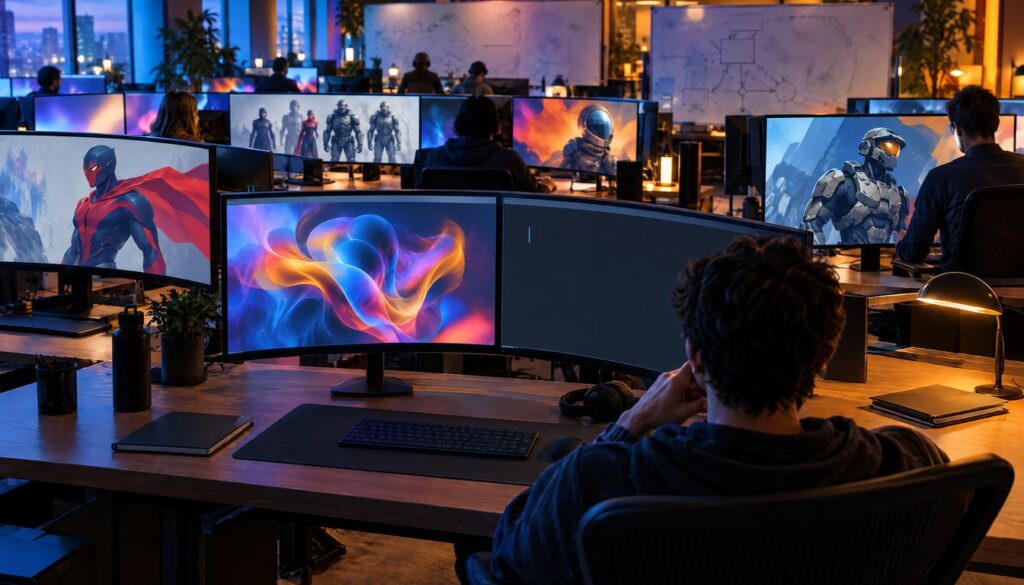
Epic Games has pushed back the release of its long-awaited collaboration with Walt Disney Co., and the reason has nothing to do with a bug list or a missing boss fight. According to reporting from Bloomberg and GamesIndustry.biz, Epic told the development team working on the project to rebuild its workflow around an “AI first” model, trading hand-written code and traditional art pipelines for generative tools including Anthropic’s Claude. The game, a multiplayer shooter built around Marvel and Star Wars characters, was slated for a March release. That date is gone, and Epic has not named a replacement.
The story lands at an awkward moment for the games industry, which is already bracing for a wave of AI-driven production changes. Epic is not a scrappy startup experimenting on a side project. It is the company behind Fortnite, the Unreal Engine that powers a huge share of AAA development, and a decade of public fights over app store economics. When Epic changes how it builds games, other studios take notice, and this delay is becoming a case study in what “AI first” actually means when it collides with a licensed, high-profile project tied to two of the most valuable entertainment brands on the planet.
What Happened to Epic’s Disney Game
The project in question is described across multiple outlets, including GamesIndustry.biz, as a multiplayer shooter drawing characters and settings from Marvel and Star Wars, two franchises Disney owns outright. It had been positioned internally for a March launch. That timeline has now slipped, and as of October 12, 2026, Epic has not communicated a new date publicly or internally, according to the reporting reviewed for this story.
What makes this delay different from a routine schedule slip is the instruction that reportedly came with it. Developers on the project were told to adopt an AI first production model, a phrase that, per the internal messaging described in the reporting, meant leaning on generative tools for both code and art rather than treating AI as a supplementary tool. One of the game’s directors reportedly wrote in an internal message that there would be “no more hand-written code,” and that the game’s art would be “generated with full AI workflows.” Those are striking lines for a licensed project built on characters as tightly controlled as Spider-Man or Darth Vader, where visual consistency with decades of established designs typically matters as much as gameplay feel.
Epic’s communications director, Jake Jones, addressed the shift in a statement to Ars Technica, saying the company is “embracing AI-accelerated development, led by Epic developers who are the visionaries and creative drivers for everything we do.” The framing is deliberate: Epic wants the story to read as developers directing AI tools, not AI tools replacing developers. Whether that distinction holds up once the game actually ships is a separate question, and one the industry will be watching closely.
Human developers were still instructed to manage and guide the AI-generated output rather than being removed from the loop entirely, based on the available reporting. That detail matters because it suggests Epic is not attempting to automate the project end to end without oversight, but rather restructuring what human developers spend their time doing, shifting them from production tasks toward direction, curation, and quality control.
Why the Timing Raises Questions
It is tempting to draw a straight line from “AI first mandate” to “project delayed,” but the reporting does not actually confirm that causation. Alongside the AI shift, reports also point to underestimated staffing needs and development time as contributing factors, a far more ordinary explanation that shows up in postmortems for licensed games going back decades. Disney properties come with extensive approval processes, legal review, and brand guidelines that can slow any studio regardless of its tooling.
Still, the optics are hard to ignore. A studio pivots to AI-generated art and code on a project, and the same project misses its date. Readers and competitors will draw their own conclusions, and some of those conclusions will be unfair to the engineers and artists who had no say in the production strategy. The more useful question is whether retooling a project mid-development around generative tools is itself a schedule risk, independent of whether the underlying technology works. Switching pipelines partway through any game’s production cycle has historically been one of the most reliable ways to blow a deadline, long before generative AI entered the picture.
There is also a simpler explanation worth taking seriously: Epic may have concluded that shipping in March with the original pipeline would have produced a worse game than shipping later with a retooled one. Delays framed around quality are common in games marketing, but they are not automatically false. Without an official release date or a direct comment from Epic on root cause, both readings remain live possibilities, and this article treats them as such rather than asserting one as fact.
Inside the “AI First” Production Model
“AI first” is quickly becoming one of those phrases every tech company wants to claim and few define consistently. For Epic’s Disney project, the reporting indicates it meant generative tools, including Anthropic’s Claude, handling first-pass code generation and full AI workflows producing art assets, with human staff reviewing, directing, and refining the output rather than originating it from scratch. That is a meaningfully different workflow from using AI as autocomplete inside an IDE, which is how most studios have deployed these tools so far.
Claude’s presence in a flagship Epic production is notable on its own. Anthropic has spent much of 2026 pushing its models deeper into coding and agentic workflows, and Claude Opus 5.5’s expanded context window has made it a popular choice for large, sprawling codebases, exactly the kind a live-service multiplayer shooter accumulates. Using it for both code and creative asset direction on a Disney-licensed title signals a level of institutional confidence from Epic that goes beyond a pilot program.
Code Generation Without Hand-Written Code
The internal line about “no more hand-written code” is the most quoted detail from the reporting, and for good reason. Most studios that have adopted AI coding assistants still describe the tools as accelerants, something that drafts boilerplate or suggests fixes while engineers remain the primary authors. A directive suggesting the reverse, that AI generates the code and engineers primarily review and steer it, represents a different division of labor. It is closer to how some teams already use Claude Code for scaffolding entire features, just scaled up to a full production title rather than a side project or prototype.
Full AI Art Workflows
Art generation carries its own set of complications that code generation does not. Marvel and Star Wars characters are governed by brand bibles that specify exact silhouettes, color palettes, and proportions. Generative art tools are good at producing plausible-looking content quickly, but matching decades-old brand guidelines with pixel-level consistency across hundreds of assets is a harder bar to clear than writing functional code. If Disney’s approval process rejected early AI-generated assets for failing to match established character designs, that alone could account for schedule slippage independent of any coding issues.
Epic’s AI Push in Context
Epic did not arrive at this decision in a vacuum. The broader game engine market has been racing toward AI-assisted tooling for more than a year. Google and Unity launched Spark, an AI game maker aimed at adult creators, and Unity’s own roadmap for Unity 7 includes AI-assisted shader work promising dramatic speed gains. Capcom has gone even further on the content side, building a suite of six internal AI programs under its REX initiative to help remake assets in its RE Engine. Against that backdrop, Epic retooling a flagship Disney collaboration around generative workflows looks less like an outlier bet and more like catching up to an industry-wide shift that is already underway.
Epic’s own engine business has repeatedly used technical superiority as a competitive weapon against Unity, and the two companies have traded market share in recent quarters, with Unreal Engine 6 reportedly holding roughly 42% share against Unity’s 30%. An AI-first production pipeline, if it proves faster without compromising quality, would be another point Epic could use to recruit studios away from competing engines. If it instead produces a visibly rough, delayed game built on one of the most recognizable entertainment properties in the world, it becomes a cautionary tale that rival engine makers will be happy to cite.
How the Industry Is Reacting
Reaction across gaming press and developer communities, including outlets like Dexerto, has split along predictable lines. Some read the delay as validation that AI-generated code and art still need more runway before they can anchor a major licensed release. Others see it as evidence that studios willing to absorb short-term schedule pain for structural workflow change will come out ahead once the tools mature. Both camps are, in effect, making predictions about technology that is evolving month to month, which is exactly why a single delayed game should not be treated as definitive proof of either position.
Sweeney has been publicly candid about Epic’s broader AI ambitions beyond this one project, describing what he called “a huge pivot underway here at Epic, moving developers around to retool for maximum AI acceleration,” a comment posted to his account on X. He has also framed the goal in terms of output rather than headcount reduction, saying the aim “isn’t to do the same stuff with fewer people, but to enable everyone here to build MORE and BETTER stuff, and to bring the benefits to all teams using Unreal,” per the same account. That framing matters for how Epic wants to be perceived: not as a company cutting jobs through automation, but as one redirecting its existing workforce toward higher-value work.
Sweeney struck a more measured tone in a separate comment, saying Epic’s “more modest aim is to survive the AI revolution, help other developers do the same, and come out on the other end making better code and content faster.” He also pointed to a specific production benefit he expects from the shift, saying “the biggest change will be much faster time from having an idea to playtesting it,” a claim that speaks directly to iteration speed rather than final output quality, and one that will be tested as the Disney project moves toward its eventual, still-unannounced release.
Comparing Epic’s Move to Other Studio AI Bets
Epic is far from the only major player restructuring around generative AI this year, but the specifics of each bet differ enough that lumping them together obscures more than it reveals. The table below lines up what is publicly known about each initiative, drawn from prior reporting on this site and the sources cited throughout this article.
| Company / Initiative | Primary AI Tool | Scope | Reported Outcome |
|---|---|---|---|
| Epic Games (Disney shooter) | Anthropic’s Claude | Code generation and full AI art workflows on a single licensed title | Project delayed past original March target; no new date set |
| Capcom (REX initiative) | Six internal AI programs | Remaking legacy assets inside the RE Engine | Positioned as an efficiency play for back-catalog remasters |
| Google and Unity (Spark) | Generative AI game maker | Consumer-facing tool for creators 18 and older | Launched as a product, not an internal production pivot |
| Unity (Unity 7 roadmap) | AI-assisted shader tooling | Engine-level performance tooling | Promised shader compilation gains, targeted for Q1 2027 |
| Meta (Muse Wonder / Spark) | In-house generative models | Consumer AI agents and coding assistants | Commercial rollout with tiered pricing, not game production |
The comparison makes Epic’s situation look distinct for one reason: it is the only entry on this list where AI tooling was applied directly to a specific, dated, licensed product rather than to an engine feature, an internal catalog project, or a standalone consumer app. That distinction is exactly why the delay carries more weight than it otherwise would. A missed internal roadmap milestone is routine. A missed date on a co-branded Marvel and Star Wars title, attached publicly to an AI production method, becomes a referendum on the method itself, fairly or not.
A Brief History of AI-First Game Development Attempts
Generative AI’s march into game production did not start with Epic’s Disney project, and it is worth placing this story on a timeline rather than treating it as an isolated event. Jagex leaned on modern engine tooling, including a jump to Unreal Engine, for its RS4 relaunch of RuneScape, a title reportedly ending a 25-year wait for a new entry in the MMO’s core lineage. Rocket League’s developers took an even bigger technical leap, skipping two engine generations entirely to jump from Unreal Engine 3 straight to Unreal Engine 6, a move that reflects how aggressively studios are willing to overhaul foundational tooling when the payoff looks big enough.
What distinguishes this moment is the specificity of the claim: not “we upgraded our engine” or “we built an AI tool,” but “we rebuilt our production process around AI mid-development on a named, dated, licensed product.” That is a much higher-stakes bet than anything on the list above, and it is why the Disney delay is drawing more scrutiny than a typical engine migration story would.
Market and Business Impact
For Epic, the immediate financial exposure from a single delayed title is limited. Epic is privately held and does not disclose per-project revenue, so there is no stock reaction to track the way there would be for a public company. The bigger stake is reputational and strategic: Epic has spent years positioning Unreal Engine as the technically superior choice for AAA and licensed development, competing directly against Unity for engine market share. A high-profile stumble on a Disney collaboration, even one eventually resolved, gives ammunition to studios weighing whether to commit to Epic’s AI-forward production philosophy for their own licensed projects.
For Disney, the calculus is different. Disney licenses its characters across dozens of partners every year and has weathered delays on games before without major fallout, provided the eventual product meets brand standards. The bigger risk for Disney is not the delay itself but the possibility that AI-generated likenesses of Spider-Man, Darth Vader, or other closely guarded characters drift even slightly from established designs in ways fans notice immediately. Brand consistency, not ship dates, is typically Disney’s highest priority in licensing deals of this scale.
For Anthropic, the exposure is reputational in the opposite direction, a positive one if the eventual game ships well, a negative one if critics trace production problems back to AI-generated code or art. Anthropic has been aggressively marketing Claude’s coding capabilities throughout 2026, and a visible win inside a Disney-branded, Epic-published title would be a significant proof point for enterprise and studio customers evaluating whether to adopt similar workflows.
What This Means for Developers
For engineers and artists working inside Epic or watching from competing studios, the practical question is what “managing and guiding AI-generated work” actually looks like day to day. Reviewing AI output at scale, catching subtle art inconsistencies, and debugging code you did not write yourself are different skills than originating that work from scratch, and they are not skills every studio has systematically trained its staff to use. Studios considering a similar pivot would be wise to treat this less as a tooling swap and more as a role redefinition that needs its own onboarding and quality assurance processes.
There is also a morale dimension that rarely shows up in corporate statements. Developers who spent months building systems for a shooter under one production model, then were told midstream to shift toward reviewing AI output instead of writing it, are absorbing a significant change in how they spend their working hours. Jones’s statement that Epic developers remain “the visionaries and creative drivers” is Epic’s attempt to reassure that workforce, but whether that framing matches the day-to-day experience on the ground is something only the people on the project can really judge.
Data Snapshot: Delay Timeline and Key Facts
| Detail | Status as of October 12, 2026 |
|---|---|
| Original release window | March (exact year not confirmed by primary sourcing) |
| New release date | Not announced |
| Game genre | Multiplayer shooter |
| Licensed IP involved | Marvel and Star Wars characters, via Disney |
| Primary AI coding tool reported | Anthropic’s Claude |
| Internal directive on code | “No more hand-written code,” per a project director |
| Internal directive on art | Assets “generated with full AI workflows” |
| Human role under new model | Managing and guiding AI-generated output |
| Official Epic statement | Confirms AI-accelerated development push, via communications director Jake Jones |
| Stated cause of delay (secondary factor) | Reports also cite underestimated staffing and development time |
Predictions: Where This Goes Next
- Expect Epic to stay quiet on a specific new release date for at least several more months, since committing to a second deadline before the AI-first pipeline has proven itself would repeat the exact risk that caused this delay.
- Watch for other Unreal Engine licensees to publicly test similar AI-first workflows on smaller, non-licensed projects first, using them as lower-risk pilots before attempting anything comparable on a major branded IP.
- Disney’s approval process will likely become a bigger story than Epic’s production method if early AI-generated character art requires multiple rounds of revision to satisfy brand guidelines.
- Anthropic will almost certainly reference this collaboration, once it ships, in future marketing around Claude’s coding and creative capabilities, regardless of how the final reception shakes out.
- Competing engine makers, including Unity, are likely to use any further delays or quality complaints from this project as a counterpoint in their own pitches to AAA and licensed-IP developers choosing between engines.
The Bigger Picture for AI in Game Development
Strip away the Disney and Marvel names, and this story is really about whether “AI first” is a production philosophy mature enough to survive contact with a real, dated, high-stakes commercial release. Plenty of studios have used AI tools successfully on smaller, lower-visibility features. Far fewer have attempted to rebuild an entire project’s code and art pipeline around generative tools mid-development, on a licensed product, with a named external partner watching the outcome. Epic’s experience, whatever the eventual verdict, will be one of the most closely studied case studies the industry has for judging that question.
The takeaway: this delay is not proof that AI-first game development fails, nor is it proof that it works. It is one data point from one studio on one project, wrapped in a licensing relationship that adds pressure the typical AI pilot program never faces. The next real signal will come when Epic actually sets, and hits or misses, a new date, and when players finally get to judge whether “full AI workflows” produced art that looks and feels like the Marvel and Star Wars they already know.
Frequently Asked Questions
What game did Epic Games delay?
Epic delayed its collaboration with Walt Disney Co., a multiplayer shooter built around Marvel and Star Wars characters. The game’s official title has not been confirmed.
When was the game originally supposed to release?
Reports indicate a March release window. The exact year has not been confirmed by primary sourcing, and Epic has not announced a replacement date.
What does “AI first” mean in Epic’s internal directive?
Based on reported internal messaging, it means code generated by AI tools rather than hand-written by engineers, and art assets produced through full AI workflows, with human developers managing and guiding that output rather than creating it from scratch.
Which AI tools is Epic reportedly using?
Reporting names Anthropic’s Claude as one of the AI tools used on the project.
Did Epic confirm the AI shift caused the delay?
Not directly. Reports attribute the delay to the AI-first production shift and, separately, to underestimated staffing and development time. Epic’s public statement confirmed the AI push without directly assigning blame for the delay to it.
What did Epic’s communications director say about the AI push?
Jake Jones said Epic is “embracing AI-accelerated development, led by Epic developers who are the visionaries and creative drivers for everything we do.”
Are human developers being removed from the project?
No. Reporting indicates human developers remain involved, shifting toward managing and guiding AI-generated code and art rather than producing all of it manually.
How does this compare to other studios’ AI initiatives?
It differs from efforts like Capcom’s REX program or Unity and Google’s Spark tool because those are internal efficiency projects or standalone consumer products, not a mid-development overhaul of a specific, dated, licensed commercial title.