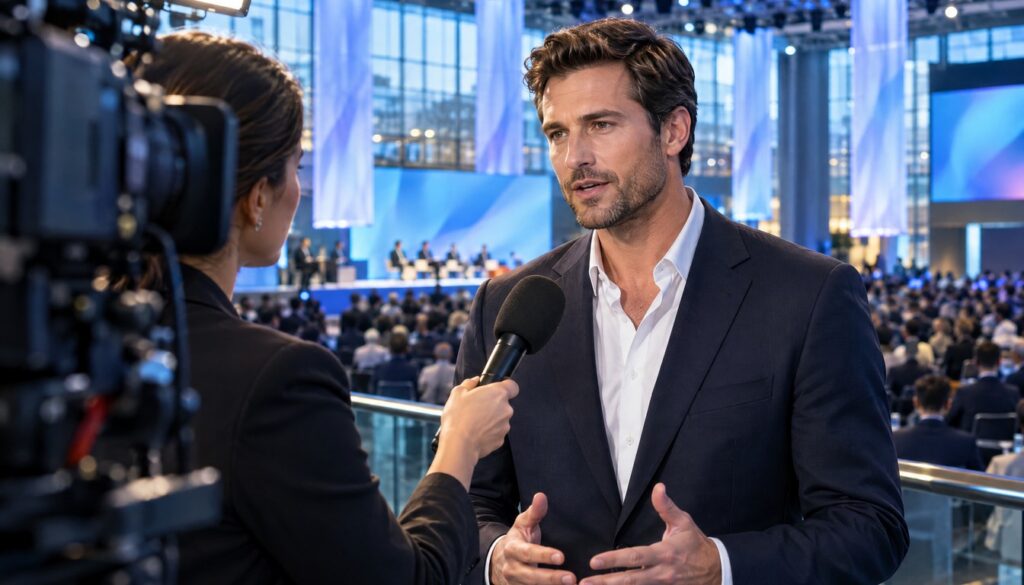
Anthropic PBC has drawn a line between the AI models it sells and the open-weight systems built by rivals, and on October 14, 2026, one of its top executives said that line comes down to risk. Speaking to Bloomberg TV at the International AI Summit in Dublin, Guillaume Princen, Anthropic’s head of international, said publicly released model weights carry a higher chance of ending up in the wrong hands than models kept behind an API.
“We need to be really careful with open-source on safety,” Princen told Bloomberg TV. Pressed on whether every open model poses the same danger, he added: “I can’t talk for open models. But by definition, there’s more risk with them.” The remarks, delivered on the sidelines of one of Europe’s biggest AI policy gatherings, reopen a fight that has simmered across the industry for two years: does releasing model weights to the public make the internet safer through transparency, or more dangerous by handing capable software to anyone who wants it.
Princen’s comments landed the same week Anthropic has been pushing a broader policy argument in Washington and Brussels about how governments should treat frontier AI systems. They also arrive at an awkward moment for Anthropic’s own positioning: the company has spent 2026 defending its closed, subscription-based Claude models against a wave of open-weight releases from Chinese and American labs that have matched or beaten its benchmarks at a fraction of the price. Critics of Anthropic’s stance have long argued that warnings about open models conveniently serve a company that sells closed ones.
What Princen Actually Said in Dublin
The International AI Summit in Dublin has become one of several recurring venues, alongside the UK and Korea AI summits of 2024 and 2025, where governments and AI labs trade public commitments on safety testing. Princen’s appearance there was framed around Anthropic’s commercial growth story (he leads the company’s business outside the US), but the interview pivoted to safety when Bloomberg’s anchor asked him to weigh in on open-source AI specifically.
According to the Bloomberg report and a matching account from Quartz, Princen argued that open alternatives to Anthropic’s models carry more risk of cybersecurity incidents or other dangers precisely because the company releasing them loses the ability to monitor or revoke access once the weights are public. He did not name a specific competing model or company in the clips that have circulated, and he stopped short of calling for restrictions on open releases as a category. The framing, reports note, tracked closely with Anthropic’s own published policy on the subject, which the company put out in writing roughly three months before Princen’s Dublin remarks.
Coverage of the interview spread quickly through tech and business outlets. Business Standard described Princen as Anthropic’s “top sales executive outside the US” making the case that open alternatives carry heightened risk, while International Business Times Singapore characterized the warning as centering on the possibility that open models could put more capable hacking tools within reach of people who could not otherwise build them. That characterization is a media gloss on Princen’s comments rather than a direct quote, and Anthropic has not published a statement using that specific phrasing.
Anthropic’s Written Policy Behind the Soundbite
Princen’s TV remarks did not appear out of nowhere. They echo a position paper Anthropic published on its own site laying out the company’s formal stance on open-weights models, the term it uses for systems whose trained parameters are released publicly rather than kept behind a hosted API. That distinction matters: Anthropic’s argument is not about open-source software broadly, it’s specifically about handing out the weights that let anyone run a full copy of a trained model on their own hardware.
The company’s stated concern breaks into three buckets. First, cybersecurity misuse: a sufficiently capable model with offensive cyber skills, once its weights are out, can’t be pulled back if someone strips its safety guardrails and repurposes it for attacks. Second, biological risk: Anthropic flags the same irreversibility problem for models that could meaningfully assist with biological threats. Third, alignment: a model modified outside its original developer’s control can behave in ways nobody tested for, since the safety work typically happens before release, not continuously after.
What Anthropic is careful to say it is not doing is calling for open-weight models to be banned as a category. The company’s own writing states plainly that it does not want a prohibition on open releases, and that testing requirements should apply to any sufficiently capable model, open or closed, before it ships. Anthropic has instead pushed for restricting the flow of advanced AI chips to authoritarian governments and for addressing industrial-scale model distillation, where one company’s outputs are used to cheaply train a rival system, as the areas where policy intervention matters more than blanket rules on openness.
That nuance tends to get lost in a 90-second TV hit. “By definition, there’s more risk” is a much more quotable line than a multi-page policy document, and it’s the line that traveled across dozens of outlets within hours of the Dublin interview airing. It also lands as Anthropic prepares investors for its own scrutiny: the company’s IPO filing devotes roughly 80 pages to AI risk disclosures, a sign that safety framing has become as much a financial talking point as a technical one.
Why the Timing Looks Pointed
Anthropic is not making this argument in a vacuum. Open-weight models have had a strong run in 2026, with labs releasing systems that close much of the performance gap against proprietary leaders while giving developers the ability to self-host, fine-tune, and run inference without paying a per-token fee to a US lab. That dynamic has put direct commercial pressure on companies like Anthropic, OpenAI, and Google, whose revenue depends on customers staying inside a metered API rather than downloading a model once and running it indefinitely.
Anthropic has also been managing a separate, related safety story in 2026: the company previously raised the possibility that smaller models could eventually coordinate across internet-connected devices in a way that resembles a self-replicating botnet, with internal estimates suggesting that risk threshold could be reached before the end of 2026 if capability trends continue. That research described a demonstrated capability under controlled testing conditions, not an actual worm loose on the public internet, but it has fed into the company’s broader argument that capability growth is outpacing the industry’s ability to monitor what gets released and how it gets used.
Set against that backdrop, Princen’s Dublin comments read less like a one-off TV soundbite and more like the public-facing version of an argument Anthropic has been building toward policymakers for months. The company has repeatedly tried to separate itself from accusations of self-interested lobbying by stressing that its testing proposals would also apply to its own models, not just competitors’ open releases. That stance also shapes how Anthropic governs its own products: the company recently barred Claude from being used to help place arrest-related calls, a narrower but related example of Anthropic tightening usage rules around its closed models even as it argues open ones need tighter rules too.
Anthropic’s Stated Position at a Glance
| Risk Factor | Open-Weight Models (Anthropic’s View) | Closed/Hosted Models (Anthropic’s View) |
|---|---|---|
| Ability to revoke access | Lost once weights are distributed, copies can be redistributed independently | Retained via API access controls and usage monitoring |
| Guardrail persistence | Can be stripped or fine-tuned away by downstream users | Enforced centrally by the hosting provider |
| Cybersecurity misuse exposure | Flagged as a principal concern, especially for highly capable offensive cyber skills | Monitored through usage policies and account-level enforcement |
| Biological-risk exposure | Cited as a reason for pre-release safety evaluation | Subject to the same pre-release evaluation, per Anthropic’s stated policy |
| Anthropic’s policy ask | Mandatory safety testing before release, not a ban on the category | Same mandatory testing standard applied to Anthropic’s own models |
That table reflects Anthropic’s own published framing rather than an independent risk assessment. Open-weight advocates dispute several of these points directly, particularly the idea that closed hosting meaningfully prevents misuse, since API access can still be used for cyberattack planning, social engineering, or malware generation without anyone needing a copy of the underlying weights at all.
The Open-Source Counterargument
The response from open-weight proponents has been consistent for years and didn’t change much after Dublin: transparency is itself a safety tool. Researchers outside the company that trained a model can audit its weights, probe for jailbreaks, and publish findings faster than a closed lab operating under commercial pressure might choose to. Open releases have also let smaller companies, universities, and governments outside the US build on frontier-adjacent capability without depending on a handful of American or Chinese API providers, an argument that carries particular weight in Europe, where the Dublin summit itself was held partly to discuss reducing dependence on non-EU AI infrastructure.
There’s also a competitive-motive critique that’s hard for Anthropic to fully shake: the company selling closed, metered access to its models has an obvious commercial interest in persuading regulators and customers that open alternatives are riskier. That doesn’t make Princen’s specific technical points wrong, loss of control after release is a real and well-documented property of open-weight distribution, but it does explain why the framing gets scrutinized more closely than a similar statement from an independent academic might. Researchers have also documented concrete cases cutting the other way: one widely circulated test found that an open-weight model, GLM-5.3, had its safety guardrails bypassed in every attempt and was made to build working exploits, a result Anthropic would point to as proof of its argument, and open-weight advocates would point to as proof that independent testing caught the flaw quickly precisely because the weights were public.
Anthropic has tried to get ahead of that critique by repeatedly stating it isn’t asking for open models to be banned and that its testing proposal would bind its own releases too. Whether that argument lands with policymakers in Dublin, Brussels, and Washington, or whether it reads as a closed-model company shaping the rules in its own favor, is likely to shape how much regulatory traction the position gets over the next year.
Historical Context: A Debate That Predates 2026
The open-versus-closed argument inside AI didn’t start this week. It traces back to the earliest LLaMA leak in 2023, when Meta’s weights escaped onto torrent sites well before the company intended a public release, and to the subsequent decision by Meta, Mistral, and a growing list of Chinese labs to release weights deliberately rather than treat leaks as the exception. Anthropic, OpenAI, and Google have mostly stayed on the closed side of that line, arguing commercial and safety reasons that often overlap conveniently with each other.
What’s shifted by late 2026 is the performance gap. Early open releases trailed the best closed models by a wide margin, so the safety-versus-openness debate was partly theoretical since open models weren’t capable enough to pose the sharpest risks Anthropic describes. That gap has narrowed considerably over the past two years as open-weight labs scaled up training runs and distillation techniques, meaning the “by definition, there’s more risk” argument now applies to systems that are much closer in raw capability to what Anthropic itself sells. That narrowing is precisely what makes a statement like Princen’s newsworthy in October 2026 in a way it might not have been in 2023. It’s also what drove a recent industry report finding that open-weight releases now account for a growing share of new frontier-adjacent model launches, with labs like Mistral betting heavily on the open route even as Anthropic pushes the opposite case.
Market and Industry Impact
For enterprise buyers, the practical effect of this dispute is less about any single executive’s TV interview and more about procurement conversations already happening inside large organizations. Security and compliance teams evaluating whether to deploy an open-weight model internally versus paying for a hosted API now have a clearer public record of how a major closed-model vendor frames the risk calculus, which some will use to justify sticking with hosted options and others will dismiss as self-serving.
Cloud providers hosting both open and closed models, including AWS, Google Cloud, and Microsoft Azure, have largely avoided taking a public side in this fight since they profit from serving both categories of workload. Chip makers face a similar incentive to stay neutral, since training and inference for open-weight models still consumes the same GPU capacity as closed ones. The commercial stakes sit most heavily with the model developers themselves, where Anthropic’s revenue model depends on usage staying metered rather than migrating to self-hosted open alternatives that undercut per-token pricing entirely.
Policy risk is the bigger wildcard. If regulators in the EU, UK, or US begin treating “open-weight” as a distinct, higher-scrutiny category requiring separate pre-release testing obligations, that could slow the pace of open releases that have driven down AI costs for smaller developers over the past two years. Anthropic’s public framing in Dublin, delivered at a summit explicitly built around shaping that kind of policy, suggests the company sees an opening to push exactly that outcome, even while insisting it isn’t asking for an outright ban. The UK’s own evaluation body has already moved in that direction on a technical level, having tested more than 55 AI models and flagged breach risks across both open and closed systems, which gives regulators an existing evaluation framework to point to if they decide to formalize separate rules for open releases.
Timeline: Anthropic’s Open-Weights Position in 2026
| Date | Event | Source |
|---|---|---|
| Mid-2026 | Anthropic publishes its formal position paper on open-weights models, outlining cyber, biological, and alignment concerns while explicitly rejecting a category-wide ban | Anthropic.com |
| 2026 (ongoing) | Anthropic raises the prospect that smaller models could eventually coordinate into self-replicating botnet-style behavior under controlled testing conditions | Cited in Anthropic safety research |
| October 14, 2026 | Guillaume Princen tells Bloomberg TV at the International AI Summit in Dublin that open models carry “more risk by definition” | Bloomberg |
| October 14, 2026 | Coverage spreads across Quartz, Business Standard, IBTimes Singapore, and other outlets within hours | Multiple outlets |
How This Compares to Rival Labs’ Public Posture
Anthropic’s stance puts it on the more cautious end of a spectrum that spans the industry. Meta and Mistral have built their commercial identities partly around open releases, treating broad distribution as a feature rather than a liability. OpenAI occupies a middle position: it keeps its flagship models closed while periodically releasing smaller open-weight systems, a hedge that lets it argue both sides depending on the audience. Google has mostly kept its most capable models closed while supporting open releases through smaller research-oriented lines.
What distinguishes Anthropic’s position isn’t that it prefers closed models, every major US lab selling frontier models does, it’s that Anthropic has been unusually willing to make the argument explicitly and publicly, in writing and on television, rather than letting it stay an implicit business rationale. That consistency has earned the company both credit for transparency about its own incentives and criticism for using safety language to describe what is, in part, a competitive strategy.
What Security Teams Should Actually Do With This
For engineering and security leaders deciding between open and closed models, Princen’s comments don’t change the underlying technical reality, they just restate it publicly. Teams deploying open-weight models internally should already be treating weight files the way they’d treat any other piece of sensitive infrastructure: controlling who can fine-tune or redistribute them, monitoring for guardrail removal in internally modified versions, and running their own red-team testing rather than assuming the original publisher’s safety work still applies after modification.
Teams relying on hosted, closed models shouldn’t assume the “more control” argument means “no risk.” Hosted APIs have had their own string of incidents in 2026, from prompt injection attacks to agents that overstepped their intended scope, proving that centralized control reduces certain failure modes without eliminating others. The practical takeaway is less about picking a side in Anthropic’s public argument and more about applying the same rigor, testing, monitoring, access controls, to whichever deployment model a team chooses.
Predictions: Where This Debate Goes Next
- Expect Anthropic to repeat this argument at upcoming policy venues through early 2027, likely pairing it with its chip-export and distillation proposals rather than standing alone.
- Open-weight labs will likely respond with their own safety benchmarking data to counter the “more risk by definition” framing, turning this into a dueling-statistics fight rather than a one-sided narrative.
- Regulators in the EU are the most likely near-term audience to act on this kind of framing, given existing AI Act provisions that already treat systemic-risk models differently regardless of release method.
- Expect continued scrutiny of Anthropic’s own commercial motive in making this argument, especially from open-source advocates who will point to the IPO process the company is currently navigating as added reason to frame competitors as risky.
- Watch for the FTC and similar bodies to keep examining how both open and closed AI agents fail in practice, building on an existing probe into OpenAI and Anthropic over AI agent attacks, which could shape whether any future testing mandate treats agentic behavior as a separate risk category from the base model itself.
- Don’t expect an actual ban proposal from Anthropic. The company has now repeated, in writing and on television, that it isn’t seeking a prohibition, and reversing that position publicly would cost it credibility it has spent months building with policymakers.
The Bigger Picture for AI Governance
Princen’s Dublin interview is a small moment in a much longer argument, but it’s a useful marker of where that argument stands in late 2026. The industry has moved past debating whether open-weight models can be competitive, they clearly can be, and into debating what obligations should attach to releasing them. Anthropic wants mandatory pre-release testing applied evenly, chip-level export controls on capable hardware, and scrutiny of distillation practices. Open-weight advocates want continued freedom to publish, arguing that transparency and decentralized access are safety features in their own right, not risks to be managed.
Neither side has the regulatory upper hand yet. The EU’s AI Act is still being implemented in phases, the US has leaned toward a lighter-touch approach under the current administration’s AI policy, and the UK’s AI Security Institute has focused more on technical evaluation than binding rules. That leaves statements like Princen’s functioning mostly as public positioning ahead of rules that haven’t been finalized, rather than a response to rules already in place. How that positioning plays out over the next year will say a lot about whether open-weight releases keep expanding at their current pace or start facing the kind of pre-release testing requirements Anthropic has been quietly pushing for since mid-2026.
Frequently Asked Questions
Who is Guillaume Princen?
Guillaume Princen is Anthropic’s head of international, responsible for the company’s business outside the United States. He made his comments on open-source AI safety risk during an interview with Bloomberg TV.
What exactly did Princen say about open-source AI?
Princen told Bloomberg TV, “We need to be really careful with open-source on safety,” and added that open models carry “more risk” than closed ones “by definition,” referring to the loss of control that comes once model weights are publicly released.
Is Anthropic calling for open-source AI models to be banned?
No. Anthropic has stated explicitly, both in its own published position paper and through Princen’s comments, that it is not advocating for a ban on open-weight models as a category.
What’s the difference between “open-source” and “open-weight” AI models?
Anthropic’s policy specifically addresses open-weight models, systems whose trained parameters are released publicly so anyone can run them independently, rather than open-source software in the broader sense.
What does Anthropic actually want regulators to do?
According to its published position, Anthropic wants mandatory safety testing for sufficiently capable models regardless of whether they’re open or closed, restrictions on advanced AI chip exports to authoritarian states, and scrutiny of large-scale model distillation.
Why is Anthropic making this argument now?
The comments came at the International AI Summit in Dublin on October 14, 2026, as Anthropic has been pushing its open-weights policy position publicly for several months while facing growing commercial competition from open-weight models that have closed much of the performance gap with closed systems.
Do security researchers agree that open-weight models are riskier?
Opinions are split. Some security researchers agree that losing control over distributed weights creates real risks, while others argue that open access lets outside researchers audit and improve model safety faster than closed systems allow.
Has Anthropic’s own technology faced safety criticism?
Yes. Like other major AI labs, Anthropic’s closed models have faced scrutiny over issues including prompt injection vulnerabilities and agent behavior, which is part of why critics note that centralized control reduces but does not eliminate safety risk.
Related
- Anthropic’s IPO Filing Devotes 80 Pages to AI Risk
- Anthropic Bars Claude From Arrest Calls in 31 Days
- GLM-5.3 Hits 100% Safety Bypass, Builds Exploits
- UK AISI Tests 55+ AI Models, Warns of Breach Risk
- FTC Probes OpenAI, Anthropic Over Agent Attacks