
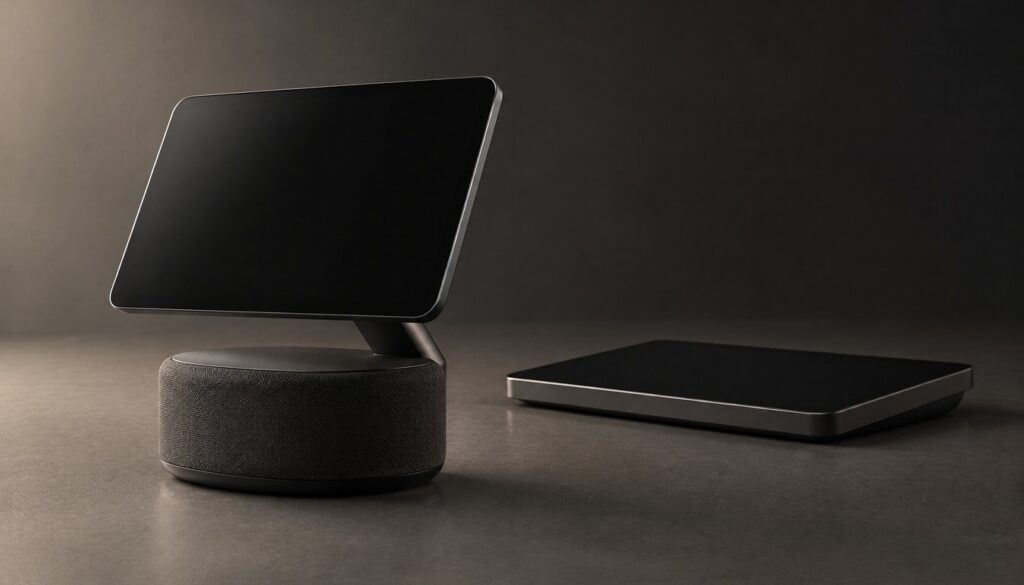
Apple spent more than a decade circling the smart home without ever building a true command center for it. That changed on October 13, 2026, when the company unveiled HomeView, a $299 touchscreen hub built around Siri, alongside a new line of partner accessories it calls the Apple Home Collection. The announcement, confirmed in Apple’s own newsroom post, closes a gap that Amazon’s Echo line and Google’s Nest Hub devices have owned almost by default since 2017.
HomeView is not a phone, a tablet, or a speaker with a screen bolted on. It is a dedicated household control panel, sold in a tabletop version with a speaker base and a wall-mounted version that doubles as a fixed display near a front door or kitchen. Both ship at the same $299 price in the United States, with preorders that opened October 13 and general availability set for November 13, according to Bloomberg’s coverage of the launch event. Apple also listed Australia, Canada, India, New Zealand, and the United Kingdom among the markets where preorders are live.
What Apple HomeView Actually Is
Strip away the marketing and HomeView is a 7-inch square Liquid Retina touchscreen running at 1088-by-1088 resolution, powered by Apple’s A18 chip. That is the same processor family found in recent iPhone hardware, and Apple is using it to run Siri’s on-device voice processing locally rather than bouncing every command through a data center. The device comes in silver, starlight, rose pink, and space gray, and buyers can choose between the tabletop model, which includes a speaker base and an adjustable display arm, or a flatter wall-mounted version meant for permanent installation near a light switch or doorway.
Functionally, HomeView controls compatible smart-home devices: lights, locks, thermostats, and cameras chief among them. It also handles FaceTime calls, plays music and video, and displays photos when idle, putting it squarely in the same category Amazon and Google have occupied for years with the Echo Show and Nest Hub Max. CNBC framed the launch as Apple using a physical product to showcase what Siri’s newer AI capabilities can actually do in a home setting, rather than leaving Siri’s progress to be judged purely through the iPhone.
The Apple Home Collection: LG and Schneider Electric Join the Push
Apple did not launch HomeView in isolation. It paired the hub with a new hardware program called the Apple Home Collection, built in partnership with LG Electronics Inc and Schneider Electric SE. The lineup covers the categories any smart-home shopper would expect: indoor and outdoor cameras, a wired video doorbell, a floodlight camera, smart thermostats, and a smart door lock. It is Apple’s clearest signal yet that it wants to own the control layer of the smart home even when it does not manufacture the sensors and locks themselves.
That is a notable departure from how Apple has typically handled HomeKit-compatible hardware, which for years meant a loose certification badge slapped on products from dozens of third parties with varying build quality and app experiences. By picking two named manufacturing partners and pricing their accessories itself, Apple is behaving more like it does with MFi-certified cables or Beats headphones: tight control over the retail experience, even if the hardware comes from outside suppliers.
Apple Home Collection Pricing
| Accessory | Manufacturer | U.S. Price |
|---|---|---|
| Indoor Camera (Plug-In) | LG Electronics | $199.95 |
| Smart Thermostat | LG / Schneider Electric | $199.95 |
| Video Doorbell (Wired) | LG Electronics | $249.95 |
| Outdoor Camera (Plug-In) | LG Electronics | $299.95 |
| Smart Door Lock | LG Electronics | $349.95 |
| Floodlight Cam | LG Electronics | $399.95 |
Add a HomeView hub, a doorbell, a lock, and one camera, and a household is already past $1,000 before touching a single light bulb. That pricing puts Apple’s smart home entry well above Amazon’s budget-first Echo and Ring catalog, and it tells you who Apple thinks is buying: existing iPhone owners willing to pay a premium for tighter integration, not first-time smart-home shoppers comparing sticker prices on a shelf.
Release Timeline and Where You Can Buy It
The rollout follows a pattern Apple has used before: announce, open preorders immediately, then let a few weeks pass before shipping. Preorders for HomeView opened October 13, the same day as the announcement, and Apple set November 13 as the date units start arriving at customers’ doors. That one-month gap gives Apple time to build inventory and gives third-party retailers a window to set up in-store displays before the holiday shopping season kicks into gear.
The U.S. is the headline market, but Apple is not treating HomeView as an American-only product. Australia, Canada, India, New Zealand, and the United Kingdom all appear on Apple’s own list of countries where preorders are open, which is a wider initial footprint than some past Apple hardware launches that trickled out market by market over several months. The Verge’s roundup of the “Welcome Home” event noted that HomeView shared the stage with a refreshed Apple TV and HomePod mini, suggesting Apple is treating this as a coordinated home-ecosystem refresh rather than a single standalone product drop.
How HomeView Stacks Up Against Echo Hub, Echo Show, and Nest Hub Max
Apple is late to this category by almost a decade. Amazon shipped the first Echo Show in 2017 and has since built out a full tier of smart displays, from the dedicated wall-control Echo Hub down to large-screen Echo Show models meant for kitchen counters. Google took a similar path with the Nest Hub and Nest Hub Max, leaning on Google Assistant, YouTube, and Google Photos integration to make its displays double as entertainment devices. Both companies built their hubs around open ecosystems that welcome a long tail of third-party skills, routines, and compatible hardware.
| Spec / Attribute | Detail |
|---|---|
| Display | 7-inch Liquid Retina touchscreen, 1088 x 1088 resolution |
| Processor | Apple A18 chip |
| Form factors | Tabletop (speaker base, adjustable arm) and wall-mounted |
| Colors | Silver, starlight, rose pink, space gray |
| U.S. price | $299 for both configurations |
| Preorders opened | October 13, 2026 |
| Ships | November 13, 2026 |
| Confirmed launch markets | United States, Australia, Canada, India, New Zealand, United Kingdom |
What sets HomeView apart on paper is the hardware underneath it. An A18 chip is considerably more capable than the processors Amazon and Google typically put in sub-$300 smart displays, which usually prioritize a cheap bill of materials over raw compute. Apple’s bet is that running Siri’s voice models locally, instead of leaning entirely on cloud round-trips, makes commands feel faster and keeps more voice data from leaving the house. Whether that translates into a meaningfully better experience for the average household, rather than a bullet point for reviewers, is the open question reviewers will spend the next month answering.
Siri’s New Job: On-Device Voice Control for the Whole House
Siri has spent the last two years as Apple’s most criticized software product, lagging behind Gemini and ChatGPT in head-to-head comparisons and missing self-imposed deadlines for a more conversational rebuild. HomeView gives Apple a second stage to prove Siri has improved, separate from the iPhone where expectations are shaped by comparisons with other chatbots. We covered how Apple’s underlying Siri assistant relates to Google’s models in our explainer on whether Siri uses Google Gemini, and HomeView is effectively a new, physical test bed for that same assistant.
Putting Siri on a dedicated screen also changes the interaction model. Instead of pulling out a phone to dim the lights or check who is at the door, HomeView is designed to sit on a counter or wall and respond to voice commands issued from across a room. That is the same pitch Amazon and Google have made with their own displays for years, and it only works if far-field voice recognition is reliable enough that people trust it during a dinner party or with a crying toddler in the background. Apple has not published independent third-party accuracy figures for HomeView’s far-field listening, so that claim remains something reviewers will need to test directly rather than something to take at face value.
The Missing App Store: Trade-off or Missed Opportunity
One detail reported ahead of launch stands out as a genuine strategic choice rather than a spec: HomeView reportedly ships without a third-party app store. Apple’s own apps, clock faces, and widgets are present, but outside developers do not get a storefront to build and sell software for the device, according to pre-launch reporting from outlets tracking the device closely in the days before the event. That is a sharp contrast with Amazon’s Echo Show and Google’s Nest Hub Max, both of which support a wider catalog of skills, routines, and third-party integrations built up over years.
There is a coherent argument for the decision. An appliance that only runs Apple-blessed software is simpler to secure, easier to support, and less likely to turn into a platform cluttered with low-quality third-party widgets, the fate that befell plenty of early smart TV app stores. The downside is that Apple is voluntarily giving up the long-tail extensibility that made Alexa and Google Assistant sticky for power users who wanted a hub tied into niche routines, custom dashboards, or hobbyist home automation setups built on platforms like Home Assistant. Apple appears to be betting that most buyers care more about a clean, reliable experience than about an open platform, a bet that mirrors the control-first approach Apple has taken with the iPhone itself.
Historical Context: From HomePod to HomeKit to HomeView
Apple’s smart home ambitions did not start this week. HomeKit launched back in 2014 as a certification framework for third-party accessories, giving Apple a software layer without forcing it to build hardware. The original HomePod arrived in 2018 as a Siri-powered speaker that could also serve as a home hub for remote access and automations, but it never shipped with a screen, and Apple discontinued the full-size model in 2021 before eventually reviving it. The HomePod mini filled the gap at a lower price point, but Apple spent years without a first-party device that could show a camera feed, display a recipe, or run a video call from the kitchen counter.
Bloomberg’s Mark Gurman, who has tracked Apple’s smart home plans for years through his reporting, described the HomeView launch as an attempt to plug a gap that had become increasingly obvious as rivals pulled ahead. That framing lines up with a broader pattern at Apple: wait until the underlying technology, in this case an efficient enough chip and a mature enough Siri, is ready, then ship a more complete product rather than iterating in public. It is the same approach Apple took with the Apple Watch, waiting years after competitors shipped early smartwatches, and with the iPad, which arrived well after other companies had tried and failed with tablet computers. Readers who want the fuller arc of Apple’s recent chip strategy, including why Apple leaned on the A18 for a non-phone device, can find more detail in our coverage of Apple’s approach to repurposing its own silicon for AI workloads.
Market Impact: What This Means for Amazon, Google, and Accessory Makers
The most immediate pressure from HomeView lands on Amazon and Google, both of which have treated smart displays as a loss-leader category meant to pull customers deeper into their respective ecosystems. Apple does not need to subsidize hardware the way Amazon has subsidized Echo devices for years, since Apple’s business model never depended on selling a smart speaker below cost to capture a customer. A $299 price point that holds steady, rather than discounting aggressively during sales events, signals Apple expects HomeView to be profitable on its own rather than a funnel into subscription revenue.
LG Electronics and Schneider Electric also stand to gain simply from being named Apple’s launch partners. Being chosen as one of the few manufacturers behind the Apple Home Collection gives both companies a retail and marketing boost that smaller HomeKit accessory makers, who have competed for years in a crowded and commoditized category, will not get. It also raises the bar for competing accessory brands like Ring, Nest, and Ecobee, which now have to make the case for why a shopper should buy their hardware over Apple’s own branded lineup. The competitive pressure extends to the broader AI assistant race as well. Google has been pushing its own agent products into more corners of the home and the browser, a trend we detailed in our report on Google’s Gemini Agent launch across linked apps.
There is also a quieter chip-industry angle. Putting an A18 chip into a $299 home device, rather than reserving that silicon exclusively for phones, hints at how aggressively Apple now treats on-device AI compute as a baseline requirement across its whole hardware lineup, not a premium feature reserved for flagship products. That mirrors a broader industry shift toward running more AI inference locally on dedicated silicon rather than routing everything to a data center, a direction chipmakers like Qualcomm have also been vocal about pursuing in phones, as covered in our piece on Qualcomm’s plans for on-device AI models.
Security and Privacy Stakes of a New Home Hub
Every camera, lock, and thermostat added to a home network widens the attack surface, and HomeView’s entire pitch is convincing households to add several of those devices at once through the Apple Home Collection. Smart home hardware has a rough recent track record on this front. Samsung had to push an emergency fix after a software update bricked a wave of its Bespoke AI refrigerators, an incident we covered in detail in our report on Samsung’s bricked SmartThings fridge update, and a cyberattack on connected refrigeration units at French supermarkets left dozens of stores dealing with spoiled stock, as we reported in our story on the cold-chain insurance fallout from the French fridge hack. Neither incident involved Apple hardware, but both illustrate what happens when internet-connected appliances fail or get compromised at scale.
Apple’s pitch has always leaned on privacy as a differentiator, and running Siri processing on-device via the A18 chip supports that positioning, since less voice data needs to travel to a server to be useful. Still, a camera-equipped doorbell and an indoor camera plugged into the same account as a touchscreen hub create a meaningfully larger blast radius if an account is ever compromised, regardless of how private any single component is designed to be. Locking down that account with strong authentication is not optional once a household’s door locks and camera feeds live behind it, and buyers should treat HomeView setup with the same account-security discipline they would apply to any other connected home system.
What Analysts and Reporters Are Saying
Coverage of the launch has been largely descriptive rather than openly skeptical, which is notable given how many product categories draw immediate pushback from reviewers. AFP’s report on the unveiling framed HomeView as part of a renewed push into the home, language that echoes how Apple has talked about the category internally for years without shipping a product to match. Yahoo Finance’s coverage, drawing on AFP reporting, described HomeView as functioning like an iPad built specifically for managing a house, a comparison that captures how Apple is positioning the device against general-purpose tablets rather than purely against Echo and Nest hardware.
Six Colors, a publication closely followed inside Apple’s own developer community, covered the announcement as a long-awaited entry rather than a surprise, consistent with years of reporting that Apple had a smart display in development. TechCrunch’s framing focused on Apple making another push into the smart home market, a phrase that implicitly acknowledges Apple’s past attempts at this category were incomplete. None of the coverage reviewed so far includes an on-record analyst estimate of how many units Apple expects to sell or what HomeView could mean for Apple’s services revenue, so any specific sales projection circulating online should be treated as speculation until Apple reports actual results.
Five Predictions for Where This Goes Next
- Expect Apple to expand the Apple Home Collection with additional partners beyond LG and Schneider Electric within the next year, following the same playbook it used to grow MFi accessory certification.
- Watch for a cheaper, smaller HomeView variant aimed at bedrooms and secondary rooms, mirroring how Apple eventually added the HomePod mini below the original HomePod.
- The lack of a third-party app store is likely to draw sustained criticism from home-automation enthusiasts, but Apple will probably hold the line through at least one more product generation before reconsidering.
- Amazon and Google will face pressure to cut prices or add new on-device AI features to their own displays heading into the 2026 holiday shopping season, rather than ceding the premium end of the category to Apple without a response.
- Expect security researchers to scrutinize HomeView and the Apple Home Collection accessories closely in the coming months, given how much attention connected cameras and locks draw once they reach meaningful sales volume.
Related
- Does Siri Use Gemini? Apple’s 3rd-Gen AFM, Explained
- Samsung Fridges Bricked by Update, 48-Hour Fix Vowed
- French Fridge Hack Exposes Cold-Chain Blind Spot for AU Insurers
- Google’s Gemini Agent Launches With 3 Linked Apps
- Qualcomm CEO: Phones May Run 100B AI Models by 2028
Frequently Asked Questions
How much does Apple HomeView cost?
Apple priced HomeView at $299 in the United States for both the tabletop and wall-mounted configurations, so the form factor you pick does not change the cost.
When can I buy Apple HomeView?
Preorders opened October 13, 2026, the same day Apple announced the device. General availability begins November 13, 2026.
What chip does Apple HomeView use?
HomeView runs on Apple’s A18 chip, the same processor family used in recent iPhone models, which handles on-device Siri processing.
Does Apple HomeView have an app store?
Reporting ahead of the launch indicated HomeView ships without a third-party app store, relying instead on Apple’s own built-in apps, clock faces, and widgets.
What is the Apple Home Collection?
It is a new accessory lineup Apple announced alongside HomeView, built with LG Electronics and Schneider Electric, covering indoor and outdoor cameras, a video doorbell, a floodlight camera, smart thermostats, and a smart door lock, priced between $199.95 and $399.95.
Which countries can preorder Apple HomeView?
Apple listed the United States, Australia, Canada, India, New Zealand, and the United Kingdom as confirmed preorder markets at launch.
How is HomeView different from an Amazon Echo Show or Google Nest Hub Max?
HomeView uses a more powerful A18 chip for on-device Siri processing and ties into Apple’s own ecosystem and new branded accessory line, but it reportedly skips the third-party app store and skill catalog that Echo Show and Nest Hub Max have built up over years.
Does HomeView replace the HomePod?
No. Apple launched HomeView alongside a refreshed HomePod mini and a new Apple TV 4K, positioning the three devices as complementary parts of a broader home refresh rather than replacements for one another.