
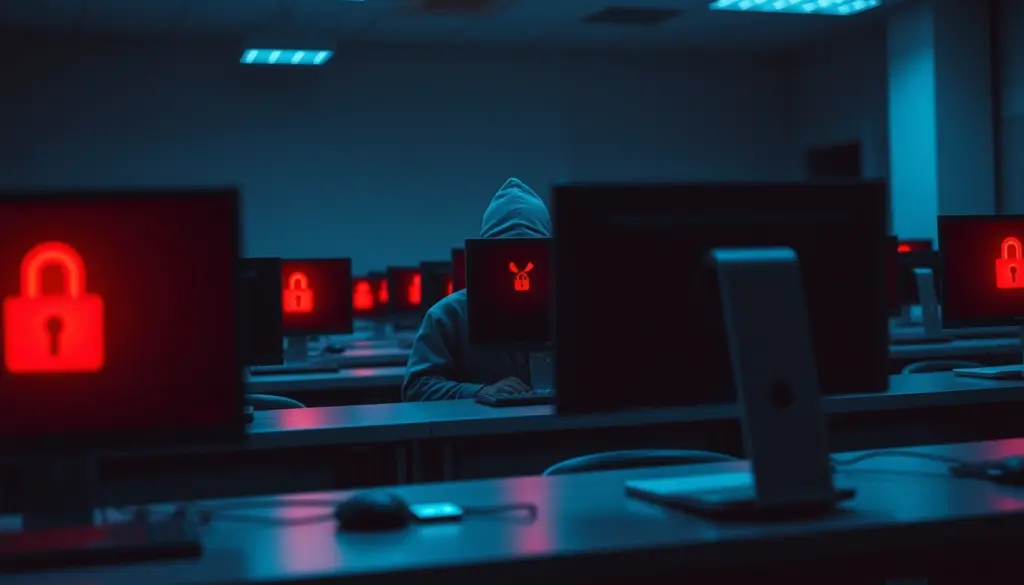
The largest education technology breach on record did not start with a kicked-in door. It started with a login. In late April 2026, the extortion crew known as ShinyHunters slipped into the production systems behind Canvas, the learning platform run by Instructure, and walked out with what the group claims is 3.65 terabytes of data tied to roughly 275 million users across nearly 9,000 institutions. By the time most students noticed, their course pages had been redirected to a ransom note.
The Canvas data breach is now the defining cybersecurity story of mid-2026, and not only because of its size. It hit a single vendor that sits underneath a huge slice of American higher education, exposed student records during finals season, and ended with a quiet ransom settlement reached one day before a public leak deadline. This analysis breaks down what happened, who is behind it, what it means for the education technology market, and what comes next.

Don't miss new tech stories on Google
Add Shattered once in the Google app and our stories show up in your news suggestions.
Canvas Data Breach: What Happened and Why It Matters
Canvas is the learning management system (LMS) that students use to submit assignments, message instructors, check grades, and read course materials. Instructure, its parent company, says its platforms reach roughly 200 million learners across more than 100 countries. In North American higher education, Canvas is the market leader, used by an estimated 41% of institutions. That concentration is exactly what made one intrusion so damaging.
According to Instructure’s own incident disclosures, attackers first gained unauthorized access to Canvas systems on April 25, 2026. The company says it detected the intruder and revoked access on April 29, then addressed an underlying vulnerability on April 30. On May 1, Instructure went public with a cybersecurity incident notice and said it was working with third-party forensics experts and law enforcement. The story would have ended there if the attackers had stayed out.
They did not. On May 7, 2026, the same threat actor returned through a second Canvas vulnerability and defaced course pages at major universities, including Harvard, the University of Pennsylvania, Duke, and Wisconsin. Visitors hit a ransom message instead of their coursework. Four days earlier, on May 3, ShinyHunters had already listed Instructure on its dark web leak site, claiming theft of 275 million records and 3.65 TB of data across 8,809 schools, universities, and education platforms. The breach went from contained incident to full extortion campaign in under two weeks.
The Breach by the Numbers
Raw scale is what separates this incident from the steady drip of education breaches. The figures below come from Instructure’s disclosures, ShinyHunters’ own leak-site claims, and the analysts who tracked the event. Where a number is the attacker’s claim rather than a confirmed count, treat it as a ceiling, not a verified total.
| Metric | Figure | Source |
|---|---|---|
| Records claimed stolen | ~275 million | ShinyHunters leak site |
| Data volume claimed | 3.65 TB | ShinyHunters leak site |
| Institutions potentially affected | ~8,809 to 9,000 | Leak-site claim / legal advisories |
| Canvas share of North American higher ed | 41% | Industry analysts |
| Learners on Instructure platforms | ~200 million | Instructure |
| Days from first access to public disclosure | 6 (Apr 25 to May 1) | Instructure timeline |
| Ransom deadline | May 12, 2026 | ShinyHunters |
Instructure says the exposed data categories were names, email addresses, student ID numbers, messages exchanged among users, and course enrollment records. The company states it found no evidence that passwords, dates of birth, government identification numbers, or financial data were involved. That distinction matters for the kind of follow-on fraud students face, a point we return to below.
A Day-by-Day Timeline of the Canvas Attack
The sequence reveals how a breach that the company believed it had closed reopened within days. The dates below are drawn from Instructure’s incident update, legal advisories from firms tracking the case, and public reporting.
| Date (2026) | Event |
|---|---|
| Apr 25 | Attackers first access Canvas production systems |
| Apr 29 | Instructure detects the intruder and revokes access |
| Apr 30 | Company addresses the underlying vulnerability |
| May 1 | Instructure publicly discloses the incident |
| May 2 | Company states the incident is “contained” |
| May 3 | ShinyHunters lists Instructure on its leak site |
| May 7 | Attacker re-enters via a second vulnerability, defaces university pages |
| May 11 | Instructure reportedly reaches an agreement with the attackers |
| May 12 | Attackers’ public leak deadline |
| May 13 | Proposed class action filed in the Southern District of California |
| May 29 | U.S. Department of Education’s Federal Student Aid office updates its security alert |
The gap between “contained” on May 2 and the second intrusion on May 7 is the part security teams keep returning to. Declaring an incident closed before the root cause is fully understood gave the attackers a public opening to prove they still had access. The public timeline of the case notes that Instructure’s status page still showed no active incident during the May 7 to May 8 window while the compromise was ongoing.
How ShinyHunters Got In
The most honest answer is that the full technical root cause is still not public. The strongest documented evidence points to direct exploitation of vulnerabilities in Instructure’s production systems rather than a stolen third-party cloud credential. The law firm Reed Smith, which published a developments tracker for higher education clients, reports that the April intrusion exploited a vulnerability in Instructure’s production environment. Instructure’s own incident update says the May 7 access came through a separate, second Canvas vulnerability.
That detail reframes the breach. This was not one mistake. It was two distinct software flaws exploited by the same group inside a two-week window, which suggests the attackers had mapped the platform well enough to keep a backup path ready. ShinyHunters has historically favored stolen credentials and SaaS access tokens, so analysts initially looked for an OAuth or third-party angle. The available record does not support that theory here. It supports a more uncomfortable one: the platform itself had exploitable holes.
PKWARE, summarizing May 2026’s breach landscape, captured the broader pattern in a single line: attackers “did not break in; they logged in.” For Canvas, the entry method differed, but the lesson rhymes. A platform trusted by thousands of schools became a single, high-value target, and a software defect was enough to expose all of them at once. The same logic drives most modern data breaches, where one weak point in a shared system cascades across every customer.
Who Is ShinyHunters?
ShinyHunters is one of the most prolific data-extortion groups of the decade. The crew built its reputation on the 2024 Snowflake campaign, in which stolen credentials were used against customers of the cloud data platform. That campaign is widely reported to have affected at least 165 companies, with publicly named victims including AT&T, Ticketmaster, and Santander. Collective exposure across those victims reached into the hundreds of millions of records.
The group’s model is consistent: gain access, exfiltrate large volumes of data, then extort the victim with a public leak-site listing and a countdown. It rarely encrypts systems in the classic ransomware sense. Instead it weaponizes the threat of publication. The Canvas page defacements were a variation on that theme, turning the victim’s own users into an audience for the ransom demand.
| Campaign | Year | Scale / Notable Victims |
|---|---|---|
| Snowflake customer campaign | 2024 | 165+ companies; AT&T, Ticketmaster, Santander |
| University of Pennsylvania (Canvas-linked access) | 2025 | Earlier Instructure-related compromise |
| Instructure / Canvas | 2026 | ~275M records claimed, ~9,000 institutions |
Cloudskope, which tracked the Canvas timeline, describes the May 2026 event as the third Instructure-related compromise in eight months, following an earlier September 2025 incident involving University of Pennsylvania data through a Canvas access path. A repeat target is a pattern, not bad luck. It tells defenders that the attacker learned the environment once and kept coming back.
The Ransom Settlement: What Instructure Paid For
On May 11, 2026, one day before the leak deadline, Reed Smith reports that Instructure reached an agreement with the attackers. Under that arrangement, the hackers reportedly returned the compromised data and supplied “shred logs” as claimed confirmation that their copies were destroyed. Instructure has not publicly detailed a dollar figure.
Security professionals are near-unanimous that “shred logs” are worthless as proof. A criminal group that has already copied 3.65 TB of data can generate a deletion log in seconds and keep the files. Paying buys a delay and a promise, not certainty. The FBI’s standing guidance discourages ransom payments precisely because they fund the next campaign and rarely guarantee data is gone. Instructure’s calculation, like that of most victims, was likely about reputational triage during finals week rather than genuine confidence in deletion.
The settlement also complicates the legal picture. A vendor that pays to suppress a leak still has to notify affected institutions and regulators, and the payment does not extinguish liability. The proposed class action filed May 13 in the Southern District of California signals that students and institutions will test that liability in court regardless of any deal struck with the attackers.
What the Experts Are Saying
Instructure’s chief information security officer, Steve Proud, was the executive who communicated the incident to customers and, by May 2, described it as “contained.” That word aged poorly when the attackers returned five days later, and it has become the focal point of criticism that the company moved to reassure customers before it understood the full scope.
“The unauthorized actor made changes to the pages” of Canvas after gaining additional access through a second vulnerability on May 7.
Instructure Security Incident Update
Check Point Research, in its June 8, 2026 threat intelligence report, flagged the Instructure exposure estimate and placed it alongside other ShinyHunters activity, underscoring that the group remained active against major data custodians through the spring. The law firm Reed Smith told higher-education clients that the central lesson is vendor concentration risk: when one LMS underpins thousands of institutions, a single vendor’s vulnerability becomes every customer’s breach.
Education-sector security analysts have made the structural point repeatedly through 2025 and 2026: EdTech vendors are high-value targets because one compromise can expose many districts or campuses at once, and schools often run on limited security budgets while depending on third-party platforms they cannot audit deeply. The Canvas breach is the clearest proof of that thesis to date. Instructure CEO Steve Daly now faces scrutiny tied to a U.S. House Homeland Security Committee interest in the incident, signaling that the political consequences may outlast the technical cleanup.
Market Impact: A $4.8 Billion Bet Under Pressure
Instructure is not a struggling startup. In July 2024, the private equity firm KKR, with participation from Dragoneer Investment Group, agreed to take the company private in an all-cash deal valued at $4.8 billion, paying $23.60 per share, a 16% premium over the unaffected price of $20.27. The deal closed on November 13, 2024. KKR bought a market leader with deep institutional lock-in. The Canvas breach is the first serious test of that thesis under private ownership.
For a private-equity-owned vendor, the financial risk is less about a stock price and more about contract renewals and procurement trust. Higher education buys software on multi-year cycles, and security incidents surface at renewal. SentinelOne’s 2026 outlook notes that vendor-risk management is turning aggressive, with new contracts allowing immediate audits and financial penalties when vendors fail to provide security information. Canvas customers now have a live reason to invoke those clauses.
The competitive opening is real. Canvas’s main LMS rivals, including D2L Brightspace, Anthology Blackboard, and Moodle, will use this incident in every sales conversation through the 2026 to 2027 buying season. Switching an LMS is painful and slow, which protects Instructure in the short term, but breaches reset the trust that high switching costs normally lock in. The danger for Instructure is not mass defection. It is a slow erosion at the margins, where new institutions and renewing customers quietly weigh alternatives they would not have considered a year ago.
FERPA, Class Actions, and the Regulatory Fallout
Student data carries specific legal weight in the United States. The Family Educational Rights and Privacy Act (FERPA) governs the privacy of education records, and the exposure of names, student ID numbers, and messages can trigger institutional notification obligations and regulatory scrutiny. Because FERPA obligations sit with the schools rather than the vendor, every one of the ~9,000 affected institutions inherited a compliance problem it did not cause.
The U.S. Department of Education’s Federal Student Aid office issued and then updated a technology security alert on the incident, with the latest revision dated May 29, 2026. That federal attention raises the stakes beyond civil litigation. State student-privacy laws and, for younger students, the Children’s Online Privacy Protection Act (COPPA) add further layers of potential exposure.
The proposed class action filed May 13 in the Southern District of California is almost certainly the first of several. Breach litigation of this scale tends to consolidate into multidistrict proceedings, and the central legal question will be whether Instructure’s security controls met a reasonable standard for a custodian of student data. The “contained” statement followed by a second intrusion will feature heavily in that argument.
How This Compares to Other 2026 Education Breaches
Education has become a primary hunting ground for extortion crews. The PowerSchool incident disclosed in early 2025 hit a K-12 student information system used across thousands of districts and exposed sensitive records on millions of students and educators, then spawned extensive litigation and follow-on extortion of individual districts. The pattern is identical to Canvas: one vendor, many customers, catastrophic blast radius.
What sets the Canvas breach apart is the combination of claimed scale and operational disruption. PowerSchool’s data was quietly exfiltrated. ShinyHunters defaced live course pages at marquee universities during finals, turning a data theft into a public spectacle. That theatricality is strategic. It maximizes pressure on the vendor and guarantees media coverage, which is the entire point of an extortion model built on reputation rather than encryption.
The through-line across both incidents, and across the broader 2026 threat landscape, is third-party concentration. IBM’s X-Force reports that major supply-chain and third-party breaches have quadrupled over the past five years. When schools standardize on a handful of platforms, they trade operational efficiency for shared risk. One vendor’s bad week becomes a sector-wide emergency, a dynamic also visible in incidents like the Jaguar Land Rover cyber attack.
What Students and Institutions Should Do Now
Because Instructure says no passwords or financial data were exposed, the immediate risk is targeted phishing rather than direct account takeover. Attackers holding names, email addresses, student IDs, and private messages can craft convincing lures that reference real courses and real conversations. That is the most dangerous use of this data set, and it makes basic phishing awareness the first line of defense.
For Students and Faculty
- Treat any email referencing your courses, grades, or Canvas messages as suspect, and verify through official channels before clicking.
- Enable multi-factor authentication on your school account and any account that reuses your school email.
- Change your Canvas password as a precaution even though Instructure says passwords were not exposed.
- Watch for impersonation attempts that cite details only someone with course data would know.
For Institutions
- Review your data-processing agreement with Instructure and document FERPA notification obligations.
- Invoke audit and security-information clauses where your contracts allow it.
- Map which downstream systems trust Canvas single sign-on and review those access paths.
- Prepare student and parent communications proactively rather than reactively.
Five Predictions for the Aftermath
The Canvas breach will shape EdTech security decisions for years. Based on the documented facts and the trajectory of similar incidents, here is where this is likely to head.
- Litigation consolidates and drags. The May 13 class action will be joined by others and likely merge into a multidistrict case that runs well past 2027.
- Procurement tightens. Higher-education RFPs through the 2026 to 2027 cycle will demand stricter breach-notification windows, audit rights, and security attestations, raising the bar for every LMS vendor.
- The data resurfaces. Despite “shred logs,” portions of the stolen data will likely appear in criminal markets within 12 to 18 months, as has happened with prior ShinyHunters victims.
- Regulatory pressure escalates. Federal interest, including the House Homeland Security Committee’s attention, will produce hearings or formal inquiries into EdTech vendor security standards.
- Competitors gain at the margins. Canvas will not collapse, but rival LMS platforms will win a measurable share of new and renewing institutions citing this breach directly.
The Bigger Lesson: Concentration Is the Vulnerability
The Canvas breach is not really a story about one company’s two software bugs. It is a story about what happens when an entire sector funnels its most sensitive data through a handful of platforms. Efficiency and standardization created a single point of failure, and a well-resourced extortion group found it. The same dynamic drove the Snowflake campaign, the PowerSchool breach, and most of the worst incidents of the past two years.
For defenders, the takeaway is uncomfortable because the fix is structural, not technical. You can patch a vulnerability. You cannot easily un-concentrate a market that has spent a decade consolidating onto a few vendors. Until education institutions price third-party concentration as the risk it is, the next Canvas is a matter of when, not if. The 275 million figure is shocking today. The real warning is that the architecture which produced it is still standing. Strong account security habits help individuals, but the systemic problem sits with the vendors and the buyers who concentrate trust in them.
Frequently Asked Questions
What is the Canvas data breach?
It is a 2026 cyberattack on Instructure, the company behind the Canvas learning management system. The extortion group ShinyHunters exploited vulnerabilities in Canvas systems beginning April 25, 2026, and claimed theft of about 275 million records and 3.65 TB of data tied to nearly 9,000 institutions.
What data was stolen in the Canvas breach?
Instructure says the exposed categories were names, email addresses, student ID numbers, messages exchanged among users, and course enrollment records. The company states it found no evidence that passwords, dates of birth, government IDs, or financial information were involved.
Did Instructure pay a ransom?
Reports indicate Instructure reached an agreement with the attackers on May 11, 2026, one day before the leak deadline. The hackers reportedly returned the data and provided “shred logs” as claimed proof of deletion. Instructure has not disclosed a dollar figure, and security experts widely consider such deletion proof unreliable.
Who are ShinyHunters?
ShinyHunters is a prolific data-extortion group known for the 2024 Snowflake customer campaign that affected at least 165 companies, including AT&T, Ticketmaster, and Santander. The group steals large data sets and extorts victims through public leak-site listings rather than encrypting systems.
Is my Canvas account safe now?
Instructure says it closed the exploited vulnerabilities. Because passwords were reportedly not exposed, the main risk is targeted phishing that references your real courses and messages. Enable multi-factor authentication, change your password as a precaution, and treat unexpected Canvas-related emails with suspicion.
How does this compare to the PowerSchool breach?
Both breaches followed the same pattern: a single EdTech vendor used by thousands of institutions was compromised, exposing millions of student records. The Canvas incident stands out for its claimed scale and for the public defacement of university course pages, which turned a data theft into a high-profile extortion spectacle.
What should institutions do about FERPA obligations?
FERPA obligations fall on schools, not on Instructure. Affected institutions should document the exposure, review their data-processing agreements, follow the Department of Education’s Federal Student Aid guidance updated May 29, 2026, and prepare notifications to affected students in line with FERPA and applicable state privacy laws.