Colorful has confirmed a 16-inch laptop built around AMD’s Ryzen AI Max+ 395 chip, and the spec sheet is the kind that makes PC builders do a double take: up to 128GB of unified LPDDR5X memory, a Radeon 8060S integrated GPU, and a price tag that climbs past $5,900 at the top end. The machine, sold under Colorful’s Colorfire brand as the Lingchuang K16, has been covered by Notebookcheck, TechPowerUp and other outlets tracking AMD’s “Strix Halo” platform, and it lands at a moment when local AI inference on a laptop is turning into a real purchasing decision, not a niche one.
The pitch is simple even if the hardware isn’t: pack enough memory into a single chip package that a laptop can hold a large language model entirely in memory, skip the cloud bill, and still play games on the side. Colorful isn’t the first vendor to build around AMD’s Ryzen AI Max+ 395, but the K16 pushes the configuration further than most, and its pricing shows what that costs.
What Colorful Actually Announced
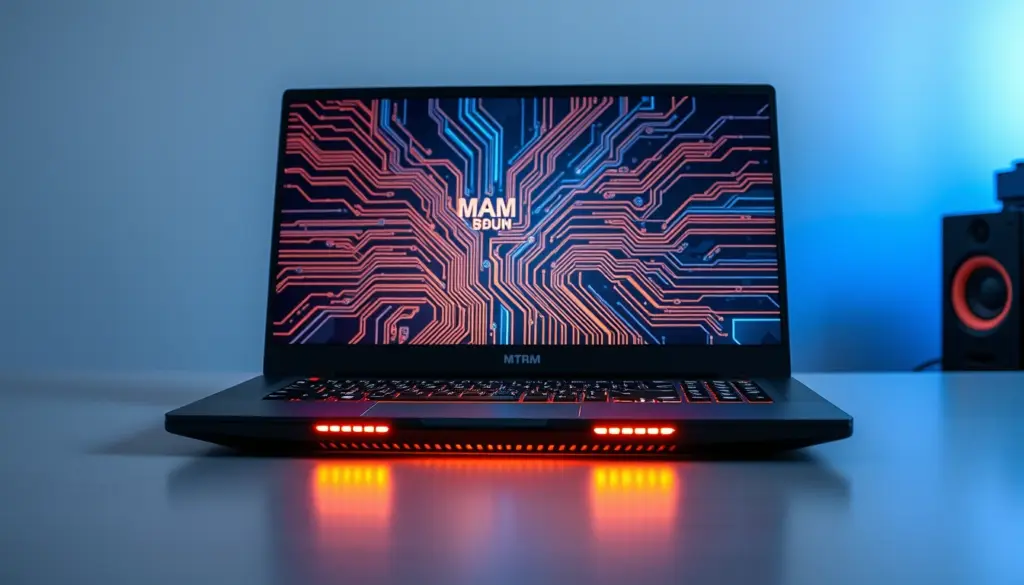
The Lingchuang K16 is a 16-inch, all-metal laptop that Colorful is marketing as a creator and AI workstation rather than a pure gaming rig, even though the hardware underneath overlaps heavily with what a gaming laptop needs. It has already reached retail listings in China through JD.com, and regional retailers in Russia and elsewhere have carried variants with slightly different configurations, according to reporting picked up by Notebookcheck and TechPowerUp.
What makes it notable is the combination of a laptop chassis, a full desktop-class Strix Halo APU, and a memory ceiling that most laptops never approach. AMD’s Ryzen AI Max+ 395 is the same silicon that powers several mini PCs built for local AI workloads, but putting it in a 16-inch laptop with a display, battery and cooling system built for sustained gaming is a different engineering problem, and Colorful’s marketing leans into that distinction.
Inside the Ryzen AI Max+ 395: 16 Cores, One Big NPU
The CPU Side: Zen 5 at Full Strength
AMD’s Ryzen AI Max+ 395 is a Zen 5 design with 16 cores and 32 threads, the same core count AMD has shipped across other Strix Halo products since the platform’s debut. Chinese-language coverage of the K16 launch cites boost clocks reaching roughly 5.1GHz and a combined cache pool around 80MB, figures consistent with how AMD has positioned the chip elsewhere on the Strix Halo lineup. The APU also carries an XDNA 2 neural processing unit rated at roughly 50 TOPS, which AMD markets as its answer to on-device Copilot+ style AI features.
The GPU Side: Radeon 8060S and 40 Compute Units
The integrated Radeon 8060S is built on RDNA 3.5 and carries 40 compute units, a substantial iGPU by any measure. Notebookcheck’s testing of Strix Halo systems elsewhere has placed the 8060S in the same performance neighborhood as a laptop RTX 4070, a claim that would have sounded absurd for integrated graphics just two generations ago. The GPU shares the same unified LPDDR5X memory pool as the CPU, which is the entire reason Strix Halo laptops can address so much memory for AI work in the first place: there’s no separate VRAM pool to run out of.
Colorful’s cooling design for the K16 reportedly uses dual fans, three heat pipes and four exhaust vents, and the company is said to allow the package to draw up to 160W total, above the more conservative 55W to 120W range AMD lists as the platform’s default configurable envelope. That’s the kind of number that matters more for sustained gaming and long AI inference runs than for benchmark screenshots, since Strix Halo’s biggest weakness compared to a discrete GPU has always been thermal headroom in slim chassis.
128GB of Memory: What It’s Actually For
The headline spec is memory, not compute. The K16 supports up to 128GB of LPDDR5X-8000, and reporting on the Chinese launch notes that up to 96GB of that pool can be allocated as GPU-addressable memory for AI or gaming workloads. That distinction matters because it’s the difference between a laptop that can technically run a large open-weight model and one that can run it comfortably, with room left for the operating system and whatever else is open.
A 70-billion-parameter model at 4-bit quantization needs somewhere around 40GB of memory just to load; a well-configured 128GB Strix Halo machine can run that with headroom to spare, something no consumer laptop with a discrete GPU and a fixed VRAM allocation of 16GB or 24GB can currently match without offloading to system RAM and taking a speed penalty. That’s the argument AMD and its laptop partners have been making since Strix Halo’s debut, and it’s the reason 128GB configurations of these chips keep showing up despite carrying a real price premium.
Storage, Display and the Rest of the Spec Sheet
Storage reporting on the K16 isn’t fully consistent across outlets, which is common for a laptop still rolling out across regional retailers. Some listings describe a 2TB PCIe 4.0 SSD as the factory default with dual internal M.2 slots for expansion, while other listings for a higher-end configuration cite 4TB out of the box. Display figures show a similar split: TechPowerUp’s coverage describes a 16-inch IPS panel running at up to 180Hz, while a Russian retail listing spotted by other outlets specifies a 2560×1600 panel at 165Hz with roughly 500 nits of brightness and full sRGB coverage. Both descriptions point to the same category of screen, a high-refresh 2.5K IPS panel, but the discrepancy suggests either multiple regional SKUs or specs that hadn’t fully settled at the time of the earliest coverage.
Battery capacity is reported at 99Wh, the practical ceiling most laptop makers stick to for international shipping rules. Connectivity includes Wi-Fi 7 and 2.5GbE wired networking, HDMI 2.1, an OCuLink port for external GPU or high-bandwidth expansion, multiple USB-C ports, a handful of USB-A ports, and a fingerprint reader built into the chassis.
| Component | Colorful Lingchuang K16 spec |
|---|---|
| APU | AMD Ryzen AI Max+ 395 (Zen 5, 16 cores / 32 threads) |
| Integrated GPU | AMD Radeon 8060S, RDNA 3.5, 40 compute units |
| NPU | XDNA 2, roughly 50 TOPS |
| Memory | Up to 128GB unified LPDDR5X-8000 |
| Storage | 2TB to 4TB PCIe 4.0 SSD, dual M.2 slots, varies by listing |
| Display | 16-inch IPS, 2.5K-class resolution, 165-180Hz depending on region |
| Battery | 99Wh |
| Networking | Wi-Fi 7, 2.5GbE Ethernet |
| Ports | USB-C, USB-A, HDMI 2.1, OCuLink, card reader |
| Reported price range | Roughly ¥24,000 to ¥39,999 (about $3,300 to $5,960) |
Pricing: What the K16 Actually Costs
Pricing for the K16 has moved as configurations have expanded. Early coverage of the launch cited a starting price around ¥23,999, roughly $3,300 to $3,500 depending on the exchange rate used and the exact memory tier included at that price. Higher-end configurations climb quickly from there: a JD.com listing cited by TechPowerUp put a high-end configuration at ¥34,999, or roughly $5,200, while a Russian retailer listing a 128GB-plus-4TB top-tier configuration priced it at the equivalent of about $5,960.
That places the K16 firmly at the expensive end of the Strix Halo laptop category, well above where most of AMD’s other design-win partners have priced comparable 128GB configurations. Whether that premium holds once the laptop reaches markets outside China is one of the bigger open questions around this launch, and it’s a question none of the outlets covering the announcement have been able to answer yet, since Colorful hasn’t confirmed international retail plans or pricing.
How the K16 Stacks Up Against Other Strix Halo Machines
Colorful is not the only company building around the Ryzen AI Max+ 395. GMKtec’s EVO-X2 mini PC, HP’s ZBook Ultra G1a mobile workstation, and ASUS’s ROG Flow Z13 tablet all ship with the same or a closely related Strix Halo APU, and each targets a slightly different buyer. Comparing sourced pricing across these devices shows just how wide the range on 128GB Strix Halo hardware has become.
| Device | Form factor | Starting price | 128GB configuration price |
|---|---|---|---|
| Colorful Lingchuang K16 | 16-inch laptop | ~$3,300 | ~$5,200 to $5,960 |
| GMKtec EVO-X2 | Mini PC | $1,999.99 (64GB) | $3,499 to $3,649 |
| HP ZBook Ultra G1a | 14-inch mobile workstation | $2,599 | up to $8,250 (128GB/4TB top config) |
| ASUS ROG Flow Z13 (2025) | 13-inch tablet/laptop hybrid | $2,099.99 | $2,799.99 |
| Framework Desktop | Mini PC (DIY-friendly) | Price not publicly confirmed for 128GB tier | Not confirmed |
The spread is striking. ASUS prices its 128GB Flow Z13 configuration under $2,800, less than half of Colorful’s top K16 configuration, while HP’s ZBook Ultra G1a can climb even higher than the K16 once fully loaded with enterprise-grade storage and support. GMKtec’s mini PC undercuts every laptop on the list, which makes sense given it skips the display, battery, and keyboard entirely. Colorful’s laptop sits in an odd middle position: more expensive than ASUS’s tablet-hybrid approach, but without the enterprise support contract that partly explains HP’s ceiling price.
Laptop vs Mini PC: Two Different Strix Halo Pitches
GMKtec’s EVO-X2 makes the strongest case for Strix Halo as a pure local-AI appliance: no screen to power, no battery to manage, and a price that undercuts every laptop carrying the same chip. Colorful’s K16 makes a different bet, that buyers want the AI and gaming capability without giving up portability, and are willing to pay for it. Both bets depend on the same underlying chip, which says something about how flexible AMD’s Strix Halo platform has turned out to be across form factors that would once have needed completely different silicon.
HP’s approach with the ZBook Ultra G1a leans further into the enterprise workstation market, where support contracts and certification for professional software matter more than raw price. ASUS, by contrast, is chasing a more mainstream creator and gaming audience with the Flow Z13’s tablet form factor, which explains why its 128GB configuration undercuts Colorful’s laptop by such a wide margin.
A Short History of Strix Halo
AMD’s Strix Halo platform, marketed under the Ryzen AI Max branding, emerged as the company’s answer to a specific problem: Apple’s unified memory architecture on M-series chips had become a genuine selling point for AI workloads, and x86 laptops had no equivalent. By combining a high core-count Zen 5 CPU, an RDNA 3.5 iGPU with a large compute unit count, and a memory controller wide enough to feed both from a single LPDDR5X pool, AMD built a chip that could plausibly compete with Apple’s approach on a Windows machine.
Mini PC makers like GMKtec were among the first to ship Strix Halo hardware at scale, since a compact desktop form factor sidesteps the thermal and battery constraints that make laptop integration harder. Laptop and workstation vendors followed once cooling solutions matured, and Colorful’s K16 represents one of the more aggressive laptop implementations of the chip to date, both in terms of sustained power draw and memory configuration.
Why This Matters for the Local AI Market
The Cloud Cost Argument
Running large open-weight models locally instead of through a cloud API has an obvious appeal for developers and researchers who burn through inference costs quickly, or who need to keep sensitive data off third-party servers entirely. A 128GB unified-memory laptop changes that calculation because it removes the VRAM ceiling that has made local inference of larger models impractical on consumer hardware. That’s the core reason chipmakers and system builders keep pushing memory capacity higher on these platforms even as it drives up bill-of-materials cost.
It’s also why Strix Halo pricing looks strange next to a typical gaming laptop. A 128GB memory module costs real money, and system builders like Colorful are passing that cost straight to buyers rather than eating margin, which is part of why the K16’s top configuration lands close to $6,000 while a similarly speced gaming laptop with 32GB of RAM and a discrete RTX 5070 might cost half that.
Market Impact: AMD’s Widening Bet on AI PCs
For AMD, every new Strix Halo design win, whether it’s a mini PC, a tablet, a mobile workstation, or now a gaming-adjacent laptop, expands the surface area of a platform the company is betting on to compete with both Apple’s Mac lineup and Nvidia’s grip on AI-capable GPUs. Colorful is a smaller, China-focused brand compared to HP or ASUS, but its willingness to push a Strix Halo laptop to a near-$6,000 price point signals confidence that a market exists for buyers who want maximum memory in a portable chassis regardless of cost.
That confidence is a bet on a fairly narrow buyer: developers, AI researchers, and content creators who need both memory capacity and portability, and who have already priced out the alternative of a desktop tower with a discrete GPU and more VRAM. It’s a smaller market than mainstream gaming laptops, but it’s one where AMD currently has fewer entrenched competitors than it does in traditional discrete graphics.
What’s Still Unconfirmed
Several details about the K16 remain unsettled across the coverage so far. There’s no confirmed international release date or pricing outside China, no fully reconciled storage configuration between the 2TB and 4TB figures reported by different outlets, and no independent third-party benchmark run yet published for the specific K16 chassis, as opposed to the Ryzen AI Max+ 395 platform generally. Buyers outside China weighing whether to import the laptop should treat exact specs as provisional until Colorful or a regional retailer publishes a finalized configuration sheet.
Predictions: Where Strix Halo Laptops Go From Here
- More laptop vendors will launch 128GB Strix Halo configurations over the next two quarters as AMD pushes the platform beyond mini PCs, following the pattern GMKtec, HP, ASUS and now Colorful have already set.
- Pricing on 128GB configurations will stay elevated through 2026 as memory costs remain tight industry-wide, keeping these machines a premium niche rather than a mainstream gaming laptop category.
- Expect at least one major Western brand to ship a direct competitor to the K16’s laptop-plus-128GB approach, since HP and ASUS have already shown the demand exists at lower price points than Colorful is charging.
- Local LLM inference benchmarks will become a standard review category for these laptops, the same way gaming frame rates and battery life already are, as reviewers build out testing methodology for unified-memory AI workloads.
- Colorful’s international expansion plans, if they materialize, will likely price the K16 above its Chinese retail price once import duties, warranty support, and regional markup are added, similar to how other China-first hardware brands have priced international launches in the past.
Frequently Asked Questions
What chip powers the Colorful Lingchuang K16?
It uses AMD’s Ryzen AI Max+ 395, a Zen 5-based APU with 16 cores and 32 threads, paired with an integrated Radeon 8060S GPU built on RDNA 3.5 with 40 compute units.
How much memory does the K16 support?
Up to 128GB of unified LPDDR5X-8000 memory, shared between the CPU and GPU, with reports indicating up to 96GB can be allocated as GPU-addressable memory for AI or gaming workloads.
How much does the Colorful K16 cost?
Reported pricing ranges from roughly ¥24,000 (about $3,300) at the base configuration to roughly ¥39,999 (about $5,960) for the top-tier 128GB configuration, based on Chinese retail listings and regional reporting from Notebookcheck and TechPowerUp.
Is the K16 available outside China?
As of this reporting, the laptop is confirmed for sale through Chinese retail channels including JD.com, with some regional retailers such as a Russian electronics retailer also carrying listings. No international release date or pricing has been confirmed by Colorful.
How does the Radeon 8060S compare to a discrete GPU?
Notebookcheck’s testing of Strix Halo systems elsewhere has placed the Radeon 8060S in a similar performance range to a laptop RTX 4070 in a number of workloads, though actual results vary by game, driver maturity, and power limits set by the specific laptop maker.
What other laptops use the same AMD chip?
HP’s ZBook Ultra G1a mobile workstation and ASUS’s ROG Flow Z13 both use the Ryzen AI Max+ 395 or closely related variants, while GMKtec’s EVO-X2 uses the same chip in a mini PC form factor rather than a laptop.
Why does 128GB of memory matter for AI on a laptop?
Large open-weight language models need enough memory to load their full parameter set. A 128GB unified-memory system can run significantly larger models locally than a laptop with a discrete GPU limited to 16GB or 24GB of dedicated VRAM, without offloading data to slower system memory.
Is the K16 a gaming laptop or a workstation?
Colorful markets it as a creator and AI workstation, but the underlying hardware, including the Radeon 8060S iGPU and high-refresh display, overlaps closely with what a gaming laptop needs, so it can reasonably serve either purpose.