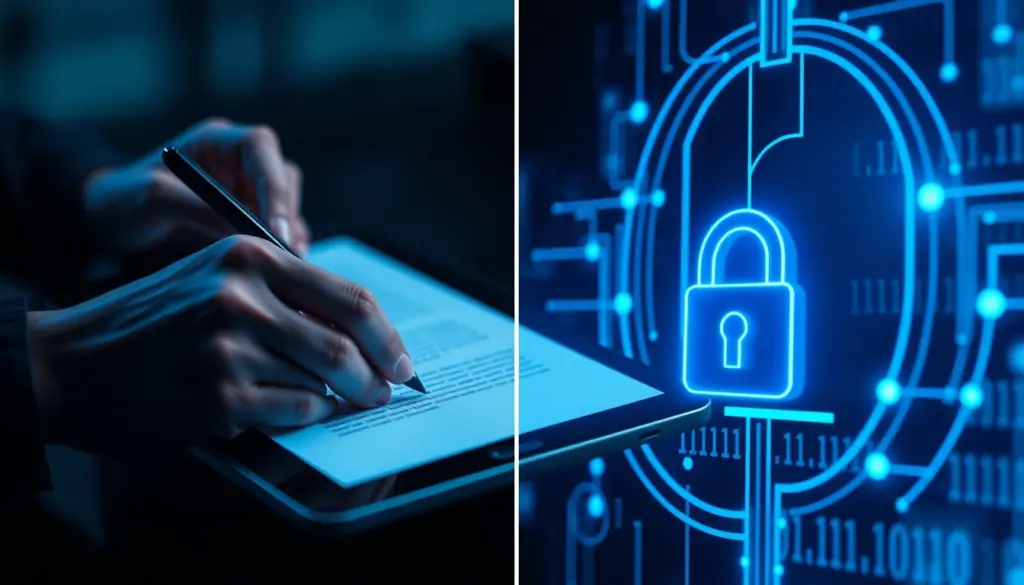
Type your name into a DocuSign box and the platform calls it an electronic signature. Sign a Git commit with an Ed25519 key and cryptographers call that a digital signature. Both terms get thrown around interchangeably in contracts, compliance memos, and marketing copy, but they describe two different things: one is a legal category built on intent and audit trails, the other is a math problem built on public-key cryptography. Mixing them up matters more in August 2026 than it did a few years ago, because courts are getting stricter about what counts as valid, the EU’s eIDAS 2.0 rollout is forcing a three-tier legal structure onto every signing workflow in Europe, and NIST has now finalized post-quantum signature standards that will eventually replace the RSA and ECDSA keys sitting inside most “digital signature” products.
This comparison breaks down the cryptography, the law, the pricing, and the real disputes that have already reached courtrooms over the difference. We’ll cover which one you actually need for a given workflow, how to migrate from a basic e-signature tool to a PKI-backed qualified digital signature, and where post-quantum algorithms fit into the picture.
What Is a Digital Signature?
A digital signature is a cryptographic construct, not a picture of your name. It’s produced by hashing a message and then signing that hash with a private key, using an asymmetric algorithm such as RSA, ECDSA, or EdDSA. Anyone holding the matching public key can verify that the signature was produced by the private key’s owner and that the message hasn’t been altered since signing. This “hash-then-sign” approach is exactly what NIST’s Digital Signature Standard, FIPS 186-5, formalizes: the standard specifies RSA, ECDSA, and EdDSA as the three approved techniques for generating and verifying digital signatures on a message digest produced by an approved hash function like SHA-256.
The hashing step matters more than it looks. Signing the raw document directly would be slow and, for some algorithms, mathematically risky; hashing first collapses an arbitrarily large file down to a fixed-size digest, and it’s that digest the private key actually operates on. Change a single character anywhere in the original document and the hash changes completely, which means the signature no longer matches. That’s the tamper-evidence property in practice, not a marketing claim: it falls directly out of how cryptographic hash functions behave.
Because digital signatures are math, they carry properties that a scribbled name never will: tamper-evidence (change one byte of the signed document and the signature no longer verifies), non-repudiation tied to possession of a specific private key, and independent third-party verification without needing the original signer present. That’s why digital signatures are the backbone of TLS certificates, code signing, software package integrity checks, and the back-end plumbing inside most “e-signature” products, even when the front-end experience looks like typing your name into a box.
PKI (public key infrastructure) is what ties a digital signature to a real-world identity. A certificate authority issues a certificate binding a public key to a person or organization, and that certificate chain is what a verifier checks when validating a signed PDF, a signed email (S/MIME), or a TLS handshake. NIST’s companion publication, SP 800-186, defines the elliptic curve parameters used for ECDSA and EdDSA inside that PKI chain, which is the reference most certificate authorities and PKI vendors build against.
What Is an Electronic Signature?
An electronic signature is a legal category, and the definition is deliberately loose. Under the US ESIGN Act, an electronic signature is “an electronic sound, symbol, or process” attached to or logically associated with a record and executed by a person with the intent to sign. That’s broad enough to cover a typed name, a mouse-drawn scribble, a click-to-accept checkbox, or a thumbs-up emoji in a text thread. You can read the full statutory language in the public law text of the ESIGN Act. The Uniform Electronic Transactions Act (UETA), adopted by most US states, tracks the same logic: what matters is the signer’s intent and the record’s association with that intent, not the underlying technology.
That’s the core distinction. An electronic signature is defined by legal effect and evidentiary weight. A digital signature is defined by an algorithm. The two overlap constantly, because most commercial e-signature platforms quietly attach a PDF digital signature (often the vendor’s own certificate) behind the scenes even while the user-facing experience is just a drawn name or a click. But the visible signature the customer sees is UI metadata, not a cryptographic object tied to their own key. That gap is exactly what courts have started probing.
It’s worth being precise about what “evidence” actually means in this context, because it’s the whole reason the legal category exists. When an electronic signature gets challenged, the party relying on it has to reconstruct, after the fact, who clicked, from what device, at what time, and whether that person had authority to sign. Platforms build this out of IP logs, email confirmation chains, and timestamped click events, none of which is cryptographically bound to the document the way a digital signature’s hash is. A digital signature sidesteps that reconstruction problem almost entirely: verify the signature against the public key in the certificate, and you either get a match or you don’t, no server logs required.
Digital Signature vs Electronic Signature: Core Differences
The table below lines up the two categories across the dimensions that actually matter when you’re deciding which one a workflow needs.
| Dimension | Digital Signature | Electronic Signature |
|---|---|---|
| Definition basis | Cryptographic algorithm (RSA, ECDSA, EdDSA) | Legal intent + record association |
| Governing standard (US) | NIST FIPS 186-5 | ESIGN Act, UETA |
| Governing standard (EU) | eIDAS Advanced/Qualified profiles | eIDAS Simple Electronic Signature (SES) |
| Identity binding | X.509 certificate issued by a CA | Email/SMS verification, IP log, or nothing |
| Tamper-evidence | Cryptographically guaranteed | Depends on platform audit trail |
| Typical algorithm | RSA-2048, ECDSA P-256, Ed25519 | None (UI capture only) |
| Post-quantum path | ML-DSA (FIPS 204), SLH-DSA (FIPS 205) | Not applicable |
| Third-party verifiable | Yes, without the platform | Usually no, needs vendor’s audit log |
| Legal weight (EU, QES tier) | Equivalent to handwritten signature | Admissible but rebuttable |
| Common tools | OpenSSL, GPG, HSMs, code-signing certs | DocuSign, Adobe Sign, PandaDoc, SignNow |
| Setup friction | Higher (certificate issuance, key management) | Low (email link, click to sign) |
| Best fit | Regulated, cross-border, high-value contracts | Internal HR forms, low-value B2B agreements |
The Cryptography Behind Digital Signatures: RSA vs ECDSA vs EdDSA
FIPS 186-5 doesn’t pick a winner among its three approved algorithms, because each one trades off differently. RSA-2048 is the oldest and slowest to sign but comparatively fast to verify, which is why it still shows up in legacy PKI deployments. ECDSA on curve P-256 flips that trade-off: signing is fast, verification is slower than RSA, and key sizes are much smaller for equivalent security. EdDSA, specifically Ed25519, is the newest of the three and was designed to avoid several implementation pitfalls that have caused real ECDSA nonce-reuse vulnerabilities in production systems over the years.
Here’s what a hash-then-sign operation looks like at the command line, using OpenSSL to produce an Ed25519 signature over a document, which is the same underlying operation a PKI-backed “digital signature” e-signature workflow performs behind its UI:
openssl genpkey -algorithm ed25519 -out signer_private.pem
openssl pkey -in signer_private.pem -pubout -out signer_public.pem
openssl pkeyutl -sign -inkey signer_private.pem -rawin -in contract.pdf -out contract.sig
openssl pkeyutl -verify -pubin -inkey signer_public.pem -rawin -in contract.pdf -sigfile contract.sig
NIST flagged a wrinkle worth knowing: a May 12, 2025 planning note on the FIPS 186-5 page states that the agency has “identified issues that will be corrected in a future update/revision” of the standard. Nothing has been withdrawn or deprecated, but it’s a signal that cryptographers tracking RSA, ECDSA, and EdDSA guidance should expect a revision rather than treat 186-5 as permanently frozen.
Key size is the other variable teams underweight. A 2048-bit RSA key is roughly equivalent in strength to a 256-bit elliptic curve key, but it’s dramatically larger on disk and over the wire, several hundred bytes of public key versus 32 bytes for an Ed25519 public key. That difference compounds in any system signing or verifying at volume: certificate chains, TLS handshakes, and signed API responses all get lighter and faster to parse once you’re off RSA. It’s a big part of why EdDSA has become the default recommendation for new PKI deployments that aren’t locked into RSA for legacy compatibility reasons.
Certificate Types: Self-Signed, CA-Issued, and Qualified
Not every digital signature certificate carries the same trust weight, and this is where a lot of engineering teams get tripped up. A self-signed certificate proves you control a key pair, nothing more, since there’s no third party vouching for who you actually are. That’s fine for internal testing or a lab environment, but a verifier has no reason to trust it beyond “someone generated a key.” A CA-issued certificate steps that up: a recognized certificate authority checks some level of identity (domain control for a TLS cert, organizational documents for an EV cert, government ID for a personal signing cert) before issuing, and browsers or verification libraries trust it because they trust the CA’s root.
A qualified certificate, the kind that underpins a QES under eIDAS, sits above both. It can only be issued by a licensed Qualified Trust Service Provider that has passed a formal conformity assessment, the identity check has to meet a specific in-person or remote-with-video-verification bar, and the private key typically has to live on a certified hardware device or a remotely managed HSM the signer controls exclusively. That last requirement, sole control of the key, is what separates a qualified digital signature from a company simply attaching its own certificate to a document customers signed with a mouse. The practical upshot: when someone asks “is this a real digital signature,” the honest answer depends on which of these three tiers actually issued the certificate behind it, not just whether a PDF shows a green checkmark.
Signing and Verification Benchmarks: RSA-2048 vs ECDSA P-256 vs Ed25519
Algorithm choice has real performance consequences at scale, whether you’re signing millions of API tokens or verifying a batch of signed PDFs. The numbers below come from three independent benchmark sources, and they agree on the same basic shape: elliptic curve algorithms sign faster, RSA verifies faster.
| Algorithm | Sign throughput | Verify throughput | Benchmark source |
|---|---|---|---|
| RSA-2048 | ~172 ops/sec | ~5,959 ops/sec | OpenSSL speed test (nginx mailing list benchmark) |
| ECDSA P-256 | ~3,588 ops/sec | ~858 ops/sec | OpenSSL speed test (nginx mailing list benchmark) |
| RSA-2048 | – | ~32,977 ops/sec | Independent Go verification-throughput benchmark, 2026 |
| ECDSA P-256 | – | ~10,499 ops/sec | Independent Go verification-throughput benchmark, 2026 |
| Ed25519 | – | ~11,870 ops/sec | Independent Go verification-throughput benchmark, 2026 |
| Ed25519 | ~4,915 ops/sec | ~6,108 ops/sec | libsodium (sodium-native) Node.js benchmark |
Read across the rows and the pattern holds up regardless of who ran the test: ECDSA P-256 and Ed25519 sign roughly 20 to 25 times faster than RSA-2048, while RSA-2048 verifies three to seven times faster than either elliptic curve scheme. For a high-throughput contract-signing backend, that means RSA is the wrong pick if you’re generating signatures on the fly, but it can still make sense on the verification side of a system that checks millions of signed documents against a static set of public keys.
Legal Frameworks: ESIGN, UETA, and eIDAS 2.0
US law treats electronic and digital signatures roughly the same way: if there’s intent and a record, it’s valid, regardless of the crypto underneath. The EU takes a stricter, tiered approach. Under eIDAS, there are three levels. A Simple Electronic Signature (SES) is any electronic signature, full stop, the same low bar as ESIGN. An Advanced Electronic Signature (AdES) must be uniquely linked to the signatory, created under their sole control, and linked to the signed data so any later change is detectable. A Qualified Electronic Signature (QES) is an AdES created with a qualified signature creation device and backed by a qualified certificate from a licensed trust service provider, and it’s the only tier the EU treats as legally equivalent to a handwritten signature.
eIDAS 2.0 raises the stakes further. Every EU member state must offer citizens a European Digital Identity Wallet by December 2026, and that wallet is built to support QES-level signing directly from a smartphone, no separate hardware token required. Formats matter here too: PAdES, XAdES, and CAdES, the ETSI-defined profiles for embedding advanced signatures in PDF, XML, and CMS/PKCS#7 structures respectively, are what most providers point to when they claim “AdES-compliant” or “QES-compliant” signing. You can review the underlying ETSI ESI technical committee’s work if you’re implementing signature validation against these formats.
Most mainstream SaaS e-signature tools default to SES unless an organization explicitly configures AdES or QES, because SES requires no identity-proofing infrastructure and matches the low-friction UX customers expect. That default is exactly what’s been landing in court.
Post-Quantum Signatures: Where ML-DSA and SLH-DSA Fit
RSA and ECDSA both break under a sufficiently large quantum computer running Shor’s algorithm, which is why NIST finalized two post-quantum digital signature standards in August 2024: ML-DSA (FIPS 204), based on the CRYSTALS-Dilithium lattice scheme, and SLH-DSA (FIPS 205), a stateless hash-based scheme derived from SPHINCS+. Per NIST’s own announcement, both are finished standards, not interim guidance, and they’re meant to cover key establishment and digital signatures, the two operations underpinning most of the modern security stack.
ML-DSA is positioned as the default RSA/ECDSA replacement. It comes in three parameter sets, ML-DSA-44, ML-DSA-65, and ML-DSA-87, with public keys running 1,312 to 2,592 bytes and signatures running 2,420 to 4,627 bytes, considerably larger than a 64-byte ECDSA P-256 signature. SLH-DSA is the conservative fallback in case lattice-based cryptography is ever broken, since its security rests entirely on hash functions, but its signatures are much heavier: roughly 7.8 KB at the smallest parameter set and over 49 KB at the largest.
For digital signature tooling specifically, this matters because PDF signing, code signing, and S/MIME email signing will all eventually need to carry ML-DSA or SLH-DSA signatures instead of, or alongside, RSA and ECDSA. That means bigger signed files and slower verification in the near term. It does not change the legal category question: a post-quantum digital signature is still a cryptographic digital signature, and it still needs a QES-grade identity binding to carry the same legal weight as a handwritten signature under eIDAS.
Market Size and Adoption in 2025-2026
Multiple research firms track the digital signature market and their 2025 figures diverge because of different scope definitions, but they agree on the growth trajectory. MarketsandMarkets puts the global digital signature market at roughly $13.46 billion in 2025, growing to about $70.25 billion by 2030, a compound annual growth rate near 39%. Other firms report lower 2025 baselines, in the $7 to $10 billion range, with similarly steep multi-year growth curves. The spread reflects how narrowly or broadly each firm defines “digital signature” (some fold in the entire e-signature SaaS category, others count only PKI-based cryptographic signing).
Whichever figure you anchor to, the drivers are consistent across every report: remote work normalization, regulatory digitization pushes like eIDAS 2.0, and vertical-specific compliance requirements in finance, healthcare, and government procurement. That growth is exactly why the legal distinction between SES, AdES, and QES is showing up in more contract templates and vendor sales pitches than it did even two years ago.
| Research firm | 2025 market size | Longer-term forecast | CAGR |
|---|---|---|---|
| MarketsandMarkets | $13.46B | $70.25B by 2030 | ~39.2% |
| Grand View Research | $6.98B | $38.16B by 2030 | ~40.5% |
| Fortune Business Insights | $9.85B | $154.52B by 2034 | ~35.4% |
| Research and Markets | $9.62B-$11.00B | $32.44B-$37.36B by 2029-2032 | ~35.5% |
The wide spread between firms is itself a useful data point: it tells you the digital signature market doesn’t have one settled definition yet, and vendors will quote whichever figure supports their pitch. When you see a “market size” number in a sales deck, ask whether it’s counting the entire e-signature SaaS category or only PKI-based cryptographic signing, because the answer changes the number by billions.
Pricing: DocuSign vs Adobe vs PandaDoc vs SignNow in 2026
All the major e-signature vendors sell SES-level signing as their default plan and gate AdES/QES behind enterprise tiers or add-on certificate integrations. Here’s what self-serve business pricing looks like as of August 2026.
| Platform | Entry business tier | Higher business tier | Notes |
|---|---|---|---|
| DocuSign | ~$25-30/user/mo (annual) | ~$40-45/user/mo (annual) | Standard vs Business Pro tiers |
| Adobe Acrobat Sign | $16.99/user/mo | $23.99-$29.99/user/mo | Bundled into Acrobat for teams |
| PandaDoc | $19/user/mo (annual) | $49/user/mo (annual) | Essentials vs Business tiers |
| Dropbox Sign | Custom/contact sales | Custom/contact sales | Standard tier pricing not published as flat monthly rate |
| SignNow | $20/user/mo (monthly billing) | $30-$50/user/mo (monthly billing) | Three paid tiers, annual billing typically lower |
None of these list prices include QES-level signing out of the box. Qualified signatures require a certified Qualified Trust Service Provider integration, which typically means an enterprise contract, an identity-proofing step, and a per-signature or per-seat surcharge on top of the base plan. Budget for that separately rather than assuming your existing DocuSign or Adobe contract already covers it; sales teams at these vendors will usually quote QES add-ons only when asked directly, since the default self-serve checkout flow never surfaces the option.
Real-World Cases: Where Courts Drew the Line
Five recent disputes show how the digital-vs-electronic distinction plays out when it actually reaches a judge.
- Argentina, Garantizar S.G.R. v. García (October 16, 2025): a lower court had refused to enforce an instrument signed only with an electronic signature, reasoning that only a full digital signature was legally valid. Argentina’s National Chamber of Appeals in Commercial Matters reversed that ruling, holding that the country’s Digital Signature Law also recognizes electronic signatures when statutory conditions are met.
- Canada, Ross v. Garvey, 2025 BCSC 705: British Columbia’s Supreme Court considered whether a thumbs-up emoji counted as a valid signature. The court found the emoji showed agreement, but the underlying land contract still failed because it lacked a signature that formally identified the party, showing intent alone isn’t always enough.
- Israel, Magistrate Court ruling (early 2025): the court upheld electronic signatures on promissory notes, a document class that traditionally required a handwritten signature, as long as identification and mutual assent requirements under the country’s Electronic Signature Law were satisfied.
- United States, Byler v. Mastec Services Co. (2025, C.D. Cal.): a challenge to an electronic signature on an arbitration agreement. The court held that under the Federal Arbitration Act, the party relying on the e-signature must prove authenticity by a preponderance of the evidence when it’s disputed, putting real weight on audit-trail quality.
- Bulgaria, Ministry of Electronic Governance mandate (2025): Bulgaria now requires all public officials to use Qualified Electronic Signatures for government workflows, citing cybersecurity, traceability, and misuse-reduction as the rationale, a government agency choosing PKI-backed QES over basic e-signatures by policy rather than by court order.
Ukraine offers a sixth example on the infrastructure side: Universal Bank was added to the country’s Trusted List in December 2025 as a Qualified Trust Service Provider, offering qualified certificate issuance and time-stamping built on ECDSA, giving its customers a PKI-backed digital signature option instead of relying on generic e-signature workflows.
When to Use Each: 7 Use-Case Recommendations
- HR onboarding and internal approvals: a simple electronic signature (SES) through DocuSign, Adobe Sign, or PandaDoc is proportionate. The stakes and dispute risk are low.
- Cross-border EU contracts and public procurement: use a Qualified Electronic Signature backed by a licensed QTSP, since eIDAS treats QES as legally equivalent to a wet signature across all member states.
- Software supply chain and code signing: skip e-signature platforms entirely and use a cryptographic digital signature (Ed25519 or ECDSA) tied to a hardware-protected key, the same primitive that protects package registries and container images.
- Regulated financial transactions: follow the model Universal Bank adopted in Ukraine, a PKI-backed digital signature issued through a Qualified Trust Service Provider, paired with a robust audit trail.
- Government and public-sector workflows: mandate QES by policy, following Bulgaria’s approach, rather than leaving signature strength to individual employee discretion.
- Machine-to-machine authentication: API tokens, TLS certificates, and JWTs need ECDSA or EdDSA digital signatures, not a consumer e-signature product, since there’s no human “intent” step involved.
- High-value or litigation-prone contracts: real estate, large B2B deals, and anything likely to be challenged should use AES or QES with strong identity proofing, given how the BC and Argentina rulings turned on exactly that gap.
None of these are permanent classifications. A vendor agreement that starts as a routine SES-signed document can turn into a litigation-prone one the moment a dispute arises, and by then it’s too late to retroactively add cryptographic assurance. The safer default for anything above a certain dollar threshold, set by your legal team rather than by engineering convenience, is to treat AdES as the floor rather than the ceiling, and reserve pure SES for documents you’d genuinely be fine losing in a dispute.
Migration Guide: Moving From Basic E-Signature to Qualified Digital Signature
If you’re currently running everything through a default SES workflow and need to step up to AdES or QES for specific document types, here’s the practical path. This isn’t a one-time swap; it’s closer to a phased rollout, because forcing every signer through a heavier identity-verification flow overnight tends to tank completion rates and generate support tickets. Treat it as a document-by-document migration driven by actual risk, not a platform-wide switch.
- Audit which document types actually carry legal or financial risk, and separate them from routine internal paperwork; not everything needs QES.
- Pick a licensed Qualified Trust Service Provider in your jurisdiction (the EU Trusted List is the authoritative registry) rather than assuming your current e-signature vendor offers QES natively.
- Confirm the QTSP supports the signature format you need: PAdES for PDFs, XAdES for XML, or CAdES for CMS-based documents.
- Set up identity proofing for signers, since QES requires verified identity behind the qualified certificate, not just an email link.
- Decide on key custody: a hardware qualified signature creation device, a cloud HSM-backed remote signing service, or (in the EU) the upcoming EUDI Wallet model.
- Update your contract templates and internal policy to specify which signature tier applies to which document class.
- Integrate signature validation on the receiving side so verifiers can check the certificate chain, not just trust that “it came from the platform.”
- Pilot the new flow on a low-risk document category before rolling it out to your highest-value contracts.
- Plan for post-quantum migration by tracking whether your QTSP and signing library have a roadmap toward ML-DSA or SLH-DSA-backed certificates.
- Re-train staff and counterparties, since the UX for QES (identity checks, possibly a hardware token or wallet app) is noticeably heavier than a one-click SES flow.
Pros and Cons
Digital Signature (PKI-backed, AdES/QES)
Pros: cryptographically tamper-evident, independently verifiable without the platform, legally equivalent to a handwritten signature at QES tier under eIDAS, has a defined post-quantum migration path via ML-DSA and SLH-DSA, and survives platform vendor lock-in since verification doesn’t depend on a specific company staying in business. Cons: higher setup friction, requires certificate issuance and key management, signer UX is heavier (identity checks, sometimes a hardware token), typically costs more through enterprise QTSP contracts, and larger post-quantum signature sizes will add storage and bandwidth overhead once ML-DSA and SLH-DSA see wider deployment.
Electronic Signature (SES, standard SaaS tools)
Pros: near-zero friction, cheap or free entry tiers, fast signer completion rates, sufficient for the vast majority of low-risk business documents, and widely recognized under ESIGN and UETA without any extra configuration. Cons: weaker evidentiary standing when challenged, courts have rejected SES-level signatures where identification or audit trails were thin, not accepted for the highest-assurance EU transactions without stepping up to QES, and the burden of proving authenticity falls on whoever wants to enforce the document if the signature is disputed.
Common Mistakes When Choosing a Signature Type
The most common mistake is assuming “e-signature platform” and “digital signature” are the same purchase decision. A team buys DocuSign, sees the platform mentions PAdES-compliant signing in its documentation, and assumes every contract signed through it now carries full digital-signature legal weight. In practice, that PAdES certificate usually belongs to the vendor, not the individual signer, unless the account is specifically configured for AdES or QES with a licensed trust service provider behind it. Read the actual certificate chain on a signed document before assuming it protects you the way a true qualified signature would.
A second mistake, common on the engineering side, is picking RSA-2048 for a new high-throughput signing service out of habit rather than benchmarking it against Ed25519 or ECDSA. The 20-to-25x signing speed gap shown in the benchmarks above is real money at scale, whether that’s cloud compute cost or API latency. A third mistake is treating post-quantum migration as someone else’s problem for the next decade. NIST finalized ML-DSA and SLH-DSA in 2024, and vendors, CAs, and PKI operators are already being asked by enterprise customers for a migration timeline, so having no answer is itself a competitive and compliance liability, not just a theoretical risk. Finally, don’t assume “more expensive tier” automatically means “more legally defensible.” A $65-a-month DocuSign Business Pro seat is still SES by default; it takes explicit QES configuration and a trust service provider integration, not a pricier plan, to get eIDAS-equivalent legal weight.
The Verdict
Neither category is objectively better, because they’re solving different problems. For pure signing speed and cost, an electronic signature through DocuSign, Adobe Sign, or PandaDoc wins on every metric that matters for routine paperwork: setup takes minutes, entry pricing starts under $20 a user, and completion rates are high because there’s no identity-proofing friction. But when a document actually gets contested, the data points the other way. Court rulings in Argentina, Canada, and the US in 2025 all turned on exactly the gap a digital signature is built to close: verifiable identity binding and tamper-evidence that doesn’t depend on trusting the platform’s server logs.
The performance numbers back up a specific technical recommendation too: if you’re building signing infrastructure rather than buying a SaaS tool, Ed25519 or ECDSA P-256 will sign 20 to 25 times faster than RSA-2048, while RSA still wins on raw verification throughput in read-heavy systems. And with ML-DSA and SLH-DSA now finalized as FIPS 204 and FIPS 205, any new PKI deployment should at minimum have a plan for algorithm agility, since the RSA and ECDSA keys underneath today’s “digital signature” products have a defined, if not immediate, expiration date against a quantum adversary.
Practical rule: default to electronic signature (SES) for internal and low-value documents, step up to Advanced or Qualified digital signatures for anything cross-border, regulated, or likely to end up in front of a judge, and start asking your PKI and QTSP vendors about their post-quantum signature roadmap now, not after ML-DSA becomes mandatory. The two categories aren’t competitors, they’re layers: a well-designed signing program uses electronic signature UX at the front end for the low-friction majority of documents, and cryptographic digital signature infrastructure underneath for the subset of documents where identity and tamper-evidence actually need to hold up under scrutiny.
Frequently Asked Questions
Is a digital signature legally the same as an electronic signature?
No. Every digital signature is a type of electronic signature, but not every electronic signature is a digital signature. A digital signature specifically uses public-key cryptography (RSA, ECDSA, or EdDSA per FIPS 186-5); an electronic signature can be as simple as a typed name with no cryptography behind it.
Which is more secure, digital or electronic signatures?
Digital signatures are more secure by construction, because they’re cryptographically tamper-evident and independently verifiable. A basic electronic signature’s security depends entirely on the platform’s audit trail and identity-verification quality, which varies widely between vendors.
What is a Qualified Electronic Signature (QES) under eIDAS?
QES is the highest of the EU’s three eIDAS signature tiers. It’s an Advanced Electronic Signature created with a qualified signature creation device and a qualified certificate from a licensed trust service provider, and it’s the only tier legally equivalent to a handwritten signature across all EU member states.
Do DocuSign and Adobe Sign use real digital signatures?
Often yes, on the back end. Many mainstream platforms apply a PDF digital signature (PAdES-style, using the vendor’s or organization’s certificate) behind the scenes, even though the user-facing “signature” is just a drawn name or typed text. That backend signature secures the document, but it typically isn’t cryptographically tied to the individual signer’s own private key unless you’ve configured AdES or QES.
Will post-quantum computers break today’s digital signatures?
A sufficiently large fault-tolerant quantum computer would break RSA and ECDSA via Shor’s algorithm, which is why NIST finalized ML-DSA (FIPS 204) and SLH-DSA (FIPS 205) as post-quantum replacements in August 2024. That threat isn’t imminent for most organizations today, but PKI operators should be planning migration paths now.
Which algorithm should I use for signing: RSA, ECDSA, or Ed25519?
For new systems, Ed25519 is generally preferred: it signs roughly as fast as ECDSA, avoids several nonce-related implementation pitfalls that have caused real ECDSA vulnerabilities, and has smaller keys and signatures than RSA. RSA-2048 remains a reasonable choice where verification throughput matters more than signing speed, since it verifies three to seven times faster than the elliptic curve alternatives in independent benchmarks.
How much does e-signature software cost in 2026?
Entry-level business tiers range from about $17 a user per month (Adobe Acrobat Sign’s Standard-for-teams plan) to around $30 a user per month (DocuSign Standard, monthly billing). Higher business tiers with more automation and integrations typically run $45 to $65 a user per month across DocuSign, PandaDoc, and SignNow.
Do I need a digital signature for a small business contract?
Usually not. A standard electronic signature through a platform like PandaDoc or SignNow is legally valid under ESIGN and UETA in the US for most B2B and vendor agreements. Reserve full PKI-backed digital signatures for cross-border EU transactions, regulated industries, or contracts with a real chance of ending up disputed in court.