
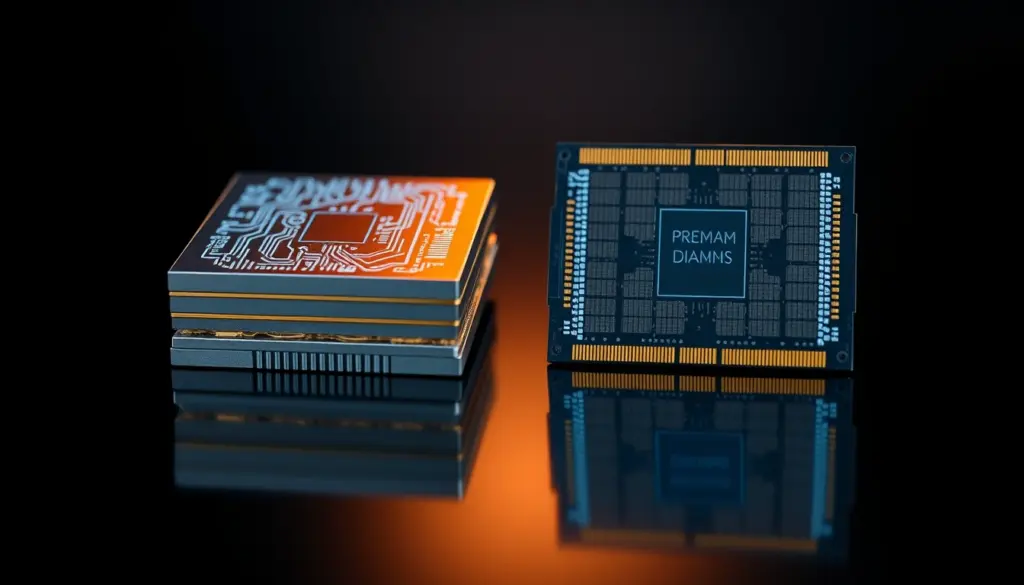
For as long as anyone in the chip business can remember, memory has been the cheap part of the silicon stack. Logic wafers built on TSMC’s most advanced nodes always carried the premium, while DRAM stayed a commodity that got cheaper as fabs scaled up. That order flipped this month. Tom’s Hardware reported on September 22, 2026 that DRAM now generates more selling value per square millimeter than TSMC’s leading-edge logic wafers, based on an analysis from Kurnal Insights. The number driving headlines: the newest DRAM generation is running roughly 54% above the estimated cost of TSMC’s N2 node on a per-area basis.
That is not a small technical footnote. It is a reversal of a decades-old pricing hierarchy, and it is rippling through everything from PC bills of materials to smartphone RAM tiers to the console business. This piece breaks down the numbers behind the DRAM prices 2026 story, what is driving it, who gets squeezed, and where the memory chip shortage goes from here.
The Numbers Behind the Reversal
Kurnal Insights built its comparison around two inputs: TSMC’s estimated wafer-processing charges and prevailing DRAM sale prices. On the logic side, a 300mm wafer processed on TSMC N3 runs an estimated $20,000, which works out to about $0.283 per square millimeter. Move up to TSMC N2, the node ramping through 2026, and that climbs to roughly $30,000 per wafer, or about $0.424 per square millimeter.
On the memory side, Kurnal Insights assumed a DRAM price of about $1.50 per gigabit and multiplied that against the bit density of three current DRAM generations. The result: 1y DRAM comes out to roughly $0.329 per square millimeter, 1z DRAM to about $0.410, and the newest 1b DRAM generation to approximately $0.654 per square millimeter. Stack that last figure against the $0.424 estimate for N2, and 1b DRAM comes out roughly 54% ahead.
It is worth being precise about what this comparison does and does not show. The TSMC figures represent estimated wafer-processing charges. The DRAM figures represent potential selling value of finished memory content. Packaging, testing, yield loss, mask costs, and R&D are treated differently on each side, so this is a value-density comparison, not proof that DRAM is harder or more expensive to manufacture than 2nm logic. Even with that caveat, the gap is large enough that it is reshaping how fabs and memory makers think about capacity allocation.
DRAM Value Density vs. TSMC Logic Wafer Cost
| Silicon Type | Node / Generation | Estimated Cost or Value | Per mm² Figure |
|---|---|---|---|
| TSMC logic wafer | N3 | ~$20,000 per 300mm wafer | ~$0.283/mm² |
| TSMC logic wafer | N2 | ~$30,000 per 300mm wafer | ~$0.424/mm² |
| DRAM (commodity) | 1y-class | ~$1.50/Gb assumed price | ~$0.329/mm² |
| DRAM (commodity) | 1z-class | ~$1.50/Gb assumed price | ~$0.410/mm² |
| DRAM (commodity) | 1b-class | ~$1.50/Gb assumed price | ~$0.654/mm² |
Notably, this is not a wild outlier reading. A separate market check lines up with Kurnal Insights’ assumptions almost exactly. DRAMeXchange data from September 21, 2026 put a 16Gb DDR5 eTT chip at $24.80, which works out to roughly $1.55 per gigabit, slightly above the $1.50 assumption used in the original analysis. Run that updated price through the same math and 1b DRAM’s implied value rises to about $0.676 per square millimeter, widening the gap over N2 logic rather than closing it.
Why HBM Is the Real Driver
Commodity DDR5 getting pricier is one story. The bigger force behind it is high bandwidth memory, the stacked DRAM that feeds AI accelerators from Nvidia, AMD, and the hyperscalers building their own silicon. HBM is not just expensive per bit, it is expensive per square millimeter of wafer, because building it eats far more area than standard DDR5 for the same nominal capacity.
Micron put a number on that gap at Hot Chips 2026. Raghu Sreeramaneni, Micron’s HBM Design Architecture Fellow, said HBM currently requires roughly three times the wafer area of DDR5 to deliver the same capacity, and that the gap is “definitely not getting better” with each new generation (Tom’s Hardware). HBM also commands a steep price premium, selling for roughly five times the per-bit price of DDR5 according to the same reporting. Put those two multipliers together and it becomes obvious why memory makers keep steering wafer starts toward HBM: the same slice of fab capacity is worth dramatically more when it comes out the other end stacked for an AI accelerator instead of packaged for a laptop.
That reallocation is exactly what strained Nvidia’s own Rubin Ultra memory configuration earlier this year, and it is the same dynamic behind Jensen Huang’s push to lock up a large share of upcoming HBM supply well ahead of shipping dates. When accelerator demand outruns HBM output, the fabs do not build more capacity overnight. They shift existing capacity away from commodity parts, and commodity DRAM prices rise as a direct consequence.
Samsung, SK Hynix and Micron Race to Reallocate Capacity
The three companies that make essentially all the world’s DRAM, Samsung, SK hynix, and Micron, are all leaning into the same bet. Samsung has reportedly outlined plans to raise its average monthly HBM wafer input from about 180,000 wafers in 2026 to approximately 250,000 in 2027, an increase of nearly 40%. That capacity has to come from somewhere, and in a fully utilized fab it comes from wafer starts that would otherwise have gone to standard DDR5 or LPDDR for phones and laptops.
SK hynix and Micron are positioned similarly, both named among the suppliers capturing the bulk of the upside from strong HBM and server-memory demand. None of the three has published a granular breakdown of exactly how many commodity wafer starts get displaced per HBM wafer added, but the direction of travel is consistent across all three: allocate more to the product that sells for five times the price per bit, even if it costs three times the area to build.
A Year of Sharply Rising Prices
The per-area reversal did not appear out of nowhere. Morgan Stanley reported in June 2026 that memory prices had climbed more than sixfold over the preceding year, a pace that has few precedents in the DRAM industry’s boom-and-bust history. TrendForce has continued to forecast further DRAM and NAND price increases through the fourth quarter of 2026, pointing to cloud-service-provider and AI accelerator demand as the main drivers rather than any single one-off event.
That run-up tracks closely with what this site covered when wafer prices were first projected to surge into 2027 on the back of AI-driven demand, and with Intel chief executive Lip-Bu Tan’s warning that memory costs could keep climbing with no meaningful relief until 2028. Those forecasts assumed memory would stay expensive relative to its own history. What nobody quite predicted was memory getting more valuable, gram for gram of silicon, than TSMC’s most advanced logic node.
The Historical Reversal, Explained
To understand why this matters, it helps to remember how the industry normally works. Commodity DRAM has always been a volume game. Fabs push bit density up, yields improve, and prices fall as huge quantities of cheap memory flood PCs, phones, and servers. Leading-edge logic runs the opposite playbook: fewer, more complex dies, lower yields early in a node’s life, and a price premium that reflects the cost of staying at the front of Moore’s Law.
Under that old order, DRAM sat well below advanced logic on a per-area basis. Kurnal Insights’ own numbers show the transition happening in real time across just three DRAM generations. 1z DRAM landed about 3% below the N2 estimate, essentially a rounding error. 1b DRAM, the newest generation, jumped to roughly 54% above it. That is not a gradual drift, it is a step change concentrated in a single product generation, and it lines up almost exactly with the period when HBM allocation for AI accelerators went from a niche line item to the priority that shapes fab planning.
DDR5 vs. HBM: The Bit Economics
| Metric | DDR5 | HBM |
|---|---|---|
| Relative wafer area for equal capacity | Baseline (1x) | ~3x DDR5 |
| Relative price per bit | Baseline (1x) | ~5x DDR5 |
| 16Gb reference price (Sept 21, 2026) | $24.80 (DRAMeXchange) | Not directly quoted; priced at a multiple of DDR5 |
| Primary buyer | PCs, laptops, phones, consoles | AI accelerators (Nvidia, AMD, hyperscaler silicon) |
Who Pays and Who Profits
The three DRAM makers are the clear beneficiaries here, provided the elevated prices hold and buyers keep absorbing them. Samsung, SK hynix, and Micron all gain when a larger share of their output goes to HBM, which sells at a premium, while the leftover commodity DRAM also commands higher prices thanks to tighter supply. That dynamic already shows up in reports of HBM4 yields climbing toward 80% even as suppliers keep most of that output earmarked for AI customers rather than the general market.
On the other side of the ledger, PC makers absorb memory cost increases in a bill of materials where RAM is one of the more visible line items, particularly in systems configured with 32GB or more. Smartphone makers face a softer version of the same pressure since phones use LPDDR rather than desktop DDR5 or HBM, but they still compete for a shrinking pool of overall DRAM capacity. Console makers, who typically lock in hardware pricing for years at launch, have the least room to maneuver when GDDR and system memory costs rise mid-cycle. Gamers and everyday buyers feel this last, but they feel it directly: retail memory kits and pre-built systems tend to reprice faster than the broader PC market average.
None of the major PC, console, or smartphone makers has published a 2026 statement explicitly tying a consumer price change to this specific DRAM-versus-logic reversal, so it is worth being careful not to overstate what is confirmed. What is confirmed is the mechanism: tighter commodity DRAM supply, driven by HBM reallocation, pushes contract and spot prices up, and those higher input costs eventually show up somewhere in a finished product’s price or spec sheet. This site has already tracked that mechanism hitting phones directly, where memory now accounts for as much as 60% of some device bills of materials, and hitting budget hardware even harder, where memory has reportedly eaten up to 80% of the component cost on some entry-level phones and laptops.
Competitive Landscape: Foundries vs. Memory Makers
This reversal also reshuffles the pecking order between two industries that used to sit in clearly separate tiers. TSMC has spent two decades as the reference point for what “expensive silicon” looks like, charging a premium for staying at the leading edge while memory makers competed on cost and volume. Now Samsung, SK hynix, and Micron are generating more value per unit of wafer area than TSMC’s N2 node, at least on the value-density measure Kurnal Insights used, without needing anywhere near TSMC’s capital intensity per transistor.
That does not mean TSMC is losing ground competitively. Its logic wafers still do fundamentally different work, and its pricing power over Nvidia, AMD, Apple, and every other major fabless customer remains intact. But it does mean the two industries are now drawing from an overlapping investor and analyst audience that evaluates them on comparable terms, wafer value per area, for the first time in years. That framing matters for how capital gets allocated across the next several years of fab construction.
The Broader Supply Chain Squeeze
This story does not sit in isolation. It follows a run of hardware-cluster coverage this year documenting the same underlying scarcity from different angles: China’s chipmakers passing HBM-driven cost increases through to AI chip pricing, and Samsung’s push into 8-layer HBM4E stacks built specifically for Nvidia’s next accelerator generation. Each of these stories traces back to the same root cause: AI accelerator demand for HBM capacity is growing faster than fabs can add it, and every other memory buyer is competing for what is left over.
What TrendForce and Analysts Expect Next
TrendForce’s baseline outlook has DRAM and NAND prices continuing to climb through the fourth quarter of 2026, with cloud-service-provider procurement and AI accelerator orders cited as the dominant drivers rather than seasonal PC or phone demand. Separately, a longer-range projection from Silicon Analysts models 2027 HBM demand growing by roughly 56% against supply growth of about 50%, with HBM4 contract prices potentially running as much as 65% above 2026 levels by 2027. That figure is a market projection rather than a confirmed supplier announcement, and it should be read as one analyst house’s model rather than an industry consensus, but it is directionally consistent with everything else in this story: more demand than supply, for years rather than quarters.
Five Predictions for the Next 12 Months
- Commodity DRAM contract prices keep climbing through early 2027. With TrendForce already forecasting Q4 2026 increases and no new fab capacity coming online fast enough to offset HBM reallocation, the path of least resistance is up.
- PC makers quietly shift base RAM configurations lower. Rather than raising sticker prices across the board, expect more entry and mid-tier laptops to ship with 16GB as the new default instead of 32GB.
- HBM allocation disputes become a bigger story than GPU allocation disputes. As accelerator vendors compete for the same constrained HBM pool, expect more public friction over who gets priority supply.
- Samsung, SK hynix, and Micron report some of their strongest DRAM-segment margins in years. Given the pricing dynamics described above, elevated DRAM and HBM pricing should flow straight to memory-segment profitability.
- The DRAM-vs-logic value comparison becomes a recurring industry talking point. Expect more analyst houses to run their own version of the Kurnal Insights math as memory pricing keeps making headlines into 2027.
Key Companies and Their Position
| Company | Role | Reported Position (September 2026) |
|---|---|---|
| TSMC | Leading logic foundry | Reference point for the per-area logic cost comparison (N2/N3) |
| Samsung Electronics | DRAM/HBM supplier | Plans to raise average monthly HBM wafer input from ~180,000 (2026) to ~250,000 (2027) |
| SK hynix | DRAM/HBM supplier | Named among suppliers capturing strong HBM and server-memory demand |
| Micron | DRAM/HBM supplier | Public confirmation that HBM needs ~3x the wafer area of DDR5 for equal capacity |
| Nvidia | AI accelerator maker | Major HBM buyer, indirectly driving commodity DRAM reallocation |
Why This Matters Beyond the Spec Sheet
It is easy to treat a per-area cost comparison as an abstraction that only matters to fab planners and equity analysts. It does not stay abstract for long. Every laptop, phone, and console sold in the next year carries some DRAM inside it, and that DRAM’s cost basis just moved in a direction the industry has not seen before. The last time memory pricing moved this sharply, during the 2017-2018 and 2021 DRAM cycles, the increases were driven by cyclical demand and supply timing that eventually corrected. This cycle is different because the demand side is structural: AI accelerator buildouts are not a temporary spike, they are a multi-year capital commitment from hyperscalers who have already signed the contracts. That is the core reason TrendForce, Morgan Stanley, and now Kurnal Insights keep pointing to 2027 and beyond rather than describing this as a cycle that self-corrects by next spring.
Frequently Asked Questions
Why is DRAM more expensive than TSMC’s 2nm chips right now?
According to the Kurnal Insights analysis reported by Tom’s Hardware, the newest DRAM generation (1b) generates about $0.654 in selling value per square millimeter, versus an estimated $0.424 per square millimeter for a TSMC N2 logic wafer, a difference of roughly 54%. The comparison measures selling value against wafer-processing cost, not raw manufacturing difficulty.
Is this the same thing as the general memory shortage?
It is connected but more specific. The broader shortage covers overall DRAM and NAND tightness. This story is about a value-density crossover: memory now sells for more per unit of wafer area than the most advanced logic chips, which is a new milestone within that broader shortage.
What is driving the price increase?
AI accelerator demand for high bandwidth memory (HBM). HBM needs roughly three times the wafer area of DDR5 for the same capacity and sells for about five times the price per bit, according to Micron. Fabs are shifting wafer starts toward HBM, which tightens supply and raises prices for commodity DDR5.
Will laptop and phone prices go up because of this?
No company has confirmed a specific 2026 price increase tied directly to this reversal. The more likely near-term effect is manufacturers shipping lower base memory configurations at existing price points rather than raising sticker prices outright.
Which companies benefit most from higher DRAM prices?
Samsung, SK hynix, and Micron, the three companies that produce essentially all the world’s DRAM and HBM. Higher commodity DRAM prices and stronger HBM allocation both support their memory-segment margins.
When are memory prices expected to stabilize?
TrendForce’s current outlook has prices rising through at least Q4 2026. Longer-range projections from Silicon Analysts model continued tightness into 2027, with HBM4 contract prices potentially running well above 2026 levels, though that figure is a projection rather than a confirmed industry commitment.
How does this compare to past DRAM price cycles?
Past cycles, including 2017-2018 and 2021, were largely driven by cyclical PC and smartphone demand that eventually corrected. Analysts describe the current cycle as structural, tied to multi-year AI accelerator buildouts rather than a seasonal swing.
Where can I verify these figures?
The core per-area analysis comes from Kurnal Insights via Tom’s Hardware’s September 22, 2026 report. The HBM wafer-area and pricing figures come from Micron’s Hot Chips 2026 comments, also reported by Tom’s Hardware. Spot DDR5 pricing is tracked by DRAMeXchange, and broader market forecasts come from TrendForce.