
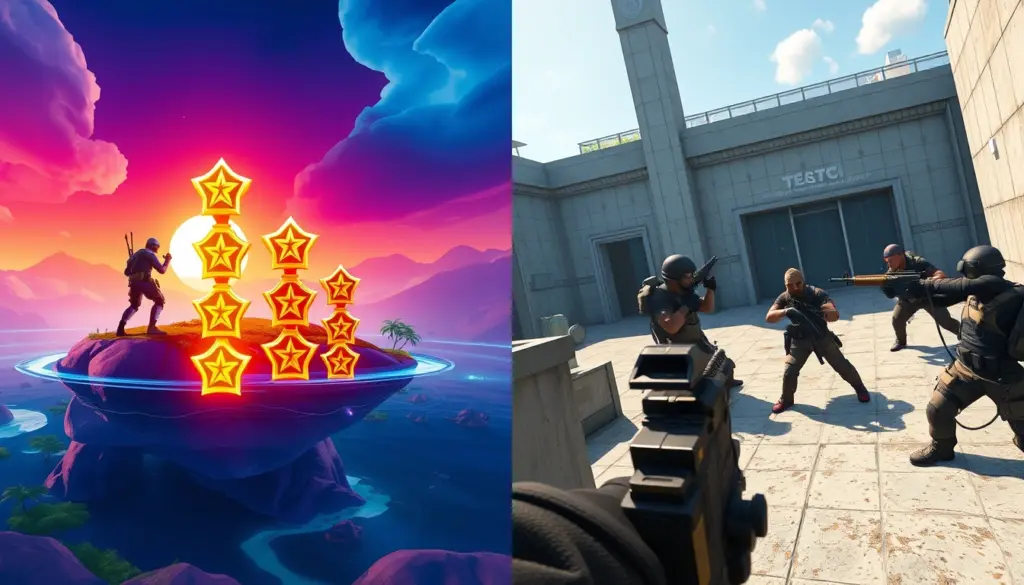
Fortnite Ranked and CS2’s dual rank systems both claim to measure skill, but they do it in almost opposite ways. Epic hides its Skill Rating behind eight visible tiers and lets you climb across six different modes. Valve splits the job in two: a classic 18-rank ladder for Competitive, and a raw numeric CS Rating for Premier that runs from 0 to over 30,000. As of August 25, 2026, both games are mid-season, both just reset parts of their ladders, and both have fresh distribution data showing exactly where players actually land. This comparison breaks down the tiers, the math, the cost of playing seriously, and which system fits which kind of player, using distribution data pulled directly from active tracking sites rather than estimates.
Fortnite Ranked Mode Explained in 2026
Fortnite Ranked runs on eight named ranks: Bronze, Silver, Gold, Platinum, Diamond, Elite, Champion, and Unreal. Every rank below Unreal splits into three divisions, so a player climbs from Bronze 1 all the way through Champion 3 before hitting the single, undivided Unreal tier at the top. That gives the ladder 22 distinct steps in Battle Royale and Zero Build, according to distribution data tracked by Esports Tales in July 2026. Progression runs on a hidden Skill Rating (SR) that adjusts after every match based on placement and eliminations, not just wins.
Six Ranked Ladders, Not One
Unlike most competitive shooters, Fortnite Ranked isn’t a single ladder. Epic runs separate ranked tracks for Battle Royale, Zero Build, Reload, Ballistic, OG, and Rocket Racing, each with its own leaderboard and season timer. Reload Ranked reset entirely in August 2026, with the new season running through August 18, 2026, and players needing just one placement match to see where they land, based on a patch breakdown from Fortnite Tracker. Ranked mode itself debuted back in patch v24.40 as “Ranked Season Zero,” and it’s been iterating on reset cadence and division sizes ever since.
Access Is Free, Cosmetics Aren’t Ranked Currency
Getting into Ranked costs nothing beyond playing the game. New accounts unlock it through an in-game milestone rather than a purchase, and Battle Pass ownership, V-Bucks, or skins have zero effect on Skill Rating. The standard Battle Pass itself runs 800 V-Bucks, about $8.99, after Epic’s March 2026 pricing change that traded a larger V-Bucks cost for a smaller completion payout, per coverage from the BBC. That pass buys cosmetics and XP boosts, not rank progress.
The practical effect is that Fortnite Ranked feels closer to a free ladder than a monetized one. Epic keeps the Battle Pass economy and the Ranked economy on separate tracks, so a player who never spends a dollar climbs at exactly the same rate as a player who owns every cosmetic in the shop. That separation matters for younger players and parents managing shared accounts, since there’s no way to buy rank progress even if someone wanted to. It also means Epic’s ranked design leans entirely on time and skill, not wallet size, which is a different bet than the one Valve makes with Prime Status gating Premier access.
Fortnite’s Skill Rating also weighs eliminations alongside placement, which changes how a squad climbs compared to a solo player. A four-person squad that wins a match but contributes only a handful of kills gains less SR than a squad that fights aggressively and stacks eliminations before taking the win. That scoring choice rewards engagement over passive survival, a deliberate shift from earlier Battle Royale ranking models that rewarded hiding until the final circles.
CS2’s Two Ranking Systems: Competitive and Premier
Valve splits CS2 ranked play into two parallel systems that share a map pool but score players differently. Competitive still uses the classic 18-tier ladder that CS:GO veterans grew up with, running from Silver I up through The Global Elite. Premier throws the named tiers out for a single number, CS Rating, that climbs from 0 to 35,000 and beyond, banded into seven color tiers for readability, according to a 2026 breakdown from WeCoach.
Competitive: 18 Ranks, No Numbers Shown
Competitive mode groups players into 18 skill groups: Silver I through IV, Silver Elite, Silver Elite Master, Gold Nova I through III, Gold Nova Master, Master Guardian I and II, Master Guardian Elite, Distinguished Master Guardian, Legendary Eagle, Legendary Eagle Master, Supreme Master First Class, and The Global Elite. There’s no visible rating attached, just the badge. To even queue, you need Account Level 2, reached by playing Casual, Deathmatch, or Bomb/Hostage modes, and to hold onto a rank rather than just queue into the mode, you need Prime Status.
Premier: CS Rating From 0 to 30,000+
Premier is the mode Valve built for players who want a number, not a badge. CS Rating starts every player at zero and moves them through Grey (0-4,999), Light Blue (5,000-9,999), Blue (10,000-14,999), Purple (15,000-19,999), Pink (20,000-24,999), Red (25,000-29,999), and Gold (30,000+). It’s described as momentum-driven and expectation-based by CSGuess, meaning a win against a weaker team pays out less rating than a win against a stronger one. Unlocking Premier requires Prime Status, a one-time $14.99 purchase, plus reaching Profile Level 10, then completing 10 placement matches to generate a starting rating.
The expectation-weighted math is the part most players misunderstand at first. A Blue-tier player who beats a Purple-tier opponent gains more CS Rating than one who beats another Blue-tier team, because the system already expected that matchup to go the other way. Grind through enough of those upset wins and the rating climbs fast. Lose to lower-rated opponents and it drops just as sharply, since the model treats that outcome as more surprising than a loss to a stronger team. This is closer to how chess Elo behaves than how a typical shooter’s hidden matchmaking rating works, and it’s the main reason CS2 veterans describe Premier as feeling more honest than the old Competitive ladder, even when the two modes share the exact same maps and round format.
Players can check their current CS Rating and match history directly from the in-game Premier tab, or pull it through third-party trackers that read the public Steam profile. A simple console command also shows connection and tick data mid-match, which competitive players use to rule out network issues before blaming a rating dip on skill:
// CS2 console commands useful for Premier and Competitive play
net_graph 1          // shows FPS, ping, and tick data on screen
cl_showfps 1          // shows raw frame rate without full net_graph
rate 786432           // sets max bandwidth for a stable Premier connection
cq_netgraph_pos 1     // repositions the net graph overlay
Fortnite Ranks vs CS2 Ranks: Full Specs Comparison Table
Laid side by side, the two systems diverge on almost every axis except one: both hide the real math behind a friendlier front end for casual players and expose more precision for players who dig for it.
| Category | Fortnite Ranked | CS2 (Competitive / Premier) |
|---|---|---|
| Named ranks | 8 (Bronze to Unreal) | 18 (Competitive) / 7 color tiers (Premier) |
| Divisions per rank | 3 (I-III), except Unreal | None (each rank standalone) / continuous rating (Premier) |
| Total steps to climb | 22 (BR / Zero Build) | 18 (Competitive) / 0-30,000+ scale (Premier) |
| Core rating metric | Hidden Skill Rating (SR) | Hidden Elo (Competitive) / Visible CS Rating (Premier) |
| Ranked modes available | Battle Royale, Zero Build, Reload, Ballistic, OG, Rocket Racing | Competitive (MR12) and Premier (MR12), same map pool |
| Placement requirement | 1 placement match after a season reset | 10 placement matches to set initial CS Rating (Premier) |
| Access requirement | Free, unlocked through in-game progression | Competitive: free at Account Level 2. Premier: Prime Status + Profile Level 10 |
| Entry cost | $0 | $0 (Competitive) / ~$14.99 one-time Prime (Premier) |
| Team size | Solo, duo, trio, or squad depending on mode | Fixed 5v5 |
| Top-tier population share | Unreal: ~1.8% (BR, July 2026) | Global Elite: ~0.2% (Competitive) / Gold: ~0.1% (Premier) |
| Entry-tier population share | Bronze 1: 99.9% at-or-above (nearly everyone starts here) | Silver I: 18.3% of the active population |
| Typical median player | Gold-Platinum band (Gold 2 sits at top ~30%) | Gold Nova (Competitive) / Blue tier, ~56th-84th percentile (Premier) |
| Season reset cadence | Per mode, varies (Reload reset ran through Aug 18, 2026) | Roughly every 3 months, tied to CS2 season updates |
The gap that jumps out fastest is precision. Fortnite gives you a rank badge and nothing else, no exposed number to obsess over. CS2 Premier does the opposite, handing you a raw rating that updates after every match, which is exactly the kind of granularity that turned Premier into the default competitive queue for players who used to track CS:GO Elo manually.
Team structure is the other major fork in the table. Fortnite lets you climb solo, in a duo, a trio, or a full squad, and your Skill Rating carries across whichever configuration you queue into. CS2 offers no such flexibility, every Competitive and Premier match locks you into a 5v5 format with no smaller or larger variant. That rigidity is a feature for players who want a stable, well-understood meta, but it removes the option to rank up casually with just one friend the way Fortnite’s duo queue allows.
Fortnite Rank Distribution: Where Players Actually Land
July 2026 tracking data from Esports Tales shows a ladder that funnels hard toward the middle, then thins out fast past Diamond. Bronze 1 covers 99.9% of the population at-or-above, meaning almost every account has technically cleared it, while the real filtering starts around Gold.
| Rank | Top % (at or above) | Rank | Top % (at or above) |
|---|---|---|---|
| Bronze 1 | 99.9% | Diamond 1 | 11% |
| Bronze 2 | 79.1% | Diamond 2 | 9.1% |
| Bronze 3 | 69.5% | Diamond 3 | 8% |
| Silver 1 | 61.8% | Elite 1 | 7.2% |
| Silver 2 | 45.4% | Elite 2 | 5.9% |
| Silver 3 | 36.7% | Elite 3 | 5% |
| Gold 1 | 33% | Champion 1 | 4.1% |
| Gold 2 | 30% | Champion 2 | 3.2% |
| Gold 3 | 27.8% | Champion 3 | 2.6% |
| Platinum 1 | 24.6% | Unreal | 1.8% |
| Platinum 2 | 16.5% | – | – |
| Platinum 3 | 12.9% | – | – |
Notice the gap between Silver 3 (36.7%) and Gold 1 (33%). That’s a small drop compared to the fall from Platinum 3 (12.9%) to Diamond 1 (11%), and then the real squeeze from Champion 3 (2.6%) down to Unreal (1.8%). Roughly 1 in 56 ranked players holds Unreal at any given point in the season, which lines up with why Epic added an “Unreal Legends” super-tier for players who hold at least 2,500 Skill Rating and crack the Top 500 leaderboard.
This shape, a long flat middle followed by a steep late drop, is common across Battle Royale-style rankings, but Fortnite’s version is unusually gradual through Bronze and Silver before it tightens up. A new player can realistically clear the first six divisions inside a single week of casual play, since roughly 63% of the population sits at Bronze or Silver at any given time. The wall shows up later, between Diamond and Champion, where mechanical skill and rotation knowledge start mattering more than raw survival instinct. Zero Build tends to show a slightly flatter curve than standard Battle Royale, since removing building levels the mechanical gap between casual and competitive players, though Epic doesn’t publish a full breakdown split by every mode.
CS2 Rank Distribution: Competitive vs Premier
CS2’s two systems don’t just score differently, they distribute differently too. Competitive still clusters heavily at the bottom, a holdover from CS:GO’s rank inflation era, while Premier’s CS Rating spreads more evenly around a true statistical average.
| Competitive Rank | Approx. Share (Jan 2026) |
|---|---|
| Silver I | 18.3% |
| Silver II-IV | 27.3% combined |
| Silver Elite / Elite Master | 15.7% combined |
| Gold Nova I-III | 20.8% combined |
| Gold Nova Master | 5.1% |
| Master Guardian I-II | 7% combined |
| Master Guardian Elite / DMG | 3.5% combined |
| Legendary Eagle / Eagle Master | 1.7% combined |
| Supreme Master First Class | 0.3% |
| The Global Elite | 0.2% |
Premier tells a cleaner story because it’s a straight percentile split rather than named badges. Leetify’s March 2026 data, cited via WeCoach, shows the population piling up between 5,000 and 15,000 rating, then dropping off a cliff past Purple.
| Premier Tier (CS Rating) | Share of Players | Standing |
|---|---|---|
| Grey (0-4,999) | 25.1% | Bottom ~25% |
| Light Blue (5,000-9,999) | 30.8% | Below average |
| Blue (10,000-14,999) | 27.6% | Around the average |
| Purple (15,000-19,999) | 12.8% | Top ~16% |
| Pink (20,000-24,999) | 3.1% | Top ~4% |
| Red (25,000-29,999) | 0.4% | Top ~0.5% |
| Gold (30,000+) | 0.1% | Leaderboard tier |
Put plainly, the median CS2 Premier player sits in Blue, around 10,000-11,000 rating, which maps roughly to Gold Nova I through Master on the old Competitive scale. That cross-system alignment is one reason Valve keeps pushing Premier as the mode with the more honest number.
The two CS2 systems also diverge in how much of the population clusters at the extremes. Competitive’s Silver and Gold Nova bands together account for roughly 61.8% of active players, a heavier concentration at the entry level than Premier shows, where Grey and Light Blue combine for 55.9%. That gap exists because Competitive still carries years of accumulated CS:GO accounts that never fully recalibrated after the CS2 transition, while Premier resets and recalculates CS Rating more aggressively each season. Players chasing a rank that actually reflects current skill, rather than a badge earned years ago, tend to trust Premier’s number more, even though both modes run on the same underlying maps and round structure.
Benchmarks: Grind Speed, Match Format, and Climb Difficulty
Raw tier counts don’t tell you how long it actually takes to move up. Three separate data points, pulled from three different trackers, paint a consistent picture: CS2’s grind is slower per match but more predictable, while Fortnite’s grind is faster per match but noisier.
- Match format. CS2 Competitive and Premier both run best-of-24 rounds (MR12), typically 30-45 minutes per match. Fortnite Battle Royale runs 15-20 minutes per match, while Zero Build and Reload tend to finish faster due to smaller lobbies and quicker eliminations.
- Rating volatility. Premier’s CS Rating swings are expectation-weighted, per CSGuess, so beating a stronger team nets more points than beating a weaker one. Fortnite’s Skill Rating factors in placement and eliminations per match, which means one strong solo run can offset several bad squad matches.
- Placement burden. Premier requires 10 placement matches to generate a starting CS Rating after unlocking the mode. Fortnite’s Reload Ranked reset in August 2026 required just 1 placement match to re-enter the ladder, a much lighter barrier to re-establishing a rank after a reset.
The practical upshot: a CS2 player chasing a big Premier jump is looking at a multi-week grind measured in dozens of full matches, while a Fortnite player can meaningfully move a division in a single strong session because match length is roughly a third of CS2’s.
Session math backs that up. A player with two hours to spend on CS2 gets through roughly three to four Premier or Competitive matches, each one carrying real weight because of the expectation-weighted rating swings. That same two-hour window in Fortnite covers anywhere from six to ten Battle Royale matches, or considerably more in Zero Build or Reload, where eliminations happen faster and rounds end sooner. More attempts per session doesn’t automatically mean a faster climb, since Fortnite’s SR model smooths out noise across a larger sample, but it does mean more opportunities to have a standout match that moves the needle. CS2’s slower cadence rewards patience and consistency across fewer, higher-stakes games.
Pricing: What It Costs to Rank Up in Each Game
Both games are free to download and free to queue into ranked at a basic level, but the real costs diverge once you factor in mode access and the boosting market that’s grown around both ladders.
| Item | Fortnite | CS2 |
|---|---|---|
| Base game | Free | Free |
| Ranked mode access | Free (unlocked via in-game milestone) | Competitive: free at Level 2. Premier: requires Prime |
| Prime Status / rank-holding fee | Not applicable | ~$14.99 one-time |
| Battle Pass / season pass | 800 V-Bucks (~$8.99), cosmetic only | No Premier-specific pass exists |
| Small rank boost (entry tier) | ~$1.00-$1.60 per small division jump | $15.00 base (Competitive) / $57.35 for a 1,900-5,000 rating jump (Premier) |
| Mid-tier boost | Not commonly sold per-division | $277.50 for 0-15,000 Premier rating |
| Full-ladder boost | Not commonly sold | $854.50 for 0-30,000 Premier rating |
| Coaching (per hour) | $25-$75/hr | $25-$75/hr |
Pricing on rank boosts comes from live calculators on BuyBoosting’s CS2 guide, where a Competitive boost from Silver 1 to Gold Nova 1 lists at $35.00 and a Global Elite push from Master Guardian 1 runs $131.00. Coaching rates come from WeCoach’s coach directory, where listed hourly rates range from $25 to $75 depending on the coach’s experience level. Fortnite’s boosting market exists too, but it’s priced in small per-division increments rather than large rating jumps, since there’s no exposed number to target.
Worth noting: none of these boosting or coaching services are affiliated with Epic or Valve, and using account-sharing boosts can violate either game’s terms of service. Coaching, by contrast, where you play your own matches with a coach reviewing replays or spectating live, carries none of that risk and is the more common route serious players take to break through a rank plateau.
Migration Guide: Switching Between Fortnite Ranked and CS2
Players moving from one ladder to the other, whether chasing a friend group or just testing a new genre, run into the same six friction points. Here’s how to cross over without losing weeks to setup confusion.
- Pick your mode first. Fortnite splits ranked across six tracks. Decide whether you want Battle Royale’s full 100-player chaos, Zero Build’s aim-focused variant, or Reload’s faster format before grinding a season.
- Unlock access. Fortnite Ranked unlocks through gameplay milestones, no purchase needed. For CS2 Premier, buy Prime Status ($14.99) and grind to Profile Level 10 through Casual, Deathmatch, or Bomb/Hostage matches first.
- Expect different placement burdens. CS2 Premier needs 10 placement matches before it shows a CS Rating. Fortnite typically needs just 1 placement match after a season reset.
- Recalibrate your mental model of “rank.” Fortnite hides its Skill Rating entirely behind a tier badge. CS2 Premier shows the raw number, so expect to see your rating move after every single match instead of only after a division-up screen.
- Adjust for team size. CS2 is locked to 5v5. Fortnite Ranked flexes between solo, duo, trio, and squad depending on mode, which changes how much a single strong player can carry a match.
- Budget for the mode, not just the game. Fortnite’s ranked economy is entirely optional cosmetics. CS2’s Premier gate means budgeting at least $14.99 before your first competitive match counts toward a rank.
The biggest adjustment isn’t mechanical, it’s psychological. Fortnite players who move to CS2 Premier often find the visible rating stressful at first, since every match produces an immediate, quantified verdict instead of a vague sense of “that felt good” or “that felt bad.” CS2 players moving the other direction sometimes struggle with Fortnite’s opposite problem: not knowing exactly how close they are to the next division, since Epic never surfaces the underlying SR number. Give each system at least two full weeks before judging it, since both need a stretch of matches for the rating model to stabilize around your actual skill level rather than your placement-match variance.
5 Real-World Examples of Climbing Each Ladder
Distribution data only means so much until you see how it plays out for an actual account. These five scenarios, built from the July and August 2026 tracking data above, show how the two systems handle real climbs differently, from the first unranked match to the final push toward each ladder’s top 2%.
- The squad grinder. A player starting fresh in Fortnite Battle Royale clears Bronze in a handful of matches, since 99.9% of accounts sit at-or-above that floor. Reaching Gold 2, the true statistical median at the top ~30%, takes a full season of consistent squad play.
- The Premier calibrator. A new CS2 account buys Prime for $14.99, hits Profile Level 10, then grinds 10 placement matches. Landing in Blue (10,000-14,999) puts them at the actual population average, roughly the 56th-84th percentile band.
- The reset refugee. A Reload Ranked player caught in the August 2026 rank reset needs just one placement match to see their new standing, a lighter reset burden than Premier’s 10-match requirement.
- The plateaued Gold Nova. A CS2 Competitive player stuck at Gold Nova III (part of the 20.8% combined Gold Nova population) hires a WeCoach coach at $25/hr to break through to Master Guardian, rather than paying $131.00 for a Master Guardian 1-to-Global Elite boost.
- The Unreal chaser. A Fortnite player pushing from Champion 3 (2.6% of the population) toward Unreal (1.8%) is fighting for a spot among roughly 1 in 56 ranked accounts, the tightest squeeze on either ladder covered in this comparison.
Best Use Cases: Which Ranked System Fits You
Neither system is objectively better, they’re built for different play patterns. Match your play style and goals against the list below before committing a season to either ladder.
- Casual players who want variety: Fortnite Ranked, since six separate modes mean you can chase rank in whichever format matches your mood that night.
- Players who want a precise, visible number: CS2 Premier, where CS Rating updates after every match instead of hiding behind a tier badge.
- Budget-conscious players: Fortnite Ranked, since it costs nothing beyond the free game to unlock and climb.
- Fixed-team competitive players: CS2 Competitive or Premier, both locked to 5v5 with a stable, well-documented meta.
- Players with limited session time: Fortnite Zero Build or Reload, where matches run a third the length of a CS2 MR12 game.
- Content creators tracking long-term progress: CS2 Premier’s exposed CS Rating gives cleaner data for stream overlays and progress charts than Fortnite’s hidden SR.
- Players recovering from a long break: Fortnite’s lighter placement requirements, often a single match after a reset, get you back into a real rank faster than Premier’s 10-match recalibration.
A few players will find both systems genuinely interchangeable once they account for the cost and time differences above. If you already own CS2 and have Prime Status from years of CS:GO play, Premier costs nothing extra to try. If you’re starting completely fresh with no existing investment in either title, Fortnite’s zero-cost entry removes one more barrier between deciding to play and actually queuing your first ranked match.
Pros and Cons of Fortnite Ranked
Pros: Completely free to unlock and climb, no purchase gate of any kind. Six separate ranked modes give players options for match length and format. Lighter placement requirements after resets, often just one match. Flexible team sizes accommodate solo players and full squads alike. Shorter match length means more attempts per session and faster feedback loops for players trying to fix a specific mistake.
Cons: Skill Rating stays completely hidden, so players never see the actual number driving their rank. Splitting ranked across six modes fragments the playerbase and makes cross-mode comparisons meaningless, since a Diamond rank in Reload doesn’t necessarily translate to Diamond skill in Battle Royale. The gap between Champion and Unreal is razor thin (2.6% to 1.8%), making the final climb disproportionately harder than earlier divisions. Squad-based scoring also means a strong individual performance can get diluted by three weaker teammates, something solo queue in CS2 avoids entirely since every player’s rating moves on individual round contribution within a fixed 5v5.
Pros and Cons of CS2 Ranked (Competitive and Premier)
Pros: Premier’s CS Rating gives players a transparent, constantly updating number instead of a vague badge. Fixed 5v5 format keeps the competitive meta stable and well-documented across guides. Two parallel systems let players choose between old-school badges (Competitive) and raw numbers (Premier). Expectation-weighted scoring rewards upsets, which keeps high-rated players from farming easy wins for cheap rating gains.
Cons: Premier requires a $14.99 Prime Status purchase plus Profile Level 10 before your first ranked match even counts. The 10-match placement requirement is a heavier barrier than most competitive shooters. Competitive’s 18-rank ladder still clusters nearly half the population between Silver and Gold Nova, which dilutes what those badges actually signal. Match length also runs long, 30-45 minutes per game, which limits how many ranked attempts a player can fit into a single evening compared to a faster-paced ladder.
How Rank Connects to the Competitive Scene
Ranked mode isn’t just a solo grind in either title, it feeds directly into how each game’s esports scene identifies talent. Fortnite tracks Ranked and Ballistic performance alongside dedicated Power Rankings that follow individual players and organizations across events, a system covered by trackers like Fortnite Tracker. Reaching Unreal, or the newer Unreal Legends tier that requires a Top 500 leaderboard placement, is often the first checkpoint scouts look for before inviting a player to competitive tryouts. Because Fortnite runs six separate ranked ladders, a player’s competitive profile can look different depending on which mode they grind, which makes cross-mode consistency a genuine signal of broad mechanical skill rather than a single format’s meta knowledge.
CS2’s path into competitive play runs almost entirely through Premier, since its transparent CS Rating gives scouts and team managers a number they can compare directly across candidates without guessing at Competitive’s less granular badges. Amateur tournament organizers frequently set CS Rating floors for open brackets, using Premier’s 0-30,000+ scale as an objective filter that Competitive’s 18-tier system can’t replicate with the same precision. That’s part of why Premier has become the default ranked queue for players serious about breaking into organized play, even though Competitive remains the more nostalgic, more populated mode for casual matchmaking.
The Verdict: Fortnite Ranks vs CS2 Ranks in 2026
If accessibility is the priority, Fortnite Ranked wins outright. It’s free from the first match to the Unreal grind, with 22 total steps spread across six modes that fit almost any session length. If precision is the priority, CS2 Premier wins just as clearly. A CS Rating from 0 to 30,000+ gives players a number that moves every match, something Fortnite’s hidden Skill Rating never exposes.
The data backs both cases. Fortnite’s Unreal tier holds about 1.8% of the ranked population, a squeeze comparable to CS2 Competitive’s Global Elite at 0.2% and Premier’s Gold tier at 0.1%, so the top of both ladders is genuinely hard to reach. The difference is what you pay to find out where you stand: nothing in Fortnite, versus $14.99 in Prime Status plus 10 placement matches in CS2 Premier. Pick Fortnite Ranked for flexibility and zero cost. Pick CS2 Premier for a number you can actually track match to match.
There’s also a middle path worth considering: play both. The two games test almost entirely different skills, aim-heavy positional play in CS2 versus a broader mix of building, rotation, and endgame decision-making in Fortnite, so climbing one ladder rarely transfers directly to the other. Plenty of competitive players keep a foot in each system specifically because the contrast keeps mechanical skills sharp in different ways. Whichever you pick first, the data above should make it clear roughly how long the climb to a respectable rank actually takes, and what it costs if you decide to speed it up.
Frequently Asked Questions
Which has more ranks, Fortnite or CS2?
CS2 Competitive has more named ranks at 18, compared to Fortnite’s 8. But counting divisions, Fortnite has 22 total steps (Bronze 1 through Unreal) versus CS2 Competitive’s 18 standalone ranks with no divisions.
Is CS2 Premier free to play ranked?
No. Premier requires Prime Status, a one-time purchase of roughly $14.99 on Steam, plus reaching Profile Level 10 through unranked XP first, according to Steam Support.
What percentage of Fortnite players reach Unreal?
About 1.8% of ranked Battle Royale and Zero Build players hold Unreal, based on July 2026 tracking from Esports Tales.
How does CS2 Premier’s CS Rating compare to Competitive ranks?
Roughly, Blue tier (10,000-14,999 CS Rating) lines up with Gold Nova I through Master on the Competitive ladder, while Purple (15,000-19,999) aligns closer to Master Guardian I through Elite, per cross-referenced 2026 data from Leetify and Esports Tales.
Do Fortnite Battle Pass purchases affect Ranked?
No. Battle Pass XP, V-Bucks, and skins have no effect on Skill Rating or Ranked progression. They’re purely cosmetic and unrelated systems.
How many placement matches does each game require?
CS2 Premier requires 10 placement matches to generate a starting CS Rating. Fortnite’s Reload Ranked required just 1 placement match after its August 2026 reset, though requirements can vary by mode and season.
Can I rank up faster in Fortnite or CS2?
Per-match, Fortnite’s shorter rounds (15-20 minutes in Battle Royale, faster in Zero Build and Reload) allow more attempts per session than CS2’s 30-45 minute MR12 matches. That doesn’t guarantee a faster overall climb, since CS2’s rating adjusts every match while Fortnite’s hidden SR can take longer to visibly move a division.
Is it worth paying for a rank boost in either game?
That’s a personal call, but the price gap is stark. Small Fortnite division boosts run $1.00-$1.60 on marketplaces, while a full CS2 Premier climb from 0 to 30,000 rating lists at $854.50 on BuyBoosting’s live calculator, reflecting how much more grinding a full CS2 climb actually requires.
Does team skill affect Fortnite rank the same way as CS2?
Not quite. Fortnite’s squad-based modes blend individual placement and eliminations into a shared outcome, so a strong player can be held back by weaker teammates. CS2’s fixed 5v5 format applies the same expectation-weighted rating logic to every player based on round-level contribution, which tends to isolate individual skill more precisely than Fortnite’s squad scoring.
Further Reading
Related Coverage
- Fortnite vs Valorant Ranks: 38% Bronze, 25 Tiers [2026]
- Fortnite vs Apex Ranks: 38% Bronze vs 52% Diamond [2026]
- Valorant Ranks vs CS2 Ranks: 25 Tiers vs 18 [2026]
- R6 Siege Ranks vs CS2 Ranks: 40 Tiers vs 18 [2026]
- CS2 Ranks vs ESEA vs FACEIT: 25M vs 3M Players [2026]
- CS2 Premier vs Competitive Rank: 7 Tiers vs 18 Ranks [2026]
- Fortnite Rank Tracker Setup: 12 Steps, 40 Min [2026]
For more ranked-system breakdowns and esports guides, visit the esports hub on Shattered.