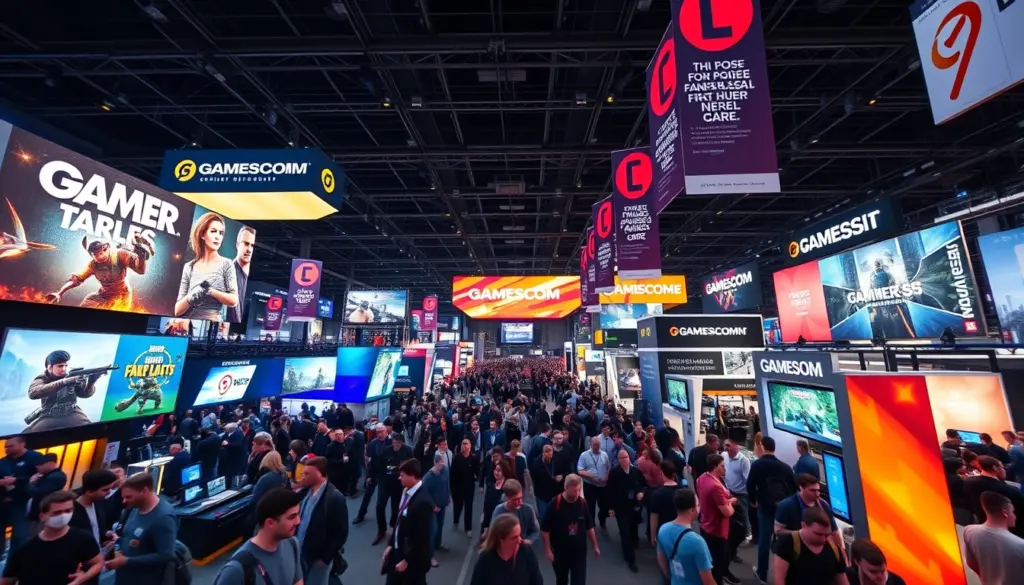
Gamescom 2026 closed its doors in Cologne on August 30 with a number organizers had never posted before: a fully sold-out exhibition floor. More than 1,600 exhibitors from 67 countries filled Koelnmesse’s halls, and 47 country pavilions lined the show, according to Tech Times. Attendance is tracking between 350,000 and 370,000-plus visitors, edging past 2025’s record of 357,000. But the headline number hides a rougher story underneath. Layoffs, studio closures, and rising hardware costs have battered the games industry for three straight years, and the people running Gamescom say the sellout is less a victory lap than a sign the industry is regrouping under pressure.
This is a news analysis of what actually happened at Gamescom 2026, why a record-breaking show and a struggling industry aren’t a contradiction, and what the numbers mean for publishers, platform holders, and the roughly $213.9 billion global games market heading into 2027.
Gamescom 2026 Sells Out Its Floor for the First Time
Koelnmesse had never run out of booth space before this year. Organizers confirmed the 2026 floor sold out completely, forcing them to start scouting hall expansions for 2027 just to keep up with demand, per Tech Times. The show ran from August 26 to 30, with Opening Night Live kicking off the week on August 25 at 8:00 p.m. CEST.
A regional German broadcaster, WDR, told Cologne residents to expect the fairgrounds “full at all times,” with attendance projected at “gut 360.000” (around 360,000) visitors, per its FAQ coverage. A trade-fair exhibitor directory pushed the projection higher still, citing 370,000-plus expected visitors including 30,000-plus trade attendees. Whichever figure lands closest once final numbers are audited, every projection clears 2025’s 357,000, and most clear it by a wide margin.
Exhibitor count grew too. Gamescom 2025 hosted 1,568 exhibitors. This year’s show topped 1,600, spread across 67 countries. That’s a modest jump on paper, but it happened while the floor itself hit its physical capacity, which is the more telling detail.
Attendance by the Numbers: 2024 to 2026
Gamescom’s growth curve over the past three years tells its own story. 2024 drew about 335,000 visitors. 2025 jumped to 357,000, a gain of roughly 22,000 people, or about 6.5%, and generated over 630 million digital impressions worldwide. 2026 is projected to clear 360,000 at minimum, with some directories forecasting north of 370,000.
| Year | Visitors | Trade Visitors | Exhibitors | Floor Status |
|---|---|---|---|---|
| 2024 | ~335,000 | Not disclosed | Not disclosed | Open capacity |
| 2025 | 357,000 | ~34,000 | 1,568 | Record, not sold out |
| 2026 | 360,000–370,000+ (est.) | 30,000+ | 1,600+ | Sold out (first time ever) |
Visitors in 2025 came from 128 countries. This year’s exhibitor base spanned 67 countries and 47 national pavilions, a sign that Gamescom’s pull now extends well past its German and European base into Asian, Middle Eastern, and Latin American publishers looking for a single stage to reach European players.
Who Showed Up: Xbox and Nintendo In, PlayStation Out Again
Only two of the three console makers had a real presence on the floor. Xbox occupied Hall 7. Nintendo held Hall 9. Sony’s PlayStation had no stand, continuing a pattern that stretches back to 2019, its last year with a booth at the show. That’s seven straight years Sony has skipped Gamescom’s exhibition floor, even as the show itself has grown by tens of thousands of visitors each cycle.
Confirmed exhibitors beyond the platform holders included Ubisoft, CD Projekt Red, Capcom, Bandai Namco, Krafton, Konami, Sega, Tencent, NetEase, HoYoverse, and Team17, a lineup that skews heavily toward live-service and multi-platform publishers rather than single-console exclusives. That mix reflects where the money in the industry has moved: toward franchises that ship everywhere at once, not toward hardware-locked showcases.
Nintendo’s Hall 9 Surprise
One entry in the show’s official game listings stood out: Call of Duty: Modern Warfare 4 shown at Nintendo’s Hall 9 booth, tied to Switch 2 hardware. If that listing holds up as an actual playable demo rather than a marketing tie-in, it would mark one of the first times a mainline Call of Duty title got hands-on floor time on Nintendo hardware at a major European show, a sign of how far cross-platform publishing has moved since Switch 2 launched with GPU power closer to last-generation consoles than to the original Switch.
The Industry Squeeze Behind the Record Turnout
A sold-out floor and a bruised industry are not opposites this year. They’re the same story told from two angles. Felix Falk, managing director of “game,” the German games industry trade association that co-organizes Gamescom, framed it directly in an interview with Deadline:
“We know it’s been tough for the past few years in the global games industry.”
Felix Falk, Managing Director, game, quoted by Deadline
Falk went further, tying the sellout directly to a wave of layoffs and studio closures that has hit the industry since 2022:
“We have had a big consolidation and not easy times for the companies, but in these circumstances, it’s great to see that at gamescom everyone gathers, everyone wants to be part of this to show the new games and to find new investors and create new endeavors and companies and projects.”
Felix Falk, Managing Director, game, quoted by Deadline
That reading lines up with what shattered.io has tracked across the industry this year, including 3,200 job cuts and four divested studios at Xbox, 136 layoffs at id Software, and Double Fine cutting a quarter of its staff. Gamescom’s growth isn’t happening despite the layoffs. In Falk’s telling, it’s partly because of them: studios and investors are using the show as a place to regroup, pitch, and find new backers after years of contraction.
What’s Actually Driving the Squeeze: Costs, Discovery, and Content Overload
Falk was specific about the pressures squeezing developers and publishers, in comments picked up by Deutsche Welle:
“Increasing costs for games hardware components pushing up prices, hyper-competition across all areas of the market meaning a glut of content, and challenges in discovery (of new users) and user acquisition.”
Felix Falk, Managing Director, game, quoted by Deutsche Welle
Three distinct pressures sit inside that one quote. Hardware component costs have pushed console and PC prices up across the board this year, something shattered.io covered directly when Xbox raised prices 50% in parts of Europe and 33% in the US. A glut of content means more games competing for the same pool of players and the same finite marketing budgets. And discovery, the ability for a new game to actually reach players instead of vanishing in a storefront, has become the hardest problem in the business now that algorithmic feeds and paid placement dominate how games get found.
Deutsche Welle also anchored the show against the broader market: the global games market is valued at $213.9 billion, up 6.1% year on year, according to Newzoo, a gaming market research firm cited in DW’s reporting. That’s a market growing in dollar terms while several of the companies operating inside it keep shrinking headcount, a split that shows up again and again in 2026’s earnings reports.
A Sold-Out Show as Proof of Recovery, Not Just Pressure
Falk didn’t frame the sellout purely as a symptom of hard times. He also pointed to it as an early signal that the worst of the contraction may be behind the industry, in comments reported by Shane The Gamer:
“The past few years have been tough for the industry… so we are really happy… that we are breaking records with exhibition space.”
Felix Falk, Managing Director, game, quoted by Shane The Gamer
“I think that’s a good indicator that the industry is preparing for new growth.”
Felix Falk, Managing Director, game, quoted by Shane The Gamer
Both readings can be true at once. A record sellout can reflect studios chasing investors during a downturn, and it can also be the leading edge of a rebound. Gamescom itself doesn’t resolve that tension. It just puts a very large number of companies, publishers, and platform holders in the same building at the same time, which makes the contradiction visible rather than hiding it in separate earnings calls.
What Got Shown: Opening Night Live and the Floor Reveals
CD Projekt Red used Opening Night Live to confirm The Witcher 3: Songs of the Past, an expansion designed as a bridge from Wild Hunt toward The Witcher 4, expanding existing base-game areas rather than adding a new region. The studio also tied a Geralt of Rivia skin to Diablo IV as part of a Witcher x Blizzard crossover, obtainable by pre-ordering the expansion on Battle.net.
Away from the big publisher stages, the show floor carried its usual mix of debuts and awards buzz. Silver Palace, an Unreal Engine 5 open-world action RPG from Singapore-based Elementa, picked up a nomination for Gamescom’s Best Mobile Game award and premiered a new trailer during Opening Night Live, according to a PR Newswire release covering the show. The same wire carried news of Animula Nook, a cozy life-sim from Guangzhou developer LilliLandia Games, debuting a new beta with hands-on demos running at the Tencent Games booth.
Hardware Made Noise Too
Samsung used the show to unveil four multi-mode Odyssey monitors, including a 49-inch QD-OLED panel capable of switching between 360Hz at 1440p and 720Hz at 720p. AOC, working with Nvidia, showed off what it billed as the first 5K G-Sync Pulsar gaming monitor, a 31.5-inch panel running native 5120×2880 resolution at 144Hz. Neither company announced pricing or a release date on the floor, which is typical for Gamescom hardware reveals that often land closer to CES the following January.
Market Impact: What a Sold-Out Gamescom Means for the Business Side
A sold-out trade show floor is, in practical terms, a demand signal. Publishers and hardware makers pay for booth space because they expect a return in press coverage, player acquisition, and B2B deal-making with distributors and investors. When that space runs out entirely for the first time in the show’s history, it tells you demand for that specific channel has outgrown supply, not that every company on the floor is financially healthy.
That distinction matters this year more than most. 2026 earnings season has been split down the middle. shattered.io reported Nintendo’s profit jumping 150% even as Switch 2 unit sales sank 34%, and Sony’s gaming division posting a 37% profit gain while PS5 hardware sales fell 33%. Meanwhile Tencent’s gaming stock took its worst drop since 2025. Companies are extracting more profit from smaller hardware bases and pricier software, which is a very different growth story than the one implied by Gamescom’s expanding floor space. The show measures exhibitor demand and public turnout. It doesn’t measure unit sales, margins, or headcount, and 2026 is the year those numbers diverged hardest.
Historical Context: From European Trade Show to Global Industry Barometer
Gamescom started in 2009 as a Cologne-based successor to the Games Convention, aimed mostly at German and European audiences. It has spent the past decade and a half absorbing space that other shows vacated. E3, once the industry’s biggest annual event, was formally discontinued in 2023 after LA-area attendance and publisher participation collapsed following a run of scaled-back, pandemic-disrupted editions. That left a gap that Gamescom, alongside Geoff Keighley’s Summer Game Fest livestream, has spent the past three years filling.
The difference between the two survivors is structural. Summer Game Fest is a broadcast product built for a global online audience, with no public show floor and no exhibitor booths to sell. Gamescom is the opposite: a hybrid event that still sells physical floor space to companies while also streaming its keynote to millions online. That hybrid model is exactly what hit a wall this year when the floor sold out, a problem a pure livestream event never has to solve.
Competitive Comparison: Gamescom, Summer Game Fest, and What’s Left of E3
| Event | Format | Public Attendance | Current Status (2026) |
|---|---|---|---|
| Gamescom | Hybrid trade show + public floor + livestream | 360,000–370,000+ (est. 2026) | Sold out for the first time, expanding for 2027 |
| Summer Game Fest | Livestream broadcast, no public floor | Online audience only | Running annually each June |
| E3 | Former trade show, LA Convention Center | N/A | Discontinued in 2023 |
What this comparison shows is that Gamescom didn’t just outlast E3, it absorbed the physical trade-show role E3 used to play while Summer Game Fest absorbed the pure-broadcast role. That’s a meaningful concentration of industry attention into two events instead of three, and it’s a big part of why a single sold-out floor in Cologne now reads as global news rather than a regional trade story.
Platform Holder Presence: A Three-Way Split That Isn’t Even
| Platform Holder | Booth Location | Years Without a Booth (as of 2026) | Notable Floor Activity |
|---|---|---|---|
| Microsoft Xbox | Hall 7 | 0 (present) | Full booth presence, cross-platform titles |
| Nintendo | Hall 9 | 0 (present) | Switch 2 lineup, listed Call of Duty demo |
| Sony PlayStation | No stand | 7 straight years | None (last booth was 2019) |
Sony’s absence has become so routine that it barely registers as news each year on its own, but stacked against a record-breaking, sold-out show, the gap stands out more than usual. Every other major platform holder chose to expand its footprint in a year when floor space itself became scarce. Sony chose, again, not to compete for it.
Five Predictions for Gamescom and the Industry Heading Into 2027
- Hall expansion gets approved for 2027. Organizers are already exploring additional Koelnmesse hall space after this year’s sellout, and a floor that maxes out two years running usually forces a venue decision rather than a wait-and-see approach.
- Sony stays away again. Seven consecutive years of no booth is a policy, not an oversight. Expect PlayStation to keep leaning on its own State of Play broadcasts instead of paying for Cologne floor space.
- More consolidation-driven exhibitors, not fewer. If Falk’s read is right that companies use Gamescom to find investors during hard times, expect 2027’s exhibitor list to keep growing even if layoff announcements continue elsewhere in the industry.
- Cross-platform reveals become the norm, not the exception. A Call of Duty listing at Nintendo’s booth this year points toward more mainline franchises showing up on hardware they wouldn’t have touched five years ago, as publishers chase every install base at once.
- Hardware makers keep using Gamescom as a pre-CES stage. Samsung and AOC both used the floor to tease monitors without locking in price or release dates, a pattern likely to repeat as companies test reaction in Cologne before finalizing launches for January’s CES.
Why This Matters Beyond Cologne
Gamescom’s numbers land at the same moment shattered.io has tracked a broader reshaping of the games business, from BCG’s projection that the industry grows from $263 billion toward $353 billion by 2030 to a wave of studio closures, buyouts, and platform-holder price hikes running through 2026. A sold-out trade show doesn’t resolve any of that tension on its own. What it does is confirm that, even in a contraction, the industry still needs one place a year where everyone from indie mobile studios to the world’s biggest publishers shows up in the same rooms to pitch, sell, and get discovered.
Frequently Asked Questions About Gamescom 2026
How many people attended Gamescom 2026?
Projections range from 350,000 to over 370,000 visitors, above 2025’s confirmed 357,000. Official final attendance figures are typically published by organizers in the weeks after the show closes.
Did PlayStation have a booth at Gamescom 2026?
No. Sony has not had its own booth at Gamescom since 2019, and 2026 marks the seventh straight year of that absence, even as Xbox and Nintendo held Halls 7 and 9 respectively.
Why did Gamescom 2026 sell out?
Organizer Felix Falk attributes the sellout to companies using the show to find investors and rebuild after years of industry consolidation, layoffs, and closures, alongside genuine demand from a growing global games market.
How big is the global games market in 2026?
Newzoo values the global games market at $213.9 billion in 2026, up 6.1% year on year, according to figures reported by Deutsche Welle’s Gamescom coverage.
What major games were revealed at Gamescom 2026?
Confirmed reveals include The Witcher 3: Songs of the Past expansion from CD Projekt Red, a Geralt of Rivia crossover skin for Diablo IV, and a listed Call of Duty: Modern Warfare 4 demo at Nintendo’s Switch 2 booth.
Is Gamescom bigger than E3 was?
E3 was formally discontinued in 2023 after attendance and publisher participation declined sharply. Gamescom has absorbed much of the trade-show role E3 once played, while Summer Game Fest covers the pure broadcast format.
Will Gamescom expand its venue for 2027?
Organizers have said they are exploring hall expansions at Koelnmesse after the 2026 floor sold out completely, though no formal expansion has been confirmed as of this article’s publication.
How does Gamescom 2026 compare to 2025 and 2024?
Attendance grew from roughly 335,000 in 2024 to 357,000 in 2025 to a projected 360,000-plus in 2026, while exhibitor count rose from 1,568 in 2025 to more than 1,600 this year, the first time the show’s floor sold out entirely.
Related Coverage
- Gamescom 2026: 357K Fans, Xbox In, No Sony
- Gaming Industry Hits $263B, BCG Sees $353B by 2030
- Nintendo Profit Jumps 150%, Switch 2 Sales Sink 34%
- Sony Gaming Profit Jumps 37% as PS5 Sales Sink 33%
- Xbox Prices Jump 50% in Europe, 33% in the US
- Tencent Gaming Stock Sinks 7%, Worst Drop Since 2025
- Xbox Layoffs: 3,200 Jobs Cut, 4 Studios Divested