A Honkai Star Rail warp costs 160 Stellar Jade no matter which banner you pull on, but the two main gacha systems in the game are not priced the same once you factor in pity. Guaranteeing the featured Light Cone costs roughly 26% less in expected value than guaranteeing the featured character, and the worst-case ceiling is $39.60 cheaper too. That gap comes directly from HoYoverse’s own published rate notice, not from guesswork, and it changes how a rational spender should prioritize a banner.
This piece breaks down both warp systems side by side, with the official base rates, the hard-pity ceilings, the 50/50 and 75/25 guarantee rules, and a full expected-value calculation priced in both Stellar Jade and real US dollars. Every rate below comes from HoYoverse’s published warp rate notice or the official US top-up listing. Where a number is a community estimate rather than an official figure, we say so explicitly.
The Short Answer: Which Pity Guarantee Is the Better Deal
If you’re deciding where to spend limited currency, the Light Cone Event Warp is the better value on paper. Its base 5-star rate is higher (0.8% versus 0.6%), its hard pity triggers sooner (80 warps versus 90), and losing its guarantee roll only costs a 25% chance instead of a 50% chance. Run the math on both systems using HoYoverse’s own numbers and a Character Event Warp pull sequence costs a conservative expected $267.30 to land the featured unit, while a Light Cone Event Warp sequence costs $198.00 for the featured item. That’s a 25.9% gap in expected spend, and it holds up at the worst-case ceiling too: $356.40 for the character against $316.80 for the Light Cone.
None of this means the Light Cone is more important to your account. A 5-star Light Cone usually boosts one character’s kit, while the featured 5-star character defines the whole team around it. The point of this comparison isn’t to tell you to skip characters. It’s to show, with real numbers, exactly how much more that priority costs, so you can budget accordingly instead of guessing.
How Honkai Star Rail’s Warp System Actually Works
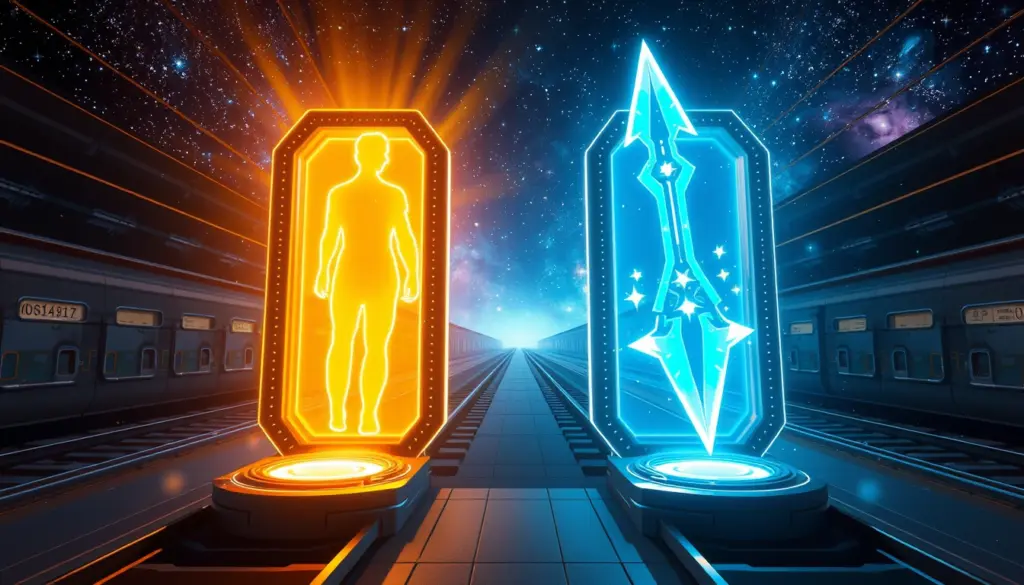
Honkai Star Rail runs on three separate warp pools: the Stellar Warp (the permanent standard banner), the Character Event Warp (limited-time featured characters), and the Light Cone Event Warp (limited-time featured weapons). Each pool tracks its own pity counter independently. Spending on the Character Event Warp does nothing for your Light Cone pity, and vice versa. That separation is exactly why the two systems need separate math instead of one blended number.
Every pull, officially called a warp, costs 160 Stellar Jade. You rarely spend Stellar Jade directly with cash, though. Real money buys Oneiric Shards, which convert to Stellar Jade at a 1:1 rate. A Star Rail Special Pass, used for both event warp types, also costs 160 Stellar Jade, so the practical chain is: dollars buy Oneiric Shards, Oneiric Shards become Stellar Jade, and 160 Stellar Jade buys one warp. That three-step conversion is where a lot of players lose track of what a pull actually costs them in cash.
Pity in Honkai Star Rail works on two layers. A hard pity guarantees a 5-star result by a fixed pull count, no exceptions. A soft pity ramps the odds up sharply in the pulls leading up to that hard cap, so most players hit their 5-star before the ceiling rather than exactly on it. HoYoverse publishes the hard numbers, a disclosure required under Apple’s App Store review guidelines for any game selling randomized virtual items. It has never published the exact soft-pity formula for either banner, and that gap matters for how confidently you can budget. For a broader look at how this base-rate-plus-pity structure shows up across other gacha games, see our breakdown of how gacha drop rates are calculated.
Character Event Warp: Base Rate, Soft Pity, Hard Pity
The Official Numbers
HoYoverse’s official Honkai Star Rail warp rate notice puts the base 5-star rate on the Character Event Warp at 0.6% per pull, with a 5.1% base rate for 4-star results and 94.3% for 3-star Light Cones that come bundled into character pulls. A 5-star is guaranteed by the 90th warp if you haven’t hit one already, no matter how unlucky the run has been up to that point.
That 0.6% figure sounds brutal in isolation. Multiply it out as a simple geometric average (1 divided by 0.006) and you’d expect to need 166.67 pulls for a single 5-star with no cap at all. The 90-pull hard pity cuts that tail risk off entirely. Nobody on this banner goes 150 pulls without a 5-star, because the game won’t let that happen.
What’s Officially Confirmed vs. Community-Estimated
Large-scale community pull tracking, the kind long-running Star Rail statistics trackers on HoYoLAB have published across hundreds of thousands of logged warps, consistently places the start of the soft-pity ramp around pull 74. From that point, the odds of a 5-star climb sharply with every additional pull until they hit 100% at pull 90. That number is useful context, but it has never appeared in an official HoYoverse rate document, so treat it as a well-supported community estimate rather than a confirmed mechanic. The only numbers HoYoverse itself puts its name to are the 0.6% base rate and the 90-pull hard cap.
Light Cone Event Warp: A Different Curve Entirely
The Official Numbers
The Light Cone Event Warp runs on a noticeably friendlier curve. The published base 5-star rate is 0.8% per pull, almost a third higher than the character banner’s 0.6%. Hard pity arrives sooner too, at 80 warps instead of 90. Community pull-tracking data places the Light Cone soft-pity ramp starting around pull 65 to 66, again unofficial but consistent across large sample sizes.
The bigger difference shows up in the featured-item odds. When a Light Cone 5-star isn’t already guaranteed, there’s a 75% chance it’s the specific featured item rather than a random 5-star from the standard pool. That’s a much friendlier split than the character banner’s flat 50/50, and it’s the single biggest reason the Light Cone math comes out cheaper overall.
The 50/50 vs the 75/25: Why the Guarantee Math Diverges
Both event warps use the same basic shape: pull a 5-star, find out if it’s the one you want, and get a guaranteed shot at the featured item if it isn’t. The odds inside that shape are where they split apart.
- Character Event Warp: when a 5-star isn’t already guaranteed to be featured, you have a 50% chance it’s the character you wanted. Lose that coin flip and the next 5-star you pull on that banner is guaranteed to be the featured character.
- Light Cone Event Warp: the same structure runs at 75/25 instead of 50/50. Lose the 25% side and the next 5-star Light Cone is guaranteed to be the featured one.
Because losing the coin flip happens half the time on the character banner and only a quarter of the time on the Light Cone banner, the “worst case, run it twice” scenario is both rarer and cheaper on the Light Cone side. That single difference in guarantee odds is what drives most of the 26% expected-value gap between the two systems. Genshin Impact runs a similar 50/50 structure on its character banner, broken down in our Genshin Impact 50/50 odds explainer, which makes a useful side-by-side comparison for anyone who plays both games.
The Worked Pity-Cost Table: Stellar Jade and USD Side by Side
Using the official rates above and a verified cost of $1.98 per warp, shown in the next section, here’s what each scenario actually costs in Stellar Jade and real money.
| Scenario | Warps | Stellar Jade | USD cost |
|---|---|---|---|
| Character: any 5-star guaranteed (hard pity floor) | 90 | 14,400 | $178.20 |
| Character: featured unit, best case (win the 50/50) | as few as 1 | 160 | $1.98 |
| Character: featured unit, worst case (lose the 50/50) | 180 | 28,800 | $356.40 |
| Character: conservative expected value (50/50-weighted) | 135 | 21,600 | $267.30 |
| Light Cone: any 5-star guaranteed (hard pity floor) | 80 | 12,800 | $158.40 |
| Light Cone: featured item, worst case (lose the 75/25) | 160 | 25,600 | $316.80 |
| Light Cone: conservative expected value (75/25-weighted) | 100 | 16,000 | $198.00 |
| Both featured units, combined worst case | 340 | 54,400 | $673.20 |
| Both featured units, combined conservative EV | 235 | 37,600 | $465.30 |
The “conservative expected value” rows aren’t a casual guess. They’re a probability-weighted calculation built entirely from HoYoverse’s own published odds, explained step by step below. Because the exact soft-pity curve isn’t officially published, this method uses the hard-pity ceiling as the input for each branch, which means the real-world average is likely somewhat lower than these figures. Most 5-stars land before the hard cap, not exactly on it, so treat these numbers as a ceiling-weighted estimate rather than a lab-measured average.
What a Pull Actually Costs: Oneiric Shard Pricing, Verified
The official US top-up listing for Honkai Star Rail, matched by the Codashop US storefront pricing table, sells Oneiric Shards in six fixed tiers. Each tier includes a standard bonus on top of the base amount.
| Pack | Base shards | Bonus | Total shards | USD price | Price per shard |
|---|---|---|---|---|---|
| Smallest | 60 | 0 | 60 | $0.99 | $0.0165 |
| Second tier | 300 | 30 | 330 | $4.99 | $0.0151 |
| Mid tier | 980 | 110 | 1,090 | $14.99 | $0.0138 |
| Upper tier | 1,980 | 260 | 2,240 | $29.99 | $0.0134 |
| Large tier | 3,280 | 600 | 3,880 | $49.99 | $0.0129 |
| Largest tier | 6,480 | 1,600 | 8,080 | $99.99 | $0.012375 |
The largest pack is the clear best value per shard, which is standard for gacha top-up tiers across the industry. At $99.99 for 8,080 total Oneiric Shards, the price per shard works out to exactly $0.012375. Multiply that by 160 shards per warp and a single pull costs $1.98 when bought at the best available rate. Every dollar figure in the pity-cost table above uses that $1.98-per-warp number. Buying only the smallest packs instead pushes the real cost up by roughly 33%, since the $0.99 tier carries no bonus shards at all.
Step-by-Step Expected-Value Calculation
Here’s the full math behind the $267.30 character figure and the $198.00 Light Cone figure, broken into each step.
- Start with the hard-pity ceiling for a single 5-star. Character Event Warp: 90 warps. Light Cone Event Warp: 80 warps. These are guaranteed, not probabilistic, so they’re a fixed input rather than an average.
- Apply the featured-unit split. Character: 50% chance the first 5-star is already the featured unit. Light Cone: 75% chance.
- Model the branch where you win immediately. Cost equals however many warps it took to land that first 5-star, capped at 90 (character) or 80 (Light Cone).
- Model the branch where you lose the coin flip. You now need a second 5-star, guaranteed to be the featured unit, capped at another 90 warps (character) or 80 warps (Light Cone). Total ceiling for this branch: 180 warps (character) or 160 warps (Light Cone).
- Weight both branches by their official probability. Character: (0.5 x 90) + (0.5 x 180) = 135 warps. Light Cone: (0.75 x 80) + (0.25 x 160) = 100 warps.
- Convert warps to Stellar Jade. 135 x 160 = 21,600 Stellar Jade (character). 100 x 160 = 16,000 Stellar Jade (Light Cone).
- Convert Stellar Jade to USD at the best-value rate. 21,600 x $0.012375 = $267.30 (character). 16,000 x $0.012375 = $198.00 (Light Cone).
Every input in that chain, the 90/80 hard pity, the 50/75 split, and the $0.012375 per-shard rate, comes from an official source. The only simplification is using the hard-pity ceiling as the branch cost instead of the true unpublished soft-pity average, which makes this a conservative, worst-case-weighted figure rather than a measured real-world average.
Five Worked Examples With Real Numbers
Example 1: A player wants any 5-star, not a specific one. Worst case, that’s 90 warps on the character banner, costing 14,400 Stellar Jade or $178.20 at the best top-up rate. On the Light Cone banner the same floor is 80 warps, 12,800 Stellar Jade, $158.40.
Example 2: A player chases the featured character and wins the 50/50 on the first try. That could happen in as few as one pull, but realistically lands somewhere before the 90-warp ceiling. The guaranteed worst case is 180 warps, $356.40. The conservative expected cost across both branches is $267.30.
Example 3: A player only wants the featured Light Cone, skipping the character entirely. Worst case is 160 warps, $316.80. Conservative expected cost is $198.00, which is $69.30 less than the equivalent character calculation.
Example 4: A player wants both the featured character and the matching featured Light Cone in the same patch. Stacking the two worst cases gives 340 total warps, 54,400 Stellar Jade, $673.20. Stacking the two conservative EV figures gives 235 warps, 37,600 Stellar Jade, $465.30. That’s the real cost of chasing a signature pairing, and it’s why most guides tell players to pick one priority per patch rather than both.
Example 5: A player with a single $14.99 top-up and nothing saved. That purchase buys 1,090 Oneiric Shards, enough for 6 full warps (960 shards spent) with 130 shards left over. Six pulls against a 0.6% base rate gets nowhere near the soft-pity ramp, let alone the 90-pull hard cap. This is the gap between buying currency and actually approaching a guarantee, and it’s the single most common budgeting mistake in gacha spending.
Why the Hard-Pity Ceiling Beats Pure Base-Rate Math
A 0.6% base rate, treated as a simple geometric average, implies you’d need 166.67 pulls on average for one 5-star, with a long tail where unlucky players could theoretically go 300 or 400 pulls without one. HoYoverse’s 90-pull hard cap removes that tail completely. No matter how the random number generator behaves, the system forces a 5-star by pull 90. The same logic applies to the 0.8% Light Cone rate, which implies a 125-pull average with no cap, cut down to an 80-pull hard ceiling.
Industry coverage of gacha monetization, including reporting from outlets like GamesIndustry.biz, has tracked this shift toward published pity ceilings as regulatory pressure in multiple regions pushed publishers away from undisclosed odds. This is the core argument for why pity systems exist at all: they bound the worst-case outcome. A player can still spend a lot chasing a specific featured unit through the 50/50 or 75/25 layer, but they can never be trapped in an unlucky streak that never ends for a basic 5-star. That bounded worst case is also what makes a real expected-value calculation possible in the first place. Without a hard cap, there would be no fixed number to weight the branches against.
Does Pity Carry Over Between Patches?
Within the same warp type, yes. A player sitting at pull 60 on the Character Event Warp when a patch ends keeps that count when the next Character Event Warp banner opens. The counter only resets to zero the moment it produces a 5-star. The same rule applies to the Light Cone Event Warp independently, and a lost 50/50 or 75/25 guarantee also carries forward: if you’re owed a guaranteed featured unit on your next 5-star, that debt follows you into the next banner of the same type.
What doesn’t carry over is pity between warp types. Grinding close to hard pity on the Light Cone banner gives you nothing on the Character banner’s counter, and the two should always be budgeted as separate pools, exactly as the pity-cost table above treats them.
Myths vs Facts About Honkai Star Rail’s Pity System
| Myth | Fact |
|---|---|
| Losing the 50/50 twice in a row means the account is rigged. | Each 50/50 is an independent 50% roll. Losing twice in a row happens to roughly 1 in 4 players who go through the cycle twice, which is unlucky but not evidence of manipulation. |
| HoYoverse publishes the exact soft-pity percentage increase per pull. | It doesn’t. The 0.6%/0.8% base rates and the 90/80 hard-pity caps are official. The pull-by-pull soft-pity ramp is a community-derived estimate from large sample tracking, not a published formula. |
| Free-to-play players can never reach a 5-star without spending. | The 90-warp (character) and 80-warp (Light Cone) hard pity apply regardless of how the currency was earned. Free sources like daily missions and events can reach that cap, just more slowly than paid currency. |
| Light Cone pity works the same as character pity. | It doesn’t. The base rate, hard-pity count, and guarantee odds are all different, and the gap is large enough to change which banner is the better value. |
| Buying the biggest currency pack is always proportionally better. | It is better, but the gap is modest, not dramatic. The largest pack’s per-shard price is about 25% lower than the smallest pack’s, not several times cheaper. |
Is Chasing Both Guarantees Ever Worth the Money?
That depends entirely on what the featured character and Light Cone do for your account, which isn’t something a probability table can answer. What the math above can answer is the price of certainty. Guaranteeing the featured character alone runs a conservative $267.30 in expected spend and caps out at $356.40 if the 50/50 breaks against you twice. Adding the matching Light Cone on top pushes the conservative figure to $465.30 and the worst case to $673.20.
For most accounts, the better strategy is to pick the higher-priority item, usually the character, since it anchors the team, and treat the Light Cone as optional unless a 4-star substitute performs close enough. That single decision is where the 26% expected-value gap between the two warp types actually matters: it shows how much extra certainty costs, in real dollars, before committing a budget to both. The same price-of-certainty logic applies across the genre, as shown in our gacha banner expected value explainer.
Frequently Asked Questions
What is Honkai Star Rail’s official 5-star drop rate?
The published base rate is 0.6% per warp on the Character Event Warp and 0.8% per warp on the Light Cone Event Warp, according to HoYoverse’s official warp rate notice.
How many warps does it take to guarantee a 5-star in Honkai Star Rail?
A 5-star is guaranteed within 90 warps on the Character Event Warp and within 80 warps on the Light Cone Event Warp. Both are hard ceilings, not averages.
What happens when you lose the 50/50 on a Character Event Warp?
Your next 5-star pull on that same banner type is guaranteed to be the featured character. In the worst case, that means up to 90 more warps, for a combined ceiling of 180 warps.
Is the Light Cone Event Warp cheaper to pity than the Character Event Warp?
Yes. The conservative expected cost is $198.00 for the Light Cone against $267.30 for the character, a 25.9% gap, driven mainly by the friendlier 75/25 guarantee odds versus the character banner’s 50/50.
Does HoYoverse publish the exact soft-pity formula?
No. It publishes the base rate and the hard-pity cap for both banners. The pull-by-pull ramp that community trackers place around pull 74 for characters and pull 65 to 66 for Light Cones is a statistical estimate, not an official mechanic.
How much does it cost in USD to guarantee a featured 5-star character?
At the best available top-up rate of $0.012375 per Oneiric Shard, the worst-case cost is $356.40 for 180 warps. The conservative expected cost is $267.30.
Does pity carry over between patches or banners?
Pity carries over within the same warp type between successive banners, and a lost guarantee roll carries over too. Pity does not transfer between the Character Event Warp and the Light Cone Event Warp, since they run as separate pools.
Is Honkai Star Rail pay-to-win based on these odds?
The hard-pity system means no player, paying or free, is permanently locked out of a 5-star. Spending shortens the time it takes to reach that guarantee, but the ceiling itself, 90 warps for a character and 80 for a Light Cone, applies the same way to every account.