How to Convert Bitcoin to Monero
- ChangeNOW is our pick for converting Bitcoin to Monero. Its BTC/XMR converter needs no account, offers both fixed and floating rates and tracks every order live, and the company reports an average standard exchange time of about one minute.
- No account doesn’t rule out checks. Any single order can still be held for a compliance review.
- Expect roughly half an hour before the XMR is spendable, most of it spent on the Bitcoin confirmation and Monero’s 10-block wallet lock.
- When you compare services, look at how much XMR each one says you’ll receive. The margin is already built into that figure.
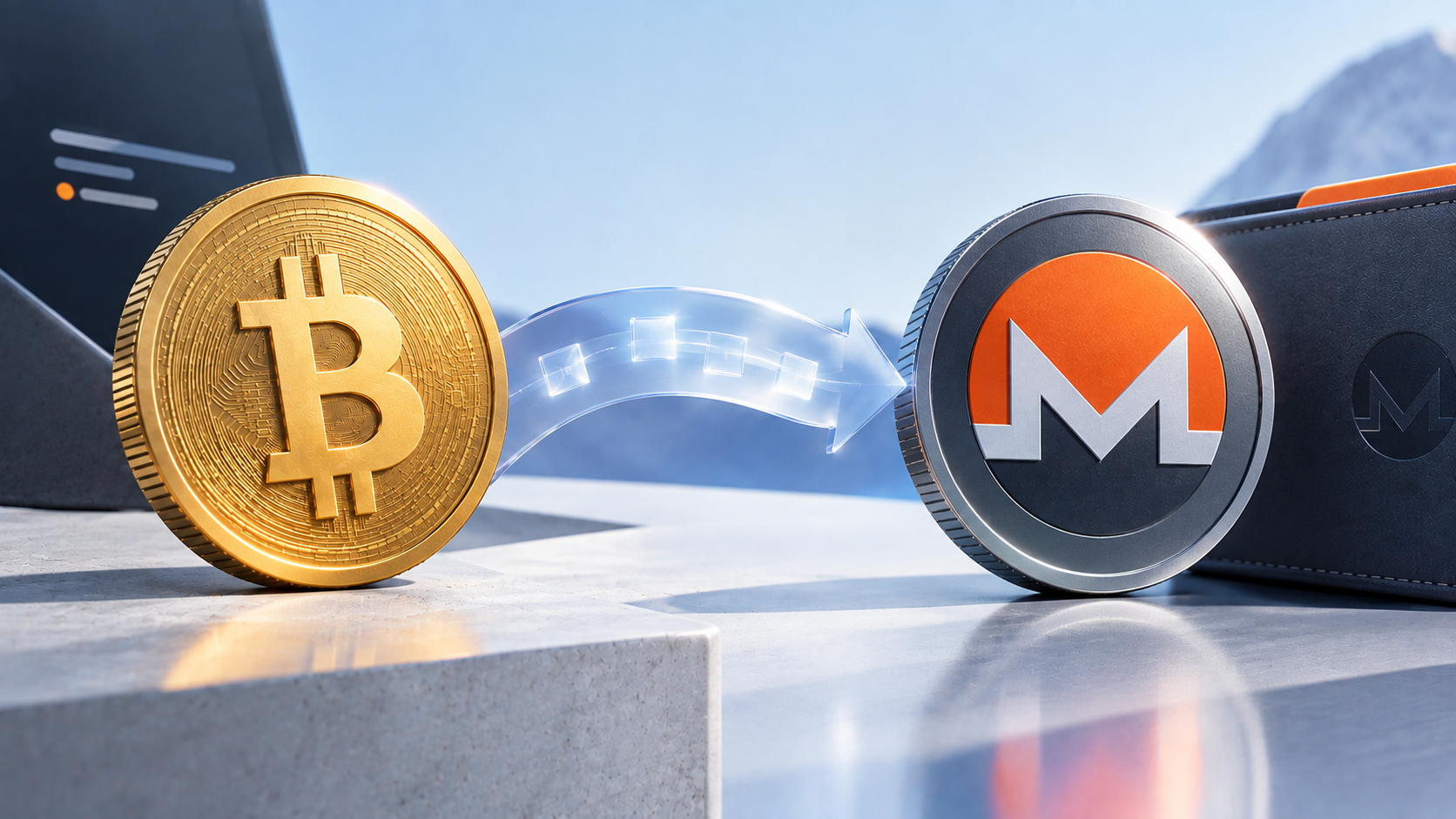
Most people convert Bitcoin to Monero through an instant converter. You send BTC to a one-time address and get XMR back in your own wallet, with no exchange account in between. If you’re figuring out how to convert Bitcoin to Monero for the first time, the two choices that change your result are the rate type and the fees hidden in the quote. Speed depends mostly on the two blockchains.
Atomic swaps and centralized exchanges are the other two routes.
Key facts
Factor | Detail | Source |
|---|---|---|
Monero block time | About 2 minutes | Monero technical specs |
Bitcoin block time | About 10 minutes on average | Bitcoin protocol target |
Lock on received XMR | Wallets commonly wait 10 blocks, roughly 20 minutes | Default in Monero GUI and CLI wallets |
Monero block reward | 0.6 XMR per block, fixed since tail emission began in 2022 | Monero technical specs |
BTC to XMR atomic swaps | Supported in the BTC-to-XMR direction through eigenwallet | eigenwallet |
Monero mining algorithm | RandomX, in use since November 2019 | Monero technical specs |
Data as of October 2026.
How Does a Bitcoin to Monero Converter Work?
To convert BTC to XMR on a converter, you send bitcoin to a one-time deposit address and the service pays Monero to your wallet. You never keep a balance with it. No account is needed to start, although an individual order can still be held for a compliance check. The steps:
- Get a Monero wallet first. The Monero Project publishes its own GUI and command-line wallets on the getmonero.org downloads page, though plenty of people use Feather on desktop or Cake Wallet on a phone instead. Whichever you pick, generate a new subaddress for this swap so the payment doesn’t blend into your other incoming transfers.
- Next comes the order form. With BTC as the coin you’re sending and XMR as the one you’re receiving, the amount you type produces an XMR estimate straight away.
- This is also where you choose between a fixed and a floating rate, which decides who carries the risk while your deposit confirms.
- The subaddress goes into the recipient field. If there’s an optional box for a BTC refund address, it’s worth the ten seconds: should the order fail, the coins come back without anyone opening a support ticket.
- Then the deposit. The amount has to match the order exactly, and the fee deserves a quick look at the mempool first, since the cheapest setting on a busy day can leave the transaction waiting for hours.
- After that it’s mostly waiting. The order page shows each stage as it happens, and the XMR lands in your wallet a few minutes after the swap goes through, though the wallet keeps it locked for a short while before you can spend it.
Ninety-five characters is a lot to check by eye, and that’s the length of a standard Monero address (it starts with a 4; subaddresses start with an 8). Hardly anyone reads the whole string. Holding the first six or so characters and the last six against what your wallet shows is usually enough to catch a bad paste, including the kind clipboard malware produces.
The BTC/XMR converter on ChangeNOW includes real-time transaction tracking, while ChangeNOW reports an average standard exchange time of about one minute. Tracking matters more with this pair than with most. With bitcoin, anyone holding a transaction ID can look the payment up on a block explorer. A Monero explorer shows that the transaction exists and what fee it paid, but RingCT hides the amount and stealth addresses hide who received it. In a dispute, the sending side can share a transaction key, which proves that a specific payment reached your address.
How Is the BTC to XMR Exchange Rate Determined?
When you convert BTC to XMR, the quote starts with the market price of BTC against XMR on the venues the service trades through. Its own margin goes on top, and the network fee for sending XMR to you is normally subtracted before you see the estimate. So the "you get" figure is already close to a net amount.
Monero trading is spread more thinly these days. Binance stopped listing XMR in February 2024, and a few other big exchanges have dropped it in parts of their markets. Prices drift apart between services because of that. On a big order the gap grows, since the trade itself pushes the price (slippage).
When Is a Fixed BTC to XMR Rate Useful?
A fixed rate locks the XMR amount when you create the order. If BTC slides against XMR while your deposit waits for a confirmation, you still get the number you were shown. Services price that guarantee into the quote, so a fixed offer usually comes in slightly below a floating one for the same amount.
The lock pays off when you need an exact result. Say you owe someone 2 XMR and need exactly that much to land in your wallet. It also helps with a large swap on a day when the market is jumpy, because a small percentage move on a big amount is real money.
The guarantee has a time limit, shown on the order. Send your BTC with a decent fee so the deposit reaches the service inside that window. If it arrives late, the service will usually either recalculate at the current rate or refund you, and its terms say which.
When Is a Floating BTC to XMR Rate Better?
A floating rate is set only when the swap executes, after your BTC has confirmed. You carry the market risk for those minutes, and the final XMR can come in above the estimate as easily as below it. In exchange, the starting quote is better.
For small and mid-sized swaps on a calm market, that trade usually works in your favor. Here’s how it can play out, with invented numbers just to show the mechanics. Suppose the floating quote is 1.000 XMR and the fixed one is 0.990 XMR. A 0.5% move against you before execution would leave the floating order paying roughly 0.995 XMR. The market has to move more than 1% the wrong way before the fixed quote would have come out ahead, and a few minutes of exposure rarely shifts BTC/XMR that much.
Floating is also more forgiving when your Bitcoin deposit is slow. There’s no lock window to miss, so a low-fee transaction that sits in the mempool for half an hour simply gets converted at whatever the price is when it lands.
How Fast Is a BTC to XMR Conversion?
A typical BTC to XMR conversion takes about half an hour before the Monero is spendable, and almost all of that time goes on waiting for blocks. The converter’s own step is the quick part.
Bitcoin is the slow side. No service releases XMR before your deposit confirms, and how soon that happens depends largely on the fee you picked. Monero blocks arrive about every two minutes, so the payout reaches your wallet soon after it’s sent.
Stage | Typical time |
|---|---|
Bitcoin deposit confirmation | About 10 minutes for one block; longer with a low fee or if the service waits for more confirmations |
Converter processing | About one minute on average, as reported by ChangeNOW |
Monero payout included in a block | About 2 minutes |
Wallet lock on received XMR | 10 blocks, about 20 minutes |
An atomic swap is slower, because both sides lock funds on-chain and wait for confirmations before anything is released, and user reviews of eigenwallet on KYCnot.me describe swaps taking roughly 30 minutes to an hour with the app left running.
What Fees Apply to BTC to XMR Conversions?
A converter swap carries three costs, and only one of them shows up as a separate line. The first is the Bitcoin network fee you pay when you send the deposit. Your wallet sets it, and the converter has no say in it. The fee is priced by the transaction’s size in bytes, as the Bitcoin developer guide explains, so sending 0.01 BTC can cost about the same as sending 1 BTC. What changes the price is how busy the mempool is at that moment.
The converter’s margin sits inside the exchange rate. That’s why the final XMR figure is the number to compare between services, and an advertised "low fee" on its own tells you little.
The Monero network fee on the payout is small. Block size on Monero adjusts to demand, so there’s little competition for space in a block, and miners are paid mostly through the fixed 0.6 XMR reward. On a converter swap, the Bitcoin fee and the spread are the costs you’ll actually notice.
Atomic swaps work out differently. The market maker you trade with sets its own price, you pay Bitcoin fees for the lock transaction, and a cancelled swap adds the cost of the refund transaction.
How Do BTC to XMR Converters Compare?
A Bitcoin to Monero converter is the quickest option and needs nothing installed. Atomic swaps take longer, but no company ever holds your coins, while a centralized exchange adds a sign-up and a withdrawal to the process.
Route | Account | Who holds the funds during the trade | What sets the time | Main trade-off |
|---|---|---|---|---|
Instant converter | Not required; compliance checks may apply | The service, for that one order | Bitcoin confirmation plus the Monero wallet lock | Margin is built into the rate |
Centralized exchange | Required, usually with identity verification | The exchange, until you withdraw | Deposit, trade and withdrawal queues | Fewer large venues list XMR |
Atomic swap (eigenwallet) | None | Locked on-chain by the protocol | Confirmations on both chains; the app has to stay running | Setup and a longer wait |
Choosing between converters comes down mostly to arithmetic. Put the same BTC amount into two or three of them within a minute or so and see which one promises the most XMR. Past the price, look at the minimum order, whether fixed rates are on offer and what the terms say about orders held for review. You’ll appreciate live tracking and round-the-clock support the moment your bitcoin has left the wallet and nothing seems to be happening.
The best-known atomic swap tool is eigenwallet, a community project built on swap code that COMIT developed and the Monero Project announced to users in 2021. It matches you with a market maker and runs the locks and refunds through its desktop app. If a swap stalls, your BTC comes back once the timelock expires, but only if the app is online to claim it. The catch is scope: it handles BTC and XMR and nothing else.
A centralized exchange makes sense mainly if you already have a verified account on one that still lists XMR. In Europe that list is set to shrink further, since the EU’s anti-money laundering regulation bars licensed crypto providers from handling anonymity-enhancing coins such as Monero from July 2027.
FAQ
Can I convert Bitcoin to Monero without an account?
Instant converters let you start an order without one, though any order can still be held for a compliance review. Atomic swaps through eigenwallet involve no account at all.
Why does my new XMR show as locked?
It’s a safety rule built into Monero wallets, and newcomers often mistake it for a stuck swap. Funds stay locked for 10 blocks so that a short chain reorganization can’t undo a payment you’ve already spent, and they unlock automatically after that.
Can I convert XMR back to BTC later?
Instant converters work in both directions, so XMR to BTC is no problem there. Atomic swap tools are another matter. For a long time they worked only in the BTC-to-XMR direction, so look at the release notes for whatever version you have before counting on one for the way back.
Is it legal to convert Bitcoin to Monero?
There’s no single answer, because the rules are set country by country (and, in the EU, at the bloc level). The EU’s upcoming restrictions target licensed providers, not people who hold XMR, and some exchanges have already pulled Monero for European users. Look up the rules where you live and make sure the converter accepts users from your country before you send BTC.