
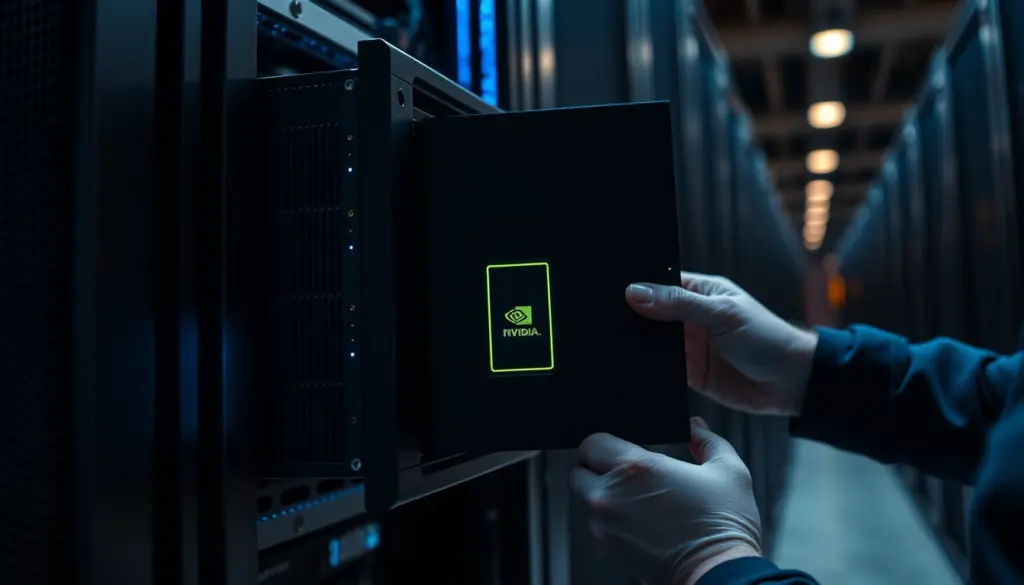
Hewlett Packard Enterprise shares pushed toward record territory on October 4, 2026, as Wall Street kept digesting a server launch that NVIDIA CEO Jensen Huang framed in blunt terms: agentic AI, he said, “has arrived, and it needs a new CPU.” The line landed on June 1, 2026, at Computex in Taipei, when HPE (NYSE: HPE) introduced the HPE ProLiant Compute DL394 Gen12, a 2U rack server built around NVIDIA’s new Vera CPU. Four months later, the stock move that followed the announcement has become one of the more closely watched hardware stories of the year, and it says as much about the AI infrastructure arms race as it does about HPE itself.
Reports from Yahoo Finance and HPE’s own newsroom describe shares rising more than 7% in premarket trading on the day of the Computex reveal, with the stock on course for a record open. That reaction, unusual for what amounts to a single server SKU announcement, reflects how starved the market has become for any signal that an enterprise hardware vendor can grab a meaningful slice of the agentic AI buildout that NVIDIA, AMD, and a widening field of chipmakers are now racing to serve.
What the HPE ProLiant Compute DL394 Gen12 Actually Is
Strip away the marketing language and the DL394 Gen12 is HPE’s answer to a specific problem: agentic AI workloads chew through memory bandwidth in ways that classic x86 servers were never built to handle. HPE’s own product page describes the machine as “built for the most demanding and secure AI and data workloads,” pairing the NVIDIA Vera CPU with what the company calls industry-leading iLO 7 security and HPE Compute Ops Management for AI-driven operational insight.
The spec sheet HPE publishes for the DL394 Gen12 lists a 2U air-cooled rack chassis, support for up to two double-wide GPUs, EDSFF storage, and as much as 3 TB of LPDDR5X memory with ECC (also marketed under the SOCAMM naming NVIDIA uses for its memory modules). HPE lists the target workloads plainly: financial services tasks like high-frequency trading and Monte Carlo simulation, agentic AI sandbox workloads, and reinforcement learning models. That is a narrower, more specific pitch than the general-purpose AI server positioning HPE has used for its GPU-heavy ProLiant lines, and it is deliberate. The company is betting that a chunk of the AI infrastructure market wants a CPU-first machine, not just another GPU box.
For context on how that compares with HPE’s GPU-centric offerings, the economics look different from systems built around NVIDIA’s DGX Spark line, where pricing splits sharply between 64GB and 128GB configurations. The DL394 Gen12 is not trying to compete on raw GPU throughput. It is selling CPU-side memory bandwidth and latency as the bottleneck worth fixing.
Inside the Vera CPU: The Numbers HPE Is Publishing
According to HPE’s own product listing, the Vera CPU inside the DL394 Gen12 ships with 88 cores and support for 176 threads, built around what HPE describes as a monolithic architecture rather than a chiplet design. HPE’s copy argues that the monolithic layout “ensures that every processor core in the system always has access to the latest, most accurate data seamlessly and instantaneously,” a design choice aimed squarely at memory-constrained workloads where chiplet-to-chiplet latency can become a bottleneck.
HPE claims the platform delivers twice the memory bandwidth of traditional x86 platforms, a fourfold increase in sandbox density, and support for up to 1.5 TB of memory per socket. Those are vendor figures, not independently benchmarked results, and HPE has not published third-party test data alongside the claims. The company’s wording tracks closely with Huang’s framing from the Computex stage, where he said Vera “was built to orchestrate AI factories, delivering 2x the efficiency and faster task completion than x86.”
Vera is NVIDIA’s successor to the Grace CPU, which the company positioned as an Arm-based data-center chip for high-performance computing and AI infrastructure starting several years ago. Where Grace was pitched broadly, Vera’s early marketing leans hard into agentic AI specifically, a sign of how fast the industry’s vocabulary has shifted from generic “AI workloads” to task-executing software agents as the thing data centers need to be provisioned for. NVIDIA has paired Vera with its Rubin GPU platform in some configurations, and early MLPerf inference results for the combined Vera Rubin NVL72 system gave the first independent look at how that pairing performs against NVIDIA’s prior GB300 generation.
DL394 Gen12 Spec Sheet at a Glance
| Spec | HPE-published detail |
|---|---|
| Form factor | 2U rack, air-cooled |
| Processor | NVIDIA Vera CPU (Vera C2), 88 cores / 176 threads, monolithic architecture |
| GPU support | Up to 2 double-wide GPUs |
| Maximum memory | Up to 3 TB LPDDR5X with ECC (SOCAMM) |
| Storage | EDSFF |
| Management | HPE iLO 7, HPE Compute Ops Management |
| Target workloads | Agentic AI sandboxing, reinforcement learning, high-frequency trading, Monte Carlo simulation |
| Stated availability | Fall 2026, per HPE’s June announcement |
That memory ceiling matters more than it might look. Reinforcement learning and agentic workloads often keep large context windows and intermediate state in memory rather than streaming everything through a GPU, so a CPU platform that can hold 3 TB locally changes how architects design the rest of the rack. It also explains why HPE and NVIDIA keep returning to the word “orchestrate” rather than “accelerate” when describing Vera’s job inside an AI factory.
Why Jensen Huang’s “New CPU” Line Landed the Way It Did
Huang has made a habit of pairing product launches with quotable, slightly provocative framing, and “agentic AI has arrived, and it needs a new CPU” fits the pattern. It is a direct challenge to the idea that x86 chips from Intel and AMD remain the default choice for every server socket in an AI data center. HPE’s newsroom carried the quote at the Computex announcement, and it has since been repeated across coverage of the DL394 Gen12 launch as shorthand for NVIDIA’s broader push to own more of the AI server stack, not just the GPU slot.
That push has rivals paying attention. AMD has been positioning its own EPYC Venice server chips against both Intel’s Xeon line and NVIDIA’s CPU ambitions, and early EPYC Venice benchmarks showed it beating Xeon by a wide margin while edging closer to Vera CPU territory. The fact that AMD is now benchmarking against an NVIDIA CPU at all, rather than just Intel, tells you how quickly Huang’s “new CPU” framing has reshaped the competitive conversation in data-center silicon.
The Stock Reaction, By the Numbers
HPE shares rose more than 7% in premarket trading on June 1, 2026, the day of the Computex announcement, putting the stock on track for a record open, according to reports cited in HPE’s own investor materials and market coverage. That initial pop was not a one-off. Yahoo Finance later reported that HPE stock closed at a fresh record high on growing networking orders, including a $1.2 billion AMD Helios order, a headline that shows the Vera server news arrived alongside, not instead of, other demand signals for HPE’s business. TradingView’s market data lists HPE’s all-time high at $70.29, reached on October 2, 2026, just two days before this report, underscoring that the rally building since the June announcement has continued rather than faded.
That is a meaningfully different trajectory from HPE’s results immediately after its fiscal third-quarter earnings, when shares reportedly fell after hours despite the company beating estimates and raising full-year guidance. Investors, in other words, have responded more enthusiastically to the Vera server story and networking order flow than to the underlying quarterly print itself, a pattern that is becoming common across the AI infrastructure trade in 2026.
HPE’s Raised Fiscal 2026 Guidance
The Vera server launch did not happen in a vacuum. HPE’s Q3 fiscal 2026 earnings materials gave a fourth-quarter revenue outlook of $13.9 billion to $14.8 billion, which the company’s own presentation framed as roughly 34% to 37% growth. HPE also raised its full-year adjusted earnings-per-share guidance to a range of $3.75 to $3.85, with fourth-quarter EPS guidance reported separately at $1.20 to $1.30. The company lifted its fiscal 2026 free-cash-flow target to at least $3.75 billion and raised its networking segment growth outlook to 73% to 74% for the year, a figure that leans heavily on the Juniper Networks integration HPE completed in 2025.
Table: HPE’s Fiscal 2026 Financial Targets
| Metric | Updated guidance |
|---|---|
| Q4 FY2026 revenue outlook | $13.9 billion – $14.8 billion |
| Implied Q4 revenue growth | Approximately 34% – 37% |
| FY2026 adjusted EPS guidance | $3.75 – $3.85 |
| Q4 FY2026 EPS guidance | $1.20 – $1.30 |
| FY2026 free cash flow target | At least $3.75 billion |
| Networking segment growth outlook | 73% – 74% for FY2026 |
Put the two tables side by side and a clearer picture forms. HPE is not betting its fiscal year on one server SKU. The Vera-based DL394 Gen12 is a flagship story for the AI-computing portfolio, but the networking growth tied to Juniper and the broader compute backlog are doing more of the heavy lifting on the balance sheet right now. The Vera server’s job, from an investor-relations standpoint, is to prove HPE can win design wins in the agentic AI category before the market share question gets settled.
Where HPE Sits Against Dell and Supermicro
Dell’s PowerEdge line and Supermicro remain the two names most frequently mentioned alongside HPE in AI server coverage, and both continue to compete heavily on systems that pair NVIDIA GPUs with high-speed networking. Neither Dell nor Supermicro has announced a comparable CPU-first AI server tied to NVIDIA’s Vera chip as of this writing, which gives HPE a window, however temporary, to claim the “first mover with Vera” position in enterprise sales conversations.
That window will not stay open indefinitely. NVIDIA sells Vera to any server partner willing to build around it, not exclusively to HPE, so Dell and Supermicro could announce their own Vera-based systems once supply allows. HPE’s actual differentiator is less the silicon itself and more the surrounding stack, specifically iLO 7’s security model and Compute Ops Management’s fleet-level tooling, both of which are HPE-proprietary and not something a rival can simply replicate by buying the same NVIDIA chip.
The broader chip supply backdrop is also squeezing every vendor in this category at once. Memory has become the binding constraint across the AI hardware stack, and NVIDIA’s own Rubin Ultra platform has reportedly lost a third of its intended memory allocation to the ongoing HBM shortage. If high-bandwidth memory stays scarce into 2027, server vendors building around any NVIDIA chip, Vera included, will be fighting for allocation as much as for customers.
The Fall 2026 Versus 2027 Availability Question
One detail worth flagging plainly: HPE’s own product announcement states the DL394 Gen12 becomes available in fall 2026. NVIDIA, in separate material describing the server in connection with HPE Private Cloud AI, has referenced a 2027 timeframe for that specific configuration. Which availability date applies to which exact SKU is not clearly reconciled across the two companies’ public materials, and buyers evaluating the platform should confirm lead times directly with HPE sales rather than assume a single universal ship date. This kind of staggered-availability messaging is common when a hardware partner announces a platform at a trade show before every configuration variant is production-ready, but it is still a gap worth watching as fall 2026 progresses.
Historical Context: HPE Since the 2015 Split
HPE exists in its current form because Hewlett-Packard split itself into two public companies in 2015, separating the PC and printer business, which kept the HP Inc. name, from the enterprise servers, storage, networking, and services business that became Hewlett Packard Enterprise. That split let HPE focus entirely on data-center customers without the consumer hardware cycle dragging on its margins, a decision that looks increasingly prescient a decade later as enterprise AI infrastructure spending has become the dominant growth story in the sector.
HPE’s 2025 acquisition of Juniper Networks added a networking business large enough to meaningfully move the company’s growth numbers, evident in the 73% to 74% networking growth guidance now baked into fiscal 2026 targets. The Vera server announcement should be read against that backdrop: HPE spent a decade building toward being a full-stack enterprise AI infrastructure vendor, spanning compute, networking, storage, and cloud management, and the DL394 Gen12 is the latest proof point in that strategy rather than a standalone bet.
Other hardware vendors are making similar full-stack bets elsewhere in the AI supply chain. Amazon’s roughly $8 billion Nvidia chip leaseback arrangement and the financing structure behind it shows how even the hyperscalers are restructuring balance sheets to keep pace with AI chip demand, while AMD’s push past a $1 trillion market cap earlier this year, detailed in coverage of that milestone, reflects how much investor appetite exists for any company positioned credibly in AI silicon right now.
What This Means for Enterprise AI Buyers
For IT buyers actually shopping for agentic AI infrastructure, the DL394 Gen12 adds a genuinely new category of decision rather than just another SKU to compare on a spec sheet. Instead of choosing purely between GPU-dense boxes from different vendors, buyers now have to decide whether a workload is bottlenecked by GPU throughput or by CPU-side memory bandwidth and latency. HPE’s pitch is that a growing share of agentic AI work, particularly reinforcement-learning training loops and financial-services simulation work, falls into the second category and has been underserved by GPU-first system design.
That is a defensible argument, but it is also an unproven one at scale. HPE has not published independent benchmark results comparing DL394 Gen12 deployments against GPU-centric alternatives running the same agentic workloads, so procurement teams evaluating the platform are, for now, relying on vendor-stated efficiency claims rather than third-party verification. Enterprises running security-sensitive AI agent fleets will also want to weigh HPE’s iLO 7 security model directly against whatever controls competing platforms, including CoreWeave’s own Vera CPU-based infrastructure for AI agents, can offer for the same workloads, since the chip underneath is increasingly similar across vendors even when the surrounding stack is not.
What HPE and NVIDIA Are Saying
HPE’s official description of the DL394 Gen12 leans on both the hardware and the management layer wrapped around it. The company’s product page states the server is “purpose-built for the age of agentic AI and reinforcement learning,” featuring “the NVIDIA Vera CPU along with industry-leading iLO 7 for next-level security and HPE Compute Ops Management for AI-driven insights, delivering breakthrough performance and energy efficiency,” according to HPE’s official product listing.
Elsewhere on the same page, HPE frames the pitch more simply: “Meet the HPE ProLiant DL394 Gen12, powered by the NVIDIA Vera CPU and built for the most demanding and secure AI and data workloads,” per HPE’s product page. A separate section of the same listing describes the target use case in workload-specific terms: “Designed for agentic AI, high-frequency trading, risk modeling, and real-time data streaming, this platform empowers enterprises to accelerate innovation, reduce latency, and securely run mission-critical workloads at scale,” according to HPE.
On the market side, Yahoo Finance’s coverage of HPE’s stock performance carried the headline “HPE stock closes at record high on growing networking orders, $1.2 billion AMD Helios order,” according to Yahoo Finance, tying the stock’s strength to order flow beyond just the Vera server story. TradingView’s market data separately notes that “HPE reached its all-time high on Oct 2, 2026 with the price of 70.29 USD,” according to TradingView, confirming the rally has extended well past the initial June announcement.
Predictions: Where This Goes From Here
- Rival Vera-based servers arrive within two quarters. Once NVIDIA has supply to spare, expect Dell and Supermicro to announce their own Vera-based platforms rather than cede the category to HPE by default.
- The fall 2026 versus 2027 timeline gets clarified, not resolved cleanly. HPE and NVIDIA will likely issue configuration-specific availability dates rather than a single unified ship date, which means buyers should expect staggered rollouts by SKU.
- Independent benchmarks become the next pressure point. HPE’s “2x efficiency” and “4x sandbox density” claims are vendor-stated. Expect third-party labs and cloud providers running Vera-based hardware to publish comparative numbers within the next two to three quarters, similar to how MLPerf results arrived for the Vera Rubin NVL72 platform.
- HBM supply remains the real ceiling on how fast this category scales. With NVIDIA’s own Rubin Ultra reportedly short on memory allocation, any Vera-based server line, including the DL394 Gen12, is exposed to the same component shortage regardless of how strong enterprise demand is.
- HPE’s networking business, not the Vera server alone, stays the bigger near-term swing factor for the stock. The Juniper-driven 73% to 74% networking growth guidance is a larger, more immediate driver of HPE’s fiscal 2026 results than a single new server line, even one generating this much attention.
The Market Impact in Plain Terms
Strip away the stock-chart excitement and the DL394 Gen12 matters most as a signal about how NVIDIA intends to compete beyond the GPU slot. By building a CPU specifically marketed around agentic AI rather than general compute, NVIDIA is pushing further into territory Intel and AMD have held for decades. HPE, by being the first major server vendor to ship a flagship product around that chip, gets to claim the early mover story even if the underlying technology eventually becomes commoditized across every major OEM.
For HPE’s stock specifically, the more durable driver through the rest of fiscal 2026 is likely to remain the combination of networking order flow, the Juniper integration, and overall AI infrastructure capital spending rather than DL394 Gen12 unit sales in isolation. The server matters as proof that HPE can win design wins against NVIDIA’s newest silicon ahead of its direct competitors, which is a meaningfully different, and more durable, kind of value than a single quarter’s hardware revenue.
Frequently Asked Questions
What is the HPE ProLiant Compute DL394 Gen12?
It is a 2U rack server from Hewlett Packard Enterprise built around NVIDIA’s new Vera CPU, announced June 1, 2026, at Computex in Taipei as part of the NVIDIA AI Computing by HPE portfolio.
Why did HPE stock jump after the announcement?
Reports describe HPE shares rising more than 7% in premarket trading on June 1, 2026, putting the stock on track for a record open, a reaction tied to enthusiasm for HPE’s early positioning around NVIDIA’s Vera CPU platform.
What are the Vera CPU’s core specs inside the DL394 Gen12?
HPE’s product listing specifies 88 cores and 176 threads with a monolithic architecture, support for up to 3 TB of LPDDR5X memory with ECC, EDSFF storage, and room for up to two double-wide GPUs in the 2U chassis.
When will the DL394 Gen12 actually ship?
HPE’s June announcement stated fall 2026 availability. Separate NVIDIA material referencing the server within HPE Private Cloud AI has mentioned 2027 for that configuration, and the two timelines have not been clearly reconciled publicly, so buyers should confirm specific lead times with HPE directly.
Is NVIDIA’s Vera CPU the same as Grace?
No. Vera is NVIDIA’s successor to the Grace CPU. Grace was positioned broadly for high-performance computing and AI infrastructure, while Vera’s early marketing is focused specifically on agentic AI, reinforcement learning, and latency-sensitive workloads like high-frequency trading.
How does the DL394 Gen12 compare with Dell PowerEdge or Supermicro systems?
As of this report, neither Dell nor Supermicro has announced a comparable CPU-first server built around NVIDIA’s Vera chip, giving HPE a first-mover position in that specific category, though both companies remain major competitors in GPU-dense AI servers generally.
Are HPE’s performance claims for Vera independently verified?
No. The claims of twice the memory bandwidth of x86 platforms, fourfold sandbox density, and Jensen Huang’s “2x the efficiency” statement are vendor claims from HPE and NVIDIA. No independent benchmark results for the DL394 Gen12 specifically had been published as of this report.
What is driving HPE’s broader fiscal 2026 growth outside the Vera server?
HPE’s networking segment, boosted by its 2025 Juniper Networks acquisition, carries a raised fiscal 2026 growth outlook of 73% to 74%, which is currently a larger driver of the company’s overall guidance than any single new server line.