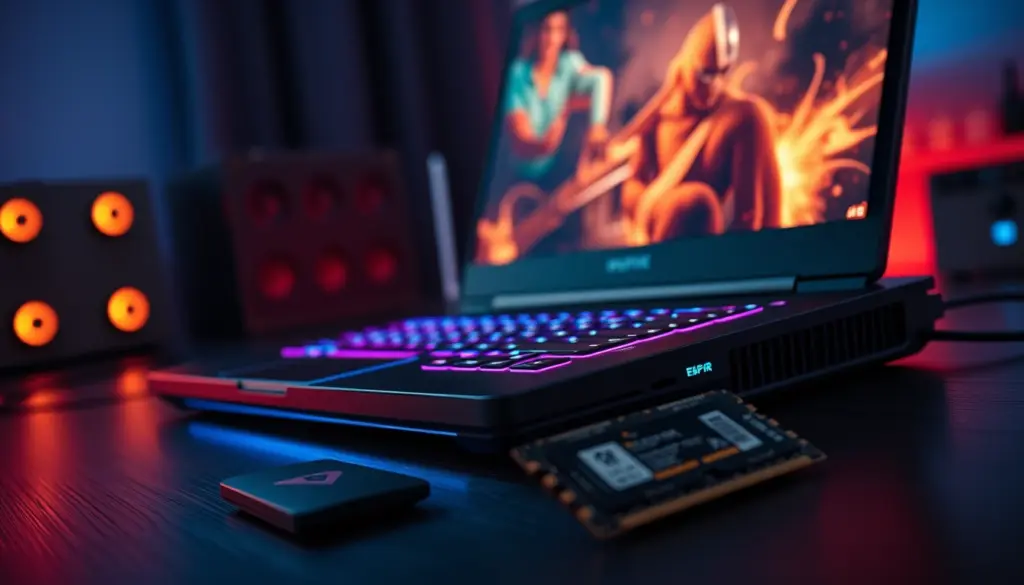
MSI confirmed on August 28, 2026 that its Katana 15 HX C14 gaming laptop is now shipping globally, and the spec sheet has hardware watchers doing a double take. Buyers can configure the machine with dual DDR4-3200 SO-DIMM slots instead of DDR5, a memory choice that all but disappeared from mainstream gaming laptops years ago. According to MSI’s own announcement and coverage from Gizchina, the DDR4 option sits alongside a DDR5 configuration on the same chassis, letting shoppers pick their memory generation the way they’d pick a paint color.
The pairing is what makes this a story instead of a routine SKU refresh. MSI put a 14th-generation Intel Core i9-14900HX and an NVIDIA GeForce RTX 5070 Laptop GPU with 8GB of GDDR7 memory behind that DDR4 option, according to WCCFTech. That’s a current-generation GPU riding on a memory standard most vendors phased out for gaming hardware two or three product cycles ago. Reporting from finance outlet BigGo Finance frames the decision plainly: DRAM prices spiked hard enough in 2026 that MSI decided a “rare backward step” on memory was worth taking to protect the laptop’s price point.
MSI Katana 15 HX C14: what actually shipped
The Katana 15 HX C14 is a 15.6-inch performance gaming laptop, and MSI redesigned the chassis around a 2.1 kg body that the company describes as lighter and thinner than the outgoing Katana generation. Display options top out at a QHD panel running 165Hz, with a cheaper FHD 144Hz configuration available for buyers who’d rather spend the difference on GPU tier or storage. Both memory variants, DDR4 and DDR5, use dual SO-DIMM slots and pair with two PCIe Gen4 M.2 slots for storage, so the actual storage and expansion story doesn’t change no matter which memory path a buyer picks.
Battery capacity lands at 60Wh, a fairly ordinary figure for a 15-inch gaming chassis packing a high-wattage CPU and discrete GPU. Like other recent RTX 50-series laptops, the Katana ships with NVIDIA’s driver and optimization software, the same suite covered in our look at the NVIDIA App replacing GeForce Experience. MSI hasn’t published a final global MSRP as of this writing, and reporting from multiple outlets, including WCCFTech, confirms the company launched the model without disclosing pricing. That’s unusual for a laptop already listed as “available,” and it’s fueling some of the search interest around the launch since shoppers want a number before they decide whether the DDR4 trade-off is worth it.
The CPU itself is worth a beat of attention too. The i9-14900HX is a Raptor Lake Refresh part, meaning MSI is pairing a chip that’s now a couple of generations old on the desktop side with brand-new RTX 5070 graphics silicon. That’s not unusual for gaming laptops, where Intel’s HX-series mobile chips often trail desktop launches by a wide margin, but it does mean buyers comparing this laptop to newer Core Ultra-based machines should know exactly what they’re getting on the CPU side.
MSI Katana 15 HX C14 specs at a glance
| Component | Katana 15 HX C14 spec |
|---|---|
| CPU | Up to Intel Core i9-14900HX (Raptor Lake Refresh) |
| GPU | Up to NVIDIA GeForce RTX 5070 Laptop GPU, 8GB GDDR7 |
| Memory (Config A) | Dual-channel DDR4-3200 SO-DIMM |
| Memory (Config B) | Dual-channel DDR5 SO-DIMM |
| Display | 15.6-inch, FHD 144Hz or QHD 165Hz |
| Storage | 2x PCIe Gen4 M.2 slots |
| Battery | 60Wh |
| Weight | 2.1 kg |
| Availability | Global launch, week of August 25, 2026 |
| Pricing | Not yet disclosed by MSI |
The dual-memory-path approach isn’t entirely new as a laptop strategy, vendors have shipped both DDR4 and DDR5 SKUs of the same model before during transition years. What stands out here is the timing. DDR5 has been the default for high-end gaming laptops for several product cycles, and MSI reintroducing a DDR4 option on brand-new RTX 5070 silicon in the second half of 2026 tells you something about where component costs sit right now, not about MSI’s product philosophy.
Why MSI brought DDR4 back for an RTX 5070 laptop
DRAM pricing has been the dominant hardware story of 2026, and it’s not just a PC enthusiast talking point. AI training clusters have been soaking up memory capacity at a pace that’s dragged consumer DDR5 pricing up across the board, and laptop OEMs buy memory on the same global spot and contract markets as hyperscale data centers. When a data center operator locks in a multi-quarter DDR5 supply deal, that capacity isn’t available for consumer SKUs, and prices for whatever’s left climb accordingly.
Pricing trackers cited in industry coverage this year put 32GB DDR5-6000 kits well above equivalent DDR4-3600 kits at retail, with the gap in some trackers running close to double depending on speed bin and brand. That’s a meaningful bill of materials difference on a laptop where MSI is also paying up for a current-generation RTX 5070 GPU. Shaving cost from the memory subsystem lets MSI hold the line on a sticker price it hasn’t announced yet, but which reporting suggests is being protected precisely because of this memory swap. This isn’t an isolated blip either, RAM prices across the PC market have climbed sharply in 2026 as AI infrastructure buyers compete for the same production capacity.
There’s also a performance argument, and it’s a smaller gap than most shoppers assume. In GPU-bound gaming scenarios, meaning most modern titles at 1440p or higher with a discrete GPU doing the heavy lifting, the difference between DDR4 and DDR5 system memory shrinks to single digits in frame rate terms. The CPU and memory subsystem matter more in esports titles running at very high frame rates on lower resolutions, where the GPU isn’t the bottleneck. For a laptop positioned around an RTX 5070, a GPU that’s going to be the limiting factor in most AAA titles at native resolution, DDR4 is a defensible place to cut cost without gutting the experience buyers are paying for.
The DDR4 vs DDR5 price gap, by the numbers
| Memory kit | Approx. street price (mid-to-late 2026) | Notes |
|---|---|---|
| DDR4-3200, 16GB (2x8GB) | ~$35 | Mature, high-volume production |
| DDR4-3600, 32GB (2x16GB) | ~$65 | Common gaming laptop config tier |
| DDR5-5600, 16GB (2x8GB) | ~$55 | Entry DDR5 speed bin |
| DDR5-6400, 32GB (2x16GB) | ~$95-plus | Pricing has trended upward through 2026 |
Those figures are approximate retail kit prices drawn from memory-pricing trackers, not MSI’s internal component costs, and OEM bulk pricing works differently than retail. But the direction of the gap is consistent across every tracker that’s published 2026 data: DDR5 costs meaningfully more per gigabyte than DDR4 right now, and that premium has been widening rather than narrowing as the year has gone on. For a laptop maker shipping hundreds of thousands of units, even a modest per-unit memory savings compounds into a real margin or pricing lever.
How the Katana 15 HX C14 stacks up against rival gaming laptops
MSI isn’t the only vendor navigating this memory cost environment, but it is, based on current reporting, the most visible major OEM to respond by reintroducing DDR4 as a standing configuration option on a current-generation GPU. Rival gaming laptops built around Intel’s HX-series chips and NVIDIA’s RTX 50-series mobile GPUs from ASUS ROG, Lenovo Legion, Acer Predator, and Gigabyte have generally stayed DDR5-only in their 2026 lineups, which means their bill of materials is absorbing the DDR5 premium directly rather than offering a workaround.
That leaves the Katana 15 HX C14 in an interesting competitive lane, one that includes recent handheld and hybrid gaming hardware launches like the Predator Atlas 8 that are also fighting for budget-conscious buyers who still want current-generation performance. If MSI prices the DDR4 configuration meaningfully below DDR5-only competitors carrying similar RTX 5070 and i9-14900HX specs, it becomes one of the more accessible ways to get current-generation NVIDIA graphics silicon in a 15-inch chassis. If MSI instead prices it close to DDR5-only rivals and pockets the difference, the DDR4 option becomes a much less compelling story for buyers, since they’d be paying similar money for a laptop that’s arguably lower-spec on paper for competitive gaming.
Since MSI hasn’t published pricing for either configuration, the DDR4-versus-DDR5 value comparison for this specific laptop stays open until retail listings go live. What is clear is that MSI has created two internally competing SKUs, so the more relevant comparison shoppers will run isn’t Katana versus a rival brand, it’s Katana DDR4 versus Katana DDR5, with the price delta between those two options determining whether the older memory standard was worth reviving at all.
Historical context: DDR4’s long goodbye
DDR5 first landed in consumer desktop platforms in late 2021 alongside Intel’s Alder Lake launch, and it took roughly two more years to fully displace DDR4 as the default choice in new gaming laptops. By 2024 and into 2025, DDR4 had mostly retreated to budget and entry-level laptop tiers, the kind of machines built around lower-end GPUs where system memory bandwidth was never the limiting factor to begin with. Seeing DDR4 paired with a current-generation RTX 5070, a GPU tier that sits comfortably in the enthusiast mid-range, is the part that’s catching hardware watchers off guard.
Memory transitions have gone this way before. DDR3 lingered in budget systems for years after DDR4 became mainstream, propped up by exactly the kind of cost pressure now pushing some 2026 laptops back toward DDR4. The difference this time is the trigger: it’s not manufacturing yield or platform immaturity holding DDR5 adoption back, it’s a demand shock from AI infrastructure buyers competing for the same wafer capacity and packaging lines that feed consumer memory production.
The AI memory squeeze behind the decision
The memory industry has spent much of 2026 reallocating fab capacity toward high-bandwidth memory for AI accelerators, a product category that commands far higher margins than commodity DDR4 or DDR5 for PCs. Every wafer start dedicated to HBM for data center GPUs is a wafer start not going toward consumer DRAM, and that capacity math has pushed spot and contract prices for both DDR4 and DDR5 upward through the year, with DDR5 rising faster given it’s the higher-volume product for premium consumer and enterprise systems.
For laptop OEMs, that leaves three levers: absorb the cost and protect margins, pass the cost to buyers and raise prices, or redesign the bill of materials to dodge the worst of the increase. MSI’s Katana 15 HX C14 DDR4 configuration is effectively the third option, applied narrowly to system memory while leaving the GPU, the single biggest cost and performance driver in a gaming laptop, untouched at current-generation spec. It’s a pragmatic response to a supply-side problem rather than a design philosophy shift, and it’s a template other OEMs may follow if DRAM pricing keeps climbing into 2027.
What this means for gaming laptop shoppers right now
If you’re shopping for a gaming laptop in the RTX 5070 tier this fall, the Katana 15 HX C14 launch is a useful signal to track alongside the rest of the hardware market, even before MSI publishes final pricing. It tells you memory configuration is becoming a real lever OEMs are pulling to hit price targets, which means shoppers should read spec sheets more carefully than they have in the DDR5-only years. A laptop advertised at an attractive price with an RTX 5070 badge could be running DDR4, and for most gaming workloads that won’t matter much, but for anything CPU-bound, heavy multitasking, or content creation alongside gaming, the memory generation is worth checking before buying.
It’s also a reason to expect more SKU fragmentation across the gaming laptop market generally through the rest of 2026. If DRAM pricing stays elevated, competing OEMs have every incentive to offer their own DDR4 fallback configurations rather than cede a price-sensitive segment of the market to MSI. Watch for ASUS, Acer, and Lenovo announcements over the next one to two quarters; a DDR4 option on one of their RTX 50-series laptops would confirm this is an industry-wide response rather than an MSI-specific move.
Predictions: where this trend goes next
- Expect at least one more major gaming laptop OEM to announce a DDR4 fallback configuration on an RTX 5060 or RTX 5070 laptop before the end of 2026, following MSI’s lead as DRAM pricing pressure persists.
- MSI’s eventual pricing for the Katana 15 HX C14 DDR4 configuration will likely undercut its own DDR5 variant by a modest but noticeable margin, most plausibly in the range publications tend to describe as “budget-friendly” for an RTX 5070 machine, once official MSRP lands.
- DDR5 pricing pressure tied to AI memory demand is unlikely to ease meaningfully before mid-2027, meaning DDR4 fallback SKUs are likely to persist as a standing option rather than a one-quarter stopgap.
- Benchmark outlets will publish head-to-head DDR4-versus-DDR5 Katana 15 HX C14 comparisons within weeks of retail availability, and the gap in most AAA gaming benchmarks at 1440p and above will likely land in the low single digits, the same pattern enthusiasts have seen when tuning higher-end RTX 5090 desktop rigs for marginal frame rate gains.
- Component pricing volatility will keep pushing OEMs toward more configurable SKUs generally, not just on memory but on storage and even display panels, as vendors try to hit price points without fully redesigning chassis lines.
DDR4 vs DDR5 in gaming laptops: the practical trade-offs
For buyers trying to decide whether a DDR4-equipped RTX 5070 laptop is a smart purchase, the honest answer depends heavily on use case. Pure gaming at 1440p or higher, where the GPU is doing most of the work, is the scenario where DDR4 loses the least. CPU-bound esports titles running at very high frame rates, heavy background multitasking, or workloads that lean on memory bandwidth, like video editing or running local AI models alongside a game, are where DDR5’s advantage shows up more clearly.
There’s also a future-proofing angle worth weighing. DDR4 SO-DIMMs are becoming harder to find and, ironically, aren’t guaranteed to stay cheap forever, since production lines for older memory standards eventually wind down as demand shifts. A buyer planning to upgrade RAM in this laptop three or four years from now may find DDR4 modules scarcer and pricier than they’d expect today, while DDR5 modules should remain in steady production and falling in price over that same window as the standard matures further.
Frequently asked questions
Is the MSI Katana 15 HX C14 available now?
MSI announced global availability starting the week of August 25, 2026, though final regional pricing had not been published as of this article’s publish date.
Does the Katana 15 HX C14 come with DDR4 or DDR5?
Both. MSI is offering the laptop in two memory configurations, dual-channel DDR4-3200 and dual-channel DDR5, on the same chassis and GPU/CPU spec.
What GPU does the Katana 15 HX C14 use?
Up to an NVIDIA GeForce RTX 5070 Laptop GPU with 8GB of GDDR7 memory, according to MSI’s announcement and multiple outlets covering the launch.
What CPU is inside the Katana 15 HX C14?
Up to an Intel Core i9-14900HX, a Raptor Lake Refresh mobile processor.
Why did MSI choose DDR4 for a new gaming laptop in 2026?
Reporting points to rising DDR5 pricing, driven in large part by AI infrastructure demand competing for the same memory production capacity, as the reason MSI reintroduced a DDR4 configuration to help control the laptop’s cost.
Will DDR4 hurt gaming performance compared to DDR5?
In GPU-bound gaming scenarios at 1440p and above, the performance gap between DDR4 and DDR5 tends to be small. The difference is more noticeable in CPU-bound or memory-bandwidth-heavy workloads.
How much RAM can the Katana 15 HX C14 support?
Reports describe support for high-capacity configurations on both memory paths via the dual SO-DIMM slot design, though MSI’s own final specification sheet should be checked for the authoritative maximum once regional listings go live.
How does the Katana 15 HX C14 compare to other RTX 5070 gaming laptops?
Most current RTX 5070 laptops from competing OEMs remain DDR5-only in 2026, which makes the Katana’s DDR4 option a distinct configuration in the market until pricing clarifies whether it delivers a real cost advantage.