OpenAI has spent the past several months buying tens of thousands of Apple Mac mini and Mac Studio desktops, according to a report from The Information relayed by outlets including finance.biggo.com, GamesReviews.com, Shane the Gamer, Free Press Journal, 36Kr and tech-insider.org. That story, on its own, is already making the rounds. The part getting less attention is the fork in strategy sitting right next to it: Anthropic is chasing the same Apple Silicon hardware, but renting it through Amazon Web Services instead of buying a single unit outright. Two frontier AI labs, the same vendor, two completely different balance-sheet decisions. That split is the more interesting story, and it says more about where AI infrastructure spending is headed than another restated purchase count.
Apple has not sold server hardware with any seriousness since it discontinued the Xserve rack server in January 2011, ceding the data center entirely to Dell, HPE and, later, the hyperscalers. Fifteen years on, Apple’s desktop chips are back in server racks, not because Apple built a new server product, but because two AI labs decided the Mac mini and Mac Studio were the right tool for a workload Nvidia’s GPUs are not built to run cheaply. That is the surprise incursion into Nvidia’s turf. Not a head-on GPU competitor, but a side door that nobody selling data center silicon was watching closely.
What The Information’s Report Says, and What Remains Unconfirmed
The core claim traces to The Information and has since been repeated by finance.biggo.com, GamesReviews.com, Shane the Gamer, Free Press Journal, 36Kr and tech-insider.org: OpenAI has purchased tens of thousands of Apple Mac mini and Mac Studio units, not MacBooks, over the past several months. The stated purpose is reinforcement learning and the training of what the reports call computer-use agents, AI systems built to operate a computer the way a person does, clicking through interfaces, editing and testing code, organizing email, and summarizing documents across multi-step tasks rather than answering one prompt and stopping.
Anthropic’s angle is different in one specific way. The same body of reporting says Anthropic is also running AI workloads on Apple Macs, but it is renting that capacity through AWS rather than owning the machines. Neither OpenAI nor Anthropic has issued an official statement confirming unit counts, purchase dates, or spend. No procurement filing has surfaced. Readers should treat “tens of thousands” as the outer bound of what is publicly known, not a precise figure, and treat everything past that phrase as informed reporting rather than an audited disclosure.
What is separately confirmed, and less disputed, is the hardware itself. Apple shipped refreshed Mac mini and Mac Studio models around August 25, 2026, built on the M6 chip and an M5 Ultra option, with configurations reaching up to 512GB of unified memory and an 80-core GPU on the top Mac Studio tier. Apple’s own marketing for that refresh leaned harder into local large-model inference and multi-machine clustering than any previous Mac launch, language that reads very differently now that it is attached to a report about a frontier AI lab buying the machines by the pallet.
Buy vs Rent: Two Infrastructure Strategies, Same Hardware
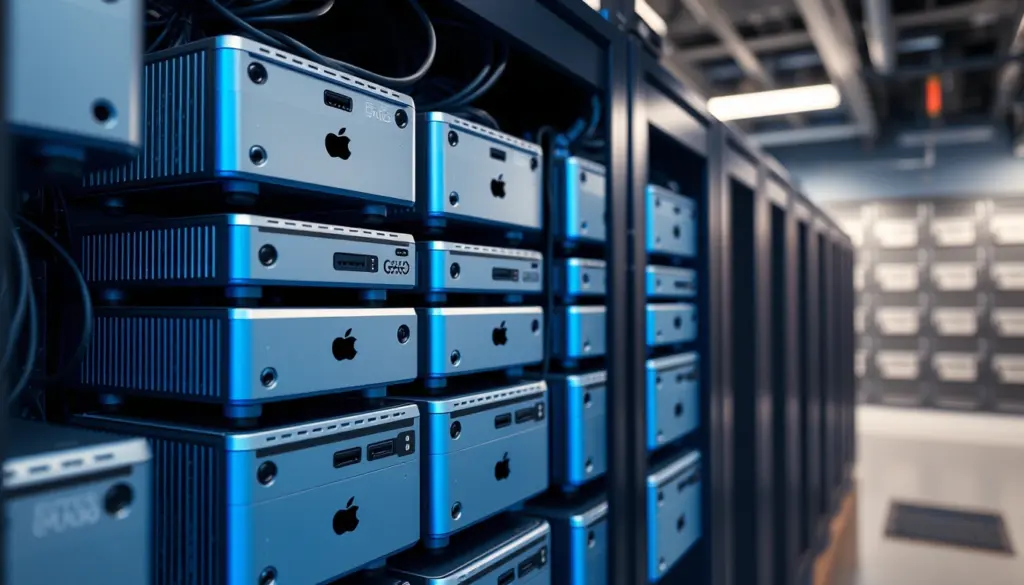
Strip away the headline number and what is left is a straightforward capital allocation question that every infrastructure team eventually faces: do you own the box, or do you pay someone else to own it for you. OpenAI’s reported approach is ownership. Tens of thousands of Mac minis and Mac Studios purchased outright, racked in OpenAI’s own facilities, depreciated on OpenAI’s own books, and available for reinforcement learning workloads on demand with no metered cloud bill attached. Anthropic’s reported approach runs through AWS’s existing EC2 Mac instance business, a service Amazon has offered since 2020 that lets customers rent bare-metal Apple Silicon by the hour rather than buy it.
Both paths get an AI lab access to the same underlying chips. The difference is who carries the depreciation risk and who captures the margin. OpenAI buying outright suggests confidence that the reinforcement learning and computer-use agent workload is durable enough to justify capital expenditure rather than a rented, cancel-anytime line item. Anthropic renting through AWS suggests the opposite bet, or simply a different point in its own infrastructure maturity: keep the workload flexible, let Amazon absorb the hardware risk, and avoid locking capital into a chip architecture that was never designed as a data center product in the first place.
There is a third reading worth taking seriously. AWS has quietly run a Mac rental business for six years without much attention, largely serving iOS developers who need real Apple hardware for builds and testing. If Anthropic’s usage is material, AWS just found an unplanned second market for a product line it never marketed as an AI training tool. That is a small, strange win for Amazon in a story that is nominally about Apple and OpenAI.
Why Reinforcement Learning Wants Desktops, Not GPU Clusters
The workload explains the hardware choice better than the brand does. Training a large language model is a bandwidth problem: enormous matrix multiplications spread across thousands of tightly interconnected GPUs, which is exactly the environment Nvidia’s H100, H200 and Blackwell-generation chips were built to dominate. Reinforcement learning for a computer-use agent is a different shape of problem. It needs many independent, low-cost environments running in parallel, each one a simulated desktop session where an agent clicks, types, waits, and gets scored on whether it completed a task correctly.
A Mac mini is, for that purpose, a cheap, power-efficient, headless computer that can run a real macOS or Linux environment and be stacked by the thousand in a rack. It does not need the interconnect bandwidth a GPU training cluster needs, because each RL environment is largely self-contained. Apple Silicon’s unified memory architecture, which lets the CPU and GPU share a single memory pool instead of shuttling data back and forth, turns out to be a reasonable fit for running many isolated agent sessions per machine without the overhead a discrete GPU setup would carry. None of that makes the Mac mini a training chip in the Nvidia sense. It makes it a very good simulation and inference box for a workload that values quantity and isolation over raw interconnect throughput.
Apple’s Data Center History: From Xserve to Accidental AI Hardware
Apple has been here before, and it did not go well the first time. The Xserve, launched in 2002, was Apple’s direct attempt at rack-mounted server hardware, built for the same corporate and education data centers that Dell and Sun Microsystems were fighting over. Apple killed the product in January 2011, redirecting server-minded customers toward the Mac Pro and, later, the Mac mini, framing servers as a market it no longer wanted to chase directly.
What is happening now is not a planned sequel to that retreat. Apple did not build the M6 Mac mini or the M5 Ultra Mac Studio as server products the way it built the Xserve. It built them as prosumer and creative-workstation machines that happened to have enough unified memory and GPU cores to be useful for local AI inference, then marketed that capability once it became clear developers and labs wanted it. The August 25, 2026 refresh, with configurations up to 512GB of memory, reads as Apple noticing the AI infrastructure use case after the fact and leaning into it, not as Apple re-entering the server business on purpose. Whether that becomes a real product strategy or stays an accident of good specs is one of the open questions this story raises.
Nvidia’s Position: Dominant, Not Threatened, But Watching
None of this puts a dent in Nvidia’s core business. Nvidia remains the dominant supplier of the data center GPU clusters that actually train frontier language models, and reporting on the AI accelerator market has pegged its training-hardware share in the 80 to 85 percent range as of 2026, down from over 90 percent a few years earlier as AMD and custom silicon pick up share at the margins, even as Nvidia keeps posting record quarterly revenue. The OpenAI Mac purchase does not touch that core market. It is a purchase for a specific, secondary workload that GPU clusters were never optimized to handle cheaply.
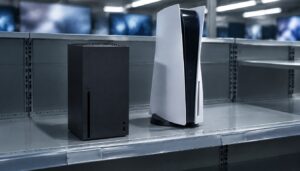
The more interesting friction point is Nvidia’s own AI PC push. The company’s RTX Spark, a compact desktop AI hardware computer built on its Grace Blackwell superchip design, reportedly sold out to distributors before launch, a sign that demand for small-form-factor AI hardware is real and not limited to Apple’s customer base. Nvidia is not losing the training market to Apple. What it is discovering is that the desktop and workstation tier of AI compute, the tier below full data center clusters, has real demand from labs looking to diversify workloads off the most contended and expensive part of the supply chain: Nvidia’s own GPUs.
Market Impact: What This Means for Apple, AWS and the AI Supply Chain
For Apple: Demand Without a Revenue Line
For Apple, the immediate effect is demand for a product line, Mac mini and Mac Studio, that has never been Apple’s growth story. Apple does not break out Mac mini or Mac Studio sales separately in its earnings reports, so there is no confirmed revenue figure tied to this story, and any claim of a dollar impact would be speculation. What is verifiable is timing: Apple pushed its M6 and M5 Ultra refresh to August 25, 2026, earlier than the October-to-November window Apple has typically used for Mac updates, and its newsroom marketed the new configurations around local large-model inference and clustering in language it has not used for Mac hardware before.
For AWS and the Wider Supply Chain
For AWS, a documented uptick in demand for its EC2 Mac instances, if Anthropic’s usage is representative of a broader trend among AI labs, would be a genuine bright spot in a product line that has mostly served iOS build pipelines since 2020. For the broader AI supply chain, the signal is diversification pressure. When frontier labs start buying or renting hardware that was never marketed as AI infrastructure, it is usually because the primary supply chain, in this case Nvidia GPU clusters, is either too expensive, too backlogged, or poorly suited to a specific workload. Reports of Nvidia raising AI server pricing amid ongoing memory shortages this year only add to that pressure, giving labs more reason to route workloads that do not strictly need GPU-cluster bandwidth toward cheaper alternatives.
Competitive Comparison: OpenAI, Anthropic and the Infrastructure Middle Ground
Laid side by side, the two labs’ reported approaches to Apple Silicon look less like a rivalry and more like two ends of the same spectrum every infrastructure buyer sits somewhere on. The table below summarizes what has been reported, and what remains general industry practice rather than a confirmed detail specific to either company.
| Factor | OpenAI (reported) | Anthropic (reported) |
|---|---|---|
| Acquisition model | Outright purchase | Rental via AWS EC2 Mac instances |
| Reported hardware | Mac mini and Mac Studio | Mac mini (via AWS) |
| Reported scale | Tens of thousands of units | Not disclosed |
| Primary workload | Reinforcement learning, computer-use agents | Reported to include Apple Silicon-based workloads |
| Capital exposure | Full ownership, on OpenAI’s books | Metered, on AWS’s books |
| Flexibility to scale down | Low (owned hardware) | High (cancel or reduce rental anytime) |
| Source | The Information, via multiple outlets | The Information, via multiple outlets |
Neither company has confirmed these details directly, and the table should be read as a summary of sourced reporting, not company-issued fact. Still, the pattern is consistent enough across outlets that the buy-versus-rent split looks like a real strategic divergence rather than a reporting artifact.
The Hardware Itself: What Apple’s August Refresh Actually Ships
Whatever the exact purchase volume, the machines being bought are real and specced. Apple’s refreshed lineup, which reports place around the OpenAI purchase timeline, tops out at an M5 Ultra Mac Studio configuration with up to 512GB of unified memory and an 80-core GPU, alongside an updated M6 Mac mini. That memory ceiling matters more than the headline chip name for AI workloads: running or fine-tuning large local models, or hosting many parallel agent environments per machine, is frequently constrained by how much unified memory a single box has, not by raw compute alone.
| Spec | Mac mini (M6, reported) | Mac Studio (M5 Ultra, top config) |
|---|---|---|
| Chip | Apple M6 | Apple M5 Ultra |
| Max unified memory | Not disclosed in fact sheet | Up to 512GB |
| Max GPU cores (top config) | Not disclosed in fact sheet | Up to 80-core GPU |
| Form factor | Headless desktop | Headless desktop |
| Apple refresh date | Around August 25, 2026 | Around August 25, 2026 |
| Marketed AI use case | Local inference, clustering | Local inference, clustering, large models |
The headless form factor is not incidental. A Mac mini or Mac Studio has no built-in display, keyboard, or trackpad to pay for, which keeps per-unit cost down relative to a MacBook while delivering the same M-series silicon. That is precisely why reports describe OpenAI buying minis and Studios specifically, not laptops: for rack-style deployment at scale, a screen and keyboard are dead weight.
Historical Context: Apple Silicon’s Slow Crawl Toward Infrastructure
Apple’s chips were not built with data centers in mind, but they have been drifting toward infrastructure use cases for years without much fanfare. AWS launched EC2 Mac instances in 2020, initially for iOS and macOS developers who needed genuine Apple hardware for continuous integration pipelines rather than emulated environments. That product has run quietly in the background of AWS’s catalog ever since, a niche offering compared to EC2’s GPU and CPU instance families.
The bigger shift has been unified memory. Since the M1 generation, Apple has pushed memory capacity per chip up generation over generation, a trend that mattered far more to video editors and 3D artists than to AI researchers until local large language models became something developers actually wanted to run outside the cloud. By the time Apple reached the M5 Ultra with a 512GB ceiling, it had, likely without designing for this exact outcome, built a chip that could hold models too large for most single consumer GPUs entirely in memory. OpenAI’s reported purchase is less a sudden pivot and more the end point of that multi-year drift finally intersecting with a workload, reinforcement learning for computer-use agents, that plays to Apple Silicon’s specific strengths.
What Remains Unverified, and Why It Matters
It is worth restating plainly what has not been confirmed by either company. There is no official unit count, no disclosed purchase price, no confirmed timeline beyond “the past several months,” and no chip-configuration breakdown of what OpenAI actually bought. Neither OpenAI nor Apple has issued a statement. Anthropic has not confirmed the scale of its AWS-based Mac usage either. All of it traces back to The Information’s sourcing, repeated across finance.biggo.com, GamesReviews.com, Shane the Gamer, Free Press Journal, 36Kr and tech-insider.org without independent verification of the underlying numbers.
That gap matters for anyone trying to size the story’s real impact. “Tens of thousands” of Mac minis could mean 20,000 units or 80,000 units, and the difference between those two numbers is the difference between a rounding error on Apple’s balance sheet and a meaningful new revenue line. Until one of the three companies involved confirms a number, treat every downstream analysis, including market-share estimates and revenue-impact claims, as bounded by that uncertainty.
Predictions: Where This Goes From Here
- Apple will likely lean further into AI-infrastructure marketing language for future Mac mini and Mac Studio refreshes, given how much attention the local-inference and clustering framing drew this cycle, without formally re-entering the server hardware business the way Xserve once did.
- AWS will probably expand or at least more actively market its EC2 Mac instance line if Anthropic’s usage pattern proves representative of broader lab interest, since it is a low-effort way to monetize existing infrastructure with minimal new investment.
- Other AI labs training computer-use or agentic products, not just OpenAI and Anthropic, are likely to evaluate similar desktop-class hardware for reinforcement learning workloads, given the same cost and interconnect logic applies industry-wide.
- Nvidia’s core training-cluster business should stay effectively unaffected through 2026 and into 2027, since none of this hardware competes with H100, H200 or Blackwell-class GPUs for actual model training, and Nvidia’s accelerated model release cadence gives it little reason to slow down, but Nvidia’s own RTX Spark and similar compact AI-PC products will keep seeing strong demand as labs and developers want smaller-scale AI hardware options.
- Expect continued ambiguity on hard numbers. Unless OpenAI, Anthropic or Apple issues an official disclosure, likely only if regulatory filings or an earnings call forces the issue, “tens of thousands” will remain the only publicly citable figure well into next year.
The Bigger Picture: Diversification, Not Disruption
The headline framing, Apple making a surprise incursion into Nvidia’s turf, oversells what is actually happening. Apple has not shipped a GPU cluster competitor, has not entered the AI training accelerator market, and has no product positioned to challenge an H200 or Blackwell chip at the workload Nvidia actually dominates. What Apple has done, mostly by accident of good chip design, is become an attractive secondary vendor for a specific slice of AI infrastructure spending: reinforcement learning environments and agent training, where cost per unit and memory capacity matter more than raw interconnect bandwidth.
That is still a meaningful shift. Frontier AI labs spending real capital, whether through outright purchase or AWS rental, on hardware that was never designed or marketed as AI infrastructure is a sign that the primary supply chain is under enough pressure, on price, on availability, or on architectural fit, that labs are actively hunting for alternatives wherever they can find them. Apple did not go looking for this business. It showed up anyway, fifteen years after Apple decided it did not want to be in the server market at all.
Frequently Asked Questions
Did OpenAI officially confirm buying tens of thousands of Macs?
No. The claim traces to a report from The Information, repeated by outlets including finance.biggo.com, GamesReviews.com, Shane the Gamer, Free Press Journal, 36Kr and tech-insider.org. Neither OpenAI nor Apple has issued an official confirmation, unit count, or spending figure.
What is Anthropic’s role in this story?
Reports say Anthropic is also using Apple Silicon-based Macs for AI workloads, but rents that capacity through AWS’s EC2 Mac instances rather than purchasing the hardware outright, unlike OpenAI’s reported approach.
Why would an AI lab use Mac minis instead of Nvidia GPUs?
Reinforcement learning for computer-use agents needs many parallel, low-cost, largely independent environments rather than the high-bandwidth interconnect that large language model training requires. A headless Mac mini or Mac Studio, with Apple’s unified memory architecture, is well suited to running many isolated agent sessions per machine at lower cost than a comparable GPU cluster footprint.
Does this threaten Nvidia’s dominance in AI training hardware?
Not directly. Nvidia’s training-accelerator market share has been estimated in the 80 to 85 percent range in 2026, and none of the Mac purchases described in this story compete with Nvidia’s H100, H200 or Blackwell-class GPUs for the core large language model training workload those chips are built for.
What new Mac hardware did Apple release around this story?
Apple refreshed the Mac mini with its M6 chip and the Mac Studio with an M5 Ultra option around August 25, 2026, with top configurations reaching up to 512GB of unified memory and an 80-core GPU, marketed with new emphasis on local large-model inference and multi-machine clustering.
Has Apple sold server hardware before?
Yes. Apple sold the Xserve rack server from 2002 until discontinuing it in January 2011, after which it exited the dedicated server hardware market. The current Mac mini and Mac Studio AI infrastructure use case was not designed as a server product in that same sense.
When did AWS start renting Mac hardware?
AWS launched EC2 Mac instances in 2020, originally aimed at developers who needed genuine Apple hardware for iOS and macOS build and testing pipelines.
Is the “tens of thousands” figure a confirmed unit count?
No. It is the only quantity that has appeared in reporting so far, sourced to The Information, and should be read as an approximate range rather than a precise, audited number.