
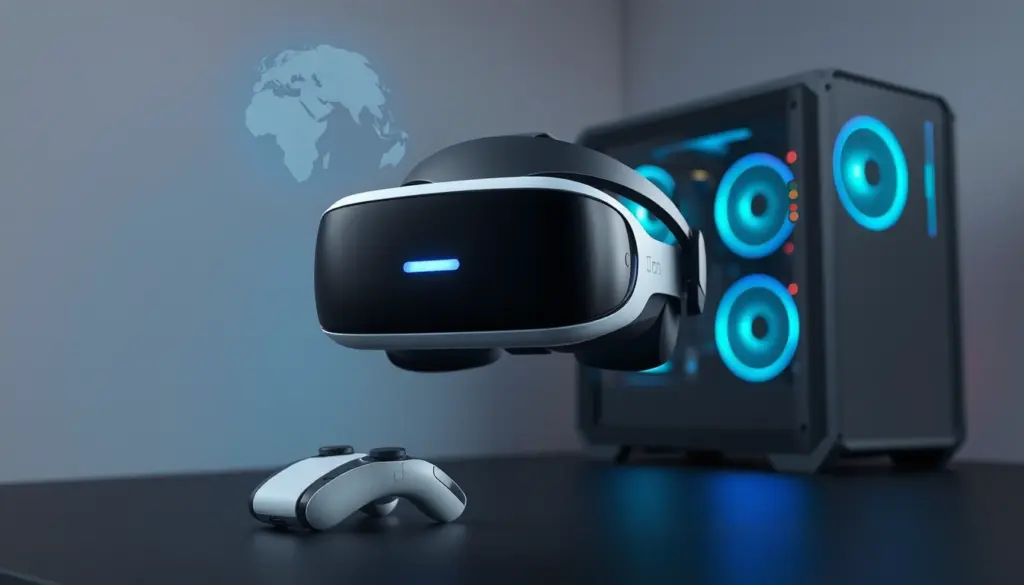
Valve is about to do something it has not done since 2019: ship a virtual reality headset. The Steam Frame – a standalone, streaming-first VR headset that runs SteamOS on an Arm chip – was announced on November 12, 2025, alongside a new Steam Machine and a redesigned Steam Controller. Eight months later, on June 30, 2026, the headset is the most-searched piece of unreleased gaming hardware on the planet, with roughly 90,500 US searches a month for the term “Steam Frame” alone. Yet the one number buyers want most – the price – still does not officially exist.
That silence is not an accident. The Steam Frame is launching into the worst memory market in a decade, and Valve has spent the spring quietly refusing to commit to a figure while DRAM contract prices climbed. This is a news analysis of where the Steam Frame stands today: confirmed specifications, the realistic price range, the summer 2026 release window, how it stacks up against the Meta Quest 3, and why a global memory shortage has turned a VR launch into a referendum on the entire 2026 hardware market.
Steam Frame: What Valve Actually Announced
The Steam Frame is a self-contained VR headset built around a Qualcomm Snapdragon 8 Gen 3 system-on-chip with 16GB of LPDDR5X memory. Unlike the tethered Valve Index that came before it, the Frame needs no external base stations and no cable to a tower PC. It uses inside-out tracking, runs SteamOS locally for standalone play, and – crucially – is engineered first and foremost to stream your existing PC library wirelessly from a gaming rig in another room.
Valve describes the device as “a new way to play your entire Steam library,” and the framing matters. Where Meta built the Quest line as a self-contained entertainment box that can optionally talk to a PC, Valve built the Steam Frame as a PC VR streaming terminal that can optionally run on its own. According to UploadVR’s announcement coverage, the company is explicitly positioning the Frame as a “streaming-first” headset – a philosophical inversion of how the standalone VR market has worked since 2019.
The headset ships in two storage configurations – 256GB and 1TB – and arrives with a wireless adapter in the box, a redesigned pair of motion controllers, and a head strap with an integrated 21 Wh battery. It is the third leg of a hardware trio that also includes the Steam Machine, the compact SteamOS console that launched at $1,049 the same week this article was published.
Steam Frame Release Date: Why Summer 2026, Not Q1
When Valve revealed the Steam Frame in November 2025, the company pointed to a release “in early 2026.” That window has slipped. As of late June 2026, the official line is a “this summer” shipping window – meaning the June-to-August 2026 quarter – with no firm calendar date attached. Valve has confirmed the headset is still coming and has shown it to press in hands-on sessions, but it has declined to nail down a day.
The delay tracks almost perfectly with the memory market. Valve’s own messaging shifted from “early 2026” to “first half of 2026” to “this summer” across the same months that DRAM contract prices spiked. The Steam Machine, which uses far more memory than the headset, launched first on June 30; the Steam Frame has been positioned as the follow-up act in the same summer window. Reporting from PC Gamer and Road to VR has consistently described the timeline as deliberately vague – a sign Valve wants pricing flexibility right up until the moment it commits.
For prospective buyers, the practical read is simple: the Steam Frame release date is a summer 2026 window, exact day unannounced, and anyone promising a specific date is guessing. The smart money expects a pre-order announcement to land within weeks of the Steam Machine reaching customers.
Steam Frame Price: What Valve Has and Hasn’t Said
Here is the single most important fact about the Steam Frame price: it is officially unannounced. Valve did not attach a number to the headset at its November 2025 reveal, and it has not done so since. Anyone quoting a confirmed Steam Frame price as of June 30, 2026, is repeating an estimate, not a fact.
What Valve has said is directional. The company stated it expects the Steam Frame to cost less than the original Valve Index, which launched at $999 for the full kit in 2019. That comment set an informal ceiling and seeded the early analyst consensus of roughly $800 to $1,000. As memory prices climbed through the spring, however, those estimates drifted upward. Per a Road to VR spec comparison, lower estimates have migrated toward an $899–$1,199 analyst range for the 256GB model, with the 1TB version expected to sit higher still.
The conservative, defensible position is this: the Steam Frame will most likely launch somewhere between $899 and $1,199 for the entry configuration, Valve’s stated intent is to undercut the Index, and the final figure will be decided by the cost of 16GB of LPDDR5X memory on the day Valve signs its production contracts. The table below summarizes the publicly available price signals.
| Price signal | Figure | Status |
|---|---|---|
| Official Valve price | Not announced | Confirmed unannounced |
| Valve’s stated intent | Less than the Index ($999 kit) | Company statement |
| Early analyst estimate | $800 – $1,000 | Estimate (Nov 2025) |
| Current analyst range (256GB) | $899 – $1,199 | Estimate (mid-2026) |
| Expected 1TB premium | Higher than 256GB | Estimate |
| Valve Index launch price (2019) | $999 full kit / $499 headset | Historical fact |
The 2026 DRAM Shortage Is Holding the Price Hostage
The reason the Steam Frame has no price tag is the same reason the Steam Machine cost more than enthusiasts hoped: a global DRAM shortage driven by AI data center buildout. Through 2025 and into 2026, hyperscalers placed enormous orders for the high-bandwidth and server memory that trains and serves large language models. That demand drained supply and pushed memory makers to prioritize their most profitable customers, squeezing the consumer-grade LPDDR5X and GDDR that go into headsets, handhelds, and graphics cards.
Industry trackers have reported DRAM contract prices rising more than 170% year-over-year between Valve’s November 2025 announcement and mid-2026. For a device whose bill of materials leans on 16GB of fast LPDDR5X – double the 8GB in a Meta Quest 3 – that swing is the difference between a comfortable sub-$1,000 sticker and an uncomfortable one. Memory is not a rounding error in a VR headset; it is one of the most expensive single components, and its price more than doubling mid-development is precisely the kind of shock that forces a company to keep its options open.
This is the market-impact story that makes the Steam Frame more than a product launch. Valve is not fighting a design problem; it is fighting a macroeconomic one. The same forces that pushed the Steam Machine to $1,049 are bearing down on the headset, and they explain why a company famous for aggressive pricing has gone quiet. Every week Valve waits is a week it can watch the memory market before locking in a number it cannot easily change.
Steam Frame Specs: Snapdragon 8 Gen 3, 16GB, Dual 2160×2160
On paper, the Steam Frame specs are aggressive for a standalone headset. The Snapdragon 8 Gen 3 is a flagship-class mobile chip, and pairing it with 16GB of LPDDR5X gives the Frame twice the working memory of the Quest 3. Storage comes in 256GB and 1TB flavors. The full spec sheet, drawn from Valve’s announcement and corroborated by the Steam Frame technical summary, is below.
| Component | Steam Frame specification |
|---|---|
| Processor | Qualcomm Snapdragon 8 Gen 3 (Arm64) |
| Memory | 16GB LPDDR5X |
| Storage | 256GB or 1TB |
| Display | LCD, 2160 × 2160 per eye, pancake lenses |
| Refresh rates | 72, 80, 90, 120 Hz (144 Hz experimental) |
| Field of view | ~110° horizontal and vertical (conservative) |
| Tracking | Inside-out (no base stations) |
| Eye tracking | Yes – drives foveated rendering and streaming |
| Weight | 185 g base unit; ~440 g with strap, battery, facial interface |
| Battery | 21 Wh (in head strap) |
| Connectivity | Wi-Fi 7 + dedicated 6 GHz streaming radio (USB 3.0 adapter) |
| Operating system | SteamOS (native, on Arm) – open platform |
Display, Optics, and the 144 Hz Question
The Frame’s dual LCD panels run at 2160 × 2160 per eye behind multi-element pancake lenses, with Valve describing sharpness as “very good across the full field of view” and “slightly less than Index.” The headset supports 72, 80, 90, and 120 Hz natively, plus an experimental 144 Hz mode. That 144 Hz figure is the eye-catching number, but it is explicitly experimental; the practical ceiling most buyers should plan around is 120 Hz. Field of view is a conservative 110 degrees, narrower than the Index but typical for modern pancake-lens designs that trade a little width for a much lighter, sharper image. The base headset weighs just 185 grams – featherweight by VR standards – though the strap, battery, and facial interface bring the worn weight to roughly 440 grams.
Foveated Streaming: Valve’s Bandwidth Trick Explained
The single most important feature in the Steam Frame is invisible: foveated streaming. Wireless PC VR has always faced a brutal tradeoff – push enough bitrate for a crisp image and you saturate the radio; throttle the bitrate and the picture turns to mush. Valve’s answer is to use the headset’s eye tracking to spend bandwidth only where you are actually looking.
Foveated rendering – drawing full detail at the center of your gaze and lower detail in the periphery – is a known technique. Valve extends it to the network layer. The headset reports your gaze to the PC many times a second, and the encoder selectively increases the bitrate for the small region your fovea is fixed on while compressing the periphery harder. Valve claims the approach can improve effective visual detail by up to 10x compared with naively streaming the whole frame at uniform quality, according to the comparison published by Tom’s Guide.
To keep that stream stable, the Frame ships with a USB 3.0 wireless adapter that plugs into your gaming PC and opens a dedicated 6 GHz channel straight to the headset, separate from the antenna handling the Frame’s own Wi-Fi 7 networking. The point of the split is isolation: game downloads, multiplayer traffic, and household Wi-Fi never compete with the live VR stream. For the software engineers in our audience, the streaming stack is configurable in the way you would expect from a SteamOS device:
# SteamOS / SteamVR streaming concepts on the Steam Frame
# 1. Dedicated 6 GHz link via the bundled USB 3.0 adapter
# 2. Eye-tracked foveated encoding raises bitrate only at the gaze point

steamvr.stream.adapter      = usb-6ghz-dedicated   # isolated from Wi-Fi 7
steamvr.stream.codec        = av1 | hevc           # hardware-accelerated
steamvr.stream.foveation    = eye-tracked          # gaze-driven bitrate
steamvr.stream.peripheral_q = compressed           # spend bits at the fovea
The configuration above is conceptual, but it captures why Valve thinks it can deliver near-wired image quality over the air: it is not trying to brute-force the whole frame, only the part of it your eyes can resolve.
SteamOS on Arm: A First for Valve
For years SteamOS has been an x86 operating system, riding on the AMD chips inside the Steam Deck and Steam Machine. The Steam Frame breaks that pattern. It is the first Valve device to run SteamOS natively on Arm, on the Snapdragon 8 Gen 3. That is a genuine engineering milestone, not a marketing line, because the entire Steam catalog is compiled for x86.
To run that x86 library on an Arm chip, Valve pairs SteamOS with its Proton compatibility layer and an x86-to-Arm translation layer, so existing PC games can execute on the Snapdragon silicon in standalone mode. It is the same strategic muscle Valve built with Proton to make Windows games run on Linux – extended one architecture further. The open nature of the platform is part of the pitch: as several outlets noted at announcement, you can install another operating system on the Frame if you want, because Valve is shipping it as an open device rather than a locked appliance.
The implications stretch beyond VR. A working SteamOS-on-Arm stack is exactly the foundation Valve would need if it ever wanted to put SteamOS on Arm-based handhelds or low-power devices. The Steam Frame is a headset, but it is also a proof of concept for a post-x86 SteamOS – and that is why developers are watching it as closely as gamers are.
The New Steam Controller and Frame Controllers
The Steam Frame ships with a pair of redesigned motion controllers, and they carry one notable upgrade: TMR (tunneling magnetoresistance) thumbsticks. Valve says TMR sticks are more precise than the Hall-effect sensors used in Meta’s Quest controllers, and because they are contactless magnetic sensors, they should resist the stick drift that has plagued consumer controllers for a decade. The same TMR technology appears in the separate Steam Controller that Valve announced alongside the Machine and the Frame.
It is a small detail that signals a larger intent. Valve is not phoning in the peripherals to hit a price; it is using the launch to push input hardware forward at the same time it pushes the display and streaming forward. For a company whose original Steam Controller in 2015 was a commercial flop, the willingness to try again – with better sensors and a clearer purpose – is part of what makes the 2026 hardware push feel coordinated rather than scattershot.
Steam Frame vs Meta Quest 3: Spec-by-Spec
The Steam Frame vs Quest 3 question is the comparison everyone is asking, and on raw specifications the Frame leads in nearly every category. It runs a newer, faster chip, carries double the memory, pushes a slightly higher per-eye resolution, and tops out at a higher refresh rate. Meta’s advantage is not the silicon – it is the price, the mature content library, and color passthrough mixed reality that Valve is downplaying in favor of streaming.
| Spec | Steam Frame | Meta Quest 3 | Meta Quest 3S |
|---|---|---|---|
| Chip | Snapdragon 8 Gen 3 | Snapdragon XR2 Gen 2 | Snapdragon XR2 Gen 2 |
| Memory | 16GB | 8GB | 8GB |
| Per-eye resolution | 2160 × 2160 | 2064 × 2208 | 1832 × 1920 |
| Max refresh | 120 Hz (144 experimental) | 120 Hz | 120 Hz |
| Eye tracking | Yes (foveated streaming) | No | No |
| Optics | Pancake | Pancake | Fresnel |
| OS | SteamOS (open) | Horizon OS | Horizon OS |
| Price | Unannounced (~$899–$1,199 est.) | $599.99 | $349.99 / $449.99 |
The pricing gap is the headline. With the Meta Quest 3 at $599.99 and the Quest 3S starting at $349.99, the Steam Frame is shaping up to cost roughly twice as much as Meta’s mainstream headset and potentially three times the Quest 3S. Valve is not chasing the impulse buyer. It is targeting the PC gamer who already owns a powerful rig and wants the best possible wireless window into it – a fundamentally different customer than the one Meta courts.
Where the Quest 3 Still Wins
Specs are not destiny. The Quest 3 has a vast, mature standalone game library built over years, polished color passthrough for mixed reality, and a price that an ordinary household can justify. The Steam Frame’s standalone catalog will lean on x86 translation and Proton on day one, which means performance will vary by title. For a buyer who wants VR that simply works out of the box without a gaming PC, the Quest 3 remains the safer pick. The Frame is the enthusiast’s machine; the Quest is the everyone-else machine.
Steam Frame vs Valve Index: A Generational Leap
To understand how far the Steam Frame moves the needle, compare it with the headset it succeeds. The Valve Index arrived in June 2019 as a tethered, base-station headset that required a beefy PC, a cable, and a careful room setup. It was excellent for its era and then sat untouched for half a decade as Valve let the category drift. The Frame discards almost every constraint the Index imposed.
| Attribute | Valve Index (2019) | Steam Frame (2026) |
|---|---|---|
| Form factor | Tethered to PC | Standalone + wireless streaming |
| Tracking | External base stations | Inside-out (no base stations) |
| Display | 1440 × 1600 per eye LCD | 2160 × 2160 per eye LCD |
| Lenses | Dual-element (Fresnel-style) | Pancake |
| Onboard compute | None (PC required) | Snapdragon 8 Gen 3, 16GB |
| OS | Runs via PC (SteamVR) | SteamOS native on Arm |
| Launch price | $999 full kit | Unannounced (intended below Index) |
The seven-year gap between the two products is the real story. Valve effectively skipped a generation of VR while it focused on the Steam Deck, and the Frame is the company cashing in everything it learned from handheld SteamOS – power efficiency, streaming, Proton – and pointing it at your face. It is less an Index sequel than an Index reinvention.
Market Impact: What Steam Frame Means for PC VR
PC VR has been a stagnant niche for years, propped up almost entirely by Meta’s standalone Quest ecosystem on one side and a thinning population of tethered enthusiast headsets on the other. The Steam Frame is the first credible attempt in a long time to make wireless PC VR mainstream-adjacent without forcing buyers into Meta’s account system and content store. That matters for the shape of the market.
If foveated streaming delivers on its promise, Valve will have solved the central technical problem that kept wireless PC VR from feeling as good as wired – and it will have done so on an open platform that any developer can target through SteamVR. That is a direct challenge to Meta’s walled garden and a lifeline to the PC VR developers who watched the category contract. It also dovetails with Valve’s broader 2026 hardware strategy, where the Steam Machine attacks the living room and the Frame attacks the headset, both running the same SteamOS spine.
The risk is price. A headset that lands near $1,000 in a year when the Quest 3S sells for $349.99 is not a volume product, and Valve knows it. The Steam Frame will not out-ship the Quest. What it can do is re-anchor the high end, give PC gamers a reason to care about VR again, and prove that SteamOS can run anywhere – outcomes that reshape the market even at modest unit numbers. The same competitive dynamics we covered in the PS5 versus Xbox console race apply here: platform control, not just hardware sales, is the prize.
Valve’s 2026 Hardware Push: Frame, Machine, Controller
The Steam Frame does not exist in isolation. It is one third of the most ambitious hardware announcement in Valve’s history – three SteamOS devices revealed on the same November day, all aimed at pulling gaming further out of Windows’ orbit and onto Valve’s own software. Seen together, the strategy is coherent in a way Valve’s past hardware experiments never were.
| Device | Category | Price | Status (June 30, 2026) |
|---|---|---|---|
| Steam Machine | Living-room SteamOS console | $1,049 (512GB) / $1,349 (2TB) | Launched June 30, 2026 |
| Steam Frame | Standalone SteamOS VR headset | Unannounced (~$899–$1,199 est.) | Summer 2026 window |
| Steam Controller | TMR-stick gamepad | Unannounced | Summer 2026 window |
| Steam Deck OLED | Handheld SteamOS PC | From $549 | On sale |
Every device in that table runs SteamOS, and that is the whole point. Valve is not selling four gadgets; it is selling one operating system on four form factors – handheld, console, headset, and controller – and using the handheld momentum from the Steam Deck to bootstrap the rest. The Steam Frame is the riskiest leg because VR is the hardest sell, but it is also the one that proves SteamOS can go anywhere.
5 Predictions for the Steam Frame and SteamOS VR
With the launch window narrowing, here is where this analysis expects the Steam Frame story to go over the next year.
- The price lands between $899 and $1,199 for the 256GB model. Valve’s “below the Index” intent collides with DRAM costs, and the entry headset settles in that band rather than the sub-$800 figure enthusiasts hoped for in 2025.
- Foveated streaming becomes the headline review topic. Whether the Frame succeeds or fails will be decided by how wired-quality the wireless stream actually feels – not by the spec sheet that already looks strong.
- SteamOS-on-Arm outlives the headset. The translation work Valve did for the Frame shows up in future Arm devices, making the Frame a Trojan horse for a post-x86 SteamOS.
- Meta responds on price, not specs. A near-$1,000 Frame lets Meta keep the Quest 3S at $349.99 and own volume, while positioning a future high-end Quest against the Frame’s enthusiast niche.
- Stock is tight at launch. The same memory shortage squeezing the price will squeeze supply, and the first production run sells out quickly, mirroring the constrained launches seen across 2026 gaming hardware.
The Bottom Line on the Steam Frame
The Steam Frame is the most interesting VR headset in years and the clearest sign yet that Valve is serious about owning gaming hardware from the handheld to the headset. Its specifications beat the Meta Quest 3 in almost every measurable way, its foveated streaming could finally make wireless PC VR feel right, and its SteamOS-on-Arm foundation matters far beyond VR. The only thing standing between it and a clean win is the one number Valve will not say – a price being held hostage by the worst memory market in a decade. Expect a summer 2026 launch, expect a figure in the four-digit range, and expect the reviews to live or die on the stream.
Steam Frame FAQ: Price, Release Date, and Specs
When is the Steam Frame release date?
Valve has confirmed a summer 2026 release window – the June-to-August quarter – but has not announced a specific date as of June 30, 2026. The headset was originally slated for early 2026 before the timeline slipped, tracking the rise in memory prices. A pre-order announcement is widely expected within weeks of the Steam Machine reaching customers.
How much will the Steam Frame cost?
The Steam Frame price is officially unannounced. Valve has said it expects the headset to cost less than the $999 Valve Index full kit, and current analyst estimates place the 256GB model in an $899–$1,199 range, with the 1TB version higher. Any specific price quoted today is an estimate, not a confirmed figure.
Is the Steam Frame better than the Meta Quest 3?
On specifications, yes: the Steam Frame uses a faster Snapdragon 8 Gen 3, 16GB of memory (double the Quest 3’s 8GB), a slightly higher 2160 × 2160 per-eye resolution, and adds eye-tracked foveated streaming. The Quest 3 counters with a much lower $599.99 price, a mature standalone library, and polished mixed reality. The Frame is the enthusiast choice; the Quest 3 is the mainstream value choice.
Does the Steam Frame need a gaming PC?
No, but it is designed for one. The Steam Frame runs SteamOS standalone on its own Snapdragon chip, so it can play games without a PC. Its core purpose, however, is to stream your full PC Steam library wirelessly over a dedicated 6 GHz link, which delivers the best performance and image quality.
What chip and specs does the Steam Frame use?
The Steam Frame runs a Qualcomm Snapdragon 8 Gen 3 with 16GB of LPDDR5X memory and 256GB or 1TB of storage. It has dual 2160 × 2160 LCD panels behind pancake lenses, refresh rates up to 120 Hz (144 Hz experimental), a roughly 110-degree field of view, inside-out tracking, eye tracking, and a 21 Wh battery in the strap. The base headset weighs 185 grams.
Why is the Steam Frame delayed?
The delay from early 2026 to summer 2026 tracks the global DRAM shortage. AI data center demand drove memory contract prices up more than 170% year-over-year, according to industry trackers, making the Frame’s 16GB of LPDDR5X far more expensive than Valve anticipated at announcement. Holding the launch lets Valve watch the memory market before committing to a price.
Can the Steam Frame run normal PC games?
Yes. In standalone mode the Frame uses SteamOS on Arm together with Valve’s Proton compatibility layer and an x86-to-Arm translation layer to run x86 PC games on its Snapdragon chip. For the best experience, the headset streams those games from a Windows or SteamOS gaming PC, where they run natively.
Analysis published June 30, 2026. Specifications reflect Valve’s November 2025 announcement and subsequent hands-on reporting; pricing and release date remain unconfirmed by Valve as of publication. Figures will be updated when Valve commits to a price and date.