
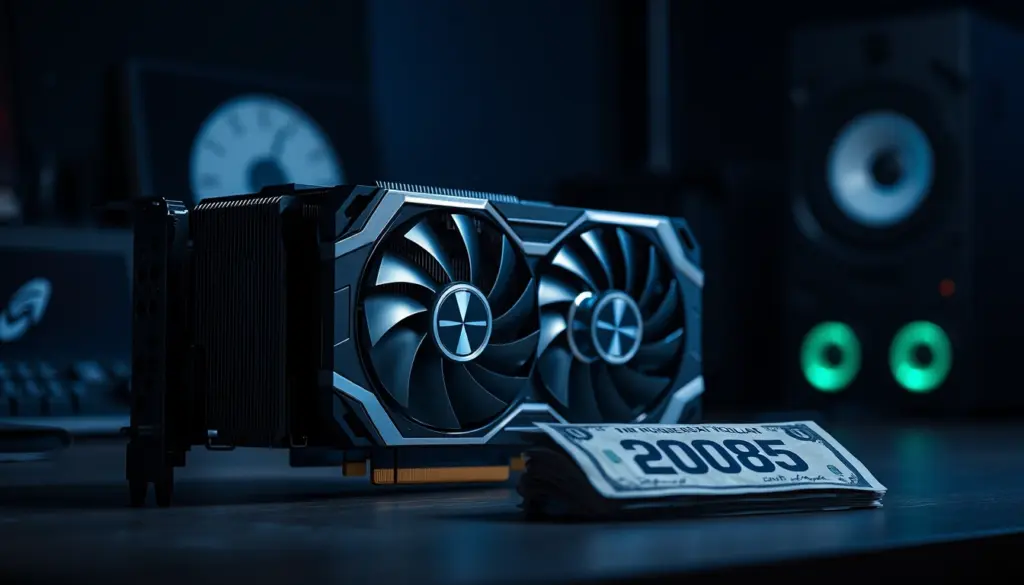
Nvidia’s flagship GeForce RTX 5090 launched at a suggested price of roughly $1,999. A year and a half later, buyers are paying north of $4,000 for the same card, and Tom’s Hardware reported in early September 2026 that street prices for the top-end Blackwell gaming GPU have crossed $5,000 in several markets. That is not a scalper story. It is an AI compute story that has spilled straight into the gaming aisle, and it is reshaping what “flagship GPU” even means in 2026.
The short version: data centers can’t get enough H100, H200, and B200 accelerators, memory prices are climbing at rates TrendForce calls historic, and AMD just raised its own Radeon prices for the second or third time in less than a year. Nvidia still controls roughly 90% of the discrete GPU market, according to Jon Peddie Research, so there is little competitive pressure stopping any of this. It’s a similar squeeze to the one already hitting Nvidia’s AI server pricing, just now landing on gamers directly. Here is what actually happened, what it costs, and where the pricing goes from here.
Nvidia’s Flagship GPU Is Now a $5,000 Card
The RTX 5090 launched as a consumer-facing card built on Nvidia’s Blackwell architecture, packing 32GB of GDDR7 memory and sitting at the top of a desktop stack that also includes the RTX 5080, RTX 5070 Ti, and RTX 5070. Nvidia’s own product pages list the RTX 5090 and RTX 5080 as fully available, not a paper launch, and the company has kept pushing the card through partner promotions, including an August 25, 2026 bundle campaign covering both desktop and laptop variants of the 50-series lineup.
What has changed is not availability. It’s price. Analysis firm SiliconAnalysts tracked the RTX 5090’s market price roughly doubling from its $1,999 launch MSRP to more than $4,000 in the spot market by late August 2026. Then Tom’s Hardware’s September 2026 pricing archive pushed the number higher still, reporting that Nvidia’s top-end gaming GPU “now costs at least $5,000” and describing Blackwell cards as continuing to “endure drastic price hikes.” For a part that already sits at the center of the leaked DLSS 5 neural rendering tests and was already priced above most gaming laptops at launch, that is a brutal trajectory.
The Price Timeline: From $1,999 to $5,000
Put the RTX 5090 next to its predecessor and the inflation becomes obvious. The RTX 4090 launched at roughly $1,599. The RTX 5090 launched about 25% higher, at close to $1,999. From there, the market took over. The table below lines up launch pricing against where the RTX 5090 sits today, based on SiliconAnalysts’ and Tom’s Hardware’s September 2026 reporting.
| Card / Stage | Price | Notes |
|---|---|---|
| RTX 4090 (2022 launch MSRP) | ~$1,599 | Previous-generation flagship, Ada Lovelace |
| RTX 5090 (launch MSRP) | ~$1,999 | Blackwell architecture, 32GB GDDR7 |
| RTX 5090 (market price, late August 2026) | $4,000+ | Roughly 2x MSRP, per SiliconAnalysts |
| RTX 5090 (street price, September 2026) | $5,000+ | Per Tom’s Hardware pricing tracker |
The gap between launch MSRP and current street price now exceeds the price of an entire midrange gaming PC. That is the number driving builders, reviewers, and Nvidia’s own retail partners to keep asking the same question: who is actually buying these at this price, and why.
Why AI Demand Is Spilling Into Consumer GPUs
SiliconAnalysts frames the RTX 5090’s price surge as demand spillover from the data center. Nvidia’s H100 and H200 accelerators remain severely supply-constrained, and the newer B200 platform, which SiliconReport says delivers roughly 4x the per-GPU inference throughput of the H200 along with 36% more memory, is even harder to source in volume. When buyers can’t get allocation for data-center parts, some turn to the highest-VRAM consumer card money can buy instead. A 32GB RTX 5090 isn’t an H200, but for a small AI startup or a solo developer running local inference, it’s a usable substitute, and that has pulled demand away from the gaming market it was built for.
This dynamic did not exist in previous GPU generations at this scale. The RTX 3090 and RTX 4090 both attracted some machine-learning users, but the AI compute shortage of 2026 is broader and more entrenched, tied directly to the buildout of large language model infrastructure across every major cloud provider, the same buildout that recently helped push Nvidia to a $96.2 billion quarterly haul. Every RTX 5090 that ends up in a rack running inference jobs is one fewer card on a shelf for a PC builder, and that scarcity shows up directly in the price tag.
Memory Costs: The Real Driver of the Shortage
Underneath the AI demand story sits a more basic supply-chain problem: memory is expensive right now, and it’s getting more expensive. TrendForce’s January 5, 2026 outlook forecast conventional DRAM contract prices rising 55% to 60% quarter-on-quarter in the first quarter of 2026, with NAND flash climbing 33% to 38% over the same period. A follow-up TrendForce note from February 2, 2026 went further, projecting that LPDDR4X and LPDDR5X contract prices would surge roughly 90% quarter-on-quarter, which the firm described as the steepest increase in their history.
GDDR7, the memory standard used in the RTX 5090 and the rest of the 50-series lineup, sits in the same supply chain as the DRAM feeding AI servers and smartphones, and the same crunch that has HBM4 yields racing to keep up with Nvidia’s Rubin platform is pulling capacity away from consumer GDDR7 production. TrendForce’s July 3, 2026 update on graphics memory noted that while GDDR7 demand tied specifically to products like Nvidia’s RTX Pro 6000 Blackwell had not yet hit expectations, and notebook shipments were softening GDDR6/7 demand on the PC side, overall memory pricing kept getting propped up by AI server demand. In plain terms: even when consumer demand for a specific memory type cools, AI-driven scarcity elsewhere in the market keeps prices elevated for everyone, including gamers buying a graphics card.
AMD’s Radeon RX 9000 Line Is Getting More Expensive Too
Nvidia isn’t alone. Wccftech reported in August 2026 that AMD officially raised suggested pricing for its Radeon RX 9000 series in the third quarter of 2026, with hikes ranging from roughly 5% to 20% depending on the SKU. The RX 9070 XT’s suggested price climbed to about 6,999 RMB (roughly $1,037) from 5,599 RMB (about $830), a jump near 20%. The RX 9070 GRE and RX 9060 XT 16GB both rose by double digits as well. TechNetBooks, reporting separately on August 12, 2026, described distributor guidance showing even steeper cumulative increases versus original launch pricing, with the RX 9060 XT 16GB running as much as 48% above its original base price once VRAM cost pressure was factored in.
This isn’t AMD’s first adjustment either. Tech Insider reported that AMD raised RX 9000 pricing by roughly $10 for every 8GB of VRAM in late 2025, then planned a second increase for January 2026, ahead of the Q3 2026 hikes. That’s three separate rounds of price increases across a single product line inside twelve months.
| AMD Radeon SKU | Prior SEP | Q3 2026 SEP | Increase |
|---|---|---|---|
| RX 9070 XT | 5,599 RMB (~$830) | 6,999 RMB (~$1,037) | ~20% |
| RX 9070 | 5,199 RMB (~$770) | 5,599 RMB (~$830) | ~7% |
| RX 9070 GRE | 3,999 RMB (~$592) | 4,599 RMB (~$680) | ~13% |
| RX 9060 XT 16GB | 3,599 RMB (~$533) | 4,299 RMB (~$637) | ~16% |
Figures per Wccftech’s August 2026 reporting on AMD’s official Q3 2026 SEP adjustments; U.S. dollar conversions are approximate. Note that AMD’s price changes are quoted in RMB because the adjustment first surfaced through Chinese distributor pricing before spreading globally.
Intel Arc and the Shrinking Competitive Pressure
If AMD’s hikes were supposed to open a lane for Intel’s Arc GPUs to grab share, that hasn’t happened yet. Jon Peddie Research’s Q1 2026 shipment data, cited by Windows Central, PC Central, and Wccftech, put Intel at roughly 1% of the discrete add-in-board GPU market, up just 0.4 percentage points from the prior quarter. Nvidia’s share slipped slightly over the same period, from 91% in Q4 2025 to 90% in Q1 2026, while AMD held flat at 8%. Intel is technically gaining ground, but from a base so small it barely registers against Nvidia’s near-total grip on the category.
That matters for the pricing story because it means there is effectively no competitive check on Nvidia’s high-end pricing. AMD’s RX 9000 series competes at the midrange, not against the RTX 5090, and Intel’s Arc lineup is priced as a budget option with negligible share. Nvidia can raise Blackwell prices, or simply let market scarcity do it for them, without worrying that buyers will defect to a rival flagship, because no rival flagship exists at a comparable performance tier.
Market Share Snapshot: Nvidia’s Grip on Discrete GPUs
| Vendor | Discrete GPU share, Q1 2026 | Change vs Q4 2025 |
|---|---|---|
| Nvidia | 90% | -1 point |
| AMD | 8% | Flat |
| Intel | 1% | +0.4 points |
Source: Jon Peddie Research Q1 2026 add-in-board shipment data, as reported by Windows Central and Wccftech in June 2026.
Rumors of an RTX 5090 Ti or “Blackwell Titan AI” Card
Adding to the pressure on existing stock, PC Gamer reported that sources at French outlet Overclocking and at Videocardz expect Nvidia to launch an even higher-end Blackwell card, potentially branded RTX 5090 Ti or a Blackwell Titan AI, around September 2026. The rumored specifications point to Nvidia’s full GB202 die, with as many as 24,064 to 24,576 CUDA cores and 48GB of GDDR7, nearly 50% more memory than the standard RTX 5090. None of this is confirmed by Nvidia, and PC Gamer was careful to frame it as sourced rumor rather than an official roadmap item, but the timing lines up awkwardly with a market that is already struggling to supply the existing flagship at a reasonable price.
What a Higher-End Card Would Mean for Existing RTX 5090 Buyers
If a 48GB Blackwell part does arrive, it would likely target the same AI and content-creation buyers currently absorbing RTX 5090 supply, potentially easing some of the spillover pressure on the existing card. But it would also almost certainly launch at a price well above $2,000, doing nothing to bring the RTX 5090 itself back toward its original MSRP, and possibly pulling GDDR7 allocation away from it in the near term.
How This Compares to the 2021 Crypto Mining Boom
Gamers who lived through the 2020-2021 crypto mining boom remember GPUs selling for two to three times their official MSRP, driven largely by scalpers, miners, and pandemic-era supply chain chaos. That premium lived almost entirely in the secondary market. Manufacturers’ list prices stayed roughly where they had always been; it was retailers, resellers, and mining operations bidding the real-world price up.
The 2026 cycle looks different in one important way. AMD’s price increases on the RX 9000 line are official, vendor-set adjustments to suggested pricing, not secondary-market inflation. Nvidia hasn’t followed with a formal MSRP hike on the RTX 5090 itself, but the effect for a buyer walking into a store is nearly identical, since the card is scarce enough that street price has detached from MSRP anyway. Where 2021’s premium came from speculation and scalping, 2026’s premium is being built into the supply chain itself, through memory costs and data-center demand that show no sign of easing. That’s arguably a more durable problem than a crypto bubble, because there’s no obvious crash waiting to pop it.
Data Center Spillover: H100, H200, B200 and the Supply Chain
It’s worth being precise about why enterprise AI demand keeps colliding with consumer gaming hardware. Nvidia’s data-center lineup, from H100 through H200 and now B200, uses the same fabrication capacity, the same high-bandwidth memory suppliers, and often the same packaging lines as its consumer Blackwell GPUs. SiliconReport’s August 21, 2026 coverage noted that B200 delivers roughly 4x the per-GPU inference throughput of H200 along with 36% more memory, based on Nvidia’s own benchmarks, which is exactly the kind of leap that keeps hyperscalers ordering as many units as they can get. When that allocation gets prioritized, the consumer supply chain feels it first, since data-center customers pay far more per unit and typically get priority in constrained fabs.
What This Means for Gamers and PC Builders
For anyone building or upgrading a gaming PC in September 2026, the RTX 5090 has effectively left the realm of enthusiast hardware and entered semi-professional pricing territory. Most PC builders simply cannot justify a $5,000 GPU for gaming alone, and reviewers have increasingly steered mainstream buyers toward the RTX 5080 or RTX 5070 Ti instead, both of which remain closer to their original MSRPs, if still elevated by the same memory cost pressure.
Which RTX 50-Series Card Actually Makes Sense Now
If the goal is gaming rather than AI workloads, the RTX 5090’s 32GB of GDDR7 is mostly wasted headroom. The RTX 5080 and RTX 5070 Ti deliver most of the same generation’s architectural gains at a fraction of the current RTX 5090 street price, which is why they’ve become the default recommendation for builders who don’t specifically need the extra VRAM for local AI inference or content-creation workloads.
The knock-on effect is visible further down the stack too. AMD’s RX 9000 hikes mean the midrange isn’t a safe harbor either. Builders who might have skipped Nvidia’s inflated flagship for a Radeon alternative are now facing 7% to 20% higher Radeon pricing on top of already-elevated memory costs across the board, the same pressure that already forced MSI to revive DDR4 memory in its RTX 5070 laptops just to hold the line on price. There is no clean escape route within the current generation.
What This Means for AI Startups and Cloud Providers
Smaller AI companies face a different calculation. A 32GB RTX 5090 costing $4,000 to $5,000 is still cheaper and easier to acquire than data-center-grade H100 or H200 allocation, even accounting for the premium over its own MSRP. For startups doing local model fine-tuning or inference at modest scale, that math can still work, which is exactly why SiliconAnalysts points to this segment as a meaningful driver of the current shortage. Cloud providers, by contrast, are largely locked out of this workaround; they need rack-scale, data-center-certified hardware with the networking and reliability features consumer cards don’t offer, so they remain entirely dependent on H100, H200, and B200 allocation, competing directly with every other hyperscaler for the same constrained supply.
Predictions: Where GPU Pricing Goes From Here
- Memory costs, not chip supply, will remain the dominant price driver through the rest of 2026, given TrendForce’s outlook shows no near-term reversal in DRAM and graphics memory contract pricing.
- If a higher-end Blackwell card (RTX 5090 Ti or similar) does launch as PC Gamer’s sources describe, expect it to arrive above $2,500 MSRP, with real-world pricing likely following the same multiple-of-MSRP pattern as the current RTX 5090.
- AMD is likely to announce at least one more Radeon RX 9000 price adjustment before year-end, continuing the pattern of staged increases seen in late 2025, January 2026, and Q3 2026.
- Intel’s Arc lineup will keep gaining fractions of a point of market share, but won’t meaningfully compete at the high end this generation, leaving Nvidia’s pricing largely unchecked at the top of the stack.
- Expect continued divergence between the RTX 5090 (AI-adjacent, scarce, expensive) and the RTX 5080/5070 Ti (still gaming-focused, closer to MSRP), as buyers self-sort based on whether they need the extra VRAM for AI workloads.
The Competitive Landscape at a Glance
Stack the three major GPU vendors side by side and the picture is stark. Nvidia commands the high end almost entirely, with no direct RTX 5090 competitor from AMD or Intel at comparable performance. AMD competes in the midrange with the RX 9000 series, but is raising prices in step with, not against, the broader memory shortage. Intel’s Arc lineup undercuts both on price but hasn’t built the market share or top-tier silicon to pull demand away from Nvidia’s flagship. The result is a market where the company with the pricing power has every incentive to let scarcity set the price, and little reason to intervene. For more coverage of the chips and components driving these shifts, see shattered.io’s hardware section.
Frequently Asked Questions
Why is the RTX 5090 so expensive right now?
A combination of factors is pushing the price up: AI compute demand is pulling buyers toward high-VRAM consumer cards because data-center GPUs like the H100 and H200 are supply-constrained, and memory prices across the industry are climbing sharply, according to TrendForce’s 2026 DRAM outlooks.
What is the RTX 5090’s official MSRP versus its current price?
The RTX 5090 launched at roughly $1,999. By late August 2026, SiliconAnalysts tracked market prices above $4,000, and Tom’s Hardware reported street prices of at least $5,000 in September 2026.
Is AMD’s Radeon RX 9000 series a cheaper alternative?
It’s cheaper than the RTX 5090, but not immune to price hikes. AMD raised RX 9000 suggested pricing by roughly 5% to 20% in Q3 2026, according to Wccftech, on top of earlier increases in late 2025 and January 2026.
Does Intel’s Arc lineup offer a way around the price hikes?
Intel Arc remains a budget-tier option and holds only about 1% of the discrete GPU market, per Jon Peddie Research’s Q1 2026 data, so it doesn’t compete directly with the RTX 5090 at the performance level most buyers in this segment need.
Is there really an RTX 5090 Ti coming?
It’s an unconfirmed rumor. PC Gamer, citing French outlet Overclocking and Videocardz, reported sourced expectations of a higher-end Blackwell card around September 2026, but Nvidia has not confirmed any such product.
How does this compare to the 2021 GPU shortage?
In 2021, inflated prices mostly came from scalpers and crypto miners bidding up secondary-market prices while MSRPs stayed flat. In 2026, official vendor pricing itself is moving upward, driven by memory costs and AI demand rather than speculative resale.
Will RTX 5090 prices come back down in 2026?
Nothing in TrendForce’s current memory pricing outlook points to a near-term reversal. Prices could ease if AI server demand cools or new memory capacity comes online, but there is no firm timeline for that from the sources tracking this market.
Should gamers buy an RTX 5090 right now?
Most reviewers are steering mainstream gaming builders toward the RTX 5080 or RTX 5070 Ti instead, since both sit closer to their original MSRPs and don’t carry the same AI-driven premium as the RTX 5090.