
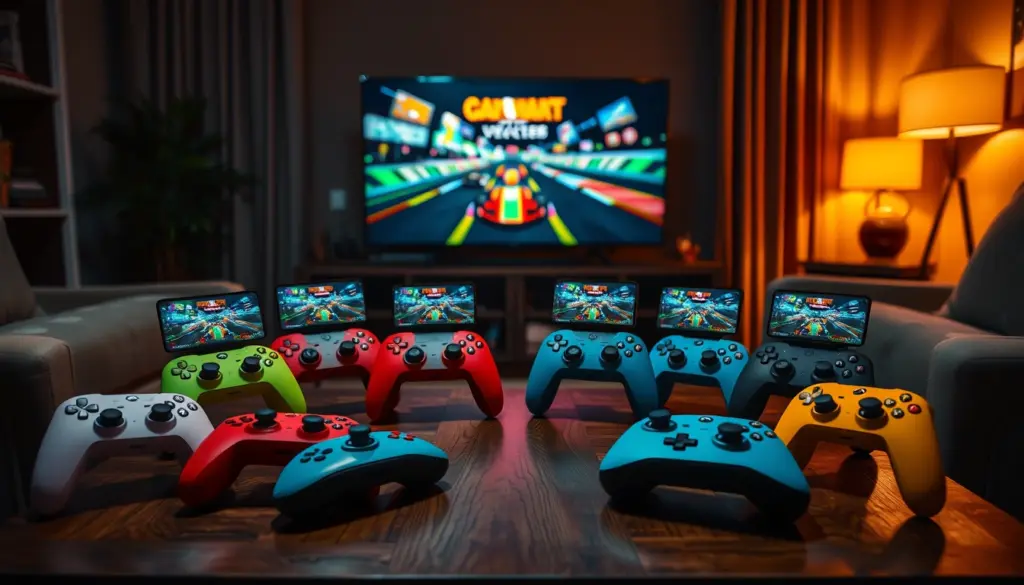
Nintendo pushed a free update to Mario Kart 8 Deluxe on September 1, 2026, and the patch notes undersell what actually changed. Version 4.0.0 doubles the game’s local split-screen ceiling from four players to eight, provided you’re running the title on a Nintendo Switch 2. Outlets including GameSpot, Engadget, 9to5Toys and MyNintendoNews confirmed the rollout within hours, and Nintendo’s own regional newsroom posted the announcement on September 1, with wider press coverage landing September 2. For a nearly decade-old kart racer that has already sold more copies than most franchises will ever see, an update this substantial is unusual. It’s also a quiet flex: Nintendo is using its oldest hit to show off what its newest hardware can do.
What Nintendo Actually Shipped in Version 4.0.0
The Mario Kart 8 Deluxe Switch 2 update bundles four changes into one free download. First, and most talked-about, is native support for eight-player local split-screen racing on a single console, up from the four-player cap that has held since the game’s Wii U debut. Second is CameraPlay, a feature that pipes a player’s face into the game world through a separately sold USB camera connected to the Switch 2. Third, the update raises the resolution ceiling for docked and handheld play. Fourth, load times before races and battles have been cut, taking advantage of the Switch 2’s faster storage and processor over the original Switch.
None of this requires buying anything extra to play, unlike a paid DLC pack. Nintendo confirmed the update is available at no cost to anyone who already owns Mario Kart 8 Deluxe and plays it on Switch 2 hardware. The catch, if you can call it that, is that the marquee eight-player feature is locked to Switch 2. Owners still on the original Switch keep the four-player split-screen cap they’ve had since 2017.
How Eight-Player Split-Screen Actually Works
Splitting one screen eight ways sounds chaotic on paper, and reviewers who tested the Mario Kart 8 Deluxe Switch 2 update describe it as exactly that: a tight grid of eight small viewports racing simultaneously on a single television or the console’s own display. Nintendo previously topped out at four-way splits going back to the Wii U original in 2014, then carried that same four-player ceiling into the 2017 Switch port. Doubling that number on one system, without requiring a second console linked over local wireless, is a genuine first for the franchise.
The update also opens a middle tier that didn’t exist before. Rather than a binary jump from four to eight, Mario Kart 8 Deluxe on Switch 2 now supports local groups ranging from five to eight players, letting families and friend groups fill whatever seats are actually available instead of forcing an all-or-nothing split. That flexibility matters more than the headline number for most living rooms, where getting exactly eight controllers into one room on a Tuesday night is rare.
Controller Requirements Are the Real Catch
Getting to eight players isn’t as simple as grabbing any eight controllers from a drawer. Nintendo’s own documentation on the update lays out a specific rule: the Switch 2 can connect up to seven legacy controllers wirelessly, meaning original Joy-Con or the first-generation Switch Pro Controller. To unlock the eighth slot, at least one connected controller has to be either a Joy-Con 2, a Nintendo Switch 2 Pro Controller, or a wired original Switch Pro Controller. Skip that requirement and the lobby caps out at seven, not eight.
| Player Count | Controller Requirement | Notes |
|---|---|---|
| 1–4 players | Any mix of legacy Joy-Con or Switch Pro Controller | Same as original Switch experience |
| 5–7 players | Up to seven legacy controllers, wireless | New tier introduced by v4.0.0 |
| 8 players | At least one Joy-Con 2, Switch 2 Pro Controller, or wired legacy Pro Controller | Hard requirement to unlock the eighth slot |
CameraPlay: Putting Faces Into the Race
CameraPlay is the update’s other headline addition, and it’s aimed less at split-screen chaos and more at online play. Connect a USB camera to the Switch 2 and the game can display a player’s face inside the race, visible to other racers in local multiplayer groups of two to four, or to friends joined through GameChat during online matches. Nintendo has been clear that footage and microphone audio only reach people already inside that GameChat session, not the wider internet, which mirrors the privacy framing the company used when it first introduced GameChat alongside the Switch 2 launch.
It’s a small feature next to the eight-player headline, but it signals where Nintendo wants Switch 2 social features to go: less about spectacle, more about making a race with friends across the country feel closer to sitting on the same couch.
Faster Load Times and Sharper Visuals
The resolution and load-time gains are less flashy but arguably more felt in everyday play. Racing on Switch 2 now runs at a higher resolution than the original Switch version allowed, whether docked to a TV or played handheld on the console’s own screen. Load times before races and battles have also dropped noticeably, a direct benefit of Switch 2’s faster internal storage and processor over the seven-year-old hardware the game originally shipped on.
These improvements apply across the game’s full roster of 96 tracks, meaning the entire back catalog of courses, including the Booster Course Pass content added over the past several years, benefits from the same visual and performance boost. Nintendo didn’t need to rebuild individual tracks to deliver this. It’s a platform-level jump that happens simply by running the existing game on newer silicon.
Why Mario Kart 8 Deluxe, Specifically
Nintendo had plenty of games it could have chosen to showcase Switch 2’s local multiplayer muscle. It picked the one that’s already in more households than almost any other title the company has ever published. That’s not an accident. Mario Kart 8 Deluxe functions as Nintendo’s default answer to “what should I play with a room full of people,” and pushing its ceiling from four to eight players turns an already-owned game into a fresh pitch for upgrading hardware, without Nintendo spending a cent on new content licensing or marketing beyond a patch note.
It’s also a low-risk way to make Switch 2 ownership feel different from Switch ownership for a game most buyers already have installed. Rather than ask consumers to buy a new game to experience what the new console can do, Nintendo made an old favorite noticeably better, which is a harder sell to ignore than another first-party exclusive sitting in a store listing.
A Decade of Sales Momentum
Mario Kart 8 Deluxe isn’t just old, it’s one of the best-selling video games ever made, and it kept climbing well into 2026. GameSpot reported the game added roughly 2.3 million copies sold between April and December 2025 alone, an unusual sales pace for a title that first launched on Wii U in 2014 before being ported to Switch in 2017. Tracking site VGChartz listed the game at approximately 70.6 million units sold as of its early February 2026 update, and separate 2026 tallies drawing on Nintendo’s own investor disclosures put the figure past 71 million copies by the end of June 2026.
| Milestone | Approximate Units Sold | Source |
|---|---|---|
| End of 2025 (shipped) | ~69.9 million | Nintendo shipment data analysis |
| Early February 2026 | ~70.6 million | VGChartz tracking |
| End of June 2026 | ~71.5 million | Nintendo IR data compilation |
| Apr–Dec 2025 sales added | ~2.3 million (period only) | GameSpot, citing Nintendo data |
That trajectory makes Mario Kart 8 Deluxe the best-selling Nintendo Switch title by a wide margin and one of only a handful of games in history to clear 70 million units, trailing only Minecraft’s cross-platform total in most industry rankings. A free update that meaningfully changes how the game plays, nine years after its Switch debut, is a rare move for a title already this commercially settled. Most publishers would rather sell a sequel.
The Switch 2 Adoption Angle
Timing matters here. Switch 2 launched in mid-2025, and Nintendo has spent the months since giving owners of its predecessor console concrete reasons to upgrade beyond raw horsepower. A backward-compatible game getting meaningfully better on new hardware, at no extra cost, is exactly the kind of soft incentive that nudges holdouts. Unlike a locked exclusive, this update reaches everyone who already owns Mario Kart 8 Deluxe and simply hasn’t made the jump to Switch 2 yet, turning existing game libraries into upgrade bait.
It also reinforces a pattern Nintendo has leaned on since the Switch 2 launch window: rather than gating features behind new purchases, the company has repeatedly used free updates to older, massively-owned titles to demonstrate hardware capability. Mario Kart 8 Deluxe’s split-screen jump is the most dramatic example yet because it changes a core mechanic that hasn’t moved since the Wii U era.
Split-Screen Multiplayer’s Long, Uneven History
Split-screen racing goes back to Mario Kart 64 in 1996, which introduced four-player local racing at a time when most consoles struggled to render even two viewpoints smoothly. That four-player standard stuck around for three decades across GoldenEye 007, Mario Kart: Double Dash, and eventually Mario Kart 8 on Wii U in 2014, which carried it into the Switch port three years later. Four became the unofficial ceiling for local console multiplayer industry-wide, not because four was some ideal number, but because hardware struggled to render more viewpoints at playable frame rates.
Split-screen itself fell out of favor through the 2010s as online play took over as the default social mode for most big titles. Plenty of major releases dropped local split-screen entirely rather than expand it. Against that backdrop, Nintendo doubling a long-standing four-player cap to eight runs against the broader industry trend of quietly retiring the feature altogether.
How This Compares to Rival Racing and Party Games
Most current-generation racing and party games on PlayStation and Xbox platforms still cap local split-screen at two to four players, a ceiling that has held across multiple hardware generations even as those consoles’ raw processing power grew far beyond what Mario Kart requires. Reports covering the Mario Kart 8 Deluxe Switch 2 update have repeatedly framed the eight-player mode as unusual specifically because it breaks from that norm rather than following it.
| Platform / Title Era | Max Local Split-Screen (Single Console) |
|---|---|
| Mario Kart 64 (1996) | 4 players |
| Mario Kart 8, Wii U (2014) | 4 players |
| Mario Kart 8 Deluxe, Switch (2017) | 4 players |
| Typical current-gen racing/party titles (PS5/Xbox) | 2–4 players, per general industry reporting |
| Mario Kart 8 Deluxe, Switch 2 (v4.0.0, 2026) | Up to 8 players |
That gap is the story. Nintendo isn’t competing on raw graphical fidelity against PlayStation or Xbox, and it hasn’t tried to for years. Instead, it’s carving out a lane where local, same-room multiplayer at a scale rivals don’t bother chasing becomes the differentiator, banking on the fact that a genuinely full-room racing game is harder to replicate than another visually impressive single-player campaign.
What This Means for Switch 2 Hardware Momentum
Free software updates rarely move hardware sales charts on their own, but they compound. Every feature that only works on Switch 2, layered onto a library of games people already own on the original Switch, chips away at the reasons to keep waiting on an upgrade. Mario Kart 8 Deluxe’s eight-player mode is a particularly effective example because it’s visible the moment friends walk into the room wanting to play together, not buried in a settings menu or a benchmark chart only enthusiasts check.
It also gives Nintendo a recurring marketing beat that costs little to produce. Rather than a single splashy launch moment, the company can keep pointing back to its best-selling game and say: it’s still getting better, and only on the new hardware. Expect that message to keep showing up around holiday shopping season.
Free Updates vs. Paid Expansion Strategy
It’s worth noting what Nintendo didn’t do here: charge for it. The Booster Course Pass, which added dozens of tracks to Mario Kart 8 Deluxe between 2022 and 2023, was paid DLC bundled as part of a Nintendo Switch Online membership tier. Version 4.0.0 takes the opposite approach, bundling hardware-driven improvements as a straight free patch tied to owning Switch 2 hardware rather than paying for extra content.
That distinction matters strategically. Paid content monetizes existing owners directly. A free, hardware-gated update instead monetizes indirectly, by making the console itself the product worth buying. Nintendo appears to be treating Mario Kart 8 Deluxe less as a revenue line at this point in its lifecycle and more as a permanent showcase title that keeps evolving alongside whatever hardware Nintendo ships next.
Predictions: Where This Goes Next
- Expect Nintendo to apply the same Switch 2-exclusive update playbook to other high-ownership Switch titles with strong local multiplayer modes, using free patches rather than paid re-releases.
- CameraPlay accessory demand will likely tick up modestly through the rest of 2026, though it will probably remain a niche add-on rather than a mainstream peripheral given the separate purchase required.
- Mario Kart 8 Deluxe will almost certainly cross further sales milestones through the remainder of 2026, with the Switch 2 update likely to be cited by Nintendo as a contributing factor in its next earnings report.
- Third-party publishers are unlikely to rush to match eight-player split-screen given the technical and design work required, meaning Nintendo may hold this specific differentiator uncontested for some time.
- Future Mario Kart entries built natively for Switch 2, rather than backward-compatible updates, will likely treat expanded local multiplayer as a baseline expectation rather than a headline feature, since Nintendo has now set that bar itself.
The Bigger Picture for Nintendo’s Console Strategy
Nintendo has built its last several hardware generations around a similar idea: local, shared-screen play is a feature competitors chase less aggressively, and it’s one families actually notice. The Wii leaned on motion controls everyone in the room could try. The Switch leaned on portability plus detachable controllers that let a living room split into two players instantly. Switch 2, at least based on this update, is leaning on scale, turning a four-player standard the whole industry settled into decades ago into an eight-player one.
The takeaway: this isn’t really a story about one patch to one racing game. It’s a data point in how Nintendo intends to keep justifying Switch 2 purchases for people who already own most of the games they want, by making those same games noticeably better rather than asking players to buy something new.
Frequently Asked Questions
Is the Mario Kart 8 Deluxe Switch 2 update free?
Yes. Nintendo confirmed Version 4.0.0 is a free update for anyone who already owns Mario Kart 8 Deluxe and plays it on a Nintendo Switch 2 console.
Does eight-player split-screen work on the original Switch?
No. The eight-player local split-screen mode is exclusive to Nintendo Switch 2. Original Switch owners retain the four-player split-screen cap the game has had since 2017.
What controllers do I need for eight players?
The Switch 2 supports up to seven legacy controllers wirelessly. To reach eight players, at least one connected controller must be a Joy-Con 2, a Nintendo Switch 2 Pro Controller, or a wired original Switch Pro Controller.
What is CameraPlay in Mario Kart 8 Deluxe?
CameraPlay uses a separately sold USB camera connected to Switch 2 to display a player’s face in-game during local multiplayer sessions of two to four players, or during online play through GameChat.
Do I need to buy a camera to use the update?
No. The eight-player split-screen mode, resolution boost, and faster load times work without any additional hardware. Only CameraPlay requires a separately purchased USB camera.
How many copies has Mario Kart 8 Deluxe sold?
Tracking estimates put the game past 71 million units sold worldwide as of mid-2026, making it the best-selling Nintendo Switch title and one of the best-selling video games in history.
Does the update improve graphics on the original Switch too?
No. The resolution and load-time improvements in Version 4.0.0 are specific to play on Nintendo Switch 2 hardware.
Will other Nintendo games get similar Switch 2 updates?
Nintendo hasn’t announced further titles, but the company has already used free, hardware-gated updates on other Switch games to highlight Switch 2 capabilities, and analysts expect that pattern to continue.