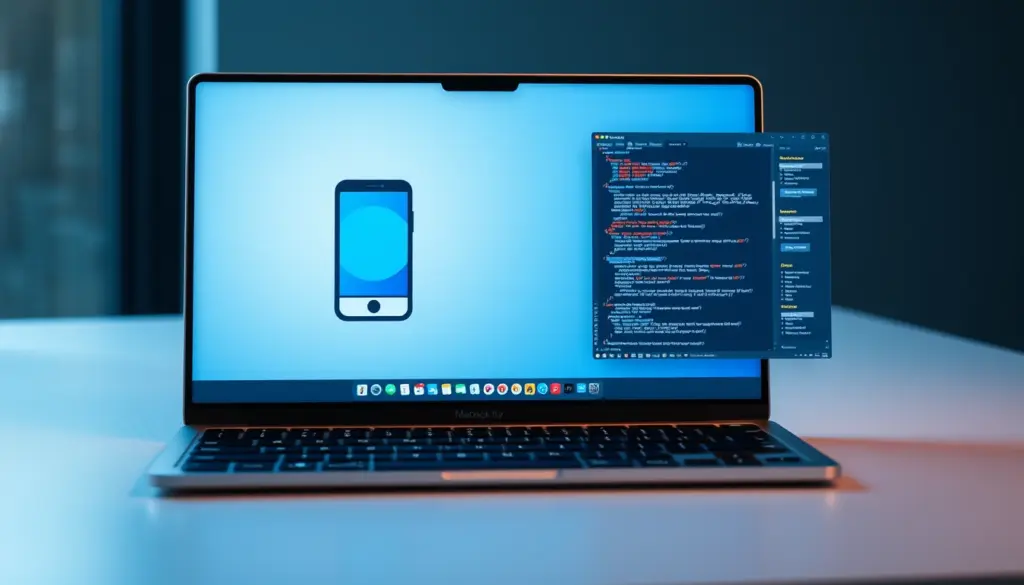
A GitHub project with a modest name, vphone-cli, has spent the past two weeks climbing tech-news feeds for an unusual reason: it boots a real, unmodified copy of iOS 27 as a virtual machine on an Apple Silicon Mac. Not a simulator that fakes the frameworks. Not an Android-style emulator translating instructions on the fly. A full iPhone, firmware and all, running inside a VM window with root shell access over SSH and a live screen over VNC. InfoQ picked up the story on September 13, 2026, and outlets from Daily.dev to Korea’s Hada.io followed within days, turning a niche security-research tool into one of the most searched hardware stories of the week.
A Real iPhone, Not a Simulator, Running on Your Mac
The distinction matters more than it sounds. Apple’s own Xcode Simulator has let developers test iOS apps on a Mac for over a decade, but it works by running iOS frameworks directly on macOS, translating calls rather than booting actual device firmware. That approach breaks down for camera access, Bluetooth, Metal-heavy graphics, App Store installs, and iCloud sync, gaps every iOS developer has hit at some point. vphone-cli takes a different route entirely. It downloads genuine IPSW firmware images, patches the boot chain, performs a DFU-style restore, and walks the resulting image through a first boot, exactly like restoring a physical iPhone, except the “phone” is a virtual machine spun up on Apple Silicon hardware instead of a handset.
Once booted, the VM hands back two things security researchers have wanted for years: a root SSH shell and VNC access to the graphical interface. That combination turns a locked-down consumer device into something closer to a Linux box you can script against, snapshot, and reset in seconds.
What vphone-cli Actually Does
Coverage from InfoQ and Daily.dev describes vphone-cli as a command-line tool that automates a process security researchers previously did by hand, often across a dozen scattered scripts. It handles firmware acquisition, boot-chain patching, the DFU restore, and the first-boot sequence in one pass, then exposes the finished virtual iPhone for immediate use. The project builds on Apple’s Virtualization.framework rather than a third-party hypervisor, which is the detail every outlet covering the launch keeps returning to. Apple built that framework primarily so developers could run Linux and macOS guests on Apple Silicon. Nobody expected it to end up booting iOS itself.
The GitHub repository is credited to a developer using the handle Lakr233, with a companion GUI project called vphone-ws, built by a separate contributor under the handle zqxwce, giving the command-line tool a SwiftUI front end for people who would rather click through a window than type flags.
Inside the Boot Pipeline: From Firmware to First Boot
Reports describe the pipeline in four stages: firmware download, boot-chain patching, DFU restore, and first boot. Each stage mirrors what happens when you restore a physical iPhone through Finder, but chained together and run against a virtual disk instead of a connected device. That is what lets vphone-cli claim it is running real iOS rather than a stand-in for it.
The DFU Restore Step Explained
DFU, or Device Firmware Update mode, is the lowest-level recovery state an iPhone can enter, used when a device is too broken to boot normally. On real hardware it requires a precise button sequence and a cable. Inside vphone-cli, the same restore logic runs against a virtual disk image, letting the tool install a patched firmware image the way iTunes or Finder would push firmware to a bricked phone. Automating that step is what turns a multi-hour manual process into a single CLI command.
Five Firmware Variants, From Patchless to Full Jailbreak
According to reporting from Glonce, vphone-cli ships five firmware variants that scale from a patchless build, closest to stock iOS behavior, up through a full jailbreak configuration bundling Sileo and TrollStore, two well-known third-party package managers from the jailbreak scene. That range matters because it lets a researcher choose exactly how much of Apple’s security stack to leave intact. A patchless VM is useful for testing how an app behaves under normal constraints. A fully jailbroken VM strips those constraints away entirely, which is closer to what a reverse engineer or exploit developer actually wants.
Coverage from Hada.io adds a technical detail: getting the more permissive variants running requires relaxing System Integrity Protection and AMFI (Apple Mobile File Integrity), along with a PV=3 entitlement setting, prerequisites familiar to anyone who has spent time in the jailbreak or security-research communities.
Built on Apple’s Own Virtualization.framework
Every outlet that has covered vphone-cli leads with the same framing: this is virtualization, not emulation. Apple’s Virtualization.framework lets a Mac run guest operating systems using the same silicon that powers the host, rather than translating instructions between architectures the way an emulator does. Because Apple Silicon Macs and iPhones both run on the same ARM-based architecture family, an iOS guest can execute close to native speed inside the VM, something an x86-to-ARM emulator could never match.
That architectural overlap is also why this project waited until Apple Silicon became the default Mac lineup to become practical. Intel Macs never had a realistic path to booting ARM-based iOS firmware at usable speed.
The Private Cloud Compute Connection Nobody Expected
The most surprising thread running through the coverage is where some of vphone-cli’s underlying plumbing came from. Reporting ties the project to research VM infrastructure Apple originally built for Private Cloud Compute, the system Apple uses to process certain Apple Intelligence requests on Apple-designed servers rather than third-party cloud hardware. As part of its Private Cloud Compute security effort, Apple built an iPhone Research Environment Virtual Machine so its own security team, and outside auditors, could inspect PCC-adjacent behavior. That research VM was never released as a general developer tool. vphone-cli effectively repurposes pieces of that infrastructure for a much broader audience.
It is worth being precise about what is and is not confirmed here: outlets report that vphone-cli builds on this PCC-era research VM plumbing, not that Apple endorsed or distributed the tool itself. The project is independent, open-source, and unofficial.
How vphone-cli Compares to Xcode’s Simulator, UTM, and Corellium
iOS developers and security researchers already had several options before vphone-cli, each with a different trade-off between fidelity and convenience. The table below lines up the main approaches people use today to test against iOS without a farm of physical devices.
| Tool | Approach | Root shell access | Runs real firmware | Typical cost |
|---|---|---|---|---|
| vphone-cli | Native virtualization via Apple’s framework | Yes, via SSH | Yes, actual IPSW | Free, open-source |
| Xcode iOS Simulator | Framework-level API translation on macOS | No | No | Free with Xcode |
| Corellium | Commercial ARM virtualization platform | Yes, by design | Yes | Paid enterprise licensing |
| UTM / QEMU | General-purpose hypervisor and emulator | Depends on guest OS | Not for iOS guests | Free, open-source |
Corellium is the closest existing comparison in spirit, a commercial platform built specifically to virtualize ARM devices including iPhones for security testing, and it has spent years selling that capability to enterprise clients and government researchers, a history documented in InfoQ’s own coverage of the ARM virtualization space. What vphone-cli changes is the price and the barrier to entry: a free, open-source CLI tool running on hardware most iOS developers already own, rather than a paid enterprise contract. UTM and QEMU remain the general-purpose options for running other operating systems on a Mac, but neither is built to boot iOS guest firmware the way vphone-cli is.
Root Access and VNC: Why Security Researchers Care
Root SSH access paired with VNC turns iOS from a black box into something a researcher can script, automate, and tear down without touching a physical device. That combination is what several outlets flag as the project’s real draw for the security community: it removes the need to jailbreak a personal phone just to get a research environment, and it makes the environment disposable. Break something, snapshot back to a clean state, and try again, all without risking a bricked handset.
Note.com’s coverage frames this shift in terms of automation and AI tooling specifically, describing a growing interest in letting automated agents interact with “real iOS” environments for testing rather than a simulated approximation. Whether that framing holds up at scale is still an open question, but it points to why a security-research tool crossed over into general tech-news coverage this month.
The Jailbreak Community’s Reaction
The jailbreak scene has watched its practical relevance shrink for years as Apple has locked down iOS with each release, so a tool that reintroduces a full jailbreak variant, on demand, with no physical device at risk, landed as welcome news in that corner of the internet. A LinkedIn post covering the release framed it plainly: someone booted a complete iPhone as a VM on Apple Silicon, and it is not an emulator. That framing, repeated across Glonce, Hada.io, and several aggregator sites, is doing a lot of the work explaining why a command-line tool aimed at a fairly technical audience broke into mainstream tech coverage at all.
A Timeline: How the Story Spread Across Tech Media
The spread of coverage follows a pattern common to niche developer-tool stories that break wide: early, technical coverage on smaller outlets and community sites, followed by pickup from larger aggregators once the story clears a certain visibility threshold. Here is how it played out across the outlets tracking vphone-cli this cycle.
| Outlet | Date | Angle |
|---|---|---|
| Hada.io | Aug. 29, 2026 | Technical breakdown of the boot chain and SIP/AMFI prerequisites |
| Mindpattern.ai | Aug. 29, 2026 | First report of a GitHub star count, cited at 9,001 |
| Glonce | Aug. 30, 2026 | Introduces the five firmware variants and the “-V jb” jailbreak option |
| LinkedIn (community post) | Aug. 30, 2026 | Frames the project as “not an emulator” for a broader professional audience |
| The Daily Commit | Aug. 9, 2026 | Groups vphone-cli with the related vphone-ws GUI project |
| Note.com | Sept. 10, 2026 | Long-form piece linking the tool to AI-agent testing use cases |
| InfoQ | Sept. 13, 2026 | Mainstream tech-news pickup, framing it as full iOS 27 virtualization |
The GitHub star count cited by Mindpattern.ai, 9,001 at the time of that late-August report, was tied to an iOS 26 release cut. By the time InfoQ picked the story up in mid-September, coverage had shifted to iOS 27 support, suggesting the project kept pace with Apple’s own release cadence rather than lagging behind it.
Historical Context: A Decade of Trying to Virtualize iOS
Running iOS somewhere other than an actual iPhone has been a persistent, mostly frustrated goal in the developer and security community for well over a decade. Early jailbreak tools focused on physical devices because there was no realistic alternative. Xcode’s Simulator solved the everyday developer testing problem but never pretended to replicate real hardware behavior. Corellium built a commercial business specifically by solving the virtualization problem for enterprise and government clients, and it has weathered legal challenges from Apple over exactly that capability in years past.
What changed the calculus is Apple’s own hardware transition. Apple Silicon Macs and iPhones share an architecture family in a way Intel Macs and iPhones never did, and Apple built Virtualization.framework, plus the PCC research VM infrastructure vphone-cli reportedly draws on, for its own internal and cloud-security purposes. vphone-cli is arguably the first widely visible project to take those Apple-built pieces and repackage them as a free, general-purpose tool rather than a paid enterprise product or an internal Apple system.
The Legal Gray Zone: What Apple’s Terms Actually Say
None of the coverage tracked so far includes a public statement from Apple about vphone-cli specifically. That silence leaves an obvious question unanswered: does running iOS firmware inside a third-party virtualization tool violate Apple’s software license and security terms? Corellium’s own legal history with Apple suggests the company has strong opinions about who gets to virtualize its operating system and under what terms, though that dispute centered on a commercial product sold to paying customers, a different situation from a free, open-source CLI tool used by individual researchers.
Why the Jailbreak Variant Raises the Stakes
Virtualization boundaries are already a live security topic elsewhere in the industry, as shown by a recent VM-escape flaw disclosed in VMware Workstation and Fusion, and a tool that deliberately weakens iOS’s own protections inside a VM sits in a related, if distinct, risk category. The patchless firmware variant is the easiest to defend as legitimate testing and research use. The full jailbreak variant, bundling Sileo and TrollStore, is a different story: it strips out the exact protections Apple’s security team spends the most engineering effort defending. If vphone-cli’s adoption keeps climbing, this is the variant most likely to draw a formal response, whether that is a takedown request, a licensing clarification, or simply silence while Apple watches how the tool is actually used in practice.
Market Impact: Pressure on Commercial iOS Testing Vendors
A free tool that replicates even part of what a paid enterprise platform offers tends to reshape a market, and iOS security testing is no exception. Corellium built a real business around solving this exact problem for clients who could not, or would not, build the tooling themselves. vphone-cli does not match Corellium’s polish, support contracts, or device-model coverage, but it does not need to. It only needs to be good enough for the long tail of independent researchers, small security shops, and hobbyists who were never going to become Corellium customers anyway.
The more interesting pressure point sits with Apple’s own tooling. Xcode’s Simulator has effectively had no direct substitute for over a decade for anyone wanting real-firmware fidelity without an enterprise budget. That vacuum is exactly what vphone-cli fills, and it does so using pieces of infrastructure Apple built for itself, the same Apple Silicon server hardware push covered in Apple’s broader AI infrastructure strategy.
What Comes Next: Five Predictions
- Apple issues guidance, not a takedown. Given the project draws on Apple’s own PCC research VM lineage rather than pirated firmware, an outright legal strike looks less likely than a quiet clarification of what Apple’s license terms permit.
- The GUI front end, vphone-ws, gains ground faster than the CLI. Command-line tools cap their own audience. A polished SwiftUI wrapper is the more likely path to mainstream developer adoption over the next few months.
- Corellium responds with pricing or feature moves. A free alternative chipping at the low end of a market historically forces the incumbent to defend its higher tiers with capabilities a hobbyist project cannot match, like multi-device fleets and official support.
- Security researchers publish the first serious findings sourced from vphone-cli VMs within a quarter. Cheaper, disposable iOS environments tend to accelerate the pace of vulnerability research simply by lowering the cost of experimentation.
- Apple hardens Virtualization.framework’s guest boundaries in a future macOS update. Projects that repurpose a framework for uses its authors did not originally intend tend to draw follow-up engineering attention, even when no legal action follows.
A Typical vphone-cli Workflow
Reporting from Glonce, Note.com, and Hada.io describes a workflow that collapses what used to be a multi-step manual process into two commands: one to create a named VM with a chosen firmware variant, and one to launch it. The representative shape of that workflow, as described across coverage, looks like this:
# Create a jailbroken iOS VM (illustrative, per outlet reporting)
vphone-cli vm create myphone -V jb

# Boot the VM
vphone-cli vm launch myphone

# Once booted, connect over SSH with root access
ssh root@<vm-address>
The exact flag syntax may shift between releases, and readers evaluating the tool for their own use should check the project’s GitHub repository directly rather than treating any third-party writeup, including this one, as the canonical reference.
Why Apple Silicon, Specifically, Made This Possible
It is easy to undersell how much of this story is a hardware story rather than a pure software one. Apple’s multi-year push to move every Mac onto its own silicon did more than cut power consumption and boost battery life. It collapsed the architectural gap between a MacBook and an iPhone down to nearly nothing, both now running variants of the same ARM-based chip design philosophy. Virtualization.framework existed for years before vphone-cli, mostly used to run Linux distributions or lightweight container workloads. What changed is that someone finally pointed that same machinery at Apple’s own mobile operating system and got it to boot.
That framing also explains why this could not have shipped a Mac generation or two earlier. An Intel Mac trying to run ARM-based iOS firmware would need genuine emulation, with the performance penalty that implies, turning a research tool into a slideshow. On Apple Silicon, the guest and host share enough architectural DNA that the VM runs close to native speed, which is precisely why the “not an emulator” framing keeps showing up across the coverage.
Frequently Asked Questions
What is vphone-cli?
vphone-cli is an open-source command-line tool that automates booting a full iOS system as a virtual machine on Apple Silicon Macs, using Apple’s Virtualization.framework instead of emulation.
Does vphone-cli run real iOS 27, or a simulated version?
Reports describe it running actual IPSW firmware images through a genuine boot chain, patch, and DFU-restore process, distinguishing it from Apple’s Xcode Simulator, which runs iOS frameworks on top of macOS rather than booting real device firmware.
Do I need a jailbroken iPhone to use vphone-cli?
No. The tool creates its own virtual iPhone environment, and reporting indicates it offers firmware variants ranging from patchless up to a full jailbreak, so no physical device needs to be modified.
Is vphone-cli legal to use?
Apple has not issued a public statement about the project specifically. Its legal standing under Apple’s software license terms remains unclear, and readers considering using it for anything beyond personal research should review Apple’s current terms directly.
How is this different from Corellium?
Corellium is a commercial, paid platform built for enterprise and government-scale ARM device virtualization. vphone-cli is a free, open-source project aimed at individual researchers and developers, with a narrower feature set but no licensing cost.
What Mac hardware do I need to run vphone-cli?
Coverage consistently specifies Apple Silicon Macs, since the project relies on architectural overlap between Apple’s Mac chips and iPhone chips to run iOS guest firmware without full emulation. Intel-based Macs are not part of the reported compatibility scope.
What is vphone-ws?
vphone-ws is a separate, related open-source project offering a native macOS SwiftUI application for managing vphone-cli virtual iPhones through a graphical window instead of the command line.
Has Apple commented on vphone-cli?
No public statement from Apple has surfaced in coverage of the project as of this writing. The tool remains an independent, unofficial community project.