
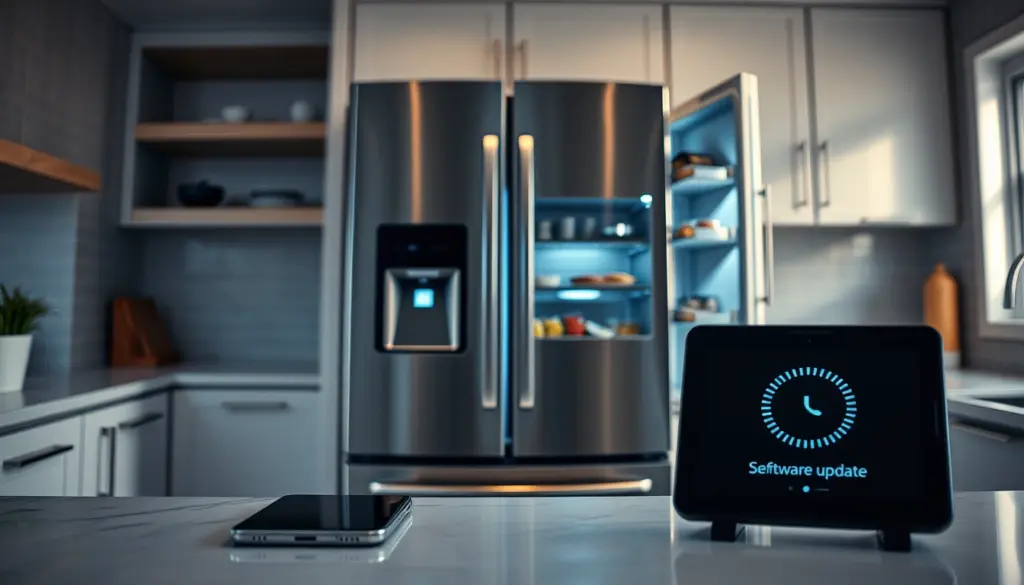
Samsung Electronics halted a software rollout this week after a botched SmartThings update left some Bespoke AI 4-Door Refrigerator units unresponsive, with owners in South Korea reporting dead displays, failed automatic doors and lost cooling starting September 22, 2026. The company says the cause was mundane and avoidable: a build meant for internal testing went out to real customers instead. Two days later, Samsung says a fix is largely in hand, but the episode has reopened a question that has dogged the smart-appliance category for a decade — what happens when the thing keeping your food cold needs a working internet connection and a clean patch to stay that way.
What happened with the Samsung refrigerator update
The trouble traces back to a routine-looking notification. Owners of Samsung’s Bespoke AI 4-Door Refrigerator line received a prompt through the SmartThings app, Samsung’s smart-home platform, asking them to install a firmware update as part of a standard Samsung refrigerator update cycle. Reports from South Korean outlets say that once the update applied, a subset of units began behaving erratically: interior lighting flickered or died, control panel displays froze or went black, automatic doors stopped responding, and in the more severe cases cooling itself dropped out. For a refrigerator, that last failure mode is the one that matters most, since a dead compressor during the days-long Chuseok holiday period in Korea meant some households faced spoiled food with no quick backup plan.
Samsung Electronics has not published an official count of affected units. Korean media reports describe the complaint volume in loose terms — dozens in some accounts, hundreds or “several hundred” in others — and no outlet has cited a firm, company-confirmed total. That ambiguity is itself notable for a company the size of Samsung, which typically moves quickly to quantify and contain consumer-facing incidents once they reach the press.
Samsung’s explanation: a test build reached real customers
Samsung’s stated root cause is a software distribution mistake rather than a hardware flaw. According to the company, software intended strictly for internal testing was mistakenly distributed to some customers during a scheduled refrigerator software update. In plain terms, a build that should have stayed inside Samsung’s own QA pipeline shipped to production devices sitting in people’s kitchens.
Samsung Electronics explained that the problem occurred because an update file that was still under the testing process was mistakenly distributed, according to a company statement reported by SBS News. The company has also been explicit about what the failure was not. The problem was not caused by a defect in the refrigerators themselves or a systemwide outage of the SmartThings platform, Samsung said, according to the Korea JoongAng Daily. That distinction matters commercially: a mechanical defect implicates the refrigerator’s manufacturing and could trigger a formal product recall process, while a software distribution error is, in Samsung’s framing, a process failure that sits entirely within its own release pipeline and can be fixed remotely.
Internal test software was accidentally distributed to customers on Sept. 22, resulting in abnormal symptoms regarding the power and screen of some customers’ refrigerators, per a Samsung SmartThings community post described by CNET’s reporting. That framing lines up with the timeline other outlets have reported: the update went out, symptoms surfaced within hours, and Samsung pulled the rollout once complaints started reaching customer service and social media.
Timeline: from update to emergency response
The Samsung refrigerator update failure unfolded quickly once Samsung became aware of it. The publicly reported sequence is short but instructive for anyone tracking how a connected-appliance vendor handles a live incident. Samsung pushed the update, users began reporting failures the same day, and the company says it halted the rollout and formed an emergency response team once the scale of the problem became clear. Below is the timeline as currently reported.
| Date | Event |
|---|---|
| September 22, 2026 | SmartThings-linked software update goes out to Bespoke AI 4-Door Refrigerator units; affected owners begin reporting power, display, door and cooling failures |
| September 22-23, 2026 | Samsung Electronics halts the update rollout and stands up an emergency response team to investigate |
| September 23, 2026 | Samsung states publicly that a test-only build was mistakenly distributed to customers, and that the issue is not a hardware defect or a broader SmartThings outage |
| September 24, 2026 | Samsung’s target date to complete recovery efforts for affected refrigerators; repair costs to be covered by the company |
A roughly 48-hour gap between the first reports and Samsung’s stated repair target is fast by the standards of most consumer electronics recalls, which often take weeks to move from “we’re investigating” to “here’s the fix.” Whether that timeline holds for every affected household, particularly ones where physical service visits are needed rather than a remote patch, is the detail worth watching in the coming days.
Which symptoms owners actually reported
Not every affected refrigerator failed the same way. Reports describe four distinct symptom categories, and the severity split between them matters because a dead display is an inconvenience while dead cooling is a food-safety problem.
| Reported symptom | Practical impact |
|---|---|
| Interior lighting failure | Refrigerator interior goes dark; cosmetic but signals a deeper fault |
| Display / control panel failure | Touch panel freezes or goes blank, blocking manual temperature and mode controls |
| Automatic door failure | Motorized doors on the Bespoke AI 4-Door line stop responding to open/close commands |
| Cooling loss | Compressor or cooling cycle drops out, risking spoiled food if unresolved |
Owner accounts circulating in Korean media describe installing the update as prompted, only to find the unit unresponsive and cooling largely lost soon after. That pattern matches what Samsung itself has acknowledged: a software fault severe enough to interrupt basic refrigeration, not just the connected features layered on top of it.
Why a firmware update can crash core refrigeration functions
Modern smart refrigerators, including Samsung’s Bespoke AI line, run on an embedded operating system that manages both the “smart” layer (touchscreen, cameras, SmartThings connectivity, AI features) and lower-level functions like compressor cycling and defrost timing. On most designs, these aren’t fully isolated systems. If a firmware update corrupts the main controller board’s software state or triggers a boot loop, it can take the compressor control logic down with it, even though the update was nominally about the smart features.
This is a known class of failure across the connected-appliance industry, not something unique to Samsung. Vendors typically try to reduce the blast radius with staged rollouts: an update pushes to a small percentage of devices first, telemetry is checked for error spikes, and only then does it roll out broadly. A test build reaching production customers, as Samsung describes happened here, suggests that safeguard either wasn’t applied to this release or failed to catch the problem before it shipped. The same class of risk shows up well beyond kitchen appliances: Microsoft’s own record 974-bug Patch Tuesday and a recent Nintendo Switch firmware exploit both show how a single bad update can ripple across millions of devices at once.
A simplified version of how staged OTA (over-the-air) gating is typically structured in the connected-device industry looks something like this — illustrative of general practice, not a description of Samsung’s actual internal system:
// Generic staged-rollout gate (illustrative example only)
if (build.channel !== "production_signed") {
  throw new Error("Blocked: non-production build cannot target retail device fleet");
}
rollout.targetPercent = 1;      // start at 1% of eligible devices
rollout.holdForTelemetryHours = 24;
if (rollout.errorRateDelta > THRESHOLD) {
  rollout.pause();
}
The point of a gate like this is precisely to stop an internal test build from ever reaching a channel labeled for retail devices. When failures show up broadly and quickly, as they did here, it usually points to a release-pipeline or channel-tagging error rather than a slow-burning bug that only appears at scale.
Samsung’s fix: free repairs, and a food-spoilage question still open
Samsung has committed to two concrete remediation steps. First, the company says repairs will be conducted free of charge for affected units. Second, it has set September 24, 2026 as its internal target to complete recovery of affected products, according to Korean press reports citing the company. Repair costs will be covered and compensation plans for food spoilage are under review, per the same reporting.
That second point, compensation for spoiled food, is the one still unresolved. Samsung has described it as “under review” rather than confirmed, which leaves affected households in the position of covering their own grocery losses for now, pending a policy the company hasn’t finalized. Given that some of the reported failures happened during the Chuseok holiday, when Korean households traditionally stock refrigerators heavily for family gatherings, the timing made the practical impact worse than the same bug would have caused on an ordinary week.
Market and trust impact for Samsung’s smart-appliance business
Samsung’s Bespoke AI appliance line sits at the center of its consumer strategy for bundling large-language-model features and SmartThings connectivity into everyday hardware. That strategy depends on customers trusting that “smart” features are additive, not a liability layered on top of a product that used to just work. A refrigerator that becomes inert because of a botched software push cuts directly against that pitch, regardless of how quickly Samsung says it can repair the units.
The immediate financial exposure looks contained: Samsung is absorbing repair costs itself, and the company says the fault sits in its release process rather than in the refrigerator’s mechanical design, which limits the odds of a formal safety recall through bodies like the U.S. Consumer Product Safety Commission for the U.S. market specifically. The reputational exposure is harder to bound. Every incident like this one becomes a reference point the next time Samsung, or any competitor, asks consumers to accept an over-the-air update on an appliance that holds hundreds of dollars of groceries. It also lands as AI assistants push into more corners of the home: Google’s own expansion of Gemini onto Windows PCs drew similar questions about how much platform reach is too much before something breaks.
How this compares to other connected-appliance software incidents
Samsung is far from the only company managing this risk. LG’s ThinQ platform, Whirlpool’s connected lineup, and Bosch’s Home Connect ecosystem all push firmware to refrigerators, ovens and washers over the internet, and all face the same fundamental tradeoff: ship updates fast enough to patch bugs and add features, without ever letting a bad build reach a device that’s holding someone’s dinner. The industry’s general answer has been staged rollouts, canary devices, and rollback mechanisms that can revert a unit to its last known-good firmware automatically if a health check fails after an update. Even gaming hardware has run into this same trap this year: Nintendo’s own Switch 2 firmware 23.0.0 rollout shipped months later than planned, a reminder that shipping an update on time and shipping it safely are two different engineering problems.
What sets this incident apart is less the failure itself, software bugs in embedded systems are not new, and more the reported category of mistake: a build meant to stay inside Samsung’s own test environment reaching production hardware. That’s a process failure, not an edge-case bug, and process failures tend to draw more scrutiny from regulators and enterprise customers because they suggest a gap in basic release controls rather than an unlucky interaction the QA team couldn’t have anticipated.
Historical context: smart appliances have failed before
Connected refrigerators and other smart appliances have a track record of software-driven outages, ranging from smart TVs losing app functionality after a botched patch to thermostats and doorbells going briefly dark during cloud-service outages. Refrigerators are a harder case than most of those categories because the cost of downtime isn’t just an inconvenienced user, it’s food loss, and in the case of medication storage for some households, a potential health issue. That’s part of why the current incident has drawn more attention in South Korean media than a typical smart-TV firmware hiccup would.
The broader pattern across the smart-home industry has been a slow tightening of update safeguards after each high-profile failure: more conservative staged rollouts, clearer rollback paths, and in some cases a manual confirmation step before an update installs on essential appliances rather than the fully automatic model many vendors, including Samsung, have leaned toward for convenience.
What owners of affected refrigerators should do now
- Check the SmartThings app for any notice specific to your Bespoke AI 4-Door Refrigerator model and follow any instructions Samsung has issued for your unit.
- If your unit shows display, lighting, door or cooling failures following a recent update, contact Samsung Electronics customer support directly rather than attempting a self-service firmware rollback.
- Keep receipts or documentation of any spoiled food in case Samsung finalizes a compensation policy, since the company has described that plan as still under review rather than confirmed.
- Avoid manually reinstalling or force-updating firmware on an affected unit until Samsung confirms the corrected build is being distributed through official channels.
The bigger question: are we too comfortable with silent OTA updates on essential appliances?
The uncomfortable part of this story isn’t that a software bug happened, bugs happen in every large release pipeline. It’s that the bug reached a refrigerator’s core cooling function through an update channel most owners never actively chose to interact with beyond tapping “install” once. As appliance makers push AI features, voice assistants and camera-based inventory tracking into refrigerators, ovens and washers, the software surface area on these devices keeps growing, and each new feature is one more thing that has to ship correctly before it reaches someone’s kitchen.
Samsung’s own statement, that this was not a hardware defect and not a platform-wide SmartThings outage, is meant to draw a narrow circle around the problem. But narrow-circle framing doesn’t change the practical reality for an affected household: a $2,000-plus appliance went dark because of a mistake in a software release pipeline, not because of anything the owner did wrong. That cost sensitivity is already rising elsewhere in the broader hardware market: reporting on RAM now eating into device costs and shrinking memory-chip stockpiles shows the components inside connected appliances are getting more expensive at the same time reliability is under more scrutiny.
What happens next
Anyone still waiting on word about the Samsung refrigerator update fix has three things worth watching over the next few weeks. First, whether Samsung meets its self-imposed September 24 target for completing repairs, or whether that date slips as service teams work through units that need in-person visits rather than a remote fix. Second, whether the company finalizes and publishes a concrete food-spoilage compensation policy, rather than leaving it “under review” indefinitely. Third, whether regulators in South Korea or elsewhere ask Samsung for a fuller accounting of how many units were actually affected, since the company has not published an official total and press estimates vary widely.
Predictions: where this story goes from here
- Samsung will likely publish a more detailed post-incident explanation once the emergency response team finishes its review, similar to how software vendors typically issue postmortems after major outages.
- Expect Samsung to tighten its release-channel controls for appliance firmware, given that the stated root cause was a test build reaching production rather than a logic bug in the shipped code itself.
- A formalized food-spoilage compensation policy is likely within weeks rather than months, given the public attention and the holiday-timing complaint volume in Korea.
- Competing smart-appliance vendors will probably use this incident in marketing or PR to emphasize their own staged-rollout and rollback safeguards, even without naming Samsung directly.
- Scrutiny of automatic, opt-out-only firmware updates on major appliances is likely to grow, with some consumers and reviewers pushing appliance makers toward opt-in or manually confirmed update models for safety-critical functions like cooling.
The takeaway for smart-appliance buyers
This incident is a reminder that “smart” and “reliable” aren’t the same promise, even from a manufacturer with Samsung’s scale and resources. The company says the underlying refrigerator hardware is fine and that the fault sits entirely in a mishandled software release, which is a relatively favorable outcome as these incidents go: it’s fixable, Samsung is covering the repair cost, and there’s no hardware recall on the table based on current reporting. But the fact that a labeled-internal test build could reach retail customers at all is the detail worth remembering next time an appliance asks to install an update before dinner.
Frequently asked questions
Which Samsung refrigerators are affected by the SmartThings update failure?
Reports identify Samsung’s Bespoke AI 4-Door Refrigerator models as the ones most affected by the September 22, 2026 update failure.
What caused the Samsung fridge update to fail?
Samsung says software intended for internal testing was mistakenly distributed to some customers during a routine refrigerator software update, rather than a hardware or mechanical defect.
Is this related to a wider SmartThings outage?
No. Samsung has stated the problem was not caused by a defect in the refrigerators themselves or a systemwide outage of the SmartThings platform, according to the Korea JoongAng Daily.
Will Samsung pay for repairs?
Samsung says repairs for affected units will be conducted free of charge, with a target of completing recovery efforts by September 24, 2026.
Will Samsung compensate owners for spoiled food?
A compensation plan for food spoilage is reported to be under review by Samsung, but no finalized policy has been confirmed as of this writing.
How many refrigerators were affected?
Samsung has not published an official total. Media estimates range from dozens to several hundred units, but no company-confirmed figure has been reported.
Should I install pending SmartThings updates on my refrigerator right now?
Samsung has halted the problematic rollout, so most owners should follow guidance in the SmartThings app rather than manually forcing an update, and should contact support if their unit shows lighting, display, door or cooling problems.
Does this affect other Samsung appliances beyond refrigerators?
Current reporting is specific to the Bespoke AI 4-Door Refrigerator line and its SmartThings-linked update. No other Samsung appliance category has been named in connection with this incident.