Apple is testing a new generation of its Vision Pro headset under the internal codename N224, according to a September 27, 2026 report from 9to5Mac citing Bloomberg’s Mark Gurman, since expanded on by BigGo Finance and several other outlets. The report describes a project still years from a decision, let alone a store shelf, but it is the clearest signal yet that Apple has not given up on mixed reality even as the original Vision Pro struggled to find a mainstream audience.
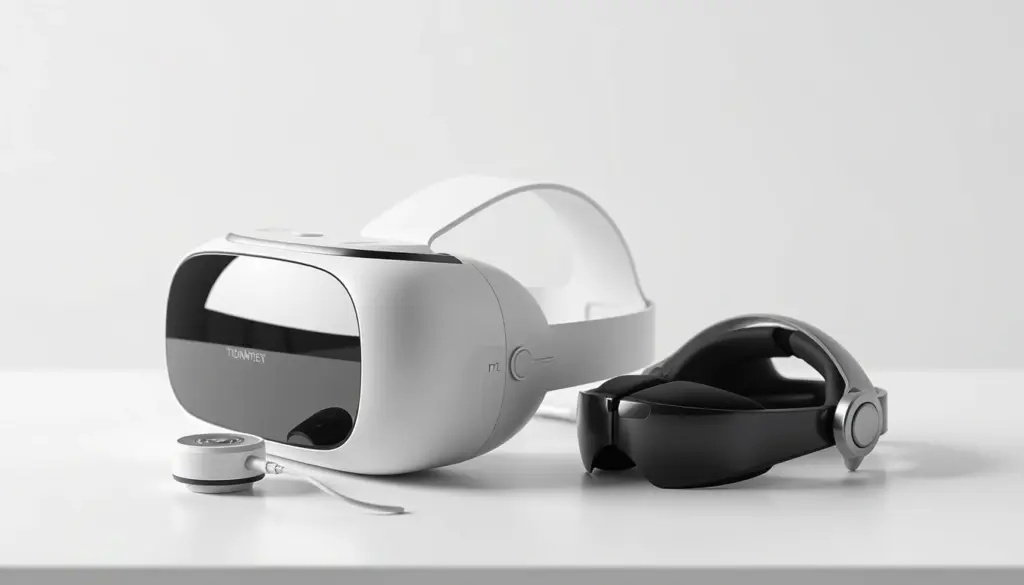
According to 9to5Mac, Apple’s Vision products group is currently juggling roughly four distinct design concepts for N224, ranging from a lighter version of the existing egg-shaped headset to a radical split design that offloads the battery and compute to an external “puck,” a layout that mirrors the approach Meta just took with its own VR glasses. No final direction has been chosen, and Apple has not confirmed any of this publicly.
What Apple Is Reportedly Testing With N224
Gurman’s reporting, as relayed by 9to5Mac, lays out four concepts Apple engineers are said to be evaluating in parallel. The first keeps the current Vision Pro’s familiar egg-shaped visor but swaps in plastic, titanium, or other lightweight metals to cut down the headset’s notoriously heavy feel on the face. The second and third variations explore different material blends aimed at the same goal: making a device people can wear for more than 20 minutes without neck fatigue.
The fourth concept is the one generating the most discussion. It would move the compute and battery out of the headset entirely and into a separate module, commonly described in the reporting as a “puck,” connected to the visor by a cable or wireless link. That layout is a near copy of the architecture Meta shipped with its recently unveiled VR glasses, and it is the approach that would do the most to shrink the size and weight of the part actually sitting on someone’s face.
None of the four concepts is locked in. The project is still described as being in an early stage, and Apple has not settled on a final industrial design, let alone specifications, pricing, or a ship date. That distinction matters: everything past this point in the reporting is a description of what Apple is testing, not what Apple has decided to build.
Why the Original Vision Pro Struggled
To understand why Apple is reportedly willing to consider such a different architecture for N224, it helps to look at what went wrong with the original Vision Pro. Apple’s first headset launched with a starting price near $3,500, a battery pack tethered by a cable, and a weight that reviewers consistently flagged as uncomfortable during extended use. The device impressed people in short demos but rarely became a daily-use product, and Apple has not disclosed unit sales figures, which is itself often read by analysts as a signal that the numbers are not something the company wants to highlight.
Apple had already tried to address the cost and comfort problem once. A cheaper, lighter model reportedly codenamed N100, sometimes referred to publicly as “Vision Air,” was in development during 2025 as a way to bring the Vision Pro experience down to a more mainstream price point. That project was shelved, and N224 appears to be Apple’s next attempt at solving the same underlying problem: how do you keep the software experience Apple wants (visionOS, spatial computing, hand and eye tracking) while making the hardware light enough that people actually want to wear it.
That history is worth keeping in mind when reading the new report. It is not Apple’s first swing at a lighter Vision Pro, and the fact that N224 is reportedly still juggling four unresolved concepts, rather than converging on one, suggests the comfort and weight problem has not gotten any easier to solve since N100 was shelved.
The Puck Debate Inside Apple
Perhaps the most interesting wrinkle in the reporting is that the external-puck concept is not a settled preference even inside Apple’s own Vision team. Coverage from VR.org of Gurman’s reporting describes internal resistance to the puck idea from some Apple executives who reportedly would rather keep the device closer to an all-in-one design, similar to how the current Vision Pro is built, rather than splitting compute away from the visor.
That internal split matters because it is exactly the kind of design fork that can stall a project for years. An all-in-one design keeps setup simple (put the headset on, nothing else to carry or charge separately) but caps how light the visor itself can get, since the battery and processor have to live somewhere on your head. A puck design can make the visor dramatically lighter, but it adds a second object to carry, charge, and potentially lose, and it changes how the product is marketed and priced.
Meta already made this bet with its own VR glasses, betting that consumers will accept a wired or paired external unit in exchange for a much lighter face-worn piece. Whether Apple follows that playbook or sticks with its historical preference for self-contained devices is, per the current reporting, still an open argument inside the company.
Timeline: Late 2028 to Early 2029, If It Ships At All
The reporting is unusually blunt about how far out this product sits. If N224 reaches the market, the earliest window described is late 2028 to early 2029, and that timeline is explicitly framed as unconfirmed rather than a target date Apple has committed to. Given that the project is still weighing four different hardware concepts with no resolution on the puck-versus-all-in-one question, a multi-year runway is not surprising.
It is worth being precise about what is and is not confirmed here. Apple has not officially announced N224, has not confirmed any of the four design concepts, has not set a price, and has not committed to a release window. Everything in this section is attributed to Gurman’s reporting as relayed by 9to5Mac, BigGo Finance, and other outlets covering the story, not to any Apple statement.
| Detail | Status per current reporting | Source attribution |
|---|---|---|
| Codename | N224 | Bloomberg’s Mark Gurman, via 9to5Mac |
| Number of design concepts | About four, under evaluation | 9to5Mac, BigGo Finance |
| Concept A | Egg-shaped design retained, lighter materials (plastic, titanium, metals) | 9to5Mac |
| Concept B | External “puck” for compute and battery, similar to Meta’s VR glasses | 9to5Mac, VR.org |
| Internal debate | Some executives reportedly favor an all-in-one design over the puck | VR.org |
| Development stage | Early stage, no final design chosen | 9to5Mac |
| Possible release window | Late 2028 to early 2029 (unconfirmed) | 9to5Mac |
| Official Apple confirmation | None | N/A |
How N224 Compares to the Current Vision Pro
The current Vision Pro runs on Apple’s M5 chip family, the same silicon lineage Apple has used to push performance gains across its Mac lineup this year. Reporting on N224 notes that future A-series mobile chips, potentially something in the same class as the A20 Pro, could theoretically handle visionOS workloads without needing the kind of active cooling the M5-based Vision Pro currently relies on. That is a meaningful distinction because active cooling and its associated fan noise have been recurring complaints in Vision Pro reviews since launch.
The comparison to Meta’s hardware strategy is also instructive. Meta’s VR glasses reportedly weigh around 100 grams and carry a $1,299 price, a figure achieved in large part by pushing weight and battery off the headset itself. Meta has also pursued a camera-free design path with its Luna smart glasses, which crossed 7 million units, showing that lighter, more limited hardware can find real commercial traction even without the full mixed-reality feature set Apple has built into Vision Pro.
If Apple does adopt a puck-style architecture for N224, it would represent a notable philosophical shift for a company that has generally favored self-contained, all-in-one devices, from the iPhone to the Apple Watch to the original Vision Pro itself. It would also put Apple in more direct architectural competition with Meta rather than simply competing on software and ecosystem.
Market Impact and Investor Reaction
Because N224 is still years from any launch decision, the immediate market impact of this report is limited mostly to sentiment rather than sales forecasts. Analysts tracking Apple’s hardware roadmap tend to treat early-stage reports like this one as evidence that Apple has not abandoned spatial computing as a category, which matters for how the company is valued relative to rivals investing heavily in headsets and glasses, including Meta and a growing list of Chinese hardware makers.
Component suppliers tied to Apple’s Vision line, including makers of micro-OLED displays and specialized optics, are the segment most likely to react to reports like this one, since a multi-year gap between Vision Pro generations affects order volumes and R&D allocation. TechTimes’ coverage of the report frames N224 as one data point among several Apple hardware bets, and none of the current reporting names specific suppliers tied to N224 concepts, so any component-level impact remains speculative at this stage.
It is also worth noting the timing relative to Apple’s broader device roadmap. Apple’s chip strategy has been visible across several 2026 launches, including the M5 generation Macs and updates to the iPhone line, and any Vision headset revision would likely draw on whichever chip architecture Apple has matured by the time N224 reaches a final design, if it ever does.
Competitive Landscape: Apple vs. Meta vs. the Rest
The mixed reality and smart glasses market has moved quickly since the original Vision Pro launched, and Apple’s reported N224 concepts have to be read against a field that has not stood still.
| Company / Product | Design approach | Reported price/weight | Status |
|---|---|---|---|
| Apple Vision Pro (current) | All-in-one, external battery pack via cable | Starting near $3,500 | Shipping |
| Apple N224 (reported) | Four concepts under review, including puck-based split design | Unconfirmed | Early development, life-support status per reports |
| Meta VR glasses | External compute puck | ~100g, $1,299 | Shipping |
| Meta Luna | Camera-free smart glasses, no display | Unconfirmed weight, 7M units sold | Shipping |
The pattern across the industry is fairly consistent: companies are converging on the idea that the part sitting on your face needs to get radically lighter, even if that means adding a second component elsewhere on your body or in your pocket. Apple’s willingness to test a puck concept, even amid internal disagreement, suggests the company recognizes that the original Vision Pro’s weight was one of its biggest adoption barriers, not a minor complaint.
What Industry Voices Are Saying About Vision Pro’s Direction
Apple executives have been relatively candid in public about viewing Vision Pro as an early, unfinished chapter rather than a finished product line. John Ternus, Apple’s SVP of Hardware Engineering, described the category in terms that suggest patience rather than urgency: “Vision Pro to me is an amazing device, right, it’s an absolutely amazing device, but I think of it as, like, the early days of computers,” Ternus said, according to Mixed News.
Ternus went further in framing the product’s long arc, saying, “It is the early days of a long journey, that’s how I feel about Vision Pro,” per the same Mixed News report. That framing lines up with what the N224 reporting describes: a company still experimenting with fundamental design questions years after the first headset shipped, rather than iterating on a settled formula.
The Historical Pattern: Apple’s Slow Hardware Iterations
Apple’s approach to N224 fits a broader pattern the company has followed with new hardware categories. The Apple Watch took several generations to find its current form and use cases. AirPods needed multiple revisions before spatial audio and noise cancellation became standard. In each case, Apple was willing to let a product sit through slow, sometimes multi-year gaps between meaningful hardware changes rather than rush a half-finished redesign to market.
Vision Pro appears to be following the same script, just on a longer clock. The original shipped in 2024, the N100 “Vision Air” concept was reportedly explored and shelved in 2025, and now N224 is being tested with a possible 2028-2029 window. That is roughly a five-year gap between the first Vision Pro and any confirmed successor, which is long even by Apple’s own standards for a device category it has publicly called strategically important.
What Could Change Apple’s Direction
Several factors could push Apple toward one of the four reported concepts faster than the others. If Meta’s puck-based VR glasses continue selling well at their current price and weight, that gives Apple’s puck-concept advocates inside the company a stronger data point to argue with. If component costs for lightweight materials like titanium alloys or advanced plastics drop enough, the modified egg-shaped concepts become more financially viable to ship at a competitive price.
Chip readiness is another variable. If Apple’s A-series roadmap, including chips in the A20 Pro class, matures to the point where it can run visionOS without active cooling, that removes one of the biggest engineering constraints tying Apple to power-hungry M-series silicon inside a headset. That shift alone could tip the internal debate toward a lighter, more glasses-like design.
Predictions: Where N224 Goes From Here
- Apple will likely take at least another 12-18 months before committing publicly to a single N224 design direction, given the current early-stage status and unresolved internal debate over the puck concept.
- If Meta’s VR glasses continue gaining market share through 2027, expect Apple’s internal puck-design advocates to gain more influence over the final N224 direction.
- A late 2028 to early 2029 launch window, if it holds, means Apple will likely ship at least one more Vision Pro software-only update on existing hardware before any N224 unveiling.
- Pricing for N224, if it ships, will probably still sit above mainstream consumer electronics, even if it undercuts the current Vision Pro’s roughly $3,500 starting point, given Apple’s pattern of positioning Vision products as premium hardware.
- Expect continued leaks and conflicting reports over the next year as Apple’s internal design debate plays out, since a project split across four concepts tends to produce more leaks than a project that has already converged on one direction.
What This Means for Developers and the Spatial Computing Market
For developers who have already built for visionOS, the N224 report is mostly a signal to keep building rather than a call to change direction. Apple has given no indication that a hardware redesign would come with a software platform change; visionOS has continued to receive updates independent of any headset revision news. The bigger practical takeaway is that Apple is not walking away from the spatial computing bet it made with the original Vision Pro, even after a rocky reception.
For hardware makers and component suppliers, the takeaway is less clear-cut. A project juggling four concepts with no resolution means Apple has not locked in bill-of-materials decisions, which in turn means suppliers of both micro-OLED displays and external battery/compute modules have reason to stay engaged with Apple’s Vision team rather than assume one architecture has already won internally.
The Bottom Line
The N224 report confirms what most industry watchers suspected after the original Vision Pro’s underwhelming commercial run: Apple has not given up on the category, but it also has not figured out the hardware formula it wants to commit to. Four concepts, an internal fight over the puck design, and a possible 2028-2029 window add up to a company still searching rather than one executing a settled roadmap.
Until Apple confirms otherwise, every detail in this story, from the codename to the concepts to the timeline, should be read as reporting, not as an Apple announcement. That distinction is easy to lose in headlines but it is the difference between an early hardware experiment and a confirmed product.
Frequently Asked Questions
What is Apple N224?
N224 is the internal codename reportedly used by Apple for a next-generation Vision Pro headset, according to Bloomberg’s Mark Gurman as relayed by 9to5Mac. Apple has not confirmed the project publicly.
Will the new Vision Pro use an external puck like Meta’s VR glasses?
An external puck design is one of about four concepts Apple is reportedly testing, but it is not confirmed and reportedly faces internal resistance from some Apple executives who prefer an all-in-one design.
When will the new Apple Vision Pro release?
Reports point to a possible window between late 2028 and early 2029, though this is explicitly described as unconfirmed and the project is still in an early development stage.
How much will the new Vision Pro cost?
Apple has not announced pricing for N224. No verified price figure exists in current reporting, so any specific number circulating online should be treated as speculation.
What happened to the cheaper Vision Air (N100) project?
The lower-cost Vision Air concept, reportedly codenamed N100, was explored during 2025 and was shelved, according to prior reporting referenced alongside the N224 story. N224 appears to be Apple’s next attempt at addressing the same weight and cost concerns.
Will the new Vision Pro use an A-series chip instead of an M-series chip?
Reporting suggests Apple is considering whether a future A-series chip, potentially in the same class as the A20 Pro, could run visionOS without the active cooling the current M5-based Vision Pro requires. This has not been confirmed as a final decision.
Is Apple definitely releasing a new Vision Pro?
No. The project is described as being in an early stage with no design finalized, and some coverage characterizes it as being on shaky footing internally. A release is possible but not guaranteed.