Thermal Grizzly and Noctua have teased a joint version of the WireView Pro II, the German cooling brand’s inline power-monitoring device for graphics cards. The new model, called the WireView Pro II Noctua Edition, swaps in one of Noctua’s signature fans and is aimed squarely at owners of high-end GPUs running the 12V-2×6 power connector, the same connector standard that has drawn years of scrutiny over melting cables and burnt pins.
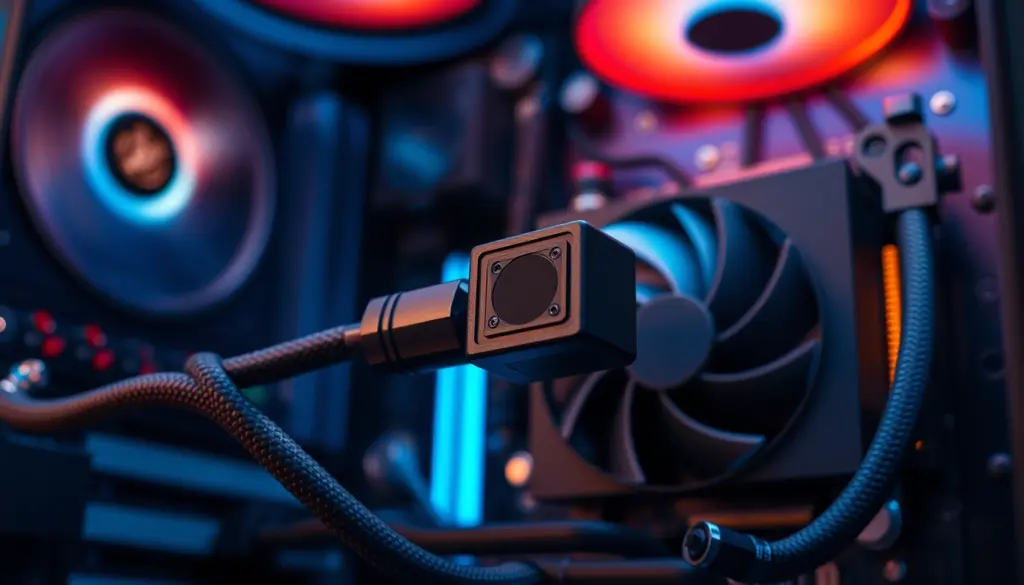
The device itself isn’t new. Thermal Grizzly’s original WireView Pro II already sits between a graphics card and its power cable, reading current on each pin individually and warning a user before a connection gets hot enough to cause damage. What’s new is the cooling hardware bolted onto it: a Noctua NF-A4x10 fan with a 40mm rotor, replacing the standard model’s 30mm fan. According to Wccftech, the larger fan runs in semi-passive mode, meaning it stays off until the device actually needs active airflow.
What Thermal Grizzly and Noctua Just Teased
Thermal Grizzly built its reputation on thermal paste and pads, then expanded into GPU connector safety hardware as the industry’s 12VHPWR and 12V-2×6 standards ran into repeated failure reports. Noctua, the Austrian company known for its brown-and-beige fans, brings cooling engineering and a loyal following among PC builders who care about acoustics as much as performance. The pairing puts a premium cooling brand’s name on a safety accessory, a combination that signals how seriously both companies now treat GPU power delivery as its own product category.
The core function hasn’t changed from the standard WireView Pro II. The unit still monitors current distribution across the individual pins of a 12V-2×6 connector, still keeps its onboard display, and still supports USB-C firmware updates. What Thermal Grizzly and Noctua changed is purely thermal: the frameless NF-A4x10 fan cools the monitoring electronics more quietly and, per early reporting, more effectively than the fan it replaces.
Why GPU Power Connectors Became a Safety Issue
To understand why a fan swap on a monitoring accessory is even newsworthy, it helps to rewind a few years. Nvidia introduced the 12VHPWR connector alongside its RTX 40-series cards, packing far more current through a smaller connector than the older eight-pin PCIe standard. Enthusiast sites including Guru3D spent much of the following two years documenting reports of melted connectors, discolored pins, and cards that drew uneven current across individual wires inside a single cable. Nvidia later revised the design into the 12V-2×6 connector, changing pin lengths to improve seating and reduce the odds of a partial connection.
The redesign helped, but it didn’t eliminate the underlying problem: a single cable carrying enough current to damage a card if even one of its twelve pins makes poor contact. That gap is exactly what created a market for devices like the WireView Pro II. Rather than trusting a connector’s mechanical fit, the device reads current on each pin in real time and can flag a problem long before a builder smells burning plastic.
What makes this history relevant to a fan upgrade in 2026 is that the underlying connector design hasn’t fundamentally changed since Nvidia’s revision. Builders are still plugging hundreds of watts through the same twelve-pin footprint, just on newer, more power-hungry cards. Every generation that pushes board power higher raises the stakes on a marginal connection, which is exactly why a company selling thermal paste a decade ago now sells safety electronics with their own cooling fans.
Per-Pin Monitoring and Emergency Shutdown, Explained
The WireView Pro II line works by sitting physically inline between the graphics card’s power connector and the cable running back to the power supply or GPU power adapter. Instead of estimating total board power the way software tools do, it measures current on every individual pin of the 12V-2×6 connector. If one pin is carrying disproportionately more current than the others, a classic warning sign of a loose or degraded connection, the device can trigger visual and audible alerts.
The unit also carries emergency-shutdown functionality, cutting power before an imbalance turns into a melted connector or a damaged graphics card. That combination, granular per-pin data plus an automatic cutoff, is what separates it from a GPU-Z overlay or a motherboard’s power-draw readout. Those tools can tell a user how much total power a card is pulling. They can’t tell anyone which of the twelve individual pins is doing more work than it should.
The Noctua Collaboration: A 40mm Fan Swap That Matters
On paper, going from a 30mm fan to a 40mm fan sounds like a minor spec bump. In practice it changes two things reviewers care about: airflow headroom and noise. A larger rotor can move comparable air at lower RPM, which tends to translate into a quieter part, an important detail for a device that sits inside a case next to a graphics card that’s already working hard.
From 30mm to 40mm: What Actually Changed
The standard WireView Pro II ships with a 30mm fan built into its housing. The Noctua Edition replaces that with a frameless NF-A4x10, one of Noctua’s smallest fans, chosen specifically because its 40mm rotor fits the WireView’s compact form factor while still offering more airflow than the part it replaces. The rest of the housing, connector layout, and display appear unchanged, based on early photos circulated by PCGamesHardware.
Semi-Passive Cooling on a Safety Device
Semi-passive operation means the NF-A4x10 only spins when the monitoring electronics actually need active cooling, staying stopped the rest of the time. For a device mounted inside a case that’s already full of GPU and CPU fan noise, that’s a small but deliberate design choice. It suggests Thermal Grizzly and Noctua are treating this less like a cheap accessory and more like a component that has to earn its place next to a flagship graphics card.
Pricing Reports: What’s Confirmed and What Isn’t
Here’s where the reporting gets murkier. Multiple outlets have floated a price for the Noctua Edition, but the figures don’t agree, and neither Thermal Grizzly nor Noctua has published an official number on a product page as of this writing. Wccftech and other European sites have cited an expected price around €199, while some coverage has referenced a lower figure closer to €189.90. A U.S. dollar price point near $189 has also circulated in early coverage, though that figure has not been confirmed by either company.
What is consistent across the reporting is the size of the premium: the Noctua Edition is expected to cost significantly more than the standard WireView Pro II, which has been priced around €119.90 in the region. Whatever the final number turns out to be, buyers should expect the fan upgrade and Noctua branding to add real cost on top of the base monitor, not a token markup.
Availability Timeline: September 2026 and the Retail Gap
Noctua’s own communications pointed to September 2026 as the planned availability window for the WireView Pro II Noctua Edition. That’s a stated intention, not a hard release date, and as of late September, reviewers and retailers had not yet reported firm listings or shipping stock. Anyone hunting for one today should expect a wait measured in weeks rather than days, with the exact date depending on when Thermal Grizzly locks in production and distribution.
Two-Year Warranty Signals Confidence in the Design
One detail that has stayed consistent across the reporting is warranty coverage. The device includes an extended Thermal Grizzly warranty covering the GPU connector itself for two years. That’s notable because it puts the company’s name behind the part of a build most likely to fail catastrophically: the point where hundreds of watts pass through a handful of thin copper pins. A company doesn’t typically extend a warranty over a failure point unless it has some confidence its own hardware will catch problems before they turn expensive.
Standard WireView Pro II vs the Noctua Edition
| Spec | Standard WireView Pro II | Noctua Edition |
|---|---|---|
| Fan size | 30mm | 40mm (Noctua NF-A4x10) |
| Cooling mode | Active | Semi-passive |
| Connector supported | 12V-2×6 | 12V-2×6 |
| Per-pin current monitoring | Yes | Yes |
| Emergency shutdown | Yes | Yes |
| Onboard display | Yes | Yes |
| USB-C firmware updates | Yes | Yes |
| Reported price (region) | ~€119.90 | ~€189-€199 (unconfirmed) |
| Connector warranty | Not specified in current reporting | 2 years |
| Planned availability | Already shipping | September 2026 (planned) |
How the WireView Pro II Compares to Other GPU Power-Safety Approaches
The WireView Pro II Noctua Edition isn’t the only way builders try to protect a graphics card from connector problems, but it’s a distinct approach compared with the alternatives already on the market. Cable and adapter makers like CableMod focus on mechanical fixes: angled connectors, stiffer locking mechanisms, and cable routing that reduces strain on the pins. Software tools such as TechPowerUp’s GPU-Z read power draw reported by the graphics card’s own sensors, which is useful for tracking overall consumption but blind to which specific pin inside the cable is struggling. Some add-in-board partners build simple LED indicators into their cards that flag a bad connector seating, but those give a pass-or-fail signal rather than continuous data.
| Approach | What It Monitors | Active Safety Response | Example |
|---|---|---|---|
| Thermal Grizzly WireView Pro II (Noctua Edition) | Per-pin current on the power cable | Emergency shutdown, visual and audible alerts | Thermal Grizzly / Noctua |
| Aftermarket cables and adapters | Mechanical seating, cable routing | None (passive hardware) | CableMod |
| Software power monitors | Total board power via GPU sensors | Alerts only, no physical cutoff | TechPowerUp GPU-Z |
| AIB-integrated connector indicators | Basic connector seating | Visual indicator only | Various add-in-board partners |
What sets the Thermal Grizzly approach apart is the combination of granularity and action. It doesn’t just tell a builder something might be wrong, it can cut power before a marginal connection turns into a melted cable. That’s a meaningfully different value proposition than a warning light or a software dashboard, and it explains why a device this specialized can command a price well above a basic power cable.
Market Impact: A New Product Category Takes Shape
The timing of this launch lines up with a broader shift in how much money enthusiasts are putting into a single graphics card. Flagship GPUs have climbed well past the price of an entire budget PC just a few years ago, and retail scarcity has pushed street prices even higher, as shown by RTX 5090 cards vanishing from US shelves at prices near $9,500. When a single card costs more than a used car, spending an extra $150-$200 on a device that protects it against a melted connector starts to look like cheap insurance rather than an indulgence.
That dynamic is already visible elsewhere in the accessory market. Cooler Master recently tripled the warranty on its own GPU connector shield adapter to three years, a move that only makes sense if the company expects real demand from builders worried about connector failures. Thermal Grizzly’s own product line already includes accessories built around protecting expensive hardware, including its LGA 1954 water block priced near $116.88, and the WireView Pro II Noctua Edition fits neatly into that same strategy of selling premium safety hardware alongside premium components.
The knock-on effect reaches beyond graphics cards. As GPUs, memory modules, and even flagship CPU chips such as those built around Nvidia’s RTX Spark N1X and its 6,144 CUDA cores keep climbing in price, the cost of a single failed component rises right alongside them. A melted connector that once meant replacing a mid-range card now risks a card worth several thousand dollars, plus whatever downstream damage it causes to a power supply or motherboard. That math changes how buyers weigh a $150-$200 safety accessory: it stops looking optional once the part it protects costs more than a laptop.
Why Thermal Grizzly and Noctua Teamed Up
From a business standpoint, the collaboration is a fairly clean brand match. Thermal Grizzly has spent years building credibility in thermal interface materials and, more recently, connector safety hardware. Noctua has spent even longer building a reputation among PC enthusiasts for quiet, reliable fans, to the point where its brown-and-beige color scheme functions almost like a seal of approval among builders. Putting an NF-A4x10 fan on a safety-critical device borrows that reputation directly, telling a skeptical buyer that the cooling on this particular accessory isn’t an afterthought.
For Noctua, the deal extends its brand into a product category, power monitoring, that it doesn’t build in-house. Rather than developing its own connector-monitoring electronics from scratch, licensing its fan and its name to Thermal Grizzly’s existing hardware lets Noctua reach GPU builders through a device it didn’t have to engineer end to end.
The Broader Context: GPU Prices, Scarcity and Protecting the Investment
Connector safety hardware isn’t emerging in a vacuum. Component prices across the PC market have been climbing through 2026, driven in large part by memory shortages that have pushed up costs for GPUs, laptops, and motherboards alike. Budget-focused motherboard makers such as ERYING, which prices its Raptor Lake desktop boards from $180, are competing in a market where every dollar matters, while enthusiasts chasing maximum performance are paying record prices for cards like modded 96GB RTX 5090 variants selling in China for roughly $3,888, as reported in coverage of that modding scene. In that environment, a device built specifically to stop an expensive card from destroying itself has an easier sales pitch than it would have had five years ago, when a top-tier GPU cost a fraction of today’s prices.
What Builders and Reviewers Should Watch For Next
A few open questions will determine whether the WireView Pro II Noctua Edition becomes a must-have accessory or a niche product for the most cautious builders. First, official pricing needs to land somewhere reviewers can actually verify it against a retail listing, rather than the range of figures currently floating around European coverage. Second, independent testing will need to confirm whether the 40mm fan meaningfully reduces noise or temperatures compared with the standard model, since the marketing case rests heavily on that upgrade. Third, actual retail availability in September, rather than a “planned” window, will tell builders whether this launches as a mainstream accessory or trickles out in limited quantities.
Predictions: Where GPU Power-Safety Hardware Goes From Here
- Official pricing will likely firm up within weeks as retailers begin listing SKUs, and the final number will probably land closer to the higher end of the reported €189-€199 range given the added Noctua hardware.
- Other cooling and cable brands will likely pursue similar co-branded safety accessories, following the same logic that pairing a trusted cooling name with a safety-critical device builds buyer confidence.
- Add-in-board partners may start bundling inline power monitors, or something functionally similar, with their most expensive flagship cards rather than leaving the accessory purchase entirely to the buyer.
- Demand for GPU connector safety accessories will likely keep growing in step with GPU prices, since the more a card costs, the more a builder is willing to spend protecting it.
- USB-C firmware update support on the current device hints that future versions could add app-based monitoring or wireless alerts, extending the same per-pin data beyond an onboard display.
Frequently Asked Questions
What is the Thermal Grizzly WireView Pro II Noctua Edition?
It’s a version of Thermal Grizzly’s inline GPU power-monitoring device, built for graphics cards using the 12V-2×6 connector, that swaps the standard model’s cooling fan for a Noctua NF-A4x10.
How much does the Noctua Edition cost?
No official price has been confirmed by Thermal Grizzly or Noctua. Early European coverage has cited figures ranging from roughly €189.90 to €199, with a U.S. price near $189 also circulating unconfirmed.
When does it launch?
Noctua’s own communications pointed to September 2026 as a planned availability window, though no firm release date or retail listing had appeared as of late September.
What does per-pin monitoring actually mean?
Instead of reading total power draw, the device measures current flowing through each individual pin of the 12V-2×6 connector, letting it catch an imbalance that a whole-cable reading would miss.
What’s different between the standard WireView Pro II and the Noctua Edition?
The core monitoring hardware, display, and firmware-update support are unchanged. The difference is cooling: a 40mm Noctua NF-A4x10 fan running in semi-passive mode replaces the standard model’s 30mm fan.
Does it work with older GPU power connectors?
Reporting on the device describes it as built for 12V-2×6 connectors, the design used on current-generation high-end graphics cards, rather than the original eight-pin PCIe standard.
Is the emergency shutdown automatic?
Yes. The device is designed to cut power automatically when it detects a dangerous current imbalance, in addition to issuing visual and audible warnings.
Where can I buy it?
As of publication, no retail listings had been confirmed. Availability is expected to follow Thermal Grizzly’s and Noctua’s planned September 2026 launch window.