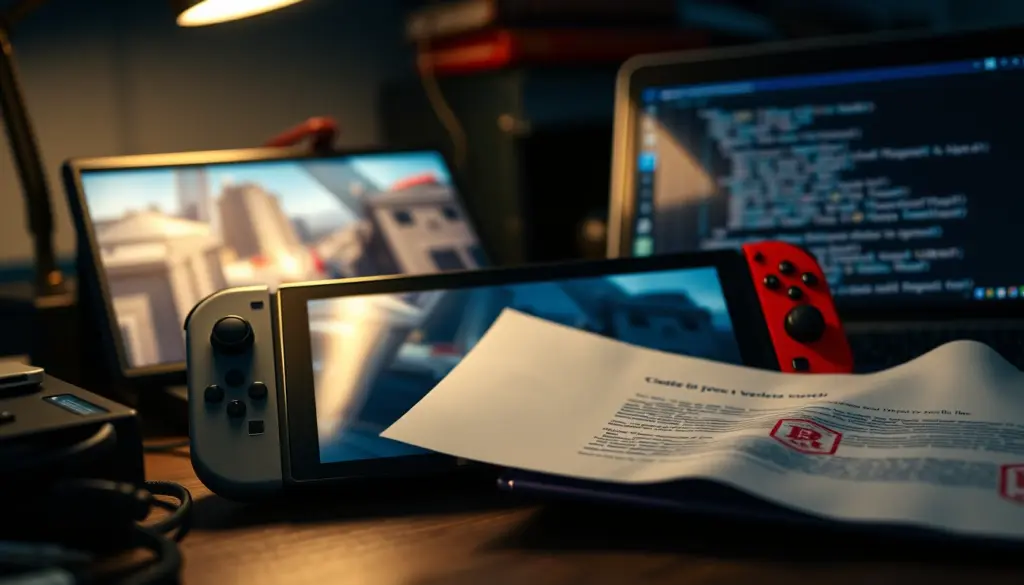
A GTA 5 Nintendo Switch port that was reportedly days away from release is dead. Paralympics Productions, the small modding team behind the project, announced on September 28, 2026 that it would shut down entirely on October 3 after receiving a cease-and-desist letter from Take-Two Interactive. The team’s lead, who goes by Mojso (also spelled M0jso), had spent weeks teasing gameplay clips of Grand Theft Auto 5 running on Nintendo’s decade-old handheld, a game that has never had an official Switch release.
The closure ends not just the Switch build but a related Android port the team had also been developing. Mojso’s own words framed the surrender in stark terms: “I am thankful for Take-Two’s mercy, so this is the definitive end.” It is a strikingly different tone from the modder’s posture just over a week earlier, when public taunts aimed at Rockstar’s parent company circulated online. What changed in between is the story: a legal letter that turned a confident hobby project into a folded operation in a matter of days.
What Happened to the GTA 5 Nintendo Switch Port
Paralympics Productions had been building an unofficial port of Grand Theft Auto V for the original Nintendo Switch, according to Kotaku and GamesRadar+. The project had picked up a following over several weeks as Mojso posted clips showing the game running on Switch hardware, with a public release described as coming “in the coming days.” That release never happened.
On September 28, Mojso posted that Take-Two Interactive, Rockstar Games’ parent company, had sent a cease-and-desist letter demanding the project stop. The announcement set October 3, 2026 as the date Paralympics Productions would formally cease operating. Both the Switch port and the newer Android build were cancelled in the same statement, and Mojso said the source code would not be released publicly, citing further legal exposure.
Coverage of the shutdown spread quickly across gaming outlets including Kotaku, GamesRadar+, Beebom, Northeast Times, The Express Tribune, Notebookcheck and ixbt.games, all pointing to the same core sequence: a near-finished fan port, a legal letter, and a fast public surrender. For a game franchise that has generated billions of dollars for Take-Two, an unauthorized native port landing on a console GTA 5 was never officially sold for was always going to draw attention once it became visible enough.
Who Is Mojso and What Was Paralympics Productions?
Paralympics Productions operated as a small, informal modding outfit rather than a registered studio, built around the work of a developer using the handle Mojso or M0jso. Reporting has not established the developer’s legal name, location, or age, and this article treats that identity as unconfirmed. What is established is the output: a working, playable build of GTA 5 running directly on Nintendo Switch hardware, demonstrated through public clips and screenshots rather than a formal press release.
That distinction matters for how the story escalated. A private hobby project rarely draws a cease-and-desist. A project with growing public visibility, teaser clips, and an announced release window is a different matter, especially once it starts to look like a substitute for something the rights holder has never shipped. GTA 5 has landed on PlayStation 3, Xbox 360, PS4, Xbox One, PC, PS5 and Xbox Series X/S since 2013. It has never had an official Nintendo Switch version, unofficial or otherwise, at any point across that run.
Inside the Take-Two Cease-and-Desist Letter
Cease-and-desist letters are a standard first step in intellectual-property enforcement, not a lawsuit and not a criminal charge. They put a target on notice that continued activity carries legal risk, and they typically demand the recipient stop distributing, promoting, or developing the disputed material. Mojso’s public statements after receiving the letter suggest he weighed his options and concluded fighting Take-Two in court was not realistic. He is reported to have said the company had “solid grounds” and that he would not win if the dispute reached a courtroom.
That calculation lines up with how Take-Two has approached GTA modding disputes before. The company rarely lets a cease-and-desist stand as an empty threat; when targets have not complied quickly, Take-Two has a documented history of moving to litigation. For a small, unfunded modding project with no legal team, the cost-benefit analysis of a drawn-out fight against Take-Two’s legal department is lopsided from the start, and Mojso’s decision to shut down rather than continue reflects that reality rather than any confirmed settlement or formal ruling.
The Quote: “Thankful for Take-Two’s Mercy”
The line drawing the most attention from Mojso’s shutdown announcement, and the one that made it into the Kotaku headline, was direct: “I am thankful for Take-Two’s mercy, so this is the definitive end.” Kotaku also reported that Mojso apologized to supporters for not delivering what he had promised, describing the outcome as leaving backers “high and dry.”
Read against the weeks that preceded it, the statement is a notable reversal. It is one thing for a modder to quietly shelve a project after a legal letter. It is another to publicly frame a major games publisher’s decision not to pursue further action as an act of mercy, particularly after having spent the prior weeks publicly goading that same publisher. The gap between those two postures is the actual story here, more than the cancellation of a single unofficial port.
From Taunting Rockstar to Backing Down
Before the cease-and-desist arrived, Mojso had been openly confident about the project’s odds of survival. Kotaku reported that on September 20, Mojso posted a message daring Rockstar to intervene, telling the studio to “try me” and that he did not care about the consequences. When critics pushed back on the tone, Mojso reportedly doubled down, framing any legal response as something he would simply have to deal with rather than something he expected to happen.
By the time the shutdown announcement went out, that posture had flipped entirely. According to Kotaku, Mojso acknowledged that the earlier public taunting had likely made the legal situation worse, strengthening Take-Two’s position rather than deterring the company. It is a pattern familiar to anyone who has watched modding communities clash with publishers before: confidence and visibility that build an audience can be the same factors that accelerate enforcement once a rights holder decides to act.
How the Port Reportedly Worked
According to GamesRadar+, the Switch build was not a cloud-streaming wrapper or an emulator running a PC or console copy of the game. It was reported to run natively on the console’s own hardware, a considerably harder technical feat than remote-streaming or basic emulation given the original Switch’s aging, mobile-class chipset. GamesRadar+ also reported that the project relied on GTA 5 source code that leaked online in 2023, an incident that has fueled a wave of unofficial mods, ports and reverse-engineering projects in the years since.
That detail, if accurate, changes the legal calculus considerably. A mod built from official, licensed assets running under a support layer is one category of dispute. A build compiled using leaked proprietary source code is a much more direct copyright and trade-secret problem, and it would explain both the speed of Take-Two’s response and Mojso’s own assessment that the company held “solid grounds” to act. It also explains why Mojso said the source code could not be shared even after the shutdown, since releasing it publicly would extend rather than end the legal exposure.
Timeline: Paralympics Productions in September 2026
| Date | Event |
|---|---|
| Weeks prior to Sept. 20 | Mojso posts gameplay clips and screenshots of GTA 5 running on Nintendo Switch hardware |
| September 20, 2026 | Mojso publicly challenges Rockstar to intervene, per Kotaku’s reporting |
| Days before Sept. 28 | Public release described as coming “in the coming days”; Android port also in development |
| September 28, 2026 | Take-Two Interactive reportedly sends cease-and-desist letter; Mojso announces shutdown |
| September 28-29, 2026 | Kotaku, GamesRadar+, Beebom and other outlets report the shutdown |
| October 3, 2026 | Paralympics Productions set to formally cease operating |
Take-Two’s Modding Enforcement Playbook: From OpenIV to FiveM
Take-Two’s willingness to send legal letters over GTA-related projects is not new. The company’s most well-known modding dispute dates back to 2017, when it issued a cease-and-desist to OpenIV, a modding tool that had underpinned much of the PC modding scene for GTA IV, GTA V and Max Payne 3 for nearly a decade. As PC Gamer reported at the time, Take-Two argued the tool let third parties “defeat security features” and modify the game in violation of its rights. PCGamesN’s follow-up coverage noted the backlash from that decision was significant enough that Take-Two later walked part of it back and worked out terms allowing offline, single-player mods to continue, while keeping tighter restrictions around anything touching GTA Online.
That carve-out shaped years of modding norms. Multiplayer modding tools have faced a separate and stricter standard. Take-Two has previously moved against unofficial multiplayer platforms for GTA Online, and today FiveM operates as the only platform with an official license agreement to host custom GTA V multiplayer servers, a status other tools have not been granted. The Paralympics Productions case fits into that same broader pattern: Take-Two tolerates a wide range of offline, cosmetic and single-player modifications, but treats attempts to reproduce, redistribute or extend its games into new commercial-adjacent territory, especially onto platforms it has never officially supported, as a different tier of risk.
Comparing Take-Two’s Cease-and-Desist History
| Target | Year | What It Was | Outcome |
|---|---|---|---|
| OpenIV | 2017 | PC modding tool for GTA IV, GTA V, Max Payne 3 | Shut down, then partially restored for offline mods after backlash |
| RAGE:Multiplayer | Undated, per reports | Unofficial GTA Online multiplayer server platform | Cease-and-desist issued; FiveM remains the only licensed platform |
| Paralympics Productions | 2026 | Unofficial native GTA 5 port for Nintendo Switch and Android | Project cancelled, team shutting down Oct. 3, 2026 |
The pattern across nearly a decade is consistent even as the specific technology has changed. Whether the tool in question is a PC modding framework, an unofficial multiplayer server, or a native console port, Take-Two’s response scales with how directly the project threatens to substitute for, or compete with, something the company sells or plans to sell.
Why Rockstar Is Extra Protective Right Now
Timing matters here. Rockstar is heading toward the launch of Grand Theft Auto VI, the most anticipated release in the franchise’s history, and the company has spent much of 2026 aggressively pursuing leakers and unauthorized distributors tied to that game. A separate, unrelated port of an older title using leaked source code lands in the middle of that same enforcement climate, even though it involves a different game and a different set of circumstances. Rockstar has also stayed notably quiet on other fronts, including reported silence around a claimed 2030 date for a potential L.A. Noire sequel, suggesting the studio is being unusually careful about what it confirms, denies, or lets slide in public right now.
Rockstar’s parent company has also dealt with its own security exposure this year, following a breach in which the ShinyHunters group claimed to have stolen tens of millions of records tied to Rockstar systems. A publisher already managing questions about how it handles sensitive internal material has extra incentive to move quickly and visibly against anything built from leaked assets, both to limit further exposure and to signal that leaked code will not be tolerated as a foundation for public projects.
Could Mojso Have Fought the Cease-and-Desist?
In theory, yes. A cease-and-desist letter is a demand, not a court order, and recipients can ignore one and wait to see whether the sender actually files suit. In practice, that route is expensive and risky, especially for an individual or small team without institutional backing. If GamesRadar+’s reporting about leaked source code is accurate, Mojso would have been contesting a case involving both copyright infringement and the use of material obtained through an unauthorized leak, a combination that gives a well-resourced publisher like Take-Two a strong starting position.
Mojso’s own reported comments suggest he reached that conclusion himself, describing an unwillingness to go up against Take-Two and acknowledging the company likely had solid legal footing. That is a rational, if deflating, outcome for backers who had been anticipating a release. It also underscores a broader reality for fan-made ports built on leaked material: even a technically impressive result carries legal exposure that has nothing to do with how well the software works.
Market and Community Impact
The direct commercial impact of one cancelled fan port is small. Paralympics Productions was never selling anything, and Take-Two loses no direct revenue from a project that never launched. The more meaningful impact is on the modding community that had rallied around the project and on the incentives facing similar efforts elsewhere. A visible, well-publicized shutdown, delivered with a quote as pointed as “thankful for Take-Two’s mercy,” functions as a public warning shot aimed at anyone else considering a similar leaked-code port for an unsupported platform.
For Nintendo, the episode is a reminder that its hardware, including the newer Switch 2, remains a target for unofficial ports of major third-party titles the company itself never negotiated to bring to its platforms. Nintendo has separately pursued its own aggressive anti-piracy actions this year, including a multimillion-dollar piracy judgment against hardware makers, but this case was Take-Two’s fight to bring, not Nintendo’s, since the underlying dispute is about GTA 5’s copyright rather than Switch piracy tools.
Competitive Comparison: How Other Publishers Handle Fan Ports
Take-Two is far from the only publisher that polices unofficial ports and mods, but its approach sits toward the stricter end of the industry spectrum once leaked code or unsupported-platform ports are involved. Nintendo is famously aggressive about protecting its own IP, having pursued legal action against emulator developers and piracy tool makers for years. Sony and Microsoft have generally been more selective, often tolerating PC-based mod scenes for their first-party franchises while reserving legal action for cases involving piracy, leaked builds, or direct competition with an official release.
What sets the Paralympics Productions case apart from a typical PC mod dispute is the platform mismatch. GTA 5 was never sold on Switch, official or otherwise, which means an unofficial native port is not just a modification of an existing product, it is effectively an unauthorized new release on a platform the rights holder never approved. That combination, leaked source code plus an entirely new unauthorized platform release, is a harder case for any publisher to ignore than a cosmetic PC mod or a fan-made level pack.
Historical Context: GTA 5’s Long Life and Its Uninvited Ports
GTA 5 first launched in 2013 and has since been re-released across seven console generations spanning PS3 through PS5, plus PC. Its longevity is part of why unofficial ports keep appearing: a game that old, that widely leaked and dissected by modders for over a decade, is a well-understood target for technically ambitious hobbyists looking to prove a platform can run it. The 2023 GTA 5 source code leak, distinct from the separate and larger GTA 6 leak the same year, gave modders a level of internal access to the game’s engine that had never previously existed publicly, and projects built from that leak have surfaced periodically ever since. Rockstar itself continues to guard its next major release closely, another sign of how sensitive leaked or unauthorized material has become for the studio.
Nintendo Switch emulation and porting projects for other big third-party titles have followed similar arcs before: initial hype, viral clips, then a legal letter once a publisher decides the project has become too visible to ignore. Paralympics Productions is the latest example rather than an outlier, and its arc, from confident public taunts to a shutdown framed as gratitude, is a familiar shape for anyone who has followed prior modding-versus-publisher standoffs.
What Happens Next
A few things are reasonably likely to follow from here, based on how similar disputes have played out in the past, though none of this is confirmed and all of it should be read as analysis rather than fact.
- Paralympics Productions will most likely go quiet after October 3 rather than resurface under a new name, given Mojso’s stated position that no one will pick up the project.
- Other modders working on similar leaked-code ports for unsupported platforms are likely to move more cautiously, or further underground, following the public nature of this shutdown.
- Take-Two is likely to keep treating leaked-code projects as a higher enforcement priority than typical cosmetic or gameplay mods, especially in the run-up to GTA 6’s launch.
- Expect continued scrutiny of the 2023 GTA 5 source code leak’s footprint, as other projects quietly built on the same leaked material may face similar letters if they become publicly visible.
- Nintendo Switch and Switch 2 will likely remain attractive targets for unofficial ports of major third-party games specifically because official support has never arrived, keeping this exact scenario from being a one-off.
The Bigger Picture for Fan Modding in 2026
The takeaway from Paralympics Productions’ collapse is not that modding is dead or that publishers universally crack down on fan work. Take-Two itself still tolerates a wide range of offline GTA 5 modding on PC nearly a decade after the OpenIV dispute forced a public negotiation over where the line sits. What this case reinforces is narrower: leaked source code, an unauthorized platform release, and loud public visibility are a combination almost any major publisher will act on quickly, regardless of how technically impressive the underlying work is. Mojso’s own words, thanking Take-Two for mercy after weeks of public defiance, capture how quickly that calculation can flip once a legal letter actually arrives.
Frequently Asked Questions
What happened to the GTA 5 Nintendo Switch port?
Paralympics Productions, led by a modder known as Mojso or M0jso, announced on September 28, 2026 that it was shutting down after Take-Two Interactive reportedly sent a cease-and-desist letter. The team’s unofficial GTA 5 Switch port and a related Android port were both cancelled, with the group set to formally close on October 3, 2026.
Who is Mojso, the developer behind the GTA 5 Switch port?
Mojso, also referred to as M0jso in some coverage, led Paralympics Productions, the small team behind the unofficial GTA 5 Switch and Android ports. The developer’s full legal identity has not been publicly confirmed in reporting on the story.
Did GTA 5 ever get an official Nintendo Switch release?
No. GTA 5 has launched on PS3, Xbox 360, PS4, Xbox One, PC, PS5 and Xbox Series X/S since 2013, but Take-Two and Rockstar have never released an official version for Nintendo Switch or Switch 2.
Why did Take-Two send a cease-and-desist letter over the port?
Take-Two has not publicly detailed its legal reasoning. GamesRadar+ reported the port reportedly used GTA 5 source code that leaked in 2023 and ran natively on Switch hardware rather than through emulation or streaming, factors that would typically raise the legal stakes for a rights holder.
Has Take-Two shut down other GTA modding projects before?
Yes. Take-Two issued a cease-and-desist against the OpenIV modding tool in 2017, a decision it later partially reversed for offline, single-player mods after community backlash. It has also acted against unofficial multiplayer server platforms, leaving FiveM as the only officially licensed option for GTA Online custom servers.
Is the GTA 5 Switch port’s source code available anywhere?
Mojso stated the source code would not be released publicly, citing the risk of additional legal exposure. No official release of the project’s code has been reported.
Could Mojso have fought the cease-and-desist in court?
Legally, a cease-and-desist letter can be contested rather than complied with, but Mojso reportedly concluded that Take-Two had strong legal grounds and that fighting the company in court was not realistic for an individual modder without institutional backing.
What does this mean for future unofficial GTA ports?
It signals that Take-Two continues to treat leaked-code projects and unauthorized platform ports as a high enforcement priority, particularly as the company approaches the launch of Grand Theft Auto VI. Other modders working on similar projects are likely to face comparable scrutiny if their work becomes publicly visible.