
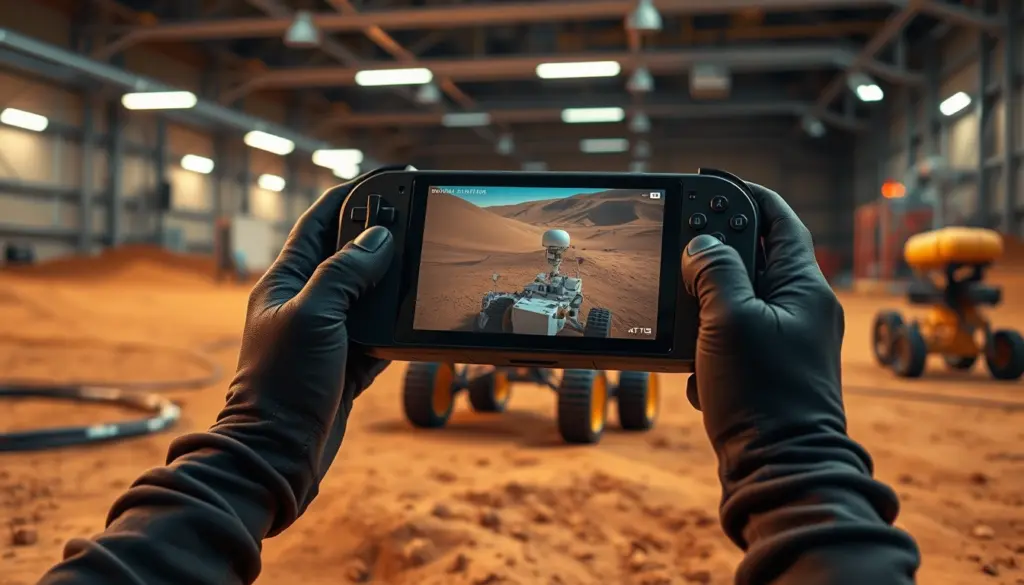
Valve built the Steam Deck to run Balatro on a couch and Elden Ring on a plane. This week it turned out the handheld has a third job: driving a Mars rover prototype across a simulated Martian test yard in Stevenage, England. Aerospace giant Airbus confirmed that engineers on its ExoMars program have been using a stock Steam Deck, loaded with custom software, to steer a test version of the Rosalind Franklin rover during ground trials — the same device millions of PC gamers use to play indie darlings and AAA ports.
The story broke publicly on September 22, 2026, when British science YouTuber Tom Scott posted footage from a visit to Airbus’s UK facility, and it spread fast through outlets including PC Guide, TechSpot, and PC Gamer. By September 30, the clip had done what gaming-hardware crossovers rarely manage: made engineers, gamers, and space-watchers all search for the same story at once.
What actually happened at Airbus’s Stevenage facility
Airbus Defence and Space runs a UK site in Stevenage that includes a simulated Martian terrain area, often called a “Mars Yard,” built to mimic the regolith and lighting conditions the Rosalind Franklin rover will face after landing. During Scott’s visit, engineers first drove a prototype rover using a standard laptop rig. Then they handed him a Steam Deck running custom control software, and he drove a separate prototype vehicle around the test area using the handheld’s thumbsticks, triggers, bumpers, and face buttons.
According to PC Gamer, one of the Deck’s bumper buttons was mapped to rotate the rover’s wheels by 90 degrees, letting the six-wheeled vehicle change direction without a wide turning circle. That detail was independently repeated by other outlets covering the visit, including Everything Edinburgh. Nobody involved has claimed the flight-ready rover will land on Mars with a game controller strapped to it. The Deck is a ground-test tool, used while engineers refine navigation and mobility software long before launch.
Kata Escott, managing director of Airbus Defence and Space UK, described the Rosalind Franklin effort as the culmination of more than 20 years of work, a framing PC Gamer reported from the visit. That timeline lines up with the program’s long and difficult history: ExoMars has survived funding gaps, a broken partnership with Russia’s Roscosmos after the 2022 invasion of Ukraine, and a redesign of its launch and landing systems.
Why a $400 gaming handheld beats a lab control rig
None of the outlets covering the story got Airbus to issue a formal engineering rationale, so the “why” has to be read off the hardware itself. The Steam Deck runs SteamOS, a Linux-based operating system built on Arch Linux, and it can also boot Windows. That gives engineers a small, self-contained computer with a screen, Wi-Fi, Bluetooth, and a full set of analog controls in one sealed unit, rather than a laptop tethered to an external gamepad.
Compare that to a conventional test rig: a laptop, a separate USB controller, cables, and a flat surface to set it all on. In a dusty outdoor test yard, that setup is fragile and awkward to carry. A handheld with integrated controls is not. Dexerto’s coverage of the story made a similar point, noting that the Deck’s combination of a Linux PC, a display, and console-style inputs in one chassis is what separates it from an ordinary gamepad plugged into a desktop.
There’s a cost angle too, even if Airbus hasn’t stated one publicly. A Steam Deck starts under $400 for the base LCD model. Purpose-built aerospace ground-control hardware, even simplified test units, typically costs many times that once you account for custom enclosures, connectors, and low-volume manufacturing. For a ground-test tool that doesn’t need to survive launch, radiation, or the Martian atmosphere, off-the-shelf consumer hardware is a rational shortcut, not a compromise.
The Rosalind Franklin rover and the ExoMars program
The prototype in the Mars Yard footage is tied to Rosalind Franklin, the European Space Agency’s ExoMars rover, developed with Airbus as prime contractor for the rover module. Reported timelines vary slightly between outlets: most coverage points to a Mars arrival around 2030, while one report cited a launch window at the end of 2028. Those numbers reflect the program’s repeated slips rather than a single fixed date, which is typical for a mission of this complexity.
Once it’s on Mars, Rosalind Franklin is designed to navigate largely on its own, using onboard cameras and autonomy software to pick safe paths across the surface, since real-time joystick control from Earth is impossible when a single radio signal takes several minutes each way. The Steam Deck’s job stops at the atmosphere’s edge. On the ground in England, it’s a convenient way for a human to drive a test vehicle while engineers watch how the chassis handles obstacles, slopes, and turns. On Mars, the rover drives itself.
That distinction matters for anyone reading headlines that make it sound like NASA-style joystick control is heading to the Red Planet. It isn’t. What’s newsworthy here is narrower and, in its own way, more interesting: a mainstream gaming device proved capable enough for a serious aerospace engineering team to reach for it instead of building something bespoke.
| Detail | Reported fact | Source |
|---|---|---|
| Rover name | Rosalind Franklin (ExoMars) | PC Guide, VGTimes |
| Program lead | Airbus Defence and Space, for ESA | PC Gamer |
| Test location | Stevenage, UK (“Mars Yard”) | PC Gamer, Mixed News |
| Control device | Valve Steam Deck, custom software | PC Guide, TechSpot |
| Demonstrated function | Bumper button rotates wheels 90 degrees | PC Gamer, Everything Edinburgh |
| Public demo date | Reported September 22-25, 2026 | TechSpot, VGTimes, PC Gamer |
| Reported Mars arrival | Around 2030 (one report cites end-2028 launch) | PC Guide, VGTimes |
| On-Mars operation | Autonomous navigation, not handheld control | WindowsForum, Mixed News |
Tom Scott’s role and how the story spread
The story exists because Tom Scott, a British presenter known for short documentaries on obscure technical and scientific subjects, got access to Airbus’s Stevenage site and was allowed to drive a test rover himself. Scott has built a career filming exactly this kind of behind-the-scenes engineering footage, and this visit followed that pattern: a plain, unglamorous demonstration that turned into a viral tech story because of one detail nobody expected.
From there, the coverage fanned out quickly. TechSpot ran a report on September 22, framing it as a practical engineering choice rather than a gimmick. PC Guide followed on September 24 with the fullest write-up, adding that engineers had used a laptop rig before switching to the Deck. PC Gamer added the Stevenage location details, the 20-years-of-work framing from Kata Escott, and the wheel-rotation control mapping. Dexerto’s piece leaned into the “YouTuber drives Mars rover” angle for a gaming audience, while sites including VGTimes, Universe Magazine, and WindowsForum picked up the story internationally, each adding small technical clarifications about the Deck’s Linux base and the rover’s intended autonomy.
None of the coverage ties the reveal to a conference, expo, or scheduled press event. It reached the public through a single video visit rather than a formal Airbus announcement, which is itself notable. Aerospace primes don’t typically let a science YouTuber film sensitive hardware without planning the message carefully, and the fact that “we use a Steam Deck” became the headline, rather than a footnote, suggests Airbus was comfortable with the crossover appeal.
Is this actually new? Gaming hardware in robotics and space work
Repurposing gaming controllers for serious robotics isn’t a new idea. University robotics labs, defense contractors, and even NASA-adjacent teams have used standard USB gamepads for years, because they’re cheap, familiar, and durable compared to building a bespoke control panel from scratch. What’s different about the Steam Deck story is the level of integration: this isn’t a $30 controller plugged into a lab PC, it’s a complete, self-contained Linux computer serving as both the brain and the input device in one handheld unit.
Available reporting doesn’t turn up an earlier confirmed case of a space agency or aerospace contractor using a Steam Deck specifically, which is part of why this story traveled as far as it did. It sits at an unusual intersection: gaming press picked it up because Valve’s hardware was the star, and space and engineering outlets picked it up because a serious ESA program was involved. Few stories land in both worlds at once.
It also lands at a moment when the Steam Deck’s own identity is shifting. Valve has spent 2026 expanding its hardware line well beyond the original handheld, with the Steam Machine console and the Steam Frame VR headset both generating enormous search interest, as shown in our coverage of Valve confirming a Steam Deck 2 and the rollout of Steam Frame purchase invites. An aerospace company reaching for a three-year-old handheld design, rather than newer Valve hardware, is a small reminder that the original Steam Deck’s stability and open Linux base, not its raw power, is what makes it useful outside gaming.
Market and industry impact: what this means beyond a fun headline
For Valve, there’s no direct revenue line here, but there is a reputational one. Every time a mainstream company or research team adopts consumer gaming hardware for a serious purpose, it reinforces the idea that SteamOS and the Deck’s open architecture are genuinely flexible platforms, not locked-down game consoles. That matters commercially because Valve has spent the past two years pitching SteamOS as a Windows alternative across a wider range of handhelds, a push covered in our report on Switch 2 and Steam Deck feature comparisons.
For Airbus and ESA, the story is a low-cost public relations win at a moment when European space efforts face scrutiny over budgets and timelines. ExoMars has been delayed multiple times, partly due to the loss of its Russian launch partnership after 2022. A viral, approachable story about engineers using familiar gaming hardware humanizes a program that otherwise reads as a long list of technical setbacks and schedule slips.
There’s also a quieter signal for the broader handheld PC market. Companies like GPD have been pushing higher-end handhelds, such as the Win Max 3 built on AMD’s Ryzen AI Max+ chips, into gaming benchmarks well above 100 frames per second in modern titles. The Airbus story is a reminder that raw gaming performance isn’t the only axis handheld PC makers compete on. Reliability, an open OS, and a known software stack matter just as much once these devices leave the living room, whether that means a Mars Yard in Stevenage or an industrial floor, a theme that echoes our coverage of Steam’s own infrastructure reliability when the platform itself goes down.
Historical context: when gaming tech crosses into serious engineering
This isn’t the first time consumer gaming hardware has quietly ended up doing unglamorous, important work. Standard game controllers have shown up in bomb-disposal robots, university-built rovers, and remotely operated underwater vehicles for well over a decade, largely because engineers would rather buy a $50 controller off the shelf than design a custom one. What’s changed is the sophistication of the gaming hardware itself. A modern handheld like the Steam Deck is a full Linux PC with a GPU, a battery, wireless radios, and a display, which puts it in a different category from a bare gamepad.
Valve’s own history sets up this moment more than most people realize. SteamOS was originally built to prove that Linux gaming could be viable outside Windows, and the Deck’s success made that case commercially. An unplanned side effect of choosing Linux is that the Deck is far easier for outside engineers to script, modify, and reprogram than a locked-down Windows handheld would be. Airbus’s custom control software almost certainly leans on that openness, even though the company hasn’t published details about how the software connects to the rover hardware.
It’s also worth remembering how young the Steam Deck still is. Valve launched it in 2022, and by the time this story broke it had already become the reference point competitors measure themselves against, as seen in comparisons like Valve’s response to a supply-chain security incident affecting Steam’s shipping partners earlier this year, and in our look at how demanding PC specs are straining handheld gaming hardware. A device barely four years old ending up in a European space program’s test yard is a fast trajectory for any consumer product.
What Airbus hasn’t said
The public reporting leaves real gaps. No outlet has published the exact Steam Deck model used, the communications protocol linking it to the rover, the latency of the control link, or the extent of the custom software beyond its existence. Airbus hasn’t named the individual engineer who built or operated the system, and the company hasn’t issued its own detailed press release explaining the choice, at least not one referenced in the coverage to date.
That gap is worth flagging plainly rather than filling with guesses. It’s tempting to assume a Bluetooth link, a Python control script, or a specific Deck revision, but none of that is confirmed anywhere in the current reporting. Until Airbus or ESA publishes something more detailed, the honest version of this story is: a real aerospace company used a real gaming handheld to drive a real rover prototype, and the exact engineering underneath that headline remains undisclosed.
Competitive comparison: how other agencies and companies control rover prototypes
| Organization / Program | Reported test-control approach | Notes |
|---|---|---|
| Airbus / ESA ExoMars (Rosalind Franklin) | Valve Steam Deck, custom software | Ground-test only; flight rover navigates autonomously |
| General consumer/university robotics | Standard USB gamepads | Long-standing practice for low-cost teleoperation rigs |
| Typical aerospace ground-control rigs | Custom laptop + external controller setups | Reported as Airbus’s earlier method before the Deck demo |
| Flight-ready planetary rovers (general) | Onboard autonomous navigation via cameras/sensors | Real-time joystick control is impractical given signal delay to Mars |
The comparison underscores how unusual the Steam Deck choice is, not because teleoperation itself is rare in early-stage robotics testing, but because a fully consumer-branded, retail gaming device replaced a custom-built or laptop-based rig at a major aerospace contractor. That’s the gap between “engineers use game controllers” and “engineers use a Steam Deck,” and it’s why this story crossed from space-industry trade coverage into mainstream gaming press within 48 hours.
What this means for Valve’s push beyond gaming
Valve has never marketed the Steam Deck as an engineering tool, and there’s no indication the company was involved in or consulted on Airbus’s decision to use it. But the story lands at a useful moment for Valve’s broader narrative. The company has spent 2026 expanding SteamOS onto a wider range of hardware, including third-party handhelds, and pushing its own new devices like the Steam Machine and Steam Frame. Every unplanned, organic use case outside gaming, whether it’s a rover test rig or a hobbyist robotics project, adds evidence that SteamOS is a genuinely general-purpose Linux platform rather than a gaming-only shell.
That reputation matters more as Valve competes with Windows-based handhelds from Asus, Lenovo, and others, several of which we’ve tracked in past coverage of the handheld PC market’s pricing and hardware shifts throughout 2026. A story like this one doesn’t move sales charts directly, but it’s the kind of free, credibility-building coverage that money can’t easily buy.
Predictions: where this story goes next
- Airbus or ESA will likely face follow-up questions from space and tech press asking for more technical detail on the control software and communications link, given how much of the current story rests on video footage rather than a technical brief.
- Expect other aerospace and robotics teams to publicize similar consumer-hardware shortcuts over the next year, now that this story has shown the PR upside of an approachable, low-cost engineering choice.
- Valve is unlikely to comment substantively, since the company wasn’t a program partner, but expect Steam Deck sales and search interest to get a small, short-lived bump from the crossover attention.
- As Rosalind Franklin’s development continues toward its reported early-2030s Mars arrival, further ground-test footage is likely to surface, and it would not be surprising if a newer Valve device eventually replaces the current Deck in Airbus’s test rig.
- Expect skepticism to persist among space-industry watchers who will keep pointing out, correctly, that the flight rover will never use a game controller on Mars itself, a distinction that’s likely to keep getting lost in retellings of this story.
Frequently asked questions
Is Airbus really controlling a Mars rover with a Steam Deck?
Airbus used a Steam Deck to drive a ground-test prototype of the Rosalind Franklin rover during development at its Stevenage, UK facility, according to reporting from PC Guide, TechSpot, and PC Gamer. The device is used only for Earth-based testing, not for controlling the actual rover once it reaches Mars.
Will the Steam Deck be used to drive the rover on Mars itself?
No. Multiple outlets, including WindowsForum and Mixed News, report that the flight rover is designed to navigate Mars autonomously using onboard cameras and sensors, since real-time control from Earth isn’t feasible given the multi-minute communication delay to Mars.
What is the Rosalind Franklin rover?
Rosalind Franklin is the rover at the center of the European Space Agency’s ExoMars program, with Airbus serving as a lead contractor on its development. Reported target dates for its Mars arrival cluster around 2030, though the program has faced multiple delays over the past decade.
Why would engineers use a gaming handheld instead of professional equipment?
The Steam Deck combines a Linux-based computer, a screen, Wi-Fi, Bluetooth, and a full set of analog controls in one compact, battery-powered unit. That makes it easier to carry and use in an outdoor test environment than a laptop paired with a separate controller, according to coverage from Dexerto and Universe Magazine.
Who is Tom Scott and why was he at Airbus?
Tom Scott is a British presenter known for short documentary videos about technical and scientific subjects. He visited Airbus’s Stevenage facility, was shown the ExoMars rover test program, and was given the opportunity to drive a prototype rover using the Steam Deck himself.
Has any other space agency used a Steam Deck before?
Available reporting doesn’t identify an earlier confirmed use of a Steam Deck specifically by a space agency or aerospace contractor. Standard gaming controllers have a longer history in robotics and remote-operation systems generally, but the Deck’s use here is reported as new.
Does this mean the Steam Deck is being redesigned for aerospace use?
No. There’s no indication Valve was involved in or aware of Airbus’s decision, and the Deck used is a standard retail unit running custom third-party software, not a modified or aerospace-certified version of the hardware.
What happens next for the ExoMars program?
Ground testing of rover prototypes is expected to continue at Airbus’s Stevenage site as the program works toward its reported early-2030s Mars arrival window, with further technical validation likely before any flight hardware is finalized.