
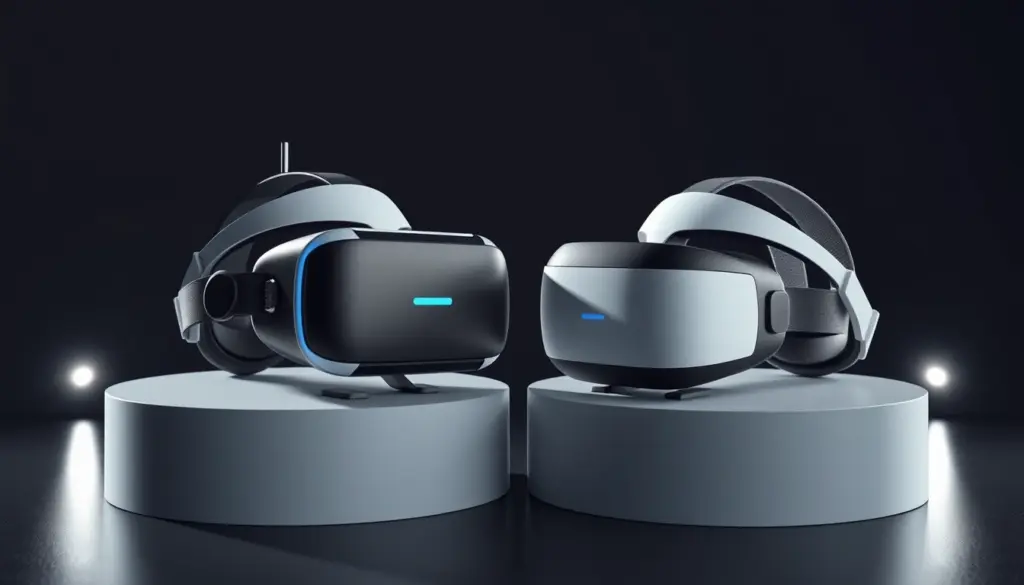
Valve’s next VR headset finally has real specs on paper, and they read like a direct answer to Meta’s biggest weaknesses. The Steam Frame packs twice the RAM and a noticeably stronger chipset than the Meta Quest 3, the standalone headset that has dominated consumer VR since October 2023. What Steam Frame doesn’t have, as of this writing, is a price tag or a confirmed release date – which makes this comparison unusual: one side is fully shipping and battle-tested, and the other is a known quantity on paper but still an open question at checkout.
This steam frame vs quest 3 comparison breaks down every confirmed spec, the chipset benchmarks behind Valve’s performance claims, what each headset actually costs today, and which one fits your setup – whether that’s a PC gaming rig gathering dust or a headset you can hand to a houseguest with zero setup. We’ll also cover the compatibility layers letting Steam Frame run x86 Windows games on ARM hardware, the games already adapting to the new headset, and a practical switching guide for Quest 3 owners eyeing Valve’s Steam Frame.
Steam Frame vs Quest 3 at a Glance
Both headsets are standalone, Snapdragon-powered, pancake-lens VR devices that don’t strictly need a PC to function – but they’re built on opposite philosophies. Quest 3 is a finished consumer product: Meta controls the hardware, the Horizon OS software, and the app store, and has sold it since October 2023. Steam Frame is Valve’s bet that an open, SteamOS-based headset can stream a full PC gaming library wirelessly while also running a growing library of x86 titles natively, translated on-device. Quest 3 has already faced this kind of comparison before, most directly against Sony’s headset in our PSVR2 vs Quest 3 breakdown – Steam Frame is a very different kind of rival.
On paper, Steam Frame wins the spec sheet comfortably: double the RAM (16GB vs 8GB), a newer and roughly 1.5-2x more powerful GPU, a higher-bandwidth dedicated wireless link for PC streaming, and eye tracking that enables foveated rendering. The two displays are close enough in total resolution to call a wash. Quest 3 counters with something Steam Frame can’t yet offer: full-color passthrough, a depth sensor for mixed-reality games, and a confirmed $599.99 price you can pay right now. Whether Steam Frame’s hardware advantage matters depends entirely on what Valve charges for it – part of the broader wave of 2026 gaming hardware news shaped by the ongoing memory shortage – and that price is still unknown.
Full Specs Comparison: Steam Frame vs Quest 3
Here’s every publicly confirmed specification for both headsets side by side. Steam Frame’s numbers come from Valve’s own announcement and cross-verified reporting; Quest 3’s numbers reflect the current 512GB-only configuration Meta sells today.
| Specification | Steam Frame | Meta Quest 3 |
|---|---|---|
| Manufacturer | Valve | Meta |
| Codename | Deckard | – |
| Announced | November 12, 2025 | June 2023 (shipped October 2023) |
| Release status | Unreleased – “summer 2026” | Shipping since October 10, 2023 |
| Operating system | SteamOS 3 (Arch Linux, ARM) | Horizon OS (Android-based) |
| Chipset | Qualcomm Snapdragon 8 Gen 3 | Qualcomm Snapdragon XR2 Gen 2 |
| RAM | 16GB LPDDR5X | 8GB |
| Storage | 256GB or 1TB + microSD | 512GB (only configuration sold) |
| Display (per eye) | 2,160 × 2,160 LCD | 2,064 × 2,208 LCD |
| Lens type | Pancake | Pancake |
| Refresh rate | 72–120Hz (144Hz experimental) | Up to 120Hz |
| Field of view | ~110° (vertical not separately specified) | 110° horizontal / 96° vertical |
| Eye tracking | Yes (foveated rendering + streaming) | No |
| Passthrough | Monochrome only | Full color + depth sensor |
| Wireless PC streaming | Dedicated 6GHz dongle (Wi-Fi 6E) + Wi-Fi 7 | Air Link / Link cable over home Wi-Fi |
| Controllers | “Roy,” TMR anti-drift sticks, AA batteries | Touch Plus, built-in battery |
| Weight | ~185g core / ~440g full kit | ~515g |
| Battery | 21.6Wh Li-ion | ~19.4Wh (5,060mAh) |
| Price | Unannounced (est. $899–$1,199) | $599.99 |
A few numbers stand out immediately. Steam Frame’s 16GB of LPDDR5X is double Quest 3’s 8GB – a meaningful gap when a headset is expected to run a compatibility layer on top of the actual game, translating x86 code to ARM in real time. Resolution, on the other hand, is nearly a dead heat once you actually run the math on both panels, which the next section covers in detail.
Display and Optics: Pixel Density, Lenses, and Refresh Rate
Both headsets use pancake lens designs, a major shift away from the bulkier Fresnel lenses that shipped in older headsets like the original Valve Index and Quest 2. Pancake optics fold the light path internally, which is why both Steam Frame and Quest 3 sit noticeably slimmer than their predecessors despite packing more powerful internals.
Do the math on total pixel count and the two are close enough to call it a wash: Steam Frame’s 2,160×2,160 panel resolves about 4.67 million pixels per eye, versus roughly 4.56 million for Quest 3’s 2,064×2,208 panel – a difference of about 2%, invisible in practice. Quest 3’s panel is stretched taller, which is part of why Meta lists a 96-degree vertical field of view alongside its 110-degree horizontal figure; Valve has only confirmed “up to 110 degrees” for Steam Frame without breaking out a separate vertical number.
Refresh rate is where the two diverge. Both headsets support 72Hz and 90Hz modes and go up to 120Hz as standard, but Steam Frame adds an experimental 144Hz mode that Quest 3 has no equivalent for. Whether that mode holds up under real GPU load – especially while running a translation layer – is one of the open questions reviewers will need to test once units actually ship.
Chipset Showdown: Snapdragon 8 Gen 3 vs Snapdragon XR2 Gen 2
The single biggest difference between these two headsets is what’s powering them. Quest 3 runs on the Qualcomm Snapdragon XR2 Gen 2, a chip purpose-built for VR/XR headsets and announced alongside Quest 3 in 2023. Steam Frame instead uses the Snapdragon 8 Gen 3, a flagship smartphone chipset Qualcomm shipped in late 2023 – one generation removed from a phone SoC, not a dedicated XR part, but considerably more powerful as a result.
Chipset benchmarking sites that track both processors put the gap at roughly 1.5x to 2x GPU performance in the Snapdragon 8 Gen 3’s favor, according to comparative analysis from Android Authority and chip-benchmark trackers Nanoreview and CPU-Monkey. The 8 Gen 3’s Adreno GPU is roughly 25% faster than the previous-generation Adreno 740 found in the Snapdragon 8 Gen 2, while Qualcomm’s own figures for the XR2 Gen 2 claim a 2.5x GPU improvement over the original XR2 – meaning the XR2 Gen 2 made a big leap over its predecessor but still trails a same-era flagship phone chip.
What the GPU Gap Means in Practice
Extra GPU headroom matters more for Steam Frame than it would for a typical phone, because part of that headroom gets spent on FEX and Proton – the compatibility layers translating x86 code before a frame ever reaches the screen. Road to VR’s spec breakdown notes Steam Frame’s chip advantage is exactly what makes running a translation layer viable without tanking frame rates, something the XR2 Gen 2 was never designed to do since Quest 3 only ever runs natively-compiled ARM code. Early hands-on impressions from PC Gamer describe Steam Frame’s wireless PC streaming as having no perceptible lag, though that’s a function of the dedicated streaming link as much as raw chip power. Tom’s Guide’s comparison reaches a similar conclusion: Frame’s silicon is built for a job Quest 3’s chip was never asked to do.
| Metric | Steam Frame | Quest 3 | Source |
|---|---|---|---|
| GPU performance gap | ~1.5–2x Quest 3’s GPU | Baseline | Android Authority / Nanoreview / CPU-Monkey chipset analysis |
| Adreno GPU generational gain | +25% vs Snapdragon 8 Gen 2’s Adreno 740 | +2.5x vs original XR2 (still behind 8 Gen 3) | Android Authority / XDA Developers |
| Memory headroom | 16GB LPDDR5X | 8GB | Valve / Meta official specs |
| Streaming impression (hands-on) | “No perceptible lag” over dedicated dongle | Comparable, but shares router bandwidth | PC Gamer hands-on |
| Translation-layer overhead | 10–20% (FEX + Proton, standalone x86) | Not applicable (native ARM only) | GamingOnLinux / Valve engineering estimate |
| Spec-for-spec framing | Favors power and streaming | Favors finished polish | Road to VR / Tom’s Guide |
PC VR Streaming: Dongle vs Router
Both headsets can stream PC VR games from a gaming rig, but the plumbing is completely different. Quest 3 streams over your home Wi-Fi network using Meta’s Air Link (wireless) or a USB-C Link cable – in both cases, wireless streaming means video has to travel from your PC to your router and back to the headset, sharing bandwidth with everything else on your network.
Steam Frame ships with a bundled USB wireless adapter that plugs directly into your gaming PC and opens a dedicated 6GHz point-to-point connection straight to the headset – no router hop required. The headset itself carries dual Wi-Fi 6E radios to make that direct link possible, plus separate Wi-Fi 7 for general connectivity and downloads. Valve has also built in foveated streaming, which – combined with Steam Frame’s eye tracking – concentrates streaming bandwidth on exactly where your eyes are pointed rather than rendering the full frame at uniform quality.
If you’ve ever had a Quest 3 Air Link session stutter because someone else in the house started a video call, the dedicated-dongle approach is Valve’s direct answer to that problem. It’s also why streaming services are worth a separate look if bandwidth-efficient wireless play is the appeal – our GeForce Now vs Xbox Cloud Gaming comparison covers the equivalent trade-offs for flatscreen cloud gaming.
If you’re planning to stream PC VR to either headset over Wi-Fi rather than Steam Frame’s dedicated dongle, a quick bandwidth and latency check tells you what to expect before you strap in:
# Check round-trip latency to your PC from another device on the network
ping -c 20 192.168.1.50

# Measure real throughput between the streaming PC and a second machine (requires iperf3 on both ends)
iperf3 -c 192.168.1.50 -t 15 -i 1
Anything under 5ms of jitter and above roughly 100Mbps sustained throughput should comfortably handle either headset’s wireless PC streaming mode; Steam Frame’s dedicated dongle link is designed to sidestep this check entirely by not touching your router at all.
Game Libraries: Native ARM Apps vs Proton and FEX
Quest 3’s library is straightforward: every app on the Horizon Store is compiled for ARM and certified to run on Quest hardware specifically, giving Meta’s platform a large, curated, guaranteed-to-work catalog. Steam Frame takes the opposite approach – instead of asking developers to rebuild specifically for ARM, Valve is running the existing x86 Steam catalog through two compatibility layers stacked on top of each other.
The FEX Translation Layer, Explained
FEX-Emu translates x86 machine code into ARM64 instructions, but rather than emulating everything (which would be painfully slow), it forwards graphics API calls – OpenGL, Vulkan – straight to the host system’s native graphics libraries, and caches translated code to cut down on in-game stuttering after the first run. Proton, Valve’s existing Windows-to-Linux compatibility layer from the Steam Deck, then handles the Windows API side of things. Stack the two together and, per Valve’s own engineering estimates reported by GamingOnLinux, FEX adds roughly 10-20% overhead – comparable to what Proton alone already costs games running on Steam Deck.
Official Steamworks documentation lists several distinct ways a game can run on Steam Frame: natively compiled for ARM, translated standalone via Proton+FEX, or streamed from a PC where none of this matters because the actual computation happens on your gaming rig. As of this writing, reporting from XDA Developers puts the number of titles already tested and confirmed working through FEX at roughly 200 games – meaningful, but well short of the thousands of titles Steam Deck’s Verified program had accumulated by the time Frame was announced. Quest 3, by contrast, doesn’t have a translation-layer question at all: if it’s on the Horizon Store, it runs.
Pricing Breakdown: One Confirmed Price, One Educated Guess
This is the section where the comparison gets lopsided, because only one of these two headsets has an actual price. Meta’s Quest 3 512GB model costs $599.99 today, after Meta raised prices across the Quest 3 and Quest 3S lineup on April 19, 2026, citing the same global memory-chip shortage that’s driven up prices across PCs, GPUs, and game consoles this year. That’s a $100 increase (+20%) from the $499.99 Quest 3 launched at in October 2023, according to Meta’s own pricing update and confirmed by TechCrunch’s reporting at the time.
Steam Frame has no official price or release date as of this writing. Valve’s original messaging positioned Frame as cheaper than the $999 Valve Index, but that was before the same memory shortage pushed the Steam Machine – Frame’s sibling product in Valve’s 2026 hardware lineup – to launch at $1,049 on June 30, 2026, higher than most pre-launch estimates. Industry analysts and retailer-database leaks have floated a range of roughly $899 to $1,199 depending on storage tier, with some outlets citing figures as high as $1,500 for a fully-loaded kit. All of these numbers are estimates, not confirmed pricing – treat them accordingly until Valve actually announces a number.
| Headset / configuration | Launch price | Price as of July 2026 | Change |
|---|---|---|---|
| Quest 3 (512GB) | $499.99 (Oct 2023) | $599.99 | +$100 (+20%), effective Apr 19, 2026 |
| Quest 3S (128GB) | $299.99 (Oct 2024) | $349.99 | +$50 (+17%) |
| Quest 3S (256GB) | $399.99 (Oct 2024) | $449.99 | +$50 (+13%) |
| Steam Frame (256GB, est.) | – | Unannounced | Analyst estimate: ~$899–$1,199 |
| Steam Frame (1TB, est.) | – | Unannounced | Expected above the 256GB tier |
| Steam Machine (context) | – | $1,049 | Launched June 30, 2026 |
| Steam Controller (context) | – | $99 | Launched May 4, 2026 |
The Steam Machine’s higher-than-expected launch price is the most useful data point available for guessing where Frame lands. As VR.org has argued, the Machine effectively set a real-world reference point for what Valve is willing to charge in the current memory-shortage market – and Frame, with its own 16GB of RAM plus a substantially more complex optical and sensor package, has no obvious reason to land meaningfully below it.
Passthrough and Mixed Reality
This is Quest 3’s clearest, least ambiguous win. Meta’s headset uses color passthrough cameras (4MP, roughly 18 pixels per degree) plus a dedicated depth sensor that builds a real-time mesh of your room – the basis for Quest 3’s “Smart Guardian” boundary system and for mixed-reality titles that place virtual objects convincingly around your actual furniture. Steam Frame’s passthrough, by contrast, is monochrome only, generated from four grayscale tracking cameras plus IR sensors that exist primarily for inside-out SLAM tracking rather than a polished color MR experience.
That gap matters if mixed-reality games and apps are a priority. Quest 3’s depth-sensing camera enables room-scale MR titles that blend virtual and physical objects in color; Steam Frame’s black-and-white passthrough is functionally closer to what Quest 2 shipped years earlier – useful for seeing your keyboard or walking around furniture safely, but not a platform for color MR game design. Valve’s focus with Frame’s camera array appears to be tracking accuracy and eye tracking for foveated rendering, not passthrough fidelity, a reasonable trade-off for a headset built around PC streaming and standalone x86 gaming rather than mixed-reality apps.
Controllers, Tracking, and Input
Steam Frame ships with controllers codenamed Roy, visually similar to Quest 3’s Touch Plus controllers but built around Tunneling Magnetoresistance (TMR) thumbsticks – the same contactless, anti-drift stick technology Valve introduced in its 2026 Steam Controller. TMR sticks use magnetic-field sensing instead of physical potentiometers, eliminating the mechanical wear that causes stick drift over time. Roy controllers run on AA batteries rather than a built-in rechargeable cell.
Quest 3’s Touch Plus controllers use a more conventional analog stick design and Meta’s own haptics package, with their own internal batteries and no external tracking rings – Quest 3 controllers are tracked via the headset’s own outward-facing cameras, a design Meta first introduced with Quest 2. Both headsets rely entirely on inside-out tracking with no external base stations, a legacy of the original Quest and, ironically, a departure from the base-station-tracked original Valve Index that Steam Frame replaces.
Eye tracking is Steam Frame’s clearest input-side advantage: Quest 3 has no eye-tracking hardware at all, while Steam Frame uses it for both foveated rendering (concentrating GPU work where you’re actually looking) and foveated streaming (concentrating wireless bandwidth the same way). Neither headset has added headset-integrated haptics – both leave force feedback to the controllers themselves.
Battery, Weight, and Comfort
Steam Frame’s core headset weighs approximately 185g, climbing to around 440g once you add the full head strap, facial interface, and rear battery pack – a modular design that spreads weight toward the back of the head rather than the front. Quest 3 weighs approximately 515g as a single, non-modular unit with the battery built into the front visor.
Battery capacity is close: Steam Frame carries a 21.6Wh cell against Quest 3’s roughly 19.4Wh (5,060mAh) battery, and neither company has published official runtime claims that hold up to the kind of independent testing reviewers will only be able to do once Frame actually ships. Quest 3 owners typically report 2 to 2.5 hours of continuous gaming per charge; expect Steam Frame’s number to land in a similar range given the comparable battery size, though its more powerful chipset could push consumption higher unless Valve has tuned power draw aggressively.
Storage, Expandability, and Accessories
Steam Frame offers a choice between 256GB and 1TB of built-in UFS storage, plus a microSD slot for further expansion – a straightforward nod to the fact that PC game installs, even after Proton and FEX overhead, can run considerably larger than mobile-native VR apps. Quest 3 ships in a single 512GB configuration with no expansion slot of any kind; Meta discontinued the smaller 128GB and 256GB tiers entirely, meaning 512GB is now the floor as well as the ceiling for anyone buying new.
That distinction matters more for Steam Frame than it first appears, because standalone x86 titles running through Proton and FEX typically carry their full PC-sized install footprint – a single AAA game can easily consume 60-100GB, compared to a few gigabytes for a typical Horizon Store app. A 256GB Frame could fill up fast with even a handful of larger standalone titles, which is likely why Valve offered the microSD expansion path Quest 3 simply doesn’t have.
On the accessories side, Quest 3 benefits from three years of third-party ecosystem maturity: aftermarket head straps, counterweight battery packs, prescription lens inserts, and silicone facial interfaces are all widely available at this point. Steam Frame’s modular strap-and-battery design ships closer to what Quest 3 owners would otherwise buy as an aftermarket upgrade, but as a brand-new platform it has no comparable third-party accessory market yet – that will only build up once actual units are in reviewers’ and buyers’ hands.
Real-World Examples: Games and Apps Already Adapting
Steam Frame hasn’t shipped yet, but developers are already treating it as a real platform rather than a rumor. Here’s what’s concretely happening ahead of launch:
- VRChat built a Frame-specific standalone package. Rather than relying purely on Proton and FEX translation, VRChat’s developers uploaded an Android Package Kit (APK) build to the Steam version of the game specifically so Steam Frame – which can load APKs – gets a more native-feeling standalone experience, per reporting from PC Guide.
- Portal 2 has an official Steam Frame compatibility rating. It’s among the first titles Valve has explicitly rated for the platform, an early signal of which flagship titles Valve wants working well at launch.
- Half-Life: Alyx remains Valve’s flagship PC VR title and the most obvious real-world test case for Steam Frame’s dedicated PC-streaming dongle – a demanding, Valve-published VR game streamed wirelessly from a gaming rig is exactly the scenario the dongle was built for.
- Batman: Arkham Shadow and Asgard’s Wrath 2 remain Quest 3-exclusive standalone showcases – neither is coming to Steam Frame, since both are built specifically for Meta’s Horizon OS and first-party MR feature set, illustrating the real cost of switching ecosystems.
- Roughly 200 titles are already confirmed working through the FEX translation layer ahead of launch, according to XDA Developers’ testing coverage – a small fraction of Steam’s total catalog, but a meaningful starting library for a headset that hasn’t officially launched.
The pattern across all five examples is the same: developers with an existing PC VR presence are hedging toward Steam Frame ahead of launch, while Meta’s first-party MR showcases remain locked to Quest hardware by design, not by technical limitation.
5 Use Cases: Which Headset Matches Your Setup
Neither headset is a universal answer, and the right pick in this steam frame vs quest 3 matchup depends heavily on what’s already in your setup. Here’s how to think about the decision based on what you actually want to do with it.
| If you are… | Best pick | Why |
|---|---|---|
| A PC gamer wanting maximum fidelity | Steam Frame | Dedicated dongle + more powerful chipset are built for streaming a full PC library |
| Looking for a headset you can use today | Quest 3 | Shipping now at a confirmed $599.99; Frame has no price or ship date |
| A Linux or open-platform enthusiast | Steam Frame | SteamOS is a real, modifiable Linux distribution rather than a locked Android fork |
| Buying for a family or casual color MR use | Quest 3 | Full-color passthrough, depth sensor, and the larger first-party MR library |
| Streaming from a gaming PC in the same room | Steam Frame | Dedicated 6GHz link bypasses home Wi-Fi congestion entirely |
| Budget-conscious and can’t wait | Quest 3S (from $349.99) | Frame’s price is still unknown; Quest 3S is the cheapest confirmed option today |
| Invested in standalone fitness/subscription apps | Quest 3 | Mature, proven native app catalog (e.g., Supernatural) with years of content |
The throughline across all of these: Quest 3’s advantage is certainty – you know the price, the library, and the passthrough quality today. Steam Frame’s advantage is upside, contingent entirely on Valve landing somewhere reasonable on price when reservations finally open.
Switching Guide: What Quest 3 Owners Should Know Before Moving to Steam Frame
If you own a Quest 3 today and are considering Steam Frame once it ships, a few things won’t carry over automatically.
- Audit your Quest library for Steam equivalents first. Cross-platform hits like Beat Saber or Population: One exist on both storefronts, but you’ll need to buy them again on Steam – Quest and Steam purchases don’t transfer between ecosystems. Meta-exclusive titles like Batman: Arkham Shadow and Asgard’s Wrath 2 simply won’t be available at all.
- Check FEX compatibility before assuming a favorite PC VR title works standalone. The official Steamworks compatibility documentation is the authoritative source for which of the roughly 200 tested titles actually run well without a PC connection.
- Your Steam library already works for streaming, day one. Unlike buying new standalone-only content, anything you already own on Steam for PC becomes playable via Steam Link streaming the moment you set up Steam Frame on the same account – no repurchase required.
- Fitness and subscription apps tied to Horizon OS won’t transfer. Apps like Supernatural are built for Quest’s ecosystem specifically; check whether a Steam equivalent exists before assuming continuity.
- Set expectations on passthrough color. If you use Quest 3’s color mixed-reality mode regularly, Steam Frame’s monochrome-only passthrough will feel like a step backward, not a lateral move.
- Budget for the dongle-based PC streaming setup, not just the headset. Getting the most out of Steam Frame assumes you have a gaming PC to stream from. Without one, you’re relying entirely on the standalone x86 library running through Proton and FEX, which is smaller and less mature than Quest 3’s native app store.
Quest 3 owners weighing a switch can check exactly what’s installed and how much local data they’d be leaving behind using ADB (Android Debug Bridge) with developer mode enabled:
# List installed packages on a connected Quest 3 (developer mode required)
adb devices
adb shell pm list packages -3

# Check available storage before deciding what to keep
adb shell df /sdcard
Pros and Cons
| Steam Frame | Quest 3 | |
|---|---|---|
| Pros | 2x the RAM; ~1.5-2x GPU headroom; native x86 library via Proton+FEX; dedicated interference-free PC streaming; eye-tracked foveated rendering; open SteamOS platform; lighter core weight | Confirmed $599.99 price, available now; full-color passthrough + depth sensor; large mature standalone app catalog; 2+ years of real-world reliability; official Meta support and returns |
| Cons | No confirmed price or release date; monochrome-only passthrough; smaller standalone library (~200 FEX-tested titles); unproven real-world battery life; needs a PC for full PCVR power | +$100 price hike in April 2026; no eye tracking; PC streaming shares home Wi-Fi bandwidth; heavier at ~515g; closed Horizon OS ecosystem tied to a Meta account |
The 2026 VR Market: Memory Shortage and Shrinking Shipments
Both headsets are launching – or re-pricing – into the same brutal memory market. A global DRAM and NAND shortage, driven by manufacturers diverting capacity toward AI data-center memory (HBM) instead of consumer chips, has pushed component costs up across the electronics industry in 2026. Spot DDR5 pricing jumped from roughly $6.84 to $27.20 per chip between September and December 2025 alone, a 298% increase, according to Tom’s Hardware’s RAM price index. Consumer DRAM contract pricing rose roughly 89% in Q2 2026 alone, per Wccftech’s TrendForce-sourced reporting, and Gartner has forecast a memory cost surge as high as 125-130% for the year, according to Tech Times. This is the same crunch driving up RAM prices across the entire gaming hardware market this year.
Intel CEO Lip-Bu Tan told reporters in early February 2026 that “there’s no relief until 2028,” relaying guidance from memory manufacturers, per Digital Trends. That shortage is the direct cause of Quest 3’s April 2026 price hike, and almost certainly a factor in the Steam Machine landing at $1,049 rather than a lower figure Valve may have originally targeted. It’s the biggest reason nobody – including, likely, Valve itself a few months ago – can say with confidence what Steam Frame will cost.
Layered on top of component costs, the VR hardware market itself has been shrinking. Global VR headset shipments fell an estimated 17% year-over-year in Q1 2026, according to Counterpoint Research, and Quest shipments specifically dropped roughly 42.3% in 2025 even as Meta retained a dominant 72.2% share of the XR headset market. IDC forecasts a rebound – as much as 33.5% growth in 2026 – but expects it to be driven mainly by smart glasses rather than traditional VR headsets like either device in this comparison. Both Valve and Meta are trying to sell dedicated VR hardware into a market that’s currently contracting, which raises the stakes on getting pricing right.
Verdict: Steam Frame vs Quest 3
On hardware alone, Steam Frame is the stronger headset: double the RAM, an estimated 1.5-2x GPU advantage, eye-tracked foveated rendering and streaming, a dedicated interference-free PC link, and an open SteamOS platform that doesn’t lock you into a single storefront. If you already own a gaming PC and want the most capable VR streaming box available, Frame is shaping up to be it.
But “shaping up to be” is doing a lot of work in that sentence, because Valve hasn’t announced a price or a release date. Quest 3, at a confirmed $599.99, is a known quantity: full-color passthrough, a mature standalone app library, more than two years of real-world reliability data, and nothing left to guess about. If Frame’s eventual price turns out to be too high for your budget, Meta’s own cheaper sibling is worth a look in our Quest 3 vs Quest 3S comparison. Until Steam Frame has an actual price tag, the honest verdict on this steam frame vs quest 3 matchup is that Quest 3 wins by default for anyone who wants a working VR headset today – Steam Frame is the headset to watch, not yet the headset to buy.
For PC-first gamers willing to wait and bet that Valve prices Frame reasonably – likely somewhere near or above the Steam Machine’s $1,049 reference point based on current estimates – Frame’s open platform and stronger internals make it the more interesting long-term pick. For everyone else, Quest 3 remains the safer, cheaper, and immediately available choice.
Frequently Asked Questions
Is the Steam Frame more powerful than the Meta Quest 3?
Yes, on paper. Steam Frame’s Snapdragon 8 Gen 3 chipset offers roughly 1.5 to 2x the GPU performance of Quest 3’s Snapdragon XR2 Gen 2, and Steam Frame has double the RAM (16GB vs 8GB). Real-world performance will depend on how well Valve’s software is optimized once the headset actually ships.
How much does the Steam Frame cost?
Valve has not announced an official price as of this writing. Analyst and retailer-listing estimates range from roughly $899 to $1,199 depending on storage tier, with some outlets citing figures as high as $1,500 for a fully-equipped kit. Treat all of these as unofficial until Valve confirms pricing.
Can the Steam Frame play Meta Quest games?
No. Steam Frame runs SteamOS and accesses the Steam library, either natively for ARM-compiled titles or translated via Proton and FEX for x86 titles. Horizon OS apps built exclusively for Quest, including first-party titles like Batman: Arkham Shadow, are not compatible.
Does the Steam Frame need a gaming PC?
Not strictly. Steam Frame can run a growing library of x86 titles standalone through its Proton and FEX compatibility layers – around 200 games tested so far. But its most powerful use case, streaming a full PC library wirelessly over the bundled 6GHz dongle, does require a gaming PC on the other end.
What is FEX and why does the Steam Frame need it?
FEX-Emu is a translation layer that converts x86 machine code into ARM64 instructions, forwarding graphics API calls straight to native libraries to keep overhead manageable. Steam Frame needs it because its Snapdragon 8 Gen 3 chip is ARM-based, while the vast majority of the Steam catalog is compiled for x86 processors.
Is Quest 3 or Steam Frame better for standalone gaming without a PC?
Quest 3, today. Its Horizon OS library is purpose-built for ARM hardware and has years of curated, certified content. Steam Frame’s standalone x86 library is real but smaller – roughly 200 confirmed-working titles as of this writing versus Quest 3’s mature, multi-year app catalog.
When is the Steam Frame release date?
Valve has confirmed only “summer 2026” as a launch window, alongside the Steam Machine, which already launched June 30, 2026. No specific reservation date has been announced as of this writing, though FCC filings for Frame’s controllers cleared in mid-June 2026, typically a sign a launch is approaching.
Does the Steam Frame have color passthrough like Quest 3?
No. Steam Frame’s passthrough cameras are monochrome only, intended primarily for tracking and safety rather than color mixed-reality experiences. Quest 3’s full-color passthrough plus dedicated depth sensor remains a clear advantage for anyone prioritizing mixed-reality apps.
Related Coverage
- PSVR2 vs Quest 3: $399 vs $599, OLED vs LCD
- Quest 3 vs Quest 3S: $599 vs $349, 30% Sharper
- Steam Frame: Valve’s 16GB SteamOS VR Headset
- Steam Machine Hits $1,049: 6x Steam Deck Power
- Steam Controller Returns: $99, Sold Out in 30 Min
- RAM Prices Up 89%: AI Memory Crunch Hits Gaming
- GeForce Now vs Xbox Cloud Gaming: 4K vs 1440p