
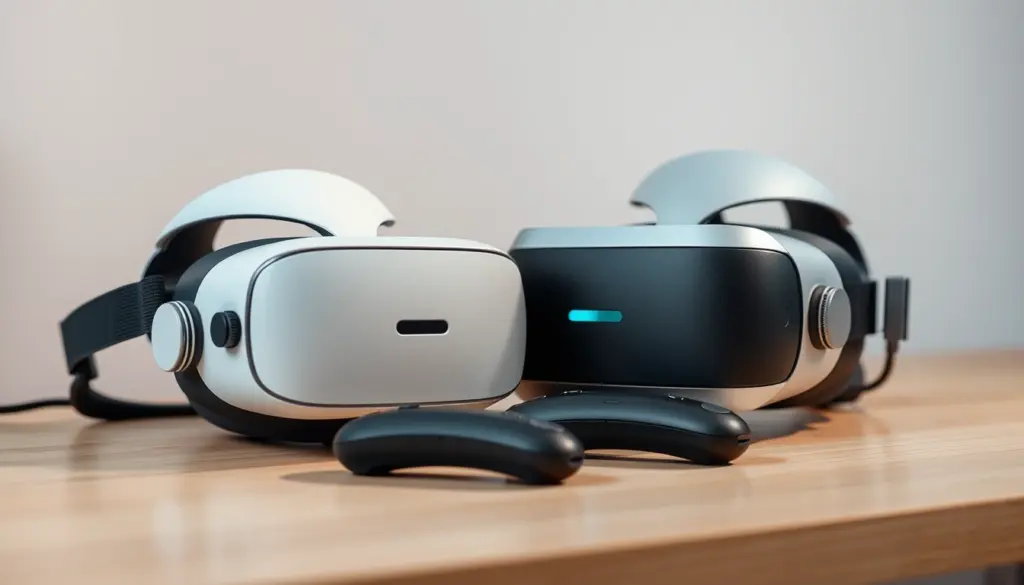
The Quest 3 vs Quest 3S decision looks simple on paper — one headset is cheaper, the other is sharper — but 2026 has quietly rewritten the math. In April 2026 Meta raised the price of every current Quest model to absorb a global memory-chip shortage, widening the gap between the two headsets to a clean $250 and forcing a fresh look at which one is actually worth buying. As of June 2026, the Meta Quest 3S starts at $349.99 and the Meta Quest 3 sells for $599.99, and the specs that separate them — lenses, resolution, and a depth sensor — matter more now that you are paying more for both.
This comparison breaks down the Quest 3 vs Quest 3S question the way a buyer actually experiences it: what you see through the lenses, how each headset handles mixed reality, what the 2026 price hike really costs you, and which model fits which kind of user. Both headsets share the same processor, the same 8GB of memory, the same controllers, and the same game library. The differences are concentrated in optics, the display, and one small sensor — and understanding them is the whole point of this guide.
Quest 3 vs Quest 3S: The 2026 Verdict at a Glance
If you only read one section, read this one. The Meta Quest 3S is the better value for most people: it uses the exact same Snapdragon XR2 Gen 2 chip, the same 8GB of RAM, the same Touch Plus controllers, and runs the identical game and app library as its pricier sibling. For pure gaming — Beat Saber, Gorilla Tag, Batman: Arkham Shadow — the two headsets deliver the same frame rates because they are the same computer inside a different shell. At $349.99 for the 128GB model, the Quest 3S is the cheapest way into first-class standalone VR in 2026.
The Meta Quest 3, at $599.99, earns its $250 premium in exactly three places: a higher-resolution display (2,064 × 2,208 pixels per eye versus 1,832 × 1,920), modern pancake lenses that deliver edge-to-edge clarity instead of the Fresnel “god rays” of the 3S, and a dedicated depth sensor that makes mixed reality noticeably more accurate. If you plan to read text, watch films, run productivity apps, or lean into passthrough-based mixed reality, the Quest 3 is the headset to buy. If you mostly want to play games on a budget, the Quest 3S gives you 90% of the experience for 58% of the price.
That is the short answer to meta quest 3 or 3s which is better: the 3S for value and gaming, the Quest 3 for visual quality and mixed reality. The rest of this article explains exactly why, with the full specs, benchmarks from multiple independent reviewers, the real 2026 pricing picture, and use-case recommendations so you can match the right headset to the way you actually use VR.
Why Quest Prices Changed in 2026: The Memory-Chip Crisis
You cannot understand the 2026 quest 3 vs quest 3s price gap without understanding why both headsets got more expensive at the same time. On April 16, 2026, Meta announced that starting April 19 it would raise prices across the Quest 3 family, citing the rising cost of building high-performance VR hardware. According to TechCrunch, the increases were driven directly by a shortage of memory chips — the same DRAM squeeze that has rippled across the entire consumer-electronics industry as AI data-center demand vacuums up global supply.
The scale of the underlying price move is startling. DDR5 memory spot prices climbed from roughly $6.84 in September 2025 to about $27.20 by December 2025 — a jump of more than 250% in a single quarter. VR headsets are unusually exposed to this because they pack fast LPDDR5 memory, high-density flash storage, and multiple camera sensors into a device that already runs on thin hardware margins. When the components inside get dramatically more expensive, a company either eats the cost or passes it on. Meta chose to pass a portion of it to buyers.
Meta stated that the cost of building high-performance VR hardware has risen significantly, with the global surge in the price of critical components — specifically memory chips — affecting nearly every category of consumer electronics, including VR.
Paraphrased from Meta’s official pricing update, meta.com, April 2026
The practical result: the Meta Quest 3 rose $100 (from $499.99 to $599.99) and both Quest 3S storage tiers rose $50 each. Meta also confirmed that the price change applied to refurbished units, while accessories held at their existing prices. Importantly, the increase was not a reflection of new features — the hardware is unchanged from launch. You are paying 2023 and 2024 headsets at 2026 component costs. That context reframes the entire value calculation, because the cheaper 3S insulates you more from the memory-crisis premium than the 512GB-only Quest 3 does.
There is a silver lining for buyers who move quickly: retail channels that stocked units before April 19 occasionally still list old pricing while inventory lasts, and Meta’s refurbished store frequently undercuts new-unit pricing by $40–$70. If budget is the deciding factor, those two avenues are the most reliable way to soften the 2026 hike without gambling on gray-market sellers.
Quest 3 vs Quest 3S Specs: The Full Comparison Table
Here is the complete side-by-side. When people search for quest 3 vs quest 3s specs, this is the table they are looking for — every meaningful hardware line, drawn from Meta’s official compare tool and cross-checked against independent spec breakdowns at Road to VR. Notice how many rows are identical: the two headsets are far more alike than the price gap suggests.
| Specification | Meta Quest 3 | Meta Quest 3S |
|---|---|---|
| Launch date | October 10, 2023 | October 16, 2024 |
| 2026 US price | $599.99 (512GB) | $349.99 (128GB) / $449.99 (256GB) |
| Processor (SoC) | Snapdragon XR2 Gen 2 | Snapdragon XR2 Gen 2 (identical) |
| RAM | 8GB | 8GB (identical) |
| Storage options | 512GB only | 128GB / 256GB |
| Display type | Dual LCD | Dual LCD |
| Resolution per eye | 2,064 × 2,208 | 1,832 × 1,920 |
| Pixels per degree (approx.) | ~25 PPD | ~20 PPD |
| Refresh rate | Up to 120Hz | Up to 120Hz (identical) |
| Lenses | Pancake | Fresnel |
| Field of view (horizontal) | 110° | 96° |
| Passthrough cameras | 4MP color, ~18 PPD | 4MP color, ~18 PPD (identical) |
| Depth sensor | Yes (dedicated projector) | No (IR flood illuminators) |
| IPD adjustment | Continuous wheel, 58–71mm | 3 fixed steps (58 / 63 / 68mm) |
| Battery capacity | 5,060 mAh | 4,324 mAh |
| Typical battery life | ~2–2.4 hours | ~2–2.5 hours |
| Weight | ~515 g | ~514 g |
| Controllers | Touch Plus | Touch Plus (identical) |
| Audio | Integrated spatial audio | Integrated spatial audio |
| Game / app library | Full Quest catalog | Full Quest catalog (identical) |
Read that table twice and a pattern emerges. Everything that determines raw performance — chip, memory, refresh rate, controllers, software — is identical. Everything that determines visual quality and spatial accuracy — resolution, lenses, field of view, depth sensor, IPD precision — favors the Quest 3. The $250 you spend upgrading from a 3S is not buying you a faster headset; it is buying you a clearer, wider, better-fitting window into the same experiences.
Display and Resolution: Where the $250 Goes
Resolution is the single most-searched difference in the quest 3 vs 3s resolution debate, and it is the clearest justification for the Quest 3’s price. The Quest 3 renders 2,064 × 2,208 pixels per eye; the Quest 3S renders 1,832 × 1,920 — the same panel Meta used in the Quest 2 back in 2020. In total pixel terms, the Quest 3 delivers roughly 30% more pixels per eye, which translates to about 25 pixels per degree (PPD) versus the 3S’s ~20 PPD.
What does that mean when you put the headset on? Text is the acid test. On the Quest 3, a virtual browser window, an in-game HUD, or subtitles on a movie look crisp and readable across the frame. On the Quest 3S, the same content is legible but softer, with a more visible screen-door effect — the faint grid between pixels — especially in bright scenes and menus. For fast, cartoonish games the difference is easy to ignore; for anything text-heavy, cinematic, or detail-oriented it becomes the thing you notice first and can never quite un-see.
Both headsets share the same peak refresh rate: 90Hz by default with a 120Hz experimental mode that supported titles can opt into. That parity matters because motion smoothness affects comfort as much as sharpness does. Neither headset will feel juddery relative to the other; the 3S is not a “slow” display, just a lower-resolution one. It is also worth stressing that both use LCD rather than OLED, so neither delivers the inky blacks of a PSVR 2 — a trade-off Meta made deliberately to keep passthrough color accurate and prices in check.
One under-discussed consequence of the resolution gap is comfort during long sessions. Sharper text means less eye strain when you are reading, coding in a virtual monitor, or watching a two-hour film, because your eyes are not fighting to resolve fuzzy edges. If your VR time skews toward media and productivity rather than quick gaming bursts, the Quest 3’s display is not a luxury — it is the feature that makes those use cases pleasant instead of tolerable.
Lenses: Pancake vs Fresnel Explained
If resolution is the headline difference, the lenses are the hidden one — and the spec that comparison shoppers most often get wrong. To be unambiguous: the Meta Quest 3 uses pancake lenses, and the Meta Quest 3S uses older Fresnel lenses, the same optical technology as the Quest 2. This is not a minor detail. Lens type shapes almost everything about how the image feels once light leaves the display and reaches your eye.
Why Pancake Lenses Feel Sharper
Pancake lenses fold the light path back on itself, letting Meta build a thinner, better-balanced headset while delivering clarity that stays sharp from the center of your vision all the way to the edges. On the Quest 3, the “sweet spot” — the zone where the image is in focus — effectively covers the whole lens. You can glance around with your eyes rather than turning your head, and the picture stays clean. Pancake optics also dramatically reduce god rays, the streaks of light that smear out from bright objects on a dark background.
The Fresnel Trade-Offs on the Quest 3S
Fresnel lenses are cheaper and proven, but they concentrate sharpness in a smaller central sweet spot that falls off toward the edges, so you tend to move your head more to keep things in focus. In high-contrast scenes — a bright UI on a dark background, a menu in a dim game — you will see the familiar god-ray smearing that Quest 2 owners know well. Combined with the narrower 96° field of view (versus 110° on the Quest 3), the 3S produces a slightly more “binocular” sensation, as though you are looking through a smaller window. None of this makes the 3S bad; it makes it a 2024 budget headset honestly priced against a flagship.
The Fresnel design also explains why the 3S is a touch chunkier than the Quest 3 despite weighing essentially the same (~514 g versus ~515 g). Pancake optics let Meta slim down the Quest 3’s profile, shifting the balance slightly closer to your face. Reviewers at Digital Trends and Android Central both single out the lens upgrade as the most immediately visible reason to spend the extra money — more so than the resolution bump, because you feel it the instant you look around.
Passthrough and Mixed Reality: The Depth-Sensor Difference
Here is where the quest 3 vs 3s passthrough conversation gets counterintuitive. The passthrough cameras are identical on both headsets: the same 4-megapixel, roughly 18-PPD full-color feed that lets you see your real room in mixed reality. If you compared a still frame of passthrough from each headset, you would struggle to tell them apart. So on the camera hardware alone, the 3S gives up nothing.
The real mixed-reality difference is the depth sensor. The Quest 3 includes a dedicated depth projector that measures the geometry of your room, allowing it to place virtual objects on real surfaces more accurately and generate an automatic room mesh with less manual setup. The Quest 3S drops that sensor, relying instead on two infrared flood illuminators and computer-vision estimation. In practice, the 3S can still do mixed reality — it just guesses at depth rather than measuring it, so virtual objects occasionally clip through furniture or sit slightly off a real surface, and room-scanning takes a bit more effort.
For casual mixed-reality apps — a virtual screen floating in your living room, a tabletop game, fitness overlays — most users will not care about the missing depth sensor. For serious mixed-reality use, spatial design work, or apps that anchor content precisely to your environment, the Quest 3’s depth sensor is the difference between “convincing” and “close enough.” This is the one MR advantage that cannot be patched away in software, because it is a physical sensor the 3S simply does not have.
If mixed reality is a curiosity for you rather than a core use case, the identical passthrough cameras mean the 3S delivers a genuinely comparable everyday experience. If mixed reality is the reason you are buying a headset at all, the depth sensor pushes you firmly toward the Quest 3 — and it is worth weighing that against Valve’s newly announced hardware, which we covered in our Steam Frame breakdown for readers watching the wider standalone-VR race.
Performance Benchmarks: Same Chip, Different Experience
This is the section that surprises people. In a head-to-head performance test, the two headsets score effectively the same, because they run the identical Qualcomm Snapdragon XR2 Gen 2 processor with the identical 8GB of RAM. There is no “pro” chip in the Quest 3. Frame rates in demanding titles, load times, and hand-tracking responsiveness are shared characteristics, not differentiators. Independent breakdowns at Road to VR, Android Central, and VRcompare all confirm the same silicon across both models.
| Performance dimension | Meta Quest 3 | Meta Quest 3S | Real-world impact |
|---|---|---|---|
| Raw GPU/CPU throughput | XR2 Gen 2 | XR2 Gen 2 | Identical — same frame rates |
| Memory bandwidth | 8GB LPDDR5 | 8GB LPDDR5 | Identical multitasking |
| Rendered clarity | ~25 PPD | ~20 PPD | Quest 3 sharper per frame |
| Effective FOV | 110° | 96° | Quest 3 more immersive |
| Passthrough latency | Low | Low | Identical — same cameras |
| Room-mesh accuracy | Depth sensor | Estimated | Quest 3 more precise MR |
| PC VR (Air Link / Link) | Supported | Supported | Same; PC does the rendering |
There is one nuance worth flagging. Because the Quest 3 pushes about 30% more pixels per eye, a game that renders at the headset’s native resolution has to do slightly more work on the Quest 3 to fill those extra pixels. In practice, Meta and developers target the same performance envelope on both headsets, so you will not see the 3S “win” benchmarks — but it does mean the two headsets are tuned to hit the same frame rate rather than the Quest 3 running objectively faster. The takeaway for benchmark-minded buyers: do not expect the extra $250 to buy performance. It buys presentation.
For PC VR enthusiasts, the story is even more level. When you tether either headset to a gaming PC over Air Link or a Link cable, the PC’s graphics card does the heavy lifting and the headset acts as a display and tracker. In that mode the Quest 3’s advantage narrows to its optics and resolution, while raw rendering horsepower comes from your desktop GPU — the same dynamic we explored when comparing dedicated handhelds in our Steam Deck vs ROG Ally analysis.
Design, Comfort, Weight and IPD
On the quest 3 vs quest 3s weight question, the answer is refreshingly boring: they weigh almost exactly the same, around 514–515 grams for the headset itself. The difference is not mass but distribution. The Quest 3’s pancake lenses allow a slimmer front profile, which shifts weight marginally closer to your face and can feel better balanced over long sessions. The 3S is a hair chunkier up front because Fresnel lenses need more physical depth. Neither headset is light by 2026 standards, and both benefit enormously from an aftermarket head strap with a rear battery to counterbalance the front-heavy default fit.
Interpupillary distance (IPD) adjustment is a more meaningful comfort divide. The Quest 3 offers a continuous IPD wheel spanning 58–71mm, so you can dial in the exact spacing between the lenses to match your eyes. The Quest 3S offers only three fixed positions (58, 63, and 68mm). If your IPD happens to land near one of those three settings, you will never notice. If it falls between them — and many adults’ does — you may see a slightly softer image or feel mild eye strain on the 3S, because the lenses are not perfectly aligned with your pupils. For anyone who has struggled with headset comfort before, the Quest 3’s continuous IPD is a genuine, underrated advantage.
Both headsets ship with the same Touch Plus controllers, the same soft facial interface, and the same basic elastic strap. Accessory ecosystems overlap almost entirely, so a comfort strap, prescription lens inserts, or a carrying case bought for one will generally fit the other. This shared accessory compatibility is a quiet win for the 3S: you get access to the entire Quest 3-era accessory market without paying Quest 3 prices.
Battery life is close but not identical. The Quest 3 carries a larger 5,060 mAh cell while the 3S uses a smaller 4,324 mAh battery; because the 3S drives a lower-resolution display, both land in the same real-world window of roughly two to two-and-a-half hours of active use. Neither is an all-day device, and both charge over USB-C. If runtime is a priority, an external battery strap is the fix for either headset — another accessory the two models share.
Pricing and Storage Tiers: The Real Cost in 2026
Let us put the full 2026 pricing picture in one place, because the storage structure is where buyers get tripped up. The Meta Quest 3 is now sold in a single 512GB configuration at $599.99 — Meta discontinued the old 128GB and 256GB Quest 3 models, so there is no “cheap” Quest 3 anymore. The Quest 3S, by contrast, comes in 128GB ($349.99) and 256GB ($449.99) versions. That means the cheapest way into a Quest 3 is $599.99, while the cheapest Quest 3S is $250 less.
| Model | Storage | Pre-April 2026 price | Current 2026 price | Increase |
|---|---|---|---|---|
| Meta Quest 3S | 128GB | $299.99 | $349.99 | +$50 |
| Meta Quest 3S | 256GB | $399.99 | $449.99 | +$50 |
| Meta Quest 3 | 512GB | $499.99 | $599.99 | +$100 |
How much storage do you actually need? VR games are smaller than modern console titles but they add up: a big title like Asgard’s Wrath 2 or Batman: Arkham Shadow can run several gigabytes, and downloaded videos or PC-VR caching eat space fast. For a casual player who keeps five to ten games installed, 128GB on the 3S is plenty. For someone who installs dozens of titles, sideloads content, or stores media on-device, the 256GB 3S ($449.99) or the 512GB Quest 3 ($599.99) makes more sense. Notably, the 256GB Quest 3S sits just $150 below the Quest 3 — so if you were going to buy the larger 3S anyway, the step up to the sharper, wider, depth-sensing Quest 3 becomes an easier call.
A word on where not to buy. In 2026, VR headsets frequently surface on gray-market key resellers at prices that look too good to be true. Stick to Meta directly, major electronics retailers, and Meta’s official refurbished store, which carries the same warranty support as new units. The savings from sketchy third-party sellers rarely justify the risk of a non-activatable or region-locked device.
Games, Apps and Backward Compatibility
This is the great equalizer. Both the Meta Quest 3 and Quest 3S run the exact same software library — every game, app, and experience in the Meta Quest Store works on both, and both are fully backward-compatible with the Quest 2 catalog. There is no “Quest 3 exclusive” tier of games that the 3S is locked out of. When a developer builds for the XR2 Gen 2 platform, they build for both headsets at once. That is a deliberate choice by Meta to keep its install base unified, and it is excellent news for 3S buyers.
Standout titles play identically on both: Beat Saber, Gorilla Tag, Asgard’s Wrath 2, Batman: Arkham Shadow, Population: One, and fitness apps like Supernatural. Media apps — a virtual big-screen for streaming services, YouTube VR, and a growing catalog of immersive video — also run on both, though this is exactly where the Quest 3’s sharper display earns its keep for movie watching. Productivity is supported on both as well: virtual multi-monitor workspaces, remote desktop, and browser-based tools.
For PC VR, both headsets connect to a gaming PC through Air Link (wireless) or a USB-C Link cable, unlocking SteamVR and the deep library of PC-only VR titles like Half-Life: Alyx. Because the PC renders those games, the headsets perform comparably in this mode, with the Quest 3’s optics providing the only meaningful edge. If you already own a capable gaming PC, either Quest becomes a flexible display for a far larger world of VR software — a versatility that echoes the platform-flexibility themes in our GeForce Now vs Xbox Cloud Gaming comparison.
The bottom line on software: there is no content-based reason to choose the Quest 3 over the 3S. Every experience is available to both. The Quest 3 simply presents that shared library more sharply. If your library dreams are identical on both headsets — and they are — the decision comes back to how much visual quality is worth to you.
Meta Quest Sales and VR Market Share in 2025–2026
To buy smart, it helps to know where the VR market actually is in 2026 — and the honest picture is turbulent. Meta remains overwhelmingly dominant: the company held roughly 74.6% of the AR/VR headset market in 2024 according to IDC’s tracker, and about 75.7% share in Q3 2025 when its combined Quest and Ray-Ban lineup is counted. In standalone VR specifically, the Quest line is effectively the market. But dominance of a shrinking category is a double-edged sword.
Volumes fell hard in 2025. Meta shipped roughly 1.7 million Quest units across the first three quarters of 2025, and its Quest shipments declined about 42.3% year over year, according to figures reported by The Register. The broader mixed-reality and VR headset category was expected to contract about 42.8% in 2025 per IDC, and Counterpoint Research measured global VR headset shipments falling 14% year over year in the first half of 2025. The enthusiasm has cooled from the pandemic-era peak.
| Metric | Figure | Source |
|---|---|---|
| Meta AR/VR market share (2024) | ~74.6% | IDC |
| Meta share Q3 2025 (Quest + Ray-Ban) | ~75.7% | IDC |
| Quest units shipped, first 3 quarters 2025 | ~1.7 million | The Register / IDC |
| Quest shipment change YoY (2025) | −42.3% | The Register / IDC |
| VR headset shipments H1 2025 (global) | −14% YoY | Counterpoint |
| Forecast market rebound (2026) | ~87% | IDC |
The forecast, however, points back up. IDC projects a roughly 87% rebound in 2026 as pricing stabilizes and next-generation hardware arrives, and expects mixed reality — anchored by devices like the Quest series — to grow from about 3.2 million units in 2026 toward 10.4 million by 2030. For a buyer, the practical implication is twofold: the Quest platform is not going anywhere, so software support is safe; but you are buying into hardware (2023 and 2024 designs) that sits late in its lifecycle, which brings us to the elephant in the room.
Is a Quest 4 coming? As of mid-2026, Meta has not officially announced one. Reports suggest a Quest 4 is targeted for late 2026 or 2027, with some indications of a longer-than-usual gap between generations and a separate, lighter mixed-reality headset planned for 2027. Nothing is confirmed. If you need a headset now, both the Quest 3 and 3S will be fully supported for years; if you can wait and want the newest hardware, keep an eye on Meta’s fall announcements before committing to the top-tier Quest 3.
Real-World Use Cases: Which Headset for Which Buyer
Specs only matter in the context of how you will use the headset. Here are five concrete buyer profiles mapped to the right pick in the Quest 3 versus 3S decision.
- The budget-first gamer. You want Beat Saber, Gorilla Tag, and social VR without spending flagship money. Buy the Quest 3S 128GB ($349.99). Identical performance, identical library, lowest cost of entry.
- The first-time VR buyer with kids. You want a headset the whole family can try without fear of buyer’s remorse. Buy the Quest 3S. It is the least expensive way to see whether VR sticks in your household, and it plays everything.
- The media and movie watcher. You will use the headset as a personal cinema and virtual monitor. Buy the Quest 3 ($599.99). The higher resolution and pancake lenses make text and film dramatically more comfortable to look at for hours.
- The mixed-reality and productivity user. You want accurate room mapping, spatial apps, and multi-monitor work. Buy the Quest 3. The depth sensor and sharper display are exactly what these use cases demand.
- The PC VR enthusiast. You own a gaming PC and want a wireless headset for SteamVR and Half-Life: Alyx. Either works, but choose the Quest 3 if you want the crispest image, since your PC already supplies the horsepower.
A sixth profile deserves mention: the value-maximizer who was already eyeing the 256GB Quest 3S. At $449.99, that model is only $150 below the Quest 3. If you have talked yourself into the larger 3S, seriously consider closing the gap to the Quest 3 — the resolution, lens, FOV, IPD, and depth-sensor upgrades are a lot of headset for that final $150. The 128GB 3S versus the Quest 3 is a real value choice; the 256GB 3S versus the Quest 3 is a much closer call that often tips toward the flagship.
Finally, if you are cross-shopping VR against other gaming hardware entirely — a handheld, a console, or a new headset generation — remember that standalone VR occupies a unique niche. It is the only category on this list that puts you inside the game. Buyers weighing a Quest against traditional platforms may find our Switch 2 vs PS5 and PS5 Pro vs PS5 comparisons useful for framing where a VR headset fits in a broader setup.
Migration Guide: Upgrading From Quest 2 to Quest 3 or 3S
Millions of the headsets in the wild are still Quest 2 units, and the most common upgrade path in 2026 runs from a Quest 2 to either a Quest 3 or a 3S. The good news: migration is nearly frictionless because both new headsets share your account, your purchases, and your saved data. Here is the practical process.
- Charge and update the old headset. Before you migrate, make sure your Quest 2 is on the latest software so cloud backups are current.
- Enable cloud backup. In Settings → System → Backup, turn on cloud backup so game saves and app data sync to your Meta account.
- Sign in on the new headset. Set up the Quest 3 or 3S with the same Meta account. Your entire library and purchases appear automatically — you do not re-buy anything.
- Redownload your games. Installed apps do not transfer as files; you reinstall them from your library, and cloud saves restore your progress.
- Re-run boundary and IPD setup. On the Quest 3, take advantage of the continuous IPD wheel to dial in a sharper fit than the Quest 2 allowed; on the 3S, pick the closest of the three fixed settings.
- Trade in or repurpose the Quest 2. Meta and major retailers periodically run trade-in credit; alternatively, keep the Quest 2 as a guest or kids’ headset.
For developers and power users, both new headsets support the same tooling as the Quest 2, so your existing workflow carries over. If you sideload apps or test builds, the Android Debug Bridge (adb) works identically across the lineup once developer mode is enabled in the Meta Quest mobile app. A quick sanity check after migrating:
# Confirm the new headset is detected over USB-C
adb devices

# Read back the model and Android build to verify the upgrade
adb shell getprop ro.product.model
adb shell getprop ro.build.version.release

# List installed VR packages to confirm your library reinstalled
adb shell pm list packages | grep -i oculus
One migration caveat: if you relied on a Quest 2 accessory that clips to the old headset’s specific shape — a particular head strap or facial interface — confirm compatibility before assuming it fits. Controllers do not carry over conceptually (both new headsets use Touch Plus rather than the Quest 2’s Touch controllers), but they ship in the box, so this is a non-issue. Overall, moving from a Quest 2 to a Quest 3 or 3S is one of the smoother hardware upgrades in consumer tech, and it is a big part of why Meta’s ecosystem lock-in is so strong.
Pros and Cons of Each Headset
A clean summary of the trade-offs, distilled from every section above.
Meta Quest 3 — Pros and Cons
- Pro: Highest resolution (2,064 × 2,208 per eye), ~30% sharper than the 3S.
- Pro: Pancake lenses deliver edge-to-edge clarity and minimal god rays.
- Pro: Wider 110° field of view for a more immersive image.
- Pro: Dedicated depth sensor for more accurate mixed reality.
- Pro: Continuous IPD wheel (58–71mm) for a precise fit.
- Con: $599.99 — $250 more than the entry 3S after the 2026 hike.
- Con: Only one storage option (512GB); no cheaper Quest 3 exists.
Meta Quest 3S — Pros and Cons
- Pro: Best value in standalone VR at $349.99.
- Pro: Identical performance — same XR2 Gen 2 chip and 8GB RAM.
- Pro: Runs the entire Quest library with full backward compatibility.
- Pro: Same passthrough cameras and Touch Plus controllers as the Quest 3.
- Con: Lower-resolution Quest 2-era display with more screen-door effect.
- Con: Fresnel lenses bring god rays and a narrower 96° sweet spot.
- Con: No depth sensor and only three fixed IPD settings.
Meta Quest 3 or 3S: Which Is Better? The Final Verdict
So, meta quest 3 or 3s which is better? The correct answer is that there is no single winner — there is a winner for you, and it hinges on one question: how much do you value visual quality and mixed-reality precision over raw savings?
Buy the Meta Quest 3S ($349.99) if you are budget-conscious, buying your first headset, kitting out a family, or primarily playing games. You lose nothing in performance and nothing in library access. You accept a lower-resolution display, Fresnel lenses with some god rays, a narrower field of view, and no depth sensor — trade-offs that fade into the background during fast, fun gameplay. For the largest slice of buyers, the 3S is the smart, rational choice, and the memory-crisis price hike stings less on the cheaper model.
Buy the Meta Quest 3 ($599.99) if you care about clarity: reading text, watching movies, doing productivity work, or running serious mixed-reality apps that need the depth sensor. The pancake lenses and sharper display are things you feel every second the headset is on, and the continuous IPD makes it more comfortable for more faces. The $250 premium is not buying speed — it is buying a better window. For enthusiasts and heavy users, that window is worth it.
The data-driven bottom line: identical guts, different glass. The quest 3 vs quest 3s choice is really a choice about optics and resolution, priced at $250. Most people should start with the 3S and never look back; discerning users and mixed-reality buyers should stretch to the Quest 3. Either way, you are getting the dominant standalone-VR platform on the market — just at 2026’s higher, memory-crisis prices.
Related Coverage
- Steam Frame: Valve’s 16GB SteamOS VR Headset [2026]
- ROG Xbox Ally X vs Legion Go 2: $999 vs $1,349 [2026]
- Steam Deck vs Switch 2: $789 vs $449.99 [2026]
- Switch 2 vs PS5: $449 vs $649, 1080p vs 4K [2026]
- Steam Machine Hits $1,049: 6x Steam Deck Power [2026]
- PS5 Pro vs PS5: $899 vs $649, 45% Faster [2026]
- More gaming hardware coverage
Frequently Asked Questions
Is the Quest 3 worth $250 more than the Quest 3S?
It depends on your use case. The Quest 3’s $250 premium buys a higher-resolution display, pancake lenses, a wider field of view, a depth sensor, and continuous IPD adjustment — but not more performance, since both use the same chip. For gaming on a budget, the 3S is the better buy. For text, media, productivity, and mixed reality, the Quest 3 is worth it.
Do Quest 3 and Quest 3S play the same games?
Yes. Both run the identical Meta Quest game and app library with full backward compatibility to the Quest 2 catalog. There are no Quest 3-exclusive games that the 3S cannot play; developers target both headsets simultaneously because they share the same Snapdragon XR2 Gen 2 platform.
Why did Meta raise Quest prices in 2026?
Meta raised prices on April 19, 2026, because of a global memory-chip shortage driven by AI data-center demand. DDR5 spot prices surged more than 250% between September and December 2025. The Quest 3 rose $100 to $599.99 and both Quest 3S tiers rose $50, to $349.99 and $449.99.
What is the difference in resolution between Quest 3 and Quest 3S?
The Quest 3 displays 2,064 × 2,208 pixels per eye, while the Quest 3S displays 1,832 × 1,920 — the same panel as the Quest 2. That gives the Quest 3 roughly 30% more pixels per eye and about 25 pixels per degree versus the 3S’s ~20 PPD, so text and fine detail look noticeably sharper.
Does the Quest 3S have a depth sensor?
No. The Quest 3S omits the dedicated depth sensor found on the Quest 3, using two infrared flood illuminators and computer-vision estimation instead. Both headsets share the same 4MP full-color passthrough cameras, so everyday passthrough looks similar, but the Quest 3 maps rooms more accurately for mixed reality.
Is a Meta Quest 4 coming in 2026?
Meta has not officially announced a Quest 4 as of mid-2026. Reports suggest a late-2026 or 2027 launch, possibly with a longer gap between generations and a separate lighter mixed-reality headset planned for 2027. If you need a headset now, the Quest 3 and 3S will be supported for years; if you want the newest hardware, watch Meta’s fall announcements.
Which Quest headset is best for mixed reality?
The Quest 3 is the better mixed-reality headset because its depth sensor measures room geometry for more accurate object placement and room meshing. The Quest 3S can still do mixed reality with the same passthrough cameras, but it estimates depth rather than measuring it, so virtual objects align slightly less precisely with real surfaces.
Do Quest 3 and Quest 3S weigh the same?
Almost exactly. The Quest 3 weighs around 515 grams and the Quest 3S around 514 grams. The difference is weight distribution, not mass: the Quest 3’s pancake lenses allow a slimmer front profile that feels marginally better balanced, while the 3S is slightly chunkier due to its thicker Fresnel lenses.