
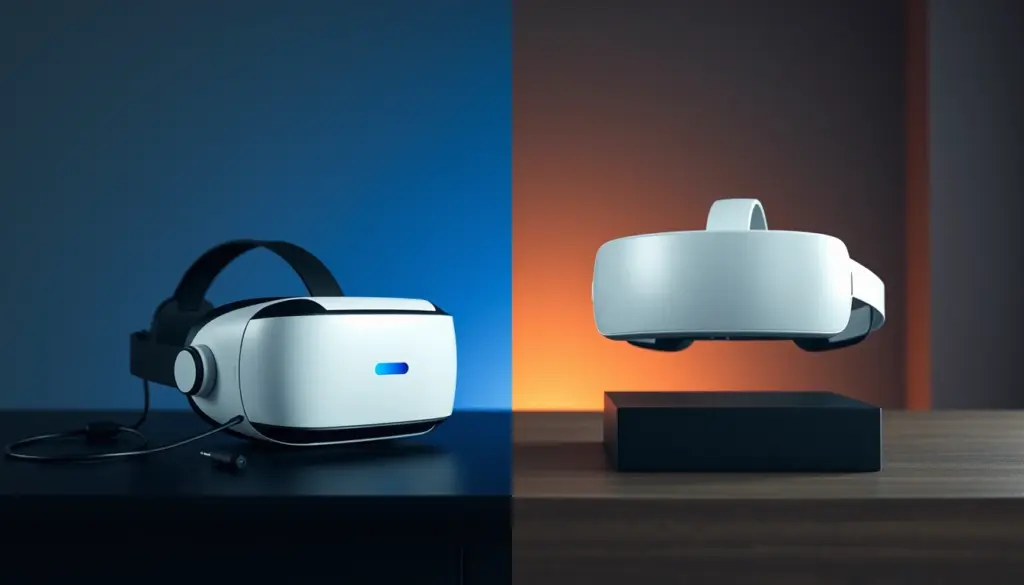
For three years, the math on VR headsets was simple: Meta Quest 3 was the affordable, do-everything option, and Sony’s PlayStation VR2 was the pricier, PS5-only luxury pick. In 2026, that math flipped. A permanent price cut pushed PSVR2 down to $399.99, while a memory-chip shortage pushed Quest 3 up to $599.99. The headset that once cost $50 more than Quest 3 at launch is now $200 cheaper.
That reversal is reason enough to compare PSVR2 vs Quest 3 again in 2026, but price is only part of the story. One headset is a tethered, OLED-equipped PS5 accessory with the best haptics in consumer VR. The other is a fully standalone LCD headset with the largest library in the industry and no console required. This guide breaks down the full specs, real pricing, benchmarks from three VR-focused outlets, five real-world use cases, a migration guide for switching platforms, and a data-backed verdict on which headset makes sense for which kind of buyer in 2026.
PSVR2 vs Quest 3: The Headline Numbers
Before the deep dive, here is the short version. Both headsets shipped years ago, both have been through a 2026 price change, and both are still receiving new games. Neither is a “new” product, which is actually an advantage for buyers: pricing, compatibility, and long-term software support are all fully known quantities rather than pre-order guesswork.
| Category | PSVR2 | Meta Quest 3 |
|---|---|---|
| Price (July 2026) | $399.99 | $599.99 |
| Requires a console or PC | Yes – PS5 only | No – fully standalone |
| Display type | Dual OLED HDR | Dual LCD |
| Resolution per eye | 2000 × 2040 | 2064 × 2208 |
| Eye tracking | Yes | No |
| Headset haptics | Yes (built-in motor) | No |
| Session length | Unlimited (cable-powered) | ~2–2.5 hours (battery) |
| Library size | 433 games (official list) | No official total; 100+ apps topped $1M revenue in 2025 |
The short version: if you already own a PS5, PSVR2 at $399.99 is difficult to argue against. If you don’t, Quest 3 remains the more flexible, more portable, and better-supported all-around headset, even at its higher 2026 price.
Full Specs Comparison: PSVR2 vs Quest 3
Here is the complete technical breakdown, drawn from Sony’s official PlayStation VR2 product page and Meta’s official Quest 3 product page, cross-checked against Wikipedia’s spec tables. Every figure below is a published spec, not an estimate.
| Spec | PSVR2 | Meta Quest 3 |
|---|---|---|
| Publisher | Sony Interactive Entertainment | Meta Platforms |
| Launch date | February 22, 2023 | October 10, 2023 |
| Launch price (USD) | $549.99 | $499.99 (512GB) |
| Price as of July 2026 | $399.99 | $599.99 (512GB, only SKU) |
| Display type | Dual OLED, HDR | Dual LCD, no HDR |
| Resolution (per eye) | 2000 × 2040 | 2064 × 2208 |
| Refresh rate | 90Hz or 120Hz | Up to 120Hz |
| Field of view (horizontal) | ~110° | 110° |
| Lens type | Fresnel | Pancake |
| Weight | ~560g | ~515g |
| Onboard processor | None — renders on PS5 | Snapdragon XR2 Gen 2 |
| RAM | N/A (uses PS5 memory) | 8GB |
| Power source | USB-C from PS5 (no battery) | Built-in 5060mAh battery |
| Session length | Unlimited while connected | ~2–2.5 hours per charge |
| Positional tracking | Inside-out, 4 headset cameras | Inside-out, no external sensors |
| Eye tracking | Yes, enables foveated rendering | No |
| Passthrough / mixed reality | Grayscale, limited | Full color, depth-sensor mesh |
| Controllers | PSVR2 Sense (adaptive triggers) | Touch Plus (self-tracking) |
| Headset haptics | Yes, built-in vibration motor | No |
| Audio | 3.5mm jack, Tempest 3D via PS5 | Built-in speakers, 3.5mm jack |
| Required host hardware | PlayStation 5 (any model) | None — standalone |
| PC VR support | Via $59.99 PC Adapter + SteamVR | Via Meta Link cable or Air Link wireless |
| Backward compatibility | Not compatible with original PSVR games | Fully compatible with Quest 2 library |
Two numbers in that table surprise most first-time buyers. First, Quest 3 actually has a slightly higher per-eye pixel count than PSVR2 — the “PSVR2 has better resolution” claim repeated across a lot of older VR coverage is out of date. Second, PSVR2 needs zero onboard processing power of its own because the PS5 does all the rendering, which is exactly why it can output OLED HDR at 120Hz without needing a battery or a chip capable of standalone 3D rendering.
Display and Optics: OLED HDR vs LCD Pancake Lenses
This is the single biggest technical difference between the two headsets, and it cuts in opposite directions depending on what you’re comparing. PSVR2 uses dual OLED panels, which means true per-pixel black levels, HDR support, and the kind of deep contrast that LCD panels structurally cannot match. Quest 3 uses LCD panels paired with pancake lenses — a newer, thinner optical design that delivers sharper edge-to-edge clarity and a wider sweet spot than the Fresnel lenses in PSVR2.
In practice, reviewers consistently describe the trade-off the same way: Quest 3’s pancake lenses produce a crisper image across the entire field of view, while PSVR2’s Fresnel lenses stay sharp in the center but can soften toward the edges and introduce mild god-ray artifacts around bright light sources in dark scenes. PSVR2’s OLED panels compensate with richer color and genuinely black blacks — a difference that matters most in horror games, space sims, and any content with high contrast between light and dark.
Sony’s own PSVR2 product page markets the OLED panels as delivering “4x the resolution of the original PlayStation VR” — a comparison to its 2016 predecessor, not to Quest 3. Read literally against Quest 3, PSVR2’s edge is panel technology and HDR, not raw sharpness.
Resolution and Clarity: More Pixels vs Richer Color
Breaking the resolution numbers down further: PSVR2 renders 2000 × 2040 pixels per eye, or roughly 4.08 megapixels per eye. Quest 3 renders 2064 × 2208 pixels per eye, or roughly 4.56 megapixels per eye — about an 11% pixel-count advantage for Quest 3. That is a real, verifiable spec difference, and it is the opposite of what a lot of older “PSVR2 is sharper” articles still claim.
What actually determines perceived sharpness in a headset is pixels per degree (PPD) — how many pixels are packed into each degree of your field of view — combined with lens quality. Quest 3’s pancake lenses concentrate that resolution more evenly across the frame, which is why hands-on reviewers consistently rate it as the visually “crisper” headset for text and fine detail, even though PSVR2 wins on color depth and contrast. Neither number tells the whole story on its own; this is a case where the spec sheet and the subjective experience point in different directions, and both are correct.
Field of View, Weight, and Comfort
Field of view is essentially a tie: both headsets sit around 110 degrees horizontal, and neither has a meaningful edge here. Weight is closer than the spec sheet suggests it should be — PSVR2 at roughly 560g versus Quest 3 at roughly 515g, a 45-gram gap that most users won’t consciously notice during a session.
Where comfort actually diverges is cable management and heat. PSVR2’s single 4.5-meter USB-C cable (with DisplayPort alt-mode and Power Delivery) means no battery weight up front, but it also means a tether to manage, which matters in room-scale games with a lot of spinning or ducking. Quest 3 has zero cables during standalone play, but as an all-in-one device it runs its own processor and battery against your forehead, which generates more heat over long sessions than a cable-fed headset that offloads all rendering to a console sitting across the room.
Tracking and Controllers
Both headsets use inside-out tracking via cameras built into the headset itself — neither requires external base stations or sensors placed around the room, which was a major limitation of first-generation PC VR. PSVR2 uses four headset-mounted cameras for controller and movement tracking, plus two additional infrared cameras dedicated entirely to eye tracking. Quest 3 uses its outward-facing cameras for both room tracking and its color passthrough feed.
Controllers differ in one specific, meaningful way: PSVR2 Sense controllers use 14 infrared LEDs for the headset to track their position, while Quest 3’s Touch Plus controllers track themselves without external tracking rings, making them smaller and less prone to occlusion when your hands move close together or behind your back. Both controller sets include capacitive finger-touch detection (5 sensors per controller on PSVR2 Sense) for partial finger gestures without needing full hand-tracking cameras. Quest 3 also supports camera-based hand tracking with no controllers at all, a feature PSVR2 does not offer.
Haptics and Immersion: Where PSVR2 Pulls Ahead
This is PSVR2’s clearest, least-disputed advantage. Beyond the Sense controllers’ adaptive triggers — which apply variable resistance so a bowstring, a gun trigger, and a car’s gas pedal all feel physically different in your hand — PSVR2 includes a haptic motor built directly into the headset. It produces a subtle rumble synced to in-game events: an explosion nearby, a heartbeat during a tense moment, rain hitting the visor.
Quest 3’s Touch Plus controllers have their own haptic feedback, but there is no headset-mounted haptic motor. The layered combination on PSVR2 — adaptive-trigger resistance, controller rumble, and visor-level haptic feedback working together — is still one of the most physically immersive setups in consumer VR, and it’s a big part of why Gran Turismo 7 and Horizon Call of the Mountain remain reference-quality VR experiences three years after PSVR2 launched.
Standalone Freedom vs Tethered Power
This is the real fork in the road, and it matters more than any single spec. Quest 3 is a complete computer: Snapdragon XR2 Gen 2 chip, 8GB of RAM, and a battery, all built into the headset. Put it on, and you’re in a game in seconds — no console, no cables, no other room required. That also means you can take it to a friend’s house, a hotel room, or a flight and use it exactly the same way.
PSVR2 has no onboard GPU of its own. Every frame is rendered on the PS5 and streamed down a single cable, which is precisely how it achieves OLED HDR visuals and adaptive-trigger-driven physics that a phone-class mobile chipset like Quest 3’s Snapdragon XR2 Gen 2 can’t match natively. The cost of that power is portability: PSVR2 only works within cable range of a PS5, and that PS5 has to be powered on and free (you can’t use the console for anything else while PSVR2 is active).
Neither approach is objectively better — they’re different bets on where the compute should live. Quest 3 bets on standalone mobile silicon getting better every generation. PSVR2 bets on borrowing a console’s GPU instead of shipping a weaker one inside the headset.
Game Library and Ecosystem Health
Library size is where the two platforms diverge the most sharply, and it’s worth being precise about the numbers rather than repeating vague “thousands of games” marketing lines.
PSVR2’s Library
Wikipedia’s maintained list of PlayStation VR2 games currently tracks 433 titles, spanning February 2023 through 2026 releases. That’s a real, if modest, library for a headset that only works with one console family. Sony paused PSVR2 hardware production in March 2024 after manufacturing more than 2 million units, according to Bloomberg reporting at the time, and first-party software support has been noticeably lighter than Quest’s since. Even so, third-party physical releases are still shipping in 2026 — specialist publisher Strictly Limited Games released a physical PSVR2 edition of I, Robot in April 2026, evidence that a niche collector market for the platform persists.
Quest 3’s Library
Meta doesn’t publish an official, verifiable total catalog count, so any precise “X,000 games” figure circulating online should be treated skeptically. What Meta has confirmed: more than 100 apps on the Meta Horizon Store crossed $1 million in gross revenue during 2025, and 2025 was a record year for Quest user numbers, according to comments from Meta’s Director of Games Chris Pruett reported by both Road to VR and UploadVR. Combined with full backward compatibility to the older Quest 2 library, Quest 3 has the broadest and most commercially active library in consumer VR, even without an exact headline number to quote.
One title worth noting sits outside this rivalry entirely: The Boys: Trigger Warning, launching spring 2026, is exclusive to VR as a category — it’s playable on both PSVR2 and Quest 3, not locked to either platform. That kind of cross-platform VR exclusive is becoming more common as publishers try to reach the largest possible VR audience rather than picking a side.
Mixed Reality and Passthrough
Quest 3 has a decisive lead here. Its full-color passthrough cameras, paired with a dedicated depth-sensor projector, let it build a real-time 3D mesh of your room — walls, furniture, doors are all detected and labeled automatically for its “Smart Guardian” boundary system. That mesh powers genuine mixed-reality apps: virtual furniture placed against real walls, games that use your actual couch as cover, and productivity apps that pin virtual monitors to a real desk.
PSVR2’s passthrough is grayscale and far more limited — enough to see your controller or find your drink without removing the headset, but not built for sustained mixed-reality use. Sony designed PSVR2 as a dedicated VR device first; Meta has spent two hardware generations positioning Quest as a mixed-reality platform, and it shows in this category specifically.
PC VR: SteamVR Adapter vs Meta Link
Both headsets can connect to a gaming PC, but through very different paths. Since August 7, 2024, Sony’s PSVR2 PC Adapter ($59.99) plus a separately purchased DisplayPort cable turns PSVR2 into a SteamVR headset, using the free PlayStation VR2 App on Steam. It works well for resolution and field of view, but several features are disabled entirely on PC: HDR, headset haptics, eye tracking, and adaptive-trigger resistance all stop working, since Sony built those features specifically around the PS5’s software stack.
Quest 3 connects to PC VR two ways: a wired Meta Link cable or wireless Air Link over Wi-Fi, both included in the software at no extra cost. Neither requires a separate adapter purchase. The trade-off is the reverse of PSVR2’s: Quest 3 keeps its full feature set in PC VR mode, but wireless Air Link quality depends heavily on your router and Wi-Fi congestion, and Quest 3’s mobile-class panel and lenses don’t automatically get better just because a powerful PC is now doing the rendering.
Minimum PC specs for the PSVR2 Adapter: Windows 10/11 64-bit, an Intel Core i5-7600 or AMD Ryzen 3 3100, 8GB RAM, an Nvidia GTX 1650 or AMD Radeon RX 5500 XT, a DisplayPort 1.4 output, and Bluetooth 4.0 or later.
Setup: What’s in the Box and First-Time Experience
Unboxing the two headsets tells you a lot about how differently Sony and Meta think about the category. The PSVR2 box contains the headset, two PSVR2 Sense controllers with wrist straps, detachable in-ear headphones with spare eartips, a USB-C-to-A cable for the headset, and a separate USB cable for pairing and charging the controllers. Notably absent: any game. You’ll need to buy or download a title separately before you can use it for anything.
Meta’s Quest 3 box contains the headset with a pre-installed facial interface, two Touch Plus controllers with wrist straps pre-installed, an 18W power adapter, a USB-C charging cable, and two AA batteries already loaded into the controllers. Quest 3 also frequently ships with a limited-time bundle that includes Batman: Arkham Shadow and a trial of Meta Horizon+ at no extra cost — meaning many buyers are playing a full game within minutes of opening the box, without a separate purchase.
First-time setup mirrors that gap. PSVR2 setup means connecting the headset to a powered-on PS5, running the guided room-boundary calibration, and pairing controllers over USB before your first session. Quest 3 setup is entirely self-contained: power it on, follow the in-headset prompts to scan your room for Smart Guardian, sign into a Meta account, and you’re in a game. Neither process takes more than about ten minutes, but only one of them requires a second piece of hardware to already be sitting in your living room.
Family Use and Parental Controls
Both companies build in real parental controls, but they route through different systems. Sony’s own PSVR2 safety guidance states that children under 12 should not use the headset at all, per the health and safety section of the PSVR2 instruction manual. Beyond that age gate, PSVR2 inherits the PS5’s existing account-level parental control tiers — Child (age 7 and under), Early Teens (13 and under), and Late Teens (16 and under) — set through the same PlayStation family management settings used for the console itself, not a separate VR-specific system.
Quest 3 uses Meta’s Family Center, which blocks app downloads and purchases above a linked account’s age rating by default, requiring explicit parent approval to unlock individual apps case by case. Parents can also separately restrict social features — voice calls, chat, and posting — independent of app-level age restrictions. Meta’s system is more granular for a device meant to be picked up and used standalone by a teenager without adult supervision nearby; PSVR2’s tethered nature means an adult typically needs to have already set up the PS5 in the same room anyway.
Pricing Breakdown: The 2026 Price Flip
This is the section that makes 2026 the right year to revisit this comparison. On February 27, 2025, Sony’s Isabelle Tomatis, Vice President of Global Marketing at Sony Interactive Entertainment, announced on the PlayStation Blog: “Starting in March, we’re reducing the recommended retail price (RRP) of PS VR2.” The cut took PSVR2 from $549.99 to $399.99 — a permanent 27% reduction, not a limited sale.
Quest 3 moved in the opposite direction. On April 19, 2026, Meta raised the price of its 512GB Quest 3 from $499.99 to $599.99, discontinuing the lower-capacity SKUs in the process, as part of a broader wave of gaming-hardware price increases tied to a global DDR5/LPDDR5X memory shortage driven by AI datacenter demand — the same shortage that pushed up prices across gaming RAM, GPUs, and consoles industry-wide in 2026.
| Item | 2023–2024 Price | July 2026 Price |
|---|---|---|
| PSVR2 headset | $549.99 (Feb 2023) | $399.99 |
| PSVR2 + Horizon Call of the Mountain bundle | $599.99 (Feb 2023) | $399.99 (same price as standalone) |
| PSVR2 PC Adapter | $59.99 (Aug 2024) | $59.99 |
| PSVR2 Sense Controller Charging Station | $49.99 | $49.99 |
| Quest 3, 128GB | $499.99 (Oct 2023) | Discontinued |
| Quest 3, 512GB | $649.99 (Oct 2023) | $599.99 (now the only SKU) |
Net effect: at launch, entry-level Quest 3 undercut PSVR2 by $50 ($499.99 vs $549.99). In July 2026, PSVR2 undercuts Quest 3 by $200 ($399.99 vs $599.99). That’s a $250 swing in relative positioning in under three years, driven by one company cutting a slow-selling accessory’s price to move inventory and another company passing a global memory shortage on to consumers.
Total Cost of Ownership
The headset price is only the entry fee. PSVR2 requires a PS5, which is not optional hardware you might already have lying around if you’re a PC or Xbox household. As of Sony’s April 2, 2026 price increase, a PS5 Digital Edition costs $599.99 and the disc model costs $649.99 — on top of the $399.99 headset. See our full PS5 pricing breakdown for how those console prices got here, and our PS5 Pro vs Xbox Series X comparison if you’re also choosing a console.
Quest 3 has no such hidden floor: the $599.99 headset price is the entire hardware cost to get into VR. The math below is illustrative, not an official calculator, but it shows the real gap once you account for what each platform actually requires to function.
# Illustrative total cost of ownership, USD, July 2026 prices
# Not an official calculator — for comparison purposes only

psvr2_headset = 399.99
ps5_digital   = 599.99      # required if you don't already own a PS5
psvr2_total_no_ps5  = psvr2_headset                  # 399.99, if you own a PS5 already
psvr2_total_new_ps5 = psvr2_headset + ps5_digital    # 999.98, starting from zero

quest3_headset = 599.99
quest3_total   = quest3_headset                      # 599.99, always — no console required

print(f"PSVR2, already own a PS5:  ${psvr2_total_no_ps5:.2f}")
print(f"PSVR2, buying a PS5 too:   ${psvr2_total_new_ps5:.2f}")
print(f"Quest 3, standalone:       ${quest3_total:.2f}")

# Output:
# PSVR2, already own a PS5:  $399.99
# PSVR2, buying a PS5 too:   $999.98
# Quest 3, standalone:       $599.99
The conclusion is straightforward: PSVR2 is the cheaper path only if you already own a PS5. Starting from zero, it’s the more expensive option by $400. That single fact should decide most of this comparison before you even get to lens types and haptics.
Ongoing costs differ too. PSVR2 has no subscription of its own, though a PS5 household is likely already paying for PlayStation Plus for online multiplayer. Replacement facial interfaces, extra Sense controller charging docks ($49.99), and spare ear tips are the main recurring PSVR2 expenses. Quest 3’s biggest optional recurring cost is Meta Horizon+ (bundled free for a trial period with some headset purchases, subscription-priced after), which offers discounts and included titles but isn’t required for the headset to function. Both platforms sell replacement facial interfaces and head straps in the $30–$50 range if the stock foam wears out with heavy use.
Benchmarks and Reviewer Verdicts
VR headsets don’t have a standardized FPS-style benchmark suite the way GPUs do, so the most useful comparative data comes from hands-on measurements and verdicts published by VR-specialist outlets. Here’s how three independent reviews broke down the same trade-offs.
| Source | What they measured | Verdict |
|---|---|---|
| Pixel count, per eye (official specs) | Raw resolution | Quest 3 wins: 4.56MP vs PSVR2’s 4.08MP |
| Road to VR | Sales volume, discount response | Quest still outsells PSVR2 by a wide margin even during PSVR2 discount periods |
| vr.org hands-on comparison | Overall recommendation framework | PSVR2 “one of the best values in VR” for PS5 owners; Quest 3 “the better everyday VR machine” otherwise |
| Session length (spec-derived) | Battery vs tethered power | PSVR2 wins: unlimited runtime vs Quest 3’s ~2–2.5 hour battery |
| Setup time (hands-on consensus) | Time from box to first game | Quest 3 wins: seconds, standalone, vs PSVR2’s PS5 + cable + room setup |
The pattern across every independent review is consistent: Quest 3 wins on convenience, versatility, and raw pixel count; PSVR2 wins on image quality per pixel (OLED contrast), haptic immersion, and unlimited session length. No outlet reviewed here found a clean overall winner — the “better” headset depends entirely on whether you already own a PS5.
Five Real-World Use Cases
Specs matter less than what you’ll actually do with the headset. Here’s how the two platforms handle five common VR use cases.
- Sim racing and driving games. Gran Turismo 7’s VR mode is a free add-on to the PS5 version and is widely considered one of the best VR racing experiences available, leaning heavily on PSVR2’s adaptive triggers and haptic feedback for road texture and collision feel. There’s no equivalent Quest 3-exclusive racing sim at the same fidelity.
- AAA narrative action-adventure. Quest 3 has the edge here with Batman: Arkham Shadow, a full Arkham-style campaign built for VR with gliding, gadgets, and freeflow combat, alongside Asgard’s Wrath 2, a 60-plus hour action-RPG. Both are Quest 3-tier exclusives that don’t run on the older Quest 2.
- Launch-day showcase experiences. Horizon Call of the Mountain remains PSVR2’s premier pack-in-style exclusive, built specifically to demonstrate the headset’s haptics and OLED contrast in a way a standalone chipset can’t replicate.
- Fitness and wellness. Both platforms run popular fitness apps like Les Mills Bodycombat and Synth Riders. Quest 3 has the edge for pure convenience — no console, no cable to trip on mid-workout — while PSVR2’s unlimited session length (no battery to run out) suits longer workout sessions better.
- Mixed reality and room-scale apps. Quest 3’s full-color passthrough and depth-sensor room mesh make it the only realistic choice for mixed-reality furniture placement, room-scale games that use your real furniture as cover, or productivity apps that pin virtual screens to a real desk. PSVR2’s grayscale passthrough isn’t built for sustained MR use.
Multiplayer and Social VR
Most cooperative and competitive VR games today support cross-play across Quest, PC VR, and PSVR2, so friend groups no longer need to own matching hardware to play rhythm games, shooters, or party titles together — a real improvement over VR’s early, fragmented years.
Meta’s dedicated social platform took a sharp turn in 2026, though. Horizon Worlds, Meta’s flagship social VR space, disappeared from the Quest store on March 31, 2026, and the app was fully removed from Quest headsets on June 15, 2026, alongside associated spaces like Horizon Central and Events Arena. Meta is converting Horizon Worlds to a mobile-only app instead. Meta VP Samantha Ryan framed the move as strategic separation: “We’re explicitly separating our Quest VR platform from our Worlds platform in order to create more space for both products to grow,” according to Game Developer’s coverage of the announcement. Meta Horizon+ subscription perks tied to the VR app were eliminated in the same move.
That’s a meaningful asterisk on Quest 3’s “biggest ecosystem” advantage: the closest thing either platform had to a dedicated social-hangout space just left VR entirely. Neither PSVR2 nor Quest 3 currently ships a first-party social hub built for the headset itself; social VR on both platforms in mid-2026 happens inside individual multiplayer games (Rec Room, VRChat, Population: One-style titles) rather than a single unified space.
Migration Guide: Switching Between Platforms
If you’re moving from one ecosystem to the other — selling a PSVR2 to fund a Quest 3, or vice versa — there’s no direct library transfer between PlayStation and Meta accounts. Games purchased on one platform do not carry over to the other. Here’s how to handle the move cleanly.
- Step 1: Audit your library before you sell anything. Cross-reference your PSN or Meta purchase history against the destination platform’s catalog. Titles like Beat Saber, Job Simulator, and Les Mills Bodycombat exist on both, so you may only need to rebuy a handful of true exclusives rather than your whole library.
- Step 2: Back up or export what you can. Fitness apps with progress tracking (workout history, calorie logs) are usually tied to the app’s own account system (e.g., a Les Mills or Supernatural login) rather than PSN or Meta specifically — log into those services directly to confirm your data persists across headsets before you migrate.
- Step 3: Factory reset and unlink the old headset. On PSVR2, this means unpairing it from your PS5 in Settings > Accessories. On Quest, go to Settings > Device Settings, and use Factory Reset, which also removes your Meta account’s spatial data tied to that specific unit from the device (though not necessarily from Meta’s servers — see the privacy section below for how to fully delete that separately).
- Step 4: Re-purchase only genuine exclusives. Budget for PSVR2-only titles like Horizon Call of the Mountain and Gran Turismo 7’s VR mode, or Quest-only titles like Batman: Arkham Shadow and Asgard’s Wrath 2, rather than assuming your whole collection needs replacing.
- Step 5: Re-do your room setup. PSVR2’s play-area setup is simpler (a seated or standing boundary), while Quest 3’s Smart Guardian room scan needs to be redone from scratch in the new space — walls, furniture, and doors are re-detected automatically, but you’ll want to allow a few extra minutes on first use in a new room.
Pros and Cons
PSVR2: Pros and Cons
- + $399.99, now $200 cheaper than Quest 3
- + OLED HDR display with true blacks and richer color
- + Eye tracking enables foveated rendering and avatar expression
- + Best-in-class haptics: adaptive triggers plus headset-mounted vibration motor
- + Unlimited session length — no battery to manage
- – Requires a PS5 ($599.99–$899.99), which most non-PS5-owner buyers don’t already have
- – Smaller library: 433 games versus Quest 3’s much larger, if imprecisely counted, catalog
- – Production paused since March 2024; first-party software support has slowed
- – PC VR mode via adapter loses HDR, haptics, eye tracking, and adaptive triggers
Quest 3: Pros and Cons
- + Fully standalone — no console, no PC, no cables required
- + Slightly higher per-eye resolution (4.56MP vs 4.08MP) and sharper pancake-lens clarity
- + Largest, most commercially active library in consumer VR
- + Full-color passthrough with real room-mesh mixed reality
- + Full PC VR feature set over Meta Link or wireless Air Link, no extra adapter to buy
- – $599.99, a $100 increase from its 2023 launch price
- – LCD panels with no HDR support; blacks look grey next to PSVR2’s OLED
- – No eye tracking, no headset-mounted haptics
- – Battery-limited to roughly 2–2.5 hours per session
Security and Privacy: Eye-Tracking Data and Account Requirements
Both headsets collect data categories that are worth understanding before you set one up, and the two companies handle it differently.
PSVR2’s eye tracking is a genuine biometric data stream — it’s used locally for foveated rendering (rendering detail only where you’re looking, to save GPU power) and for driving avatar facial expressions in social and multiplayer titles. PSVR2 requires a PSN account and a PS5 to function at all; there’s no way to use the headset without both.
Quest 3 requires a Meta account, but not a Facebook account — Meta decoupled the two in August 2022 following community and regulatory pressure, and you can now set up a Quest 3 using only an email address. The more relevant privacy consideration for Quest 3 is spatial data: its room-scanning feature builds a persistent 3D mesh of your home, labeling furniture, walls, and doors to power Smart Guardian and mixed-reality apps. Meta’s own spatial data support page confirms this data can be reviewed and deleted from Meta’s servers at any time via Settings > Privacy and Safety > Device Permissions, and individual apps only get access to it when you explicitly grant permission.
Practical recommendations for either platform: review app permission grants periodically rather than accepting defaults, use a dedicated email (not your primary personal or work address) for the account tied to the headset, and if you’re reselling a used unit, confirm the factory reset actually clears paired-account data rather than just app data — a step that’s easy to skip when you’re in a hurry to box up hardware for resale.
The VR Market in 2026: Where Both Platforms Stand
Neither headset exists in a vacuum. Meta holds an estimated 74–76% share of the AR/VR hardware market by unit shipments as of late 2025, according to IDC and Counterpoint Research tracking, and the broader VR/MR category has been in a multi-year shipment downturn — Counterpoint recorded VR shipments down roughly 14% year-over-year in the first half of 2025, with IDC forecasting a rebound only starting in 2026. Sony has not published PSVR2 shipment figures since confirming the March 2024 production pause, which is itself informative: a company that stopped disclosing numbers is rarely doing so because the numbers improved.
That market backdrop explains a lot about why the two companies made opposite pricing decisions in roughly the same window. Meta, with the dominant standalone platform and its own AI-datacenter memory demand competing for the same DRAM supply pushing costs up, passed the shortage on to buyers. Sony, sitting on a hardware line it had already paused and a smaller, PS5-locked audience, cut price instead to move existing inventory rather than let a slow-selling accessory get slower.
A third option is also about to complicate this comparison further: Valve’s Steam Frame, a standalone SteamOS-based VR headset built around a Snapdragon 8 Gen 3 chip, is expected to launch in 2026 with foveated streaming and native Proton/FEX compatibility for PC VR libraries. If you’re specifically weighing Meta’s own lineup rather than PSVR2, our Quest 3 vs Quest 3S comparison breaks down the cheaper Quest 3S alternative in detail.
There’s also a physical-media angle worth noting for PlayStation households specifically: Sony has confirmed it will end physical disc production for PS5 games by January 2028, part of a broader digital-first shift that makes PSVR2’s continued (if niche) third-party physical releases, like the April 2026 Strictly Limited Games release of I, Robot, feel increasingly like a collector’s-market exception rather than the norm.
The Verdict: Which Should You Buy in 2026
The data points to a conditional answer rather than a universal winner, and that condition is almost entirely about what hardware you already own.
| If you… | Buy |
|---|---|
| Already own a PS5 and want the cheapest possible entry into VR | PSVR2 ($399.99) |
| Don’t own a PS5 or gaming PC and want a single standalone device | Quest 3 ($599.99) |
| Want the best haptic immersion and OLED contrast, budget aside | PSVR2 |
| Want the largest library and cross-platform flexibility | Quest 3 |
| Plan to travel with your headset or use it outside a fixed room | Quest 3 |
| Care most about mixed reality / room-scale apps | Quest 3 |
| Want unlimited session length with zero battery anxiety | PSVR2 |
For PS5 owners, the calculus genuinely changed in 2026: at $399.99, PSVR2 is no longer a hard sell, it’s an easy one, provided you’re realistic about a slower software release cadence since Sony paused hardware production. For everyone else, Quest 3 remains the safer, more versatile, better-supported headset even after its price increase — standalone convenience and library size are advantages that a lower PSVR2 price tag doesn’t offset if you’d need to buy an entire $599.99-plus PS5 just to use it.
What about owning both? It’s a less unreasonable question in 2026 than it was at launch. A PS5-owning household that adds a $399.99 PSVR2 for haptics-heavy exclusives like Gran Turismo 7, while keeping a Quest 3 around for standalone convenience and mixed-reality apps, is paying a combined $999.98 — almost exactly what a Quest 3 plus a brand-new PS5 alone would already cost. For anyone who already owns the console half of that equation, adding PSVR2 is a comparatively cheap way to get access to a genuinely different VR experience rather than a second copy of the same one.
Frequently Asked Questions
Is PSVR2 or Quest 3 better in 2026?
Neither is universally better. PSVR2 wins on display contrast, haptics, and price if you already own a PS5. Quest 3 wins on standalone convenience, library size, and mixed reality if you don’t.
Can I use PSVR2 without a PS5?
Not for its native library. PSVR2 requires a PS5 to render and power the headset. You can use it on a Windows PC via the $59.99 PSVR2 PC Adapter and SteamVR, but that requires owning a compatible gaming PC instead, and several features (HDR, eye tracking, adaptive triggers, headset haptics) are disabled in PC mode.
Does Quest 3 need a PC or console?
No. Quest 3 is fully standalone, running its own Snapdragon XR2 Gen 2 chip and 8GB of RAM. A PC is optional, used only if you want to play PC VR games via Meta Link or Air Link in addition to Quest 3’s native library.
Which has better resolution, PSVR2 or Quest 3?
Quest 3 has a higher raw pixel count per eye (2064×2208 vs PSVR2’s 2000×2040). PSVR2’s OLED panels deliver better contrast and true blacks, which many reviewers describe as looking “richer” despite the lower pixel count. They’re both accurate observations describing different things.
Is PSVR2 worth it at $399.99 in 2026?
If you already own a PS5, yes — it’s a permanent price cut, not a limited sale, and it undercuts Quest 3 by $200. If you’d need to buy a PS5 as well, the total cost (at least $999.98) exceeds Quest 3’s all-in $599.99 price.
Will my games transfer if I switch from one headset to the other?
No. PSN and Meta accounts are entirely separate ecosystems with no cross-platform library transfer. You’ll need to repurchase any titles you want to keep playing, though some cross-platform titles and fitness apps use their own login systems that may preserve progress separately from either console account.
Does either headset require a subscription?
Neither headset itself requires a subscription to function. However, PSVR2 requires a PS5, and some PS5 online features require PlayStation Plus. Quest 3 has no equivalent mandatory subscription for core functionality.
How is Quest 3 different from Quest 3S, and does that affect this comparison?
Quest 3S is Meta’s cheaper sibling headset, using Fresnel lenses (like PSVR2) instead of Quest 3’s pancake lenses, at a lower resolution. If your real choice is between Meta’s own lineup and PSVR2 rather than specifically Quest 3, see our full Quest 3 vs Quest 3S breakdown for how the cheaper Meta option compares.
Is a PSVR3 or Quest 4 coming?
Neither company has officially announced a successor as of mid-2026. Sony has given no public roadmap for a PSVR3, and the March 2024 PSVR2 production pause makes near-term hardware unlikely. A Quest 4 has not been announced either; industry reporting has pointed to a possible lighter Meta mixed-reality headset around 2027, but nothing is confirmed. Buying either headset today is a bet on the current generation for at least the next year or two, not a stopgap before an imminent upgrade.
Can I use Quest 3 with a PlayStation or Xbox console instead of a PC?
No. Quest 3’s PC VR mode (Meta Link or Air Link) only connects to a Windows gaming PC running SteamVR or a compatible PC VR platform — there is no official path to pair Quest 3 with a PS5 or Xbox console. If you want PS5-native VR, PSVR2 is the only first-party option Sony offers.
Related Coverage
- Quest 3 vs Quest 3S: $599 vs $349, 30% Sharper [2026]
- Steam Frame: Valve’s 16GB SteamOS VR Headset [2026]
- PlayStation Ends Discs in 2028: 85% Now Digital [2026]
- PS5 Pro vs Xbox Series X: $899 vs $649, 37% Faster [2026]
- PS5 Sales Crash 58% as Console Prices Surge [2026]
- RAM Prices Up 89%: AI Memory Crunch Hits Gaming [2026]
- More Gaming Coverage