
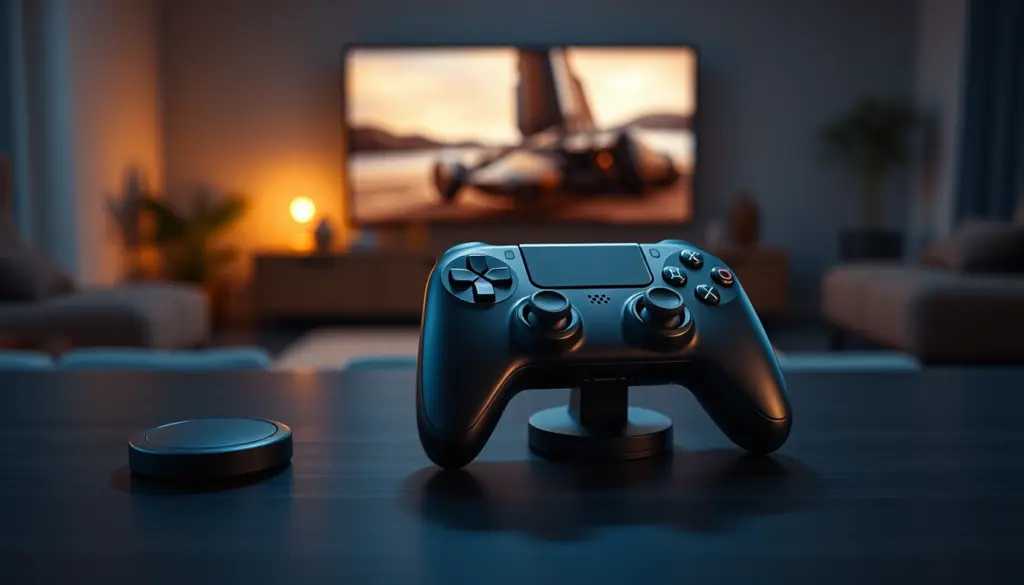
Seven years after Valve quietly buried its first gamepad in a $5 clearance bin, the Steam Controller is back – and this time it disappeared from virtual shelves faster than most people could add it to a cart. When Valve opened sales on May 4, 2026, at 10 a.m. Pacific, the entire first wave sold out in roughly 30 minutes. At $99, the new controller is the cheapest and most attainable piece of Valve’s 2026 hardware trilogy, and after a month on the market it has become the surprise breakout of the company’s living-room comeback.
This is a news analysis of what Valve shipped, why the launch sold out so fast, how the new Steam Controller stacks up against the DualSense Edge and Xbox Elite Series 2, and what its arrival signals for the wider gaming-hardware market in a year defined by a brutal memory shortage. Every price and spec below is drawn from Valve’s own listing and verified secondary sources, not from unconfirmed rumor.
What Valve Just Launched: The New Steam Controller at $99
The new Steam Controller is a wireless gamepad that Valve first revealed on November 12, 2025, alongside the Steam Machine mini-PC and the Steam Frame VR headset. It went on sale months later, on May 4, 2026, exclusively through the Steam store – not Amazon, not Best Buy, not any brick-and-mortar retailer. According to Valve’s official Steam Controller store page, the launch price is $99 in the United States, €99 in Europe, £85 in the United Kingdom and ¥17,800 in Japan, with Canadian and Australian buyers paying $149 in their local dollars.
Availability spans the United States, United Kingdom, Canada, the EU, Australia, Japan, South Korea, Hong Kong and Taiwan. That $99 sticker is the headline. It undercuts every mainstream premium controller on the market – the $199.99 DualSense Edge and the $179.99 Xbox Elite Series 2 – while packing anti-drift magnetic thumbsticks that neither of those rivals shipped with at launch. For a company that once let its gamepad die on the vine, Valve is now positioning the Steam Controller as the value anchor of an entire hardware ecosystem rather than a niche curiosity.
The device is fundamentally a Steam-first accessory. It talks to PCs, Macs, Linux boxes, the Steam Deck and SteamOS devices through Valve’s Steam Input layer, and it is not natively compatible with a PlayStation 5, Xbox Series console or Nintendo Switch 2. That deliberate lock-in is the price of the deep configurability Valve is selling, and it frames every comparison that follows.
A 30-Minute Sellout: Inside the Launch-Day Frenzy
The most newsworthy number from launch week is not a spec – it is 30 minutes. That is roughly how long it took for Valve’s first production run to sell out after the store went live on May 4. Multiple outlets that tracked the drop reported the controller was out of stock within the half-hour, with no confirmed restock date attached at the time. For an accessory rather than a flagship console, that is an unusually sharp demand curve.
Two things drove it. First, Valve deliberately restricted distribution to the Steam store, concentrating all demand into a single channel and eliminating the retail buffer that normally absorbs launch-day pressure. Second, pent-up nostalgia and curiosity around the Steam Controller name – dormant since 2019 – collided with a genuinely competitive $99 price. The result looked less like a peripheral launch and more like a limited hardware drop.
The sellout is a double-edged signal. On one hand, it validates Valve’s bet that there is real appetite for a first-party controller built around the Steam ecosystem. On the other, the same memory and storage crunch squeezing the rest of the 2026 hardware calendar is constraining how many units Valve can build at a $99 target margin. Scarcity, in other words, may be as much a supply story as a demand story – a theme that runs through Valve’s entire 2026 lineup.
TMR Thumbsticks Explained: Why Valve Bet Against Stick Drift
The defining engineering decision in the new Steam Controller is its use of two full-size clickable analog sticks built on Tunneling Magnetoresistance, or TMR, sensors. As TweakTown detailed at reveal, this pairs contactless magnetic sticks with Valve’s signature trackpads in a layout no other mainstream controller currently offers. The sticks also carry capacitive touch, so the controller knows when your thumb is resting on them.
How TMR Differs From Hall Effect and Potentiometers
Traditional gamepads use potentiometers – small resistive components that physically wear down as the stick moves, eventually producing the phantom inputs known as stick drift. Hall effect sensors were the first magnetic fix, reading a magnet’s field with no physical contact. TMR is the next step: it uses a tunneling-magnetoresistance element that is more sensitive and more power-efficient than a Hall sensor, delivering finer positional accuracy while sipping less battery. Because nothing physically touches, there are no contacts to wear out, which is why manufacturers now market TMR and Hall sticks as effectively drift-proof for the life of the pad.
Why Drift Matters to the Premium Market
Drift is the single most common failure mode in modern controllers, and it has driven class-action complaints against multiple manufacturers. Even the $179.99 Xbox Elite Series 2 has historically shown drift after 12 to 18 months of heavy use because it still relies on potentiometer sticks. By shipping TMR as standard at $99, Valve is turning a premium-tier durability feature into a baseline expectation – and quietly pressuring every rival that still charges more for less.
Full Steam Controller Specs and Features (2026)
The 2026 model is a substantially different device from the 2015 original, which shipped with a single thumbstick and leaned almost entirely on its trackpads. The new controller adds a second stick, modern magnetic sensors and a proprietary wireless dock. Here is the full published specification, verified against the Steam Controller (2026) reference listing.
| Specification | Steam Controller (2026) |
|---|---|
| Launch price | $99 / €99 / £85 / ¥17,800 |
| Release date | May 4, 2026 (announced Nov 12, 2025) |
| Thumbsticks | 2 clickable analog sticks, capacitive touch, TMR magnetic sensors |
| Trackpads | 2 pressure-sensitive haptic trackpads (34.5 mm) |
| Buttons | 20 total (A/B/X/Y, D-pad, L1/R1, L2/R2, 4 grip buttons, View, Menu, Steam, Quick Access) |
| Motion | 6-axis IMU (3-axis accelerometer + 3-axis gyroscope) |
| Grip sensing | 2 capacitive grip sensors (Grip Sense) |
| Battery | 8.39 Wh lithium-ion, rated ~35 hours |
| Connectivity | 2.4 GHz via Puck dongle, Bluetooth, USB-C wired |
| Weight / size | 292 g (10.3 oz); 111 × 159 × 57 mm |
| Charging | USB-C or magnetic Puck dock |
| Platforms | PC, Mac, Linux, SteamOS, mobile via Steam Input |
Two figures stand out. The ~35-hour battery rating, drawn from the 8.39 Wh cell, is roughly six times the runtime of the DualSense Edge, which manages around six hours per charge. And the 292-gram weight places it in the same heft class as premium pads without tipping into the brick territory some enthusiast controllers occupy.
The Steam Controller Puck: Wireless Dongle Meets Charging Dock
Bundled in the box is the “Puck,” a small USB-C dongle that is the most quietly clever part of the package. It is simultaneously a 2.4 GHz wireless receiver and a magnetic charging dock. Rather than pairing over higher-latency Bluetooth, the controller talks to the Puck on a dedicated 2.4 GHz link that Valve rates at roughly 8 ms end-to-end latency with a 4 ms polling rate at up to five meters – low enough for competitive play where Bluetooth would introduce noticeable lag.
A single Puck can pair up to four controllers at once, which makes local multiplayer in the living room trivial to set up. When the controller is not in use, it snaps magnetically onto the Puck to charge, so the same accessory that connects the pad also tops it up. Valve does warn that the magnets are strong enough to attract nearby metallic objects, advising users to keep the dock clear – a minor caveat for an otherwise elegant two-in-one design.
Connectivity is tri-mode overall: the 2.4 GHz Puck link for lowest latency, standard Bluetooth for convenience on devices without the dongle, and a direct USB-C cable for wired play or charging. That flexibility mirrors the approach Valve took with the Steam Deck, treating the controller as a companion that should work everywhere SteamOS does.
Confirming the Controller on SteamOS and Linux
Because the site’s readers skew technical, it is worth noting that the controller and its Puck present as standard USB HID devices on Linux and SteamOS, so they can be inspected with ordinary tooling before you ever open Steam Input:
# List USB devices and look for the Valve Puck receiver
lsusb | grep -i valve

# Watch raw input events to confirm sticks, pads and buttons register
sudo evtest

# Steam Input handles remapping once the pad is detected;
# no vendor driver install is required on SteamOS.
All button, trackpad and gyro mapping is then handled inside Steam Input, where per-game configurations can be published and shared – the same community-driven system that made the original controller a cult favorite among tinkerers.
Dual Trackpads Return: Valve’s Mouse-Replacement Gamble
The trackpads are the feature that most clearly separates the Steam Controller from every console pad. The 2026 model carries two 34.5 mm pressure-sensitive, haptic-enabled trackpads positioned alongside the thumbsticks. Their purpose is precision: they are designed to substitute for a mouse in genres that gamepads traditionally handle poorly, including real-time strategy, first-person shooters and general desktop navigation.
This is where Valve is playing to its home turf. Steam’s catalog is full of strategy games, immersive sims and point-and-click titles that were built around keyboard and mouse. A controller that can credibly drive a cursor lets those games work from the couch – precisely the use case that the Steam Machine and a big-screen TV are meant to serve. The haptics under each pad simulate the feel of a scroll wheel or textured surface, giving tactile feedback that a bare touchpad cannot.
The gamble is that mainstream players still associate trackpads with the original controller’s steep learning curve. Valve’s answer in 2026 is to hedge: by adding a second conventional thumbstick, the new pad works like a familiar gamepad out of the box, with the trackpads available as a power-user upgrade rather than a mandatory reinvention of muscle memory. It is a more forgiving pitch than the all-or-nothing 2015 design, and early reviews suggest the compromise largely works.
Steam Controller vs DualSense Edge vs Xbox Elite Series 2
The most useful way to judge the Steam Controller’s $99 price is against the two premium pads it undercuts. The DualSense Edge and Xbox Elite Series 2 are the reference points for “enthusiast controller,” and both cost substantially more. The table below compares the headline specs; note that battery figures and drift resistance are where Valve’s positioning is sharpest.
| Feature | Steam Controller (2026) | DualSense Edge | Xbox Elite Series 2 | Budget TMR pad |
|---|---|---|---|---|
| Price | $99 | $199.99 | $179.99 ($129.99 Core) | ~$64 |
| Stick tech | TMR magnetic | Replaceable modules | Potentiometer | TMR / Hall |
| Drift resistance | High (contactless) | Via module swap | Prone after 12–18 mo | High (contactless) |
| Battery life | ~35 hours | ~6 hours | Up to 40 hours | Varies |
| Trackpads | 2 haptic | None | None | None |
| Rear buttons | 4 grip | 2 back / triggers | 4 paddles | Varies |
| Native platforms | PC / SteamOS | PS5 / PC | Xbox / PC | PC / multi |
The read is straightforward. Against the DualSense Edge, the Steam Controller is half the price and lasts roughly six times as long per charge, though Sony’s pad wins on native PS5 support and swappable modules. Against the Xbox Elite Series 2, Valve matches the paddle count, beats it on drift resistance thanks to TMR versus potentiometer sticks, and undercuts it by $80 – while ceding raw battery life, since the Elite is rated up to 40 hours. As TechRadar’s head-to-head of the two incumbents notes, buyers have long paid a premium for durability those pads did not always deliver; Valve is now selling that durability at the low end of the premium bracket.
The wildcard is the budget tier. Third-party makers already sell TMR-stick controllers for around $64, complete with charging stands, so Valve is not the cheapest route to drift-free sticks. What $99 buys instead is the trackpads, Grip Sense, the Puck ecosystem and first-party Steam Input integration – a bundle no budget pad matches.
From $5 Fire Sale to Sellout: The Original Steam Controller’s Story
To understand why the sellout is remarkable, you have to remember how the first act ended. The original Steam Controller launched in November 2015 alongside Valve’s first, ill-fated Steam Machines. It was a genuinely radical design – one thumbstick, two trackpads and dual haptic motors – but it demanded that players relearn how to hold a gamepad, and the market largely declined.
Sales were not catastrophic at first: Valve moved more than 500,000 units by June 2016 and neared a million by that October, including controllers bundled with Steam Machines. By September 2018, roughly 1.5 million Steam Controllers were connecting to Steam, according to figures cited on the first-generation Steam Controller record. But momentum stalled against a wave of standard gamepads, and in November 2019 Valve discontinued the line, clearing remaining stock in an infamous $5 fire sale – a roughly 90% cut that priced the last units below the cost of shipping them.
| Attribute | Original (2015) | New (2026) |
|---|---|---|
| Thumbsticks | 1 | 2 (TMR magnetic) |
| Trackpads | 2 | 2 (34.5 mm haptic) |
| Wireless | 2.4 GHz dongle | 2.4 GHz Puck + BT + USB-C |
| Motion | Gyro / accelerometer | 6-axis IMU |
| Launch price | $49.99 | $99 |
| Fate | Discontinued 2019, $5 sell-off | Sold out in ~30 min |
The contrast is the story. The same product name that once symbolized Valve’s hardware failures now sells out in half an hour. What changed is not just the controller – it is the ecosystem around it. In 2015 there was no Steam Deck, no mature Proton compatibility layer and no SteamOS momentum. In 2026 the controller lands inside a functioning hardware platform, and that context is doing much of the heavy lifting.
Completing the Trilogy: Steam Machine, Steam Frame and the Living Room Play
The Steam Controller is not a standalone product; it is the third leg of a trilogy Valve announced together in November 2025. The other two are the Steam Machine, a roughly six-inch cube that Valve says is about six times more powerful than the Steam Deck and starts around $1,049, and the Steam Frame, a standalone SteamOS VR headset. Both are arriving in the same summer 2026 window, and all three run SteamOS.
Read as a set, the strategy is obvious: Valve is rebuilding the living-room console play it botched a decade ago, but this time on top of a proven software stack. The Steam Machine is the box under the TV, the Steam Frame is the VR option, and the Steam Controller is the input device that ties couch gaming together – with trackpads specifically so mouse-driven PC games work on a television. Valve designer Pierre-Loup Griffais has framed the Machine’s pricing as comparable to a PC with similar specs, positioning the lineup against prebuilt PCs rather than purely against consoles like the PlayStation 5 and Switch 2.
At $99, the controller is the low-friction entry point to that world. A curious PC gamer can buy in for a fraction of a Steam Machine, use the pad with an existing PC or Steam Deck, and graduate to the rest of the ecosystem later. That funnel – cheap accessory first, expensive hardware later – is a familiar platform-building tactic, and Valve is running it deliberately.
The DRAM Shortage Shadow: Why $99 Is Aggressive in 2026
The $99 price looks even sharper in the context of 2026’s hardware economics. A global memory shortage – driven by AI data-center demand pulling DRAM and NAND capacity toward high-margin enterprise chips – has pushed consumer memory prices up sharply this year, with some segments seeing steep double-digit percentage jumps quarter over quarter. That crunch is exactly why Valve delayed parts of its lineup and rethought pricing.
The impact is visible across gaming hardware. Valve raised the Steam Deck OLED to $789 for the 512 GB model in May 2026, up from $549 – a roughly 44% increase attributed directly to rising memory and storage costs. The Steam Machine launched at $1,049 in the same environment. Consoles were not spared either: the PlayStation 5 and PS5 Pro saw price increases in April 2026, and Nintendo scheduled a Switch 2 hike for later in the year.
Against that backdrop, a controller is the one category relatively insulated from the memory crisis – gamepads use little DRAM or flash – which is likely how Valve held the line at $99 while its memory-hungry Deck and Machine climbed. That makes the controller not just the cheapest way into the ecosystem, but arguably the best value in Valve’s catalog on a dollar-for-durability basis in 2026.
What Reviewers Are Saying About the New Steam Controller
Early critical reception has been notably warmer than the 2015 model ever received. In its hands-on review, TechRadar ranked the new Steam Controller among its favorite gamepads in years, singling out the drift-free TMR sticks and the flexibility of Steam Input. PC Gamer’s review made the living-room case explicitly, arguing that for couch gaming on a big screen there is little else quite like it, thanks to the trackpads that let mouse-native PC games work from the sofa.
The recurring critiques are equally consistent. Reviewers flag the learning curve on the trackpads for players coming straight from an Xbox or PlayStation pad, the strong magnets on the Puck as a minor annoyance, and the Steam-only ecosystem lock-in as the main limitation – you cannot simply plug it into a PS5 or Switch 2. Pricing confirmation and launch details were corroborated by Notebookcheck’s launch coverage, which matched Valve’s own $99 figure and May 4 date.
The consensus, a month in, is that Valve learned from 2015: keep the trackpads for the power users, add a normal second stick for everyone else, and price it to move. The reviews, combined with the sellout, suggest that formula is landing.
Market Impact and Industry Analysis
The bigger question is what a successful $99 first-party controller does to the peripheral market. The clearest pressure point is on premium pricing. Sony and Microsoft have anchored their enthusiast controllers at $199.99 and $179.99 respectively for years, largely without magnetic sticks. A first-party alternative that ships TMR at $99 reframes the value conversation and gives budget-conscious buyers a credible reason to wait for drift-free hardware rather than pay premium prices for potentiometer designs.
There is also a platform-lock dimension. Because the Steam Controller is tuned for Steam Input and does not natively work on rival consoles, every unit sold deepens a player’s investment in Valve’s ecosystem rather than Sony’s or Microsoft’s. Multiply that across a hardware trilogy – controller, console-class Machine and VR headset – and Valve is assembling a self-reinforcing platform in the living room for the first time since the original Steam Machine flopped.
The constraint is supply. A 30-minute sellout with no immediate restock is great marketing but poor availability, and in a memory-shortage year Valve’s ability to scale production is genuinely uncertain. The company that wins the accessory war is usually the one that can keep product on shelves; right now, demand is comfortably ahead of what Valve is shipping.
5 Predictions for the Steam Controller and Valve Hardware
Based on the launch data, the competitive landscape and Valve’s stated strategy, here are five reasoned predictions for the months ahead. These are analysis, not confirmed facts.
- Restocks will stay demand-constrained into late 2026. With the DRAM and NAND shortage forecast to persist into 2027, expect intermittent drops rather than steady availability, keeping resale prices elevated above the $99 MSRP.
- Sony and Microsoft will accelerate magnetic-stick controllers. The $99 TMR price point makes potentiometer premium pads look dated; a Hall or TMR revision of the DualSense Edge or Elite line becomes far more likely within a year.
- Steam Input configuration sharing will be the real moat. As with the 2015 model, community-published control schemes – not the hardware alone – will drive stickiness, especially for mouse-native genres.
- The controller will outsell the Steam Machine several times over. At a fraction of the price and with broad PC compatibility, the $99 pad is the volume product of the trilogy, funneling buyers toward the pricier hardware over time.
- Trackpads will remain divisive. Power users will champion them for strategy and desktop use; mainstream players will mostly default to the sticks – validating Valve’s decision to include both.
Related Coverage
- Steam Machine Hits $1,049: 6x Steam Deck Power [2026]
- Steam Frame: Valve’s 16GB SteamOS VR Headset [2026]
- Steam Deck vs ROG Ally: $789 OLED vs $999 120Hz [2026]
- Steam Deck vs Switch 2: $789 vs $449.99 [2026]
- ROG Xbox Ally X vs Legion Go 2: $999 vs $1,349 [2026]
- Switch 2 vs PS5: $449 vs $649, 1080p vs 4K [2026]
- More gaming hardware coverage
Frequently Asked Questions
How much does the new Steam Controller cost?
The Steam Controller launched at $99 in the United States, €99 in Europe, £85 in the United Kingdom and ¥17,800 in Japan, with Canadian and Australian buyers paying $149 in local currency. It is sold only through the Steam store.
When did the Steam Controller release and why did it sell out?
It went on sale May 4, 2026, at 10 a.m. Pacific and sold out in roughly 30 minutes. The combination of a Steam-store-only launch, a competitive $99 price and pent-up demand for the revived brand overwhelmed the initial supply.
Does the Steam Controller have stick drift?
It uses TMR (Tunneling Magnetoresistance) magnetic thumbsticks, which are contactless and have no wearing parts. This design is marketed as effectively drift-proof, unlike the potentiometer sticks in many older controllers that can drift after a year or more of use.
Does the Steam Controller work with a PS5, Xbox or Switch 2?
No. The controller is built around Valve’s Steam Input and works natively on PC, Mac, Linux, SteamOS and the Steam Deck. It is not natively compatible with the PlayStation 5, Xbox Series consoles or the Nintendo Switch 2.
What is the Steam Controller Puck?
The Puck is the bundled USB-C dongle that provides a low-latency 2.4 GHz wireless connection – about 8 ms end-to-end – and doubles as a magnetic charging dock. A single Puck can pair up to four controllers for local multiplayer.
How long does the Steam Controller’s battery last?
Valve rates the 8.39 Wh battery at about 35 hours of gameplay per charge – roughly six times the runtime of the DualSense Edge and close to the Xbox Elite Series 2’s up-to-40-hour figure.
Is the new Steam Controller better than the DualSense Edge or Xbox Elite Series 2?
It depends on your platform. For Steam and PC play, the Steam Controller offers drift-free TMR sticks, dual trackpads and far longer battery life than the DualSense Edge at half the price. But the DualSense Edge is the better native PS5 pad, and the Xbox Elite Series 2 remains the choice for Xbox owners.
How does the 2026 Steam Controller compare to the original 2015 model?
The 2026 model adds a second thumbstick, upgrades to TMR magnetic sensors, includes the Puck dongle and dock, and launches at $99 versus the original’s $49.99. The 2015 controller was discontinued in 2019 and cleared out in a $5 fire sale; the new one sold out in half an hour.