
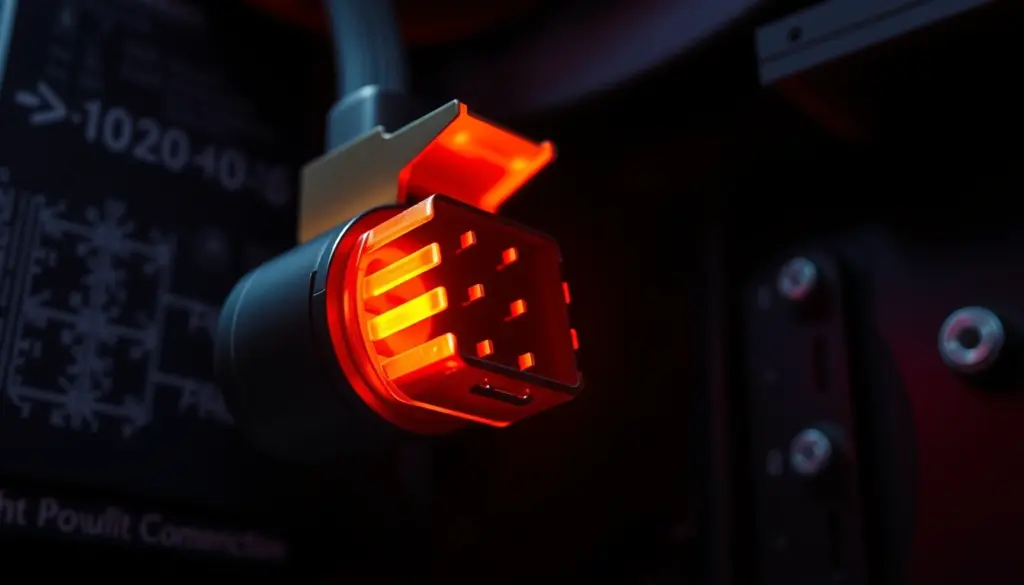
A Reddit user’s weekend soldering project just became the most interesting fix in the ongoing saga of the RTX 5090 power connector. On October 4, 2026, Tom’s Hardware reported that a user known as DallasGrave built a custom module that replaces the GPU’s single 16-pin 12V-2×6 connector with two separate 8-pin inputs, then ran it for 48 hours at roughly 550 watts. The connector held at about 40°C. That number matters because independent lab testing published around the same time put stock 12V-2×6 connectors well above 90°C under a demanding 4K workload. The gap between those two figures is the story: four years after the first melting reports hit NVIDIA’s flagship cards, the industry still hasn’t closed the loop on power connector safety.
A New Fix Surfaces for the RTX 5090’s Power Connector Problem
The DallasGrave workaround isn’t an official NVIDIA or AIB product. It’s a community-built distributor module, screwed to the back of the card, that splits incoming power across two conventional 8-pin PCIe connectors instead of routing everything through the 16-pin 12V-2×6 plug. According to Tom’s Hardware’s coverage, the mod kept connector temperatures around 40°C across a 48-hour stress run at approximately 550 watts of sustained draw. That’s a meaningful data point for an RTX 5090 power connector story that’s been running, in one form or another, since the card’s predecessor launched in 2022.
What makes this moment different is timing. NVIDIA’s current flagship is already scarce and expensive — retail listings for the RTX 5090 have reportedly hit $9,500 at some US third-party sellers — so owners have more reason than ever to protect the card they have rather than gamble on a replacement. A DIY fix that trades a bit of cable-management convenience for lower connector temperatures is an easy sell when the alternative is hunting for stock at inflated prices.
What the 12V-2×6 Connector Actually Does
The connector at the center of this debate is the 12V-2×6, a 16-pin design rated to deliver up to 600 watts through a single cable. It replaced the original 12VHPWR connector that shipped with the RTX 40 series, after that earlier design became associated with a wave of melting incidents starting in October 2022. NVIDIA’s redesign, which arrived with the RTX 50 series launch in January 2025, added recessed sense pins intended to prevent a cable from appearing fully seated when it isn’t. The idea was to stop the specific failure mode that caused early 12VHPWR connectors to arc and melt: uneven current distribution across the 12 power pins when a cable sits even slightly loose.
The redesign reduced the frequency of catastrophic failures, but it didn’t eliminate the underlying physics. A single connector carrying 500-650 watts has very little thermal margin, and any imperfection in cable seating, pin contact, or cable quality can push local temperatures past safe limits. That’s the context for both the DallasGrave fix and the independent lab numbers that surfaced this week.
Inside the DallasGrave Dual 8-Pin Workaround
The mod itself is mechanically simple: a small distributor board intercepts the power path and splits it across two 8-pin PCIe connectors, each individually rated and each carrying less current than a single overloaded 12V-2×6 pin would under the same total wattage. Spreading 550 watts across two separate 8-pin inputs, each handling roughly 150-160 watts per connector including headroom, keeps every individual contact point well inside its thermal comfort zone.
It’s a trade-off familiar to PC builders who’ve dealt with high-wattage components before: more cables and connectors to manage, in exchange for distributing electrical load instead of concentrating it. Tom’s Hardware’s report didn’t frame this as an NVIDIA-endorsed fix, and it isn’t one — it’s an enthusiast workaround for a problem the industry hasn’t fully solved on the official hardware side. Still, a 48-hour stress test holding at 40°C is a hard number that’s difficult to argue with, even from a single test sample.
Independent Testing Shows a Hotter Picture
Separate from the DIY fix, independent lab testing reported this week put stock 12V-2×6 connector temperatures considerably higher than NVIDIA’s comfort zone would suggest. Testing measured a sense-pin-side connector temperature of 91.7°C during a 4K Cyberpunk 2077 run with NVIDIA’s DLSS 5 frame generation enabled. Running the same scene without DLSS 5 produced a sense-pin temperature of 80.9°C, a 10.8°C difference tied directly to how much additional power the card draws when generating extra frames.
DLSS 5 Raises the Stakes
The power numbers behind those temperature readings tell their own story. Average board power climbed from 527.3 watts without DLSS 5 to 593.9 watts with it enabled, while peak power rose from 582.5 watts to 658.0 watts. That peak figure sits above the 12V-2×6 connector’s 600-watt rated ceiling, even if only briefly during transient spikes. NVIDIA markets DLSS 5 as a performance win, and in frame-rate terms it is. But the testing suggests that performance comes with a thermal cost that lands squarely on the component already under the most scrutiny: the power connector itself.
Neither of these numbers represents a card that’s actively failing. A sense pin running at 91.7°C is hot, but it’s not the kind of runaway thermal event that produced visible melting and discoloration in the earliest 12VHPWR incidents. The concern instead is margin: a connector that routinely runs near 90°C under a popular workload has less room to tolerate the kind of imperfect cable seating that has triggered failures in the past.
A $5,245 Prebuilt Becomes a Warranty Fight
The thermal numbers aren’t the only RTX 5090 connector story making news this cycle. Tom’s Hardware also reported on a $5,245 prebuilt system whose power connectors reportedly melted after the machine sat boxed and unused for roughly a year. The system’s builder, Digital Storm, and GPU vendor PNY both reportedly denied the resulting warranty claim, citing expired coverage windows and the use of third-party cables rather than a manufacturing defect.
That dispute matters beyond the individual customer involved. A connector that can reportedly degrade or fail even while a system sits idle in its box raises harder questions than one that fails under sustained gaming load. It also puts buyers in an awkward spot: if a component failure is blamed on cable choice or coverage timing rather than a design flaw, the financial risk of a bad connector lands entirely on the owner, not the manufacturer.
A Short History of Connector Failures, From RTX 4090 to RTX 5090
None of this is happening in a vacuum. The RTX 4090’s original 12VHPWR connector became associated with melting reports almost immediately after launch in October 2022, with users posting photos of charred pins and discolored plastic housings. NVIDIA’s response at the time focused on cable seating guidance rather than a hardware redesign, which didn’t fully resolve community concerns.
The 12V-2×6 connector that debuted with the RTX 50 series in January 2025 was meant to close that chapter. Recessed sense pins made it mechanically harder for a cable to look seated when it wasn’t, and early reporting suggested the redesign reduced the rate of serious incidents. But “reduced” isn’t the same as “eliminated,” and the reports accumulating through 2025 and into October 2026, including the DallasGrave workaround, the Digital Storm/PNY dispute, and the DLSS 5 thermal data, suggest the underlying risk never fully went away. It simply moved from a dramatic, highly visible failure mode to a quieter pattern of elevated operating temperatures and isolated incident reports.
Market Pressure Is Making the Problem Worse
The connector debate is colliding with a GPU market that’s unusually unforgiving right now. Desktop discrete GPU shipments hit roughly 12.5 million units in Q2 2026, the highest quarterly total since early 2022, and NVIDIA controlled close to 90% of that market. With AMD and Intel splitting the remaining share, most gamers buying a high-end card this year are buying NVIDIA, and a meaningful share of those buyers are chasing the RTX 5090 specifically.
That demand, combined with tight supply, has pushed secondary-market behavior to extremes. Beyond the retail pricing already mentioned, modified RTX 5090 cards with 96GB of memory have shown up for under $4,000 in China, built from parts that bypass NVIDIA’s official distribution entirely. New export rules have also added friction, with RTX 5090 buyers now required to sign a five-point export pledge before purchase in some markets. In an environment where replacing a damaged card isn’t quick or cheap, a connector running hot under DLSS 5 workloads becomes a bigger financial risk than it would be if RTX 5090 stock were sitting on shelves at MSRP.
Memory supply adds another wrinkle. GDDR7 production capacity has been squeezed as manufacturers redirect wafer output toward the HBM used in AI accelerators, and reports indicate Micron has already discontinued its 2GB GDDR7 chips in favor of denser 3GB parts aimed at AI-adjacent demand. That’s not a connector issue directly, but it illustrates the broader point: every component on an RTX 5090, from memory to power delivery, is being stretched by demand the card’s original design never anticipated. A connector rated for a 600-watt ceiling in 2025 is now routinely running workloads, like DLSS 5-enabled 4K gaming, that push it toward that ceiling more often than NVIDIA’s original testing likely accounted for.
What This Means If You’re Buying an RTX 5090 Right Now
For anyone shopping for an RTX 5090 today, the practical takeaway isn’t panic, it’s caution. The failure rate for 12V-2×6 connectors remains a small fraction of total units sold, and NVIDIA’s redesign genuinely did reduce the kind of dramatic incidents that defined the RTX 4090 era. But the combination of high prices, scarce stock, and a connector running closer to its thermal ceiling under modern workloads means the cost of getting it wrong, financially and in terms of downtime, is higher than it’s ever been.
Buyers should check that their cable is fully seated with an audible click, avoid daisy-chaining adapters from older power supplies when possible, and consider a monitoring accessory if they plan to run DLSS 5-heavy workloads for extended sessions. None of that eliminates the risk entirely, but it addresses the specific failure mode, loose or uneven pin contact, that both the original 12VHPWR incidents and the current round of reports keep circling back to.
NVIDIA and Board Partners’ Response So Far
NVIDIA has not issued a dedicated statement addressing the October 2026 testing or the Digital Storm/PNY dispute specifically. The company’s public guidance on the 12V-2×6 connector continues to emphasize proper cable seating and the use of certified cables, pointed at through NVIDIA’s own support and driver resources. Board partners, for their part, have generally responded to past connector concerns with incremental changes: reinforced cable housings, angled adapters that reduce mechanical stress near the GPU bracket, and in some cases bundled power monitoring accessories.
None of those measures directly addresses the power-draw increase tied to DLSS 5, though. If a software feature is pushing peak board power past the connector’s rated ceiling even briefly, the fix arguably needs to happen at the firmware or driver level, capping transient spikes, rather than through better cables alone. So far, there’s no indication NVIDIA plans a change along those lines.
It’s also worth noting what hasn’t happened: there’s been no recall, no official safety advisory, and no acknowledgment from NVIDIA that the 91.7°C figure represents a design concern rather than normal operation within spec. That silence is itself a notable part of the story. Compare it to the RTX 4090 era, when mounting public pressure eventually pushed NVIDIA toward the 12V-2×6 redesign. Four years later, the company appears to be treating isolated reports and independent lab data as something short of the same threshold, even as the underlying connector technology hasn’t fundamentally changed.
RTX 5090 vs. the Competition: Connector Design Compared
AMD’s current flagship, the RX 9070 XT, sidesteps this entire category of risk by sticking with conventional 8-pin PCIe connectors rather than adopting a single high-density 16-pin design. It’s a less elegant cabling solution, more plugs, more cable clutter, but it spreads power delivery across multiple lower-current paths instead of concentrating it in one connector rated near its practical ceiling. That’s effectively the same principle behind the DallasGrave workaround, just built into AMD’s reference design from the start rather than retrofitted by an enthusiast.
The trade-off is performance and price positioning rather than connector safety. The RTX 5070 Ti has been priced around $1,100 against the RX 9070 XT’s roughly $800, and NVIDIA’s cards consistently win in raw benchmark results and in features like DLSS 5. AMD isn’t offering a true alternative to the RTX 5090’s performance tier at all right now, which is exactly why NVIDIA’s connector debate matters so much: there’s no comparable AMD flagship for RTX 5090 owners to switch to if they want to avoid the 12V-2×6 connector altogether. The choice, for now, is NVIDIA’s performance with NVIDIA’s connector risk, or a step down in raw capability.
Intel’s Arc lineup sits even further from this conversation. With roughly 2% of the desktop discrete GPU market, Intel doesn’t compete at the RTX 5090’s power or performance tier at all, and its cards use standard multi-pin connectors rather than anything resembling the 12V-2×6. The practical effect is that the entire high-wattage, single-connector design approach is currently an NVIDIA-only experiment. If it continues to generate incident reports, NVIDIA has no competitor forcing its hand, and no competitor to point to as having solved the problem differently at the same performance level.
Reported RTX 5090 Connector Temperatures by Test Scenario
The numbers below come from the testing and reporting cited throughout this piece, laid out side by side for comparison. They weren’t produced under identical, controlled conditions, so they should be read as indicative rather than a strict apples-to-apples benchmark.
| Test Scenario | Board Power | Connector Temp | Source |
|---|---|---|---|
| DallasGrave dual 8-pin mod, 48-hr stress test | ~550W sustained | ~40°C | Tom’s Hardware, Oct. 4, 2026 |
| Stock connector, 4K Cyberpunk 2077, DLSS 5 on | 593.9W avg / 658.0W peak | 91.7°C (sense pin) | Independent lab testing |
| Stock connector, 4K Cyberpunk 2077, DLSS 5 off | 527.3W avg / 582.5W peak | 80.9°C (sense pin) | Independent lab testing |
| Boxed/unused system, connectors later found melted | 0W (idle, in storage) | Melting reported after ~1 year | Tom’s Hardware (Digital Storm/PNY case) |
RTX 5090 Power Connector Timeline, 2022-2026
| Date | Event |
|---|---|
| October 2022 | First 12VHPWR melting reports surface on RTX 4090 launch cards |
| 2023-2024 | NVIDIA and partners issue cable-seating guidance, connector redesign work begins |
| January 2025 | RTX 50 series launches with the redesigned 12V-2×6 connector and recessed sense pins |
| 2025-2026 | Scattered overheating and melting reports continue on RTX 5090 cards |
| September 2026 | Digital Storm/PNY $5,245 prebuilt warranty dispute reported by Tom’s Hardware |
| October 4, 2026 | DallasGrave’s dual 8-pin workaround and independent DLSS 5 connector temperature testing both reported |
The DIY Fix Ecosystem: Monitors, Adapters, and the Risk of Voiding Your Warranty
The DallasGrave mod isn’t the only community response to RTX 5090 connector anxiety. A small market of monitoring accessories has grown around exactly this problem, letting owners watch per-pin current and connector temperature in real time rather than hoping for the best. Products like the Thermal Grizzly WireView Pro II, which sits inline on the power cable and reports live readings, exist specifically because the stock connector doesn’t surface this data on its own.
Should You Try a DIY Power Mod?
For most RTX 5090 owners, the honest answer is no, not without accepting real trade-offs. A dual 8-pin distributor like DallasGrave’s isn’t an NVIDIA-sanctioned accessory, and soldering or installing a third-party power module on a card that can cost thousands of dollars carries obvious warranty risk, the same kind of third-party-cable argument that reportedly factored into the Digital Storm/PNY dispute. Monitoring accessories carry far less risk since they don’t alter the power path, which makes them a more sensible starting point for anyone worried about connector temperatures. A full DIY rewiring job makes more sense for enthusiasts who understand the risk and are comfortable losing official support if something goes wrong.
What’s Next: 5 Predictions for RTX 5090 Power Safety
- Monitoring accessories will see a sales bump. Expect products like inline connector monitors to become more common bundled extras from board partners, not just aftermarket purchases.
- Driver-level power capping becomes more likely. If DLSS 5’s power draw keeps drawing scrutiny, a software-side cap on transient spikes is a cheaper fix than another connector redesign.
- Warranty disputes will increase before they decrease. As more RTX 5090 units age past their first year, expect more cases like the Digital Storm/PNY dispute to surface publicly.
- DIY fixes will keep spreading despite the risk. With RTX 5090 stock scarce and expensive, owners will keep favoring unofficial fixes over the cost of replacement.
- Next-generation GPUs will face early scrutiny on this exact issue. Any future NVIDIA flagship pulling comparable or higher power will be tested against the 12V-2×6’s track record from day one.
FAQ
What is the RTX 5090 power connector problem?
It refers to ongoing reports of the RTX 5090’s 12V-2×6 power connector running hot or, in some cases, melting. The issue traces back to the earlier 12VHPWR connector used on the RTX 4090, and while NVIDIA’s redesign reduced the frequency of serious incidents, reports of high connector temperatures and isolated failures have continued into 2026.
Is my RTX 5090 at risk of connector melting?
Most RTX 5090 cards run without incident, but the risk isn’t zero. Independent testing has recorded connector temperatures above 90°C under demanding workloads with DLSS 5 enabled, which leaves less thermal margin for a loose or imperfect cable connection than NVIDIA’s rated specifications would suggest is ideal.
What is the 12V-2×6 connector?
It’s the 16-pin power connector NVIDIA introduced with the RTX 50 series in January 2025, rated for up to 600 watts through a single cable. It replaced the original 12VHPWR connector and added recessed sense pins meant to prevent a cable from appearing seated when it isn’t fully connected.
Does DLSS 5 make the RTX 5090 run hotter?
Independent testing found that enabling DLSS 5 in a 4K Cyberpunk 2077 test raised average board power from 527.3W to 593.9W and peak power from 582.5W to 658.0W, with connector temperature rising from 80.9°C to 91.7°C at the sense pin.
Is the DallasGrave dual 8-pin mod safe to try?
It held connector temperatures around 40°C in a 48-hour test at roughly 550 watts, according to Tom’s Hardware’s reporting. It is not an NVIDIA-sanctioned fix, requires technical comfort with modifying the power path, and may carry warranty implications.
Will using the dual 8-pin mod void my warranty?
It’s likely to, since it involves a third-party power-delivery modification. A recent warranty dispute involving a Digital Storm/PNY prebuilt system was reportedly denied in part over the use of third-party cables, which suggests GPU vendors and builders scrutinize non-stock power components closely.
How can I monitor my RTX 5090’s connector temperature?
Inline monitoring accessories, such as the Thermal Grizzly WireView Pro II, sit on the power cable and report live current and temperature readings without altering the power path itself, making them a lower-risk option than a full connector modification.
Is NVIDIA planning an official fix?
NVIDIA hasn’t issued a public statement addressing the October 2026 testing or the warranty dispute specifically. Its current guidance continues to focus on proper cable seating and using certified cables rather than a further hardware redesign.