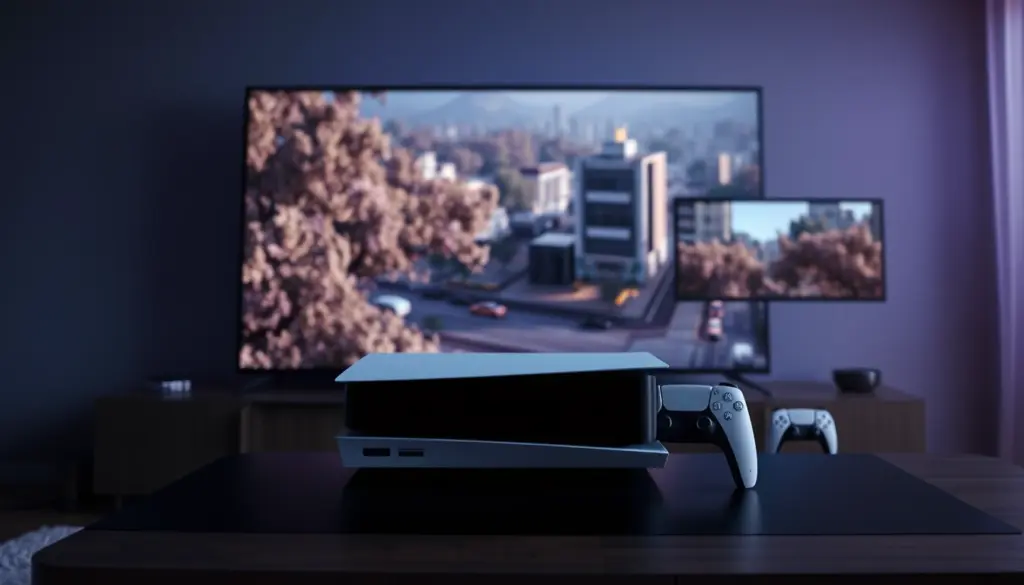
Sony has started rolling out a new AI upscaling tool for the standard PlayStation 5, nearly two years after it reserved its most advanced reconstruction technology for the pricier PS5 Pro. The tool is called QSSR, short for Quick Spectral Super Resolution, and it landed this week as an optional graphics setting in two first-party games: Insomniac Games’ Marvel’s Wolverine and Sucker Punch’s Ghost of Yōtei. Digital Foundry and GamesIndustry.biz both covered the rollout on October 5 and October 6, framing it as Sony’s answer to a gap that has bothered base PS5 owners since PSSR debuted on PS5 Pro.
The move matters beyond two game patches. It reshapes how Sony separates its two current-generation consoles, and it puts Sony’s machine learning upscaling back in a three-way conversation with Nvidia’s DLSS and AMD’s FSR. Two games, two PS5 hardware tiers, one shared goal: close the image-quality gap between the standard console and its pricier sibling without asking millions of players to buy new hardware.
What Sony Just Announced This Week
GamesIndustry.biz reported on October 5, 2026 that Sony Interactive Entertainment had built a new upscaling tier specifically for the base PS5, separate from the PSSR system that has run exclusively on PS5 Pro since that console launched. Sony’s PlayStation Blog described QSSR as a new performance tier of AI-driven reconstruction, not simply the Pro version switched on for weaker hardware. The company said the technology analyzes image information across frames and aims to produce more detail and more stability than the temporal upscaling methods already built into most PS5 games.
Daniel Craig, Principal Engineer for Graphics R&D at PlayStation, told Digital Foundry the company wants QSSR available widely rather than locked to a handful of flagship releases. GamesIndustry.biz quoted him saying the technology would be “offered broadly” to PlayStation developers going forward, with the same reporting describing his characterization of the rollout as largely a drop-in option for studios that already built PSSR support into their engines.
That drop-in framing comes with a caveat worth repeating: it is not automatic. Developers still need to patch and validate each title, which is why only two games shipped with QSSR on day one instead of the dozens of PS5 releases that already support PSSR on the Pro.
QSSR vs PSSR: What’s Actually Different
Sony has gone out of its way to keep QSSR and PSSR as separate names rather than letting QSSR ride on PSSR’s established reputation. PSSR, PlayStation Spectral Super Resolution, remains tied to PS5 Pro, where Sony calls it the gold standard version of the technology. QSSR exists because PSSR’s full computational cost never fit inside the base PS5’s smaller GPU budget.
“We are bringing the benefits of AI-guided upscaling to PS5. While PSSR remains the gold standard on PS5 Pro, QSSR provides some notable improvements to both image detail and image stability on PS5.”
Daniel Craig, Principal Engineer, Graphics R&D at PlayStation, via FlatpanelsHD
The headline engineering choice is a streamlined neural network, smaller and cheaper to run than the PSSR model, built so it leaves enough GPU headroom on base PS5 for the rest of a game’s rendering workload. Sony and AMD reportedly hand-tuned the implementation specifically for the standard console’s hardware rather than just shrinking the Pro model and hoping it still ran in real time.
Craig’s own words, relayed by Digital Foundry, cut to the point directly.
“QSSR is fundamentally a drop-in replacement for titles that already support PSSR.”
Daniel Craig, Principal Engineer, Graphics R&D at PlayStation, via Digital Foundry
IGN’s hands-on coverage pushed back gently on how close the two technologies actually look. Its reviewers described QSSR as much lighter than PSSR, and therefore not quite as capable of holding fine detail in every scene. One specific observation stuck out: grass in test footage kept more of its intended shape with QSSR turned on, though some noise remained visible compared to the Pro experience.
Why the Base PS5 Needed Its Own Upscaler
The standard PS5 shipped in 2020 with a GPU rated at 10.28 teraflops, built on a customized RDNA 2 design. PS5 Pro, which launched in 2024, raised that to roughly 16.7 teraflops alongside a dedicated machine learning accelerator that PSSR leans on heavily. That gap is exactly why Sony never simply ported PSSR down to the cheaper console. The PlayStation Blog said plainly that PSSR’s computational requirements had kept Sony from bringing the same experience to standard hardware until QSSR’s smaller network made the math work.
This is part of a broader shift across the industry toward squeezing more image quality out of fixed hardware through software rather than raw silicon. Nvidia has pushed a similar philosophy with ongoing RTX Mega Geometry updates that stream scene detail instead of storing it all in VRAM, and Microsoft has leaned on machine learning to cut rendering load on its own graphics stack, a strategy covered in detail in reporting on Microsoft’s Automatic Super Resolution rollout across Nvidia RTX GPUs. Sony’s bet with QSSR fits the same pattern: trade a small, targeted slice of AI compute for a bigger gain in perceived image quality than a traditional upscaler could deliver for the same cost.
Inside Project Amethyst: Sony and AMD’s Joint Research Effort
QSSR did not appear out of nowhere. Thurrott’s technical writeup tied the new tier to Project Amethyst, the ongoing collaboration between Sony and AMD focused on machine learning graphics techniques across PlayStation hardware. PSSR itself came out of that same partnership, and Mark Cerny, Sony’s lead system architect on PlayStation hardware, has spoken publicly about how much faster the system needed to get before Sony would ship a second generation.
“The new PSSR would have to be faster than the original one.”
Mark Cerny, Sony/PlayStation lead system architect, via Digital Foundry
What Amethyst Has Shipped So Far
Sony has not published a full roadmap for Project Amethyst, and the available reporting does not confirm what, if anything, comes after QSSR. What is confirmed is narrower: two shipped technologies, PSSR and now QSSR, one shared hardware partner in AMD, and a stated goal of extending machine learning reconstruction across more of the PlayStation install base over time rather than treating it as a Pro-only perk forever.
Marvel’s Wolverine and Ghost of Yōtei Get First Access
Sony picked two first-party, Sony-published titles for the initial QSSR rollout rather than a broad third-party push, a common pattern when a platform holder wants tight control over quality during a new feature’s first weeks in the wild. Insomniac’s Mike Fitzgerald, Head of Technology at the studio, told IGN the update sharpens detail across some of the game’s busiest environments.
“QSSR adds more pixel-level clarity and stability to our environments, bringing out extra detail amidst the busy streets of Madripoor, the dense alleyways of Shinjuku, and many other areas across Logan’s epic journey.”
Mike Fitzgerald, Head of Technology, Insomniac Games, via IGN
Fitzgerald framed the update as progress toward a longer-standing wish inside the studio rather than a one-off patch.
“We’ve long wished that all PS5 players could experience the incredible image quality that PSSR brings to PS5 Pro, and QSSR is a positive step towards that goal!”
Mike Fitzgerald, Head of Technology, Insomniac Games, via IGN
Sucker Punch added QSSR support to Ghost of Yōtei as part of the same wave of patches, though public reporting does not yet include a detailed statement from that studio comparable to Fitzgerald’s. Both games add QSSR strictly as an additional graphics option, sitting alongside existing performance and resolution modes rather than replacing them outright.
How QSSR Stacks Up Against Nvidia DLSS and AMD FSR
It is tempting to call QSSR “Sony’s DLSS,” and the comparison is useful at a high level. Both systems render a game at a lower internal resolution and use a trained model to reconstruct a sharper, higher-resolution image using data gathered across several frames. Beyond that broad similarity, the details diverge. Nvidia’s DLSS runs on dedicated Tensor Cores built into RTX graphics cards and has iterated through several major versions since its 2018 debut. AMD’s FSR takes the opposite approach, running without specialized AI hardware so it can support a far wider range of GPUs, including older and non-Nvidia cards, a tradeoff AMD has repeatedly defended even as rivals compared in recent AMD Gorgon Halo benchmark coverage push for feature parity with Nvidia’s stack.
QSSR sits closer to the DLSS model in spirit: a fixed hardware target, a purpose-built neural network, and no attempt to run on arbitrary silicon. But Sony has not published QSSR’s model architecture, parameter count, or training approach, so a precise technical comparison with either rival remains out of reach for outside engineers. What can be said with confidence is that QSSR is not a rebrand of FSR running under a new name. Sony’s own materials describe distinct neural network work that sets it apart from AMD’s non-AI reconstruction approach, even though AMD co-developed QSSR’s PS5-specific tuning.
Upscaling Technologies Compared
| Technology | Maker | Target Hardware | AI-Driven | Status as of Oct 7, 2026 |
|---|---|---|---|---|
| QSSR | Sony / AMD (Project Amethyst) | Standard PS5 | Yes | Live in 2 games |
| PSSR | Sony / AMD (Project Amethyst) | PS5 Pro | Yes | Established, called “gold standard” by Sony |
| DLSS | Nvidia | RTX GPUs (Tensor Cores) | Yes | Multiple iterations since 2018 |
| FSR | AMD | Broad GPU range, no AI hardware required | No | Widely supported, hardware-agnostic |
The Performance Numbers Sony Still Hasn’t Published
Here is where the reporting runs out, and it is worth being direct about that instead of guessing. Sony has not confirmed a specific internal rendering resolution for QSSR in either launch game. It has not promised a fixed frame-rate jump, and nothing in the public record ties QSSR to a 30-to-60 fps conversion the way some marketing for rival upscalers does. Digital Foundry’s own framing treats QSSR as a refactoring of PSSR built for more limited hardware, which is a technical description, not a performance guarantee.
What’s Confirmed vs What Isn’t
- Confirmed: QSSR exists, is distinct from PSSR, and is live in two games.
- Confirmed: Sony describes the benefit as better detail and image stability, not a specific resolution or frame-rate target.
- Unconfirmed: exact neural network size, GPU budget, or execution cost.
- Unconfirmed: controlled, same-resolution image-quality comparisons against DLSS or FSR.
- Unconfirmed: any sales or demand impact tied directly to the announcement.
That gap matters for how seriously to take early hands-on impressions. IGN’s observation that grass “retained more of its intended shape” with QSSR on is a real, specific data point, but it is anecdotal rather than measured, and readers should treat frame-by-frame claims from any outlet, including this one, with that caveat until Sony or an independent lab publishes harder numbers.
From Checkerboard Rendering to AI Upscaling: A Short History
Console upscaling did not start with machine learning. The PS4 Pro popularized checkerboard rendering in 2016, a technique that filled in alternating pixel patterns to approximate a 4K image without the GPU cost of rendering every pixel natively. Xbox One X leaned on dynamic resolution scaling around the same era. The current generation moved the whole conversation toward trained neural networks, following Nvidia’s DLSS launch in 2018 and AMD’s FSR debut in 2021, both aimed first at PC gaming before console makers adapted the idea for fixed hardware.
PSSR arrived with PS5 Pro in 2024 as Sony’s first serious entry into that race, and QSSR extends the same philosophy down to the console that actually sells in the largest numbers. The pattern across three console generations is consistent: every time fixed hardware starts to feel dated next to PC graphics cards, the platform holder reaches for smarter reconstruction instead of a mid-cycle hardware refresh. QSSR is simply the newest chapter in that cycle, and recent coverage of a fan-made DLSS 5 mod reworking Geralt’s model in The Witcher 3 shows the same instinct playing out on PC at the same time, just through unofficial channels instead of a first-party patch.
Market Impact: What QSSR Means for PS5 and PS5 Pro Sales
No outlet in the current reporting has published a sales figure, demand shift, or analyst forecast tied directly to QSSR, and this piece will not invent one. What can be reasoned through is strategy. Sony sells far more standard PS5 units than PS5 Pro units, simply because the base console costs less. Giving that larger install base a taste of PSSR-style quality, even a lighter version of it, makes every first-party release look sharper for the audience Sony cares about most without forcing a hardware upgrade.
PS5 Pro’s Shrinking Differentiator
The flip side is real too. Sony has spent two years selling PS5 Pro partly on the strength of PSSR’s exclusivity. Craig’s own gold standard framing is an attempt to protect that pitch even while narrowing the gap QSSR closes. Whether that balance holds depends on how close QSSR actually looks to PSSR once more players compare the two side by side, which is exactly the kind of independent testing Digital Foundry and similar outlets will likely run in the coming weeks.
PS5 Hardware Lineup and Upscaling Support
| Console | Launch Year | GPU (approx.) | Upscaling Tech |
|---|---|---|---|
| PS5 (standard) | 2020 | 10.28 TFLOPS, custom RDNA 2 | QSSR (new, 2 games) |
| PS5 Pro | 2024 | ~16.7 TFLOPS, enhanced RDNA with ML accelerator | PSSR |
| PS4 Pro | 2016 | 4.2 TFLOPS GCN | Checkerboard rendering |
The Competitive Pressure Behind Sony’s Timing
Sony is not making this move in a vacuum. Microsoft has already pushed machine learning upscaling across a wide swath of Windows PC gaming through Nvidia’s RTX hardware, and GPU makers keep shipping faster hardware at a pace consoles cannot match, a dynamic visible in ongoing coverage of desktop GPU shipment data showing Nvidia’s dominant share of the discrete graphics market, and in head-to-head testing like the recent RTX 5070 Ti vs RX 9070 XT benchmark comparison. Every year PC graphics pull further ahead on raw power, console makers have one real lever to pull: smarter software that makes fixed hardware look like it is punching above its weight. QSSR is Sony pulling that lever for its larger, cheaper console instead of leaving the gap to widen.
What Comes Next for QSSR
Based on what Sony, Digital Foundry, IGN, and GamesIndustry.biz have confirmed so far, a few outcomes look likely over the next two to three months.
- More first-party titles will likely add QSSR support through patches rather than wait for new releases, following the pattern Sony used for PSSR adoption on PS5 Pro.
- Independent outlets such as Digital Foundry will almost certainly run frame-by-frame, same-scene comparisons between QSSR and PSSR within weeks, which should surface the first real numbers this article cannot provide.
- Sony is unlikely to publish QSSR’s full technical specifications soon, consistent with how long it took to detail PSSR’s architecture after PS5 Pro’s 2024 launch.
- Third-party developers will adopt QSSR more slowly than Sony’s own studios, since patching and validating existing PSSR-supported titles takes engineering time that is not guaranteed for every outside studio.
- Expect Sony to keep drawing a hard line between PSSR as the Pro’s premium feature and QSSR as the base console’s upgrade, protecting the Pro’s value pitch even as the visual gap between the two consoles narrows.
Frequently Asked Questions
What is QSSR on PS5?
QSSR, or Quick Spectral Super Resolution, is Sony’s new AI upscaling technology built specifically for the standard PlayStation 5. It uses a streamlined neural network to improve image detail and stability without the full computational cost of PSSR, the upscaler reserved for PS5 Pro.
Is QSSR the same as PSSR?
No. Sony keeps the two names and systems separate on purpose. PSSR remains exclusive to PS5 Pro and is described by Sony as the gold standard version of the technology. QSSR is a lighter implementation designed to run within the base PS5’s smaller GPU budget.
Which games support QSSR right now?
As of October 7, 2026, two games support QSSR: Insomniac Games’ Marvel’s Wolverine and Sucker Punch’s Ghost of Yōtei. Both added the feature through patches as an optional graphics setting.
Does QSSR increase frame rate on base PS5?
Sony has not published a confirmed frame-rate gain tied to QSSR. The company frames the technology around image detail and stability rather than a specific performance boost, and any frame-rate effect would depend on how individual games use the GPU time QSSR’s lighter model frees up.
How does QSSR compare to Nvidia DLSS?
Both use trained neural networks to reconstruct a higher-quality image from a lower-resolution render, so the comparison is fair at a conceptual level. Sony has not released QSSR’s architecture details, parameter count, or training method, so a precise technical or image-quality comparison with DLSS is not yet possible from public information.
Was QSSR developed with AMD?
Reporting from Thurrott ties QSSR to Project Amethyst, Sony and AMD’s ongoing joint research effort on machine learning graphics technology for PlayStation hardware. The same partnership previously produced PSSR for PS5 Pro.
Will QSSR come to more PS5 games?
Sony has said it wants to offer QSSR broadly to PlayStation developers, and Daniel Craig described it as a drop-in option for titles that already support PSSR. No full list of upcoming QSSR titles has been published yet.
Related
- Nvidia RTX Mega Geometry 2.0 Streams Detail, Cuts VRAM 1GB
- Microsoft’s ASD Hits All RTX GPUs, Cuts Loads 90%
- AMD Gorgon Halo Benchmarks Hit Back at RTX Spark
- Witcher 3 DLSS 5 Mod Fixes Geralt, Costs 30% FPS
- RTX 5070 Ti vs RX 9070 XT: 6% FPS, $150 Cheaper