U.S. video game hardware sales fell to their weakest August performance in 13 years, according to new figures from market research firm Circana. The numbers, published this week and reported by Yahoo Finance and Polygon, show a console market squeezed from two directions at once: unit sales are dropping while prices climb, driven largely by a worsening shortage of memory and storage chips that has spilled over from the data center industry into consumer electronics.
Circana’s data shows U.S. video game hardware sales dropped 15% year over year in August 2026, marking the lowest August result in over a decade. Hardware spending for the month slipped 3%, and year-to-date hardware spending through August is down 11% compared to the same stretch of 2025. Microsoft, Nintendo, and Sony have all raised prices on their consoles this year, moves the companies have linked to rising component costs and lingering tariff effects from earlier trade disputes.
The timing matters. Console price hikes used to be rare, headline-grabbing events that happened once or twice a console generation. In 2026, they’ve become a recurring story, and the reason isn’t a design refresh or a new chip architecture. It’s a global squeeze on DRAM and NAND flash supply, pulled toward AI data centers that pay far more per gigabyte than a game console manufacturer ever could.
What Circana’s August 2026 Numbers Actually Show
Circana, the research firm that has tracked U.S. video game retail spending for decades, is the industry’s most-cited source for hardware and software sales data. Its monthly reports get picked up by outlets ranging from Yahoo Finance to Polygon, and this month’s release landed with a thud. The 15% year-over-year drop in August hardware unit sales pushed the category to its lowest August total in 13 years, a benchmark that places current sales below even the depths of prior console-generation lulls.
Mat Piscatella, Circana’s executive director and the analyst who authors most of the firm’s gaming commentary, put it plainly: “We are seeing the negative impact of those higher price points on the consoles.” That’s a direct acknowledgment that the price hikes Microsoft, Nintendo, and Sony pushed through earlier this year are now visibly suppressing demand, not just making headlines.
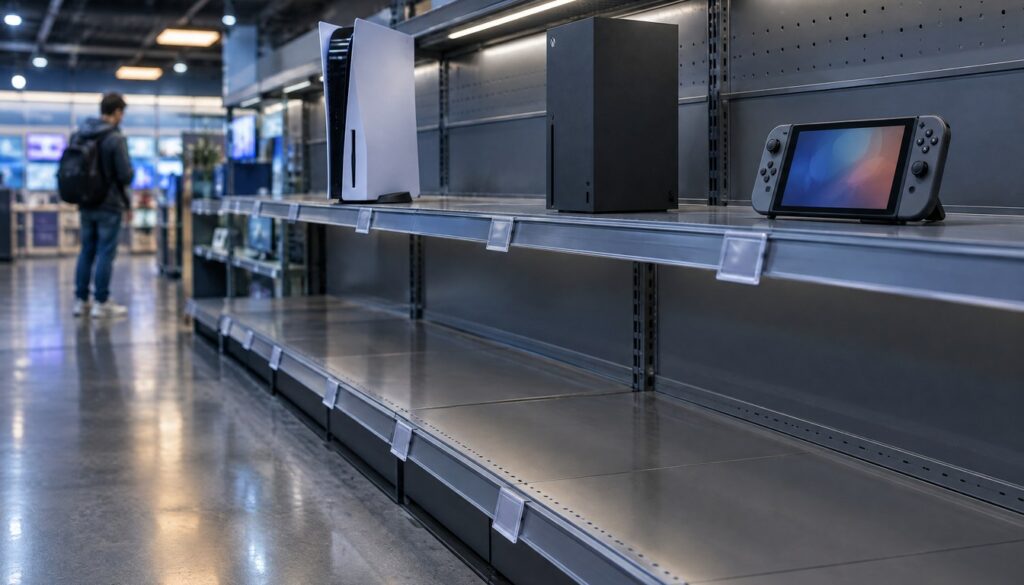
Piscatella added a second warning sign in his commentary, one that’s arguably more concerning than a sales dip: “We’re also starting to see, spotty right now, but we’re starting to see some products becoming unavailable, likely because of the RAM and component crisis.” Spotty stockouts are a different problem from slow sales. A product that’s merely expensive can still find buyers. A product that simply isn’t on the shelf can’t sell at any price.
Year-to-date spending on hardware through August sits 11% below where it was at the same point in 2025, according to Circana’s figures. That’s a steeper decline than the single-month 3% drop, suggesting the slowdown has been building across most of 2026 rather than appearing suddenly in late summer. For readers tracking the broader memory and component shortage, this console data is one of the clearest consumer-facing signals yet that the crunch has moved well past enterprise hardware and into everyday retail products.
| Metric (U.S. market) | August 2026 | Change vs. prior year |
|---|---|---|
| Hardware unit sales | Lowest August in 13 years | -15% |
| Hardware spending (monthly) | Declined | -3% |
| Hardware spending (year-to-date) | Below 2025 pace | -11% |
| Console makers raising prices | Microsoft, Nintendo, Sony | Industry-wide |
| Stock availability | “Spotty” shortages reported | Emerging trend |
Why Console Makers Raised Prices in the First Place
Microsoft, Nintendo, and Sony didn’t raise console prices in a vacuum. Circana’s reporting, echoed by Yahoo Finance, frames the increases as a response to two overlapping pressures: higher component costs and the residual impact of tariffs imposed in earlier trade actions. Console manufacturers typically operate on thin hardware margins, sometimes selling consoles near or below cost and making up the difference on software and services. When the input cost of memory chips jumps, that math breaks down fast.
Xbox’s own leadership has spoken to the scale of the cost increase. Asha Sharma, CEO of Xbox, said: “When I joined as CEO in February, the price we paid for console storage components was over 2x as high as we paid last fall. These costs have since doubled again. And as we plan for the 2027 holiday season, we expect another significant increase, taking us over 5x the prices we paid only two years earlier,” according to Eurogamer. That’s not a one-time cost bump. It’s a compounding spiral, and Sharma’s own numbers suggest the pressure gets worse before it gets better.
The storage and memory crunch traces back to the same supply chains that feed AI data centers. Memory manufacturers can sell DRAM and NAND to cloud providers building out AI training and inference clusters at prices consumer electronics simply can’t match. Every wafer allocated to a data center GPU module is a wafer not available for a game console’s RAM chips or SSD. That reallocation of capacity is the throughline connecting console price hikes to the broader AI hardware boom covered elsewhere on this site, including our look at Nvidia’s RTX Spark rollout and the demand pressures it reflects.
Tariffs compound the problem rather than replacing it. Trade policy changes enacted in prior years raised the landed cost of imported electronics components, and those costs never fully unwound even as some tariff schedules were adjusted. Console manufacturers absorbed part of that hit initially, hoping memory prices would normalize. Instead, memory costs kept climbing, and by 2026 the companies ran out of room to eat the difference without passing it to buyers.
Xbox and PlayStation: Diverging Reports, Shared Pressure
Piscatella’s public commentary, cited by GamesRadar, described the U.S. console market’s current position as one of the most precarious in decades. He characterized Xbox’s year-to-date U.S. hardware unit sales as sitting at an all-time low for the platform, while PlayStation’s year-to-date figure was described as its weakest point since 2013. Those are qualitative characterizations from Circana’s own analyst rather than specific unit counts, but they align directly with the broader 15% August decline and the 11% year-to-date drop in spending.
Nintendo’s Switch 2 sits in a slightly different position. The console launched more recently than the current Xbox Series X and PlayStation 5 generation, and Piscatella’s commentary, reported by Polygon, linked a Switch 2 hardware price increase to the same RAM and component crisis affecting its rivals. Even a console with strong launch momentum isn’t insulated from a global memory shortage; component costs hit every manufacturer’s bill of materials regardless of how well the hardware is selling at retail.
It’s worth being precise about what’s confirmed here and what isn’t. Circana’s topline numbers, the 15% August unit decline and 11% year-to-date spending drop, are the figures the firm has put on the record this cycle. Some outlets covering this story have published platform-specific unit breakdowns and average selling prices for Xbox and PlayStation individually. Those figures haven’t been independently verified against Circana’s primary release for this article, so they’re presented here only through direct, attributed analyst commentary rather than as standalone statistics.
The Memory Shortage Driving Every Price Tag Higher
The root cause threading through this entire story is memory. DRAM and NAND flash prices have climbed sharply through 2026 as chipmakers redirect fab capacity toward the kind of high-bandwidth memory that AI accelerators need. Samsung, SK Hynix, and Micron, the three companies that produce the overwhelming majority of the world’s memory chips, have all prioritized AI-linked memory products because they command far higher margins than the commodity DRAM and NAND used in laptops, phones, and game consoles.
That reallocation shows up elsewhere on the hardware side of the industry too. Our earlier coverage of DRAM pricing now exceeding the cost of TSMC’s 2nm silicon captured just how extreme the supply-demand imbalance has become. When memory itself costs more per unit than leading-edge logic chips, every device that relies on standard RAM and storage, not just consoles, ends up absorbing the increase.
Game consoles are particularly exposed because they carry relatively fixed memory and storage configurations set at launch. A laptop maker can offer a cheaper configuration with less RAM to hit a lower price point. A console maker generally can’t, since game developers build titles against a known hardware spec across the console’s entire lifecycle. That rigidity means console manufacturers have fewer levers to pull when component costs spike, and raising the retail price becomes one of the few options left.
Historical Context: How This Compares to Past Console Slumps
The video game industry has weathered hardware slumps before, but the mechanics behind them were usually different. The 2008 financial crisis cut discretionary consumer spending broadly, hitting console sales alongside nearly every other retail category. The mid-2010s saw a natural sales plateau as the Xbox One and PlayStation 4 generation matured and buyers waited for the next hardware cycle. The 2020-2022 period brought the opposite problem: overwhelming demand for PS5 and Xbox Series X units that manufacturers couldn’t produce fast enough due to pandemic-era chip shortages.
What’s happening in 2026 is distinct from all three. Demand for consoles hasn’t necessarily collapsed the way it did after 2008, and supply isn’t constrained by a one-time pandemic disruption that resolves as factories reopen. Instead, the current slump pairs rising prices with falling unit sales, a combination that points to a structural cost problem rather than a temporary demand shock. Piscatella’s framing of the market’s position as among the most precarious in decades underscores that this isn’t a routine mid-cycle dip; it’s a cost-driven contraction with no clear expiration date, since the underlying memory shortage is tied to long-term AI infrastructure buildout rather than a short-term supply hiccup.
That distinction matters for how long the pain lasts. Past shortages eased once factories caught up with demand. This one eases only if memory makers either expand capacity enough to serve both AI and consumer markets, or if AI demand growth itself slows. Neither outcome looks imminent based on current reporting.
Competitive Comparison: How the Three Console Makers Are Responding
Microsoft, Nintendo, and Sony are all raising prices, but their market positions give them different amounts of room to maneuver. Microsoft has leaned increasingly on Xbox Game Pass and multi-platform publishing (including putting its own first-party titles on PlayStation and Nintendo hardware) which means hardware sales matter less to its overall gaming revenue than they do for Sony. Sharma’s comments about storage component costs potentially reaching five times 2024 levels by the 2027 holiday season suggest Microsoft sees further hardware price pressure as close to unavoidable, regardless of competitive positioning.
Sony remains more dependent on PlayStation hardware and software sales as a share of its gaming division’s revenue, which makes a prolonged unit-sales slump a bigger strategic concern. Nintendo’s Switch 2, still in its early sales window relative to the Xbox Series X and PS5, has the benefit of fresh hardware demand, but Piscatella’s commentary indicates even Nintendo wasn’t exempt from a RAM-driven price increase this year.
| Manufacturer | 2026 Pricing Action | Stated Driver |
|---|---|---|
| Microsoft (Xbox) | Price increase implemented | Storage component costs, tariffs |
| Sony (PlayStation) | Price increase implemented | Component costs, tariffs |
| Nintendo (Switch 2) | Price increase implemented | RAM and component crisis, per Circana |
None of the three companies has a clean way out of this cycle through pricing alone. Raising prices further risks accelerating the unit-sales decline Circana is already tracking, while holding prices steady in the face of rising component costs squeezes margins that were already thin. The strategic calculus for console makers increasingly resembles the one facing premium laptop makers grappling with the same memory-driven cost inflation: price in the cost increase and risk losing buyers, or absorb it and risk losing profitability.
Market Impact: Retailers, Publishers, and Buyers
A 15% year-over-year drop in hardware units and an 11% year-to-date spending decline ripple outward past the console makers themselves. Retailers that build floor plans and promotional calendars around console sales volume now have to plan for thinner foot traffic tied to hardware purchases, which historically brings attach-rate sales on games, accessories, and subscriptions. Fewer new console owners means a smaller pool of buyers for day-one software purchases, a dynamic publishers watch closely when setting launch-window sales expectations.
For consumers already in the market, the “spotty” stockouts Piscatella flagged add a second layer of friction beyond price. A shopper willing to pay the higher price for a console may still find it unavailable at a given retailer, pushing them toward resale marketplaces where prices typically run above MSRP, or toward delaying the purchase entirely. Holiday shopping season, which typically drives the single largest chunk of annual console sales, becomes a real test of how deep the supply constraints run heading into Q4 2026.
Game publishers face a quieter but real consequence too. Slower hardware adoption curves can delay the point at which a new console generation reaches the installed base needed to justify dropping support for prior-generation hardware. Studios planning cross-generation releases may need to extend backward-compatibility support longer than originally budgeted if the current console’s user base grows more slowly than past generations did.
What Comes Next: Predictions Through 2027
Based on the trajectory Circana’s data and Xbox’s own cost commentary describe, a few outcomes look likely over the next year:
- Further console price increases are probable rather than possible. Sharma’s comment about storage costs potentially reaching five times 2024 levels by the 2027 holiday season implies at least one more round of hikes is already being planned internally at Microsoft, and rivals facing the same input costs are unlikely to hold prices steady in isolation.
- Holiday 2026 will be the clearest test yet of demand elasticity. If unit sales keep falling through the traditionally strongest sales quarter, expect console makers to lean harder into bundles, trade-in promotions, and subscription incentives rather than outright price cuts, since the underlying component costs aren’t going down.
- Stockouts will likely become less “spotty” and more consistent if memory allocation toward AI data centers keeps accelerating. Piscatella’s early-stage warning about product unavailability is the kind of signal that tends to compound once it starts.
- Expect console makers to push subscription and cloud gaming services harder as a hedge against hardware margin pressure, since those revenue streams aren’t directly exposed to DRAM and NAND pricing the way physical console sales are.
- Memory prices are unlikely to normalize quickly. The shortage is structural, tied to AI infrastructure investment cycles that span years, not a short-term supply disruption that resolves once a factory ramps back up. Expect this story to recur in Circana’s reporting through at least 2027.
How This Fits the Broader Memory Shortage Story
Console pricing is just one visible symptom of a much larger supply chain story. The same memory shortage pushing console prices up has also been a factor in rising prices across laptops, desktops, and other consumer electronics that depend on standard DRAM and NAND components. Our coverage of Micron’s record quarterly results showed one side of this equation plainly: memory manufacturers are posting record revenue precisely because demand for their products, driven by AI infrastructure buildout, now outstrips what they can supply to every market segment at once.
That same dynamic connects to broader hardware pricing pressure covered in our report on GPU price surges in Europe, where component scarcity pushed graphics card prices up by double-digit percentages. Consoles, GPUs, and premium laptops are all drawing from the same constrained pool of memory chips, and manufacturers across every category are making similar choices: raise prices, accept thinner margins, or risk product unavailability.
For readers tracking hardware purchases generally, the console hardware slump is a useful bellwether. Consoles have fixed, well-documented specs and relatively transparent pricing histories, which makes trend data like Circana’s easier to interpret cleanly than more fragmented categories like PC components. When console prices and availability both move in the wrong direction at the same time, it’s a strong signal the underlying memory shortage has moved from an enterprise problem into a consumer one.
What This Means for Shoppers Right Now
For anyone weighing a console purchase this fall, the Circana data points to a fairly blunt reality: prices are unlikely to go back down in the near term, and availability could get tighter before it gets better. Waiting for a price drop, the strategy that worked well during past console generations once initial launch scarcity eased, doesn’t line up with a market where the cost pressure is coming from outside the gaming industry entirely.
Buyers who need a console soon are better served treating any in-stock unit at the current price as the likely floor rather than a peak. That’s a different calculus than the one most shoppers learned during the PS5 and Xbox Series X launch years, when patience often paid off once initial supply caught up with demand. This time, supply isn’t catching up, since the constraint sits upstream in the memory supply chain rather than in console assembly lines.
Why This Story Reaches Beyond Gaming
Console hardware is a small fraction of global memory chip demand compared to data centers, smartphones, and PCs, but it’s one of the most closely tracked consumer categories thanks to firms like Circana publishing monthly data. That makes console pricing a useful early-warning signal for the wider electronics market. When a category with such transparent, well-documented pricing history starts showing both unit declines and stockouts simultaneously, it’s a reasonable bet that less-visible categories are feeling the same pressure, even where the reporting is thinner.
The console story also illustrates a point that applies across the tech industry in 2026: component costs set by AI infrastructure demand are no longer a background concern for companies that don’t build AI products themselves. Microsoft, Sony, and Nintendo aren’t AI companies in the way their product lines are usually discussed, yet all three are now making retail pricing decisions shaped directly by how much memory capacity the AI buildout consumes.
Frequently Asked Questions
Why did video game hardware sales drop to a 13-year low in August 2026?
Circana’s data shows a 15% year-over-year decline in U.S. hardware unit sales for August 2026, the weakest August result in 13 years. The firm attributes the drop largely to higher console prices, which Microsoft, Nintendo, and Sony implemented to offset rising memory and storage component costs along with lingering tariff effects.
Which console makers raised prices in 2026?
According to Circana’s reporting, Microsoft, Nintendo, and Sony all raised prices on their respective consoles in 2026. The increases are tied to higher component costs, particularly for RAM and storage, as well as the continuing impact of tariffs.
What’s causing the RAM and storage shortage affecting game consoles?
Memory manufacturers have shifted significant production capacity toward chips used in AI data center hardware, which commands higher margins than consumer-grade DRAM and NAND. That reallocation has tightened supply and raised prices for memory used in consumer electronics, including game consoles, laptops, and GPUs.
Is the console hardware shortage the same as the 2020-2022 chip shortage?
No. The 2020-2022 shortage was largely a pandemic-driven supply disruption paired with unusually high demand, and it eased as factories and logistics networks recovered. The current situation is structural, driven by sustained, long-term AI infrastructure demand for memory chips rather than a temporary production disruption.
Are consoles becoming hard to find in stores?
Circana’s Mat Piscatella described early, “spotty” instances of products becoming unavailable, which he linked to the RAM and component crisis. It’s not yet a widespread, consistent shortage across all console models and retailers, but the trend is one Circana is actively flagging as a risk.
Will console prices keep rising into 2027?
Xbox CEO Asha Sharma indicated that storage component costs could reach roughly five times 2024 levels by the 2027 holiday season, which suggests further price pressure is likely across the industry rather than isolated to a single platform.
How does this affect game publishers and software sales?
Slower console adoption can delay the point at which a new console generation reaches a large enough installed base to justify publishers dropping support for older hardware, potentially extending cross-generation development timelines and affecting day-one sales expectations for new titles.
Where does this data come from?
The figures in this article come from Circana, the market research firm that tracks U.S. video game retail spending, as reported by outlets including Polygon, GamesRadar, and Eurogamer.