
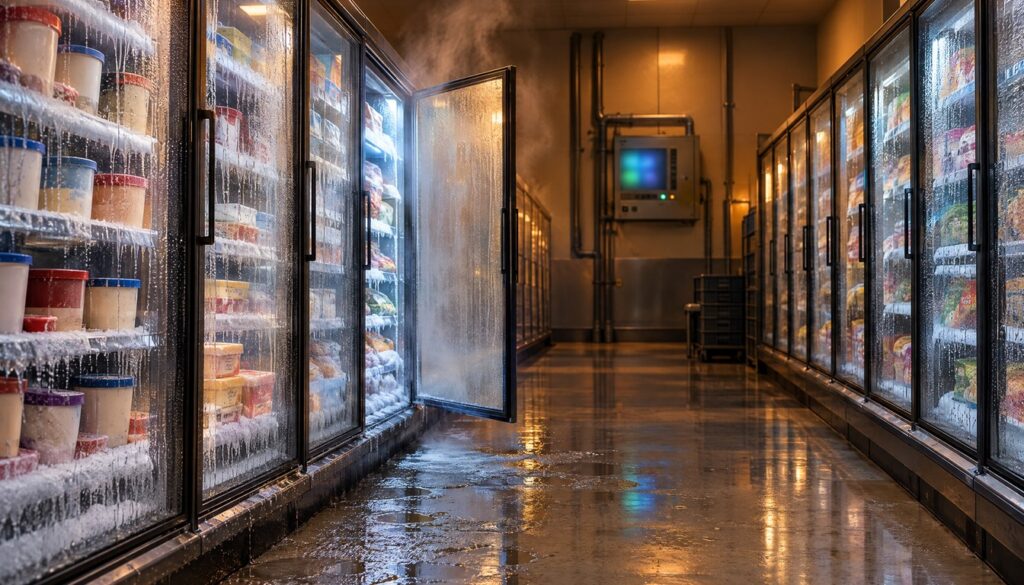
French supermarkets did not lose their refrigeration because a lock picked a digital door. They lost it because a thermostat obeyed a command it should never have trusted. On the night of Sunday, October 11, 2026, attackers reached into the software that runs cooling units at hundreds of stores across France and told those units to defrost, over and over, until frozen aisles turned warm. By Monday, October 12, the damage was done: spoiled stock, closed freezer cases, and a food-safety scare that French officials are still untangling, as the BBC reported.
The headline numbers are striking enough on their own. But the more durable story for security teams is not the temperature spike, it is the plumbing underneath it: refrigeration-management software that, by the equipment maker’s own admission, was running outdated firmware. That single detail turns a food-industry inconvenience into a case study in operational technology (OT) risk, the kind security researchers have been warning about for a decade across power grids, pipelines, and factory floors. This time the target was an ice-cream aisle.
What happened to French supermarket refrigeration
According to multiple reports, the disruption hit refrigeration systems at hundreds of French supermarkets starting overnight on Sunday, October 11, and surfacing publicly on Monday, October 12, 2026. Intermarché, the grocery chain owned by Les Mousquetaires, reported that its refrigeration units reached 50°C (122°F) for roughly six hours. Les Mousquetaires said about 150 of its stores were affected. BFMTV published a photo of a freezer in an ice-cream aisle displaying 26.5°C, a visual that circulated widely as shorthand for how badly the cooling failure had gone.
The mechanism, as described in reporting, was not a ransomware lockout or a stolen-data breach in the conventional sense. BFMTV reported that “hackers reportedly managed to remotely trigger forced defrost cycles in refrigeration systems at numerous supermarkets, with temperatures programmed to reach as high as 50°C (122°F),” as first reported by Infosecurity Magazine. That is a materially different attack than the usual ransomware lockout: instead of running for minutes, as a defrost cycle normally does, the cycle appears to have run for hours, long enough to push cases well past the temperatures needed to keep perishable and frozen goods safe. Retailers discarded food rather than risk selling it, a decision that protected customers but turned a software fault into a straightforward inventory loss.
Dominique Schelcher, President and CEO of the retail cooperative Coopérative U, confirmed the attack publicly, writing: “I can confirm that, since last night, a cyberattack has been affecting the refrigeration systems in several stores within our @CooperativeU network,” according to BleepingComputer. He added that teams were “fully mobilized, working alongside refrigeration specialists, to resolve the situation as quickly as possible,” and that “an investigation will be conducted to shed full light on this attack,” a point a separate Coopérative U spokesperson reinforced by saying “an investigation will be needed to shed full light on this attack,” as reported by Infosecurity Magazine. An Intermarché spokesperson described the incident in similar terms, saying it followed “a cyberattack reportedly affecting a service provider that manages refrigeration systems in stores,” which left some fresh and frozen food display units out of service, per BleepingComputer.
The firmware problem nobody wants to admit to
The detail that separates this incident from a routine equipment malfunction is Danfoss’s own response. The Danish industrial manufacturer, whose refrigeration-management systems are widely used in European retail, acknowledged incidents involving what it described as a limited number of refrigeration management systems running outdated firmware, a disclosure Cybersecurity Dive connected to flaws in refrigeration equipment that had already been flagged months earlier. That is a vendor conceding, in effect, that some of the equipment caught up in this attack had not received current security updates, a condition that is common across industrial and building-management hardware precisely because that equipment is expensive to take offline for patching and often outlives the support window the manufacturer originally planned for it.
This is where the French case becomes a national-security story rather than a grocery story. Refrigeration controllers sit in the same category as the programmable logic controllers and supervisory systems that run water treatment plants, substations, and manufacturing lines: purpose-built industrial computers that were designed for reliability and uptime long before anyone expected them to face a remote attacker. When those systems are connected to the internet for remote monitoring and maintenance, convenient for the vendor and the retailer, they also become reachable by anyone who finds the right entry point. Outdated firmware simply means that whatever protections exist in current versions of the software were never installed in the field.
Who is investigating, and what they have confirmed
The Paris prosecutor’s office opened an investigation into what it characterized as a large-scale attack affecting connected refrigerators at several major food retailers. France’s National Cybersecurity Agency, ANSSI, was assigned to investigate the technical side of the intrusion. As of this writing, no party has publicly claimed responsibility for the attack, and investigators have not disclosed the precise method used to reach the refrigeration-management systems. That gap matters: until ANSSI or another authority confirms the entry point, security teams elsewhere can only infer the likely attack surface from what Danfoss has already admitted about outdated firmware and from the broader pattern of how industrial refrigeration systems are typically deployed and exposed.
Some reporting has floated a higher temperature figure, around 80°C, but that number is not corroborated by the stronger, more widely cited sourcing behind the 50°C figure from Intermarché and the 26.5°C photo from BFMTV, so it should be treated as unverified rather than repeated as fact. Similarly, no official source has confirmed the exact nationwide count of affected stores, only the approximately 150 reported by Les Mousquetaires for its own network, nor has any investigator confirmed that the attack was narrowly limited to Danfoss equipment alone. Readers should treat anything beyond these confirmed points, including the dollar value of spoiled food, as still unresolved.
Why connected refrigeration became an attack surface
Ten years ago, a supermarket’s refrigeration unit was a closed, standalone appliance: a compressor, a thermostat, and a technician who checked on it in person. That model has largely disappeared from large retail chains. Modern refrigeration-management platforms centralize monitoring and control across hundreds of stores from a single dashboard, letting a facilities team spot a failing compressor in a store three hundred miles away before it fails outright. That centralization is exactly what makes the French incident possible at this scale: a single compromised management layer can, in principle, touch every store connected to it, rather than requiring an attacker to breach each location individually.
Retail chains adopted this model because it genuinely reduces costs and spoilage in normal operation. Remote monitoring catches problems early, schedules maintenance efficiently, and cuts energy use by fine-tuning defrost cycles to actual conditions rather than a fixed clock. The tradeoff is concentration risk: the same remote-access pathway that lets a technician adjust a set point from a laptop also gives an attacker who compromises that pathway the ability to issue the same command, at scale, to systems that were never designed with an adversarial user in mind. Industrial control systems historically trusted that only authorized engineers would ever send them commands. That assumption breaks the moment the control interface is reachable from the open internet.
A decade of warnings: how this fits the history of OT attacks
Security researchers have been cataloguing attacks on operational technology and industrial control systems since at least 2010, when Stuxnet demonstrated that malware could physically damage centrifuges while hiding the sabotage from the operators watching the control panel. The French refrigeration incident belongs to that same lineage: an attack that manipulates a physical process variable, in this case temperature, rather than simply stealing data or locking files. The table below places it alongside the attacks most often cited as turning points in OT security.
| Incident | Year | Sector | What made it notable |
|---|---|---|---|
| Stuxnet | 2010 | Nuclear/industrial | Malware manipulated centrifuges while masking the physical effect from operators |
| Ukraine power-grid attacks | 2015–2016 | Electric utilities | Attackers remotely operated substation equipment, cutting power to customers |
| Mirai botnet | 2016 onward | Consumer/embedded IoT | Compromised cameras and routers at scale via default credentials |
| Triton / Trisis | Disclosed 2017 | Petrochemical | Malware targeted safety-instrumented systems, not just production controls |
| Norsk Hydro | 2019 | Manufacturing/aluminum | Ransomware forced a shift to manual operations across plants |
| Colonial Pipeline | 2021 | Fuel distribution | Ransomware on IT systems led to a precautionary pipeline shutdown |
| French supermarket refrigeration | 2026 | Retail/food cold chain | Remote manipulation of defrost cycles spoiled food across hundreds of stores |
What distinguishes the French case from Stuxnet or the Ukraine grid attacks is the target’s apparent ordinariness. A nuclear enrichment facility and a power substation are protected, at least in theory, as critical infrastructure. A supermarket’s walk-in freezer is not typically categorized that way, even though the consequences, spoiled food, closed stores, a public-health scare, are real and immediate. The incident argues for widening the definition of critical infrastructure to include the unglamorous systems that keep food safe, not just the ones that keep the lights on.
The scale of the incident, by the numbers
Confirmed figures from this incident remain narrower than the headlines might suggest, and that narrowness is itself informative about how early-stage this investigation still is, even as outlets like The Register tracked the numbers as they emerged. The table below separates what has been officially confirmed from what remains reported but unverified.
| Data point | Status | Source |
|---|---|---|
| Attack began overnight Sunday, Oct. 11, surfaced Monday, Oct. 12, 2026 | Confirmed | Multiple reports |
| Intermarché units reached 50°C (122°F) for about six hours | Confirmed | Intermarché |
| About 150 Les Mousquetaires stores affected | Confirmed | Les Mousquetaires |
| Freezer photographed at 26.5°C in an ice-cream aisle | Confirmed | BFMTV |
| Danfoss systems running outdated firmware involved | Confirmed | Danfoss |
| ANSSI assigned to investigate | Confirmed | French authorities |
| Paris prosecutor’s office opened a probe | Confirmed | Paris prosecutor’s office |
| Temperatures reaching 80°C | Unconfirmed | Disputed reporting |
| Nationwide store count beyond Les Mousquetaires | Unconfirmed | Not yet disclosed |
| Dollar value of spoiled food | Unconfirmed | Not yet disclosed |
| Party responsible for the attack | Unconfirmed | No claim made |
Food safety meets cybersecurity
As Food Safety Magazine noted, regulators have spent decades building a cold-chain compliance regime around physical risk: a broken compressor, a power outage, a truck that loses refrigeration en route. None of that framework was built with an adversary in mind who can trigger the same failure mode on command, at hundreds of locations simultaneously, by sending a network message rather than cutting a wire. That is the uncomfortable overlap this incident exposes. A food-safety inspector checking a single store’s temperature logs has no way to distinguish a compressor failure from a malicious command unless the retailer’s security team has already built that correlation into its monitoring.
It also reframes what “critical” means for a retailer’s IT and security budget. Point-of-sale systems and customer databases have historically absorbed most retail security investment, because card-data breaches carry direct regulatory and reputational consequences. Refrigeration management, by contrast, has often sat in a facilities budget rather than a security budget, overseen by whichever vendor sold the equipment rather than by the retailer’s own security operations center. This incident is a forceful argument for folding OT systems like refrigeration into the same monitoring, patching, and incident-response processes that already cover payment systems.
Market and operational impact
The immediate financial toll is still unquantified in official terms, and this article will not invent a figure where none has been confirmed, though Time described the episode as an unprecedented test of France’s food-retail cybersecurity. What can be said with confidence is the shape of the impact: discarded fresh and frozen inventory across roughly 150 stores in one retail network alone, lost sales during the hours those cases sat empty or closed, emergency labor costs for refrigeration specialists called in overnight, and whatever cost Danfoss and other vendors absorb in firmware remediation and customer support across the affected fleet. For a grocery chain operating on thin margins, a multi-hour loss of an entire product category at 150 locations is not a rounding error, even before any inventory is formally totaled.
There is a second-order cost that rarely makes it into incident reports: trust. Shoppers who saw news coverage of spoiled food at their regular supermarket chain have reason to wonder, at least briefly, whether products on the shelf during the incident window were handled safely. Retailers that communicate clearly and quickly, as Coopérative U and Intermarché both did through public statements within a day of the attack, tend to recover that trust faster than those that stay silent. The transparency shown here, naming the affected chains and the general cause, is itself a data point worth tracking as other OT incidents inevitably follow.
How French retailers’ response compares to other OT incidents
Compared with Colonial Pipeline, where the operator shut down the entire pipeline rather than risk a compromised IT environment touching operational systems, the French retailers’ response looks more surgical: specific stores lost refrigeration, but the chains did not report a wholesale shutdown of unrelated systems like payment processing or inventory management. That is a meaningfully better outcome than a blanket precautionary shutdown, and it suggests at least some segmentation existed between refrigeration controls and other store systems, even if that segmentation was not enough to stop the attack from reaching the refrigeration layer itself.
Compared with Norsk Hydro, which fell back to manual, pen-and-paper operations across its plants after a 2019 ransomware attack, French supermarkets had a narrower manual fallback available: throw away spoiled food and keep the registers running. That is a lower-stakes failure mode than an aluminum plant losing production control, but it is also a reminder that retail refrigeration, unlike a factory floor, cannot simply be run manually at scale. Nobody can station a person at every freezer case in 150 stores to monitor temperature by hand.
What Danfoss and other vendors need to fix
Danfoss’s acknowledgment that outdated firmware was involved points to a familiar and largely unsolved problem in industrial technology: devices that are expensive and disruptive to patch tend not to get patched, even when the vendor has shipped a fix. Retail refrigeration units run around the clock; taking one offline for a firmware update means either accepting a cooling gap or arranging redundant capacity, neither of which is trivial across hundreds of stores. Vendors have generally not solved this with seamless, zero-downtime update mechanisms, and retailers have generally not solved it by building the operational slack needed to patch on a predictable schedule.
The practical fixes security researchers have pushed for years apply directly here: removing unnecessary internet exposure of control interfaces, requiring strong authentication before any set-point or defrost command is accepted, segmenting refrigeration networks away from general store IT, and building independent high-temperature alarms that trigger regardless of what the management software reports. None of these are exotic. All of them cost money and operational attention that, before this week, refrigeration vendors and retailers alike had reason to defer.
The regulatory question France now faces
With ANSSI investigating and the Paris prosecutor’s office pursuing a criminal angle, France has two separate institutional tracks now examining the same incident: one technical, one legal. The European Union’s NIS2 directive already pushes member states to extend cybersecurity obligations to a broader set of operators than earlier rules covered, and food supply and retail infrastructure sit closer to that expanding perimeter than they did five years ago. Whether this specific incident becomes the trigger for France to formally classify large-scale refrigeration and cold-chain management as critical infrastructure, subject to the stricter reporting and security requirements that implies, is an open question that ANSSI’s findings will likely shape.
What to expect next
- ANSSI’s investigation will likely produce a more specific technical account of the intrusion path within weeks, which should confirm or rule out whether outdated firmware was the sole entry point or one of several.
- Danfoss and other refrigeration-management vendors will face pressure to publish firmware update timelines and to explain how many deployed units worldwide remain on unsupported versions.
- Other French and European retailers using similar centralized refrigeration platforms will likely conduct internal audits even if they were not directly affected, given how exposed the broader model now looks.
- Expect renewed debate in France and at the EU level over whether cold-chain and food-retail infrastructure should be formally designated as critical, which would trigger stricter security and reporting obligations under frameworks like NIS2.
- Insurance underwriters covering retail property and business interruption will likely revisit how they price cyber-triggered physical losses, since this incident sits awkwardly between a cyber policy and a property policy.
Lessons for any company running connected OT equipment
Few readers of a security-focused publication run a supermarket chain, but almost every organization now runs some equivalent of a connected refrigeration unit: a building-management system, a manufacturing controller, a fleet of IoT sensors, something purchased for operational convenience rather than security, and plugged into a network that was assumed to be trusted. The French incident is a concrete, dated example of what happens when that assumption fails. An inventory of every internet-reachable control system, a firmware-currency audit against vendor advisories, and an alarm system that does not depend solely on the compromised software for its own temperature or status readings, are not glamorous security investments. They are, as this week in France demonstrated, the difference between a quiet patch cycle and a prosecutor’s office opening a file.
Frequently asked questions
What actually broke in the French supermarket refrigeration attack?
Attackers manipulated refrigeration-control software and forced cooling units into prolonged or continuous defrost cycles, pushing internal temperatures well above safe levels for stored food rather than simply shutting the units off.
How hot did the refrigeration units get?
Intermarché reported units reaching 50°C (122°F) for about six hours. BFMTV separately photographed a freezer in an ice-cream aisle displaying 26.5°C. A higher figure of 80°C has appeared in some reporting but is not corroborated by the stronger sourcing behind these numbers.
How many stores were affected?
Les Mousquetaires, the owner of Intermarché, said about 150 of its stores were hit. The exact nationwide total across all affected retailers has not been officially confirmed.
Who is investigating the attack?
The Paris prosecutor’s office opened an investigation into what it called a large-scale attack, and France’s national cybersecurity agency, ANSSI, was assigned to investigate the technical side of the intrusion.
Did outdated firmware cause the attack?
Danfoss, the refrigeration-equipment manufacturer, acknowledged incidents involving a limited number of its refrigeration management systems running outdated firmware. Investigators have not yet confirmed the exact technical entry point attackers used.
Has anyone claimed responsibility?
No. As of this writing, no individual or group has publicly claimed responsibility for the attack.
Is this similar to past attacks like Stuxnet or Colonial Pipeline?
It belongs to the same broad category of attacks that manipulate a physical process rather than just stealing data, but the target, retail cold-chain equipment, is a less traditionally “critical” sector than nuclear facilities or fuel pipelines, which is part of why this incident is drawing attention from security researchers.
What should other retailers do now?
Security researchers point to removing unnecessary internet exposure on refrigeration and building-management control interfaces, enforcing strong authentication on any system that can change temperature or defrost settings, segmenting OT networks from general store IT, and building independent high-temperature alarms that do not rely solely on the same software an attacker could compromise.