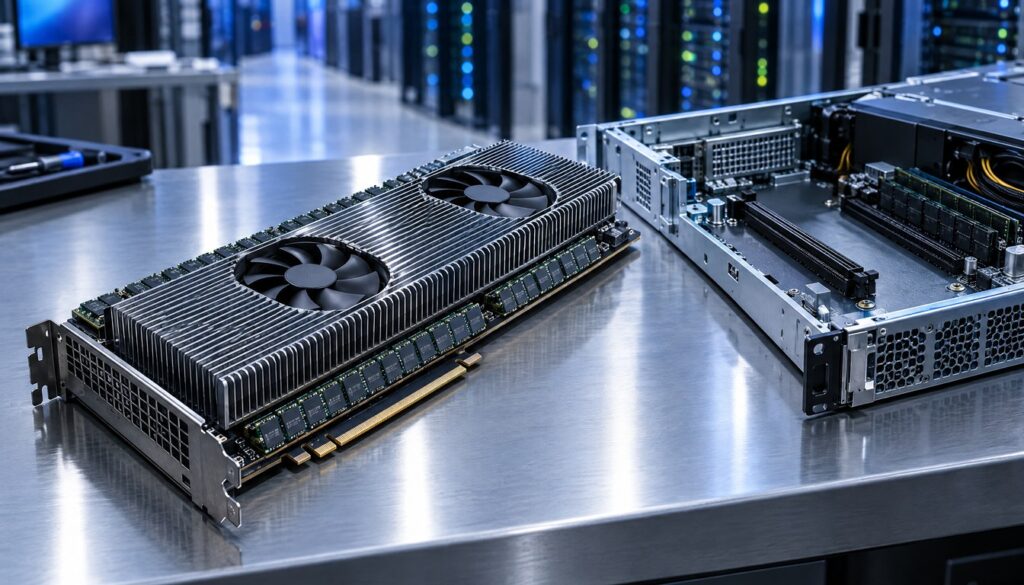
Intel put a real name and a real spec sheet on its long-teased inference chip on October 12, 2026. At the Open Compute Project Global Summit, the company confirmed that Crescent Island, the accelerator it had only sketched out in broad strokes earlier this year, now ships as the Intel GPU D-Series. The headline numbers: 1.3 peak petaflops of FP8 compute, 1.5 TB/s of memory bandwidth, and up to 480 GB of LPDDR5X memory inside a 350-watt, air-cooled PCIe card, according to Intel’s own announcement and reporting from Tom’s Hardware.
That is a big jump from what Intel disclosed earlier in 2026, when Crescent Island was described as a 160 GB part still waiting for customer sampling. The memory capacity has tripled, the branding has solidified, and Intel is now explicit that this chip is built to compete in the AI inference market, not the training market where Nvidia has spent a decade building a moat. This is a news analysis of what actually changed, what Intel is claiming, where the numbers hold up, and where the competitive picture still has gaps Intel has not filled in.
What Intel Announced on October 12, 2026
Intel used the OCP Global Summit, the industry’s main venue for hyperscaler and open-hardware announcements, to give Crescent Island an official product identity. The chip now sits inside the Intel GPU D-Series line, a new family name that sets it apart from Intel’s consumer Arc graphics cards and its existing Gaudi AI training accelerators. The company says the card targets AI inference workloads specifically, including large language models, long-context tasks, and concurrent inference serving where many requests hit the same hardware at once.
Intel’s own newsroom post frames the announcement as part of a broader push on “open infrastructure” for what it calls the agentic AI era, pairing the D-Series GPU news with new Xeon-based rack designs aimed at the same data center customers. Intel says customer sampling of the D-Series is already underway, though it has not published a broad commercial launch date, pricing, or a full retail rollout plan. Reporting from wccftech ties a specific model number, the D270, to this family, though that designation comes from third-party coverage rather than Intel’s own cited materials, so it should be treated as reported rather than officially confirmed.
Inside the Xe3P Architecture
The D-Series runs on Intel’s Xe3P architecture, a variant of the Xe graphics architecture Intel has been iterating on since its original Arc discrete GPU push. The “P” suffix signals a data-center-oriented branch of the Xe3 family, distinct from the Xe3 silicon that will likely show up in future client graphics. Intel has not published granular architectural details such as core counts or cache hierarchy in its cited announcement materials, so specifics beyond the headline compute and bandwidth figures remain unconfirmed by Intel directly.
What Intel has made clear is the design philosophy: build an inference-first chip around high memory capacity and strong bandwidth rather than chasing the largest possible peak FLOPS figure. That is a deliberate contrast with the training-optimized accelerators that dominate headlines, where raw compute density and HBM stacks tend to be the selling point. Inference workloads, especially serving large or long-context models to many concurrent users, are often bottlenecked by how much model weight and context a chip can hold in fast memory, not by how many matrix multiplications it can theoretically push per second.
The Spec Sheet: 1.3 PFLOPS FP8, 1.5 TB/s Bandwidth, 480GB LPDDR5X
Here is what Intel has actually confirmed for the D-Series, drawn directly from the October 12 announcement and corroborating coverage.
| Spec | Intel GPU D-Series (Crescent Island) |
|---|---|
| Architecture | Xe3P |
| Peak FP8 compute | Up to 1.3 petaflops |
| Memory bandwidth | 1.5 TB/s |
| Memory capacity | Up to 480 GB LPDDR5X |
| Power envelope | 350 watts |
| Form factor | Air-cooled PCIe card |
| Target workload | AI inference (LLMs, long-context, concurrent serving) |
| Single-card model capacity | Up to roughly 300 billion parameters |
| Eight-GPU system model capacity | More than 1 trillion parameters |
| Sampling status | Customer sampling in progress; no broad-launch date given |
Intel’s choice of LPDDR5X instead of HBM is the most unusual engineering decision here. HBM delivers higher bandwidth per stack but costs more, draws more power at the memory level, and has been in chronically short supply through 2026 as training clusters soak up allocation. LPDDR5X is cheaper, more available, and lets Intel reach very high total capacity (480 GB) on a single card without the packaging complexity of stacking HBM dies next to the compute die. The tradeoff is that 1.5 TB/s of bandwidth, while solid, trails what top-end HBM-based accelerators can deliver. Intel is betting that for inference, capacity and cost-per-GB matter more than squeezing out every last gigabyte-per-second.
Why 350 Watts and Air Cooling Matter
A 350-watt card that Intel says can be air-cooled is a meaningful claim for data center operators. Liquid cooling retrofits are expensive and slow to deploy, and plenty of existing colocation and enterprise data center floors were never built with the direct-liquid-cooling loops that today’s 700W-plus training GPUs often require. By staying in the air-cooled range, Intel is explicitly targeting operators who want AI inference capacity without a facilities overhaul.
This also matters for racks that mix inference cards with existing compute. A 350W PCIe card slots into far more chassis designs, from standard 2U servers to repurposed GPU nodes, than parts that need custom power delivery or liquid cold plates. Intel is not disclosing exact rack density numbers yet, but the power envelope alone suggests the D-Series is meant to slide into infrastructure operators already have, rather than forcing a new build-out the way some of the largest training clusters do.
Model Capacity: 300B Parameters on One Card, 1 Trillion in a Rack
Intel’s most eye-catching claim is model scale. The company says a single D-Series card can hold and serve a model of up to roughly 300 billion parameters, and that an eight-GPU system can handle more than 1 trillion parameters. Those figures line up with the 480 GB memory ceiling: large language models at FP8 precision need roughly one byte per parameter plus overhead for key-value cache and activations, so a 480 GB card comfortably fitting a 300-billion-parameter model checks out mathematically, assuming favorable quantization and a model architecture that does not blow up context memory.
The 1-trillion-parameter, eight-GPU claim is the more interesting one for enterprise buyers, because it suggests Intel is positioning the D-Series as a practical way to serve today’s largest frontier-scale open models without resorting to the kind of 16- or 32-GPU clusters that HBM-bound hardware sometimes needs for the same job. If that holds up under independent benchmarking once the hardware reaches third-party reviewers, it would be a genuine differentiator. Right now it is Intel’s own figure, not an independently verified one.
From 160GB to 480GB: How the Spec Sheet Changed
The jump in disclosed memory capacity is worth sitting with. Earlier in 2026, Intel’s public description of Crescent Island put memory at 160 GB of LPDDR5X, with customer sampling expected in the second half of the year. The October 12 announcement triples that figure to 480 GB. It is not clear from Intel’s cited materials whether 160 GB and 480 GB represent different SKUs within the same D-Series family, an early engineering sample versus a production configuration, or simply an earlier, more conservative disclosure that Intel has now revised upward. Reporting around the D270 name suggests a configuration range rather than a single fixed spec, which would mean Intel sells variants at different memory tiers rather than one fixed part.
| Disclosure point | Earlier 2026 description | October 12, 2026 announcement |
|---|---|---|
| Codename / branding | Crescent Island (codename only) | Intel GPU D-Series (official name) |
| Memory capacity | 160 GB LPDDR5X | Up to 480 GB LPDDR5X |
| Memory bandwidth | Not disclosed | 1.5 TB/s |
| Peak FP8 compute | Not disclosed | Up to 1.3 petaflops |
| Power envelope | Not disclosed | 350 watts |
| Sampling timeline | Expected H2 2026 | Customer sampling in progress |
What this table shows, more than anything, is that Intel has moved from a vague roadmap slide to an actual spec sheet backed by a named product and a trade-show stage. That is a meaningfully different stage of maturity for an accelerator program, even before independent benchmarks exist.
How Intel’s Approach Compares to Nvidia, AMD and Google’s TPUs
Nvidia’s data center inference lineup leans on tightly integrated platforms built around high-bandwidth memory and, increasingly, rack-scale systems that pool many GPUs together over fast interconnects. That approach generally wins on raw bandwidth and software maturity, since Nvidia’s CUDA ecosystem has a multi-year head start among model-serving frameworks. AMD remains the other major GPU-based alternative, competing largely on price and open-software compatibility with the same general HBM-centric design philosophy Nvidia uses. Google’s TPU family takes a different route entirely: a vertically integrated custom ASIC that Google controls end to end, from silicon to its own serving stack, which gives it tight efficiency gains inside Google’s own cloud but limits it as an off-the-shelf part for other buyers.
| Vendor | Inference hardware approach | Primary differentiator |
|---|---|---|
| Intel (GPU D-Series) | LPDDR5X-based PCIe cards, air-cooled, standard server form factor | High memory capacity per card at lower power and cost than HBM parts |
| Nvidia | HBM-based accelerators and rack-scale integrated systems | Bandwidth leadership and the most mature inference software stack |
| AMD | HBM-based GPUs positioned as an open, lower-cost alternative | Price and open-source software compatibility |
| Custom TPU ASICs, vertically integrated into Google Cloud | End-to-end efficiency inside Google’s own infrastructure |
Intel is not claiming to beat Nvidia or AMD on raw bandwidth or on software maturity, and it would be a stretch for Intel to make that claim credibly given how far behind its inference software ecosystem still trails CUDA’s installed base. The pitch is narrower and, arguably, more realistic: a standard PCIe card that slots into existing air-cooled racks and holds far more model weight per card than rival parts at a given price and power point. Whether that pitch converts into actual enterprise purchase orders depends heavily on pricing Intel has not yet disclosed, and on independent benchmarks that do not yet exist.
Market Impact: What This Means for the AI Inference Chip Race
The timing matters. 2026 has been the year inference economics overtook training economics as the industry’s central cost problem, as more companies move from building frontier models to actually serving them to paying users at scale. Every major chipmaker has been racing to claim a piece of that spend, and memory capacity and bandwidth, not just raw compute, have become the metrics customers actually care about when a model needs to stay resident across millions of concurrent requests.
For Intel specifically, a credible, named inference product matters beyond the chip itself. Intel’s data center GPU ambitions have had a rocky public history, and a product that reaches customer sampling with concrete, verifiable specs is a different kind of proof point than another roadmap slide. If the D-Series ships in volume with pricing that undercuts HBM-based rivals on a cost-per-served-token basis, it gives hyperscalers and neoclouds leverage in price negotiations with Nvidia and AMD, even if they don’t buy a single D-Series card themselves. Competitive pressure on memory-bound inference pricing would be the realistic, near-term market effect, more so than Intel immediately capturing large market share.
Historical Context: Intel’s Long Road to a Real AI Accelerator
Intel’s path to the D-Series has been anything but direct. The company’s discrete graphics ambitions trace back to the aborted Larrabee project, which never shipped as a GPU but seeded ideas that eventually fed into later Xe efforts. Intel then built the Gaudi line of AI training accelerators through its Habana Labs acquisition, positioning Gaudi as a training-focused alternative to Nvidia’s data center GPUs. Crescent Island, now the D-Series, represents a pivot toward inference specifically, an acknowledgment that training and inference increasingly call for different hardware tradeoffs rather than one chip trying to do both well.
That history matters for how skeptically the market should treat today’s announcement. Intel has shown AI accelerator roadmap slides before that took longer to materialize into shipping silicon than initially suggested, and Gaudi’s market traction against Nvidia has been limited despite genuine technical merit. The fact that Intel is now citing customer sampling, rather than a future roadmap date, is a sign of progress, but it is not the same as general availability, confirmed pricing, or third-party benchmark validation.
What’s Still Unconfirmed
Several details that would normally accompany a product launch of this scale remain open. Intel has not published pricing for any D-Series configuration. The exact PCIe generation and lane width the card uses have not been specified in Intel’s cited materials. A specific model number such as D270 appears only in third-party reporting, including coverage from wccftech, not in Intel’s own disclosed documentation. And there is no confirmed, broad commercial launch date beyond “customer sampling in progress.”
What Intel Has Confirmed Beyond the Spec Sheet
Intel paired the GPU announcement with new Xeon-based rack designs at the same event, signaling that the company wants to sell D-Series inference cards as part of a broader rack-level infrastructure story rather than as a standalone component. That bundling strategy, CPU plus accelerator plus rack design sold as one open-infrastructure pitch, mirrors how Nvidia has pushed its own rack-scale systems and suggests Intel is trying to compete on total system economics, not just a single chip’s spec sheet.
Predictions: Where the D-Series Goes From Here
- Pricing will undercut HBM-based rivals on a per-GB basis. Intel’s entire design logic around LPDDR5X only makes sense commercially if the resulting card costs meaningfully less per gigabyte of usable memory than HBM-based competitors, so expect aggressive pricing once Intel discloses numbers.
- Independent benchmarks will narrow the gap between Intel’s claims and real-world throughput. The 300-billion and 1-trillion-parameter figures are Intel’s own; third-party reviewers testing actual token-per-second throughput on real models will be the first real test of whether the memory capacity translates into usable performance at acceptable latency.
- Software support will be the bigger bottleneck than silicon. Intel’s oneAPI and inference-serving ecosystem still lags the maturity of CUDA-based tooling, and that gap, not raw specs, is likely to determine how fast enterprise buyers actually adopt the D-Series.
- Expect more SKUs across the 160GB-to-480GB range, not a single fixed part. The spread between Intel’s earlier 160 GB disclosure and the new 480 GB figure points toward a tiered product family rather than one configuration, similar to how Nvidia and AMD segment their own data center lineups.
- Hyperscalers will use the D-Series as a negotiating lever even before buying it. A credible third inference option, alongside Nvidia and AMD, strengthens buyers’ hands in pricing talks regardless of how many D-Series units actually ship in year one.
What to Watch Next
The next concrete milestones to watch are straightforward: official pricing, a general-availability date beyond “sampling in progress,” and the first independent benchmarks from outlets that get hands-on hardware rather than Intel-supplied performance figures. Until those three things land, every claim about the D-Series, including the model-capacity figures, should be read as a vendor’s own projection rather than a verified result. Intel has cleared the bar of naming a real product with real specs at a real event. The harder bar, proving it in production at scale against Nvidia and AMD’s existing enterprise relationships, is still ahead.
Frequently Asked Questions
What is the Intel GPU D-Series?
The Intel GPU D-Series is the official product name for the accelerator Intel previously code-named Crescent Island. It is a data center GPU built on the Xe3P architecture and designed specifically for AI inference workloads, including serving large language models and long-context tasks.
What are the Intel Crescent Island specs?
Intel says the D-Series delivers up to 1.3 peak petaflops of FP8 compute, 1.5 TB/s of memory bandwidth, and up to 480 GB of LPDDR5X memory, all within a 350-watt, air-cooled PCIe card.
When was the Intel GPU D-Series announced?
Intel announced the D-Series on October 12, 2026, at the Open Compute Project Global Summit, alongside new Xeon-based rack designs.
Is the Intel D270 the same as Crescent Island?
Reporting from outlets including wccftech ties the D270 name to this family of chips, but that specific model number has not been confirmed directly in Intel’s own cited announcement materials, so it should be treated as reported rather than officially verified.
How much does the Intel GPU D-Series cost?
Intel has not disclosed pricing for any D-Series configuration. No official price has been confirmed as of this announcement.
How does the D-Series compare to Nvidia and AMD inference GPUs?
Nvidia and AMD both lean on HBM-based accelerators that generally offer higher bandwidth and more mature inference software ecosystems. Intel’s D-Series instead uses LPDDR5X to reach much higher memory capacity per card at lower power, targeting cost-per-served-model economics rather than peak bandwidth.
Can the D-Series run trillion-parameter models?
Intel says an eight-GPU D-Series system can support models with more than 1 trillion parameters, and that a single card can handle models up to roughly 300 billion parameters. These are Intel’s own figures and have not yet been independently benchmarked.
Is the Intel GPU D-Series available to buy now?
No. Intel says customer sampling is underway, but the company has not announced a general availability date or broad retail launch.