
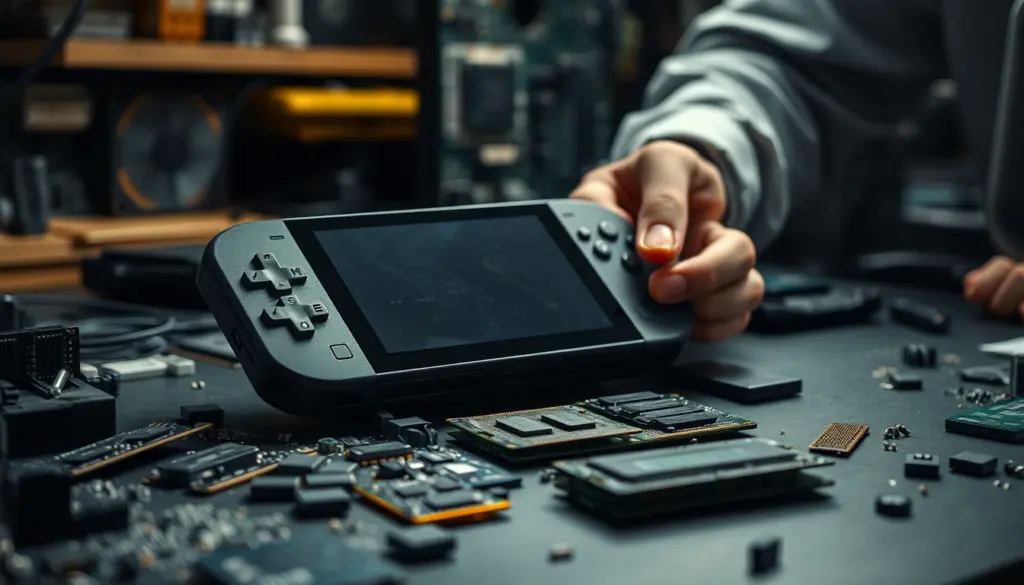
Valve is still building a Steam Deck 2, and the memory crisis squeezing the rest of the PC hardware market has not knocked the project off course. That is the headline from comments given by Valve engineer Pierre-Loup Griffais, who told reporters this month that the surge in RAM and DRAM pricing has “not really” changed Valve’s plans for a next-generation handheld. The catch: there is still no release date, no confirmed chip, and no price, even as Valve’s competitors keep shipping new hardware into a market where memory now eats a bigger share of every bill of materials than it did a year ago.
The comments landed in the same month Valve shipped its first new piece of hardware in over a year: the Steam Frame VR headset, a $1,059 SteamOS device bundled with Half-Life: Alyx. That launch, combined with Griffais’s remarks, gives the clearest public picture yet of how Valve is threading a needle: keep building the next Steam Deck, but don’t ship it into a memory market that would force an ugly price tag on day one.
What Valve actually said about Steam Deck 2
Griffais, one of the lead engineers behind the original Steam Deck, was asked directly whether the ongoing RAM price spike had changed Valve’s roadmap. His answer was short: “Not really.” He followed that up with more detail on what Valve is actually optimizing for. “We’ve talked before about how we want to make sure there’s a very delineated performance improvement for something like a future Steam Deck, and I think we’re still looking at it in the same way,” Griffais said, according to Video Games Chronicle.
That framing matters because it rules out a quiet, incremental refresh. Valve shipped the Steam Deck OLED in 2023 as a mid-cycle upgrade with a better screen and battery, not a generational leap in horsepower. Griffais’s comments suggest Deck 2 is meant to be the opposite: a device with a performance jump big enough that owners of the original Deck would feel it immediately. Getting there requires a newer chip, and newer chips lean harder on the same memory supply chain that is currently squeezing every device maker from Apple to Samsung.
On timing, Griffais declined to commit to anything. “It’s just a matter of looking at the current conditions and seeing how and when we can deliver something like that,” he said. Asked about the broader product experience Valve is targeting, he added that the underlying goals for the next Deck remain “very similar” to what Valve has described before. Earlier remarks reported by VGChartz quoted Griffais saying simply, “We’re working hard on [Steam Deck 2],” which lines up with the September comments: active development, no fixed launch window.
The RAM crisis Valve is building around
The memory shortage behind all of this isn’t specific to gaming handhelds. It’s a global DRAM and NAND supply crunch driven by AI data center demand pulling memory capacity away from consumer devices, a dynamic shattered.io has tracked as it pushed RAM to roughly 60% of the bill-of-materials cost on some phones. The same pressure has already shown up directly in Valve’s own hardware: the Steam Frame launched in September 2026 at $1,059, a price shaped in part by the same memory costs now squeezing every device maker, a point covered in detail when Steam Frame shipped.
Valve’s existing handheld line has already absorbed price increases this year. The base Steam Deck rose from $450 to $500 in September 2026, according to Engadget. That’s an 11% jump on the entry-level model, the one most likely to attract price-sensitive buyers who might otherwise wait for a sequel. The OLED tier moved too: 512GB and 1TB Steam Deck OLED models now list at $789 and $949 following pricing changes in May 2026, continuing a climb that shattered.io flagged when the OLED model first jumped 46% earlier in the cycle.
Steam Deck and Steam Frame pricing since 2022
| Device | Launch or prior price | Price as of September 2026 | Change |
|---|---|---|---|
| Steam Deck (base LCD) | $450 | $500 | +11.1% |
| Steam Deck OLED 512GB | Prior tier pricing | $789 | Repriced May 27, 2026 |
| Steam Deck OLED 1TB | Prior tier pricing | $949 | Repriced May 27, 2026 |
| Steam Frame VR headset | New product, no prior price | $1,059 / £889 | Launched September 2026, bundled with Half-Life: Alyx |
None of those figures include an announced Steam Deck 2 price, because Valve has not set one. But the trend line is the context that makes Griffais’s “current conditions” comment easy to read: if the company that makes the Deck is already raising prices on hardware it has been shipping for years, a brand-new chip generation launching mid-crisis would carry real risk of landing at a price point that alienates the Deck’s core, budget-conscious buyer.
Steam Frame as the preview, not the sequel
It’s worth separating the two products clearly, because they get conflated online. Steam Frame is a standalone VR headset running SteamOS, listed on Valve’s own Steam Deck storefront alongside the existing handheld lineup, not a handheld and not the successor to the Steam Deck line. It shipped without a dedicated launch game of its own, leaning on 2019’s Half-Life: Alyx to anchor the pitch, a decision detailed in earlier coverage of the launch. Invitations to buy went out on a 72-hour purchase window rather than an open storefront listing, a rollout pattern Valve has used before to manage supply against demand it can’t fully predict in a constrained component market.
What Steam Frame does tell us about Deck 2 is operational, not technical: Valve is willing to ship hardware into a bad memory market when it has a product ready, and it is willing to gate access with invite windows rather than eat a stockout. If Steam Deck 2 follows the same playbook, expect a similarly metered rollout rather than a broad day-one launch across every retailer at once.
The handheld market Valve has to answer to
Valve is no longer setting the pace alone in PC handhelds, a shift Tom’s Hardware has tracked closely across the console and handheld gaming beat this year. Microsoft and Asus co-developed the ROG Xbox Ally line, integrating the Xbox app and storefront directly into a Windows handheld, an approach shattered.io compared directly against the Steam Deck OLED at launch. Lenovo has iterated fast too, moving from the original Legion Go to the Legion Go 2, a jump benchmarked against the Steam Deck OLED that shows Lenovo pricing its top-tier hardware well above Valve’s. Even Sony has entered adjacent territory with the PlayStation Portal, a cheaper, streaming-only device that undercuts the Deck on price while offering none of its local processing power.
Handheld gaming PC comparison, September 2026
| Device | Maker | Price | Platform |
|---|---|---|---|
| Steam Deck OLED | Valve | $789 – $949 | SteamOS |
| ROG Xbox Ally | Asus / Microsoft | $599 | Windows with Xbox app |
| Legion Go | Lenovo | $599 | Windows |
| Legion Go 2 | Lenovo | $1,349 | Windows |
| PlayStation Portal | Sony | $199 | Remote streaming only |
| Steam Frame | Valve | $1,059 | SteamOS (VR) |
That spread is the market Steam Deck 2 has to land in. Sony’s Portal proves there’s demand for a sub-$200 option that trades local power for streaming. Lenovo’s Legion Go 2 proves buyers will pay well over $1,000 for raw performance. Valve’s own SteamOS strategy has already spread beyond its own hardware, with the SteamOS 3.8.25 update adding support for five rival handhelds ahead of any Deck 2 announcement, a move that reads as Valve hedging by making its software available broadly while its own next-generation hardware stays in development.
Historical context: the Deck’s original launch was also chip-constrained
Valve has been here before. The original Steam Deck launched into a 2022 semiconductor shortage that stretched pre-order wait times to months, with reservation slots doled out in waves rather than sold outright. That launch also happened during a period when component costs were elevated industry-wide, forcing Valve to hold the line on a $399 starting price that reviewers at the time treated as aggressive given the silicon market. The current situation inverts the pressure: instead of chip supply constraining a fixed product, memory pricing is constraining a product that hasn’t been finalized yet, giving Valve more room to wait it out than it had in 2022.
That history is part of why Griffais’s “current conditions” language reads as deliberate rather than evasive. Valve absorbed a rough launch once already and ended up with a device that sold well despite the environment. Repeating that playbook with a pricier, more memory-hungry chip is a bigger bet, and the company appears to be choosing patience over a repeat gamble.
Why memory pricing hits a handheld harder than a desktop GPU
Fixed memory, fixed margin
A desktop gamer upgrading a GPU can defer the purchase, keep an older card running, or shop a used market. A handheld like the Steam Deck ships with soldered, fixed memory that can’t be swapped or upgraded after the fact, so every unit sold has to absorb the current market price of RAM at the moment of manufacture, not the price it might fall to a year later. That makes handhelds unusually exposed to exactly the kind of spike the market has seen through 2026, where memory now accounts for a much larger share of device bill-of-materials cost than it did in prior years.
A performance jump needs more memory, not less
Griffais’s own description of the goal, a “delineated performance improvement,” typically implies more RAM and faster memory bandwidth than the current Deck’s 16GB LPDDR5, not a lateral move. That’s the worst possible spec target to chase during a memory shortage, since it increases exposure to the exact component category that’s most expensive right now. It’s also likely the real reason Valve won’t commit to a date: locking in a chip and memory configuration today could mean re-negotiating the bill of materials multiple times before the device actually ships.
Market impact: what this means for buyers right now
For anyone deciding whether to buy a Steam Deck today or wait, the practical read is straightforward. There’s no announced Steam Deck 2 launch window, and Valve’s own comments suggest the timeline is tied to a memory market that analysts don’t expect to normalize quickly. Buyers weighing the Deck against Nintendo’s handheld line face a similar calculus, since the Switch 2 also absorbed a price increase to $499.99 in 2026, part of the same industry-wide cost pressure. Retailers and resellers have little incentive to discount current Steam Deck stock while a sequel remains undated, which likely keeps prices near current levels through the rest of 2026.
For Valve, the calculation is different but related. Every additional quarter it waits is a quarter competitors get to lock in handheld buyers with Windows-based devices that don’t carry the “wait for the real sequel” hesitation SteamOS users now have. That’s a real cost, even if it’s a smaller one than shipping an overpriced device that damages the brand’s reputation for value, the reputation the original Deck built in 2022.
Competitive comparison: Valve’s strategy versus Microsoft, Lenovo, and Sony
Microsoft’s approach with Asus on the ROG Xbox Ally line leans on software integration and brand reach rather than raw hardware differentiation, betting that Xbox account holders will pick a familiar storefront over Valve’s Steam library. Lenovo has taken the opposite bet with the Legion Go 2, chasing top-end performance at a premium price and accepting a smaller addressable market. Sony’s PlayStation Portal sidesteps the memory and chip cost problem entirely by pushing processing to the cloud or a home console, trading capability for a lower price point that doesn’t depend on handheld silicon at all.
Valve’s strategy, based on Griffais’s comments, is closer to “wait for the math to work” than any of those three. It’s a lower-risk approach in a shortage, but it cedes the news cycle and the shelf space to competitors willing to ship into a bad market. Whether that trade-off pays off depends largely on how long the memory crisis actually runs, a question none of the companies involved can answer with confidence right now.
What experts and insiders are saying
The clearest on-record perspective so far comes from Griffais himself, and it’s worth reading his full framing rather than the “not really” headline alone. On the product goals specifically, he told Video Games Chronicle: “But from what we’re working on, as far as the user experience goes and what the product that we’re trying to build goes, it’s very similar goals.” That’s a notable statement because it confirms Valve hasn’t scaled back its ambitions for Deck 2 in response to the memory market, it has only left the delivery timeline open. Combined with his earlier, blunter comment that Valve is “working hard on” the device, reported by VGChartz, the picture is a project that’s active but deliberately undated.
Predictions: where Steam Deck 2 goes from here
- Valve will not announce a firm release date until memory pricing shows a sustained decline, likely tying any formal reveal to a broader cost recovery rather than a fixed calendar milestone.
- When Steam Deck 2 does launch, expect a metered rollout similar to Steam Frame’s 72-hour invite window rather than a simultaneous global retail launch, to manage supply against demand.
- Valve will keep expanding SteamOS support to third-party handhelds like the ROG Xbox Ally and Legion Go in the meantime, treating software reach as a way to stay relevant while hardware development continues.
- Pricing on the current Steam Deck OLED lineup is more likely to rise again than fall before Deck 2 ships, given the trend already seen in 2026.
- Competitors including Lenovo and Asus will likely release at least one more hardware refresh each before Valve ships Deck 2, widening the gap between Valve’s cautious pace and the rest of the market’s faster iteration cycle.
Frequently Asked Questions
Is Steam Deck 2 officially confirmed?
Yes. Valve engineer Pierre-Loup Griffais confirmed active development in comments reported by Video Games Chronicle, saying the RAM crisis has “not really” changed the company’s plans. No official product name, price, or release window has been announced.
When will Steam Deck 2 release?
Valve has not set a date. Griffais said the timing is “just a matter of looking at the current conditions,” tying the launch to how the memory market evolves rather than to a fixed calendar target.
How much will Steam Deck 2 cost?
No price has been announced. Given the current Steam Deck OLED lineup starts at $789 and the base Steam Deck rose to $500 in September 2026, a next-generation chip with more memory could carry a higher starting price than the original Deck’s $399 launch point, though Valve has not confirmed any figure.
Why is the RAM shortage affecting Steam Deck 2 development?
Handhelds use fixed, soldered memory that can’t be upgraded later, so every unit’s cost is locked to memory prices at the time of manufacture. A global DRAM shortage driven largely by AI data center demand has pushed memory costs higher across the device market, and a performance-focused Deck sequel would likely need more memory, not less.
What is the difference between Steam Deck 2 and Steam Frame?
They are separate products. Steam Frame is a standalone VR headset that launched in September 2026 at $1,059, bundled with Half-Life: Alyx. Steam Deck 2 would be a handheld gaming PC succeeding the current Steam Deck line and has not launched.
Will Steam Deck 2 run SteamOS?
Valve has not detailed the software for an unannounced product, but every Valve handheld to date, including the original Steam Deck and Steam Frame, has run SteamOS, and Valve has continued expanding SteamOS support to third-party handhelds through updates like version 3.8.25.
What handhelds compete with the Steam Deck right now?
Current competitors include the Asus ROG Xbox Ally and Ally X, Lenovo’s Legion Go and Legion Go 2, and Sony’s streaming-focused PlayStation Portal, each targeting a different price and performance tier.
Should I buy a Steam Deck now or wait for Deck 2?
With no confirmed date or price for Steam Deck 2, buyers who need a handheld now are choosing between the current Steam Deck OLED lineup and rivals like the ROG Xbox Ally or Legion Go, rather than waiting on an undated future product.