
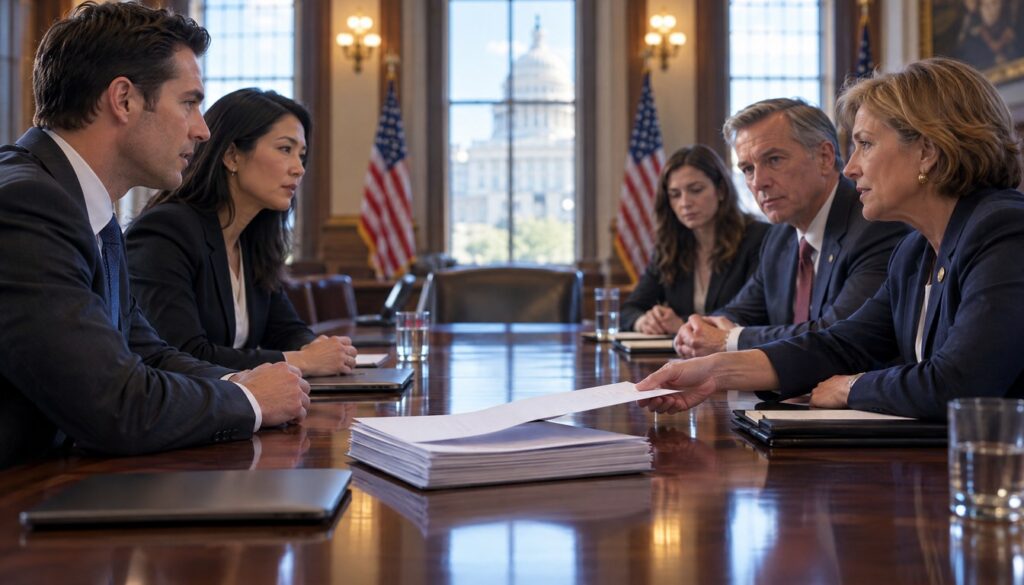
Anthropic has spent much of 2026 telling Congress that AI companies cannot be trusted to police themselves. Now the company wants to write the policing rules itself. According to POLITICO, Anthropic representatives have quietly circulated a confidential draft bill on frontier AI safety and security to lawmakers on Capitol Hill, a document three people familiar with the effort say had not been previously reported. The pitch marks one of the most concrete attempts yet by a frontier AI lab to turn its own policy preferences into binding federal law, rather than leave the shape of AI regulation to Congress alone.
The timing matters. Washington has spent most of 2026 arguing over whether AI oversight should come from Congress, from state legislatures, or from the companies themselves. Anthropic’s draft bill, obtained by POLITICO, attempts to settle that argument on terms the company can live with: a narrow definition of catastrophic risk, a single enforcement path through the courts, and a ceiling on how aggressively other federal agencies can intervene. This anthropic ai safety bill proposal is already drawing attention precisely because it reads less like a wish list and more like a markup-ready statute.
What Anthropic Is Proposing to Congress
The draft bill, as described in POLITICO’s reporting, would let the federal government intervene against a frontier AI model only when there is a foreseeable, imminent risk tied to specific, high-severity outcomes. The bill sets two financial and human-harm thresholds: more than $1 billion in damages, or the death or serious injury of more than 50 people. Below those lines, the bill does not grant the government a basis to act, regardless of how an AI system behaves.
Those thresholds only apply, though, if the harm traces back to one of three categories. The draft bill limits qualifying risks to the creation or release of a biological weapon, a model evading its developer’s controls, or a cyberattack. Anything outside those three buckets, even if it causes real damage, would sit outside the bill’s intervention framework entirely. That is a deliberately narrow definition of catastrophic risk, and it is the clearest signal of how Anthropic wants Washington to think about AI harm: rare, severe, and tightly categorized, rather than broad and discretionary.
An Anthropic spokesperson described the submission in direct terms: “This bill represents the proposals outlined in Anthropic’s Advanced AI Framework, which we have been advocating for with federal and state lawmakers since June.” The company has made that case publicly for months, but putting it into statutory language is a different kind of move. It shifts Anthropic from commentator to drafter, and that shift is what has lawmakers and rival labs paying attention this week.
Inside the Draft Bill’s Risk Thresholds
The mechanics of the bill read like a decision tree built for regulators, not a sweeping mandate. A plain-language version of the trigger logic, based on the provisions POLITICO and other outlets have reported, looks roughly like this:
IF risk_category IN [bioweapon_creation, control_evasion, cyberattack]
   AND projected_harm > $1,000,000,000 damages
        OR projected_deaths_or_serious_injury > 50 people
   AND risk IS foreseeable AND imminent
THEN Commerce Department MAY petition a federal judge
     (U.S. District Court for the District of Columbia)
     to halt the model's release or use
ELSE no federal intervention basis under this bill
That structure explains why some AI policy watchers will call this bill narrow by design. It is not a general-purpose AI safety statute. It is a tripwire built around three specific failure modes, with a high bar for financial loss or casualties before the tripwire can be pulled. For an administration or future Congress hoping for broader authority over AI systems, a bill shaped this way would represent a ceiling, not a floor.
How the Enforcement Mechanism Would Work
Enforcement in the draft runs through independent evaluators rather than a new regulatory bureaucracy. Those evaluators would register with the U.S. Department of Commerce and periodically assess frontier AI companies and their models. If an evaluator identifies what the bill calls an imminent enumerated risk, the draft requires that finding be reported to Commerce within 72 hours of completing the assessment.
From there, the Commerce Department does not get unilateral authority to pull a model offline. Instead, the draft requires Commerce to ask a federal judge for an order, and only a federal judge in the U.S. District Court for the District of Columbia could grant a suspension. That is a meaningful design choice. It routes the most consequential power in the bill, the power to stop an AI model from shipping or operating, through the judiciary rather than an executive agency acting alone.
Why Route Through a Single Court
Concentrating suspension authority in one federal court does two things at once. It creates a predictable venue and a developing body of case law that AI companies could plan around, rather than facing inconsistent rulings across circuits. It also, not incidentally, limits the number of judges and jurisdictions with the power to shut an Anthropic model down. Whether that is read as prudent centralization or self-interested venue selection will likely depend on which lawmaker is reading the bill.
Limiting Federal Agency Power: A Deliberate Design Choice
Perhaps the most politically loaded provision in the draft is the one restricting other parts of the federal government. The proposal would prohibit other U.S. government departments, agencies, or officers from independently suspending AI development, deployment, or internal use. In practice, that means no other agency, not an export-control office, not a consumer protection regulator, not a sector-specific watchdog, could act against a frontier model’s deployment outside the single channel the bill creates through Commerce and the D.C. district court.
That is a request for regulatory certainty, and it is easy to see why a company spending billions building frontier systems would want it. It is also a request that concentrates enormous discretion in one agency and one court, at a moment when trust in how fast and how safely AI labs are moving is still an open question in Washington. Lawmakers who want multiple checks on AI companies are unlikely to embrace a bill that removes most of them by statute.
Why Anthropic Is Pushing Its Own Framework
Anthropic’s public reasoning for the draft bill lines up with arguments the company’s policy team has made for months: voluntary commitments are not enough, and a federal statute written narrowly around catastrophic risk is better than a patchwork of state rules or an open-ended regulatory mandate. An Anthropic spokesperson summarized the pitch to lawmakers plainly: “These are sensible policies we believe Congress should act on.”
Sarah Heck, Anthropic’s head of public policy, has made a version of that same argument about self-regulation specifically. “We can’t be checking our own homework, and that’s very clear,” Heck said, arguing that AI companies cannot rely solely on their own internal safety assurances and that outside, government-backed oversight is necessary. That framing, government oversight as something AI labs should want rather than resist, has been central to how Anthropic positions itself against rivals that have leaned harder on voluntary pledges.
The Advanced AI Framework, Explained
The draft bill is not a new idea from Anthropic so much as a translation of an existing one. The company has said the bill represents the proposals outlined in its Advanced AI Framework, a policy document it has pushed with federal and state lawmakers since June. That framework calls for frontier model developers to test for catastrophic risks, document mitigations, disclose safety incidents, use independent evaluators, and ultimately answer to some government body with the power to act when something goes seriously wrong.
What changed between June and this week is the format. A framework is a position paper. A draft bill is legislative text that a member of Congress could, in theory, introduce largely as written. That is a much higher-stakes artifact, and it is why outlets beyond POLITICO, including TradingView, Investing.com, and Bloomberg Law, picked up the story within hours of POLITICO’s report.
Independent Evaluators and the Commerce Department’s Role
The independent evaluator system sits at the center of how this bill would actually function day to day. Rather than Commerce staff directly auditing frontier models, outside evaluators would register with the department and conduct periodic assessments of covered companies and their systems. That model mirrors how financial auditing and some industrial safety inspection regimes work: a third party checks the work, and a government agency receives the results rather than performing the checks itself.
The 72-hour reporting window for an identified imminent risk is tight by regulatory standards, and it signals that Anthropic’s drafters wanted speed built into the one part of the process that matters most: getting a genuine emergency in front of a court quickly. Whether 72 hours is realistic depends heavily on details the public draft reportedly does not fully spell out, including how an evaluator would access the technical information needed to make that call in the first place.
| Bill Element | Threshold or Rule | Who Acts |
|---|---|---|
| Damage threshold | More than $1 billion | Qualifies for federal intervention review |
| Casualty threshold | More than 50 people killed or seriously injured | Qualifies for federal intervention review |
| Covered risk categories | Biological weapon, control evasion, cyberattack | Only these three trigger the bill |
| Evaluator registration | Must register with Commerce | Independent evaluators |
| Incident reporting window | 72 hours after assessment completion | Independent evaluators to Commerce |
| Suspension authority | Court order required | Federal judge, U.S. District Court for D.C. |
| Other agency authority | Barred from independent action | All other federal departments and officers |
Historical Context: How AI Safety Legislation Got Here
Anthropic’s lobbying push did not appear out of nowhere. The company’s leadership, including CEO Dario Amodei, has argued for a uniform federal standard over a patchwork of state rules for some time, while also backing state-level action as an interim step when Washington moves slowly. “Our longstanding position has been that a uniform federal approach is preferable to a patchwork of state laws,” Amodei has said. He has also acknowledged the tension in waiting for Congress: “While we continue to advocate for that federal standard, AI is moving so fast that we can’t wait for Congress to act.”
That tension, federal preemption versus state urgency, has defined much of the AI policy fight in 2026. States have moved on their own timelines on AI transparency and safety rules, while Congress has debated competing visions for a national standard. Anthropic’s decision to circulate actual bill text is best read as an attempt to resolve that tension in its preferred direction: get a federal statute on the books, narrowly scoped, before state rules multiply into something harder for a single company to navigate. Readers who want more on the state-versus-federal fight can look at coverage of the administration’s own de facto AI licensing approach, which has been developing on a parallel track.
Market and Industry Reaction
The immediate market reaction to a confidential draft bill is necessarily muted, since the document is not public legislation and no company has confirmed a formal position on its specific terms. But the broader pattern, a major AI lab shaping the regulatory environment it will eventually operate under, fits a trend that has accelerated across the industry in 2026. Anthropic has simultaneously been expanding commercially, including large infrastructure commitments like its reported edge-computing arrangement covered in Akamai’s $11.6 billion deal with the company, while also pushing policy that would define how aggressively regulators can respond if something goes wrong with the models those deals are built on.
For competitors, the stakes are not abstract. A federal statute modeled on Anthropic’s framework would apply to every frontier lab, not just the one that drafted it. OpenAI, Google DeepMind, Meta, and xAI would all operate under the same $1 billion and 50-person thresholds, the same three risk categories, and the same single enforcement path through Commerce and a D.C. court. That is precisely why competitors watch a move like this closely: whoever’s framework becomes the template effectively writes the rulebook for the entire industry, not just its own labs.
Competitive Landscape: How the Policy Positions Compare
Washington’s AI safety debate in 2026 has generally split into three camps: companies pushing for binding, narrowly scoped federal statutes (Anthropic’s position), companies and trade groups favoring continued voluntary commitments with minimal new statutory obligations, and state legislators moving ahead with their own disclosure and safety rules regardless of what Congress does. The table below frames those camps structurally, without attributing specific commitments to any company beyond what has been publicly reported about Anthropic’s own proposal.
| Policy Approach | Core Mechanism | Who Would Enforce | Scope of Risk Covered |
|---|---|---|---|
| Anthropic’s draft bill | Binding federal statute | Commerce + single federal court | Narrow: 3 enumerated catastrophic risk categories |
| Voluntary industry commitments | Self-reported pledges, no statute | No external enforcement body | Varies by company, not legally defined |
| State-level AI safety laws | State statutes, vary by jurisdiction | State attorneys general and regulators | Varies widely across states |
| Broad federal AI oversight (debated, not enacted) | Would require new congressional action | Would depend on final legislation | Potentially broader than Anthropic’s three categories |
What Critics and Skeptics Are Likely to Say
Even without a public comment period, the shape of likely objections is not hard to predict from the bill’s own structure. Consumer advocates and some lawmakers who have pushed for broader AI oversight are likely to argue that limiting qualifying harms to three categories, bioweapons, control evasion, and cyberattacks, leaves out entire classes of AI harm that do not fit neatly into those buckets, including large-scale fraud, discriminatory automated decision-making, or harms that accumulate gradually rather than in a single catastrophic event.
Critics are also likely to focus on the clause barring other federal agencies from acting independently. A rule that funnels all enforcement through one agency and one court is efficient for the companies being regulated, but it also means that if Commerce is slow, under-resourced, or reluctant to act, there is reportedly no other federal lever available under this bill. That is the kind of provision that tends to generate pushback from agencies whose authority would be curtailed, even before any formal hearing is scheduled.
The Self-Regulation Argument, Cuts Both Ways
Anthropic’s own framing, that AI companies cannot be left checking their own homework, invites an obvious question: does a bill largely written by one of the companies being regulated avoid that same problem? Skeptics will likely argue that a statute shaped heavily around one lab’s preferred thresholds and preferred enforcement venue is still a form of the industry writing its own rules, just one step removed from pure self-regulation rather than a clean break from it.
What Happens Next in Congress
A confidential draft is not legislation. For this bill to matter beyond a policy signal, a member of Congress would need to formally introduce it, attach a bill number, and move it through committee, a process that typically takes months even for proposals with bipartisan support. Nothing in the current reporting establishes that any lawmaker has agreed to sponsor the text as written, and the formal name of the bill, if it gets one, has not been established in available reporting either.
What is more likely in the near term is that pieces of Anthropic’s draft, the risk categories, the dollar and casualty thresholds, the evaluator-reporting structure, get folded into broader AI safety legislation that is already moving through House and Senate offices. Lawmakers rarely adopt an industry-drafted bill wholesale, but they frequently borrow specific mechanisms from one when drafting their own. The real test for Anthropic’s pitch is not whether this exact document becomes law, it is whether its thresholds and enforcement structure become the baseline other proposals get measured against.
How This Fits Anthropic’s Broader AI Safety Posture
This isn’t Anthropic’s only recent move signaling how seriously it takes the gap between AI capability and AI oversight. The company has also tightened its own usage policies this year, including restrictions covered in reporting on Claude’s usage rules around law enforcement requests, and it has publicly staked out a cautious position on open-weight AI models, detailed in coverage of an Anthropic executive’s warnings on open-source AI risk. Taken together, the pattern is consistent: Anthropic wants to be seen pushing for guardrails before it is asked to, both in its own products and in the law that would eventually govern all of them.
That posture also plays out in how Anthropic talks about competitors. OpenAI’s own safety organization has faced turnover this year, a dynamic explored in coverage of OpenAI’s safety lead departing after a string of model launches, and public disagreements between the two companies’ leaders over how much risk current AI systems actually pose have surfaced repeatedly, as detailed in reporting on where OpenAI and Anthropic diverge on AI risk. A federal bill shaped by Anthropic’s thresholds would, by definition, apply the same rules to OpenAI regardless of how that rivalry plays out in public statements.
Predictions: Where This Goes From Here
- Expect Anthropic to continue pushing its Advanced AI Framework publicly even if this specific draft never gets formally introduced, since the framework itself predates the bill and will outlast any single legislative attempt.
- Expect other frontier labs to respond with their own policy counter-proposals rather than silence, given how directly a bill built on these thresholds would bind their own future model releases.
- Expect the $1 billion and 50-person thresholds specifically to become a reference point in future AI policy debates, whether or not this exact bill advances, simply because they are now the most concrete numbers on the table.
- Expect scrutiny of the clause barring other federal agencies from acting independently, since that provision concentrates power in a way that tends to draw the most resistance during any committee process.
- Expect state legislators to keep moving on their own AI safety rules in the meantime, since nothing about a confidential draft circulating on Capitol Hill changes state-level timelines already in motion.
Why This Story Matters Beyond Washington
For engineers and product teams building on frontier models, the practical question is not whether this exact bill passes, it is what kind of compliance obligations eventually attach to the models they depend on. A statute built around independent evaluators registering with Commerce and a 72-hour reporting clock would create new downstream expectations for any company whose product sits on top of a covered frontier model, even if that company never interacts with Commerce directly. The same logic applies to anyone tracking how fast frontier capability is advancing relative to oversight, a tension visible in parallel coverage of rumors around Anthropic’s next-generation Claude models, where capability gains and cost cuts are arriving faster than any regulatory framework currently on the table.
Frequently Asked Questions
What is the Anthropic AI safety bill?
It is a confidential draft of frontier AI safety and security legislation that Anthropic representatives pitched to lawmakers on Capitol Hill, first reported by POLITICO. It is not legislation that has been formally introduced in Congress.
What risk thresholds does the draft bill use?
The bill allows government intervention only for a foreseeable, imminent risk of more than $1 billion in damages, or the death or serious injury of more than 50 people, and only when that risk stems from a biological weapon, a model evading its developer’s controls, or a cyberattack.
Who would enforce the bill if it became law?
Independent evaluators registered with the U.S. Department of Commerce would assess frontier AI companies and models. If they find an imminent enumerated risk, they would report it to Commerce within 72 hours, and Commerce could then ask a federal judge in the U.S. District Court for the District of Columbia to order a suspension.
Has any member of Congress agreed to introduce this bill?
Available reporting does not establish that any lawmaker has committed to formally introducing the draft text. The bill’s formal name and any bill number also have not been established in reporting so far.
How does this relate to Anthropic’s Advanced AI Framework?
Anthropic has said the draft bill represents the proposals outlined in its Advanced AI Framework, a policy document the company says it has advocated to federal and state lawmakers since June.
Would this bill apply to AI companies besides Anthropic?
Yes. If enacted as a general statute, the thresholds, risk categories, and enforcement process would apply to any frontier AI developer meeting the bill’s criteria, not just Anthropic.
Why would other federal agencies be barred from acting independently?
The draft reportedly limits enforcement to a single channel through Commerce and one federal court, which its drafters frame as regulatory predictability. Critics are likely to view the same provision as concentrating too much power in one agency and one venue.
What should companies building on frontier AI models watch for next?
Whether any lawmaker formally introduces similar legislation, and whether the specific thresholds and evaluator-reporting structure in Anthropic’s draft get adopted, in whole or in part, by broader AI safety bills already moving through Congress.