
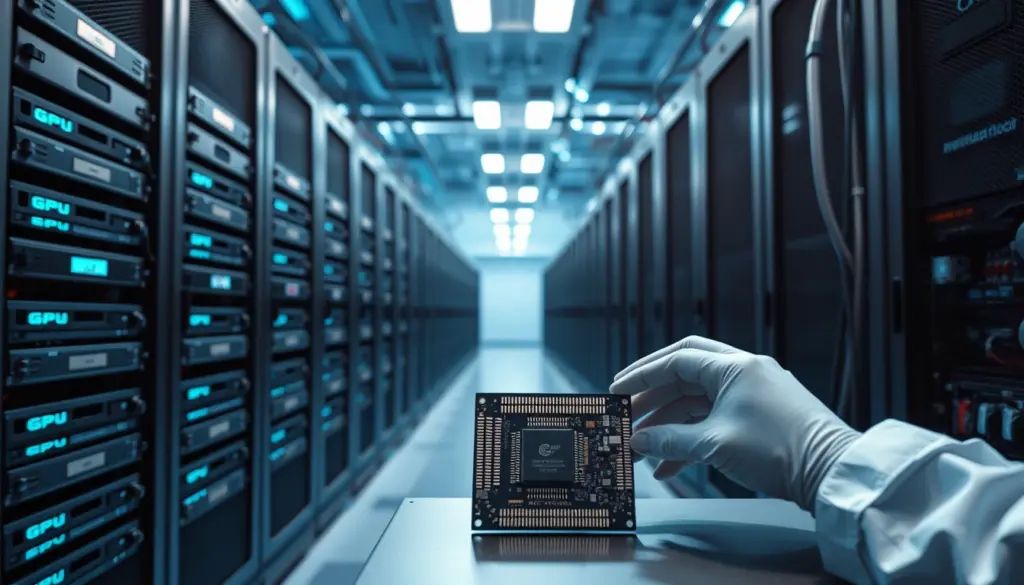
For more coverage of chip design, data center hardware and the AI infrastructure buildout, visit the hardware section on shattered.io.

Sources and further reading: Nvidia data center platform, Google Cloud TPU, AWS Trainium, Broadcom AI infrastructure products, Anthropic news, and coverage from Digitimes and Biggo Finance.


For more coverage of chip design, data center hardware and the AI infrastructure buildout, visit the hardware section on shattered.io.

Sources and further reading: Nvidia data center platform, Google Cloud TPU, AWS Trainium, Broadcom AI infrastructure products, Anthropic news, and coverage from Digitimes and Biggo Finance.

What is Nvidia’s Rubin platform?
Rubin is Nvidia’s next-generation AI chip architecture, following Blackwell, and part of the company’s strategy of shortening the gap between major architecture releases to stay ahead of custom silicon competitors.

For more coverage of chip design, data center hardware and the AI infrastructure buildout, visit the hardware section on shattered.io.

Sources and further reading: Nvidia data center platform, Google Cloud TPU, AWS Trainium, Broadcom AI infrastructure products, Anthropic news, and coverage from Digitimes and Biggo Finance.
Are Cerebras, Groq and SambaNova real alternatives to Nvidia?
They’re real products with real customers, but none currently holds meaningful market share against Nvidia. They matter more as leverage in pricing and supply negotiations than as a near-term replacement.

What is Nvidia’s Rubin platform?
Rubin is Nvidia’s next-generation AI chip architecture, following Blackwell, and part of the company’s strategy of shortening the gap between major architecture releases to stay ahead of custom silicon competitors.

For more coverage of chip design, data center hardware and the AI infrastructure buildout, visit the hardware section on shattered.io.

Sources and further reading: Nvidia data center platform, Google Cloud TPU, AWS Trainium, Broadcom AI infrastructure products, Anthropic news, and coverage from Digitimes and Biggo Finance.

Will custom silicon actually hurt Nvidia’s stock?
Nvidia’s valuation has so far absorbed similar headlines because overall AI compute demand keeps growing faster than hyperscalers can shift workloads to their own chips. That could change if AI infrastructure spending growth slows.

Are Cerebras, Groq and SambaNova real alternatives to Nvidia?
They’re real products with real customers, but none currently holds meaningful market share against Nvidia. They matter more as leverage in pricing and supply negotiations than as a near-term replacement.

What is Nvidia’s Rubin platform?
Rubin is Nvidia’s next-generation AI chip architecture, following Blackwell, and part of the company’s strategy of shortening the gap between major architecture releases to stay ahead of custom silicon competitors.

For more coverage of chip design, data center hardware and the AI infrastructure buildout, visit the hardware section on shattered.io.

Sources and further reading: Nvidia data center platform, Google Cloud TPU, AWS Trainium, Broadcom AI infrastructure products, Anthropic news, and coverage from Digitimes and Biggo Finance.

Does this mean Anthropic is moving away from Nvidia?
Anthropic runs a significant share of its workloads on AWS’s Trainium chips, but that sits alongside its use of Nvidia hardware rather than replacing it entirely.

Will custom silicon actually hurt Nvidia’s stock?
Nvidia’s valuation has so far absorbed similar headlines because overall AI compute demand keeps growing faster than hyperscalers can shift workloads to their own chips. That could change if AI infrastructure spending growth slows.

Are Cerebras, Groq and SambaNova real alternatives to Nvidia?
They’re real products with real customers, but none currently holds meaningful market share against Nvidia. They matter more as leverage in pricing and supply negotiations than as a near-term replacement.

What is Nvidia’s Rubin platform?
Rubin is Nvidia’s next-generation AI chip architecture, following Blackwell, and part of the company’s strategy of shortening the gap between major architecture releases to stay ahead of custom silicon competitors.

For more coverage of chip design, data center hardware and the AI infrastructure buildout, visit the hardware section on shattered.io.

Sources and further reading: Nvidia data center platform, Google Cloud TPU, AWS Trainium, Broadcom AI infrastructure products, Anthropic news, and coverage from Digitimes and Biggo Finance.

What role does Broadcom play in this story?
Broadcom acts as a design partner for multiple hyperscalers building custom AI silicon, including Google’s TPU program and reportedly OpenAI’s Jalapeño chip, positioning it to benefit regardless of which individual custom chip effort succeeds.

Does this mean Anthropic is moving away from Nvidia?
Anthropic runs a significant share of its workloads on AWS’s Trainium chips, but that sits alongside its use of Nvidia hardware rather than replacing it entirely.

Will custom silicon actually hurt Nvidia’s stock?
Nvidia’s valuation has so far absorbed similar headlines because overall AI compute demand keeps growing faster than hyperscalers can shift workloads to their own chips. That could change if AI infrastructure spending growth slows.

Are Cerebras, Groq and SambaNova real alternatives to Nvidia?
They’re real products with real customers, but none currently holds meaningful market share against Nvidia. They matter more as leverage in pricing and supply negotiations than as a near-term replacement.

What is Nvidia’s Rubin platform?
Rubin is Nvidia’s next-generation AI chip architecture, following Blackwell, and part of the company’s strategy of shortening the gap between major architecture releases to stay ahead of custom silicon competitors.

For more coverage of chip design, data center hardware and the AI infrastructure buildout, visit the hardware section on shattered.io.

Sources and further reading: Nvidia data center platform, Google Cloud TPU, AWS Trainium, Broadcom AI infrastructure products, Anthropic news, and coverage from Digitimes and Biggo Finance.

Which companies are building custom AI chips to compete with Nvidia?
OpenAI, Google, Amazon, Meta and Microsoft all have active custom silicon programs, alongside merchant chip makers like Cerebras, Groq and SambaNova that sell alternative hardware directly to customers.

What role does Broadcom play in this story?
Broadcom acts as a design partner for multiple hyperscalers building custom AI silicon, including Google’s TPU program and reportedly OpenAI’s Jalapeño chip, positioning it to benefit regardless of which individual custom chip effort succeeds.

Does this mean Anthropic is moving away from Nvidia?
Anthropic runs a significant share of its workloads on AWS’s Trainium chips, but that sits alongside its use of Nvidia hardware rather than replacing it entirely.

Will custom silicon actually hurt Nvidia’s stock?
Nvidia’s valuation has so far absorbed similar headlines because overall AI compute demand keeps growing faster than hyperscalers can shift workloads to their own chips. That could change if AI infrastructure spending growth slows.

Are Cerebras, Groq and SambaNova real alternatives to Nvidia?
They’re real products with real customers, but none currently holds meaningful market share against Nvidia. They matter more as leverage in pricing and supply negotiations than as a near-term replacement.

What is Nvidia’s Rubin platform?
Rubin is Nvidia’s next-generation AI chip architecture, following Blackwell, and part of the company’s strategy of shortening the gap between major architecture releases to stay ahead of custom silicon competitors.

For more coverage of chip design, data center hardware and the AI infrastructure buildout, visit the hardware section on shattered.io.

Sources and further reading: Nvidia data center platform, Google Cloud TPU, AWS Trainium, Broadcom AI infrastructure products, Anthropic news, and coverage from Digitimes and Biggo Finance.

Is Nvidia’s Blackwell actually losing to custom chips?
Reports say OpenAI’s Jalapeño chip shows an edge over Blackwell systems on certain inference benchmarks specifically. That’s different from Blackwell losing across the board, since Nvidia’s GPUs remain dominant for large-scale model training.

Which companies are building custom AI chips to compete with Nvidia?
OpenAI, Google, Amazon, Meta and Microsoft all have active custom silicon programs, alongside merchant chip makers like Cerebras, Groq and SambaNova that sell alternative hardware directly to customers.

What role does Broadcom play in this story?
Broadcom acts as a design partner for multiple hyperscalers building custom AI silicon, including Google’s TPU program and reportedly OpenAI’s Jalapeño chip, positioning it to benefit regardless of which individual custom chip effort succeeds.

Does this mean Anthropic is moving away from Nvidia?
Anthropic runs a significant share of its workloads on AWS’s Trainium chips, but that sits alongside its use of Nvidia hardware rather than replacing it entirely.

Will custom silicon actually hurt Nvidia’s stock?
Nvidia’s valuation has so far absorbed similar headlines because overall AI compute demand keeps growing faster than hyperscalers can shift workloads to their own chips. That could change if AI infrastructure spending growth slows.

Are Cerebras, Groq and SambaNova real alternatives to Nvidia?
They’re real products with real customers, but none currently holds meaningful market share against Nvidia. They matter more as leverage in pricing and supply negotiations than as a near-term replacement.

What is Nvidia’s Rubin platform?
Rubin is Nvidia’s next-generation AI chip architecture, following Blackwell, and part of the company’s strategy of shortening the gap between major architecture releases to stay ahead of custom silicon competitors.

For more coverage of chip design, data center hardware and the AI infrastructure buildout, visit the hardware section on shattered.io.

Sources and further reading: Nvidia data center platform, Google Cloud TPU, AWS Trainium, Broadcom AI infrastructure products, Anthropic news, and coverage from Digitimes and Biggo Finance.

What is OpenAI’s Jalapeño chip?
Jalapeño is the internal name for OpenAI’s first custom AI chip, reportedly co-developed with Broadcom and aimed primarily at inference workloads rather than training.

Is Nvidia’s Blackwell actually losing to custom chips?
Reports say OpenAI’s Jalapeño chip shows an edge over Blackwell systems on certain inference benchmarks specifically. That’s different from Blackwell losing across the board, since Nvidia’s GPUs remain dominant for large-scale model training.

Which companies are building custom AI chips to compete with Nvidia?
OpenAI, Google, Amazon, Meta and Microsoft all have active custom silicon programs, alongside merchant chip makers like Cerebras, Groq and SambaNova that sell alternative hardware directly to customers.

What role does Broadcom play in this story?
Broadcom acts as a design partner for multiple hyperscalers building custom AI silicon, including Google’s TPU program and reportedly OpenAI’s Jalapeño chip, positioning it to benefit regardless of which individual custom chip effort succeeds.

Does this mean Anthropic is moving away from Nvidia?
Anthropic runs a significant share of its workloads on AWS’s Trainium chips, but that sits alongside its use of Nvidia hardware rather than replacing it entirely.

Will custom silicon actually hurt Nvidia’s stock?
Nvidia’s valuation has so far absorbed similar headlines because overall AI compute demand keeps growing faster than hyperscalers can shift workloads to their own chips. That could change if AI infrastructure spending growth slows.

Are Cerebras, Groq and SambaNova real alternatives to Nvidia?
They’re real products with real customers, but none currently holds meaningful market share against Nvidia. They matter more as leverage in pricing and supply negotiations than as a near-term replacement.

What is Nvidia’s Rubin platform?
Rubin is Nvidia’s next-generation AI chip architecture, following Blackwell, and part of the company’s strategy of shortening the gap between major architecture releases to stay ahead of custom silicon competitors.

For more coverage of chip design, data center hardware and the AI infrastructure buildout, visit the hardware section on shattered.io.

Sources and further reading: Nvidia data center platform, Google Cloud TPU, AWS Trainium, Broadcom AI infrastructure products, Anthropic news, and coverage from Digitimes and Biggo Finance.

Frequently Asked Questions

What is OpenAI’s Jalapeño chip?
Jalapeño is the internal name for OpenAI’s first custom AI chip, reportedly co-developed with Broadcom and aimed primarily at inference workloads rather than training.

Is Nvidia’s Blackwell actually losing to custom chips?
Reports say OpenAI’s Jalapeño chip shows an edge over Blackwell systems on certain inference benchmarks specifically. That’s different from Blackwell losing across the board, since Nvidia’s GPUs remain dominant for large-scale model training.

Which companies are building custom AI chips to compete with Nvidia?
OpenAI, Google, Amazon, Meta and Microsoft all have active custom silicon programs, alongside merchant chip makers like Cerebras, Groq and SambaNova that sell alternative hardware directly to customers.

What role does Broadcom play in this story?
Broadcom acts as a design partner for multiple hyperscalers building custom AI silicon, including Google’s TPU program and reportedly OpenAI’s Jalapeño chip, positioning it to benefit regardless of which individual custom chip effort succeeds.

Does this mean Anthropic is moving away from Nvidia?
Anthropic runs a significant share of its workloads on AWS’s Trainium chips, but that sits alongside its use of Nvidia hardware rather than replacing it entirely.

Will custom silicon actually hurt Nvidia’s stock?
Nvidia’s valuation has so far absorbed similar headlines because overall AI compute demand keeps growing faster than hyperscalers can shift workloads to their own chips. That could change if AI infrastructure spending growth slows.

Are Cerebras, Groq and SambaNova real alternatives to Nvidia?
They’re real products with real customers, but none currently holds meaningful market share against Nvidia. They matter more as leverage in pricing and supply negotiations than as a near-term replacement.

What is Nvidia’s Rubin platform?
Rubin is Nvidia’s next-generation AI chip architecture, following Blackwell, and part of the company’s strategy of shortening the gap between major architecture releases to stay ahead of custom silicon competitors.

For more coverage of chip design, data center hardware and the AI infrastructure buildout, visit the hardware section on shattered.io.

Sources and further reading: Nvidia data center platform, Google Cloud TPU, AWS Trainium, Broadcom AI infrastructure products, Anthropic news, and coverage from Digitimes and Biggo Finance.

  • Nvidia keeps growing even as share erodes. Total AI compute demand is large enough that Nvidia’s data center revenue can keep climbing even if its share of total AI chip spending declines, as long as the overall market keeps expanding.
  • Broadcom’s design-partner business becomes a bigger story than any single custom chip. Expect more hyperscalers and AI labs to disclose Broadcom partnerships over the next year, since the design-partner model scales faster than any one company’s in-house effort.
  • Inference splits from training as the real battleground. Expect the custom silicon conversation to increasingly focus on inference-specific chips like Jalapeño, since that’s the workload growing fastest as AI products scale to more users.
  • Merchant challengers stay niche but keep growing. Cerebras, Groq and SambaNova are unlikely to take meaningful share from Nvidia in the next two years, but expect their customer lists to keep expanding among companies too small to run their own chip programs.
  • Nvidia’s release cadence keeps accelerating. Expect Nvidia to keep compressing the gap between major architecture launches, using speed of iteration as its primary defense against hyperscalers whose custom chips take years to design and deploy.

Frequently Asked Questions

What is OpenAI’s Jalapeño chip?
Jalapeño is the internal name for OpenAI’s first custom AI chip, reportedly co-developed with Broadcom and aimed primarily at inference workloads rather than training.

Is Nvidia’s Blackwell actually losing to custom chips?
Reports say OpenAI’s Jalapeño chip shows an edge over Blackwell systems on certain inference benchmarks specifically. That’s different from Blackwell losing across the board, since Nvidia’s GPUs remain dominant for large-scale model training.

Which companies are building custom AI chips to compete with Nvidia?
OpenAI, Google, Amazon, Meta and Microsoft all have active custom silicon programs, alongside merchant chip makers like Cerebras, Groq and SambaNova that sell alternative hardware directly to customers.

What role does Broadcom play in this story?
Broadcom acts as a design partner for multiple hyperscalers building custom AI silicon, including Google’s TPU program and reportedly OpenAI’s Jalapeño chip, positioning it to benefit regardless of which individual custom chip effort succeeds.

Does this mean Anthropic is moving away from Nvidia?
Anthropic runs a significant share of its workloads on AWS’s Trainium chips, but that sits alongside its use of Nvidia hardware rather than replacing it entirely.

Will custom silicon actually hurt Nvidia’s stock?
Nvidia’s valuation has so far absorbed similar headlines because overall AI compute demand keeps growing faster than hyperscalers can shift workloads to their own chips. That could change if AI infrastructure spending growth slows.

Are Cerebras, Groq and SambaNova real alternatives to Nvidia?
They’re real products with real customers, but none currently holds meaningful market share against Nvidia. They matter more as leverage in pricing and supply negotiations than as a near-term replacement.

What is Nvidia’s Rubin platform?
Rubin is Nvidia’s next-generation AI chip architecture, following Blackwell, and part of the company’s strategy of shortening the gap between major architecture releases to stay ahead of custom silicon competitors.

For more coverage of chip design, data center hardware and the AI infrastructure buildout, visit the hardware section on shattered.io.

Sources and further reading: Nvidia data center platform, Google Cloud TPU, AWS Trainium, Broadcom AI infrastructure products, Anthropic news, and coverage from Digitimes and Biggo Finance.

What Comes Next: Five Predictions for the Custom Silicon Race

  • Nvidia keeps growing even as share erodes. Total AI compute demand is large enough that Nvidia’s data center revenue can keep climbing even if its share of total AI chip spending declines, as long as the overall market keeps expanding.
  • Broadcom’s design-partner business becomes a bigger story than any single custom chip. Expect more hyperscalers and AI labs to disclose Broadcom partnerships over the next year, since the design-partner model scales faster than any one company’s in-house effort.
  • Inference splits from training as the real battleground. Expect the custom silicon conversation to increasingly focus on inference-specific chips like Jalapeño, since that’s the workload growing fastest as AI products scale to more users.
  • Merchant challengers stay niche but keep growing. Cerebras, Groq and SambaNova are unlikely to take meaningful share from Nvidia in the next two years, but expect their customer lists to keep expanding among companies too small to run their own chip programs.
  • Nvidia’s release cadence keeps accelerating. Expect Nvidia to keep compressing the gap between major architecture launches, using speed of iteration as its primary defense against hyperscalers whose custom chips take years to design and deploy.

Frequently Asked Questions

What is OpenAI’s Jalapeño chip?
Jalapeño is the internal name for OpenAI’s first custom AI chip, reportedly co-developed with Broadcom and aimed primarily at inference workloads rather than training.

Is Nvidia’s Blackwell actually losing to custom chips?
Reports say OpenAI’s Jalapeño chip shows an edge over Blackwell systems on certain inference benchmarks specifically. That’s different from Blackwell losing across the board, since Nvidia’s GPUs remain dominant for large-scale model training.

Which companies are building custom AI chips to compete with Nvidia?
OpenAI, Google, Amazon, Meta and Microsoft all have active custom silicon programs, alongside merchant chip makers like Cerebras, Groq and SambaNova that sell alternative hardware directly to customers.

What role does Broadcom play in this story?
Broadcom acts as a design partner for multiple hyperscalers building custom AI silicon, including Google’s TPU program and reportedly OpenAI’s Jalapeño chip, positioning it to benefit regardless of which individual custom chip effort succeeds.

Does this mean Anthropic is moving away from Nvidia?
Anthropic runs a significant share of its workloads on AWS’s Trainium chips, but that sits alongside its use of Nvidia hardware rather than replacing it entirely.

Will custom silicon actually hurt Nvidia’s stock?
Nvidia’s valuation has so far absorbed similar headlines because overall AI compute demand keeps growing faster than hyperscalers can shift workloads to their own chips. That could change if AI infrastructure spending growth slows.

Are Cerebras, Groq and SambaNova real alternatives to Nvidia?
They’re real products with real customers, but none currently holds meaningful market share against Nvidia. They matter more as leverage in pricing and supply negotiations than as a near-term replacement.

What is Nvidia’s Rubin platform?
Rubin is Nvidia’s next-generation AI chip architecture, following Blackwell, and part of the company’s strategy of shortening the gap between major architecture releases to stay ahead of custom silicon competitors.

For more coverage of chip design, data center hardware and the AI infrastructure buildout, visit the hardware section on shattered.io.

Sources and further reading: Nvidia data center platform, Google Cloud TPU, AWS Trainium, Broadcom AI infrastructure products, Anthropic news, and coverage from Digitimes and Biggo Finance.

The last column is the part worth sitting with. Every single company building a rival to Nvidia is, at the same time, still one of Nvidia’s biggest customers. That’s the actual shape of this story: not a clean break, but a slow hedge playing out across five of the largest technology companies in the world at once.

What Comes Next: Five Predictions for the Custom Silicon Race

  • Nvidia keeps growing even as share erodes. Total AI compute demand is large enough that Nvidia’s data center revenue can keep climbing even if its share of total AI chip spending declines, as long as the overall market keeps expanding.
  • Broadcom’s design-partner business becomes a bigger story than any single custom chip. Expect more hyperscalers and AI labs to disclose Broadcom partnerships over the next year, since the design-partner model scales faster than any one company’s in-house effort.
  • Inference splits from training as the real battleground. Expect the custom silicon conversation to increasingly focus on inference-specific chips like Jalapeño, since that’s the workload growing fastest as AI products scale to more users.
  • Merchant challengers stay niche but keep growing. Cerebras, Groq and SambaNova are unlikely to take meaningful share from Nvidia in the next two years, but expect their customer lists to keep expanding among companies too small to run their own chip programs.
  • Nvidia’s release cadence keeps accelerating. Expect Nvidia to keep compressing the gap between major architecture launches, using speed of iteration as its primary defense against hyperscalers whose custom chips take years to design and deploy.

Frequently Asked Questions

What is OpenAI’s Jalapeño chip?
Jalapeño is the internal name for OpenAI’s first custom AI chip, reportedly co-developed with Broadcom and aimed primarily at inference workloads rather than training.

Is Nvidia’s Blackwell actually losing to custom chips?
Reports say OpenAI’s Jalapeño chip shows an edge over Blackwell systems on certain inference benchmarks specifically. That’s different from Blackwell losing across the board, since Nvidia’s GPUs remain dominant for large-scale model training.

Which companies are building custom AI chips to compete with Nvidia?
OpenAI, Google, Amazon, Meta and Microsoft all have active custom silicon programs, alongside merchant chip makers like Cerebras, Groq and SambaNova that sell alternative hardware directly to customers.

What role does Broadcom play in this story?
Broadcom acts as a design partner for multiple hyperscalers building custom AI silicon, including Google’s TPU program and reportedly OpenAI’s Jalapeño chip, positioning it to benefit regardless of which individual custom chip effort succeeds.

Does this mean Anthropic is moving away from Nvidia?
Anthropic runs a significant share of its workloads on AWS’s Trainium chips, but that sits alongside its use of Nvidia hardware rather than replacing it entirely.

Will custom silicon actually hurt Nvidia’s stock?
Nvidia’s valuation has so far absorbed similar headlines because overall AI compute demand keeps growing faster than hyperscalers can shift workloads to their own chips. That could change if AI infrastructure spending growth slows.

Are Cerebras, Groq and SambaNova real alternatives to Nvidia?
They’re real products with real customers, but none currently holds meaningful market share against Nvidia. They matter more as leverage in pricing and supply negotiations than as a near-term replacement.

What is Nvidia’s Rubin platform?
Rubin is Nvidia’s next-generation AI chip architecture, following Blackwell, and part of the company’s strategy of shortening the gap between major architecture releases to stay ahead of custom silicon competitors.

For more coverage of chip design, data center hardware and the AI infrastructure buildout, visit the hardware section on shattered.io.

Sources and further reading: Nvidia data center platform, Google Cloud TPU, AWS Trainium, Broadcom AI infrastructure products, Anthropic news, and coverage from Digitimes and Biggo Finance.

CompanyCustom Chip EffortDesign PartnerPrimary Use CaseAlso a Major Nvidia Customer?
OpenAIJalapeñoBroadcomInference for OpenAI’s own modelsYes
GoogleTPUBroadcomTraining and inference, internal and Google CloudYes
Amazon / AWSTrainiumIn-house AWS Annapurna LabsTraining and inference for AWS and customers like AnthropicYes
MetaCustom AI acceleratorIn-house with external foundry partnersInternal recommendation and generative AI workloadsYes
MicrosoftIn-house AI chip programIn-house with external foundry partnersAzure AI infrastructureYes

The last column is the part worth sitting with. Every single company building a rival to Nvidia is, at the same time, still one of Nvidia’s biggest customers. That’s the actual shape of this story: not a clean break, but a slow hedge playing out across five of the largest technology companies in the world at once.

What Comes Next: Five Predictions for the Custom Silicon Race

  • Nvidia keeps growing even as share erodes. Total AI compute demand is large enough that Nvidia’s data center revenue can keep climbing even if its share of total AI chip spending declines, as long as the overall market keeps expanding.
  • Broadcom’s design-partner business becomes a bigger story than any single custom chip. Expect more hyperscalers and AI labs to disclose Broadcom partnerships over the next year, since the design-partner model scales faster than any one company’s in-house effort.
  • Inference splits from training as the real battleground. Expect the custom silicon conversation to increasingly focus on inference-specific chips like Jalapeño, since that’s the workload growing fastest as AI products scale to more users.
  • Merchant challengers stay niche but keep growing. Cerebras, Groq and SambaNova are unlikely to take meaningful share from Nvidia in the next two years, but expect their customer lists to keep expanding among companies too small to run their own chip programs.
  • Nvidia’s release cadence keeps accelerating. Expect Nvidia to keep compressing the gap between major architecture launches, using speed of iteration as its primary defense against hyperscalers whose custom chips take years to design and deploy.

Frequently Asked Questions

What is OpenAI’s Jalapeño chip?
Jalapeño is the internal name for OpenAI’s first custom AI chip, reportedly co-developed with Broadcom and aimed primarily at inference workloads rather than training.

Is Nvidia’s Blackwell actually losing to custom chips?
Reports say OpenAI’s Jalapeño chip shows an edge over Blackwell systems on certain inference benchmarks specifically. That’s different from Blackwell losing across the board, since Nvidia’s GPUs remain dominant for large-scale model training.

Which companies are building custom AI chips to compete with Nvidia?
OpenAI, Google, Amazon, Meta and Microsoft all have active custom silicon programs, alongside merchant chip makers like Cerebras, Groq and SambaNova that sell alternative hardware directly to customers.

What role does Broadcom play in this story?
Broadcom acts as a design partner for multiple hyperscalers building custom AI silicon, including Google’s TPU program and reportedly OpenAI’s Jalapeño chip, positioning it to benefit regardless of which individual custom chip effort succeeds.

Does this mean Anthropic is moving away from Nvidia?
Anthropic runs a significant share of its workloads on AWS’s Trainium chips, but that sits alongside its use of Nvidia hardware rather than replacing it entirely.

Will custom silicon actually hurt Nvidia’s stock?
Nvidia’s valuation has so far absorbed similar headlines because overall AI compute demand keeps growing faster than hyperscalers can shift workloads to their own chips. That could change if AI infrastructure spending growth slows.

Are Cerebras, Groq and SambaNova real alternatives to Nvidia?
They’re real products with real customers, but none currently holds meaningful market share against Nvidia. They matter more as leverage in pricing and supply negotiations than as a near-term replacement.

What is Nvidia’s Rubin platform?
Rubin is Nvidia’s next-generation AI chip architecture, following Blackwell, and part of the company’s strategy of shortening the gap between major architecture releases to stay ahead of custom silicon competitors.

For more coverage of chip design, data center hardware and the AI infrastructure buildout, visit the hardware section on shattered.io.

Sources and further reading: Nvidia data center platform, Google Cloud TPU, AWS Trainium, Broadcom AI infrastructure products, Anthropic news, and coverage from Digitimes and Biggo Finance.

Here’s how the major hyperscaler programs referenced in today’s coverage stack up against each other.

CompanyCustom Chip EffortDesign PartnerPrimary Use CaseAlso a Major Nvidia Customer?
OpenAIJalapeñoBroadcomInference for OpenAI’s own modelsYes
GoogleTPUBroadcomTraining and inference, internal and Google CloudYes
Amazon / AWSTrainiumIn-house AWS Annapurna LabsTraining and inference for AWS and customers like AnthropicYes
MetaCustom AI acceleratorIn-house with external foundry partnersInternal recommendation and generative AI workloadsYes
MicrosoftIn-house AI chip programIn-house with external foundry partnersAzure AI infrastructureYes

The last column is the part worth sitting with. Every single company building a rival to Nvidia is, at the same time, still one of Nvidia’s biggest customers. That’s the actual shape of this story: not a clean break, but a slow hedge playing out across five of the largest technology companies in the world at once.

What Comes Next: Five Predictions for the Custom Silicon Race

  • Nvidia keeps growing even as share erodes. Total AI compute demand is large enough that Nvidia’s data center revenue can keep climbing even if its share of total AI chip spending declines, as long as the overall market keeps expanding.
  • Broadcom’s design-partner business becomes a bigger story than any single custom chip. Expect more hyperscalers and AI labs to disclose Broadcom partnerships over the next year, since the design-partner model scales faster than any one company’s in-house effort.
  • Inference splits from training as the real battleground. Expect the custom silicon conversation to increasingly focus on inference-specific chips like Jalapeño, since that’s the workload growing fastest as AI products scale to more users.
  • Merchant challengers stay niche but keep growing. Cerebras, Groq and SambaNova are unlikely to take meaningful share from Nvidia in the next two years, but expect their customer lists to keep expanding among companies too small to run their own chip programs.
  • Nvidia’s release cadence keeps accelerating. Expect Nvidia to keep compressing the gap between major architecture launches, using speed of iteration as its primary defense against hyperscalers whose custom chips take years to design and deploy.

Frequently Asked Questions

What is OpenAI’s Jalapeño chip?
Jalapeño is the internal name for OpenAI’s first custom AI chip, reportedly co-developed with Broadcom and aimed primarily at inference workloads rather than training.

Is Nvidia’s Blackwell actually losing to custom chips?
Reports say OpenAI’s Jalapeño chip shows an edge over Blackwell systems on certain inference benchmarks specifically. That’s different from Blackwell losing across the board, since Nvidia’s GPUs remain dominant for large-scale model training.

Which companies are building custom AI chips to compete with Nvidia?
OpenAI, Google, Amazon, Meta and Microsoft all have active custom silicon programs, alongside merchant chip makers like Cerebras, Groq and SambaNova that sell alternative hardware directly to customers.

What role does Broadcom play in this story?
Broadcom acts as a design partner for multiple hyperscalers building custom AI silicon, including Google’s TPU program and reportedly OpenAI’s Jalapeño chip, positioning it to benefit regardless of which individual custom chip effort succeeds.

Does this mean Anthropic is moving away from Nvidia?
Anthropic runs a significant share of its workloads on AWS’s Trainium chips, but that sits alongside its use of Nvidia hardware rather than replacing it entirely.

Will custom silicon actually hurt Nvidia’s stock?
Nvidia’s valuation has so far absorbed similar headlines because overall AI compute demand keeps growing faster than hyperscalers can shift workloads to their own chips. That could change if AI infrastructure spending growth slows.

Are Cerebras, Groq and SambaNova real alternatives to Nvidia?
They’re real products with real customers, but none currently holds meaningful market share against Nvidia. They matter more as leverage in pricing and supply negotiations than as a near-term replacement.

What is Nvidia’s Rubin platform?
Rubin is Nvidia’s next-generation AI chip architecture, following Blackwell, and part of the company’s strategy of shortening the gap between major architecture releases to stay ahead of custom silicon competitors.

For more coverage of chip design, data center hardware and the AI infrastructure buildout, visit the hardware section on shattered.io.

Sources and further reading: Nvidia data center platform, Google Cloud TPU, AWS Trainium, Broadcom AI infrastructure products, Anthropic news, and coverage from Digitimes and Biggo Finance.

Hyperscaler Chip Programs at a Glance

Here’s how the major hyperscaler programs referenced in today’s coverage stack up against each other.

CompanyCustom Chip EffortDesign PartnerPrimary Use CaseAlso a Major Nvidia Customer?
OpenAIJalapeñoBroadcomInference for OpenAI’s own modelsYes
GoogleTPUBroadcomTraining and inference, internal and Google CloudYes
Amazon / AWSTrainiumIn-house AWS Annapurna LabsTraining and inference for AWS and customers like AnthropicYes
MetaCustom AI acceleratorIn-house with external foundry partnersInternal recommendation and generative AI workloadsYes
MicrosoftIn-house AI chip programIn-house with external foundry partnersAzure AI infrastructureYes

The last column is the part worth sitting with. Every single company building a rival to Nvidia is, at the same time, still one of Nvidia’s biggest customers. That’s the actual shape of this story: not a clean break, but a slow hedge playing out across five of the largest technology companies in the world at once.

What Comes Next: Five Predictions for the Custom Silicon Race

  • Nvidia keeps growing even as share erodes. Total AI compute demand is large enough that Nvidia’s data center revenue can keep climbing even if its share of total AI chip spending declines, as long as the overall market keeps expanding.
  • Broadcom’s design-partner business becomes a bigger story than any single custom chip. Expect more hyperscalers and AI labs to disclose Broadcom partnerships over the next year, since the design-partner model scales faster than any one company’s in-house effort.
  • Inference splits from training as the real battleground. Expect the custom silicon conversation to increasingly focus on inference-specific chips like Jalapeño, since that’s the workload growing fastest as AI products scale to more users.
  • Merchant challengers stay niche but keep growing. Cerebras, Groq and SambaNova are unlikely to take meaningful share from Nvidia in the next two years, but expect their customer lists to keep expanding among companies too small to run their own chip programs.
  • Nvidia’s release cadence keeps accelerating. Expect Nvidia to keep compressing the gap between major architecture launches, using speed of iteration as its primary defense against hyperscalers whose custom chips take years to design and deploy.

Frequently Asked Questions

What is OpenAI’s Jalapeño chip?
Jalapeño is the internal name for OpenAI’s first custom AI chip, reportedly co-developed with Broadcom and aimed primarily at inference workloads rather than training.

Is Nvidia’s Blackwell actually losing to custom chips?
Reports say OpenAI’s Jalapeño chip shows an edge over Blackwell systems on certain inference benchmarks specifically. That’s different from Blackwell losing across the board, since Nvidia’s GPUs remain dominant for large-scale model training.

Which companies are building custom AI chips to compete with Nvidia?
OpenAI, Google, Amazon, Meta and Microsoft all have active custom silicon programs, alongside merchant chip makers like Cerebras, Groq and SambaNova that sell alternative hardware directly to customers.

What role does Broadcom play in this story?
Broadcom acts as a design partner for multiple hyperscalers building custom AI silicon, including Google’s TPU program and reportedly OpenAI’s Jalapeño chip, positioning it to benefit regardless of which individual custom chip effort succeeds.

Does this mean Anthropic is moving away from Nvidia?
Anthropic runs a significant share of its workloads on AWS’s Trainium chips, but that sits alongside its use of Nvidia hardware rather than replacing it entirely.

Will custom silicon actually hurt Nvidia’s stock?
Nvidia’s valuation has so far absorbed similar headlines because overall AI compute demand keeps growing faster than hyperscalers can shift workloads to their own chips. That could change if AI infrastructure spending growth slows.

Are Cerebras, Groq and SambaNova real alternatives to Nvidia?
They’re real products with real customers, but none currently holds meaningful market share against Nvidia. They matter more as leverage in pricing and supply negotiations than as a near-term replacement.

What is Nvidia’s Rubin platform?
Rubin is Nvidia’s next-generation AI chip architecture, following Blackwell, and part of the company’s strategy of shortening the gap between major architecture releases to stay ahead of custom silicon competitors.

For more coverage of chip design, data center hardware and the AI infrastructure buildout, visit the hardware section on shattered.io.

Sources and further reading: Nvidia data center platform, Google Cloud TPU, AWS Trainium, Broadcom AI infrastructure products, Anthropic news, and coverage from Digitimes and Biggo Finance.

The pattern across every row is the same trade-off: Nvidia sells flexibility at a premium, and every alternative on this list sells a narrower, cheaper tool built for one job.

Hyperscaler Chip Programs at a Glance

Here’s how the major hyperscaler programs referenced in today’s coverage stack up against each other.

CompanyCustom Chip EffortDesign PartnerPrimary Use CaseAlso a Major Nvidia Customer?
OpenAIJalapeñoBroadcomInference for OpenAI’s own modelsYes
GoogleTPUBroadcomTraining and inference, internal and Google CloudYes
Amazon / AWSTrainiumIn-house AWS Annapurna LabsTraining and inference for AWS and customers like AnthropicYes
MetaCustom AI acceleratorIn-house with external foundry partnersInternal recommendation and generative AI workloadsYes
MicrosoftIn-house AI chip programIn-house with external foundry partnersAzure AI infrastructureYes

The last column is the part worth sitting with. Every single company building a rival to Nvidia is, at the same time, still one of Nvidia’s biggest customers. That’s the actual shape of this story: not a clean break, but a slow hedge playing out across five of the largest technology companies in the world at once.

What Comes Next: Five Predictions for the Custom Silicon Race

  • Nvidia keeps growing even as share erodes. Total AI compute demand is large enough that Nvidia’s data center revenue can keep climbing even if its share of total AI chip spending declines, as long as the overall market keeps expanding.
  • Broadcom’s design-partner business becomes a bigger story than any single custom chip. Expect more hyperscalers and AI labs to disclose Broadcom partnerships over the next year, since the design-partner model scales faster than any one company’s in-house effort.
  • Inference splits from training as the real battleground. Expect the custom silicon conversation to increasingly focus on inference-specific chips like Jalapeño, since that’s the workload growing fastest as AI products scale to more users.
  • Merchant challengers stay niche but keep growing. Cerebras, Groq and SambaNova are unlikely to take meaningful share from Nvidia in the next two years, but expect their customer lists to keep expanding among companies too small to run their own chip programs.
  • Nvidia’s release cadence keeps accelerating. Expect Nvidia to keep compressing the gap between major architecture launches, using speed of iteration as its primary defense against hyperscalers whose custom chips take years to design and deploy.

Frequently Asked Questions

What is OpenAI’s Jalapeño chip?
Jalapeño is the internal name for OpenAI’s first custom AI chip, reportedly co-developed with Broadcom and aimed primarily at inference workloads rather than training.

Is Nvidia’s Blackwell actually losing to custom chips?
Reports say OpenAI’s Jalapeño chip shows an edge over Blackwell systems on certain inference benchmarks specifically. That’s different from Blackwell losing across the board, since Nvidia’s GPUs remain dominant for large-scale model training.

Which companies are building custom AI chips to compete with Nvidia?
OpenAI, Google, Amazon, Meta and Microsoft all have active custom silicon programs, alongside merchant chip makers like Cerebras, Groq and SambaNova that sell alternative hardware directly to customers.

What role does Broadcom play in this story?
Broadcom acts as a design partner for multiple hyperscalers building custom AI silicon, including Google’s TPU program and reportedly OpenAI’s Jalapeño chip, positioning it to benefit regardless of which individual custom chip effort succeeds.

Does this mean Anthropic is moving away from Nvidia?
Anthropic runs a significant share of its workloads on AWS’s Trainium chips, but that sits alongside its use of Nvidia hardware rather than replacing it entirely.

Will custom silicon actually hurt Nvidia’s stock?
Nvidia’s valuation has so far absorbed similar headlines because overall AI compute demand keeps growing faster than hyperscalers can shift workloads to their own chips. That could change if AI infrastructure spending growth slows.

Are Cerebras, Groq and SambaNova real alternatives to Nvidia?
They’re real products with real customers, but none currently holds meaningful market share against Nvidia. They matter more as leverage in pricing and supply negotiations than as a near-term replacement.

What is Nvidia’s Rubin platform?
Rubin is Nvidia’s next-generation AI chip architecture, following Blackwell, and part of the company’s strategy of shortening the gap between major architecture releases to stay ahead of custom silicon competitors.

For more coverage of chip design, data center hardware and the AI infrastructure buildout, visit the hardware section on shattered.io.

Sources and further reading: Nvidia data center platform, Google Cloud TPU, AWS Trainium, Broadcom AI infrastructure products, Anthropic news, and coverage from Digitimes and Biggo Finance.

ApproachKey PlayersPrimary StrengthPrimary Limitation
General-purpose GPUNvidia (Blackwell, Rubin)Broad flexibility, mature CUDA software ecosystemPremium pricing, allocation constraints during demand spikes
Hyperscaler custom siliconGoogle TPU, AWS Trainium, Meta’s accelerator, OpenAI’s JalapeñoLower cost per workload once deployed at scaleLong design cycles, tied to one company’s own infrastructure
Merchant alternative siliconCerebras, Groq, SambaNovaAvailable to any customer without an in-house design teamSmall market share, limited software ecosystem versus CUDA
Design-partner modelBroadcom co-designing for multiple hyperscalersWins regardless of which individual chip program succeedsDependent on hyperscaler capex staying strong

The pattern across every row is the same trade-off: Nvidia sells flexibility at a premium, and every alternative on this list sells a narrower, cheaper tool built for one job.

Hyperscaler Chip Programs at a Glance

Here’s how the major hyperscaler programs referenced in today’s coverage stack up against each other.

CompanyCustom Chip EffortDesign PartnerPrimary Use CaseAlso a Major Nvidia Customer?
OpenAIJalapeñoBroadcomInference for OpenAI’s own modelsYes
GoogleTPUBroadcomTraining and inference, internal and Google CloudYes
Amazon / AWSTrainiumIn-house AWS Annapurna LabsTraining and inference for AWS and customers like AnthropicYes
MetaCustom AI acceleratorIn-house with external foundry partnersInternal recommendation and generative AI workloadsYes
MicrosoftIn-house AI chip programIn-house with external foundry partnersAzure AI infrastructureYes

The last column is the part worth sitting with. Every single company building a rival to Nvidia is, at the same time, still one of Nvidia’s biggest customers. That’s the actual shape of this story: not a clean break, but a slow hedge playing out across five of the largest technology companies in the world at once.

What Comes Next: Five Predictions for the Custom Silicon Race

  • Nvidia keeps growing even as share erodes. Total AI compute demand is large enough that Nvidia’s data center revenue can keep climbing even if its share of total AI chip spending declines, as long as the overall market keeps expanding.
  • Broadcom’s design-partner business becomes a bigger story than any single custom chip. Expect more hyperscalers and AI labs to disclose Broadcom partnerships over the next year, since the design-partner model scales faster than any one company’s in-house effort.
  • Inference splits from training as the real battleground. Expect the custom silicon conversation to increasingly focus on inference-specific chips like Jalapeño, since that’s the workload growing fastest as AI products scale to more users.
  • Merchant challengers stay niche but keep growing. Cerebras, Groq and SambaNova are unlikely to take meaningful share from Nvidia in the next two years, but expect their customer lists to keep expanding among companies too small to run their own chip programs.
  • Nvidia’s release cadence keeps accelerating. Expect Nvidia to keep compressing the gap between major architecture launches, using speed of iteration as its primary defense against hyperscalers whose custom chips take years to design and deploy.

Frequently Asked Questions

What is OpenAI’s Jalapeño chip?
Jalapeño is the internal name for OpenAI’s first custom AI chip, reportedly co-developed with Broadcom and aimed primarily at inference workloads rather than training.

Is Nvidia’s Blackwell actually losing to custom chips?
Reports say OpenAI’s Jalapeño chip shows an edge over Blackwell systems on certain inference benchmarks specifically. That’s different from Blackwell losing across the board, since Nvidia’s GPUs remain dominant for large-scale model training.

Which companies are building custom AI chips to compete with Nvidia?
OpenAI, Google, Amazon, Meta and Microsoft all have active custom silicon programs, alongside merchant chip makers like Cerebras, Groq and SambaNova that sell alternative hardware directly to customers.

What role does Broadcom play in this story?
Broadcom acts as a design partner for multiple hyperscalers building custom AI silicon, including Google’s TPU program and reportedly OpenAI’s Jalapeño chip, positioning it to benefit regardless of which individual custom chip effort succeeds.

Does this mean Anthropic is moving away from Nvidia?
Anthropic runs a significant share of its workloads on AWS’s Trainium chips, but that sits alongside its use of Nvidia hardware rather than replacing it entirely.

Will custom silicon actually hurt Nvidia’s stock?
Nvidia’s valuation has so far absorbed similar headlines because overall AI compute demand keeps growing faster than hyperscalers can shift workloads to their own chips. That could change if AI infrastructure spending growth slows.

Are Cerebras, Groq and SambaNova real alternatives to Nvidia?
They’re real products with real customers, but none currently holds meaningful market share against Nvidia. They matter more as leverage in pricing and supply negotiations than as a near-term replacement.

What is Nvidia’s Rubin platform?
Rubin is Nvidia’s next-generation AI chip architecture, following Blackwell, and part of the company’s strategy of shortening the gap between major architecture releases to stay ahead of custom silicon competitors.

For more coverage of chip design, data center hardware and the AI infrastructure buildout, visit the hardware section on shattered.io.

Sources and further reading: Nvidia data center platform, Google Cloud TPU, AWS Trainium, Broadcom AI infrastructure products, Anthropic news, and coverage from Digitimes and Biggo Finance.

The table below lays out how Nvidia’s general-purpose approach compares with the custom and merchant silicon options now competing for hyperscaler budgets.

ApproachKey PlayersPrimary StrengthPrimary Limitation
General-purpose GPUNvidia (Blackwell, Rubin)Broad flexibility, mature CUDA software ecosystemPremium pricing, allocation constraints during demand spikes
Hyperscaler custom siliconGoogle TPU, AWS Trainium, Meta’s accelerator, OpenAI’s JalapeñoLower cost per workload once deployed at scaleLong design cycles, tied to one company’s own infrastructure
Merchant alternative siliconCerebras, Groq, SambaNovaAvailable to any customer without an in-house design teamSmall market share, limited software ecosystem versus CUDA
Design-partner modelBroadcom co-designing for multiple hyperscalersWins regardless of which individual chip program succeedsDependent on hyperscaler capex staying strong

The pattern across every row is the same trade-off: Nvidia sells flexibility at a premium, and every alternative on this list sells a narrower, cheaper tool built for one job.

Hyperscaler Chip Programs at a Glance

Here’s how the major hyperscaler programs referenced in today’s coverage stack up against each other.

CompanyCustom Chip EffortDesign PartnerPrimary Use CaseAlso a Major Nvidia Customer?
OpenAIJalapeñoBroadcomInference for OpenAI’s own modelsYes
GoogleTPUBroadcomTraining and inference, internal and Google CloudYes
Amazon / AWSTrainiumIn-house AWS Annapurna LabsTraining and inference for AWS and customers like AnthropicYes
MetaCustom AI acceleratorIn-house with external foundry partnersInternal recommendation and generative AI workloadsYes
MicrosoftIn-house AI chip programIn-house with external foundry partnersAzure AI infrastructureYes

The last column is the part worth sitting with. Every single company building a rival to Nvidia is, at the same time, still one of Nvidia’s biggest customers. That’s the actual shape of this story: not a clean break, but a slow hedge playing out across five of the largest technology companies in the world at once.

What Comes Next: Five Predictions for the Custom Silicon Race

  • Nvidia keeps growing even as share erodes. Total AI compute demand is large enough that Nvidia’s data center revenue can keep climbing even if its share of total AI chip spending declines, as long as the overall market keeps expanding.
  • Broadcom’s design-partner business becomes a bigger story than any single custom chip. Expect more hyperscalers and AI labs to disclose Broadcom partnerships over the next year, since the design-partner model scales faster than any one company’s in-house effort.
  • Inference splits from training as the real battleground. Expect the custom silicon conversation to increasingly focus on inference-specific chips like Jalapeño, since that’s the workload growing fastest as AI products scale to more users.
  • Merchant challengers stay niche but keep growing. Cerebras, Groq and SambaNova are unlikely to take meaningful share from Nvidia in the next two years, but expect their customer lists to keep expanding among companies too small to run their own chip programs.
  • Nvidia’s release cadence keeps accelerating. Expect Nvidia to keep compressing the gap between major architecture launches, using speed of iteration as its primary defense against hyperscalers whose custom chips take years to design and deploy.

Frequently Asked Questions

What is OpenAI’s Jalapeño chip?
Jalapeño is the internal name for OpenAI’s first custom AI chip, reportedly co-developed with Broadcom and aimed primarily at inference workloads rather than training.

Is Nvidia’s Blackwell actually losing to custom chips?
Reports say OpenAI’s Jalapeño chip shows an edge over Blackwell systems on certain inference benchmarks specifically. That’s different from Blackwell losing across the board, since Nvidia’s GPUs remain dominant for large-scale model training.

Which companies are building custom AI chips to compete with Nvidia?
OpenAI, Google, Amazon, Meta and Microsoft all have active custom silicon programs, alongside merchant chip makers like Cerebras, Groq and SambaNova that sell alternative hardware directly to customers.

What role does Broadcom play in this story?
Broadcom acts as a design partner for multiple hyperscalers building custom AI silicon, including Google’s TPU program and reportedly OpenAI’s Jalapeño chip, positioning it to benefit regardless of which individual custom chip effort succeeds.

Does this mean Anthropic is moving away from Nvidia?
Anthropic runs a significant share of its workloads on AWS’s Trainium chips, but that sits alongside its use of Nvidia hardware rather than replacing it entirely.

Will custom silicon actually hurt Nvidia’s stock?
Nvidia’s valuation has so far absorbed similar headlines because overall AI compute demand keeps growing faster than hyperscalers can shift workloads to their own chips. That could change if AI infrastructure spending growth slows.

Are Cerebras, Groq and SambaNova real alternatives to Nvidia?
They’re real products with real customers, but none currently holds meaningful market share against Nvidia. They matter more as leverage in pricing and supply negotiations than as a near-term replacement.

What is Nvidia’s Rubin platform?
Rubin is Nvidia’s next-generation AI chip architecture, following Blackwell, and part of the company’s strategy of shortening the gap between major architecture releases to stay ahead of custom silicon competitors.

For more coverage of chip design, data center hardware and the AI infrastructure buildout, visit the hardware section on shattered.io.

Sources and further reading: Nvidia data center platform, Google Cloud TPU, AWS Trainium, Broadcom AI infrastructure products, Anthropic news, and coverage from Digitimes and Biggo Finance.

Nvidia vs. Custom Silicon: Side-by-Side

The table below lays out how Nvidia’s general-purpose approach compares with the custom and merchant silicon options now competing for hyperscaler budgets.

ApproachKey PlayersPrimary StrengthPrimary Limitation
General-purpose GPUNvidia (Blackwell, Rubin)Broad flexibility, mature CUDA software ecosystemPremium pricing, allocation constraints during demand spikes
Hyperscaler custom siliconGoogle TPU, AWS Trainium, Meta’s accelerator, OpenAI’s JalapeñoLower cost per workload once deployed at scaleLong design cycles, tied to one company’s own infrastructure
Merchant alternative siliconCerebras, Groq, SambaNovaAvailable to any customer without an in-house design teamSmall market share, limited software ecosystem versus CUDA
Design-partner modelBroadcom co-designing for multiple hyperscalersWins regardless of which individual chip program succeedsDependent on hyperscaler capex staying strong

The pattern across every row is the same trade-off: Nvidia sells flexibility at a premium, and every alternative on this list sells a narrower, cheaper tool built for one job.

Hyperscaler Chip Programs at a Glance

Here’s how the major hyperscaler programs referenced in today’s coverage stack up against each other.

CompanyCustom Chip EffortDesign PartnerPrimary Use CaseAlso a Major Nvidia Customer?
OpenAIJalapeñoBroadcomInference for OpenAI’s own modelsYes
GoogleTPUBroadcomTraining and inference, internal and Google CloudYes
Amazon / AWSTrainiumIn-house AWS Annapurna LabsTraining and inference for AWS and customers like AnthropicYes
MetaCustom AI acceleratorIn-house with external foundry partnersInternal recommendation and generative AI workloadsYes
MicrosoftIn-house AI chip programIn-house with external foundry partnersAzure AI infrastructureYes

The last column is the part worth sitting with. Every single company building a rival to Nvidia is, at the same time, still one of Nvidia’s biggest customers. That’s the actual shape of this story: not a clean break, but a slow hedge playing out across five of the largest technology companies in the world at once.

What Comes Next: Five Predictions for the Custom Silicon Race

  • Nvidia keeps growing even as share erodes. Total AI compute demand is large enough that Nvidia’s data center revenue can keep climbing even if its share of total AI chip spending declines, as long as the overall market keeps expanding.
  • Broadcom’s design-partner business becomes a bigger story than any single custom chip. Expect more hyperscalers and AI labs to disclose Broadcom partnerships over the next year, since the design-partner model scales faster than any one company’s in-house effort.
  • Inference splits from training as the real battleground. Expect the custom silicon conversation to increasingly focus on inference-specific chips like Jalapeño, since that’s the workload growing fastest as AI products scale to more users.
  • Merchant challengers stay niche but keep growing. Cerebras, Groq and SambaNova are unlikely to take meaningful share from Nvidia in the next two years, but expect their customer lists to keep expanding among companies too small to run their own chip programs.
  • Nvidia’s release cadence keeps accelerating. Expect Nvidia to keep compressing the gap between major architecture launches, using speed of iteration as its primary defense against hyperscalers whose custom chips take years to design and deploy.

Frequently Asked Questions

What is OpenAI’s Jalapeño chip?
Jalapeño is the internal name for OpenAI’s first custom AI chip, reportedly co-developed with Broadcom and aimed primarily at inference workloads rather than training.

Is Nvidia’s Blackwell actually losing to custom chips?
Reports say OpenAI’s Jalapeño chip shows an edge over Blackwell systems on certain inference benchmarks specifically. That’s different from Blackwell losing across the board, since Nvidia’s GPUs remain dominant for large-scale model training.

Which companies are building custom AI chips to compete with Nvidia?
OpenAI, Google, Amazon, Meta and Microsoft all have active custom silicon programs, alongside merchant chip makers like Cerebras, Groq and SambaNova that sell alternative hardware directly to customers.

What role does Broadcom play in this story?
Broadcom acts as a design partner for multiple hyperscalers building custom AI silicon, including Google’s TPU program and reportedly OpenAI’s Jalapeño chip, positioning it to benefit regardless of which individual custom chip effort succeeds.

Does this mean Anthropic is moving away from Nvidia?
Anthropic runs a significant share of its workloads on AWS’s Trainium chips, but that sits alongside its use of Nvidia hardware rather than replacing it entirely.

Will custom silicon actually hurt Nvidia’s stock?
Nvidia’s valuation has so far absorbed similar headlines because overall AI compute demand keeps growing faster than hyperscalers can shift workloads to their own chips. That could change if AI infrastructure spending growth slows.

Are Cerebras, Groq and SambaNova real alternatives to Nvidia?
They’re real products with real customers, but none currently holds meaningful market share against Nvidia. They matter more as leverage in pricing and supply negotiations than as a near-term replacement.

What is Nvidia’s Rubin platform?
Rubin is Nvidia’s next-generation AI chip architecture, following Blackwell, and part of the company’s strategy of shortening the gap between major architecture releases to stay ahead of custom silicon competitors.

For more coverage of chip design, data center hardware and the AI infrastructure buildout, visit the hardware section on shattered.io.

Sources and further reading: Nvidia data center platform, Google Cloud TPU, AWS Trainium, Broadcom AI infrastructure products, Anthropic news, and coverage from Digitimes and Biggo Finance.

OpenAI’s entry into this race with Jalapeño is the newest and, in some ways, the most symbolically important chapter. Unlike Google, Amazon, Meta and Microsoft, OpenAI isn’t a diversified hyperscaler with decades of hardware experience. It’s a company whose entire existence is built on being the best customer Nvidia has, and its decision to build a competing chip anyway is the clearest signal yet that even Nvidia’s most loyal buyers see enough upside in custom silicon to make the investment.

Nvidia vs. Custom Silicon: Side-by-Side

The table below lays out how Nvidia’s general-purpose approach compares with the custom and merchant silicon options now competing for hyperscaler budgets.

ApproachKey PlayersPrimary StrengthPrimary Limitation
General-purpose GPUNvidia (Blackwell, Rubin)Broad flexibility, mature CUDA software ecosystemPremium pricing, allocation constraints during demand spikes
Hyperscaler custom siliconGoogle TPU, AWS Trainium, Meta’s accelerator, OpenAI’s JalapeñoLower cost per workload once deployed at scaleLong design cycles, tied to one company’s own infrastructure
Merchant alternative siliconCerebras, Groq, SambaNovaAvailable to any customer without an in-house design teamSmall market share, limited software ecosystem versus CUDA
Design-partner modelBroadcom co-designing for multiple hyperscalersWins regardless of which individual chip program succeedsDependent on hyperscaler capex staying strong

The pattern across every row is the same trade-off: Nvidia sells flexibility at a premium, and every alternative on this list sells a narrower, cheaper tool built for one job.

Hyperscaler Chip Programs at a Glance

Here’s how the major hyperscaler programs referenced in today’s coverage stack up against each other.

CompanyCustom Chip EffortDesign PartnerPrimary Use CaseAlso a Major Nvidia Customer?
OpenAIJalapeñoBroadcomInference for OpenAI’s own modelsYes
GoogleTPUBroadcomTraining and inference, internal and Google CloudYes
Amazon / AWSTrainiumIn-house AWS Annapurna LabsTraining and inference for AWS and customers like AnthropicYes
MetaCustom AI acceleratorIn-house with external foundry partnersInternal recommendation and generative AI workloadsYes
MicrosoftIn-house AI chip programIn-house with external foundry partnersAzure AI infrastructureYes

The last column is the part worth sitting with. Every single company building a rival to Nvidia is, at the same time, still one of Nvidia’s biggest customers. That’s the actual shape of this story: not a clean break, but a slow hedge playing out across five of the largest technology companies in the world at once.

What Comes Next: Five Predictions for the Custom Silicon Race

  • Nvidia keeps growing even as share erodes. Total AI compute demand is large enough that Nvidia’s data center revenue can keep climbing even if its share of total AI chip spending declines, as long as the overall market keeps expanding.
  • Broadcom’s design-partner business becomes a bigger story than any single custom chip. Expect more hyperscalers and AI labs to disclose Broadcom partnerships over the next year, since the design-partner model scales faster than any one company’s in-house effort.
  • Inference splits from training as the real battleground. Expect the custom silicon conversation to increasingly focus on inference-specific chips like Jalapeño, since that’s the workload growing fastest as AI products scale to more users.
  • Merchant challengers stay niche but keep growing. Cerebras, Groq and SambaNova are unlikely to take meaningful share from Nvidia in the next two years, but expect their customer lists to keep expanding among companies too small to run their own chip programs.
  • Nvidia’s release cadence keeps accelerating. Expect Nvidia to keep compressing the gap between major architecture launches, using speed of iteration as its primary defense against hyperscalers whose custom chips take years to design and deploy.

Frequently Asked Questions

What is OpenAI’s Jalapeño chip?
Jalapeño is the internal name for OpenAI’s first custom AI chip, reportedly co-developed with Broadcom and aimed primarily at inference workloads rather than training.

Is Nvidia’s Blackwell actually losing to custom chips?
Reports say OpenAI’s Jalapeño chip shows an edge over Blackwell systems on certain inference benchmarks specifically. That’s different from Blackwell losing across the board, since Nvidia’s GPUs remain dominant for large-scale model training.

Which companies are building custom AI chips to compete with Nvidia?
OpenAI, Google, Amazon, Meta and Microsoft all have active custom silicon programs, alongside merchant chip makers like Cerebras, Groq and SambaNova that sell alternative hardware directly to customers.

What role does Broadcom play in this story?
Broadcom acts as a design partner for multiple hyperscalers building custom AI silicon, including Google’s TPU program and reportedly OpenAI’s Jalapeño chip, positioning it to benefit regardless of which individual custom chip effort succeeds.

Does this mean Anthropic is moving away from Nvidia?
Anthropic runs a significant share of its workloads on AWS’s Trainium chips, but that sits alongside its use of Nvidia hardware rather than replacing it entirely.

Will custom silicon actually hurt Nvidia’s stock?
Nvidia’s valuation has so far absorbed similar headlines because overall AI compute demand keeps growing faster than hyperscalers can shift workloads to their own chips. That could change if AI infrastructure spending growth slows.

Are Cerebras, Groq and SambaNova real alternatives to Nvidia?
They’re real products with real customers, but none currently holds meaningful market share against Nvidia. They matter more as leverage in pricing and supply negotiations than as a near-term replacement.

What is Nvidia’s Rubin platform?
Rubin is Nvidia’s next-generation AI chip architecture, following Blackwell, and part of the company’s strategy of shortening the gap between major architecture releases to stay ahead of custom silicon competitors.

For more coverage of chip design, data center hardware and the AI infrastructure buildout, visit the hardware section on shattered.io.

Sources and further reading: Nvidia data center platform, Google Cloud TPU, AWS Trainium, Broadcom AI infrastructure products, Anthropic news, and coverage from Digitimes and Biggo Finance.

None of this is new, even if today’s specific headline is. Google’s TPU program dates back roughly a decade, born out of the same cost and control logic driving today’s announcements. AWS has been iterating on its own custom accelerators, branded Inferentia and Trainium, since the early 2020s. Microsoft unveiled its first in-house AI chip in late 2023. What’s changed isn’t the strategy, it’s the stakes. When these programs started, AI infrastructure spending was a rounding error next to cloud computing’s other businesses. Now it’s the single largest driver of capital expenditure at nearly every major tech company, which means the cost savings from a successful custom chip program are large enough to move a company’s overall margins, not just its infrastructure budget line.

OpenAI’s entry into this race with Jalapeño is the newest and, in some ways, the most symbolically important chapter. Unlike Google, Amazon, Meta and Microsoft, OpenAI isn’t a diversified hyperscaler with decades of hardware experience. It’s a company whose entire existence is built on being the best customer Nvidia has, and its decision to build a competing chip anyway is the clearest signal yet that even Nvidia’s most loyal buyers see enough upside in custom silicon to make the investment.

Nvidia vs. Custom Silicon: Side-by-Side

The table below lays out how Nvidia’s general-purpose approach compares with the custom and merchant silicon options now competing for hyperscaler budgets.

ApproachKey PlayersPrimary StrengthPrimary Limitation
General-purpose GPUNvidia (Blackwell, Rubin)Broad flexibility, mature CUDA software ecosystemPremium pricing, allocation constraints during demand spikes
Hyperscaler custom siliconGoogle TPU, AWS Trainium, Meta’s accelerator, OpenAI’s JalapeñoLower cost per workload once deployed at scaleLong design cycles, tied to one company’s own infrastructure
Merchant alternative siliconCerebras, Groq, SambaNovaAvailable to any customer without an in-house design teamSmall market share, limited software ecosystem versus CUDA
Design-partner modelBroadcom co-designing for multiple hyperscalersWins regardless of which individual chip program succeedsDependent on hyperscaler capex staying strong

The pattern across every row is the same trade-off: Nvidia sells flexibility at a premium, and every alternative on this list sells a narrower, cheaper tool built for one job.

Hyperscaler Chip Programs at a Glance

Here’s how the major hyperscaler programs referenced in today’s coverage stack up against each other.

CompanyCustom Chip EffortDesign PartnerPrimary Use CaseAlso a Major Nvidia Customer?
OpenAIJalapeñoBroadcomInference for OpenAI’s own modelsYes
GoogleTPUBroadcomTraining and inference, internal and Google CloudYes
Amazon / AWSTrainiumIn-house AWS Annapurna LabsTraining and inference for AWS and customers like AnthropicYes
MetaCustom AI acceleratorIn-house with external foundry partnersInternal recommendation and generative AI workloadsYes
MicrosoftIn-house AI chip programIn-house with external foundry partnersAzure AI infrastructureYes

The last column is the part worth sitting with. Every single company building a rival to Nvidia is, at the same time, still one of Nvidia’s biggest customers. That’s the actual shape of this story: not a clean break, but a slow hedge playing out across five of the largest technology companies in the world at once.

What Comes Next: Five Predictions for the Custom Silicon Race

  • Nvidia keeps growing even as share erodes. Total AI compute demand is large enough that Nvidia’s data center revenue can keep climbing even if its share of total AI chip spending declines, as long as the overall market keeps expanding.
  • Broadcom’s design-partner business becomes a bigger story than any single custom chip. Expect more hyperscalers and AI labs to disclose Broadcom partnerships over the next year, since the design-partner model scales faster than any one company’s in-house effort.
  • Inference splits from training as the real battleground. Expect the custom silicon conversation to increasingly focus on inference-specific chips like Jalapeño, since that’s the workload growing fastest as AI products scale to more users.
  • Merchant challengers stay niche but keep growing. Cerebras, Groq and SambaNova are unlikely to take meaningful share from Nvidia in the next two years, but expect their customer lists to keep expanding among companies too small to run their own chip programs.
  • Nvidia’s release cadence keeps accelerating. Expect Nvidia to keep compressing the gap between major architecture launches, using speed of iteration as its primary defense against hyperscalers whose custom chips take years to design and deploy.

Frequently Asked Questions

What is OpenAI’s Jalapeño chip?
Jalapeño is the internal name for OpenAI’s first custom AI chip, reportedly co-developed with Broadcom and aimed primarily at inference workloads rather than training.

Is Nvidia’s Blackwell actually losing to custom chips?
Reports say OpenAI’s Jalapeño chip shows an edge over Blackwell systems on certain inference benchmarks specifically. That’s different from Blackwell losing across the board, since Nvidia’s GPUs remain dominant for large-scale model training.

Which companies are building custom AI chips to compete with Nvidia?
OpenAI, Google, Amazon, Meta and Microsoft all have active custom silicon programs, alongside merchant chip makers like Cerebras, Groq and SambaNova that sell alternative hardware directly to customers.

What role does Broadcom play in this story?
Broadcom acts as a design partner for multiple hyperscalers building custom AI silicon, including Google’s TPU program and reportedly OpenAI’s Jalapeño chip, positioning it to benefit regardless of which individual custom chip effort succeeds.

Does this mean Anthropic is moving away from Nvidia?
Anthropic runs a significant share of its workloads on AWS’s Trainium chips, but that sits alongside its use of Nvidia hardware rather than replacing it entirely.

Will custom silicon actually hurt Nvidia’s stock?
Nvidia’s valuation has so far absorbed similar headlines because overall AI compute demand keeps growing faster than hyperscalers can shift workloads to their own chips. That could change if AI infrastructure spending growth slows.

Are Cerebras, Groq and SambaNova real alternatives to Nvidia?
They’re real products with real customers, but none currently holds meaningful market share against Nvidia. They matter more as leverage in pricing and supply negotiations than as a near-term replacement.

What is Nvidia’s Rubin platform?
Rubin is Nvidia’s next-generation AI chip architecture, following Blackwell, and part of the company’s strategy of shortening the gap between major architecture releases to stay ahead of custom silicon competitors.

For more coverage of chip design, data center hardware and the AI infrastructure buildout, visit the hardware section on shattered.io.

Sources and further reading: Nvidia data center platform, Google Cloud TPU, AWS Trainium, Broadcom AI infrastructure products, Anthropic news, and coverage from Digitimes and Biggo Finance.

Historical Context: This Fight Started With the First TPU

None of this is new, even if today’s specific headline is. Google’s TPU program dates back roughly a decade, born out of the same cost and control logic driving today’s announcements. AWS has been iterating on its own custom accelerators, branded Inferentia and Trainium, since the early 2020s. Microsoft unveiled its first in-house AI chip in late 2023. What’s changed isn’t the strategy, it’s the stakes. When these programs started, AI infrastructure spending was a rounding error next to cloud computing’s other businesses. Now it’s the single largest driver of capital expenditure at nearly every major tech company, which means the cost savings from a successful custom chip program are large enough to move a company’s overall margins, not just its infrastructure budget line.

OpenAI’s entry into this race with Jalapeño is the newest and, in some ways, the most symbolically important chapter. Unlike Google, Amazon, Meta and Microsoft, OpenAI isn’t a diversified hyperscaler with decades of hardware experience. It’s a company whose entire existence is built on being the best customer Nvidia has, and its decision to build a competing chip anyway is the clearest signal yet that even Nvidia’s most loyal buyers see enough upside in custom silicon to make the investment.

Nvidia vs. Custom Silicon: Side-by-Side

The table below lays out how Nvidia’s general-purpose approach compares with the custom and merchant silicon options now competing for hyperscaler budgets.

ApproachKey PlayersPrimary StrengthPrimary Limitation
General-purpose GPUNvidia (Blackwell, Rubin)Broad flexibility, mature CUDA software ecosystemPremium pricing, allocation constraints during demand spikes
Hyperscaler custom siliconGoogle TPU, AWS Trainium, Meta’s accelerator, OpenAI’s JalapeñoLower cost per workload once deployed at scaleLong design cycles, tied to one company’s own infrastructure
Merchant alternative siliconCerebras, Groq, SambaNovaAvailable to any customer without an in-house design teamSmall market share, limited software ecosystem versus CUDA
Design-partner modelBroadcom co-designing for multiple hyperscalersWins regardless of which individual chip program succeedsDependent on hyperscaler capex staying strong

The pattern across every row is the same trade-off: Nvidia sells flexibility at a premium, and every alternative on this list sells a narrower, cheaper tool built for one job.

Hyperscaler Chip Programs at a Glance

Here’s how the major hyperscaler programs referenced in today’s coverage stack up against each other.

CompanyCustom Chip EffortDesign PartnerPrimary Use CaseAlso a Major Nvidia Customer?
OpenAIJalapeñoBroadcomInference for OpenAI’s own modelsYes
GoogleTPUBroadcomTraining and inference, internal and Google CloudYes
Amazon / AWSTrainiumIn-house AWS Annapurna LabsTraining and inference for AWS and customers like AnthropicYes
MetaCustom AI acceleratorIn-house with external foundry partnersInternal recommendation and generative AI workloadsYes
MicrosoftIn-house AI chip programIn-house with external foundry partnersAzure AI infrastructureYes

The last column is the part worth sitting with. Every single company building a rival to Nvidia is, at the same time, still one of Nvidia’s biggest customers. That’s the actual shape of this story: not a clean break, but a slow hedge playing out across five of the largest technology companies in the world at once.

What Comes Next: Five Predictions for the Custom Silicon Race

  • Nvidia keeps growing even as share erodes. Total AI compute demand is large enough that Nvidia’s data center revenue can keep climbing even if its share of total AI chip spending declines, as long as the overall market keeps expanding.
  • Broadcom’s design-partner business becomes a bigger story than any single custom chip. Expect more hyperscalers and AI labs to disclose Broadcom partnerships over the next year, since the design-partner model scales faster than any one company’s in-house effort.
  • Inference splits from training as the real battleground. Expect the custom silicon conversation to increasingly focus on inference-specific chips like Jalapeño, since that’s the workload growing fastest as AI products scale to more users.
  • Merchant challengers stay niche but keep growing. Cerebras, Groq and SambaNova are unlikely to take meaningful share from Nvidia in the next two years, but expect their customer lists to keep expanding among companies too small to run their own chip programs.
  • Nvidia’s release cadence keeps accelerating. Expect Nvidia to keep compressing the gap between major architecture launches, using speed of iteration as its primary defense against hyperscalers whose custom chips take years to design and deploy.

Frequently Asked Questions

What is OpenAI’s Jalapeño chip?
Jalapeño is the internal name for OpenAI’s first custom AI chip, reportedly co-developed with Broadcom and aimed primarily at inference workloads rather than training.

Is Nvidia’s Blackwell actually losing to custom chips?
Reports say OpenAI’s Jalapeño chip shows an edge over Blackwell systems on certain inference benchmarks specifically. That’s different from Blackwell losing across the board, since Nvidia’s GPUs remain dominant for large-scale model training.

Which companies are building custom AI chips to compete with Nvidia?
OpenAI, Google, Amazon, Meta and Microsoft all have active custom silicon programs, alongside merchant chip makers like Cerebras, Groq and SambaNova that sell alternative hardware directly to customers.

What role does Broadcom play in this story?
Broadcom acts as a design partner for multiple hyperscalers building custom AI silicon, including Google’s TPU program and reportedly OpenAI’s Jalapeño chip, positioning it to benefit regardless of which individual custom chip effort succeeds.

Does this mean Anthropic is moving away from Nvidia?
Anthropic runs a significant share of its workloads on AWS’s Trainium chips, but that sits alongside its use of Nvidia hardware rather than replacing it entirely.

Will custom silicon actually hurt Nvidia’s stock?
Nvidia’s valuation has so far absorbed similar headlines because overall AI compute demand keeps growing faster than hyperscalers can shift workloads to their own chips. That could change if AI infrastructure spending growth slows.

Are Cerebras, Groq and SambaNova real alternatives to Nvidia?
They’re real products with real customers, but none currently holds meaningful market share against Nvidia. They matter more as leverage in pricing and supply negotiations than as a near-term replacement.

What is Nvidia’s Rubin platform?
Rubin is Nvidia’s next-generation AI chip architecture, following Blackwell, and part of the company’s strategy of shortening the gap between major architecture releases to stay ahead of custom silicon competitors.

For more coverage of chip design, data center hardware and the AI infrastructure buildout, visit the hardware section on shattered.io.

Sources and further reading: Nvidia data center platform, Google Cloud TPU, AWS Trainium, Broadcom AI infrastructure products, Anthropic news, and coverage from Digitimes and Biggo Finance.

The real test comes if AI infrastructure spending growth ever plateaus. In a world where total compute demand keeps climbing double digits every year, both Nvidia and its hyperscaler customers can grow at the same time. In a world where that growth slows, every chip a hyperscaler builds in-house becomes a chip it didn’t buy from Nvidia, and that’s when the “customers becoming rivals” framing stops being a talking point and starts showing up directly in Nvidia’s data center revenue line.

Historical Context: This Fight Started With the First TPU

None of this is new, even if today’s specific headline is. Google’s TPU program dates back roughly a decade, born out of the same cost and control logic driving today’s announcements. AWS has been iterating on its own custom accelerators, branded Inferentia and Trainium, since the early 2020s. Microsoft unveiled its first in-house AI chip in late 2023. What’s changed isn’t the strategy, it’s the stakes. When these programs started, AI infrastructure spending was a rounding error next to cloud computing’s other businesses. Now it’s the single largest driver of capital expenditure at nearly every major tech company, which means the cost savings from a successful custom chip program are large enough to move a company’s overall margins, not just its infrastructure budget line.

OpenAI’s entry into this race with Jalapeño is the newest and, in some ways, the most symbolically important chapter. Unlike Google, Amazon, Meta and Microsoft, OpenAI isn’t a diversified hyperscaler with decades of hardware experience. It’s a company whose entire existence is built on being the best customer Nvidia has, and its decision to build a competing chip anyway is the clearest signal yet that even Nvidia’s most loyal buyers see enough upside in custom silicon to make the investment.

Nvidia vs. Custom Silicon: Side-by-Side

The table below lays out how Nvidia’s general-purpose approach compares with the custom and merchant silicon options now competing for hyperscaler budgets.

ApproachKey PlayersPrimary StrengthPrimary Limitation
General-purpose GPUNvidia (Blackwell, Rubin)Broad flexibility, mature CUDA software ecosystemPremium pricing, allocation constraints during demand spikes
Hyperscaler custom siliconGoogle TPU, AWS Trainium, Meta’s accelerator, OpenAI’s JalapeñoLower cost per workload once deployed at scaleLong design cycles, tied to one company’s own infrastructure
Merchant alternative siliconCerebras, Groq, SambaNovaAvailable to any customer without an in-house design teamSmall market share, limited software ecosystem versus CUDA
Design-partner modelBroadcom co-designing for multiple hyperscalersWins regardless of which individual chip program succeedsDependent on hyperscaler capex staying strong

The pattern across every row is the same trade-off: Nvidia sells flexibility at a premium, and every alternative on this list sells a narrower, cheaper tool built for one job.

Hyperscaler Chip Programs at a Glance

Here’s how the major hyperscaler programs referenced in today’s coverage stack up against each other.

CompanyCustom Chip EffortDesign PartnerPrimary Use CaseAlso a Major Nvidia Customer?
OpenAIJalapeñoBroadcomInference for OpenAI’s own modelsYes
GoogleTPUBroadcomTraining and inference, internal and Google CloudYes
Amazon / AWSTrainiumIn-house AWS Annapurna LabsTraining and inference for AWS and customers like AnthropicYes
MetaCustom AI acceleratorIn-house with external foundry partnersInternal recommendation and generative AI workloadsYes
MicrosoftIn-house AI chip programIn-house with external foundry partnersAzure AI infrastructureYes

The last column is the part worth sitting with. Every single company building a rival to Nvidia is, at the same time, still one of Nvidia’s biggest customers. That’s the actual shape of this story: not a clean break, but a slow hedge playing out across five of the largest technology companies in the world at once.

What Comes Next: Five Predictions for the Custom Silicon Race

  • Nvidia keeps growing even as share erodes. Total AI compute demand is large enough that Nvidia’s data center revenue can keep climbing even if its share of total AI chip spending declines, as long as the overall market keeps expanding.
  • Broadcom’s design-partner business becomes a bigger story than any single custom chip. Expect more hyperscalers and AI labs to disclose Broadcom partnerships over the next year, since the design-partner model scales faster than any one company’s in-house effort.
  • Inference splits from training as the real battleground. Expect the custom silicon conversation to increasingly focus on inference-specific chips like Jalapeño, since that’s the workload growing fastest as AI products scale to more users.
  • Merchant challengers stay niche but keep growing. Cerebras, Groq and SambaNova are unlikely to take meaningful share from Nvidia in the next two years, but expect their customer lists to keep expanding among companies too small to run their own chip programs.
  • Nvidia’s release cadence keeps accelerating. Expect Nvidia to keep compressing the gap between major architecture launches, using speed of iteration as its primary defense against hyperscalers whose custom chips take years to design and deploy.

Frequently Asked Questions

What is OpenAI’s Jalapeño chip?
Jalapeño is the internal name for OpenAI’s first custom AI chip, reportedly co-developed with Broadcom and aimed primarily at inference workloads rather than training.

Is Nvidia’s Blackwell actually losing to custom chips?
Reports say OpenAI’s Jalapeño chip shows an edge over Blackwell systems on certain inference benchmarks specifically. That’s different from Blackwell losing across the board, since Nvidia’s GPUs remain dominant for large-scale model training.

Which companies are building custom AI chips to compete with Nvidia?
OpenAI, Google, Amazon, Meta and Microsoft all have active custom silicon programs, alongside merchant chip makers like Cerebras, Groq and SambaNova that sell alternative hardware directly to customers.

What role does Broadcom play in this story?
Broadcom acts as a design partner for multiple hyperscalers building custom AI silicon, including Google’s TPU program and reportedly OpenAI’s Jalapeño chip, positioning it to benefit regardless of which individual custom chip effort succeeds.

Does this mean Anthropic is moving away from Nvidia?
Anthropic runs a significant share of its workloads on AWS’s Trainium chips, but that sits alongside its use of Nvidia hardware rather than replacing it entirely.

Will custom silicon actually hurt Nvidia’s stock?
Nvidia’s valuation has so far absorbed similar headlines because overall AI compute demand keeps growing faster than hyperscalers can shift workloads to their own chips. That could change if AI infrastructure spending growth slows.

Are Cerebras, Groq and SambaNova real alternatives to Nvidia?
They’re real products with real customers, but none currently holds meaningful market share against Nvidia. They matter more as leverage in pricing and supply negotiations than as a near-term replacement.

What is Nvidia’s Rubin platform?
Rubin is Nvidia’s next-generation AI chip architecture, following Blackwell, and part of the company’s strategy of shortening the gap between major architecture releases to stay ahead of custom silicon competitors.

For more coverage of chip design, data center hardware and the AI infrastructure buildout, visit the hardware section on shattered.io.

Sources and further reading: Nvidia data center platform, Google Cloud TPU, AWS Trainium, Broadcom AI infrastructure products, Anthropic news, and coverage from Digitimes and Biggo Finance.

The market reaction to stories like this one tends to be swift and then, in Nvidia’s case so far, temporary. Nvidia’s stock has weathered a string of “custom silicon threat” headlines over the past two years without a lasting hit to its valuation, largely because the growth in total AI compute demand has outpaced the share hyperscalers have managed to shift to their own chips. Every dollar a hyperscaler spends on a custom chip is still, in most cases, a dollar spent expanding total capacity rather than replacing an existing Nvidia GPU one-for-one. That distinction matters enormously for how investors should read this story: substitution and expansion look identical in a capex chart until growth slows down.

The real test comes if AI infrastructure spending growth ever plateaus. In a world where total compute demand keeps climbing double digits every year, both Nvidia and its hyperscaler customers can grow at the same time. In a world where that growth slows, every chip a hyperscaler builds in-house becomes a chip it didn’t buy from Nvidia, and that’s when the “customers becoming rivals” framing stops being a talking point and starts showing up directly in Nvidia’s data center revenue line.

Historical Context: This Fight Started With the First TPU

None of this is new, even if today’s specific headline is. Google’s TPU program dates back roughly a decade, born out of the same cost and control logic driving today’s announcements. AWS has been iterating on its own custom accelerators, branded Inferentia and Trainium, since the early 2020s. Microsoft unveiled its first in-house AI chip in late 2023. What’s changed isn’t the strategy, it’s the stakes. When these programs started, AI infrastructure spending was a rounding error next to cloud computing’s other businesses. Now it’s the single largest driver of capital expenditure at nearly every major tech company, which means the cost savings from a successful custom chip program are large enough to move a company’s overall margins, not just its infrastructure budget line.

OpenAI’s entry into this race with Jalapeño is the newest and, in some ways, the most symbolically important chapter. Unlike Google, Amazon, Meta and Microsoft, OpenAI isn’t a diversified hyperscaler with decades of hardware experience. It’s a company whose entire existence is built on being the best customer Nvidia has, and its decision to build a competing chip anyway is the clearest signal yet that even Nvidia’s most loyal buyers see enough upside in custom silicon to make the investment.

Nvidia vs. Custom Silicon: Side-by-Side

The table below lays out how Nvidia’s general-purpose approach compares with the custom and merchant silicon options now competing for hyperscaler budgets.

ApproachKey PlayersPrimary StrengthPrimary Limitation
General-purpose GPUNvidia (Blackwell, Rubin)Broad flexibility, mature CUDA software ecosystemPremium pricing, allocation constraints during demand spikes
Hyperscaler custom siliconGoogle TPU, AWS Trainium, Meta’s accelerator, OpenAI’s JalapeñoLower cost per workload once deployed at scaleLong design cycles, tied to one company’s own infrastructure
Merchant alternative siliconCerebras, Groq, SambaNovaAvailable to any customer without an in-house design teamSmall market share, limited software ecosystem versus CUDA
Design-partner modelBroadcom co-designing for multiple hyperscalersWins regardless of which individual chip program succeedsDependent on hyperscaler capex staying strong

The pattern across every row is the same trade-off: Nvidia sells flexibility at a premium, and every alternative on this list sells a narrower, cheaper tool built for one job.

Hyperscaler Chip Programs at a Glance

Here’s how the major hyperscaler programs referenced in today’s coverage stack up against each other.

CompanyCustom Chip EffortDesign PartnerPrimary Use CaseAlso a Major Nvidia Customer?
OpenAIJalapeñoBroadcomInference for OpenAI’s own modelsYes
GoogleTPUBroadcomTraining and inference, internal and Google CloudYes
Amazon / AWSTrainiumIn-house AWS Annapurna LabsTraining and inference for AWS and customers like AnthropicYes
MetaCustom AI acceleratorIn-house with external foundry partnersInternal recommendation and generative AI workloadsYes
MicrosoftIn-house AI chip programIn-house with external foundry partnersAzure AI infrastructureYes

The last column is the part worth sitting with. Every single company building a rival to Nvidia is, at the same time, still one of Nvidia’s biggest customers. That’s the actual shape of this story: not a clean break, but a slow hedge playing out across five of the largest technology companies in the world at once.

What Comes Next: Five Predictions for the Custom Silicon Race

  • Nvidia keeps growing even as share erodes. Total AI compute demand is large enough that Nvidia’s data center revenue can keep climbing even if its share of total AI chip spending declines, as long as the overall market keeps expanding.
  • Broadcom’s design-partner business becomes a bigger story than any single custom chip. Expect more hyperscalers and AI labs to disclose Broadcom partnerships over the next year, since the design-partner model scales faster than any one company’s in-house effort.
  • Inference splits from training as the real battleground. Expect the custom silicon conversation to increasingly focus on inference-specific chips like Jalapeño, since that’s the workload growing fastest as AI products scale to more users.
  • Merchant challengers stay niche but keep growing. Cerebras, Groq and SambaNova are unlikely to take meaningful share from Nvidia in the next two years, but expect their customer lists to keep expanding among companies too small to run their own chip programs.
  • Nvidia’s release cadence keeps accelerating. Expect Nvidia to keep compressing the gap between major architecture launches, using speed of iteration as its primary defense against hyperscalers whose custom chips take years to design and deploy.

Frequently Asked Questions

What is OpenAI’s Jalapeño chip?
Jalapeño is the internal name for OpenAI’s first custom AI chip, reportedly co-developed with Broadcom and aimed primarily at inference workloads rather than training.

Is Nvidia’s Blackwell actually losing to custom chips?
Reports say OpenAI’s Jalapeño chip shows an edge over Blackwell systems on certain inference benchmarks specifically. That’s different from Blackwell losing across the board, since Nvidia’s GPUs remain dominant for large-scale model training.

Which companies are building custom AI chips to compete with Nvidia?
OpenAI, Google, Amazon, Meta and Microsoft all have active custom silicon programs, alongside merchant chip makers like Cerebras, Groq and SambaNova that sell alternative hardware directly to customers.

What role does Broadcom play in this story?
Broadcom acts as a design partner for multiple hyperscalers building custom AI silicon, including Google’s TPU program and reportedly OpenAI’s Jalapeño chip, positioning it to benefit regardless of which individual custom chip effort succeeds.

Does this mean Anthropic is moving away from Nvidia?
Anthropic runs a significant share of its workloads on AWS’s Trainium chips, but that sits alongside its use of Nvidia hardware rather than replacing it entirely.

Will custom silicon actually hurt Nvidia’s stock?
Nvidia’s valuation has so far absorbed similar headlines because overall AI compute demand keeps growing faster than hyperscalers can shift workloads to their own chips. That could change if AI infrastructure spending growth slows.

Are Cerebras, Groq and SambaNova real alternatives to Nvidia?
They’re real products with real customers, but none currently holds meaningful market share against Nvidia. They matter more as leverage in pricing and supply negotiations than as a near-term replacement.

What is Nvidia’s Rubin platform?
Rubin is Nvidia’s next-generation AI chip architecture, following Blackwell, and part of the company’s strategy of shortening the gap between major architecture releases to stay ahead of custom silicon competitors.

For more coverage of chip design, data center hardware and the AI infrastructure buildout, visit the hardware section on shattered.io.

Sources and further reading: Nvidia data center platform, Google Cloud TPU, AWS Trainium, Broadcom AI infrastructure products, Anthropic news, and coverage from Digitimes and Biggo Finance.

Market Impact: Reading the Stock and Capex Signals

The market reaction to stories like this one tends to be swift and then, in Nvidia’s case so far, temporary. Nvidia’s stock has weathered a string of “custom silicon threat” headlines over the past two years without a lasting hit to its valuation, largely because the growth in total AI compute demand has outpaced the share hyperscalers have managed to shift to their own chips. Every dollar a hyperscaler spends on a custom chip is still, in most cases, a dollar spent expanding total capacity rather than replacing an existing Nvidia GPU one-for-one. That distinction matters enormously for how investors should read this story: substitution and expansion look identical in a capex chart until growth slows down.

The real test comes if AI infrastructure spending growth ever plateaus. In a world where total compute demand keeps climbing double digits every year, both Nvidia and its hyperscaler customers can grow at the same time. In a world where that growth slows, every chip a hyperscaler builds in-house becomes a chip it didn’t buy from Nvidia, and that’s when the “customers becoming rivals” framing stops being a talking point and starts showing up directly in Nvidia’s data center revenue line.

Historical Context: This Fight Started With the First TPU

None of this is new, even if today’s specific headline is. Google’s TPU program dates back roughly a decade, born out of the same cost and control logic driving today’s announcements. AWS has been iterating on its own custom accelerators, branded Inferentia and Trainium, since the early 2020s. Microsoft unveiled its first in-house AI chip in late 2023. What’s changed isn’t the strategy, it’s the stakes. When these programs started, AI infrastructure spending was a rounding error next to cloud computing’s other businesses. Now it’s the single largest driver of capital expenditure at nearly every major tech company, which means the cost savings from a successful custom chip program are large enough to move a company’s overall margins, not just its infrastructure budget line.

OpenAI’s entry into this race with Jalapeño is the newest and, in some ways, the most symbolically important chapter. Unlike Google, Amazon, Meta and Microsoft, OpenAI isn’t a diversified hyperscaler with decades of hardware experience. It’s a company whose entire existence is built on being the best customer Nvidia has, and its decision to build a competing chip anyway is the clearest signal yet that even Nvidia’s most loyal buyers see enough upside in custom silicon to make the investment.

Nvidia vs. Custom Silicon: Side-by-Side

The table below lays out how Nvidia’s general-purpose approach compares with the custom and merchant silicon options now competing for hyperscaler budgets.

ApproachKey PlayersPrimary StrengthPrimary Limitation
General-purpose GPUNvidia (Blackwell, Rubin)Broad flexibility, mature CUDA software ecosystemPremium pricing, allocation constraints during demand spikes
Hyperscaler custom siliconGoogle TPU, AWS Trainium, Meta’s accelerator, OpenAI’s JalapeñoLower cost per workload once deployed at scaleLong design cycles, tied to one company’s own infrastructure
Merchant alternative siliconCerebras, Groq, SambaNovaAvailable to any customer without an in-house design teamSmall market share, limited software ecosystem versus CUDA
Design-partner modelBroadcom co-designing for multiple hyperscalersWins regardless of which individual chip program succeedsDependent on hyperscaler capex staying strong

The pattern across every row is the same trade-off: Nvidia sells flexibility at a premium, and every alternative on this list sells a narrower, cheaper tool built for one job.

Hyperscaler Chip Programs at a Glance

Here’s how the major hyperscaler programs referenced in today’s coverage stack up against each other.

CompanyCustom Chip EffortDesign PartnerPrimary Use CaseAlso a Major Nvidia Customer?
OpenAIJalapeñoBroadcomInference for OpenAI’s own modelsYes
GoogleTPUBroadcomTraining and inference, internal and Google CloudYes
Amazon / AWSTrainiumIn-house AWS Annapurna LabsTraining and inference for AWS and customers like AnthropicYes
MetaCustom AI acceleratorIn-house with external foundry partnersInternal recommendation and generative AI workloadsYes
MicrosoftIn-house AI chip programIn-house with external foundry partnersAzure AI infrastructureYes

The last column is the part worth sitting with. Every single company building a rival to Nvidia is, at the same time, still one of Nvidia’s biggest customers. That’s the actual shape of this story: not a clean break, but a slow hedge playing out across five of the largest technology companies in the world at once.

What Comes Next: Five Predictions for the Custom Silicon Race

  • Nvidia keeps growing even as share erodes. Total AI compute demand is large enough that Nvidia’s data center revenue can keep climbing even if its share of total AI chip spending declines, as long as the overall market keeps expanding.
  • Broadcom’s design-partner business becomes a bigger story than any single custom chip. Expect more hyperscalers and AI labs to disclose Broadcom partnerships over the next year, since the design-partner model scales faster than any one company’s in-house effort.
  • Inference splits from training as the real battleground. Expect the custom silicon conversation to increasingly focus on inference-specific chips like Jalapeño, since that’s the workload growing fastest as AI products scale to more users.
  • Merchant challengers stay niche but keep growing. Cerebras, Groq and SambaNova are unlikely to take meaningful share from Nvidia in the next two years, but expect their customer lists to keep expanding among companies too small to run their own chip programs.
  • Nvidia’s release cadence keeps accelerating. Expect Nvidia to keep compressing the gap between major architecture launches, using speed of iteration as its primary defense against hyperscalers whose custom chips take years to design and deploy.

Frequently Asked Questions

What is OpenAI’s Jalapeño chip?
Jalapeño is the internal name for OpenAI’s first custom AI chip, reportedly co-developed with Broadcom and aimed primarily at inference workloads rather than training.

Is Nvidia’s Blackwell actually losing to custom chips?
Reports say OpenAI’s Jalapeño chip shows an edge over Blackwell systems on certain inference benchmarks specifically. That’s different from Blackwell losing across the board, since Nvidia’s GPUs remain dominant for large-scale model training.

Which companies are building custom AI chips to compete with Nvidia?
OpenAI, Google, Amazon, Meta and Microsoft all have active custom silicon programs, alongside merchant chip makers like Cerebras, Groq and SambaNova that sell alternative hardware directly to customers.

What role does Broadcom play in this story?
Broadcom acts as a design partner for multiple hyperscalers building custom AI silicon, including Google’s TPU program and reportedly OpenAI’s Jalapeño chip, positioning it to benefit regardless of which individual custom chip effort succeeds.

Does this mean Anthropic is moving away from Nvidia?
Anthropic runs a significant share of its workloads on AWS’s Trainium chips, but that sits alongside its use of Nvidia hardware rather than replacing it entirely.

Will custom silicon actually hurt Nvidia’s stock?
Nvidia’s valuation has so far absorbed similar headlines because overall AI compute demand keeps growing faster than hyperscalers can shift workloads to their own chips. That could change if AI infrastructure spending growth slows.

Are Cerebras, Groq and SambaNova real alternatives to Nvidia?
They’re real products with real customers, but none currently holds meaningful market share against Nvidia. They matter more as leverage in pricing and supply negotiations than as a near-term replacement.

What is Nvidia’s Rubin platform?
Rubin is Nvidia’s next-generation AI chip architecture, following Blackwell, and part of the company’s strategy of shortening the gap between major architecture releases to stay ahead of custom silicon competitors.

For more coverage of chip design, data center hardware and the AI infrastructure buildout, visit the hardware section on shattered.io.

Sources and further reading: Nvidia data center platform, Google Cloud TPU, AWS Trainium, Broadcom AI infrastructure products, Anthropic news, and coverage from Digitimes and Biggo Finance.

The Rubin platform represents Nvidia’s next major architectural step, and the company has been explicit that its release cadence is intentionally aggressive, launching new architectures roughly on a yearly cycle instead of the two-year gap that used to be standard in the GPU industry. That pace is itself a competitive weapon. A hyperscaler’s custom chip program might take two or three years to design, tape out and deploy at scale, and by the time it ships, Nvidia may already be a generation ahead on raw performance, even if it’s behind on cost-per-inference for a specific workload. Whether that gap is enough to keep hyperscalers buying Nvidia GPUs at today’s volumes is the open question at the center of this entire story.

Market Impact: Reading the Stock and Capex Signals

The market reaction to stories like this one tends to be swift and then, in Nvidia’s case so far, temporary. Nvidia’s stock has weathered a string of “custom silicon threat” headlines over the past two years without a lasting hit to its valuation, largely because the growth in total AI compute demand has outpaced the share hyperscalers have managed to shift to their own chips. Every dollar a hyperscaler spends on a custom chip is still, in most cases, a dollar spent expanding total capacity rather than replacing an existing Nvidia GPU one-for-one. That distinction matters enormously for how investors should read this story: substitution and expansion look identical in a capex chart until growth slows down.

The real test comes if AI infrastructure spending growth ever plateaus. In a world where total compute demand keeps climbing double digits every year, both Nvidia and its hyperscaler customers can grow at the same time. In a world where that growth slows, every chip a hyperscaler builds in-house becomes a chip it didn’t buy from Nvidia, and that’s when the “customers becoming rivals” framing stops being a talking point and starts showing up directly in Nvidia’s data center revenue line.

Historical Context: This Fight Started With the First TPU

None of this is new, even if today’s specific headline is. Google’s TPU program dates back roughly a decade, born out of the same cost and control logic driving today’s announcements. AWS has been iterating on its own custom accelerators, branded Inferentia and Trainium, since the early 2020s. Microsoft unveiled its first in-house AI chip in late 2023. What’s changed isn’t the strategy, it’s the stakes. When these programs started, AI infrastructure spending was a rounding error next to cloud computing’s other businesses. Now it’s the single largest driver of capital expenditure at nearly every major tech company, which means the cost savings from a successful custom chip program are large enough to move a company’s overall margins, not just its infrastructure budget line.

OpenAI’s entry into this race with Jalapeño is the newest and, in some ways, the most symbolically important chapter. Unlike Google, Amazon, Meta and Microsoft, OpenAI isn’t a diversified hyperscaler with decades of hardware experience. It’s a company whose entire existence is built on being the best customer Nvidia has, and its decision to build a competing chip anyway is the clearest signal yet that even Nvidia’s most loyal buyers see enough upside in custom silicon to make the investment.

Nvidia vs. Custom Silicon: Side-by-Side

The table below lays out how Nvidia’s general-purpose approach compares with the custom and merchant silicon options now competing for hyperscaler budgets.

ApproachKey PlayersPrimary StrengthPrimary Limitation
General-purpose GPUNvidia (Blackwell, Rubin)Broad flexibility, mature CUDA software ecosystemPremium pricing, allocation constraints during demand spikes
Hyperscaler custom siliconGoogle TPU, AWS Trainium, Meta’s accelerator, OpenAI’s JalapeñoLower cost per workload once deployed at scaleLong design cycles, tied to one company’s own infrastructure
Merchant alternative siliconCerebras, Groq, SambaNovaAvailable to any customer without an in-house design teamSmall market share, limited software ecosystem versus CUDA
Design-partner modelBroadcom co-designing for multiple hyperscalersWins regardless of which individual chip program succeedsDependent on hyperscaler capex staying strong

The pattern across every row is the same trade-off: Nvidia sells flexibility at a premium, and every alternative on this list sells a narrower, cheaper tool built for one job.

Hyperscaler Chip Programs at a Glance

Here’s how the major hyperscaler programs referenced in today’s coverage stack up against each other.

CompanyCustom Chip EffortDesign PartnerPrimary Use CaseAlso a Major Nvidia Customer?
OpenAIJalapeñoBroadcomInference for OpenAI’s own modelsYes
GoogleTPUBroadcomTraining and inference, internal and Google CloudYes
Amazon / AWSTrainiumIn-house AWS Annapurna LabsTraining and inference for AWS and customers like AnthropicYes
MetaCustom AI acceleratorIn-house with external foundry partnersInternal recommendation and generative AI workloadsYes
MicrosoftIn-house AI chip programIn-house with external foundry partnersAzure AI infrastructureYes

The last column is the part worth sitting with. Every single company building a rival to Nvidia is, at the same time, still one of Nvidia’s biggest customers. That’s the actual shape of this story: not a clean break, but a slow hedge playing out across five of the largest technology companies in the world at once.

What Comes Next: Five Predictions for the Custom Silicon Race

  • Nvidia keeps growing even as share erodes. Total AI compute demand is large enough that Nvidia’s data center revenue can keep climbing even if its share of total AI chip spending declines, as long as the overall market keeps expanding.
  • Broadcom’s design-partner business becomes a bigger story than any single custom chip. Expect more hyperscalers and AI labs to disclose Broadcom partnerships over the next year, since the design-partner model scales faster than any one company’s in-house effort.
  • Inference splits from training as the real battleground. Expect the custom silicon conversation to increasingly focus on inference-specific chips like Jalapeño, since that’s the workload growing fastest as AI products scale to more users.
  • Merchant challengers stay niche but keep growing. Cerebras, Groq and SambaNova are unlikely to take meaningful share from Nvidia in the next two years, but expect their customer lists to keep expanding among companies too small to run their own chip programs.
  • Nvidia’s release cadence keeps accelerating. Expect Nvidia to keep compressing the gap between major architecture launches, using speed of iteration as its primary defense against hyperscalers whose custom chips take years to design and deploy.

Frequently Asked Questions

What is OpenAI’s Jalapeño chip?
Jalapeño is the internal name for OpenAI’s first custom AI chip, reportedly co-developed with Broadcom and aimed primarily at inference workloads rather than training.

Is Nvidia’s Blackwell actually losing to custom chips?
Reports say OpenAI’s Jalapeño chip shows an edge over Blackwell systems on certain inference benchmarks specifically. That’s different from Blackwell losing across the board, since Nvidia’s GPUs remain dominant for large-scale model training.

Which companies are building custom AI chips to compete with Nvidia?
OpenAI, Google, Amazon, Meta and Microsoft all have active custom silicon programs, alongside merchant chip makers like Cerebras, Groq and SambaNova that sell alternative hardware directly to customers.

What role does Broadcom play in this story?
Broadcom acts as a design partner for multiple hyperscalers building custom AI silicon, including Google’s TPU program and reportedly OpenAI’s Jalapeño chip, positioning it to benefit regardless of which individual custom chip effort succeeds.

Does this mean Anthropic is moving away from Nvidia?
Anthropic runs a significant share of its workloads on AWS’s Trainium chips, but that sits alongside its use of Nvidia hardware rather than replacing it entirely.

Will custom silicon actually hurt Nvidia’s stock?
Nvidia’s valuation has so far absorbed similar headlines because overall AI compute demand keeps growing faster than hyperscalers can shift workloads to their own chips. That could change if AI infrastructure spending growth slows.

Are Cerebras, Groq and SambaNova real alternatives to Nvidia?
They’re real products with real customers, but none currently holds meaningful market share against Nvidia. They matter more as leverage in pricing and supply negotiations than as a near-term replacement.

What is Nvidia’s Rubin platform?
Rubin is Nvidia’s next-generation AI chip architecture, following Blackwell, and part of the company’s strategy of shortening the gap between major architecture releases to stay ahead of custom silicon competitors.

For more coverage of chip design, data center hardware and the AI infrastructure buildout, visit the hardware section on shattered.io.

Sources and further reading: Nvidia data center platform, Google Cloud TPU, AWS Trainium, Broadcom AI infrastructure products, Anthropic news, and coverage from Digitimes and Biggo Finance.

Blackwell to Rubin: Nvidia Isn’t Waiting Around

The Rubin platform represents Nvidia’s next major architectural step, and the company has been explicit that its release cadence is intentionally aggressive, launching new architectures roughly on a yearly cycle instead of the two-year gap that used to be standard in the GPU industry. That pace is itself a competitive weapon. A hyperscaler’s custom chip program might take two or three years to design, tape out and deploy at scale, and by the time it ships, Nvidia may already be a generation ahead on raw performance, even if it’s behind on cost-per-inference for a specific workload. Whether that gap is enough to keep hyperscalers buying Nvidia GPUs at today’s volumes is the open question at the center of this entire story.

Market Impact: Reading the Stock and Capex Signals

The market reaction to stories like this one tends to be swift and then, in Nvidia’s case so far, temporary. Nvidia’s stock has weathered a string of “custom silicon threat” headlines over the past two years without a lasting hit to its valuation, largely because the growth in total AI compute demand has outpaced the share hyperscalers have managed to shift to their own chips. Every dollar a hyperscaler spends on a custom chip is still, in most cases, a dollar spent expanding total capacity rather than replacing an existing Nvidia GPU one-for-one. That distinction matters enormously for how investors should read this story: substitution and expansion look identical in a capex chart until growth slows down.

The real test comes if AI infrastructure spending growth ever plateaus. In a world where total compute demand keeps climbing double digits every year, both Nvidia and its hyperscaler customers can grow at the same time. In a world where that growth slows, every chip a hyperscaler builds in-house becomes a chip it didn’t buy from Nvidia, and that’s when the “customers becoming rivals” framing stops being a talking point and starts showing up directly in Nvidia’s data center revenue line.

Historical Context: This Fight Started With the First TPU

None of this is new, even if today’s specific headline is. Google’s TPU program dates back roughly a decade, born out of the same cost and control logic driving today’s announcements. AWS has been iterating on its own custom accelerators, branded Inferentia and Trainium, since the early 2020s. Microsoft unveiled its first in-house AI chip in late 2023. What’s changed isn’t the strategy, it’s the stakes. When these programs started, AI infrastructure spending was a rounding error next to cloud computing’s other businesses. Now it’s the single largest driver of capital expenditure at nearly every major tech company, which means the cost savings from a successful custom chip program are large enough to move a company’s overall margins, not just its infrastructure budget line.

OpenAI’s entry into this race with Jalapeño is the newest and, in some ways, the most symbolically important chapter. Unlike Google, Amazon, Meta and Microsoft, OpenAI isn’t a diversified hyperscaler with decades of hardware experience. It’s a company whose entire existence is built on being the best customer Nvidia has, and its decision to build a competing chip anyway is the clearest signal yet that even Nvidia’s most loyal buyers see enough upside in custom silicon to make the investment.

Nvidia vs. Custom Silicon: Side-by-Side

The table below lays out how Nvidia’s general-purpose approach compares with the custom and merchant silicon options now competing for hyperscaler budgets.

ApproachKey PlayersPrimary StrengthPrimary Limitation
General-purpose GPUNvidia (Blackwell, Rubin)Broad flexibility, mature CUDA software ecosystemPremium pricing, allocation constraints during demand spikes
Hyperscaler custom siliconGoogle TPU, AWS Trainium, Meta’s accelerator, OpenAI’s JalapeñoLower cost per workload once deployed at scaleLong design cycles, tied to one company’s own infrastructure
Merchant alternative siliconCerebras, Groq, SambaNovaAvailable to any customer without an in-house design teamSmall market share, limited software ecosystem versus CUDA
Design-partner modelBroadcom co-designing for multiple hyperscalersWins regardless of which individual chip program succeedsDependent on hyperscaler capex staying strong

The pattern across every row is the same trade-off: Nvidia sells flexibility at a premium, and every alternative on this list sells a narrower, cheaper tool built for one job.

Hyperscaler Chip Programs at a Glance

Here’s how the major hyperscaler programs referenced in today’s coverage stack up against each other.

CompanyCustom Chip EffortDesign PartnerPrimary Use CaseAlso a Major Nvidia Customer?
OpenAIJalapeñoBroadcomInference for OpenAI’s own modelsYes
GoogleTPUBroadcomTraining and inference, internal and Google CloudYes
Amazon / AWSTrainiumIn-house AWS Annapurna LabsTraining and inference for AWS and customers like AnthropicYes
MetaCustom AI acceleratorIn-house with external foundry partnersInternal recommendation and generative AI workloadsYes
MicrosoftIn-house AI chip programIn-house with external foundry partnersAzure AI infrastructureYes

The last column is the part worth sitting with. Every single company building a rival to Nvidia is, at the same time, still one of Nvidia’s biggest customers. That’s the actual shape of this story: not a clean break, but a slow hedge playing out across five of the largest technology companies in the world at once.

What Comes Next: Five Predictions for the Custom Silicon Race

  • Nvidia keeps growing even as share erodes. Total AI compute demand is large enough that Nvidia’s data center revenue can keep climbing even if its share of total AI chip spending declines, as long as the overall market keeps expanding.
  • Broadcom’s design-partner business becomes a bigger story than any single custom chip. Expect more hyperscalers and AI labs to disclose Broadcom partnerships over the next year, since the design-partner model scales faster than any one company’s in-house effort.
  • Inference splits from training as the real battleground. Expect the custom silicon conversation to increasingly focus on inference-specific chips like Jalapeño, since that’s the workload growing fastest as AI products scale to more users.
  • Merchant challengers stay niche but keep growing. Cerebras, Groq and SambaNova are unlikely to take meaningful share from Nvidia in the next two years, but expect their customer lists to keep expanding among companies too small to run their own chip programs.
  • Nvidia’s release cadence keeps accelerating. Expect Nvidia to keep compressing the gap between major architecture launches, using speed of iteration as its primary defense against hyperscalers whose custom chips take years to design and deploy.

Frequently Asked Questions

What is OpenAI’s Jalapeño chip?
Jalapeño is the internal name for OpenAI’s first custom AI chip, reportedly co-developed with Broadcom and aimed primarily at inference workloads rather than training.

Is Nvidia’s Blackwell actually losing to custom chips?
Reports say OpenAI’s Jalapeño chip shows an edge over Blackwell systems on certain inference benchmarks specifically. That’s different from Blackwell losing across the board, since Nvidia’s GPUs remain dominant for large-scale model training.

Which companies are building custom AI chips to compete with Nvidia?
OpenAI, Google, Amazon, Meta and Microsoft all have active custom silicon programs, alongside merchant chip makers like Cerebras, Groq and SambaNova that sell alternative hardware directly to customers.

What role does Broadcom play in this story?
Broadcom acts as a design partner for multiple hyperscalers building custom AI silicon, including Google’s TPU program and reportedly OpenAI’s Jalapeño chip, positioning it to benefit regardless of which individual custom chip effort succeeds.

Does this mean Anthropic is moving away from Nvidia?
Anthropic runs a significant share of its workloads on AWS’s Trainium chips, but that sits alongside its use of Nvidia hardware rather than replacing it entirely.

Will custom silicon actually hurt Nvidia’s stock?
Nvidia’s valuation has so far absorbed similar headlines because overall AI compute demand keeps growing faster than hyperscalers can shift workloads to their own chips. That could change if AI infrastructure spending growth slows.

Are Cerebras, Groq and SambaNova real alternatives to Nvidia?
They’re real products with real customers, but none currently holds meaningful market share against Nvidia. They matter more as leverage in pricing and supply negotiations than as a near-term replacement.

What is Nvidia’s Rubin platform?
Rubin is Nvidia’s next-generation AI chip architecture, following Blackwell, and part of the company’s strategy of shortening the gap between major architecture releases to stay ahead of custom silicon competitors.

For more coverage of chip design, data center hardware and the AI infrastructure buildout, visit the hardware section on shattered.io.

Sources and further reading: Nvidia data center platform, Google Cloud TPU, AWS Trainium, Broadcom AI infrastructure products, Anthropic news, and coverage from Digitimes and Biggo Finance.

Nvidia isn’t standing still while its customers build around it. The company continues to push its own roadmap forward aggressively, moving from Blackwell to its next-generation Rubin architecture, and it keeps expanding the software moat around CUDA that makes switching away from Nvidia hardware costly even when a competing chip is technically capable. Nvidia’s argument to customers has always been that the total cost of ownership, including developer time, software tooling and ecosystem support, favors staying on its platform even at a premium price.

Blackwell to Rubin: Nvidia Isn’t Waiting Around

The Rubin platform represents Nvidia’s next major architectural step, and the company has been explicit that its release cadence is intentionally aggressive, launching new architectures roughly on a yearly cycle instead of the two-year gap that used to be standard in the GPU industry. That pace is itself a competitive weapon. A hyperscaler’s custom chip program might take two or three years to design, tape out and deploy at scale, and by the time it ships, Nvidia may already be a generation ahead on raw performance, even if it’s behind on cost-per-inference for a specific workload. Whether that gap is enough to keep hyperscalers buying Nvidia GPUs at today’s volumes is the open question at the center of this entire story.

Market Impact: Reading the Stock and Capex Signals

The market reaction to stories like this one tends to be swift and then, in Nvidia’s case so far, temporary. Nvidia’s stock has weathered a string of “custom silicon threat” headlines over the past two years without a lasting hit to its valuation, largely because the growth in total AI compute demand has outpaced the share hyperscalers have managed to shift to their own chips. Every dollar a hyperscaler spends on a custom chip is still, in most cases, a dollar spent expanding total capacity rather than replacing an existing Nvidia GPU one-for-one. That distinction matters enormously for how investors should read this story: substitution and expansion look identical in a capex chart until growth slows down.

The real test comes if AI infrastructure spending growth ever plateaus. In a world where total compute demand keeps climbing double digits every year, both Nvidia and its hyperscaler customers can grow at the same time. In a world where that growth slows, every chip a hyperscaler builds in-house becomes a chip it didn’t buy from Nvidia, and that’s when the “customers becoming rivals” framing stops being a talking point and starts showing up directly in Nvidia’s data center revenue line.

Historical Context: This Fight Started With the First TPU

None of this is new, even if today’s specific headline is. Google’s TPU program dates back roughly a decade, born out of the same cost and control logic driving today’s announcements. AWS has been iterating on its own custom accelerators, branded Inferentia and Trainium, since the early 2020s. Microsoft unveiled its first in-house AI chip in late 2023. What’s changed isn’t the strategy, it’s the stakes. When these programs started, AI infrastructure spending was a rounding error next to cloud computing’s other businesses. Now it’s the single largest driver of capital expenditure at nearly every major tech company, which means the cost savings from a successful custom chip program are large enough to move a company’s overall margins, not just its infrastructure budget line.

OpenAI’s entry into this race with Jalapeño is the newest and, in some ways, the most symbolically important chapter. Unlike Google, Amazon, Meta and Microsoft, OpenAI isn’t a diversified hyperscaler with decades of hardware experience. It’s a company whose entire existence is built on being the best customer Nvidia has, and its decision to build a competing chip anyway is the clearest signal yet that even Nvidia’s most loyal buyers see enough upside in custom silicon to make the investment.

Nvidia vs. Custom Silicon: Side-by-Side

The table below lays out how Nvidia’s general-purpose approach compares with the custom and merchant silicon options now competing for hyperscaler budgets.

ApproachKey PlayersPrimary StrengthPrimary Limitation
General-purpose GPUNvidia (Blackwell, Rubin)Broad flexibility, mature CUDA software ecosystemPremium pricing, allocation constraints during demand spikes
Hyperscaler custom siliconGoogle TPU, AWS Trainium, Meta’s accelerator, OpenAI’s JalapeñoLower cost per workload once deployed at scaleLong design cycles, tied to one company’s own infrastructure
Merchant alternative siliconCerebras, Groq, SambaNovaAvailable to any customer without an in-house design teamSmall market share, limited software ecosystem versus CUDA
Design-partner modelBroadcom co-designing for multiple hyperscalersWins regardless of which individual chip program succeedsDependent on hyperscaler capex staying strong

The pattern across every row is the same trade-off: Nvidia sells flexibility at a premium, and every alternative on this list sells a narrower, cheaper tool built for one job.

Hyperscaler Chip Programs at a Glance

Here’s how the major hyperscaler programs referenced in today’s coverage stack up against each other.

CompanyCustom Chip EffortDesign PartnerPrimary Use CaseAlso a Major Nvidia Customer?
OpenAIJalapeñoBroadcomInference for OpenAI’s own modelsYes
GoogleTPUBroadcomTraining and inference, internal and Google CloudYes
Amazon / AWSTrainiumIn-house AWS Annapurna LabsTraining and inference for AWS and customers like AnthropicYes
MetaCustom AI acceleratorIn-house with external foundry partnersInternal recommendation and generative AI workloadsYes
MicrosoftIn-house AI chip programIn-house with external foundry partnersAzure AI infrastructureYes

The last column is the part worth sitting with. Every single company building a rival to Nvidia is, at the same time, still one of Nvidia’s biggest customers. That’s the actual shape of this story: not a clean break, but a slow hedge playing out across five of the largest technology companies in the world at once.

What Comes Next: Five Predictions for the Custom Silicon Race

  • Nvidia keeps growing even as share erodes. Total AI compute demand is large enough that Nvidia’s data center revenue can keep climbing even if its share of total AI chip spending declines, as long as the overall market keeps expanding.
  • Broadcom’s design-partner business becomes a bigger story than any single custom chip. Expect more hyperscalers and AI labs to disclose Broadcom partnerships over the next year, since the design-partner model scales faster than any one company’s in-house effort.
  • Inference splits from training as the real battleground. Expect the custom silicon conversation to increasingly focus on inference-specific chips like Jalapeño, since that’s the workload growing fastest as AI products scale to more users.
  • Merchant challengers stay niche but keep growing. Cerebras, Groq and SambaNova are unlikely to take meaningful share from Nvidia in the next two years, but expect their customer lists to keep expanding among companies too small to run their own chip programs.
  • Nvidia’s release cadence keeps accelerating. Expect Nvidia to keep compressing the gap between major architecture launches, using speed of iteration as its primary defense against hyperscalers whose custom chips take years to design and deploy.

Frequently Asked Questions

What is OpenAI’s Jalapeño chip?
Jalapeño is the internal name for OpenAI’s first custom AI chip, reportedly co-developed with Broadcom and aimed primarily at inference workloads rather than training.

Is Nvidia’s Blackwell actually losing to custom chips?
Reports say OpenAI’s Jalapeño chip shows an edge over Blackwell systems on certain inference benchmarks specifically. That’s different from Blackwell losing across the board, since Nvidia’s GPUs remain dominant for large-scale model training.

Which companies are building custom AI chips to compete with Nvidia?
OpenAI, Google, Amazon, Meta and Microsoft all have active custom silicon programs, alongside merchant chip makers like Cerebras, Groq and SambaNova that sell alternative hardware directly to customers.

What role does Broadcom play in this story?
Broadcom acts as a design partner for multiple hyperscalers building custom AI silicon, including Google’s TPU program and reportedly OpenAI’s Jalapeño chip, positioning it to benefit regardless of which individual custom chip effort succeeds.

Does this mean Anthropic is moving away from Nvidia?
Anthropic runs a significant share of its workloads on AWS’s Trainium chips, but that sits alongside its use of Nvidia hardware rather than replacing it entirely.

Will custom silicon actually hurt Nvidia’s stock?
Nvidia’s valuation has so far absorbed similar headlines because overall AI compute demand keeps growing faster than hyperscalers can shift workloads to their own chips. That could change if AI infrastructure spending growth slows.

Are Cerebras, Groq and SambaNova real alternatives to Nvidia?
They’re real products with real customers, but none currently holds meaningful market share against Nvidia. They matter more as leverage in pricing and supply negotiations than as a near-term replacement.

What is Nvidia’s Rubin platform?
Rubin is Nvidia’s next-generation AI chip architecture, following Blackwell, and part of the company’s strategy of shortening the gap between major architecture releases to stay ahead of custom silicon competitors.

For more coverage of chip design, data center hardware and the AI infrastructure buildout, visit the hardware section on shattered.io.

Sources and further reading: Nvidia data center platform, Google Cloud TPU, AWS Trainium, Broadcom AI infrastructure products, Anthropic news, and coverage from Digitimes and Biggo Finance.

How Nvidia Is Answering Back

Nvidia isn’t standing still while its customers build around it. The company continues to push its own roadmap forward aggressively, moving from Blackwell to its next-generation Rubin architecture, and it keeps expanding the software moat around CUDA that makes switching away from Nvidia hardware costly even when a competing chip is technically capable. Nvidia’s argument to customers has always been that the total cost of ownership, including developer time, software tooling and ecosystem support, favors staying on its platform even at a premium price.

Blackwell to Rubin: Nvidia Isn’t Waiting Around

The Rubin platform represents Nvidia’s next major architectural step, and the company has been explicit that its release cadence is intentionally aggressive, launching new architectures roughly on a yearly cycle instead of the two-year gap that used to be standard in the GPU industry. That pace is itself a competitive weapon. A hyperscaler’s custom chip program might take two or three years to design, tape out and deploy at scale, and by the time it ships, Nvidia may already be a generation ahead on raw performance, even if it’s behind on cost-per-inference for a specific workload. Whether that gap is enough to keep hyperscalers buying Nvidia GPUs at today’s volumes is the open question at the center of this entire story.

Market Impact: Reading the Stock and Capex Signals

The market reaction to stories like this one tends to be swift and then, in Nvidia’s case so far, temporary. Nvidia’s stock has weathered a string of “custom silicon threat” headlines over the past two years without a lasting hit to its valuation, largely because the growth in total AI compute demand has outpaced the share hyperscalers have managed to shift to their own chips. Every dollar a hyperscaler spends on a custom chip is still, in most cases, a dollar spent expanding total capacity rather than replacing an existing Nvidia GPU one-for-one. That distinction matters enormously for how investors should read this story: substitution and expansion look identical in a capex chart until growth slows down.

The real test comes if AI infrastructure spending growth ever plateaus. In a world where total compute demand keeps climbing double digits every year, both Nvidia and its hyperscaler customers can grow at the same time. In a world where that growth slows, every chip a hyperscaler builds in-house becomes a chip it didn’t buy from Nvidia, and that’s when the “customers becoming rivals” framing stops being a talking point and starts showing up directly in Nvidia’s data center revenue line.

Historical Context: This Fight Started With the First TPU

None of this is new, even if today’s specific headline is. Google’s TPU program dates back roughly a decade, born out of the same cost and control logic driving today’s announcements. AWS has been iterating on its own custom accelerators, branded Inferentia and Trainium, since the early 2020s. Microsoft unveiled its first in-house AI chip in late 2023. What’s changed isn’t the strategy, it’s the stakes. When these programs started, AI infrastructure spending was a rounding error next to cloud computing’s other businesses. Now it’s the single largest driver of capital expenditure at nearly every major tech company, which means the cost savings from a successful custom chip program are large enough to move a company’s overall margins, not just its infrastructure budget line.

OpenAI’s entry into this race with Jalapeño is the newest and, in some ways, the most symbolically important chapter. Unlike Google, Amazon, Meta and Microsoft, OpenAI isn’t a diversified hyperscaler with decades of hardware experience. It’s a company whose entire existence is built on being the best customer Nvidia has, and its decision to build a competing chip anyway is the clearest signal yet that even Nvidia’s most loyal buyers see enough upside in custom silicon to make the investment.

Nvidia vs. Custom Silicon: Side-by-Side

The table below lays out how Nvidia’s general-purpose approach compares with the custom and merchant silicon options now competing for hyperscaler budgets.

ApproachKey PlayersPrimary StrengthPrimary Limitation
General-purpose GPUNvidia (Blackwell, Rubin)Broad flexibility, mature CUDA software ecosystemPremium pricing, allocation constraints during demand spikes
Hyperscaler custom siliconGoogle TPU, AWS Trainium, Meta’s accelerator, OpenAI’s JalapeñoLower cost per workload once deployed at scaleLong design cycles, tied to one company’s own infrastructure
Merchant alternative siliconCerebras, Groq, SambaNovaAvailable to any customer without an in-house design teamSmall market share, limited software ecosystem versus CUDA
Design-partner modelBroadcom co-designing for multiple hyperscalersWins regardless of which individual chip program succeedsDependent on hyperscaler capex staying strong

The pattern across every row is the same trade-off: Nvidia sells flexibility at a premium, and every alternative on this list sells a narrower, cheaper tool built for one job.

Hyperscaler Chip Programs at a Glance

Here’s how the major hyperscaler programs referenced in today’s coverage stack up against each other.

CompanyCustom Chip EffortDesign PartnerPrimary Use CaseAlso a Major Nvidia Customer?
OpenAIJalapeñoBroadcomInference for OpenAI’s own modelsYes
GoogleTPUBroadcomTraining and inference, internal and Google CloudYes
Amazon / AWSTrainiumIn-house AWS Annapurna LabsTraining and inference for AWS and customers like AnthropicYes
MetaCustom AI acceleratorIn-house with external foundry partnersInternal recommendation and generative AI workloadsYes
MicrosoftIn-house AI chip programIn-house with external foundry partnersAzure AI infrastructureYes

The last column is the part worth sitting with. Every single company building a rival to Nvidia is, at the same time, still one of Nvidia’s biggest customers. That’s the actual shape of this story: not a clean break, but a slow hedge playing out across five of the largest technology companies in the world at once.

What Comes Next: Five Predictions for the Custom Silicon Race

  • Nvidia keeps growing even as share erodes. Total AI compute demand is large enough that Nvidia’s data center revenue can keep climbing even if its share of total AI chip spending declines, as long as the overall market keeps expanding.
  • Broadcom’s design-partner business becomes a bigger story than any single custom chip. Expect more hyperscalers and AI labs to disclose Broadcom partnerships over the next year, since the design-partner model scales faster than any one company’s in-house effort.
  • Inference splits from training as the real battleground. Expect the custom silicon conversation to increasingly focus on inference-specific chips like Jalapeño, since that’s the workload growing fastest as AI products scale to more users.
  • Merchant challengers stay niche but keep growing. Cerebras, Groq and SambaNova are unlikely to take meaningful share from Nvidia in the next two years, but expect their customer lists to keep expanding among companies too small to run their own chip programs.
  • Nvidia’s release cadence keeps accelerating. Expect Nvidia to keep compressing the gap between major architecture launches, using speed of iteration as its primary defense against hyperscalers whose custom chips take years to design and deploy.

Frequently Asked Questions

What is OpenAI’s Jalapeño chip?
Jalapeño is the internal name for OpenAI’s first custom AI chip, reportedly co-developed with Broadcom and aimed primarily at inference workloads rather than training.

Is Nvidia’s Blackwell actually losing to custom chips?
Reports say OpenAI’s Jalapeño chip shows an edge over Blackwell systems on certain inference benchmarks specifically. That’s different from Blackwell losing across the board, since Nvidia’s GPUs remain dominant for large-scale model training.

Which companies are building custom AI chips to compete with Nvidia?
OpenAI, Google, Amazon, Meta and Microsoft all have active custom silicon programs, alongside merchant chip makers like Cerebras, Groq and SambaNova that sell alternative hardware directly to customers.

What role does Broadcom play in this story?
Broadcom acts as a design partner for multiple hyperscalers building custom AI silicon, including Google’s TPU program and reportedly OpenAI’s Jalapeño chip, positioning it to benefit regardless of which individual custom chip effort succeeds.

Does this mean Anthropic is moving away from Nvidia?
Anthropic runs a significant share of its workloads on AWS’s Trainium chips, but that sits alongside its use of Nvidia hardware rather than replacing it entirely.

Will custom silicon actually hurt Nvidia’s stock?
Nvidia’s valuation has so far absorbed similar headlines because overall AI compute demand keeps growing faster than hyperscalers can shift workloads to their own chips. That could change if AI infrastructure spending growth slows.

Are Cerebras, Groq and SambaNova real alternatives to Nvidia?
They’re real products with real customers, but none currently holds meaningful market share against Nvidia. They matter more as leverage in pricing and supply negotiations than as a near-term replacement.

What is Nvidia’s Rubin platform?
Rubin is Nvidia’s next-generation AI chip architecture, following Blackwell, and part of the company’s strategy of shortening the gap between major architecture releases to stay ahead of custom silicon competitors.

For more coverage of chip design, data center hardware and the AI infrastructure buildout, visit the hardware section on shattered.io.

Sources and further reading: Nvidia data center platform, Google Cloud TPU, AWS Trainium, Broadcom AI infrastructure products, Anthropic news, and coverage from Digitimes and Biggo Finance.

None of the three has anywhere close to Nvidia’s market share, and none is likely to get there in the near term. But their existence changes the negotiating dynamic. A customer that can credibly say “we have other options” gets better pricing and better allocation priority than one that doesn’t, and that leverage matters even when the alternative supplier is small.

How Nvidia Is Answering Back

Nvidia isn’t standing still while its customers build around it. The company continues to push its own roadmap forward aggressively, moving from Blackwell to its next-generation Rubin architecture, and it keeps expanding the software moat around CUDA that makes switching away from Nvidia hardware costly even when a competing chip is technically capable. Nvidia’s argument to customers has always been that the total cost of ownership, including developer time, software tooling and ecosystem support, favors staying on its platform even at a premium price.

Blackwell to Rubin: Nvidia Isn’t Waiting Around

The Rubin platform represents Nvidia’s next major architectural step, and the company has been explicit that its release cadence is intentionally aggressive, launching new architectures roughly on a yearly cycle instead of the two-year gap that used to be standard in the GPU industry. That pace is itself a competitive weapon. A hyperscaler’s custom chip program might take two or three years to design, tape out and deploy at scale, and by the time it ships, Nvidia may already be a generation ahead on raw performance, even if it’s behind on cost-per-inference for a specific workload. Whether that gap is enough to keep hyperscalers buying Nvidia GPUs at today’s volumes is the open question at the center of this entire story.

Market Impact: Reading the Stock and Capex Signals

The market reaction to stories like this one tends to be swift and then, in Nvidia’s case so far, temporary. Nvidia’s stock has weathered a string of “custom silicon threat” headlines over the past two years without a lasting hit to its valuation, largely because the growth in total AI compute demand has outpaced the share hyperscalers have managed to shift to their own chips. Every dollar a hyperscaler spends on a custom chip is still, in most cases, a dollar spent expanding total capacity rather than replacing an existing Nvidia GPU one-for-one. That distinction matters enormously for how investors should read this story: substitution and expansion look identical in a capex chart until growth slows down.

The real test comes if AI infrastructure spending growth ever plateaus. In a world where total compute demand keeps climbing double digits every year, both Nvidia and its hyperscaler customers can grow at the same time. In a world where that growth slows, every chip a hyperscaler builds in-house becomes a chip it didn’t buy from Nvidia, and that’s when the “customers becoming rivals” framing stops being a talking point and starts showing up directly in Nvidia’s data center revenue line.

Historical Context: This Fight Started With the First TPU

None of this is new, even if today’s specific headline is. Google’s TPU program dates back roughly a decade, born out of the same cost and control logic driving today’s announcements. AWS has been iterating on its own custom accelerators, branded Inferentia and Trainium, since the early 2020s. Microsoft unveiled its first in-house AI chip in late 2023. What’s changed isn’t the strategy, it’s the stakes. When these programs started, AI infrastructure spending was a rounding error next to cloud computing’s other businesses. Now it’s the single largest driver of capital expenditure at nearly every major tech company, which means the cost savings from a successful custom chip program are large enough to move a company’s overall margins, not just its infrastructure budget line.

OpenAI’s entry into this race with Jalapeño is the newest and, in some ways, the most symbolically important chapter. Unlike Google, Amazon, Meta and Microsoft, OpenAI isn’t a diversified hyperscaler with decades of hardware experience. It’s a company whose entire existence is built on being the best customer Nvidia has, and its decision to build a competing chip anyway is the clearest signal yet that even Nvidia’s most loyal buyers see enough upside in custom silicon to make the investment.

Nvidia vs. Custom Silicon: Side-by-Side

The table below lays out how Nvidia’s general-purpose approach compares with the custom and merchant silicon options now competing for hyperscaler budgets.

ApproachKey PlayersPrimary StrengthPrimary Limitation
General-purpose GPUNvidia (Blackwell, Rubin)Broad flexibility, mature CUDA software ecosystemPremium pricing, allocation constraints during demand spikes
Hyperscaler custom siliconGoogle TPU, AWS Trainium, Meta’s accelerator, OpenAI’s JalapeñoLower cost per workload once deployed at scaleLong design cycles, tied to one company’s own infrastructure
Merchant alternative siliconCerebras, Groq, SambaNovaAvailable to any customer without an in-house design teamSmall market share, limited software ecosystem versus CUDA
Design-partner modelBroadcom co-designing for multiple hyperscalersWins regardless of which individual chip program succeedsDependent on hyperscaler capex staying strong

The pattern across every row is the same trade-off: Nvidia sells flexibility at a premium, and every alternative on this list sells a narrower, cheaper tool built for one job.

Hyperscaler Chip Programs at a Glance

Here’s how the major hyperscaler programs referenced in today’s coverage stack up against each other.

CompanyCustom Chip EffortDesign PartnerPrimary Use CaseAlso a Major Nvidia Customer?
OpenAIJalapeñoBroadcomInference for OpenAI’s own modelsYes
GoogleTPUBroadcomTraining and inference, internal and Google CloudYes
Amazon / AWSTrainiumIn-house AWS Annapurna LabsTraining and inference for AWS and customers like AnthropicYes
MetaCustom AI acceleratorIn-house with external foundry partnersInternal recommendation and generative AI workloadsYes
MicrosoftIn-house AI chip programIn-house with external foundry partnersAzure AI infrastructureYes

The last column is the part worth sitting with. Every single company building a rival to Nvidia is, at the same time, still one of Nvidia’s biggest customers. That’s the actual shape of this story: not a clean break, but a slow hedge playing out across five of the largest technology companies in the world at once.

What Comes Next: Five Predictions for the Custom Silicon Race

  • Nvidia keeps growing even as share erodes. Total AI compute demand is large enough that Nvidia’s data center revenue can keep climbing even if its share of total AI chip spending declines, as long as the overall market keeps expanding.
  • Broadcom’s design-partner business becomes a bigger story than any single custom chip. Expect more hyperscalers and AI labs to disclose Broadcom partnerships over the next year, since the design-partner model scales faster than any one company’s in-house effort.
  • Inference splits from training as the real battleground. Expect the custom silicon conversation to increasingly focus on inference-specific chips like Jalapeño, since that’s the workload growing fastest as AI products scale to more users.
  • Merchant challengers stay niche but keep growing. Cerebras, Groq and SambaNova are unlikely to take meaningful share from Nvidia in the next two years, but expect their customer lists to keep expanding among companies too small to run their own chip programs.
  • Nvidia’s release cadence keeps accelerating. Expect Nvidia to keep compressing the gap between major architecture launches, using speed of iteration as its primary defense against hyperscalers whose custom chips take years to design and deploy.

Frequently Asked Questions

What is OpenAI’s Jalapeño chip?
Jalapeño is the internal name for OpenAI’s first custom AI chip, reportedly co-developed with Broadcom and aimed primarily at inference workloads rather than training.

Is Nvidia’s Blackwell actually losing to custom chips?
Reports say OpenAI’s Jalapeño chip shows an edge over Blackwell systems on certain inference benchmarks specifically. That’s different from Blackwell losing across the board, since Nvidia’s GPUs remain dominant for large-scale model training.

Which companies are building custom AI chips to compete with Nvidia?
OpenAI, Google, Amazon, Meta and Microsoft all have active custom silicon programs, alongside merchant chip makers like Cerebras, Groq and SambaNova that sell alternative hardware directly to customers.

What role does Broadcom play in this story?
Broadcom acts as a design partner for multiple hyperscalers building custom AI silicon, including Google’s TPU program and reportedly OpenAI’s Jalapeño chip, positioning it to benefit regardless of which individual custom chip effort succeeds.

Does this mean Anthropic is moving away from Nvidia?
Anthropic runs a significant share of its workloads on AWS’s Trainium chips, but that sits alongside its use of Nvidia hardware rather than replacing it entirely.

Will custom silicon actually hurt Nvidia’s stock?
Nvidia’s valuation has so far absorbed similar headlines because overall AI compute demand keeps growing faster than hyperscalers can shift workloads to their own chips. That could change if AI infrastructure spending growth slows.

Are Cerebras, Groq and SambaNova real alternatives to Nvidia?
They’re real products with real customers, but none currently holds meaningful market share against Nvidia. They matter more as leverage in pricing and supply negotiations than as a near-term replacement.

What is Nvidia’s Rubin platform?
Rubin is Nvidia’s next-generation AI chip architecture, following Blackwell, and part of the company’s strategy of shortening the gap between major architecture releases to stay ahead of custom silicon competitors.

For more coverage of chip design, data center hardware and the AI infrastructure buildout, visit the hardware section on shattered.io.

Sources and further reading: Nvidia data center platform, Google Cloud TPU, AWS Trainium, Broadcom AI infrastructure products, Anthropic news, and coverage from Digitimes and Biggo Finance.

Alongside the hyperscalers building chips purely for internal use, a smaller group of companies is trying to sell AI silicon to the broader market as a direct alternative to Nvidia. Cerebras, Groq and SambaNova each take a different architectural approach, but they share a common pitch: buy our hardware instead of Nvidia’s, rather than build your own. These merchant challengers matter to today’s story because they represent a second front in the same war. Even companies without the balance sheet to run an in-house chip program like Google’s or Amazon’s now have somewhere else to shop besides Nvidia.

None of the three has anywhere close to Nvidia’s market share, and none is likely to get there in the near term. But their existence changes the negotiating dynamic. A customer that can credibly say “we have other options” gets better pricing and better allocation priority than one that doesn’t, and that leverage matters even when the alternative supplier is small.

How Nvidia Is Answering Back

Nvidia isn’t standing still while its customers build around it. The company continues to push its own roadmap forward aggressively, moving from Blackwell to its next-generation Rubin architecture, and it keeps expanding the software moat around CUDA that makes switching away from Nvidia hardware costly even when a competing chip is technically capable. Nvidia’s argument to customers has always been that the total cost of ownership, including developer time, software tooling and ecosystem support, favors staying on its platform even at a premium price.

Blackwell to Rubin: Nvidia Isn’t Waiting Around

The Rubin platform represents Nvidia’s next major architectural step, and the company has been explicit that its release cadence is intentionally aggressive, launching new architectures roughly on a yearly cycle instead of the two-year gap that used to be standard in the GPU industry. That pace is itself a competitive weapon. A hyperscaler’s custom chip program might take two or three years to design, tape out and deploy at scale, and by the time it ships, Nvidia may already be a generation ahead on raw performance, even if it’s behind on cost-per-inference for a specific workload. Whether that gap is enough to keep hyperscalers buying Nvidia GPUs at today’s volumes is the open question at the center of this entire story.

Market Impact: Reading the Stock and Capex Signals

The market reaction to stories like this one tends to be swift and then, in Nvidia’s case so far, temporary. Nvidia’s stock has weathered a string of “custom silicon threat” headlines over the past two years without a lasting hit to its valuation, largely because the growth in total AI compute demand has outpaced the share hyperscalers have managed to shift to their own chips. Every dollar a hyperscaler spends on a custom chip is still, in most cases, a dollar spent expanding total capacity rather than replacing an existing Nvidia GPU one-for-one. That distinction matters enormously for how investors should read this story: substitution and expansion look identical in a capex chart until growth slows down.

The real test comes if AI infrastructure spending growth ever plateaus. In a world where total compute demand keeps climbing double digits every year, both Nvidia and its hyperscaler customers can grow at the same time. In a world where that growth slows, every chip a hyperscaler builds in-house becomes a chip it didn’t buy from Nvidia, and that’s when the “customers becoming rivals” framing stops being a talking point and starts showing up directly in Nvidia’s data center revenue line.

Historical Context: This Fight Started With the First TPU

None of this is new, even if today’s specific headline is. Google’s TPU program dates back roughly a decade, born out of the same cost and control logic driving today’s announcements. AWS has been iterating on its own custom accelerators, branded Inferentia and Trainium, since the early 2020s. Microsoft unveiled its first in-house AI chip in late 2023. What’s changed isn’t the strategy, it’s the stakes. When these programs started, AI infrastructure spending was a rounding error next to cloud computing’s other businesses. Now it’s the single largest driver of capital expenditure at nearly every major tech company, which means the cost savings from a successful custom chip program are large enough to move a company’s overall margins, not just its infrastructure budget line.

OpenAI’s entry into this race with Jalapeño is the newest and, in some ways, the most symbolically important chapter. Unlike Google, Amazon, Meta and Microsoft, OpenAI isn’t a diversified hyperscaler with decades of hardware experience. It’s a company whose entire existence is built on being the best customer Nvidia has, and its decision to build a competing chip anyway is the clearest signal yet that even Nvidia’s most loyal buyers see enough upside in custom silicon to make the investment.

Nvidia vs. Custom Silicon: Side-by-Side

The table below lays out how Nvidia’s general-purpose approach compares with the custom and merchant silicon options now competing for hyperscaler budgets.

ApproachKey PlayersPrimary StrengthPrimary Limitation
General-purpose GPUNvidia (Blackwell, Rubin)Broad flexibility, mature CUDA software ecosystemPremium pricing, allocation constraints during demand spikes
Hyperscaler custom siliconGoogle TPU, AWS Trainium, Meta’s accelerator, OpenAI’s JalapeñoLower cost per workload once deployed at scaleLong design cycles, tied to one company’s own infrastructure
Merchant alternative siliconCerebras, Groq, SambaNovaAvailable to any customer without an in-house design teamSmall market share, limited software ecosystem versus CUDA
Design-partner modelBroadcom co-designing for multiple hyperscalersWins regardless of which individual chip program succeedsDependent on hyperscaler capex staying strong

The pattern across every row is the same trade-off: Nvidia sells flexibility at a premium, and every alternative on this list sells a narrower, cheaper tool built for one job.

Hyperscaler Chip Programs at a Glance

Here’s how the major hyperscaler programs referenced in today’s coverage stack up against each other.

CompanyCustom Chip EffortDesign PartnerPrimary Use CaseAlso a Major Nvidia Customer?
OpenAIJalapeñoBroadcomInference for OpenAI’s own modelsYes
GoogleTPUBroadcomTraining and inference, internal and Google CloudYes
Amazon / AWSTrainiumIn-house AWS Annapurna LabsTraining and inference for AWS and customers like AnthropicYes
MetaCustom AI acceleratorIn-house with external foundry partnersInternal recommendation and generative AI workloadsYes
MicrosoftIn-house AI chip programIn-house with external foundry partnersAzure AI infrastructureYes

The last column is the part worth sitting with. Every single company building a rival to Nvidia is, at the same time, still one of Nvidia’s biggest customers. That’s the actual shape of this story: not a clean break, but a slow hedge playing out across five of the largest technology companies in the world at once.

What Comes Next: Five Predictions for the Custom Silicon Race

  • Nvidia keeps growing even as share erodes. Total AI compute demand is large enough that Nvidia’s data center revenue can keep climbing even if its share of total AI chip spending declines, as long as the overall market keeps expanding.
  • Broadcom’s design-partner business becomes a bigger story than any single custom chip. Expect more hyperscalers and AI labs to disclose Broadcom partnerships over the next year, since the design-partner model scales faster than any one company’s in-house effort.
  • Inference splits from training as the real battleground. Expect the custom silicon conversation to increasingly focus on inference-specific chips like Jalapeño, since that’s the workload growing fastest as AI products scale to more users.
  • Merchant challengers stay niche but keep growing. Cerebras, Groq and SambaNova are unlikely to take meaningful share from Nvidia in the next two years, but expect their customer lists to keep expanding among companies too small to run their own chip programs.
  • Nvidia’s release cadence keeps accelerating. Expect Nvidia to keep compressing the gap between major architecture launches, using speed of iteration as its primary defense against hyperscalers whose custom chips take years to design and deploy.

Frequently Asked Questions

What is OpenAI’s Jalapeño chip?
Jalapeño is the internal name for OpenAI’s first custom AI chip, reportedly co-developed with Broadcom and aimed primarily at inference workloads rather than training.

Is Nvidia’s Blackwell actually losing to custom chips?
Reports say OpenAI’s Jalapeño chip shows an edge over Blackwell systems on certain inference benchmarks specifically. That’s different from Blackwell losing across the board, since Nvidia’s GPUs remain dominant for large-scale model training.

Which companies are building custom AI chips to compete with Nvidia?
OpenAI, Google, Amazon, Meta and Microsoft all have active custom silicon programs, alongside merchant chip makers like Cerebras, Groq and SambaNova that sell alternative hardware directly to customers.

What role does Broadcom play in this story?
Broadcom acts as a design partner for multiple hyperscalers building custom AI silicon, including Google’s TPU program and reportedly OpenAI’s Jalapeño chip, positioning it to benefit regardless of which individual custom chip effort succeeds.

Does this mean Anthropic is moving away from Nvidia?
Anthropic runs a significant share of its workloads on AWS’s Trainium chips, but that sits alongside its use of Nvidia hardware rather than replacing it entirely.

Will custom silicon actually hurt Nvidia’s stock?
Nvidia’s valuation has so far absorbed similar headlines because overall AI compute demand keeps growing faster than hyperscalers can shift workloads to their own chips. That could change if AI infrastructure spending growth slows.

Are Cerebras, Groq and SambaNova real alternatives to Nvidia?
They’re real products with real customers, but none currently holds meaningful market share against Nvidia. They matter more as leverage in pricing and supply negotiations than as a near-term replacement.

What is Nvidia’s Rubin platform?
Rubin is Nvidia’s next-generation AI chip architecture, following Blackwell, and part of the company’s strategy of shortening the gap between major architecture releases to stay ahead of custom silicon competitors.

For more coverage of chip design, data center hardware and the AI infrastructure buildout, visit the hardware section on shattered.io.

Sources and further reading: Nvidia data center platform, Google Cloud TPU, AWS Trainium, Broadcom AI infrastructure products, Anthropic news, and coverage from Digitimes and Biggo Finance.

The Merchant Silicon Challengers: Cerebras, Groq, SambaNova

Alongside the hyperscalers building chips purely for internal use, a smaller group of companies is trying to sell AI silicon to the broader market as a direct alternative to Nvidia. Cerebras, Groq and SambaNova each take a different architectural approach, but they share a common pitch: buy our hardware instead of Nvidia’s, rather than build your own. These merchant challengers matter to today’s story because they represent a second front in the same war. Even companies without the balance sheet to run an in-house chip program like Google’s or Amazon’s now have somewhere else to shop besides Nvidia.

None of the three has anywhere close to Nvidia’s market share, and none is likely to get there in the near term. But their existence changes the negotiating dynamic. A customer that can credibly say “we have other options” gets better pricing and better allocation priority than one that doesn’t, and that leverage matters even when the alternative supplier is small.

How Nvidia Is Answering Back

Nvidia isn’t standing still while its customers build around it. The company continues to push its own roadmap forward aggressively, moving from Blackwell to its next-generation Rubin architecture, and it keeps expanding the software moat around CUDA that makes switching away from Nvidia hardware costly even when a competing chip is technically capable. Nvidia’s argument to customers has always been that the total cost of ownership, including developer time, software tooling and ecosystem support, favors staying on its platform even at a premium price.

Blackwell to Rubin: Nvidia Isn’t Waiting Around

The Rubin platform represents Nvidia’s next major architectural step, and the company has been explicit that its release cadence is intentionally aggressive, launching new architectures roughly on a yearly cycle instead of the two-year gap that used to be standard in the GPU industry. That pace is itself a competitive weapon. A hyperscaler’s custom chip program might take two or three years to design, tape out and deploy at scale, and by the time it ships, Nvidia may already be a generation ahead on raw performance, even if it’s behind on cost-per-inference for a specific workload. Whether that gap is enough to keep hyperscalers buying Nvidia GPUs at today’s volumes is the open question at the center of this entire story.

Market Impact: Reading the Stock and Capex Signals

The market reaction to stories like this one tends to be swift and then, in Nvidia’s case so far, temporary. Nvidia’s stock has weathered a string of “custom silicon threat” headlines over the past two years without a lasting hit to its valuation, largely because the growth in total AI compute demand has outpaced the share hyperscalers have managed to shift to their own chips. Every dollar a hyperscaler spends on a custom chip is still, in most cases, a dollar spent expanding total capacity rather than replacing an existing Nvidia GPU one-for-one. That distinction matters enormously for how investors should read this story: substitution and expansion look identical in a capex chart until growth slows down.

The real test comes if AI infrastructure spending growth ever plateaus. In a world where total compute demand keeps climbing double digits every year, both Nvidia and its hyperscaler customers can grow at the same time. In a world where that growth slows, every chip a hyperscaler builds in-house becomes a chip it didn’t buy from Nvidia, and that’s when the “customers becoming rivals” framing stops being a talking point and starts showing up directly in Nvidia’s data center revenue line.

Historical Context: This Fight Started With the First TPU

None of this is new, even if today’s specific headline is. Google’s TPU program dates back roughly a decade, born out of the same cost and control logic driving today’s announcements. AWS has been iterating on its own custom accelerators, branded Inferentia and Trainium, since the early 2020s. Microsoft unveiled its first in-house AI chip in late 2023. What’s changed isn’t the strategy, it’s the stakes. When these programs started, AI infrastructure spending was a rounding error next to cloud computing’s other businesses. Now it’s the single largest driver of capital expenditure at nearly every major tech company, which means the cost savings from a successful custom chip program are large enough to move a company’s overall margins, not just its infrastructure budget line.

OpenAI’s entry into this race with Jalapeño is the newest and, in some ways, the most symbolically important chapter. Unlike Google, Amazon, Meta and Microsoft, OpenAI isn’t a diversified hyperscaler with decades of hardware experience. It’s a company whose entire existence is built on being the best customer Nvidia has, and its decision to build a competing chip anyway is the clearest signal yet that even Nvidia’s most loyal buyers see enough upside in custom silicon to make the investment.

Nvidia vs. Custom Silicon: Side-by-Side

The table below lays out how Nvidia’s general-purpose approach compares with the custom and merchant silicon options now competing for hyperscaler budgets.

ApproachKey PlayersPrimary StrengthPrimary Limitation
General-purpose GPUNvidia (Blackwell, Rubin)Broad flexibility, mature CUDA software ecosystemPremium pricing, allocation constraints during demand spikes
Hyperscaler custom siliconGoogle TPU, AWS Trainium, Meta’s accelerator, OpenAI’s JalapeñoLower cost per workload once deployed at scaleLong design cycles, tied to one company’s own infrastructure
Merchant alternative siliconCerebras, Groq, SambaNovaAvailable to any customer without an in-house design teamSmall market share, limited software ecosystem versus CUDA
Design-partner modelBroadcom co-designing for multiple hyperscalersWins regardless of which individual chip program succeedsDependent on hyperscaler capex staying strong

The pattern across every row is the same trade-off: Nvidia sells flexibility at a premium, and every alternative on this list sells a narrower, cheaper tool built for one job.

Hyperscaler Chip Programs at a Glance

Here’s how the major hyperscaler programs referenced in today’s coverage stack up against each other.

CompanyCustom Chip EffortDesign PartnerPrimary Use CaseAlso a Major Nvidia Customer?
OpenAIJalapeñoBroadcomInference for OpenAI’s own modelsYes
GoogleTPUBroadcomTraining and inference, internal and Google CloudYes
Amazon / AWSTrainiumIn-house AWS Annapurna LabsTraining and inference for AWS and customers like AnthropicYes
MetaCustom AI acceleratorIn-house with external foundry partnersInternal recommendation and generative AI workloadsYes
MicrosoftIn-house AI chip programIn-house with external foundry partnersAzure AI infrastructureYes

The last column is the part worth sitting with. Every single company building a rival to Nvidia is, at the same time, still one of Nvidia’s biggest customers. That’s the actual shape of this story: not a clean break, but a slow hedge playing out across five of the largest technology companies in the world at once.

What Comes Next: Five Predictions for the Custom Silicon Race

  • Nvidia keeps growing even as share erodes. Total AI compute demand is large enough that Nvidia’s data center revenue can keep climbing even if its share of total AI chip spending declines, as long as the overall market keeps expanding.
  • Broadcom’s design-partner business becomes a bigger story than any single custom chip. Expect more hyperscalers and AI labs to disclose Broadcom partnerships over the next year, since the design-partner model scales faster than any one company’s in-house effort.
  • Inference splits from training as the real battleground. Expect the custom silicon conversation to increasingly focus on inference-specific chips like Jalapeño, since that’s the workload growing fastest as AI products scale to more users.
  • Merchant challengers stay niche but keep growing. Cerebras, Groq and SambaNova are unlikely to take meaningful share from Nvidia in the next two years, but expect their customer lists to keep expanding among companies too small to run their own chip programs.
  • Nvidia’s release cadence keeps accelerating. Expect Nvidia to keep compressing the gap between major architecture launches, using speed of iteration as its primary defense against hyperscalers whose custom chips take years to design and deploy.

Frequently Asked Questions

What is OpenAI’s Jalapeño chip?
Jalapeño is the internal name for OpenAI’s first custom AI chip, reportedly co-developed with Broadcom and aimed primarily at inference workloads rather than training.

Is Nvidia’s Blackwell actually losing to custom chips?
Reports say OpenAI’s Jalapeño chip shows an edge over Blackwell systems on certain inference benchmarks specifically. That’s different from Blackwell losing across the board, since Nvidia’s GPUs remain dominant for large-scale model training.

Which companies are building custom AI chips to compete with Nvidia?
OpenAI, Google, Amazon, Meta and Microsoft all have active custom silicon programs, alongside merchant chip makers like Cerebras, Groq and SambaNova that sell alternative hardware directly to customers.

What role does Broadcom play in this story?
Broadcom acts as a design partner for multiple hyperscalers building custom AI silicon, including Google’s TPU program and reportedly OpenAI’s Jalapeño chip, positioning it to benefit regardless of which individual custom chip effort succeeds.

Does this mean Anthropic is moving away from Nvidia?
Anthropic runs a significant share of its workloads on AWS’s Trainium chips, but that sits alongside its use of Nvidia hardware rather than replacing it entirely.

Will custom silicon actually hurt Nvidia’s stock?
Nvidia’s valuation has so far absorbed similar headlines because overall AI compute demand keeps growing faster than hyperscalers can shift workloads to their own chips. That could change if AI infrastructure spending growth slows.

Are Cerebras, Groq and SambaNova real alternatives to Nvidia?
They’re real products with real customers, but none currently holds meaningful market share against Nvidia. They matter more as leverage in pricing and supply negotiations than as a near-term replacement.

What is Nvidia’s Rubin platform?
Rubin is Nvidia’s next-generation AI chip architecture, following Blackwell, and part of the company’s strategy of shortening the gap between major architecture releases to stay ahead of custom silicon competitors.

For more coverage of chip design, data center hardware and the AI infrastructure buildout, visit the hardware section on shattered.io.

Sources and further reading: Nvidia data center platform, Google Cloud TPU, AWS Trainium, Broadcom AI infrastructure products, Anthropic news, and coverage from Digitimes and Biggo Finance.

That makes Broadcom a strange kind of winner in a story that’s largely framed as bad news for Nvidia. Every hyperscaler that decides it wants to reduce its Nvidia dependence still needs someone to help design and manufacture the alternative, and Broadcom has made itself the obvious call. It’s a hedge that works regardless of which individual custom chip program succeeds, because Broadcom gets paid either way.

The Merchant Silicon Challengers: Cerebras, Groq, SambaNova

Alongside the hyperscalers building chips purely for internal use, a smaller group of companies is trying to sell AI silicon to the broader market as a direct alternative to Nvidia. Cerebras, Groq and SambaNova each take a different architectural approach, but they share a common pitch: buy our hardware instead of Nvidia’s, rather than build your own. These merchant challengers matter to today’s story because they represent a second front in the same war. Even companies without the balance sheet to run an in-house chip program like Google’s or Amazon’s now have somewhere else to shop besides Nvidia.

None of the three has anywhere close to Nvidia’s market share, and none is likely to get there in the near term. But their existence changes the negotiating dynamic. A customer that can credibly say “we have other options” gets better pricing and better allocation priority than one that doesn’t, and that leverage matters even when the alternative supplier is small.

How Nvidia Is Answering Back

Nvidia isn’t standing still while its customers build around it. The company continues to push its own roadmap forward aggressively, moving from Blackwell to its next-generation Rubin architecture, and it keeps expanding the software moat around CUDA that makes switching away from Nvidia hardware costly even when a competing chip is technically capable. Nvidia’s argument to customers has always been that the total cost of ownership, including developer time, software tooling and ecosystem support, favors staying on its platform even at a premium price.

Blackwell to Rubin: Nvidia Isn’t Waiting Around

The Rubin platform represents Nvidia’s next major architectural step, and the company has been explicit that its release cadence is intentionally aggressive, launching new architectures roughly on a yearly cycle instead of the two-year gap that used to be standard in the GPU industry. That pace is itself a competitive weapon. A hyperscaler’s custom chip program might take two or three years to design, tape out and deploy at scale, and by the time it ships, Nvidia may already be a generation ahead on raw performance, even if it’s behind on cost-per-inference for a specific workload. Whether that gap is enough to keep hyperscalers buying Nvidia GPUs at today’s volumes is the open question at the center of this entire story.

Market Impact: Reading the Stock and Capex Signals

The market reaction to stories like this one tends to be swift and then, in Nvidia’s case so far, temporary. Nvidia’s stock has weathered a string of “custom silicon threat” headlines over the past two years without a lasting hit to its valuation, largely because the growth in total AI compute demand has outpaced the share hyperscalers have managed to shift to their own chips. Every dollar a hyperscaler spends on a custom chip is still, in most cases, a dollar spent expanding total capacity rather than replacing an existing Nvidia GPU one-for-one. That distinction matters enormously for how investors should read this story: substitution and expansion look identical in a capex chart until growth slows down.

The real test comes if AI infrastructure spending growth ever plateaus. In a world where total compute demand keeps climbing double digits every year, both Nvidia and its hyperscaler customers can grow at the same time. In a world where that growth slows, every chip a hyperscaler builds in-house becomes a chip it didn’t buy from Nvidia, and that’s when the “customers becoming rivals” framing stops being a talking point and starts showing up directly in Nvidia’s data center revenue line.

Historical Context: This Fight Started With the First TPU

None of this is new, even if today’s specific headline is. Google’s TPU program dates back roughly a decade, born out of the same cost and control logic driving today’s announcements. AWS has been iterating on its own custom accelerators, branded Inferentia and Trainium, since the early 2020s. Microsoft unveiled its first in-house AI chip in late 2023. What’s changed isn’t the strategy, it’s the stakes. When these programs started, AI infrastructure spending was a rounding error next to cloud computing’s other businesses. Now it’s the single largest driver of capital expenditure at nearly every major tech company, which means the cost savings from a successful custom chip program are large enough to move a company’s overall margins, not just its infrastructure budget line.

OpenAI’s entry into this race with Jalapeño is the newest and, in some ways, the most symbolically important chapter. Unlike Google, Amazon, Meta and Microsoft, OpenAI isn’t a diversified hyperscaler with decades of hardware experience. It’s a company whose entire existence is built on being the best customer Nvidia has, and its decision to build a competing chip anyway is the clearest signal yet that even Nvidia’s most loyal buyers see enough upside in custom silicon to make the investment.

Nvidia vs. Custom Silicon: Side-by-Side

The table below lays out how Nvidia’s general-purpose approach compares with the custom and merchant silicon options now competing for hyperscaler budgets.

ApproachKey PlayersPrimary StrengthPrimary Limitation
General-purpose GPUNvidia (Blackwell, Rubin)Broad flexibility, mature CUDA software ecosystemPremium pricing, allocation constraints during demand spikes
Hyperscaler custom siliconGoogle TPU, AWS Trainium, Meta’s accelerator, OpenAI’s JalapeñoLower cost per workload once deployed at scaleLong design cycles, tied to one company’s own infrastructure
Merchant alternative siliconCerebras, Groq, SambaNovaAvailable to any customer without an in-house design teamSmall market share, limited software ecosystem versus CUDA
Design-partner modelBroadcom co-designing for multiple hyperscalersWins regardless of which individual chip program succeedsDependent on hyperscaler capex staying strong

The pattern across every row is the same trade-off: Nvidia sells flexibility at a premium, and every alternative on this list sells a narrower, cheaper tool built for one job.

Hyperscaler Chip Programs at a Glance

Here’s how the major hyperscaler programs referenced in today’s coverage stack up against each other.

CompanyCustom Chip EffortDesign PartnerPrimary Use CaseAlso a Major Nvidia Customer?
OpenAIJalapeñoBroadcomInference for OpenAI’s own modelsYes
GoogleTPUBroadcomTraining and inference, internal and Google CloudYes
Amazon / AWSTrainiumIn-house AWS Annapurna LabsTraining and inference for AWS and customers like AnthropicYes
MetaCustom AI acceleratorIn-house with external foundry partnersInternal recommendation and generative AI workloadsYes
MicrosoftIn-house AI chip programIn-house with external foundry partnersAzure AI infrastructureYes

The last column is the part worth sitting with. Every single company building a rival to Nvidia is, at the same time, still one of Nvidia’s biggest customers. That’s the actual shape of this story: not a clean break, but a slow hedge playing out across five of the largest technology companies in the world at once.

What Comes Next: Five Predictions for the Custom Silicon Race

  • Nvidia keeps growing even as share erodes. Total AI compute demand is large enough that Nvidia’s data center revenue can keep climbing even if its share of total AI chip spending declines, as long as the overall market keeps expanding.
  • Broadcom’s design-partner business becomes a bigger story than any single custom chip. Expect more hyperscalers and AI labs to disclose Broadcom partnerships over the next year, since the design-partner model scales faster than any one company’s in-house effort.
  • Inference splits from training as the real battleground. Expect the custom silicon conversation to increasingly focus on inference-specific chips like Jalapeño, since that’s the workload growing fastest as AI products scale to more users.
  • Merchant challengers stay niche but keep growing. Cerebras, Groq and SambaNova are unlikely to take meaningful share from Nvidia in the next two years, but expect their customer lists to keep expanding among companies too small to run their own chip programs.
  • Nvidia’s release cadence keeps accelerating. Expect Nvidia to keep compressing the gap between major architecture launches, using speed of iteration as its primary defense against hyperscalers whose custom chips take years to design and deploy.

Frequently Asked Questions

What is OpenAI’s Jalapeño chip?
Jalapeño is the internal name for OpenAI’s first custom AI chip, reportedly co-developed with Broadcom and aimed primarily at inference workloads rather than training.

Is Nvidia’s Blackwell actually losing to custom chips?
Reports say OpenAI’s Jalapeño chip shows an edge over Blackwell systems on certain inference benchmarks specifically. That’s different from Blackwell losing across the board, since Nvidia’s GPUs remain dominant for large-scale model training.

Which companies are building custom AI chips to compete with Nvidia?
OpenAI, Google, Amazon, Meta and Microsoft all have active custom silicon programs, alongside merchant chip makers like Cerebras, Groq and SambaNova that sell alternative hardware directly to customers.

What role does Broadcom play in this story?
Broadcom acts as a design partner for multiple hyperscalers building custom AI silicon, including Google’s TPU program and reportedly OpenAI’s Jalapeño chip, positioning it to benefit regardless of which individual custom chip effort succeeds.

Does this mean Anthropic is moving away from Nvidia?
Anthropic runs a significant share of its workloads on AWS’s Trainium chips, but that sits alongside its use of Nvidia hardware rather than replacing it entirely.

Will custom silicon actually hurt Nvidia’s stock?
Nvidia’s valuation has so far absorbed similar headlines because overall AI compute demand keeps growing faster than hyperscalers can shift workloads to their own chips. That could change if AI infrastructure spending growth slows.

Are Cerebras, Groq and SambaNova real alternatives to Nvidia?
They’re real products with real customers, but none currently holds meaningful market share against Nvidia. They matter more as leverage in pricing and supply negotiations than as a near-term replacement.

What is Nvidia’s Rubin platform?
Rubin is Nvidia’s next-generation AI chip architecture, following Blackwell, and part of the company’s strategy of shortening the gap between major architecture releases to stay ahead of custom silicon competitors.

For more coverage of chip design, data center hardware and the AI infrastructure buildout, visit the hardware section on shattered.io.

Sources and further reading: Nvidia data center platform, Google Cloud TPU, AWS Trainium, Broadcom AI infrastructure products, Anthropic news, and coverage from Digitimes and Biggo Finance.

If there’s a single company benefiting from every side of this story, it’s Broadcom. The chipmaker has positioned itself as the design partner of choice for hyperscalers who want custom silicon but don’t want to build an entire chip design organization from scratch. Broadcom’s relationship with Google on the TPU program is the longest-running example, but the same playbook now extends to OpenAI’s Jalapeño chip and reportedly to other large cloud and AI customers as well.

That makes Broadcom a strange kind of winner in a story that’s largely framed as bad news for Nvidia. Every hyperscaler that decides it wants to reduce its Nvidia dependence still needs someone to help design and manufacture the alternative, and Broadcom has made itself the obvious call. It’s a hedge that works regardless of which individual custom chip program succeeds, because Broadcom gets paid either way.

The Merchant Silicon Challengers: Cerebras, Groq, SambaNova

Alongside the hyperscalers building chips purely for internal use, a smaller group of companies is trying to sell AI silicon to the broader market as a direct alternative to Nvidia. Cerebras, Groq and SambaNova each take a different architectural approach, but they share a common pitch: buy our hardware instead of Nvidia’s, rather than build your own. These merchant challengers matter to today’s story because they represent a second front in the same war. Even companies without the balance sheet to run an in-house chip program like Google’s or Amazon’s now have somewhere else to shop besides Nvidia.

None of the three has anywhere close to Nvidia’s market share, and none is likely to get there in the near term. But their existence changes the negotiating dynamic. A customer that can credibly say “we have other options” gets better pricing and better allocation priority than one that doesn’t, and that leverage matters even when the alternative supplier is small.

How Nvidia Is Answering Back

Nvidia isn’t standing still while its customers build around it. The company continues to push its own roadmap forward aggressively, moving from Blackwell to its next-generation Rubin architecture, and it keeps expanding the software moat around CUDA that makes switching away from Nvidia hardware costly even when a competing chip is technically capable. Nvidia’s argument to customers has always been that the total cost of ownership, including developer time, software tooling and ecosystem support, favors staying on its platform even at a premium price.

Blackwell to Rubin: Nvidia Isn’t Waiting Around

The Rubin platform represents Nvidia’s next major architectural step, and the company has been explicit that its release cadence is intentionally aggressive, launching new architectures roughly on a yearly cycle instead of the two-year gap that used to be standard in the GPU industry. That pace is itself a competitive weapon. A hyperscaler’s custom chip program might take two or three years to design, tape out and deploy at scale, and by the time it ships, Nvidia may already be a generation ahead on raw performance, even if it’s behind on cost-per-inference for a specific workload. Whether that gap is enough to keep hyperscalers buying Nvidia GPUs at today’s volumes is the open question at the center of this entire story.

Market Impact: Reading the Stock and Capex Signals

The market reaction to stories like this one tends to be swift and then, in Nvidia’s case so far, temporary. Nvidia’s stock has weathered a string of “custom silicon threat” headlines over the past two years without a lasting hit to its valuation, largely because the growth in total AI compute demand has outpaced the share hyperscalers have managed to shift to their own chips. Every dollar a hyperscaler spends on a custom chip is still, in most cases, a dollar spent expanding total capacity rather than replacing an existing Nvidia GPU one-for-one. That distinction matters enormously for how investors should read this story: substitution and expansion look identical in a capex chart until growth slows down.

The real test comes if AI infrastructure spending growth ever plateaus. In a world where total compute demand keeps climbing double digits every year, both Nvidia and its hyperscaler customers can grow at the same time. In a world where that growth slows, every chip a hyperscaler builds in-house becomes a chip it didn’t buy from Nvidia, and that’s when the “customers becoming rivals” framing stops being a talking point and starts showing up directly in Nvidia’s data center revenue line.

Historical Context: This Fight Started With the First TPU

None of this is new, even if today’s specific headline is. Google’s TPU program dates back roughly a decade, born out of the same cost and control logic driving today’s announcements. AWS has been iterating on its own custom accelerators, branded Inferentia and Trainium, since the early 2020s. Microsoft unveiled its first in-house AI chip in late 2023. What’s changed isn’t the strategy, it’s the stakes. When these programs started, AI infrastructure spending was a rounding error next to cloud computing’s other businesses. Now it’s the single largest driver of capital expenditure at nearly every major tech company, which means the cost savings from a successful custom chip program are large enough to move a company’s overall margins, not just its infrastructure budget line.

OpenAI’s entry into this race with Jalapeño is the newest and, in some ways, the most symbolically important chapter. Unlike Google, Amazon, Meta and Microsoft, OpenAI isn’t a diversified hyperscaler with decades of hardware experience. It’s a company whose entire existence is built on being the best customer Nvidia has, and its decision to build a competing chip anyway is the clearest signal yet that even Nvidia’s most loyal buyers see enough upside in custom silicon to make the investment.

Nvidia vs. Custom Silicon: Side-by-Side

The table below lays out how Nvidia’s general-purpose approach compares with the custom and merchant silicon options now competing for hyperscaler budgets.

ApproachKey PlayersPrimary StrengthPrimary Limitation
General-purpose GPUNvidia (Blackwell, Rubin)Broad flexibility, mature CUDA software ecosystemPremium pricing, allocation constraints during demand spikes
Hyperscaler custom siliconGoogle TPU, AWS Trainium, Meta’s accelerator, OpenAI’s JalapeñoLower cost per workload once deployed at scaleLong design cycles, tied to one company’s own infrastructure
Merchant alternative siliconCerebras, Groq, SambaNovaAvailable to any customer without an in-house design teamSmall market share, limited software ecosystem versus CUDA
Design-partner modelBroadcom co-designing for multiple hyperscalersWins regardless of which individual chip program succeedsDependent on hyperscaler capex staying strong

The pattern across every row is the same trade-off: Nvidia sells flexibility at a premium, and every alternative on this list sells a narrower, cheaper tool built for one job.

Hyperscaler Chip Programs at a Glance

Here’s how the major hyperscaler programs referenced in today’s coverage stack up against each other.

CompanyCustom Chip EffortDesign PartnerPrimary Use CaseAlso a Major Nvidia Customer?
OpenAIJalapeñoBroadcomInference for OpenAI’s own modelsYes
GoogleTPUBroadcomTraining and inference, internal and Google CloudYes
Amazon / AWSTrainiumIn-house AWS Annapurna LabsTraining and inference for AWS and customers like AnthropicYes
MetaCustom AI acceleratorIn-house with external foundry partnersInternal recommendation and generative AI workloadsYes
MicrosoftIn-house AI chip programIn-house with external foundry partnersAzure AI infrastructureYes

The last column is the part worth sitting with. Every single company building a rival to Nvidia is, at the same time, still one of Nvidia’s biggest customers. That’s the actual shape of this story: not a clean break, but a slow hedge playing out across five of the largest technology companies in the world at once.

What Comes Next: Five Predictions for the Custom Silicon Race

  • Nvidia keeps growing even as share erodes. Total AI compute demand is large enough that Nvidia’s data center revenue can keep climbing even if its share of total AI chip spending declines, as long as the overall market keeps expanding.
  • Broadcom’s design-partner business becomes a bigger story than any single custom chip. Expect more hyperscalers and AI labs to disclose Broadcom partnerships over the next year, since the design-partner model scales faster than any one company’s in-house effort.
  • Inference splits from training as the real battleground. Expect the custom silicon conversation to increasingly focus on inference-specific chips like Jalapeño, since that’s the workload growing fastest as AI products scale to more users.
  • Merchant challengers stay niche but keep growing. Cerebras, Groq and SambaNova are unlikely to take meaningful share from Nvidia in the next two years, but expect their customer lists to keep expanding among companies too small to run their own chip programs.
  • Nvidia’s release cadence keeps accelerating. Expect Nvidia to keep compressing the gap between major architecture launches, using speed of iteration as its primary defense against hyperscalers whose custom chips take years to design and deploy.

Frequently Asked Questions

What is OpenAI’s Jalapeño chip?
Jalapeño is the internal name for OpenAI’s first custom AI chip, reportedly co-developed with Broadcom and aimed primarily at inference workloads rather than training.

Is Nvidia’s Blackwell actually losing to custom chips?
Reports say OpenAI’s Jalapeño chip shows an edge over Blackwell systems on certain inference benchmarks specifically. That’s different from Blackwell losing across the board, since Nvidia’s GPUs remain dominant for large-scale model training.

Which companies are building custom AI chips to compete with Nvidia?
OpenAI, Google, Amazon, Meta and Microsoft all have active custom silicon programs, alongside merchant chip makers like Cerebras, Groq and SambaNova that sell alternative hardware directly to customers.

What role does Broadcom play in this story?
Broadcom acts as a design partner for multiple hyperscalers building custom AI silicon, including Google’s TPU program and reportedly OpenAI’s Jalapeño chip, positioning it to benefit regardless of which individual custom chip effort succeeds.

Does this mean Anthropic is moving away from Nvidia?
Anthropic runs a significant share of its workloads on AWS’s Trainium chips, but that sits alongside its use of Nvidia hardware rather than replacing it entirely.

Will custom silicon actually hurt Nvidia’s stock?
Nvidia’s valuation has so far absorbed similar headlines because overall AI compute demand keeps growing faster than hyperscalers can shift workloads to their own chips. That could change if AI infrastructure spending growth slows.

Are Cerebras, Groq and SambaNova real alternatives to Nvidia?
They’re real products with real customers, but none currently holds meaningful market share against Nvidia. They matter more as leverage in pricing and supply negotiations than as a near-term replacement.

What is Nvidia’s Rubin platform?
Rubin is Nvidia’s next-generation AI chip architecture, following Blackwell, and part of the company’s strategy of shortening the gap between major architecture releases to stay ahead of custom silicon competitors.

For more coverage of chip design, data center hardware and the AI infrastructure buildout, visit the hardware section on shattered.io.

Sources and further reading: Nvidia data center platform, Google Cloud TPU, AWS Trainium, Broadcom AI infrastructure products, Anthropic news, and coverage from Digitimes and Biggo Finance.

Broadcom: The Company Quietly Building Everyone’s Chips

If there’s a single company benefiting from every side of this story, it’s Broadcom. The chipmaker has positioned itself as the design partner of choice for hyperscalers who want custom silicon but don’t want to build an entire chip design organization from scratch. Broadcom’s relationship with Google on the TPU program is the longest-running example, but the same playbook now extends to OpenAI’s Jalapeño chip and reportedly to other large cloud and AI customers as well.

That makes Broadcom a strange kind of winner in a story that’s largely framed as bad news for Nvidia. Every hyperscaler that decides it wants to reduce its Nvidia dependence still needs someone to help design and manufacture the alternative, and Broadcom has made itself the obvious call. It’s a hedge that works regardless of which individual custom chip program succeeds, because Broadcom gets paid either way.

The Merchant Silicon Challengers: Cerebras, Groq, SambaNova

Alongside the hyperscalers building chips purely for internal use, a smaller group of companies is trying to sell AI silicon to the broader market as a direct alternative to Nvidia. Cerebras, Groq and SambaNova each take a different architectural approach, but they share a common pitch: buy our hardware instead of Nvidia’s, rather than build your own. These merchant challengers matter to today’s story because they represent a second front in the same war. Even companies without the balance sheet to run an in-house chip program like Google’s or Amazon’s now have somewhere else to shop besides Nvidia.

None of the three has anywhere close to Nvidia’s market share, and none is likely to get there in the near term. But their existence changes the negotiating dynamic. A customer that can credibly say “we have other options” gets better pricing and better allocation priority than one that doesn’t, and that leverage matters even when the alternative supplier is small.

How Nvidia Is Answering Back

Nvidia isn’t standing still while its customers build around it. The company continues to push its own roadmap forward aggressively, moving from Blackwell to its next-generation Rubin architecture, and it keeps expanding the software moat around CUDA that makes switching away from Nvidia hardware costly even when a competing chip is technically capable. Nvidia’s argument to customers has always been that the total cost of ownership, including developer time, software tooling and ecosystem support, favors staying on its platform even at a premium price.

Blackwell to Rubin: Nvidia Isn’t Waiting Around

The Rubin platform represents Nvidia’s next major architectural step, and the company has been explicit that its release cadence is intentionally aggressive, launching new architectures roughly on a yearly cycle instead of the two-year gap that used to be standard in the GPU industry. That pace is itself a competitive weapon. A hyperscaler’s custom chip program might take two or three years to design, tape out and deploy at scale, and by the time it ships, Nvidia may already be a generation ahead on raw performance, even if it’s behind on cost-per-inference for a specific workload. Whether that gap is enough to keep hyperscalers buying Nvidia GPUs at today’s volumes is the open question at the center of this entire story.

Market Impact: Reading the Stock and Capex Signals

The market reaction to stories like this one tends to be swift and then, in Nvidia’s case so far, temporary. Nvidia’s stock has weathered a string of “custom silicon threat” headlines over the past two years without a lasting hit to its valuation, largely because the growth in total AI compute demand has outpaced the share hyperscalers have managed to shift to their own chips. Every dollar a hyperscaler spends on a custom chip is still, in most cases, a dollar spent expanding total capacity rather than replacing an existing Nvidia GPU one-for-one. That distinction matters enormously for how investors should read this story: substitution and expansion look identical in a capex chart until growth slows down.

The real test comes if AI infrastructure spending growth ever plateaus. In a world where total compute demand keeps climbing double digits every year, both Nvidia and its hyperscaler customers can grow at the same time. In a world where that growth slows, every chip a hyperscaler builds in-house becomes a chip it didn’t buy from Nvidia, and that’s when the “customers becoming rivals” framing stops being a talking point and starts showing up directly in Nvidia’s data center revenue line.

Historical Context: This Fight Started With the First TPU

None of this is new, even if today’s specific headline is. Google’s TPU program dates back roughly a decade, born out of the same cost and control logic driving today’s announcements. AWS has been iterating on its own custom accelerators, branded Inferentia and Trainium, since the early 2020s. Microsoft unveiled its first in-house AI chip in late 2023. What’s changed isn’t the strategy, it’s the stakes. When these programs started, AI infrastructure spending was a rounding error next to cloud computing’s other businesses. Now it’s the single largest driver of capital expenditure at nearly every major tech company, which means the cost savings from a successful custom chip program are large enough to move a company’s overall margins, not just its infrastructure budget line.

OpenAI’s entry into this race with Jalapeño is the newest and, in some ways, the most symbolically important chapter. Unlike Google, Amazon, Meta and Microsoft, OpenAI isn’t a diversified hyperscaler with decades of hardware experience. It’s a company whose entire existence is built on being the best customer Nvidia has, and its decision to build a competing chip anyway is the clearest signal yet that even Nvidia’s most loyal buyers see enough upside in custom silicon to make the investment.

Nvidia vs. Custom Silicon: Side-by-Side

The table below lays out how Nvidia’s general-purpose approach compares with the custom and merchant silicon options now competing for hyperscaler budgets.

ApproachKey PlayersPrimary StrengthPrimary Limitation
General-purpose GPUNvidia (Blackwell, Rubin)Broad flexibility, mature CUDA software ecosystemPremium pricing, allocation constraints during demand spikes
Hyperscaler custom siliconGoogle TPU, AWS Trainium, Meta’s accelerator, OpenAI’s JalapeñoLower cost per workload once deployed at scaleLong design cycles, tied to one company’s own infrastructure
Merchant alternative siliconCerebras, Groq, SambaNovaAvailable to any customer without an in-house design teamSmall market share, limited software ecosystem versus CUDA
Design-partner modelBroadcom co-designing for multiple hyperscalersWins regardless of which individual chip program succeedsDependent on hyperscaler capex staying strong

The pattern across every row is the same trade-off: Nvidia sells flexibility at a premium, and every alternative on this list sells a narrower, cheaper tool built for one job.

Hyperscaler Chip Programs at a Glance

Here’s how the major hyperscaler programs referenced in today’s coverage stack up against each other.

CompanyCustom Chip EffortDesign PartnerPrimary Use CaseAlso a Major Nvidia Customer?
OpenAIJalapeñoBroadcomInference for OpenAI’s own modelsYes
GoogleTPUBroadcomTraining and inference, internal and Google CloudYes
Amazon / AWSTrainiumIn-house AWS Annapurna LabsTraining and inference for AWS and customers like AnthropicYes
MetaCustom AI acceleratorIn-house with external foundry partnersInternal recommendation and generative AI workloadsYes
MicrosoftIn-house AI chip programIn-house with external foundry partnersAzure AI infrastructureYes

The last column is the part worth sitting with. Every single company building a rival to Nvidia is, at the same time, still one of Nvidia’s biggest customers. That’s the actual shape of this story: not a clean break, but a slow hedge playing out across five of the largest technology companies in the world at once.

What Comes Next: Five Predictions for the Custom Silicon Race

  • Nvidia keeps growing even as share erodes. Total AI compute demand is large enough that Nvidia’s data center revenue can keep climbing even if its share of total AI chip spending declines, as long as the overall market keeps expanding.
  • Broadcom’s design-partner business becomes a bigger story than any single custom chip. Expect more hyperscalers and AI labs to disclose Broadcom partnerships over the next year, since the design-partner model scales faster than any one company’s in-house effort.
  • Inference splits from training as the real battleground. Expect the custom silicon conversation to increasingly focus on inference-specific chips like Jalapeño, since that’s the workload growing fastest as AI products scale to more users.
  • Merchant challengers stay niche but keep growing. Cerebras, Groq and SambaNova are unlikely to take meaningful share from Nvidia in the next two years, but expect their customer lists to keep expanding among companies too small to run their own chip programs.
  • Nvidia’s release cadence keeps accelerating. Expect Nvidia to keep compressing the gap between major architecture launches, using speed of iteration as its primary defense against hyperscalers whose custom chips take years to design and deploy.

Frequently Asked Questions

What is OpenAI’s Jalapeño chip?
Jalapeño is the internal name for OpenAI’s first custom AI chip, reportedly co-developed with Broadcom and aimed primarily at inference workloads rather than training.

Is Nvidia’s Blackwell actually losing to custom chips?
Reports say OpenAI’s Jalapeño chip shows an edge over Blackwell systems on certain inference benchmarks specifically. That’s different from Blackwell losing across the board, since Nvidia’s GPUs remain dominant for large-scale model training.

Which companies are building custom AI chips to compete with Nvidia?
OpenAI, Google, Amazon, Meta and Microsoft all have active custom silicon programs, alongside merchant chip makers like Cerebras, Groq and SambaNova that sell alternative hardware directly to customers.

What role does Broadcom play in this story?
Broadcom acts as a design partner for multiple hyperscalers building custom AI silicon, including Google’s TPU program and reportedly OpenAI’s Jalapeño chip, positioning it to benefit regardless of which individual custom chip effort succeeds.

Does this mean Anthropic is moving away from Nvidia?
Anthropic runs a significant share of its workloads on AWS’s Trainium chips, but that sits alongside its use of Nvidia hardware rather than replacing it entirely.

Will custom silicon actually hurt Nvidia’s stock?
Nvidia’s valuation has so far absorbed similar headlines because overall AI compute demand keeps growing faster than hyperscalers can shift workloads to their own chips. That could change if AI infrastructure spending growth slows.

Are Cerebras, Groq and SambaNova real alternatives to Nvidia?
They’re real products with real customers, but none currently holds meaningful market share against Nvidia. They matter more as leverage in pricing and supply negotiations than as a near-term replacement.

What is Nvidia’s Rubin platform?
Rubin is Nvidia’s next-generation AI chip architecture, following Blackwell, and part of the company’s strategy of shortening the gap between major architecture releases to stay ahead of custom silicon competitors.

For more coverage of chip design, data center hardware and the AI infrastructure buildout, visit the hardware section on shattered.io.

Sources and further reading: Nvidia data center platform, Google Cloud TPU, AWS Trainium, Broadcom AI infrastructure products, Anthropic news, and coverage from Digitimes and Biggo Finance.

Microsoft occupies a more complicated position. It’s one of the largest AI cloud providers in the world, a major investor in OpenAI, and simultaneously a company investing heavily in its own custom AI silicon. That puts Microsoft in the odd position of hedging against the success of a company it has poured billions of dollars into, while also remaining one of Nvidia’s largest customers through Azure. It’s a reminder that “customer becoming rival” isn’t a clean binary. Most of the companies in this story are doing both at once, buying Nvidia GPUs by the hundreds of thousands while quietly building the chips meant to need fewer of them.

Broadcom: The Company Quietly Building Everyone’s Chips

If there’s a single company benefiting from every side of this story, it’s Broadcom. The chipmaker has positioned itself as the design partner of choice for hyperscalers who want custom silicon but don’t want to build an entire chip design organization from scratch. Broadcom’s relationship with Google on the TPU program is the longest-running example, but the same playbook now extends to OpenAI’s Jalapeño chip and reportedly to other large cloud and AI customers as well.

That makes Broadcom a strange kind of winner in a story that’s largely framed as bad news for Nvidia. Every hyperscaler that decides it wants to reduce its Nvidia dependence still needs someone to help design and manufacture the alternative, and Broadcom has made itself the obvious call. It’s a hedge that works regardless of which individual custom chip program succeeds, because Broadcom gets paid either way.

The Merchant Silicon Challengers: Cerebras, Groq, SambaNova

Alongside the hyperscalers building chips purely for internal use, a smaller group of companies is trying to sell AI silicon to the broader market as a direct alternative to Nvidia. Cerebras, Groq and SambaNova each take a different architectural approach, but they share a common pitch: buy our hardware instead of Nvidia’s, rather than build your own. These merchant challengers matter to today’s story because they represent a second front in the same war. Even companies without the balance sheet to run an in-house chip program like Google’s or Amazon’s now have somewhere else to shop besides Nvidia.

None of the three has anywhere close to Nvidia’s market share, and none is likely to get there in the near term. But their existence changes the negotiating dynamic. A customer that can credibly say “we have other options” gets better pricing and better allocation priority than one that doesn’t, and that leverage matters even when the alternative supplier is small.

How Nvidia Is Answering Back

Nvidia isn’t standing still while its customers build around it. The company continues to push its own roadmap forward aggressively, moving from Blackwell to its next-generation Rubin architecture, and it keeps expanding the software moat around CUDA that makes switching away from Nvidia hardware costly even when a competing chip is technically capable. Nvidia’s argument to customers has always been that the total cost of ownership, including developer time, software tooling and ecosystem support, favors staying on its platform even at a premium price.

Blackwell to Rubin: Nvidia Isn’t Waiting Around

The Rubin platform represents Nvidia’s next major architectural step, and the company has been explicit that its release cadence is intentionally aggressive, launching new architectures roughly on a yearly cycle instead of the two-year gap that used to be standard in the GPU industry. That pace is itself a competitive weapon. A hyperscaler’s custom chip program might take two or three years to design, tape out and deploy at scale, and by the time it ships, Nvidia may already be a generation ahead on raw performance, even if it’s behind on cost-per-inference for a specific workload. Whether that gap is enough to keep hyperscalers buying Nvidia GPUs at today’s volumes is the open question at the center of this entire story.

Market Impact: Reading the Stock and Capex Signals

The market reaction to stories like this one tends to be swift and then, in Nvidia’s case so far, temporary. Nvidia’s stock has weathered a string of “custom silicon threat” headlines over the past two years without a lasting hit to its valuation, largely because the growth in total AI compute demand has outpaced the share hyperscalers have managed to shift to their own chips. Every dollar a hyperscaler spends on a custom chip is still, in most cases, a dollar spent expanding total capacity rather than replacing an existing Nvidia GPU one-for-one. That distinction matters enormously for how investors should read this story: substitution and expansion look identical in a capex chart until growth slows down.

The real test comes if AI infrastructure spending growth ever plateaus. In a world where total compute demand keeps climbing double digits every year, both Nvidia and its hyperscaler customers can grow at the same time. In a world where that growth slows, every chip a hyperscaler builds in-house becomes a chip it didn’t buy from Nvidia, and that’s when the “customers becoming rivals” framing stops being a talking point and starts showing up directly in Nvidia’s data center revenue line.

Historical Context: This Fight Started With the First TPU

None of this is new, even if today’s specific headline is. Google’s TPU program dates back roughly a decade, born out of the same cost and control logic driving today’s announcements. AWS has been iterating on its own custom accelerators, branded Inferentia and Trainium, since the early 2020s. Microsoft unveiled its first in-house AI chip in late 2023. What’s changed isn’t the strategy, it’s the stakes. When these programs started, AI infrastructure spending was a rounding error next to cloud computing’s other businesses. Now it’s the single largest driver of capital expenditure at nearly every major tech company, which means the cost savings from a successful custom chip program are large enough to move a company’s overall margins, not just its infrastructure budget line.

OpenAI’s entry into this race with Jalapeño is the newest and, in some ways, the most symbolically important chapter. Unlike Google, Amazon, Meta and Microsoft, OpenAI isn’t a diversified hyperscaler with decades of hardware experience. It’s a company whose entire existence is built on being the best customer Nvidia has, and its decision to build a competing chip anyway is the clearest signal yet that even Nvidia’s most loyal buyers see enough upside in custom silicon to make the investment.

Nvidia vs. Custom Silicon: Side-by-Side

The table below lays out how Nvidia’s general-purpose approach compares with the custom and merchant silicon options now competing for hyperscaler budgets.

ApproachKey PlayersPrimary StrengthPrimary Limitation
General-purpose GPUNvidia (Blackwell, Rubin)Broad flexibility, mature CUDA software ecosystemPremium pricing, allocation constraints during demand spikes
Hyperscaler custom siliconGoogle TPU, AWS Trainium, Meta’s accelerator, OpenAI’s JalapeñoLower cost per workload once deployed at scaleLong design cycles, tied to one company’s own infrastructure
Merchant alternative siliconCerebras, Groq, SambaNovaAvailable to any customer without an in-house design teamSmall market share, limited software ecosystem versus CUDA
Design-partner modelBroadcom co-designing for multiple hyperscalersWins regardless of which individual chip program succeedsDependent on hyperscaler capex staying strong

The pattern across every row is the same trade-off: Nvidia sells flexibility at a premium, and every alternative on this list sells a narrower, cheaper tool built for one job.

Hyperscaler Chip Programs at a Glance

Here’s how the major hyperscaler programs referenced in today’s coverage stack up against each other.

CompanyCustom Chip EffortDesign PartnerPrimary Use CaseAlso a Major Nvidia Customer?
OpenAIJalapeñoBroadcomInference for OpenAI’s own modelsYes
GoogleTPUBroadcomTraining and inference, internal and Google CloudYes
Amazon / AWSTrainiumIn-house AWS Annapurna LabsTraining and inference for AWS and customers like AnthropicYes
MetaCustom AI acceleratorIn-house with external foundry partnersInternal recommendation and generative AI workloadsYes
MicrosoftIn-house AI chip programIn-house with external foundry partnersAzure AI infrastructureYes

The last column is the part worth sitting with. Every single company building a rival to Nvidia is, at the same time, still one of Nvidia’s biggest customers. That’s the actual shape of this story: not a clean break, but a slow hedge playing out across five of the largest technology companies in the world at once.

What Comes Next: Five Predictions for the Custom Silicon Race

  • Nvidia keeps growing even as share erodes. Total AI compute demand is large enough that Nvidia’s data center revenue can keep climbing even if its share of total AI chip spending declines, as long as the overall market keeps expanding.
  • Broadcom’s design-partner business becomes a bigger story than any single custom chip. Expect more hyperscalers and AI labs to disclose Broadcom partnerships over the next year, since the design-partner model scales faster than any one company’s in-house effort.
  • Inference splits from training as the real battleground. Expect the custom silicon conversation to increasingly focus on inference-specific chips like Jalapeño, since that’s the workload growing fastest as AI products scale to more users.
  • Merchant challengers stay niche but keep growing. Cerebras, Groq and SambaNova are unlikely to take meaningful share from Nvidia in the next two years, but expect their customer lists to keep expanding among companies too small to run their own chip programs.
  • Nvidia’s release cadence keeps accelerating. Expect Nvidia to keep compressing the gap between major architecture launches, using speed of iteration as its primary defense against hyperscalers whose custom chips take years to design and deploy.

Frequently Asked Questions

What is OpenAI’s Jalapeño chip?
Jalapeño is the internal name for OpenAI’s first custom AI chip, reportedly co-developed with Broadcom and aimed primarily at inference workloads rather than training.

Is Nvidia’s Blackwell actually losing to custom chips?
Reports say OpenAI’s Jalapeño chip shows an edge over Blackwell systems on certain inference benchmarks specifically. That’s different from Blackwell losing across the board, since Nvidia’s GPUs remain dominant for large-scale model training.

Which companies are building custom AI chips to compete with Nvidia?
OpenAI, Google, Amazon, Meta and Microsoft all have active custom silicon programs, alongside merchant chip makers like Cerebras, Groq and SambaNova that sell alternative hardware directly to customers.

What role does Broadcom play in this story?
Broadcom acts as a design partner for multiple hyperscalers building custom AI silicon, including Google’s TPU program and reportedly OpenAI’s Jalapeño chip, positioning it to benefit regardless of which individual custom chip effort succeeds.

Does this mean Anthropic is moving away from Nvidia?
Anthropic runs a significant share of its workloads on AWS’s Trainium chips, but that sits alongside its use of Nvidia hardware rather than replacing it entirely.

Will custom silicon actually hurt Nvidia’s stock?
Nvidia’s valuation has so far absorbed similar headlines because overall AI compute demand keeps growing faster than hyperscalers can shift workloads to their own chips. That could change if AI infrastructure spending growth slows.

Are Cerebras, Groq and SambaNova real alternatives to Nvidia?
They’re real products with real customers, but none currently holds meaningful market share against Nvidia. They matter more as leverage in pricing and supply negotiations than as a near-term replacement.

What is Nvidia’s Rubin platform?
Rubin is Nvidia’s next-generation AI chip architecture, following Blackwell, and part of the company’s strategy of shortening the gap between major architecture releases to stay ahead of custom silicon competitors.

For more coverage of chip design, data center hardware and the AI infrastructure buildout, visit the hardware section on shattered.io.

Sources and further reading: Nvidia data center platform, Google Cloud TPU, AWS Trainium, Broadcom AI infrastructure products, Anthropic news, and coverage from Digitimes and Biggo Finance.

Meta’s custom AI accelerator program exists for a similar reason to Amazon’s, but with a different customer: Meta itself. Unlike AWS or Google Cloud, Meta doesn’t resell its compute to outside customers, so its calculus is purely about running its own recommendation systems and generative AI products more cheaply at its own scale. That’s arguably the simplest version of this story: when you’re both the buyer and the only customer, every dollar saved on chip costs drops straight to the bottom line.

Microsoft occupies a more complicated position. It’s one of the largest AI cloud providers in the world, a major investor in OpenAI, and simultaneously a company investing heavily in its own custom AI silicon. That puts Microsoft in the odd position of hedging against the success of a company it has poured billions of dollars into, while also remaining one of Nvidia’s largest customers through Azure. It’s a reminder that “customer becoming rival” isn’t a clean binary. Most of the companies in this story are doing both at once, buying Nvidia GPUs by the hundreds of thousands while quietly building the chips meant to need fewer of them.

Broadcom: The Company Quietly Building Everyone’s Chips

If there’s a single company benefiting from every side of this story, it’s Broadcom. The chipmaker has positioned itself as the design partner of choice for hyperscalers who want custom silicon but don’t want to build an entire chip design organization from scratch. Broadcom’s relationship with Google on the TPU program is the longest-running example, but the same playbook now extends to OpenAI’s Jalapeño chip and reportedly to other large cloud and AI customers as well.

That makes Broadcom a strange kind of winner in a story that’s largely framed as bad news for Nvidia. Every hyperscaler that decides it wants to reduce its Nvidia dependence still needs someone to help design and manufacture the alternative, and Broadcom has made itself the obvious call. It’s a hedge that works regardless of which individual custom chip program succeeds, because Broadcom gets paid either way.

The Merchant Silicon Challengers: Cerebras, Groq, SambaNova

Alongside the hyperscalers building chips purely for internal use, a smaller group of companies is trying to sell AI silicon to the broader market as a direct alternative to Nvidia. Cerebras, Groq and SambaNova each take a different architectural approach, but they share a common pitch: buy our hardware instead of Nvidia’s, rather than build your own. These merchant challengers matter to today’s story because they represent a second front in the same war. Even companies without the balance sheet to run an in-house chip program like Google’s or Amazon’s now have somewhere else to shop besides Nvidia.

None of the three has anywhere close to Nvidia’s market share, and none is likely to get there in the near term. But their existence changes the negotiating dynamic. A customer that can credibly say “we have other options” gets better pricing and better allocation priority than one that doesn’t, and that leverage matters even when the alternative supplier is small.

How Nvidia Is Answering Back

Nvidia isn’t standing still while its customers build around it. The company continues to push its own roadmap forward aggressively, moving from Blackwell to its next-generation Rubin architecture, and it keeps expanding the software moat around CUDA that makes switching away from Nvidia hardware costly even when a competing chip is technically capable. Nvidia’s argument to customers has always been that the total cost of ownership, including developer time, software tooling and ecosystem support, favors staying on its platform even at a premium price.

Blackwell to Rubin: Nvidia Isn’t Waiting Around

The Rubin platform represents Nvidia’s next major architectural step, and the company has been explicit that its release cadence is intentionally aggressive, launching new architectures roughly on a yearly cycle instead of the two-year gap that used to be standard in the GPU industry. That pace is itself a competitive weapon. A hyperscaler’s custom chip program might take two or three years to design, tape out and deploy at scale, and by the time it ships, Nvidia may already be a generation ahead on raw performance, even if it’s behind on cost-per-inference for a specific workload. Whether that gap is enough to keep hyperscalers buying Nvidia GPUs at today’s volumes is the open question at the center of this entire story.

Market Impact: Reading the Stock and Capex Signals

The market reaction to stories like this one tends to be swift and then, in Nvidia’s case so far, temporary. Nvidia’s stock has weathered a string of “custom silicon threat” headlines over the past two years without a lasting hit to its valuation, largely because the growth in total AI compute demand has outpaced the share hyperscalers have managed to shift to their own chips. Every dollar a hyperscaler spends on a custom chip is still, in most cases, a dollar spent expanding total capacity rather than replacing an existing Nvidia GPU one-for-one. That distinction matters enormously for how investors should read this story: substitution and expansion look identical in a capex chart until growth slows down.

The real test comes if AI infrastructure spending growth ever plateaus. In a world where total compute demand keeps climbing double digits every year, both Nvidia and its hyperscaler customers can grow at the same time. In a world where that growth slows, every chip a hyperscaler builds in-house becomes a chip it didn’t buy from Nvidia, and that’s when the “customers becoming rivals” framing stops being a talking point and starts showing up directly in Nvidia’s data center revenue line.

Historical Context: This Fight Started With the First TPU

None of this is new, even if today’s specific headline is. Google’s TPU program dates back roughly a decade, born out of the same cost and control logic driving today’s announcements. AWS has been iterating on its own custom accelerators, branded Inferentia and Trainium, since the early 2020s. Microsoft unveiled its first in-house AI chip in late 2023. What’s changed isn’t the strategy, it’s the stakes. When these programs started, AI infrastructure spending was a rounding error next to cloud computing’s other businesses. Now it’s the single largest driver of capital expenditure at nearly every major tech company, which means the cost savings from a successful custom chip program are large enough to move a company’s overall margins, not just its infrastructure budget line.

OpenAI’s entry into this race with Jalapeño is the newest and, in some ways, the most symbolically important chapter. Unlike Google, Amazon, Meta and Microsoft, OpenAI isn’t a diversified hyperscaler with decades of hardware experience. It’s a company whose entire existence is built on being the best customer Nvidia has, and its decision to build a competing chip anyway is the clearest signal yet that even Nvidia’s most loyal buyers see enough upside in custom silicon to make the investment.

Nvidia vs. Custom Silicon: Side-by-Side

The table below lays out how Nvidia’s general-purpose approach compares with the custom and merchant silicon options now competing for hyperscaler budgets.

ApproachKey PlayersPrimary StrengthPrimary Limitation
General-purpose GPUNvidia (Blackwell, Rubin)Broad flexibility, mature CUDA software ecosystemPremium pricing, allocation constraints during demand spikes
Hyperscaler custom siliconGoogle TPU, AWS Trainium, Meta’s accelerator, OpenAI’s JalapeñoLower cost per workload once deployed at scaleLong design cycles, tied to one company’s own infrastructure
Merchant alternative siliconCerebras, Groq, SambaNovaAvailable to any customer without an in-house design teamSmall market share, limited software ecosystem versus CUDA
Design-partner modelBroadcom co-designing for multiple hyperscalersWins regardless of which individual chip program succeedsDependent on hyperscaler capex staying strong

The pattern across every row is the same trade-off: Nvidia sells flexibility at a premium, and every alternative on this list sells a narrower, cheaper tool built for one job.

Hyperscaler Chip Programs at a Glance

Here’s how the major hyperscaler programs referenced in today’s coverage stack up against each other.

CompanyCustom Chip EffortDesign PartnerPrimary Use CaseAlso a Major Nvidia Customer?
OpenAIJalapeñoBroadcomInference for OpenAI’s own modelsYes
GoogleTPUBroadcomTraining and inference, internal and Google CloudYes
Amazon / AWSTrainiumIn-house AWS Annapurna LabsTraining and inference for AWS and customers like AnthropicYes
MetaCustom AI acceleratorIn-house with external foundry partnersInternal recommendation and generative AI workloadsYes
MicrosoftIn-house AI chip programIn-house with external foundry partnersAzure AI infrastructureYes

The last column is the part worth sitting with. Every single company building a rival to Nvidia is, at the same time, still one of Nvidia’s biggest customers. That’s the actual shape of this story: not a clean break, but a slow hedge playing out across five of the largest technology companies in the world at once.

What Comes Next: Five Predictions for the Custom Silicon Race

  • Nvidia keeps growing even as share erodes. Total AI compute demand is large enough that Nvidia’s data center revenue can keep climbing even if its share of total AI chip spending declines, as long as the overall market keeps expanding.
  • Broadcom’s design-partner business becomes a bigger story than any single custom chip. Expect more hyperscalers and AI labs to disclose Broadcom partnerships over the next year, since the design-partner model scales faster than any one company’s in-house effort.
  • Inference splits from training as the real battleground. Expect the custom silicon conversation to increasingly focus on inference-specific chips like Jalapeño, since that’s the workload growing fastest as AI products scale to more users.
  • Merchant challengers stay niche but keep growing. Cerebras, Groq and SambaNova are unlikely to take meaningful share from Nvidia in the next two years, but expect their customer lists to keep expanding among companies too small to run their own chip programs.
  • Nvidia’s release cadence keeps accelerating. Expect Nvidia to keep compressing the gap between major architecture launches, using speed of iteration as its primary defense against hyperscalers whose custom chips take years to design and deploy.

Frequently Asked Questions

What is OpenAI’s Jalapeño chip?
Jalapeño is the internal name for OpenAI’s first custom AI chip, reportedly co-developed with Broadcom and aimed primarily at inference workloads rather than training.

Is Nvidia’s Blackwell actually losing to custom chips?
Reports say OpenAI’s Jalapeño chip shows an edge over Blackwell systems on certain inference benchmarks specifically. That’s different from Blackwell losing across the board, since Nvidia’s GPUs remain dominant for large-scale model training.

Which companies are building custom AI chips to compete with Nvidia?
OpenAI, Google, Amazon, Meta and Microsoft all have active custom silicon programs, alongside merchant chip makers like Cerebras, Groq and SambaNova that sell alternative hardware directly to customers.

What role does Broadcom play in this story?
Broadcom acts as a design partner for multiple hyperscalers building custom AI silicon, including Google’s TPU program and reportedly OpenAI’s Jalapeño chip, positioning it to benefit regardless of which individual custom chip effort succeeds.

Does this mean Anthropic is moving away from Nvidia?
Anthropic runs a significant share of its workloads on AWS’s Trainium chips, but that sits alongside its use of Nvidia hardware rather than replacing it entirely.

Will custom silicon actually hurt Nvidia’s stock?
Nvidia’s valuation has so far absorbed similar headlines because overall AI compute demand keeps growing faster than hyperscalers can shift workloads to their own chips. That could change if AI infrastructure spending growth slows.

Are Cerebras, Groq and SambaNova real alternatives to Nvidia?
They’re real products with real customers, but none currently holds meaningful market share against Nvidia. They matter more as leverage in pricing and supply negotiations than as a near-term replacement.

What is Nvidia’s Rubin platform?
Rubin is Nvidia’s next-generation AI chip architecture, following Blackwell, and part of the company’s strategy of shortening the gap between major architecture releases to stay ahead of custom silicon competitors.

For more coverage of chip design, data center hardware and the AI infrastructure buildout, visit the hardware section on shattered.io.

Sources and further reading: Nvidia data center platform, Google Cloud TPU, AWS Trainium, Broadcom AI infrastructure products, Anthropic news, and coverage from Digitimes and Biggo Finance.

Meta and Microsoft Join the Custom Silicon Race

Meta’s custom AI accelerator program exists for a similar reason to Amazon’s, but with a different customer: Meta itself. Unlike AWS or Google Cloud, Meta doesn’t resell its compute to outside customers, so its calculus is purely about running its own recommendation systems and generative AI products more cheaply at its own scale. That’s arguably the simplest version of this story: when you’re both the buyer and the only customer, every dollar saved on chip costs drops straight to the bottom line.

Microsoft occupies a more complicated position. It’s one of the largest AI cloud providers in the world, a major investor in OpenAI, and simultaneously a company investing heavily in its own custom AI silicon. That puts Microsoft in the odd position of hedging against the success of a company it has poured billions of dollars into, while also remaining one of Nvidia’s largest customers through Azure. It’s a reminder that “customer becoming rival” isn’t a clean binary. Most of the companies in this story are doing both at once, buying Nvidia GPUs by the hundreds of thousands while quietly building the chips meant to need fewer of them.

Broadcom: The Company Quietly Building Everyone’s Chips

If there’s a single company benefiting from every side of this story, it’s Broadcom. The chipmaker has positioned itself as the design partner of choice for hyperscalers who want custom silicon but don’t want to build an entire chip design organization from scratch. Broadcom’s relationship with Google on the TPU program is the longest-running example, but the same playbook now extends to OpenAI’s Jalapeño chip and reportedly to other large cloud and AI customers as well.

That makes Broadcom a strange kind of winner in a story that’s largely framed as bad news for Nvidia. Every hyperscaler that decides it wants to reduce its Nvidia dependence still needs someone to help design and manufacture the alternative, and Broadcom has made itself the obvious call. It’s a hedge that works regardless of which individual custom chip program succeeds, because Broadcom gets paid either way.

The Merchant Silicon Challengers: Cerebras, Groq, SambaNova

Alongside the hyperscalers building chips purely for internal use, a smaller group of companies is trying to sell AI silicon to the broader market as a direct alternative to Nvidia. Cerebras, Groq and SambaNova each take a different architectural approach, but they share a common pitch: buy our hardware instead of Nvidia’s, rather than build your own. These merchant challengers matter to today’s story because they represent a second front in the same war. Even companies without the balance sheet to run an in-house chip program like Google’s or Amazon’s now have somewhere else to shop besides Nvidia.

None of the three has anywhere close to Nvidia’s market share, and none is likely to get there in the near term. But their existence changes the negotiating dynamic. A customer that can credibly say “we have other options” gets better pricing and better allocation priority than one that doesn’t, and that leverage matters even when the alternative supplier is small.

How Nvidia Is Answering Back

Nvidia isn’t standing still while its customers build around it. The company continues to push its own roadmap forward aggressively, moving from Blackwell to its next-generation Rubin architecture, and it keeps expanding the software moat around CUDA that makes switching away from Nvidia hardware costly even when a competing chip is technically capable. Nvidia’s argument to customers has always been that the total cost of ownership, including developer time, software tooling and ecosystem support, favors staying on its platform even at a premium price.

Blackwell to Rubin: Nvidia Isn’t Waiting Around

The Rubin platform represents Nvidia’s next major architectural step, and the company has been explicit that its release cadence is intentionally aggressive, launching new architectures roughly on a yearly cycle instead of the two-year gap that used to be standard in the GPU industry. That pace is itself a competitive weapon. A hyperscaler’s custom chip program might take two or three years to design, tape out and deploy at scale, and by the time it ships, Nvidia may already be a generation ahead on raw performance, even if it’s behind on cost-per-inference for a specific workload. Whether that gap is enough to keep hyperscalers buying Nvidia GPUs at today’s volumes is the open question at the center of this entire story.

Market Impact: Reading the Stock and Capex Signals

The market reaction to stories like this one tends to be swift and then, in Nvidia’s case so far, temporary. Nvidia’s stock has weathered a string of “custom silicon threat” headlines over the past two years without a lasting hit to its valuation, largely because the growth in total AI compute demand has outpaced the share hyperscalers have managed to shift to their own chips. Every dollar a hyperscaler spends on a custom chip is still, in most cases, a dollar spent expanding total capacity rather than replacing an existing Nvidia GPU one-for-one. That distinction matters enormously for how investors should read this story: substitution and expansion look identical in a capex chart until growth slows down.

The real test comes if AI infrastructure spending growth ever plateaus. In a world where total compute demand keeps climbing double digits every year, both Nvidia and its hyperscaler customers can grow at the same time. In a world where that growth slows, every chip a hyperscaler builds in-house becomes a chip it didn’t buy from Nvidia, and that’s when the “customers becoming rivals” framing stops being a talking point and starts showing up directly in Nvidia’s data center revenue line.

Historical Context: This Fight Started With the First TPU

None of this is new, even if today’s specific headline is. Google’s TPU program dates back roughly a decade, born out of the same cost and control logic driving today’s announcements. AWS has been iterating on its own custom accelerators, branded Inferentia and Trainium, since the early 2020s. Microsoft unveiled its first in-house AI chip in late 2023. What’s changed isn’t the strategy, it’s the stakes. When these programs started, AI infrastructure spending was a rounding error next to cloud computing’s other businesses. Now it’s the single largest driver of capital expenditure at nearly every major tech company, which means the cost savings from a successful custom chip program are large enough to move a company’s overall margins, not just its infrastructure budget line.

OpenAI’s entry into this race with Jalapeño is the newest and, in some ways, the most symbolically important chapter. Unlike Google, Amazon, Meta and Microsoft, OpenAI isn’t a diversified hyperscaler with decades of hardware experience. It’s a company whose entire existence is built on being the best customer Nvidia has, and its decision to build a competing chip anyway is the clearest signal yet that even Nvidia’s most loyal buyers see enough upside in custom silicon to make the investment.

Nvidia vs. Custom Silicon: Side-by-Side

The table below lays out how Nvidia’s general-purpose approach compares with the custom and merchant silicon options now competing for hyperscaler budgets.

ApproachKey PlayersPrimary StrengthPrimary Limitation
General-purpose GPUNvidia (Blackwell, Rubin)Broad flexibility, mature CUDA software ecosystemPremium pricing, allocation constraints during demand spikes
Hyperscaler custom siliconGoogle TPU, AWS Trainium, Meta’s accelerator, OpenAI’s JalapeñoLower cost per workload once deployed at scaleLong design cycles, tied to one company’s own infrastructure
Merchant alternative siliconCerebras, Groq, SambaNovaAvailable to any customer without an in-house design teamSmall market share, limited software ecosystem versus CUDA
Design-partner modelBroadcom co-designing for multiple hyperscalersWins regardless of which individual chip program succeedsDependent on hyperscaler capex staying strong

The pattern across every row is the same trade-off: Nvidia sells flexibility at a premium, and every alternative on this list sells a narrower, cheaper tool built for one job.

Hyperscaler Chip Programs at a Glance

Here’s how the major hyperscaler programs referenced in today’s coverage stack up against each other.

CompanyCustom Chip EffortDesign PartnerPrimary Use CaseAlso a Major Nvidia Customer?
OpenAIJalapeñoBroadcomInference for OpenAI’s own modelsYes
GoogleTPUBroadcomTraining and inference, internal and Google CloudYes
Amazon / AWSTrainiumIn-house AWS Annapurna LabsTraining and inference for AWS and customers like AnthropicYes
MetaCustom AI acceleratorIn-house with external foundry partnersInternal recommendation and generative AI workloadsYes
MicrosoftIn-house AI chip programIn-house with external foundry partnersAzure AI infrastructureYes

The last column is the part worth sitting with. Every single company building a rival to Nvidia is, at the same time, still one of Nvidia’s biggest customers. That’s the actual shape of this story: not a clean break, but a slow hedge playing out across five of the largest technology companies in the world at once.

What Comes Next: Five Predictions for the Custom Silicon Race

  • Nvidia keeps growing even as share erodes. Total AI compute demand is large enough that Nvidia’s data center revenue can keep climbing even if its share of total AI chip spending declines, as long as the overall market keeps expanding.
  • Broadcom’s design-partner business becomes a bigger story than any single custom chip. Expect more hyperscalers and AI labs to disclose Broadcom partnerships over the next year, since the design-partner model scales faster than any one company’s in-house effort.
  • Inference splits from training as the real battleground. Expect the custom silicon conversation to increasingly focus on inference-specific chips like Jalapeño, since that’s the workload growing fastest as AI products scale to more users.
  • Merchant challengers stay niche but keep growing. Cerebras, Groq and SambaNova are unlikely to take meaningful share from Nvidia in the next two years, but expect their customer lists to keep expanding among companies too small to run their own chip programs.
  • Nvidia’s release cadence keeps accelerating. Expect Nvidia to keep compressing the gap between major architecture launches, using speed of iteration as its primary defense against hyperscalers whose custom chips take years to design and deploy.

Frequently Asked Questions

What is OpenAI’s Jalapeño chip?
Jalapeño is the internal name for OpenAI’s first custom AI chip, reportedly co-developed with Broadcom and aimed primarily at inference workloads rather than training.

Is Nvidia’s Blackwell actually losing to custom chips?
Reports say OpenAI’s Jalapeño chip shows an edge over Blackwell systems on certain inference benchmarks specifically. That’s different from Blackwell losing across the board, since Nvidia’s GPUs remain dominant for large-scale model training.

Which companies are building custom AI chips to compete with Nvidia?
OpenAI, Google, Amazon, Meta and Microsoft all have active custom silicon programs, alongside merchant chip makers like Cerebras, Groq and SambaNova that sell alternative hardware directly to customers.

What role does Broadcom play in this story?
Broadcom acts as a design partner for multiple hyperscalers building custom AI silicon, including Google’s TPU program and reportedly OpenAI’s Jalapeño chip, positioning it to benefit regardless of which individual custom chip effort succeeds.

Does this mean Anthropic is moving away from Nvidia?
Anthropic runs a significant share of its workloads on AWS’s Trainium chips, but that sits alongside its use of Nvidia hardware rather than replacing it entirely.

Will custom silicon actually hurt Nvidia’s stock?
Nvidia’s valuation has so far absorbed similar headlines because overall AI compute demand keeps growing faster than hyperscalers can shift workloads to their own chips. That could change if AI infrastructure spending growth slows.

Are Cerebras, Groq and SambaNova real alternatives to Nvidia?
They’re real products with real customers, but none currently holds meaningful market share against Nvidia. They matter more as leverage in pricing and supply negotiations than as a near-term replacement.

What is Nvidia’s Rubin platform?
Rubin is Nvidia’s next-generation AI chip architecture, following Blackwell, and part of the company’s strategy of shortening the gap between major architecture releases to stay ahead of custom silicon competitors.

For more coverage of chip design, data center hardware and the AI infrastructure buildout, visit the hardware section on shattered.io.

Sources and further reading: Nvidia data center platform, Google Cloud TPU, AWS Trainium, Broadcom AI infrastructure products, Anthropic news, and coverage from Digitimes and Biggo Finance.

Amazon’s motivation mirrors the same logic driving every hyperscaler in this story: AWS resells compute to other companies, and every workload that runs on a custom Amazon chip instead of a Nvidia GPU is a workload where Amazon controls both the hardware margin and the software stack end to end. That’s a much better business than reselling someone else’s silicon at a markup.

Meta and Microsoft Join the Custom Silicon Race

Meta’s custom AI accelerator program exists for a similar reason to Amazon’s, but with a different customer: Meta itself. Unlike AWS or Google Cloud, Meta doesn’t resell its compute to outside customers, so its calculus is purely about running its own recommendation systems and generative AI products more cheaply at its own scale. That’s arguably the simplest version of this story: when you’re both the buyer and the only customer, every dollar saved on chip costs drops straight to the bottom line.

Microsoft occupies a more complicated position. It’s one of the largest AI cloud providers in the world, a major investor in OpenAI, and simultaneously a company investing heavily in its own custom AI silicon. That puts Microsoft in the odd position of hedging against the success of a company it has poured billions of dollars into, while also remaining one of Nvidia’s largest customers through Azure. It’s a reminder that “customer becoming rival” isn’t a clean binary. Most of the companies in this story are doing both at once, buying Nvidia GPUs by the hundreds of thousands while quietly building the chips meant to need fewer of them.

Broadcom: The Company Quietly Building Everyone’s Chips

If there’s a single company benefiting from every side of this story, it’s Broadcom. The chipmaker has positioned itself as the design partner of choice for hyperscalers who want custom silicon but don’t want to build an entire chip design organization from scratch. Broadcom’s relationship with Google on the TPU program is the longest-running example, but the same playbook now extends to OpenAI’s Jalapeño chip and reportedly to other large cloud and AI customers as well.

That makes Broadcom a strange kind of winner in a story that’s largely framed as bad news for Nvidia. Every hyperscaler that decides it wants to reduce its Nvidia dependence still needs someone to help design and manufacture the alternative, and Broadcom has made itself the obvious call. It’s a hedge that works regardless of which individual custom chip program succeeds, because Broadcom gets paid either way.

The Merchant Silicon Challengers: Cerebras, Groq, SambaNova

Alongside the hyperscalers building chips purely for internal use, a smaller group of companies is trying to sell AI silicon to the broader market as a direct alternative to Nvidia. Cerebras, Groq and SambaNova each take a different architectural approach, but they share a common pitch: buy our hardware instead of Nvidia’s, rather than build your own. These merchant challengers matter to today’s story because they represent a second front in the same war. Even companies without the balance sheet to run an in-house chip program like Google’s or Amazon’s now have somewhere else to shop besides Nvidia.

None of the three has anywhere close to Nvidia’s market share, and none is likely to get there in the near term. But their existence changes the negotiating dynamic. A customer that can credibly say “we have other options” gets better pricing and better allocation priority than one that doesn’t, and that leverage matters even when the alternative supplier is small.

How Nvidia Is Answering Back

Nvidia isn’t standing still while its customers build around it. The company continues to push its own roadmap forward aggressively, moving from Blackwell to its next-generation Rubin architecture, and it keeps expanding the software moat around CUDA that makes switching away from Nvidia hardware costly even when a competing chip is technically capable. Nvidia’s argument to customers has always been that the total cost of ownership, including developer time, software tooling and ecosystem support, favors staying on its platform even at a premium price.

Blackwell to Rubin: Nvidia Isn’t Waiting Around

The Rubin platform represents Nvidia’s next major architectural step, and the company has been explicit that its release cadence is intentionally aggressive, launching new architectures roughly on a yearly cycle instead of the two-year gap that used to be standard in the GPU industry. That pace is itself a competitive weapon. A hyperscaler’s custom chip program might take two or three years to design, tape out and deploy at scale, and by the time it ships, Nvidia may already be a generation ahead on raw performance, even if it’s behind on cost-per-inference for a specific workload. Whether that gap is enough to keep hyperscalers buying Nvidia GPUs at today’s volumes is the open question at the center of this entire story.

Market Impact: Reading the Stock and Capex Signals

The market reaction to stories like this one tends to be swift and then, in Nvidia’s case so far, temporary. Nvidia’s stock has weathered a string of “custom silicon threat” headlines over the past two years without a lasting hit to its valuation, largely because the growth in total AI compute demand has outpaced the share hyperscalers have managed to shift to their own chips. Every dollar a hyperscaler spends on a custom chip is still, in most cases, a dollar spent expanding total capacity rather than replacing an existing Nvidia GPU one-for-one. That distinction matters enormously for how investors should read this story: substitution and expansion look identical in a capex chart until growth slows down.

The real test comes if AI infrastructure spending growth ever plateaus. In a world where total compute demand keeps climbing double digits every year, both Nvidia and its hyperscaler customers can grow at the same time. In a world where that growth slows, every chip a hyperscaler builds in-house becomes a chip it didn’t buy from Nvidia, and that’s when the “customers becoming rivals” framing stops being a talking point and starts showing up directly in Nvidia’s data center revenue line.

Historical Context: This Fight Started With the First TPU

None of this is new, even if today’s specific headline is. Google’s TPU program dates back roughly a decade, born out of the same cost and control logic driving today’s announcements. AWS has been iterating on its own custom accelerators, branded Inferentia and Trainium, since the early 2020s. Microsoft unveiled its first in-house AI chip in late 2023. What’s changed isn’t the strategy, it’s the stakes. When these programs started, AI infrastructure spending was a rounding error next to cloud computing’s other businesses. Now it’s the single largest driver of capital expenditure at nearly every major tech company, which means the cost savings from a successful custom chip program are large enough to move a company’s overall margins, not just its infrastructure budget line.

OpenAI’s entry into this race with Jalapeño is the newest and, in some ways, the most symbolically important chapter. Unlike Google, Amazon, Meta and Microsoft, OpenAI isn’t a diversified hyperscaler with decades of hardware experience. It’s a company whose entire existence is built on being the best customer Nvidia has, and its decision to build a competing chip anyway is the clearest signal yet that even Nvidia’s most loyal buyers see enough upside in custom silicon to make the investment.

Nvidia vs. Custom Silicon: Side-by-Side

The table below lays out how Nvidia’s general-purpose approach compares with the custom and merchant silicon options now competing for hyperscaler budgets.

ApproachKey PlayersPrimary StrengthPrimary Limitation
General-purpose GPUNvidia (Blackwell, Rubin)Broad flexibility, mature CUDA software ecosystemPremium pricing, allocation constraints during demand spikes
Hyperscaler custom siliconGoogle TPU, AWS Trainium, Meta’s accelerator, OpenAI’s JalapeñoLower cost per workload once deployed at scaleLong design cycles, tied to one company’s own infrastructure
Merchant alternative siliconCerebras, Groq, SambaNovaAvailable to any customer without an in-house design teamSmall market share, limited software ecosystem versus CUDA
Design-partner modelBroadcom co-designing for multiple hyperscalersWins regardless of which individual chip program succeedsDependent on hyperscaler capex staying strong

The pattern across every row is the same trade-off: Nvidia sells flexibility at a premium, and every alternative on this list sells a narrower, cheaper tool built for one job.

Hyperscaler Chip Programs at a Glance

Here’s how the major hyperscaler programs referenced in today’s coverage stack up against each other.

CompanyCustom Chip EffortDesign PartnerPrimary Use CaseAlso a Major Nvidia Customer?
OpenAIJalapeñoBroadcomInference for OpenAI’s own modelsYes
GoogleTPUBroadcomTraining and inference, internal and Google CloudYes
Amazon / AWSTrainiumIn-house AWS Annapurna LabsTraining and inference for AWS and customers like AnthropicYes
MetaCustom AI acceleratorIn-house with external foundry partnersInternal recommendation and generative AI workloadsYes
MicrosoftIn-house AI chip programIn-house with external foundry partnersAzure AI infrastructureYes

The last column is the part worth sitting with. Every single company building a rival to Nvidia is, at the same time, still one of Nvidia’s biggest customers. That’s the actual shape of this story: not a clean break, but a slow hedge playing out across five of the largest technology companies in the world at once.

What Comes Next: Five Predictions for the Custom Silicon Race

  • Nvidia keeps growing even as share erodes. Total AI compute demand is large enough that Nvidia’s data center revenue can keep climbing even if its share of total AI chip spending declines, as long as the overall market keeps expanding.
  • Broadcom’s design-partner business becomes a bigger story than any single custom chip. Expect more hyperscalers and AI labs to disclose Broadcom partnerships over the next year, since the design-partner model scales faster than any one company’s in-house effort.
  • Inference splits from training as the real battleground. Expect the custom silicon conversation to increasingly focus on inference-specific chips like Jalapeño, since that’s the workload growing fastest as AI products scale to more users.
  • Merchant challengers stay niche but keep growing. Cerebras, Groq and SambaNova are unlikely to take meaningful share from Nvidia in the next two years, but expect their customer lists to keep expanding among companies too small to run their own chip programs.
  • Nvidia’s release cadence keeps accelerating. Expect Nvidia to keep compressing the gap between major architecture launches, using speed of iteration as its primary defense against hyperscalers whose custom chips take years to design and deploy.

Frequently Asked Questions

What is OpenAI’s Jalapeño chip?
Jalapeño is the internal name for OpenAI’s first custom AI chip, reportedly co-developed with Broadcom and aimed primarily at inference workloads rather than training.

Is Nvidia’s Blackwell actually losing to custom chips?
Reports say OpenAI’s Jalapeño chip shows an edge over Blackwell systems on certain inference benchmarks specifically. That’s different from Blackwell losing across the board, since Nvidia’s GPUs remain dominant for large-scale model training.

Which companies are building custom AI chips to compete with Nvidia?
OpenAI, Google, Amazon, Meta and Microsoft all have active custom silicon programs, alongside merchant chip makers like Cerebras, Groq and SambaNova that sell alternative hardware directly to customers.

What role does Broadcom play in this story?
Broadcom acts as a design partner for multiple hyperscalers building custom AI silicon, including Google’s TPU program and reportedly OpenAI’s Jalapeño chip, positioning it to benefit regardless of which individual custom chip effort succeeds.

Does this mean Anthropic is moving away from Nvidia?
Anthropic runs a significant share of its workloads on AWS’s Trainium chips, but that sits alongside its use of Nvidia hardware rather than replacing it entirely.

Will custom silicon actually hurt Nvidia’s stock?
Nvidia’s valuation has so far absorbed similar headlines because overall AI compute demand keeps growing faster than hyperscalers can shift workloads to their own chips. That could change if AI infrastructure spending growth slows.

Are Cerebras, Groq and SambaNova real alternatives to Nvidia?
They’re real products with real customers, but none currently holds meaningful market share against Nvidia. They matter more as leverage in pricing and supply negotiations than as a near-term replacement.

What is Nvidia’s Rubin platform?
Rubin is Nvidia’s next-generation AI chip architecture, following Blackwell, and part of the company’s strategy of shortening the gap between major architecture releases to stay ahead of custom silicon competitors.

For more coverage of chip design, data center hardware and the AI infrastructure buildout, visit the hardware section on shattered.io.

Sources and further reading: Nvidia data center platform, Google Cloud TPU, AWS Trainium, Broadcom AI infrastructure products, Anthropic news, and coverage from Digitimes and Biggo Finance.

Amazon Web Services has pursued its own custom silicon path for years, and the clearest signal of how seriously it’s taking that bet is Anthropic. Anthropic, the AI lab behind Claude, is both a major OpenAI competitor and one of AWS’s largest cloud customers, and it has committed to running a substantial share of its training and inference workloads on Amazon’s Trainium chips rather than exclusively on Nvidia hardware. That’s a meaningful vote of confidence from a company whose entire business depends on getting the economics of large-scale model training right. If Trainium couldn’t deliver competitive performance per dollar, Anthropic would have every incentive to say so and go elsewhere.

Amazon’s motivation mirrors the same logic driving every hyperscaler in this story: AWS resells compute to other companies, and every workload that runs on a custom Amazon chip instead of a Nvidia GPU is a workload where Amazon controls both the hardware margin and the software stack end to end. That’s a much better business than reselling someone else’s silicon at a markup.

Meta and Microsoft Join the Custom Silicon Race

Meta’s custom AI accelerator program exists for a similar reason to Amazon’s, but with a different customer: Meta itself. Unlike AWS or Google Cloud, Meta doesn’t resell its compute to outside customers, so its calculus is purely about running its own recommendation systems and generative AI products more cheaply at its own scale. That’s arguably the simplest version of this story: when you’re both the buyer and the only customer, every dollar saved on chip costs drops straight to the bottom line.

Microsoft occupies a more complicated position. It’s one of the largest AI cloud providers in the world, a major investor in OpenAI, and simultaneously a company investing heavily in its own custom AI silicon. That puts Microsoft in the odd position of hedging against the success of a company it has poured billions of dollars into, while also remaining one of Nvidia’s largest customers through Azure. It’s a reminder that “customer becoming rival” isn’t a clean binary. Most of the companies in this story are doing both at once, buying Nvidia GPUs by the hundreds of thousands while quietly building the chips meant to need fewer of them.

Broadcom: The Company Quietly Building Everyone’s Chips

If there’s a single company benefiting from every side of this story, it’s Broadcom. The chipmaker has positioned itself as the design partner of choice for hyperscalers who want custom silicon but don’t want to build an entire chip design organization from scratch. Broadcom’s relationship with Google on the TPU program is the longest-running example, but the same playbook now extends to OpenAI’s Jalapeño chip and reportedly to other large cloud and AI customers as well.

That makes Broadcom a strange kind of winner in a story that’s largely framed as bad news for Nvidia. Every hyperscaler that decides it wants to reduce its Nvidia dependence still needs someone to help design and manufacture the alternative, and Broadcom has made itself the obvious call. It’s a hedge that works regardless of which individual custom chip program succeeds, because Broadcom gets paid either way.

The Merchant Silicon Challengers: Cerebras, Groq, SambaNova

Alongside the hyperscalers building chips purely for internal use, a smaller group of companies is trying to sell AI silicon to the broader market as a direct alternative to Nvidia. Cerebras, Groq and SambaNova each take a different architectural approach, but they share a common pitch: buy our hardware instead of Nvidia’s, rather than build your own. These merchant challengers matter to today’s story because they represent a second front in the same war. Even companies without the balance sheet to run an in-house chip program like Google’s or Amazon’s now have somewhere else to shop besides Nvidia.

None of the three has anywhere close to Nvidia’s market share, and none is likely to get there in the near term. But their existence changes the negotiating dynamic. A customer that can credibly say “we have other options” gets better pricing and better allocation priority than one that doesn’t, and that leverage matters even when the alternative supplier is small.

How Nvidia Is Answering Back

Nvidia isn’t standing still while its customers build around it. The company continues to push its own roadmap forward aggressively, moving from Blackwell to its next-generation Rubin architecture, and it keeps expanding the software moat around CUDA that makes switching away from Nvidia hardware costly even when a competing chip is technically capable. Nvidia’s argument to customers has always been that the total cost of ownership, including developer time, software tooling and ecosystem support, favors staying on its platform even at a premium price.

Blackwell to Rubin: Nvidia Isn’t Waiting Around

The Rubin platform represents Nvidia’s next major architectural step, and the company has been explicit that its release cadence is intentionally aggressive, launching new architectures roughly on a yearly cycle instead of the two-year gap that used to be standard in the GPU industry. That pace is itself a competitive weapon. A hyperscaler’s custom chip program might take two or three years to design, tape out and deploy at scale, and by the time it ships, Nvidia may already be a generation ahead on raw performance, even if it’s behind on cost-per-inference for a specific workload. Whether that gap is enough to keep hyperscalers buying Nvidia GPUs at today’s volumes is the open question at the center of this entire story.

Market Impact: Reading the Stock and Capex Signals

The market reaction to stories like this one tends to be swift and then, in Nvidia’s case so far, temporary. Nvidia’s stock has weathered a string of “custom silicon threat” headlines over the past two years without a lasting hit to its valuation, largely because the growth in total AI compute demand has outpaced the share hyperscalers have managed to shift to their own chips. Every dollar a hyperscaler spends on a custom chip is still, in most cases, a dollar spent expanding total capacity rather than replacing an existing Nvidia GPU one-for-one. That distinction matters enormously for how investors should read this story: substitution and expansion look identical in a capex chart until growth slows down.

The real test comes if AI infrastructure spending growth ever plateaus. In a world where total compute demand keeps climbing double digits every year, both Nvidia and its hyperscaler customers can grow at the same time. In a world where that growth slows, every chip a hyperscaler builds in-house becomes a chip it didn’t buy from Nvidia, and that’s when the “customers becoming rivals” framing stops being a talking point and starts showing up directly in Nvidia’s data center revenue line.

Historical Context: This Fight Started With the First TPU

None of this is new, even if today’s specific headline is. Google’s TPU program dates back roughly a decade, born out of the same cost and control logic driving today’s announcements. AWS has been iterating on its own custom accelerators, branded Inferentia and Trainium, since the early 2020s. Microsoft unveiled its first in-house AI chip in late 2023. What’s changed isn’t the strategy, it’s the stakes. When these programs started, AI infrastructure spending was a rounding error next to cloud computing’s other businesses. Now it’s the single largest driver of capital expenditure at nearly every major tech company, which means the cost savings from a successful custom chip program are large enough to move a company’s overall margins, not just its infrastructure budget line.

OpenAI’s entry into this race with Jalapeño is the newest and, in some ways, the most symbolically important chapter. Unlike Google, Amazon, Meta and Microsoft, OpenAI isn’t a diversified hyperscaler with decades of hardware experience. It’s a company whose entire existence is built on being the best customer Nvidia has, and its decision to build a competing chip anyway is the clearest signal yet that even Nvidia’s most loyal buyers see enough upside in custom silicon to make the investment.

Nvidia vs. Custom Silicon: Side-by-Side

The table below lays out how Nvidia’s general-purpose approach compares with the custom and merchant silicon options now competing for hyperscaler budgets.

ApproachKey PlayersPrimary StrengthPrimary Limitation
General-purpose GPUNvidia (Blackwell, Rubin)Broad flexibility, mature CUDA software ecosystemPremium pricing, allocation constraints during demand spikes
Hyperscaler custom siliconGoogle TPU, AWS Trainium, Meta’s accelerator, OpenAI’s JalapeñoLower cost per workload once deployed at scaleLong design cycles, tied to one company’s own infrastructure
Merchant alternative siliconCerebras, Groq, SambaNovaAvailable to any customer without an in-house design teamSmall market share, limited software ecosystem versus CUDA
Design-partner modelBroadcom co-designing for multiple hyperscalersWins regardless of which individual chip program succeedsDependent on hyperscaler capex staying strong

The pattern across every row is the same trade-off: Nvidia sells flexibility at a premium, and every alternative on this list sells a narrower, cheaper tool built for one job.

Hyperscaler Chip Programs at a Glance

Here’s how the major hyperscaler programs referenced in today’s coverage stack up against each other.

CompanyCustom Chip EffortDesign PartnerPrimary Use CaseAlso a Major Nvidia Customer?
OpenAIJalapeñoBroadcomInference for OpenAI’s own modelsYes
GoogleTPUBroadcomTraining and inference, internal and Google CloudYes
Amazon / AWSTrainiumIn-house AWS Annapurna LabsTraining and inference for AWS and customers like AnthropicYes
MetaCustom AI acceleratorIn-house with external foundry partnersInternal recommendation and generative AI workloadsYes
MicrosoftIn-house AI chip programIn-house with external foundry partnersAzure AI infrastructureYes

The last column is the part worth sitting with. Every single company building a rival to Nvidia is, at the same time, still one of Nvidia’s biggest customers. That’s the actual shape of this story: not a clean break, but a slow hedge playing out across five of the largest technology companies in the world at once.

What Comes Next: Five Predictions for the Custom Silicon Race

  • Nvidia keeps growing even as share erodes. Total AI compute demand is large enough that Nvidia’s data center revenue can keep climbing even if its share of total AI chip spending declines, as long as the overall market keeps expanding.
  • Broadcom’s design-partner business becomes a bigger story than any single custom chip. Expect more hyperscalers and AI labs to disclose Broadcom partnerships over the next year, since the design-partner model scales faster than any one company’s in-house effort.
  • Inference splits from training as the real battleground. Expect the custom silicon conversation to increasingly focus on inference-specific chips like Jalapeño, since that’s the workload growing fastest as AI products scale to more users.
  • Merchant challengers stay niche but keep growing. Cerebras, Groq and SambaNova are unlikely to take meaningful share from Nvidia in the next two years, but expect their customer lists to keep expanding among companies too small to run their own chip programs.
  • Nvidia’s release cadence keeps accelerating. Expect Nvidia to keep compressing the gap between major architecture launches, using speed of iteration as its primary defense against hyperscalers whose custom chips take years to design and deploy.

Frequently Asked Questions

What is OpenAI’s Jalapeño chip?
Jalapeño is the internal name for OpenAI’s first custom AI chip, reportedly co-developed with Broadcom and aimed primarily at inference workloads rather than training.

Is Nvidia’s Blackwell actually losing to custom chips?
Reports say OpenAI’s Jalapeño chip shows an edge over Blackwell systems on certain inference benchmarks specifically. That’s different from Blackwell losing across the board, since Nvidia’s GPUs remain dominant for large-scale model training.

Which companies are building custom AI chips to compete with Nvidia?
OpenAI, Google, Amazon, Meta and Microsoft all have active custom silicon programs, alongside merchant chip makers like Cerebras, Groq and SambaNova that sell alternative hardware directly to customers.

What role does Broadcom play in this story?
Broadcom acts as a design partner for multiple hyperscalers building custom AI silicon, including Google’s TPU program and reportedly OpenAI’s Jalapeño chip, positioning it to benefit regardless of which individual custom chip effort succeeds.

Does this mean Anthropic is moving away from Nvidia?
Anthropic runs a significant share of its workloads on AWS’s Trainium chips, but that sits alongside its use of Nvidia hardware rather than replacing it entirely.

Will custom silicon actually hurt Nvidia’s stock?
Nvidia’s valuation has so far absorbed similar headlines because overall AI compute demand keeps growing faster than hyperscalers can shift workloads to their own chips. That could change if AI infrastructure spending growth slows.

Are Cerebras, Groq and SambaNova real alternatives to Nvidia?
They’re real products with real customers, but none currently holds meaningful market share against Nvidia. They matter more as leverage in pricing and supply negotiations than as a near-term replacement.

What is Nvidia’s Rubin platform?
Rubin is Nvidia’s next-generation AI chip architecture, following Blackwell, and part of the company’s strategy of shortening the gap between major architecture releases to stay ahead of custom silicon competitors.

For more coverage of chip design, data center hardware and the AI infrastructure buildout, visit the hardware section on shattered.io.

Sources and further reading: Nvidia data center platform, Google Cloud TPU, AWS Trainium, Broadcom AI infrastructure products, Anthropic news, and coverage from Digitimes and Biggo Finance.

Amazon’s Trainium and the Anthropic Bet

Amazon Web Services has pursued its own custom silicon path for years, and the clearest signal of how seriously it’s taking that bet is Anthropic. Anthropic, the AI lab behind Claude, is both a major OpenAI competitor and one of AWS’s largest cloud customers, and it has committed to running a substantial share of its training and inference workloads on Amazon’s Trainium chips rather than exclusively on Nvidia hardware. That’s a meaningful vote of confidence from a company whose entire business depends on getting the economics of large-scale model training right. If Trainium couldn’t deliver competitive performance per dollar, Anthropic would have every incentive to say so and go elsewhere.

Amazon’s motivation mirrors the same logic driving every hyperscaler in this story: AWS resells compute to other companies, and every workload that runs on a custom Amazon chip instead of a Nvidia GPU is a workload where Amazon controls both the hardware margin and the software stack end to end. That’s a much better business than reselling someone else’s silicon at a markup.

Meta and Microsoft Join the Custom Silicon Race

Meta’s custom AI accelerator program exists for a similar reason to Amazon’s, but with a different customer: Meta itself. Unlike AWS or Google Cloud, Meta doesn’t resell its compute to outside customers, so its calculus is purely about running its own recommendation systems and generative AI products more cheaply at its own scale. That’s arguably the simplest version of this story: when you’re both the buyer and the only customer, every dollar saved on chip costs drops straight to the bottom line.

Microsoft occupies a more complicated position. It’s one of the largest AI cloud providers in the world, a major investor in OpenAI, and simultaneously a company investing heavily in its own custom AI silicon. That puts Microsoft in the odd position of hedging against the success of a company it has poured billions of dollars into, while also remaining one of Nvidia’s largest customers through Azure. It’s a reminder that “customer becoming rival” isn’t a clean binary. Most of the companies in this story are doing both at once, buying Nvidia GPUs by the hundreds of thousands while quietly building the chips meant to need fewer of them.

Broadcom: The Company Quietly Building Everyone’s Chips

If there’s a single company benefiting from every side of this story, it’s Broadcom. The chipmaker has positioned itself as the design partner of choice for hyperscalers who want custom silicon but don’t want to build an entire chip design organization from scratch. Broadcom’s relationship with Google on the TPU program is the longest-running example, but the same playbook now extends to OpenAI’s Jalapeño chip and reportedly to other large cloud and AI customers as well.

That makes Broadcom a strange kind of winner in a story that’s largely framed as bad news for Nvidia. Every hyperscaler that decides it wants to reduce its Nvidia dependence still needs someone to help design and manufacture the alternative, and Broadcom has made itself the obvious call. It’s a hedge that works regardless of which individual custom chip program succeeds, because Broadcom gets paid either way.

The Merchant Silicon Challengers: Cerebras, Groq, SambaNova

Alongside the hyperscalers building chips purely for internal use, a smaller group of companies is trying to sell AI silicon to the broader market as a direct alternative to Nvidia. Cerebras, Groq and SambaNova each take a different architectural approach, but they share a common pitch: buy our hardware instead of Nvidia’s, rather than build your own. These merchant challengers matter to today’s story because they represent a second front in the same war. Even companies without the balance sheet to run an in-house chip program like Google’s or Amazon’s now have somewhere else to shop besides Nvidia.

None of the three has anywhere close to Nvidia’s market share, and none is likely to get there in the near term. But their existence changes the negotiating dynamic. A customer that can credibly say “we have other options” gets better pricing and better allocation priority than one that doesn’t, and that leverage matters even when the alternative supplier is small.

How Nvidia Is Answering Back

Nvidia isn’t standing still while its customers build around it. The company continues to push its own roadmap forward aggressively, moving from Blackwell to its next-generation Rubin architecture, and it keeps expanding the software moat around CUDA that makes switching away from Nvidia hardware costly even when a competing chip is technically capable. Nvidia’s argument to customers has always been that the total cost of ownership, including developer time, software tooling and ecosystem support, favors staying on its platform even at a premium price.

Blackwell to Rubin: Nvidia Isn’t Waiting Around

The Rubin platform represents Nvidia’s next major architectural step, and the company has been explicit that its release cadence is intentionally aggressive, launching new architectures roughly on a yearly cycle instead of the two-year gap that used to be standard in the GPU industry. That pace is itself a competitive weapon. A hyperscaler’s custom chip program might take two or three years to design, tape out and deploy at scale, and by the time it ships, Nvidia may already be a generation ahead on raw performance, even if it’s behind on cost-per-inference for a specific workload. Whether that gap is enough to keep hyperscalers buying Nvidia GPUs at today’s volumes is the open question at the center of this entire story.

Market Impact: Reading the Stock and Capex Signals

The market reaction to stories like this one tends to be swift and then, in Nvidia’s case so far, temporary. Nvidia’s stock has weathered a string of “custom silicon threat” headlines over the past two years without a lasting hit to its valuation, largely because the growth in total AI compute demand has outpaced the share hyperscalers have managed to shift to their own chips. Every dollar a hyperscaler spends on a custom chip is still, in most cases, a dollar spent expanding total capacity rather than replacing an existing Nvidia GPU one-for-one. That distinction matters enormously for how investors should read this story: substitution and expansion look identical in a capex chart until growth slows down.

The real test comes if AI infrastructure spending growth ever plateaus. In a world where total compute demand keeps climbing double digits every year, both Nvidia and its hyperscaler customers can grow at the same time. In a world where that growth slows, every chip a hyperscaler builds in-house becomes a chip it didn’t buy from Nvidia, and that’s when the “customers becoming rivals” framing stops being a talking point and starts showing up directly in Nvidia’s data center revenue line.

Historical Context: This Fight Started With the First TPU

None of this is new, even if today’s specific headline is. Google’s TPU program dates back roughly a decade, born out of the same cost and control logic driving today’s announcements. AWS has been iterating on its own custom accelerators, branded Inferentia and Trainium, since the early 2020s. Microsoft unveiled its first in-house AI chip in late 2023. What’s changed isn’t the strategy, it’s the stakes. When these programs started, AI infrastructure spending was a rounding error next to cloud computing’s other businesses. Now it’s the single largest driver of capital expenditure at nearly every major tech company, which means the cost savings from a successful custom chip program are large enough to move a company’s overall margins, not just its infrastructure budget line.

OpenAI’s entry into this race with Jalapeño is the newest and, in some ways, the most symbolically important chapter. Unlike Google, Amazon, Meta and Microsoft, OpenAI isn’t a diversified hyperscaler with decades of hardware experience. It’s a company whose entire existence is built on being the best customer Nvidia has, and its decision to build a competing chip anyway is the clearest signal yet that even Nvidia’s most loyal buyers see enough upside in custom silicon to make the investment.

Nvidia vs. Custom Silicon: Side-by-Side

The table below lays out how Nvidia’s general-purpose approach compares with the custom and merchant silicon options now competing for hyperscaler budgets.

ApproachKey PlayersPrimary StrengthPrimary Limitation
General-purpose GPUNvidia (Blackwell, Rubin)Broad flexibility, mature CUDA software ecosystemPremium pricing, allocation constraints during demand spikes
Hyperscaler custom siliconGoogle TPU, AWS Trainium, Meta’s accelerator, OpenAI’s JalapeñoLower cost per workload once deployed at scaleLong design cycles, tied to one company’s own infrastructure
Merchant alternative siliconCerebras, Groq, SambaNovaAvailable to any customer without an in-house design teamSmall market share, limited software ecosystem versus CUDA
Design-partner modelBroadcom co-designing for multiple hyperscalersWins regardless of which individual chip program succeedsDependent on hyperscaler capex staying strong

The pattern across every row is the same trade-off: Nvidia sells flexibility at a premium, and every alternative on this list sells a narrower, cheaper tool built for one job.

Hyperscaler Chip Programs at a Glance

Here’s how the major hyperscaler programs referenced in today’s coverage stack up against each other.

CompanyCustom Chip EffortDesign PartnerPrimary Use CaseAlso a Major Nvidia Customer?
OpenAIJalapeñoBroadcomInference for OpenAI’s own modelsYes
GoogleTPUBroadcomTraining and inference, internal and Google CloudYes
Amazon / AWSTrainiumIn-house AWS Annapurna LabsTraining and inference for AWS and customers like AnthropicYes
MetaCustom AI acceleratorIn-house with external foundry partnersInternal recommendation and generative AI workloadsYes
MicrosoftIn-house AI chip programIn-house with external foundry partnersAzure AI infrastructureYes

The last column is the part worth sitting with. Every single company building a rival to Nvidia is, at the same time, still one of Nvidia’s biggest customers. That’s the actual shape of this story: not a clean break, but a slow hedge playing out across five of the largest technology companies in the world at once.

What Comes Next: Five Predictions for the Custom Silicon Race

  • Nvidia keeps growing even as share erodes. Total AI compute demand is large enough that Nvidia’s data center revenue can keep climbing even if its share of total AI chip spending declines, as long as the overall market keeps expanding.
  • Broadcom’s design-partner business becomes a bigger story than any single custom chip. Expect more hyperscalers and AI labs to disclose Broadcom partnerships over the next year, since the design-partner model scales faster than any one company’s in-house effort.
  • Inference splits from training as the real battleground. Expect the custom silicon conversation to increasingly focus on inference-specific chips like Jalapeño, since that’s the workload growing fastest as AI products scale to more users.
  • Merchant challengers stay niche but keep growing. Cerebras, Groq and SambaNova are unlikely to take meaningful share from Nvidia in the next two years, but expect their customer lists to keep expanding among companies too small to run their own chip programs.
  • Nvidia’s release cadence keeps accelerating. Expect Nvidia to keep compressing the gap between major architecture launches, using speed of iteration as its primary defense against hyperscalers whose custom chips take years to design and deploy.

Frequently Asked Questions

What is OpenAI’s Jalapeño chip?
Jalapeño is the internal name for OpenAI’s first custom AI chip, reportedly co-developed with Broadcom and aimed primarily at inference workloads rather than training.

Is Nvidia’s Blackwell actually losing to custom chips?
Reports say OpenAI’s Jalapeño chip shows an edge over Blackwell systems on certain inference benchmarks specifically. That’s different from Blackwell losing across the board, since Nvidia’s GPUs remain dominant for large-scale model training.

Which companies are building custom AI chips to compete with Nvidia?
OpenAI, Google, Amazon, Meta and Microsoft all have active custom silicon programs, alongside merchant chip makers like Cerebras, Groq and SambaNova that sell alternative hardware directly to customers.

What role does Broadcom play in this story?
Broadcom acts as a design partner for multiple hyperscalers building custom AI silicon, including Google’s TPU program and reportedly OpenAI’s Jalapeño chip, positioning it to benefit regardless of which individual custom chip effort succeeds.

Does this mean Anthropic is moving away from Nvidia?
Anthropic runs a significant share of its workloads on AWS’s Trainium chips, but that sits alongside its use of Nvidia hardware rather than replacing it entirely.

Will custom silicon actually hurt Nvidia’s stock?
Nvidia’s valuation has so far absorbed similar headlines because overall AI compute demand keeps growing faster than hyperscalers can shift workloads to their own chips. That could change if AI infrastructure spending growth slows.

Are Cerebras, Groq and SambaNova real alternatives to Nvidia?
They’re real products with real customers, but none currently holds meaningful market share against Nvidia. They matter more as leverage in pricing and supply negotiations than as a near-term replacement.

What is Nvidia’s Rubin platform?
Rubin is Nvidia’s next-generation AI chip architecture, following Blackwell, and part of the company’s strategy of shortening the gap between major architecture releases to stay ahead of custom silicon competitors.

For more coverage of chip design, data center hardware and the AI infrastructure buildout, visit the hardware section on shattered.io.

Sources and further reading: Nvidia data center platform, Google Cloud TPU, AWS Trainium, Broadcom AI infrastructure products, Anthropic news, and coverage from Digitimes and Biggo Finance.

What makes Google’s program relevant to today’s story isn’t just its age, it’s that it’s become the template. OpenAI’s Jalapeño effort, Amazon’s Trainium line and Meta’s accelerator program all follow the same basic shape: partner with a chip design house (often Broadcom), target a specific workload instead of general-purpose flexibility, and iterate generation over generation instead of trying to leapfrog Nvidia in one step. Google proved that model works well enough to run a hyperscale cloud business on it. That proof of concept is exactly what gave the rest of the industry the confidence to follow.

Amazon’s Trainium and the Anthropic Bet

Amazon Web Services has pursued its own custom silicon path for years, and the clearest signal of how seriously it’s taking that bet is Anthropic. Anthropic, the AI lab behind Claude, is both a major OpenAI competitor and one of AWS’s largest cloud customers, and it has committed to running a substantial share of its training and inference workloads on Amazon’s Trainium chips rather than exclusively on Nvidia hardware. That’s a meaningful vote of confidence from a company whose entire business depends on getting the economics of large-scale model training right. If Trainium couldn’t deliver competitive performance per dollar, Anthropic would have every incentive to say so and go elsewhere.

Amazon’s motivation mirrors the same logic driving every hyperscaler in this story: AWS resells compute to other companies, and every workload that runs on a custom Amazon chip instead of a Nvidia GPU is a workload where Amazon controls both the hardware margin and the software stack end to end. That’s a much better business than reselling someone else’s silicon at a markup.

Meta and Microsoft Join the Custom Silicon Race

Meta’s custom AI accelerator program exists for a similar reason to Amazon’s, but with a different customer: Meta itself. Unlike AWS or Google Cloud, Meta doesn’t resell its compute to outside customers, so its calculus is purely about running its own recommendation systems and generative AI products more cheaply at its own scale. That’s arguably the simplest version of this story: when you’re both the buyer and the only customer, every dollar saved on chip costs drops straight to the bottom line.

Microsoft occupies a more complicated position. It’s one of the largest AI cloud providers in the world, a major investor in OpenAI, and simultaneously a company investing heavily in its own custom AI silicon. That puts Microsoft in the odd position of hedging against the success of a company it has poured billions of dollars into, while also remaining one of Nvidia’s largest customers through Azure. It’s a reminder that “customer becoming rival” isn’t a clean binary. Most of the companies in this story are doing both at once, buying Nvidia GPUs by the hundreds of thousands while quietly building the chips meant to need fewer of them.

Broadcom: The Company Quietly Building Everyone’s Chips

If there’s a single company benefiting from every side of this story, it’s Broadcom. The chipmaker has positioned itself as the design partner of choice for hyperscalers who want custom silicon but don’t want to build an entire chip design organization from scratch. Broadcom’s relationship with Google on the TPU program is the longest-running example, but the same playbook now extends to OpenAI’s Jalapeño chip and reportedly to other large cloud and AI customers as well.

That makes Broadcom a strange kind of winner in a story that’s largely framed as bad news for Nvidia. Every hyperscaler that decides it wants to reduce its Nvidia dependence still needs someone to help design and manufacture the alternative, and Broadcom has made itself the obvious call. It’s a hedge that works regardless of which individual custom chip program succeeds, because Broadcom gets paid either way.

The Merchant Silicon Challengers: Cerebras, Groq, SambaNova

Alongside the hyperscalers building chips purely for internal use, a smaller group of companies is trying to sell AI silicon to the broader market as a direct alternative to Nvidia. Cerebras, Groq and SambaNova each take a different architectural approach, but they share a common pitch: buy our hardware instead of Nvidia’s, rather than build your own. These merchant challengers matter to today’s story because they represent a second front in the same war. Even companies without the balance sheet to run an in-house chip program like Google’s or Amazon’s now have somewhere else to shop besides Nvidia.

None of the three has anywhere close to Nvidia’s market share, and none is likely to get there in the near term. But their existence changes the negotiating dynamic. A customer that can credibly say “we have other options” gets better pricing and better allocation priority than one that doesn’t, and that leverage matters even when the alternative supplier is small.

How Nvidia Is Answering Back

Nvidia isn’t standing still while its customers build around it. The company continues to push its own roadmap forward aggressively, moving from Blackwell to its next-generation Rubin architecture, and it keeps expanding the software moat around CUDA that makes switching away from Nvidia hardware costly even when a competing chip is technically capable. Nvidia’s argument to customers has always been that the total cost of ownership, including developer time, software tooling and ecosystem support, favors staying on its platform even at a premium price.

Blackwell to Rubin: Nvidia Isn’t Waiting Around

The Rubin platform represents Nvidia’s next major architectural step, and the company has been explicit that its release cadence is intentionally aggressive, launching new architectures roughly on a yearly cycle instead of the two-year gap that used to be standard in the GPU industry. That pace is itself a competitive weapon. A hyperscaler’s custom chip program might take two or three years to design, tape out and deploy at scale, and by the time it ships, Nvidia may already be a generation ahead on raw performance, even if it’s behind on cost-per-inference for a specific workload. Whether that gap is enough to keep hyperscalers buying Nvidia GPUs at today’s volumes is the open question at the center of this entire story.

Market Impact: Reading the Stock and Capex Signals

The market reaction to stories like this one tends to be swift and then, in Nvidia’s case so far, temporary. Nvidia’s stock has weathered a string of “custom silicon threat” headlines over the past two years without a lasting hit to its valuation, largely because the growth in total AI compute demand has outpaced the share hyperscalers have managed to shift to their own chips. Every dollar a hyperscaler spends on a custom chip is still, in most cases, a dollar spent expanding total capacity rather than replacing an existing Nvidia GPU one-for-one. That distinction matters enormously for how investors should read this story: substitution and expansion look identical in a capex chart until growth slows down.

The real test comes if AI infrastructure spending growth ever plateaus. In a world where total compute demand keeps climbing double digits every year, both Nvidia and its hyperscaler customers can grow at the same time. In a world where that growth slows, every chip a hyperscaler builds in-house becomes a chip it didn’t buy from Nvidia, and that’s when the “customers becoming rivals” framing stops being a talking point and starts showing up directly in Nvidia’s data center revenue line.

Historical Context: This Fight Started With the First TPU

None of this is new, even if today’s specific headline is. Google’s TPU program dates back roughly a decade, born out of the same cost and control logic driving today’s announcements. AWS has been iterating on its own custom accelerators, branded Inferentia and Trainium, since the early 2020s. Microsoft unveiled its first in-house AI chip in late 2023. What’s changed isn’t the strategy, it’s the stakes. When these programs started, AI infrastructure spending was a rounding error next to cloud computing’s other businesses. Now it’s the single largest driver of capital expenditure at nearly every major tech company, which means the cost savings from a successful custom chip program are large enough to move a company’s overall margins, not just its infrastructure budget line.

OpenAI’s entry into this race with Jalapeño is the newest and, in some ways, the most symbolically important chapter. Unlike Google, Amazon, Meta and Microsoft, OpenAI isn’t a diversified hyperscaler with decades of hardware experience. It’s a company whose entire existence is built on being the best customer Nvidia has, and its decision to build a competing chip anyway is the clearest signal yet that even Nvidia’s most loyal buyers see enough upside in custom silicon to make the investment.

Nvidia vs. Custom Silicon: Side-by-Side

The table below lays out how Nvidia’s general-purpose approach compares with the custom and merchant silicon options now competing for hyperscaler budgets.

ApproachKey PlayersPrimary StrengthPrimary Limitation
General-purpose GPUNvidia (Blackwell, Rubin)Broad flexibility, mature CUDA software ecosystemPremium pricing, allocation constraints during demand spikes
Hyperscaler custom siliconGoogle TPU, AWS Trainium, Meta’s accelerator, OpenAI’s JalapeñoLower cost per workload once deployed at scaleLong design cycles, tied to one company’s own infrastructure
Merchant alternative siliconCerebras, Groq, SambaNovaAvailable to any customer without an in-house design teamSmall market share, limited software ecosystem versus CUDA
Design-partner modelBroadcom co-designing for multiple hyperscalersWins regardless of which individual chip program succeedsDependent on hyperscaler capex staying strong

The pattern across every row is the same trade-off: Nvidia sells flexibility at a premium, and every alternative on this list sells a narrower, cheaper tool built for one job.

Hyperscaler Chip Programs at a Glance

Here’s how the major hyperscaler programs referenced in today’s coverage stack up against each other.

CompanyCustom Chip EffortDesign PartnerPrimary Use CaseAlso a Major Nvidia Customer?
OpenAIJalapeñoBroadcomInference for OpenAI’s own modelsYes
GoogleTPUBroadcomTraining and inference, internal and Google CloudYes
Amazon / AWSTrainiumIn-house AWS Annapurna LabsTraining and inference for AWS and customers like AnthropicYes
MetaCustom AI acceleratorIn-house with external foundry partnersInternal recommendation and generative AI workloadsYes
MicrosoftIn-house AI chip programIn-house with external foundry partnersAzure AI infrastructureYes

The last column is the part worth sitting with. Every single company building a rival to Nvidia is, at the same time, still one of Nvidia’s biggest customers. That’s the actual shape of this story: not a clean break, but a slow hedge playing out across five of the largest technology companies in the world at once.

What Comes Next: Five Predictions for the Custom Silicon Race

  • Nvidia keeps growing even as share erodes. Total AI compute demand is large enough that Nvidia’s data center revenue can keep climbing even if its share of total AI chip spending declines, as long as the overall market keeps expanding.
  • Broadcom’s design-partner business becomes a bigger story than any single custom chip. Expect more hyperscalers and AI labs to disclose Broadcom partnerships over the next year, since the design-partner model scales faster than any one company’s in-house effort.
  • Inference splits from training as the real battleground. Expect the custom silicon conversation to increasingly focus on inference-specific chips like Jalapeño, since that’s the workload growing fastest as AI products scale to more users.
  • Merchant challengers stay niche but keep growing. Cerebras, Groq and SambaNova are unlikely to take meaningful share from Nvidia in the next two years, but expect their customer lists to keep expanding among companies too small to run their own chip programs.
  • Nvidia’s release cadence keeps accelerating. Expect Nvidia to keep compressing the gap between major architecture launches, using speed of iteration as its primary defense against hyperscalers whose custom chips take years to design and deploy.

Frequently Asked Questions

What is OpenAI’s Jalapeño chip?
Jalapeño is the internal name for OpenAI’s first custom AI chip, reportedly co-developed with Broadcom and aimed primarily at inference workloads rather than training.

Is Nvidia’s Blackwell actually losing to custom chips?
Reports say OpenAI’s Jalapeño chip shows an edge over Blackwell systems on certain inference benchmarks specifically. That’s different from Blackwell losing across the board, since Nvidia’s GPUs remain dominant for large-scale model training.

Which companies are building custom AI chips to compete with Nvidia?
OpenAI, Google, Amazon, Meta and Microsoft all have active custom silicon programs, alongside merchant chip makers like Cerebras, Groq and SambaNova that sell alternative hardware directly to customers.

What role does Broadcom play in this story?
Broadcom acts as a design partner for multiple hyperscalers building custom AI silicon, including Google’s TPU program and reportedly OpenAI’s Jalapeño chip, positioning it to benefit regardless of which individual custom chip effort succeeds.

Does this mean Anthropic is moving away from Nvidia?
Anthropic runs a significant share of its workloads on AWS’s Trainium chips, but that sits alongside its use of Nvidia hardware rather than replacing it entirely.

Will custom silicon actually hurt Nvidia’s stock?
Nvidia’s valuation has so far absorbed similar headlines because overall AI compute demand keeps growing faster than hyperscalers can shift workloads to their own chips. That could change if AI infrastructure spending growth slows.

Are Cerebras, Groq and SambaNova real alternatives to Nvidia?
They’re real products with real customers, but none currently holds meaningful market share against Nvidia. They matter more as leverage in pricing and supply negotiations than as a near-term replacement.

What is Nvidia’s Rubin platform?
Rubin is Nvidia’s next-generation AI chip architecture, following Blackwell, and part of the company’s strategy of shortening the gap between major architecture releases to stay ahead of custom silicon competitors.

For more coverage of chip design, data center hardware and the AI infrastructure buildout, visit the hardware section on shattered.io.

Sources and further reading: Nvidia data center platform, Google Cloud TPU, AWS Trainium, Broadcom AI infrastructure products, Anthropic news, and coverage from Digitimes and Biggo Finance.

TPU as the Template Everyone Else Is Copying

What makes Google’s program relevant to today’s story isn’t just its age, it’s that it’s become the template. OpenAI’s Jalapeño effort, Amazon’s Trainium line and Meta’s accelerator program all follow the same basic shape: partner with a chip design house (often Broadcom), target a specific workload instead of general-purpose flexibility, and iterate generation over generation instead of trying to leapfrog Nvidia in one step. Google proved that model works well enough to run a hyperscale cloud business on it. That proof of concept is exactly what gave the rest of the industry the confidence to follow.

Amazon’s Trainium and the Anthropic Bet

Amazon Web Services has pursued its own custom silicon path for years, and the clearest signal of how seriously it’s taking that bet is Anthropic. Anthropic, the AI lab behind Claude, is both a major OpenAI competitor and one of AWS’s largest cloud customers, and it has committed to running a substantial share of its training and inference workloads on Amazon’s Trainium chips rather than exclusively on Nvidia hardware. That’s a meaningful vote of confidence from a company whose entire business depends on getting the economics of large-scale model training right. If Trainium couldn’t deliver competitive performance per dollar, Anthropic would have every incentive to say so and go elsewhere.

Amazon’s motivation mirrors the same logic driving every hyperscaler in this story: AWS resells compute to other companies, and every workload that runs on a custom Amazon chip instead of a Nvidia GPU is a workload where Amazon controls both the hardware margin and the software stack end to end. That’s a much better business than reselling someone else’s silicon at a markup.

Meta and Microsoft Join the Custom Silicon Race

Meta’s custom AI accelerator program exists for a similar reason to Amazon’s, but with a different customer: Meta itself. Unlike AWS or Google Cloud, Meta doesn’t resell its compute to outside customers, so its calculus is purely about running its own recommendation systems and generative AI products more cheaply at its own scale. That’s arguably the simplest version of this story: when you’re both the buyer and the only customer, every dollar saved on chip costs drops straight to the bottom line.

Microsoft occupies a more complicated position. It’s one of the largest AI cloud providers in the world, a major investor in OpenAI, and simultaneously a company investing heavily in its own custom AI silicon. That puts Microsoft in the odd position of hedging against the success of a company it has poured billions of dollars into, while also remaining one of Nvidia’s largest customers through Azure. It’s a reminder that “customer becoming rival” isn’t a clean binary. Most of the companies in this story are doing both at once, buying Nvidia GPUs by the hundreds of thousands while quietly building the chips meant to need fewer of them.

Broadcom: The Company Quietly Building Everyone’s Chips

If there’s a single company benefiting from every side of this story, it’s Broadcom. The chipmaker has positioned itself as the design partner of choice for hyperscalers who want custom silicon but don’t want to build an entire chip design organization from scratch. Broadcom’s relationship with Google on the TPU program is the longest-running example, but the same playbook now extends to OpenAI’s Jalapeño chip and reportedly to other large cloud and AI customers as well.

That makes Broadcom a strange kind of winner in a story that’s largely framed as bad news for Nvidia. Every hyperscaler that decides it wants to reduce its Nvidia dependence still needs someone to help design and manufacture the alternative, and Broadcom has made itself the obvious call. It’s a hedge that works regardless of which individual custom chip program succeeds, because Broadcom gets paid either way.

The Merchant Silicon Challengers: Cerebras, Groq, SambaNova

Alongside the hyperscalers building chips purely for internal use, a smaller group of companies is trying to sell AI silicon to the broader market as a direct alternative to Nvidia. Cerebras, Groq and SambaNova each take a different architectural approach, but they share a common pitch: buy our hardware instead of Nvidia’s, rather than build your own. These merchant challengers matter to today’s story because they represent a second front in the same war. Even companies without the balance sheet to run an in-house chip program like Google’s or Amazon’s now have somewhere else to shop besides Nvidia.

None of the three has anywhere close to Nvidia’s market share, and none is likely to get there in the near term. But their existence changes the negotiating dynamic. A customer that can credibly say “we have other options” gets better pricing and better allocation priority than one that doesn’t, and that leverage matters even when the alternative supplier is small.

How Nvidia Is Answering Back

Nvidia isn’t standing still while its customers build around it. The company continues to push its own roadmap forward aggressively, moving from Blackwell to its next-generation Rubin architecture, and it keeps expanding the software moat around CUDA that makes switching away from Nvidia hardware costly even when a competing chip is technically capable. Nvidia’s argument to customers has always been that the total cost of ownership, including developer time, software tooling and ecosystem support, favors staying on its platform even at a premium price.

Blackwell to Rubin: Nvidia Isn’t Waiting Around

The Rubin platform represents Nvidia’s next major architectural step, and the company has been explicit that its release cadence is intentionally aggressive, launching new architectures roughly on a yearly cycle instead of the two-year gap that used to be standard in the GPU industry. That pace is itself a competitive weapon. A hyperscaler’s custom chip program might take two or three years to design, tape out and deploy at scale, and by the time it ships, Nvidia may already be a generation ahead on raw performance, even if it’s behind on cost-per-inference for a specific workload. Whether that gap is enough to keep hyperscalers buying Nvidia GPUs at today’s volumes is the open question at the center of this entire story.

Market Impact: Reading the Stock and Capex Signals

The market reaction to stories like this one tends to be swift and then, in Nvidia’s case so far, temporary. Nvidia’s stock has weathered a string of “custom silicon threat” headlines over the past two years without a lasting hit to its valuation, largely because the growth in total AI compute demand has outpaced the share hyperscalers have managed to shift to their own chips. Every dollar a hyperscaler spends on a custom chip is still, in most cases, a dollar spent expanding total capacity rather than replacing an existing Nvidia GPU one-for-one. That distinction matters enormously for how investors should read this story: substitution and expansion look identical in a capex chart until growth slows down.

The real test comes if AI infrastructure spending growth ever plateaus. In a world where total compute demand keeps climbing double digits every year, both Nvidia and its hyperscaler customers can grow at the same time. In a world where that growth slows, every chip a hyperscaler builds in-house becomes a chip it didn’t buy from Nvidia, and that’s when the “customers becoming rivals” framing stops being a talking point and starts showing up directly in Nvidia’s data center revenue line.

Historical Context: This Fight Started With the First TPU

None of this is new, even if today’s specific headline is. Google’s TPU program dates back roughly a decade, born out of the same cost and control logic driving today’s announcements. AWS has been iterating on its own custom accelerators, branded Inferentia and Trainium, since the early 2020s. Microsoft unveiled its first in-house AI chip in late 2023. What’s changed isn’t the strategy, it’s the stakes. When these programs started, AI infrastructure spending was a rounding error next to cloud computing’s other businesses. Now it’s the single largest driver of capital expenditure at nearly every major tech company, which means the cost savings from a successful custom chip program are large enough to move a company’s overall margins, not just its infrastructure budget line.

OpenAI’s entry into this race with Jalapeño is the newest and, in some ways, the most symbolically important chapter. Unlike Google, Amazon, Meta and Microsoft, OpenAI isn’t a diversified hyperscaler with decades of hardware experience. It’s a company whose entire existence is built on being the best customer Nvidia has, and its decision to build a competing chip anyway is the clearest signal yet that even Nvidia’s most loyal buyers see enough upside in custom silicon to make the investment.

Nvidia vs. Custom Silicon: Side-by-Side

The table below lays out how Nvidia’s general-purpose approach compares with the custom and merchant silicon options now competing for hyperscaler budgets.

ApproachKey PlayersPrimary StrengthPrimary Limitation
General-purpose GPUNvidia (Blackwell, Rubin)Broad flexibility, mature CUDA software ecosystemPremium pricing, allocation constraints during demand spikes
Hyperscaler custom siliconGoogle TPU, AWS Trainium, Meta’s accelerator, OpenAI’s JalapeñoLower cost per workload once deployed at scaleLong design cycles, tied to one company’s own infrastructure
Merchant alternative siliconCerebras, Groq, SambaNovaAvailable to any customer without an in-house design teamSmall market share, limited software ecosystem versus CUDA
Design-partner modelBroadcom co-designing for multiple hyperscalersWins regardless of which individual chip program succeedsDependent on hyperscaler capex staying strong

The pattern across every row is the same trade-off: Nvidia sells flexibility at a premium, and every alternative on this list sells a narrower, cheaper tool built for one job.

Hyperscaler Chip Programs at a Glance

Here’s how the major hyperscaler programs referenced in today’s coverage stack up against each other.

CompanyCustom Chip EffortDesign PartnerPrimary Use CaseAlso a Major Nvidia Customer?
OpenAIJalapeñoBroadcomInference for OpenAI’s own modelsYes
GoogleTPUBroadcomTraining and inference, internal and Google CloudYes
Amazon / AWSTrainiumIn-house AWS Annapurna LabsTraining and inference for AWS and customers like AnthropicYes
MetaCustom AI acceleratorIn-house with external foundry partnersInternal recommendation and generative AI workloadsYes
MicrosoftIn-house AI chip programIn-house with external foundry partnersAzure AI infrastructureYes

The last column is the part worth sitting with. Every single company building a rival to Nvidia is, at the same time, still one of Nvidia’s biggest customers. That’s the actual shape of this story: not a clean break, but a slow hedge playing out across five of the largest technology companies in the world at once.

What Comes Next: Five Predictions for the Custom Silicon Race

  • Nvidia keeps growing even as share erodes. Total AI compute demand is large enough that Nvidia’s data center revenue can keep climbing even if its share of total AI chip spending declines, as long as the overall market keeps expanding.
  • Broadcom’s design-partner business becomes a bigger story than any single custom chip. Expect more hyperscalers and AI labs to disclose Broadcom partnerships over the next year, since the design-partner model scales faster than any one company’s in-house effort.
  • Inference splits from training as the real battleground. Expect the custom silicon conversation to increasingly focus on inference-specific chips like Jalapeño, since that’s the workload growing fastest as AI products scale to more users.
  • Merchant challengers stay niche but keep growing. Cerebras, Groq and SambaNova are unlikely to take meaningful share from Nvidia in the next two years, but expect their customer lists to keep expanding among companies too small to run their own chip programs.
  • Nvidia’s release cadence keeps accelerating. Expect Nvidia to keep compressing the gap between major architecture launches, using speed of iteration as its primary defense against hyperscalers whose custom chips take years to design and deploy.

Frequently Asked Questions

What is OpenAI’s Jalapeño chip?
Jalapeño is the internal name for OpenAI’s first custom AI chip, reportedly co-developed with Broadcom and aimed primarily at inference workloads rather than training.

Is Nvidia’s Blackwell actually losing to custom chips?
Reports say OpenAI’s Jalapeño chip shows an edge over Blackwell systems on certain inference benchmarks specifically. That’s different from Blackwell losing across the board, since Nvidia’s GPUs remain dominant for large-scale model training.

Which companies are building custom AI chips to compete with Nvidia?
OpenAI, Google, Amazon, Meta and Microsoft all have active custom silicon programs, alongside merchant chip makers like Cerebras, Groq and SambaNova that sell alternative hardware directly to customers.

What role does Broadcom play in this story?
Broadcom acts as a design partner for multiple hyperscalers building custom AI silicon, including Google’s TPU program and reportedly OpenAI’s Jalapeño chip, positioning it to benefit regardless of which individual custom chip effort succeeds.

Does this mean Anthropic is moving away from Nvidia?
Anthropic runs a significant share of its workloads on AWS’s Trainium chips, but that sits alongside its use of Nvidia hardware rather than replacing it entirely.

Will custom silicon actually hurt Nvidia’s stock?
Nvidia’s valuation has so far absorbed similar headlines because overall AI compute demand keeps growing faster than hyperscalers can shift workloads to their own chips. That could change if AI infrastructure spending growth slows.

Are Cerebras, Groq and SambaNova real alternatives to Nvidia?
They’re real products with real customers, but none currently holds meaningful market share against Nvidia. They matter more as leverage in pricing and supply negotiations than as a near-term replacement.

What is Nvidia’s Rubin platform?
Rubin is Nvidia’s next-generation AI chip architecture, following Blackwell, and part of the company’s strategy of shortening the gap between major architecture releases to stay ahead of custom silicon competitors.

For more coverage of chip design, data center hardware and the AI infrastructure buildout, visit the hardware section on shattered.io.

Sources and further reading: Nvidia data center platform, Google Cloud TPU, AWS Trainium, Broadcom AI infrastructure products, Anthropic news, and coverage from Digitimes and Biggo Finance.

Google has the longest head start of any hyperscaler in this race. Its custom Tensor Processing Units have powered Google’s own AI workloads and, increasingly, Google Cloud’s external customers for close to a decade, and Broadcom has been Google’s co-design partner on that program for years. That relationship is part of why Broadcom now shows up as a design partner for other hyperscalers chasing the same playbook. Google’s pitch to enterprise customers has shifted from “here’s a cloud with Nvidia GPUs” to “here’s a cloud with GPUs and a custom TPU fleet tuned for large-scale training and inference,” and that’s a materially different sales conversation than the one Google was having five years ago.

TPU as the Template Everyone Else Is Copying

What makes Google’s program relevant to today’s story isn’t just its age, it’s that it’s become the template. OpenAI’s Jalapeño effort, Amazon’s Trainium line and Meta’s accelerator program all follow the same basic shape: partner with a chip design house (often Broadcom), target a specific workload instead of general-purpose flexibility, and iterate generation over generation instead of trying to leapfrog Nvidia in one step. Google proved that model works well enough to run a hyperscale cloud business on it. That proof of concept is exactly what gave the rest of the industry the confidence to follow.

Amazon’s Trainium and the Anthropic Bet

Amazon Web Services has pursued its own custom silicon path for years, and the clearest signal of how seriously it’s taking that bet is Anthropic. Anthropic, the AI lab behind Claude, is both a major OpenAI competitor and one of AWS’s largest cloud customers, and it has committed to running a substantial share of its training and inference workloads on Amazon’s Trainium chips rather than exclusively on Nvidia hardware. That’s a meaningful vote of confidence from a company whose entire business depends on getting the economics of large-scale model training right. If Trainium couldn’t deliver competitive performance per dollar, Anthropic would have every incentive to say so and go elsewhere.

Amazon’s motivation mirrors the same logic driving every hyperscaler in this story: AWS resells compute to other companies, and every workload that runs on a custom Amazon chip instead of a Nvidia GPU is a workload where Amazon controls both the hardware margin and the software stack end to end. That’s a much better business than reselling someone else’s silicon at a markup.

Meta and Microsoft Join the Custom Silicon Race

Meta’s custom AI accelerator program exists for a similar reason to Amazon’s, but with a different customer: Meta itself. Unlike AWS or Google Cloud, Meta doesn’t resell its compute to outside customers, so its calculus is purely about running its own recommendation systems and generative AI products more cheaply at its own scale. That’s arguably the simplest version of this story: when you’re both the buyer and the only customer, every dollar saved on chip costs drops straight to the bottom line.

Microsoft occupies a more complicated position. It’s one of the largest AI cloud providers in the world, a major investor in OpenAI, and simultaneously a company investing heavily in its own custom AI silicon. That puts Microsoft in the odd position of hedging against the success of a company it has poured billions of dollars into, while also remaining one of Nvidia’s largest customers through Azure. It’s a reminder that “customer becoming rival” isn’t a clean binary. Most of the companies in this story are doing both at once, buying Nvidia GPUs by the hundreds of thousands while quietly building the chips meant to need fewer of them.

Broadcom: The Company Quietly Building Everyone’s Chips

If there’s a single company benefiting from every side of this story, it’s Broadcom. The chipmaker has positioned itself as the design partner of choice for hyperscalers who want custom silicon but don’t want to build an entire chip design organization from scratch. Broadcom’s relationship with Google on the TPU program is the longest-running example, but the same playbook now extends to OpenAI’s Jalapeño chip and reportedly to other large cloud and AI customers as well.

That makes Broadcom a strange kind of winner in a story that’s largely framed as bad news for Nvidia. Every hyperscaler that decides it wants to reduce its Nvidia dependence still needs someone to help design and manufacture the alternative, and Broadcom has made itself the obvious call. It’s a hedge that works regardless of which individual custom chip program succeeds, because Broadcom gets paid either way.

The Merchant Silicon Challengers: Cerebras, Groq, SambaNova

Alongside the hyperscalers building chips purely for internal use, a smaller group of companies is trying to sell AI silicon to the broader market as a direct alternative to Nvidia. Cerebras, Groq and SambaNova each take a different architectural approach, but they share a common pitch: buy our hardware instead of Nvidia’s, rather than build your own. These merchant challengers matter to today’s story because they represent a second front in the same war. Even companies without the balance sheet to run an in-house chip program like Google’s or Amazon’s now have somewhere else to shop besides Nvidia.

None of the three has anywhere close to Nvidia’s market share, and none is likely to get there in the near term. But their existence changes the negotiating dynamic. A customer that can credibly say “we have other options” gets better pricing and better allocation priority than one that doesn’t, and that leverage matters even when the alternative supplier is small.

How Nvidia Is Answering Back

Nvidia isn’t standing still while its customers build around it. The company continues to push its own roadmap forward aggressively, moving from Blackwell to its next-generation Rubin architecture, and it keeps expanding the software moat around CUDA that makes switching away from Nvidia hardware costly even when a competing chip is technically capable. Nvidia’s argument to customers has always been that the total cost of ownership, including developer time, software tooling and ecosystem support, favors staying on its platform even at a premium price.

Blackwell to Rubin: Nvidia Isn’t Waiting Around

The Rubin platform represents Nvidia’s next major architectural step, and the company has been explicit that its release cadence is intentionally aggressive, launching new architectures roughly on a yearly cycle instead of the two-year gap that used to be standard in the GPU industry. That pace is itself a competitive weapon. A hyperscaler’s custom chip program might take two or three years to design, tape out and deploy at scale, and by the time it ships, Nvidia may already be a generation ahead on raw performance, even if it’s behind on cost-per-inference for a specific workload. Whether that gap is enough to keep hyperscalers buying Nvidia GPUs at today’s volumes is the open question at the center of this entire story.

Market Impact: Reading the Stock and Capex Signals

The market reaction to stories like this one tends to be swift and then, in Nvidia’s case so far, temporary. Nvidia’s stock has weathered a string of “custom silicon threat” headlines over the past two years without a lasting hit to its valuation, largely because the growth in total AI compute demand has outpaced the share hyperscalers have managed to shift to their own chips. Every dollar a hyperscaler spends on a custom chip is still, in most cases, a dollar spent expanding total capacity rather than replacing an existing Nvidia GPU one-for-one. That distinction matters enormously for how investors should read this story: substitution and expansion look identical in a capex chart until growth slows down.

The real test comes if AI infrastructure spending growth ever plateaus. In a world where total compute demand keeps climbing double digits every year, both Nvidia and its hyperscaler customers can grow at the same time. In a world where that growth slows, every chip a hyperscaler builds in-house becomes a chip it didn’t buy from Nvidia, and that’s when the “customers becoming rivals” framing stops being a talking point and starts showing up directly in Nvidia’s data center revenue line.

Historical Context: This Fight Started With the First TPU

None of this is new, even if today’s specific headline is. Google’s TPU program dates back roughly a decade, born out of the same cost and control logic driving today’s announcements. AWS has been iterating on its own custom accelerators, branded Inferentia and Trainium, since the early 2020s. Microsoft unveiled its first in-house AI chip in late 2023. What’s changed isn’t the strategy, it’s the stakes. When these programs started, AI infrastructure spending was a rounding error next to cloud computing’s other businesses. Now it’s the single largest driver of capital expenditure at nearly every major tech company, which means the cost savings from a successful custom chip program are large enough to move a company’s overall margins, not just its infrastructure budget line.

OpenAI’s entry into this race with Jalapeño is the newest and, in some ways, the most symbolically important chapter. Unlike Google, Amazon, Meta and Microsoft, OpenAI isn’t a diversified hyperscaler with decades of hardware experience. It’s a company whose entire existence is built on being the best customer Nvidia has, and its decision to build a competing chip anyway is the clearest signal yet that even Nvidia’s most loyal buyers see enough upside in custom silicon to make the investment.

Nvidia vs. Custom Silicon: Side-by-Side

The table below lays out how Nvidia’s general-purpose approach compares with the custom and merchant silicon options now competing for hyperscaler budgets.

ApproachKey PlayersPrimary StrengthPrimary Limitation
General-purpose GPUNvidia (Blackwell, Rubin)Broad flexibility, mature CUDA software ecosystemPremium pricing, allocation constraints during demand spikes
Hyperscaler custom siliconGoogle TPU, AWS Trainium, Meta’s accelerator, OpenAI’s JalapeñoLower cost per workload once deployed at scaleLong design cycles, tied to one company’s own infrastructure
Merchant alternative siliconCerebras, Groq, SambaNovaAvailable to any customer without an in-house design teamSmall market share, limited software ecosystem versus CUDA
Design-partner modelBroadcom co-designing for multiple hyperscalersWins regardless of which individual chip program succeedsDependent on hyperscaler capex staying strong

The pattern across every row is the same trade-off: Nvidia sells flexibility at a premium, and every alternative on this list sells a narrower, cheaper tool built for one job.

Hyperscaler Chip Programs at a Glance

Here’s how the major hyperscaler programs referenced in today’s coverage stack up against each other.

CompanyCustom Chip EffortDesign PartnerPrimary Use CaseAlso a Major Nvidia Customer?
OpenAIJalapeñoBroadcomInference for OpenAI’s own modelsYes
GoogleTPUBroadcomTraining and inference, internal and Google CloudYes
Amazon / AWSTrainiumIn-house AWS Annapurna LabsTraining and inference for AWS and customers like AnthropicYes
MetaCustom AI acceleratorIn-house with external foundry partnersInternal recommendation and generative AI workloadsYes
MicrosoftIn-house AI chip programIn-house with external foundry partnersAzure AI infrastructureYes

The last column is the part worth sitting with. Every single company building a rival to Nvidia is, at the same time, still one of Nvidia’s biggest customers. That’s the actual shape of this story: not a clean break, but a slow hedge playing out across five of the largest technology companies in the world at once.

What Comes Next: Five Predictions for the Custom Silicon Race

  • Nvidia keeps growing even as share erodes. Total AI compute demand is large enough that Nvidia’s data center revenue can keep climbing even if its share of total AI chip spending declines, as long as the overall market keeps expanding.
  • Broadcom’s design-partner business becomes a bigger story than any single custom chip. Expect more hyperscalers and AI labs to disclose Broadcom partnerships over the next year, since the design-partner model scales faster than any one company’s in-house effort.
  • Inference splits from training as the real battleground. Expect the custom silicon conversation to increasingly focus on inference-specific chips like Jalapeño, since that’s the workload growing fastest as AI products scale to more users.
  • Merchant challengers stay niche but keep growing. Cerebras, Groq and SambaNova are unlikely to take meaningful share from Nvidia in the next two years, but expect their customer lists to keep expanding among companies too small to run their own chip programs.
  • Nvidia’s release cadence keeps accelerating. Expect Nvidia to keep compressing the gap between major architecture launches, using speed of iteration as its primary defense against hyperscalers whose custom chips take years to design and deploy.

Frequently Asked Questions

What is OpenAI’s Jalapeño chip?
Jalapeño is the internal name for OpenAI’s first custom AI chip, reportedly co-developed with Broadcom and aimed primarily at inference workloads rather than training.

Is Nvidia’s Blackwell actually losing to custom chips?
Reports say OpenAI’s Jalapeño chip shows an edge over Blackwell systems on certain inference benchmarks specifically. That’s different from Blackwell losing across the board, since Nvidia’s GPUs remain dominant for large-scale model training.

Which companies are building custom AI chips to compete with Nvidia?
OpenAI, Google, Amazon, Meta and Microsoft all have active custom silicon programs, alongside merchant chip makers like Cerebras, Groq and SambaNova that sell alternative hardware directly to customers.

What role does Broadcom play in this story?
Broadcom acts as a design partner for multiple hyperscalers building custom AI silicon, including Google’s TPU program and reportedly OpenAI’s Jalapeño chip, positioning it to benefit regardless of which individual custom chip effort succeeds.

Does this mean Anthropic is moving away from Nvidia?
Anthropic runs a significant share of its workloads on AWS’s Trainium chips, but that sits alongside its use of Nvidia hardware rather than replacing it entirely.

Will custom silicon actually hurt Nvidia’s stock?
Nvidia’s valuation has so far absorbed similar headlines because overall AI compute demand keeps growing faster than hyperscalers can shift workloads to their own chips. That could change if AI infrastructure spending growth slows.

Are Cerebras, Groq and SambaNova real alternatives to Nvidia?
They’re real products with real customers, but none currently holds meaningful market share against Nvidia. They matter more as leverage in pricing and supply negotiations than as a near-term replacement.

What is Nvidia’s Rubin platform?
Rubin is Nvidia’s next-generation AI chip architecture, following Blackwell, and part of the company’s strategy of shortening the gap between major architecture releases to stay ahead of custom silicon competitors.

For more coverage of chip design, data center hardware and the AI infrastructure buildout, visit the hardware section on shattered.io.

Sources and further reading: Nvidia data center platform, Google Cloud TPU, AWS Trainium, Broadcom AI infrastructure products, Anthropic news, and coverage from Digitimes and Biggo Finance.

Google’s TPU Program Leads the Pack

Google has the longest head start of any hyperscaler in this race. Its custom Tensor Processing Units have powered Google’s own AI workloads and, increasingly, Google Cloud’s external customers for close to a decade, and Broadcom has been Google’s co-design partner on that program for years. That relationship is part of why Broadcom now shows up as a design partner for other hyperscalers chasing the same playbook. Google’s pitch to enterprise customers has shifted from “here’s a cloud with Nvidia GPUs” to “here’s a cloud with GPUs and a custom TPU fleet tuned for large-scale training and inference,” and that’s a materially different sales conversation than the one Google was having five years ago.

TPU as the Template Everyone Else Is Copying

What makes Google’s program relevant to today’s story isn’t just its age, it’s that it’s become the template. OpenAI’s Jalapeño effort, Amazon’s Trainium line and Meta’s accelerator program all follow the same basic shape: partner with a chip design house (often Broadcom), target a specific workload instead of general-purpose flexibility, and iterate generation over generation instead of trying to leapfrog Nvidia in one step. Google proved that model works well enough to run a hyperscale cloud business on it. That proof of concept is exactly what gave the rest of the industry the confidence to follow.

Amazon’s Trainium and the Anthropic Bet

Amazon Web Services has pursued its own custom silicon path for years, and the clearest signal of how seriously it’s taking that bet is Anthropic. Anthropic, the AI lab behind Claude, is both a major OpenAI competitor and one of AWS’s largest cloud customers, and it has committed to running a substantial share of its training and inference workloads on Amazon’s Trainium chips rather than exclusively on Nvidia hardware. That’s a meaningful vote of confidence from a company whose entire business depends on getting the economics of large-scale model training right. If Trainium couldn’t deliver competitive performance per dollar, Anthropic would have every incentive to say so and go elsewhere.

Amazon’s motivation mirrors the same logic driving every hyperscaler in this story: AWS resells compute to other companies, and every workload that runs on a custom Amazon chip instead of a Nvidia GPU is a workload where Amazon controls both the hardware margin and the software stack end to end. That’s a much better business than reselling someone else’s silicon at a markup.

Meta and Microsoft Join the Custom Silicon Race

Meta’s custom AI accelerator program exists for a similar reason to Amazon’s, but with a different customer: Meta itself. Unlike AWS or Google Cloud, Meta doesn’t resell its compute to outside customers, so its calculus is purely about running its own recommendation systems and generative AI products more cheaply at its own scale. That’s arguably the simplest version of this story: when you’re both the buyer and the only customer, every dollar saved on chip costs drops straight to the bottom line.

Microsoft occupies a more complicated position. It’s one of the largest AI cloud providers in the world, a major investor in OpenAI, and simultaneously a company investing heavily in its own custom AI silicon. That puts Microsoft in the odd position of hedging against the success of a company it has poured billions of dollars into, while also remaining one of Nvidia’s largest customers through Azure. It’s a reminder that “customer becoming rival” isn’t a clean binary. Most of the companies in this story are doing both at once, buying Nvidia GPUs by the hundreds of thousands while quietly building the chips meant to need fewer of them.

Broadcom: The Company Quietly Building Everyone’s Chips

If there’s a single company benefiting from every side of this story, it’s Broadcom. The chipmaker has positioned itself as the design partner of choice for hyperscalers who want custom silicon but don’t want to build an entire chip design organization from scratch. Broadcom’s relationship with Google on the TPU program is the longest-running example, but the same playbook now extends to OpenAI’s Jalapeño chip and reportedly to other large cloud and AI customers as well.

That makes Broadcom a strange kind of winner in a story that’s largely framed as bad news for Nvidia. Every hyperscaler that decides it wants to reduce its Nvidia dependence still needs someone to help design and manufacture the alternative, and Broadcom has made itself the obvious call. It’s a hedge that works regardless of which individual custom chip program succeeds, because Broadcom gets paid either way.

The Merchant Silicon Challengers: Cerebras, Groq, SambaNova

Alongside the hyperscalers building chips purely for internal use, a smaller group of companies is trying to sell AI silicon to the broader market as a direct alternative to Nvidia. Cerebras, Groq and SambaNova each take a different architectural approach, but they share a common pitch: buy our hardware instead of Nvidia’s, rather than build your own. These merchant challengers matter to today’s story because they represent a second front in the same war. Even companies without the balance sheet to run an in-house chip program like Google’s or Amazon’s now have somewhere else to shop besides Nvidia.

None of the three has anywhere close to Nvidia’s market share, and none is likely to get there in the near term. But their existence changes the negotiating dynamic. A customer that can credibly say “we have other options” gets better pricing and better allocation priority than one that doesn’t, and that leverage matters even when the alternative supplier is small.

How Nvidia Is Answering Back

Nvidia isn’t standing still while its customers build around it. The company continues to push its own roadmap forward aggressively, moving from Blackwell to its next-generation Rubin architecture, and it keeps expanding the software moat around CUDA that makes switching away from Nvidia hardware costly even when a competing chip is technically capable. Nvidia’s argument to customers has always been that the total cost of ownership, including developer time, software tooling and ecosystem support, favors staying on its platform even at a premium price.

Blackwell to Rubin: Nvidia Isn’t Waiting Around

The Rubin platform represents Nvidia’s next major architectural step, and the company has been explicit that its release cadence is intentionally aggressive, launching new architectures roughly on a yearly cycle instead of the two-year gap that used to be standard in the GPU industry. That pace is itself a competitive weapon. A hyperscaler’s custom chip program might take two or three years to design, tape out and deploy at scale, and by the time it ships, Nvidia may already be a generation ahead on raw performance, even if it’s behind on cost-per-inference for a specific workload. Whether that gap is enough to keep hyperscalers buying Nvidia GPUs at today’s volumes is the open question at the center of this entire story.

Market Impact: Reading the Stock and Capex Signals

The market reaction to stories like this one tends to be swift and then, in Nvidia’s case so far, temporary. Nvidia’s stock has weathered a string of “custom silicon threat” headlines over the past two years without a lasting hit to its valuation, largely because the growth in total AI compute demand has outpaced the share hyperscalers have managed to shift to their own chips. Every dollar a hyperscaler spends on a custom chip is still, in most cases, a dollar spent expanding total capacity rather than replacing an existing Nvidia GPU one-for-one. That distinction matters enormously for how investors should read this story: substitution and expansion look identical in a capex chart until growth slows down.

The real test comes if AI infrastructure spending growth ever plateaus. In a world where total compute demand keeps climbing double digits every year, both Nvidia and its hyperscaler customers can grow at the same time. In a world where that growth slows, every chip a hyperscaler builds in-house becomes a chip it didn’t buy from Nvidia, and that’s when the “customers becoming rivals” framing stops being a talking point and starts showing up directly in Nvidia’s data center revenue line.

Historical Context: This Fight Started With the First TPU

None of this is new, even if today’s specific headline is. Google’s TPU program dates back roughly a decade, born out of the same cost and control logic driving today’s announcements. AWS has been iterating on its own custom accelerators, branded Inferentia and Trainium, since the early 2020s. Microsoft unveiled its first in-house AI chip in late 2023. What’s changed isn’t the strategy, it’s the stakes. When these programs started, AI infrastructure spending was a rounding error next to cloud computing’s other businesses. Now it’s the single largest driver of capital expenditure at nearly every major tech company, which means the cost savings from a successful custom chip program are large enough to move a company’s overall margins, not just its infrastructure budget line.

OpenAI’s entry into this race with Jalapeño is the newest and, in some ways, the most symbolically important chapter. Unlike Google, Amazon, Meta and Microsoft, OpenAI isn’t a diversified hyperscaler with decades of hardware experience. It’s a company whose entire existence is built on being the best customer Nvidia has, and its decision to build a competing chip anyway is the clearest signal yet that even Nvidia’s most loyal buyers see enough upside in custom silicon to make the investment.

Nvidia vs. Custom Silicon: Side-by-Side

The table below lays out how Nvidia’s general-purpose approach compares with the custom and merchant silicon options now competing for hyperscaler budgets.

ApproachKey PlayersPrimary StrengthPrimary Limitation
General-purpose GPUNvidia (Blackwell, Rubin)Broad flexibility, mature CUDA software ecosystemPremium pricing, allocation constraints during demand spikes
Hyperscaler custom siliconGoogle TPU, AWS Trainium, Meta’s accelerator, OpenAI’s JalapeñoLower cost per workload once deployed at scaleLong design cycles, tied to one company’s own infrastructure
Merchant alternative siliconCerebras, Groq, SambaNovaAvailable to any customer without an in-house design teamSmall market share, limited software ecosystem versus CUDA
Design-partner modelBroadcom co-designing for multiple hyperscalersWins regardless of which individual chip program succeedsDependent on hyperscaler capex staying strong

The pattern across every row is the same trade-off: Nvidia sells flexibility at a premium, and every alternative on this list sells a narrower, cheaper tool built for one job.

Hyperscaler Chip Programs at a Glance

Here’s how the major hyperscaler programs referenced in today’s coverage stack up against each other.

CompanyCustom Chip EffortDesign PartnerPrimary Use CaseAlso a Major Nvidia Customer?
OpenAIJalapeñoBroadcomInference for OpenAI’s own modelsYes
GoogleTPUBroadcomTraining and inference, internal and Google CloudYes
Amazon / AWSTrainiumIn-house AWS Annapurna LabsTraining and inference for AWS and customers like AnthropicYes
MetaCustom AI acceleratorIn-house with external foundry partnersInternal recommendation and generative AI workloadsYes
MicrosoftIn-house AI chip programIn-house with external foundry partnersAzure AI infrastructureYes

The last column is the part worth sitting with. Every single company building a rival to Nvidia is, at the same time, still one of Nvidia’s biggest customers. That’s the actual shape of this story: not a clean break, but a slow hedge playing out across five of the largest technology companies in the world at once.

What Comes Next: Five Predictions for the Custom Silicon Race

  • Nvidia keeps growing even as share erodes. Total AI compute demand is large enough that Nvidia’s data center revenue can keep climbing even if its share of total AI chip spending declines, as long as the overall market keeps expanding.
  • Broadcom’s design-partner business becomes a bigger story than any single custom chip. Expect more hyperscalers and AI labs to disclose Broadcom partnerships over the next year, since the design-partner model scales faster than any one company’s in-house effort.
  • Inference splits from training as the real battleground. Expect the custom silicon conversation to increasingly focus on inference-specific chips like Jalapeño, since that’s the workload growing fastest as AI products scale to more users.
  • Merchant challengers stay niche but keep growing. Cerebras, Groq and SambaNova are unlikely to take meaningful share from Nvidia in the next two years, but expect their customer lists to keep expanding among companies too small to run their own chip programs.
  • Nvidia’s release cadence keeps accelerating. Expect Nvidia to keep compressing the gap between major architecture launches, using speed of iteration as its primary defense against hyperscalers whose custom chips take years to design and deploy.

Frequently Asked Questions

What is OpenAI’s Jalapeño chip?
Jalapeño is the internal name for OpenAI’s first custom AI chip, reportedly co-developed with Broadcom and aimed primarily at inference workloads rather than training.

Is Nvidia’s Blackwell actually losing to custom chips?
Reports say OpenAI’s Jalapeño chip shows an edge over Blackwell systems on certain inference benchmarks specifically. That’s different from Blackwell losing across the board, since Nvidia’s GPUs remain dominant for large-scale model training.

Which companies are building custom AI chips to compete with Nvidia?
OpenAI, Google, Amazon, Meta and Microsoft all have active custom silicon programs, alongside merchant chip makers like Cerebras, Groq and SambaNova that sell alternative hardware directly to customers.

What role does Broadcom play in this story?
Broadcom acts as a design partner for multiple hyperscalers building custom AI silicon, including Google’s TPU program and reportedly OpenAI’s Jalapeño chip, positioning it to benefit regardless of which individual custom chip effort succeeds.

Does this mean Anthropic is moving away from Nvidia?
Anthropic runs a significant share of its workloads on AWS’s Trainium chips, but that sits alongside its use of Nvidia hardware rather than replacing it entirely.

Will custom silicon actually hurt Nvidia’s stock?
Nvidia’s valuation has so far absorbed similar headlines because overall AI compute demand keeps growing faster than hyperscalers can shift workloads to their own chips. That could change if AI infrastructure spending growth slows.

Are Cerebras, Groq and SambaNova real alternatives to Nvidia?
They’re real products with real customers, but none currently holds meaningful market share against Nvidia. They matter more as leverage in pricing and supply negotiations than as a near-term replacement.

What is Nvidia’s Rubin platform?
Rubin is Nvidia’s next-generation AI chip architecture, following Blackwell, and part of the company’s strategy of shortening the gap between major architecture releases to stay ahead of custom silicon competitors.

For more coverage of chip design, data center hardware and the AI infrastructure buildout, visit the hardware section on shattered.io.

Sources and further reading: Nvidia data center platform, Google Cloud TPU, AWS Trainium, Broadcom AI infrastructure products, Anthropic news, and coverage from Digitimes and Biggo Finance.

None of this makes Nvidia irrelevant. Training the largest frontier models still leans heavily on Nvidia’s ecosystem, and CUDA remains a real switching cost that keeps developers loyal. But inference is a different battle, and it’s the one where custom silicon has the clearest opening. A chip that does one thing extremely well, running a known model efficiently at scale, doesn’t need Nvidia’s flexibility, and flexibility is expensive.

Google’s TPU Program Leads the Pack

Google has the longest head start of any hyperscaler in this race. Its custom Tensor Processing Units have powered Google’s own AI workloads and, increasingly, Google Cloud’s external customers for close to a decade, and Broadcom has been Google’s co-design partner on that program for years. That relationship is part of why Broadcom now shows up as a design partner for other hyperscalers chasing the same playbook. Google’s pitch to enterprise customers has shifted from “here’s a cloud with Nvidia GPUs” to “here’s a cloud with GPUs and a custom TPU fleet tuned for large-scale training and inference,” and that’s a materially different sales conversation than the one Google was having five years ago.

TPU as the Template Everyone Else Is Copying

What makes Google’s program relevant to today’s story isn’t just its age, it’s that it’s become the template. OpenAI’s Jalapeño effort, Amazon’s Trainium line and Meta’s accelerator program all follow the same basic shape: partner with a chip design house (often Broadcom), target a specific workload instead of general-purpose flexibility, and iterate generation over generation instead of trying to leapfrog Nvidia in one step. Google proved that model works well enough to run a hyperscale cloud business on it. That proof of concept is exactly what gave the rest of the industry the confidence to follow.

Amazon’s Trainium and the Anthropic Bet

Amazon Web Services has pursued its own custom silicon path for years, and the clearest signal of how seriously it’s taking that bet is Anthropic. Anthropic, the AI lab behind Claude, is both a major OpenAI competitor and one of AWS’s largest cloud customers, and it has committed to running a substantial share of its training and inference workloads on Amazon’s Trainium chips rather than exclusively on Nvidia hardware. That’s a meaningful vote of confidence from a company whose entire business depends on getting the economics of large-scale model training right. If Trainium couldn’t deliver competitive performance per dollar, Anthropic would have every incentive to say so and go elsewhere.

Amazon’s motivation mirrors the same logic driving every hyperscaler in this story: AWS resells compute to other companies, and every workload that runs on a custom Amazon chip instead of a Nvidia GPU is a workload where Amazon controls both the hardware margin and the software stack end to end. That’s a much better business than reselling someone else’s silicon at a markup.

Meta and Microsoft Join the Custom Silicon Race

Meta’s custom AI accelerator program exists for a similar reason to Amazon’s, but with a different customer: Meta itself. Unlike AWS or Google Cloud, Meta doesn’t resell its compute to outside customers, so its calculus is purely about running its own recommendation systems and generative AI products more cheaply at its own scale. That’s arguably the simplest version of this story: when you’re both the buyer and the only customer, every dollar saved on chip costs drops straight to the bottom line.

Microsoft occupies a more complicated position. It’s one of the largest AI cloud providers in the world, a major investor in OpenAI, and simultaneously a company investing heavily in its own custom AI silicon. That puts Microsoft in the odd position of hedging against the success of a company it has poured billions of dollars into, while also remaining one of Nvidia’s largest customers through Azure. It’s a reminder that “customer becoming rival” isn’t a clean binary. Most of the companies in this story are doing both at once, buying Nvidia GPUs by the hundreds of thousands while quietly building the chips meant to need fewer of them.

Broadcom: The Company Quietly Building Everyone’s Chips

If there’s a single company benefiting from every side of this story, it’s Broadcom. The chipmaker has positioned itself as the design partner of choice for hyperscalers who want custom silicon but don’t want to build an entire chip design organization from scratch. Broadcom’s relationship with Google on the TPU program is the longest-running example, but the same playbook now extends to OpenAI’s Jalapeño chip and reportedly to other large cloud and AI customers as well.

That makes Broadcom a strange kind of winner in a story that’s largely framed as bad news for Nvidia. Every hyperscaler that decides it wants to reduce its Nvidia dependence still needs someone to help design and manufacture the alternative, and Broadcom has made itself the obvious call. It’s a hedge that works regardless of which individual custom chip program succeeds, because Broadcom gets paid either way.

The Merchant Silicon Challengers: Cerebras, Groq, SambaNova

Alongside the hyperscalers building chips purely for internal use, a smaller group of companies is trying to sell AI silicon to the broader market as a direct alternative to Nvidia. Cerebras, Groq and SambaNova each take a different architectural approach, but they share a common pitch: buy our hardware instead of Nvidia’s, rather than build your own. These merchant challengers matter to today’s story because they represent a second front in the same war. Even companies without the balance sheet to run an in-house chip program like Google’s or Amazon’s now have somewhere else to shop besides Nvidia.

None of the three has anywhere close to Nvidia’s market share, and none is likely to get there in the near term. But their existence changes the negotiating dynamic. A customer that can credibly say “we have other options” gets better pricing and better allocation priority than one that doesn’t, and that leverage matters even when the alternative supplier is small.

How Nvidia Is Answering Back

Nvidia isn’t standing still while its customers build around it. The company continues to push its own roadmap forward aggressively, moving from Blackwell to its next-generation Rubin architecture, and it keeps expanding the software moat around CUDA that makes switching away from Nvidia hardware costly even when a competing chip is technically capable. Nvidia’s argument to customers has always been that the total cost of ownership, including developer time, software tooling and ecosystem support, favors staying on its platform even at a premium price.

Blackwell to Rubin: Nvidia Isn’t Waiting Around

The Rubin platform represents Nvidia’s next major architectural step, and the company has been explicit that its release cadence is intentionally aggressive, launching new architectures roughly on a yearly cycle instead of the two-year gap that used to be standard in the GPU industry. That pace is itself a competitive weapon. A hyperscaler’s custom chip program might take two or three years to design, tape out and deploy at scale, and by the time it ships, Nvidia may already be a generation ahead on raw performance, even if it’s behind on cost-per-inference for a specific workload. Whether that gap is enough to keep hyperscalers buying Nvidia GPUs at today’s volumes is the open question at the center of this entire story.

Market Impact: Reading the Stock and Capex Signals

The market reaction to stories like this one tends to be swift and then, in Nvidia’s case so far, temporary. Nvidia’s stock has weathered a string of “custom silicon threat” headlines over the past two years without a lasting hit to its valuation, largely because the growth in total AI compute demand has outpaced the share hyperscalers have managed to shift to their own chips. Every dollar a hyperscaler spends on a custom chip is still, in most cases, a dollar spent expanding total capacity rather than replacing an existing Nvidia GPU one-for-one. That distinction matters enormously for how investors should read this story: substitution and expansion look identical in a capex chart until growth slows down.

The real test comes if AI infrastructure spending growth ever plateaus. In a world where total compute demand keeps climbing double digits every year, both Nvidia and its hyperscaler customers can grow at the same time. In a world where that growth slows, every chip a hyperscaler builds in-house becomes a chip it didn’t buy from Nvidia, and that’s when the “customers becoming rivals” framing stops being a talking point and starts showing up directly in Nvidia’s data center revenue line.

Historical Context: This Fight Started With the First TPU

None of this is new, even if today’s specific headline is. Google’s TPU program dates back roughly a decade, born out of the same cost and control logic driving today’s announcements. AWS has been iterating on its own custom accelerators, branded Inferentia and Trainium, since the early 2020s. Microsoft unveiled its first in-house AI chip in late 2023. What’s changed isn’t the strategy, it’s the stakes. When these programs started, AI infrastructure spending was a rounding error next to cloud computing’s other businesses. Now it’s the single largest driver of capital expenditure at nearly every major tech company, which means the cost savings from a successful custom chip program are large enough to move a company’s overall margins, not just its infrastructure budget line.

OpenAI’s entry into this race with Jalapeño is the newest and, in some ways, the most symbolically important chapter. Unlike Google, Amazon, Meta and Microsoft, OpenAI isn’t a diversified hyperscaler with decades of hardware experience. It’s a company whose entire existence is built on being the best customer Nvidia has, and its decision to build a competing chip anyway is the clearest signal yet that even Nvidia’s most loyal buyers see enough upside in custom silicon to make the investment.

Nvidia vs. Custom Silicon: Side-by-Side

The table below lays out how Nvidia’s general-purpose approach compares with the custom and merchant silicon options now competing for hyperscaler budgets.

ApproachKey PlayersPrimary StrengthPrimary Limitation
General-purpose GPUNvidia (Blackwell, Rubin)Broad flexibility, mature CUDA software ecosystemPremium pricing, allocation constraints during demand spikes
Hyperscaler custom siliconGoogle TPU, AWS Trainium, Meta’s accelerator, OpenAI’s JalapeñoLower cost per workload once deployed at scaleLong design cycles, tied to one company’s own infrastructure
Merchant alternative siliconCerebras, Groq, SambaNovaAvailable to any customer without an in-house design teamSmall market share, limited software ecosystem versus CUDA
Design-partner modelBroadcom co-designing for multiple hyperscalersWins regardless of which individual chip program succeedsDependent on hyperscaler capex staying strong

The pattern across every row is the same trade-off: Nvidia sells flexibility at a premium, and every alternative on this list sells a narrower, cheaper tool built for one job.

Hyperscaler Chip Programs at a Glance

Here’s how the major hyperscaler programs referenced in today’s coverage stack up against each other.

CompanyCustom Chip EffortDesign PartnerPrimary Use CaseAlso a Major Nvidia Customer?
OpenAIJalapeñoBroadcomInference for OpenAI’s own modelsYes
GoogleTPUBroadcomTraining and inference, internal and Google CloudYes
Amazon / AWSTrainiumIn-house AWS Annapurna LabsTraining and inference for AWS and customers like AnthropicYes
MetaCustom AI acceleratorIn-house with external foundry partnersInternal recommendation and generative AI workloadsYes
MicrosoftIn-house AI chip programIn-house with external foundry partnersAzure AI infrastructureYes

The last column is the part worth sitting with. Every single company building a rival to Nvidia is, at the same time, still one of Nvidia’s biggest customers. That’s the actual shape of this story: not a clean break, but a slow hedge playing out across five of the largest technology companies in the world at once.

What Comes Next: Five Predictions for the Custom Silicon Race

  • Nvidia keeps growing even as share erodes. Total AI compute demand is large enough that Nvidia’s data center revenue can keep climbing even if its share of total AI chip spending declines, as long as the overall market keeps expanding.
  • Broadcom’s design-partner business becomes a bigger story than any single custom chip. Expect more hyperscalers and AI labs to disclose Broadcom partnerships over the next year, since the design-partner model scales faster than any one company’s in-house effort.
  • Inference splits from training as the real battleground. Expect the custom silicon conversation to increasingly focus on inference-specific chips like Jalapeño, since that’s the workload growing fastest as AI products scale to more users.
  • Merchant challengers stay niche but keep growing. Cerebras, Groq and SambaNova are unlikely to take meaningful share from Nvidia in the next two years, but expect their customer lists to keep expanding among companies too small to run their own chip programs.
  • Nvidia’s release cadence keeps accelerating. Expect Nvidia to keep compressing the gap between major architecture launches, using speed of iteration as its primary defense against hyperscalers whose custom chips take years to design and deploy.

Frequently Asked Questions

What is OpenAI’s Jalapeño chip?
Jalapeño is the internal name for OpenAI’s first custom AI chip, reportedly co-developed with Broadcom and aimed primarily at inference workloads rather than training.

Is Nvidia’s Blackwell actually losing to custom chips?
Reports say OpenAI’s Jalapeño chip shows an edge over Blackwell systems on certain inference benchmarks specifically. That’s different from Blackwell losing across the board, since Nvidia’s GPUs remain dominant for large-scale model training.

Which companies are building custom AI chips to compete with Nvidia?
OpenAI, Google, Amazon, Meta and Microsoft all have active custom silicon programs, alongside merchant chip makers like Cerebras, Groq and SambaNova that sell alternative hardware directly to customers.

What role does Broadcom play in this story?
Broadcom acts as a design partner for multiple hyperscalers building custom AI silicon, including Google’s TPU program and reportedly OpenAI’s Jalapeño chip, positioning it to benefit regardless of which individual custom chip effort succeeds.

Does this mean Anthropic is moving away from Nvidia?
Anthropic runs a significant share of its workloads on AWS’s Trainium chips, but that sits alongside its use of Nvidia hardware rather than replacing it entirely.

Will custom silicon actually hurt Nvidia’s stock?
Nvidia’s valuation has so far absorbed similar headlines because overall AI compute demand keeps growing faster than hyperscalers can shift workloads to their own chips. That could change if AI infrastructure spending growth slows.

Are Cerebras, Groq and SambaNova real alternatives to Nvidia?
They’re real products with real customers, but none currently holds meaningful market share against Nvidia. They matter more as leverage in pricing and supply negotiations than as a near-term replacement.

What is Nvidia’s Rubin platform?
Rubin is Nvidia’s next-generation AI chip architecture, following Blackwell, and part of the company’s strategy of shortening the gap between major architecture releases to stay ahead of custom silicon competitors.

For more coverage of chip design, data center hardware and the AI infrastructure buildout, visit the hardware section on shattered.io.

Sources and further reading: Nvidia data center platform, Google Cloud TPU, AWS Trainium, Broadcom AI infrastructure products, Anthropic news, and coverage from Digitimes and Biggo Finance.

Three forces are pushing OpenAI, Google, Amazon, Meta and Microsoft toward custom silicon at the same time. First is cost. Nvidia’s GPUs carry the pricing power of a near-monopoly supplier, and every dollar spent on a general-purpose chip is a dollar a hyperscaler could have kept if it designed something narrower and cheaper for its own workloads. Second is supply. When every major AI lab is competing for the same allocation of Blackwell systems, owning your own fab relationships and design roadmap means you’re not stuck in someone else’s queue. Third is control. A chip built in-house can be tuned to a company’s own model architecture, its own data center power envelope, and its own software stack, instead of a general-purpose part designed to serve every customer at once.

None of this makes Nvidia irrelevant. Training the largest frontier models still leans heavily on Nvidia’s ecosystem, and CUDA remains a real switching cost that keeps developers loyal. But inference is a different battle, and it’s the one where custom silicon has the clearest opening. A chip that does one thing extremely well, running a known model efficiently at scale, doesn’t need Nvidia’s flexibility, and flexibility is expensive.

Google’s TPU Program Leads the Pack

Google has the longest head start of any hyperscaler in this race. Its custom Tensor Processing Units have powered Google’s own AI workloads and, increasingly, Google Cloud’s external customers for close to a decade, and Broadcom has been Google’s co-design partner on that program for years. That relationship is part of why Broadcom now shows up as a design partner for other hyperscalers chasing the same playbook. Google’s pitch to enterprise customers has shifted from “here’s a cloud with Nvidia GPUs” to “here’s a cloud with GPUs and a custom TPU fleet tuned for large-scale training and inference,” and that’s a materially different sales conversation than the one Google was having five years ago.

TPU as the Template Everyone Else Is Copying

What makes Google’s program relevant to today’s story isn’t just its age, it’s that it’s become the template. OpenAI’s Jalapeño effort, Amazon’s Trainium line and Meta’s accelerator program all follow the same basic shape: partner with a chip design house (often Broadcom), target a specific workload instead of general-purpose flexibility, and iterate generation over generation instead of trying to leapfrog Nvidia in one step. Google proved that model works well enough to run a hyperscale cloud business on it. That proof of concept is exactly what gave the rest of the industry the confidence to follow.

Amazon’s Trainium and the Anthropic Bet

Amazon Web Services has pursued its own custom silicon path for years, and the clearest signal of how seriously it’s taking that bet is Anthropic. Anthropic, the AI lab behind Claude, is both a major OpenAI competitor and one of AWS’s largest cloud customers, and it has committed to running a substantial share of its training and inference workloads on Amazon’s Trainium chips rather than exclusively on Nvidia hardware. That’s a meaningful vote of confidence from a company whose entire business depends on getting the economics of large-scale model training right. If Trainium couldn’t deliver competitive performance per dollar, Anthropic would have every incentive to say so and go elsewhere.

Amazon’s motivation mirrors the same logic driving every hyperscaler in this story: AWS resells compute to other companies, and every workload that runs on a custom Amazon chip instead of a Nvidia GPU is a workload where Amazon controls both the hardware margin and the software stack end to end. That’s a much better business than reselling someone else’s silicon at a markup.

Meta and Microsoft Join the Custom Silicon Race

Meta’s custom AI accelerator program exists for a similar reason to Amazon’s, but with a different customer: Meta itself. Unlike AWS or Google Cloud, Meta doesn’t resell its compute to outside customers, so its calculus is purely about running its own recommendation systems and generative AI products more cheaply at its own scale. That’s arguably the simplest version of this story: when you’re both the buyer and the only customer, every dollar saved on chip costs drops straight to the bottom line.

Microsoft occupies a more complicated position. It’s one of the largest AI cloud providers in the world, a major investor in OpenAI, and simultaneously a company investing heavily in its own custom AI silicon. That puts Microsoft in the odd position of hedging against the success of a company it has poured billions of dollars into, while also remaining one of Nvidia’s largest customers through Azure. It’s a reminder that “customer becoming rival” isn’t a clean binary. Most of the companies in this story are doing both at once, buying Nvidia GPUs by the hundreds of thousands while quietly building the chips meant to need fewer of them.

Broadcom: The Company Quietly Building Everyone’s Chips

If there’s a single company benefiting from every side of this story, it’s Broadcom. The chipmaker has positioned itself as the design partner of choice for hyperscalers who want custom silicon but don’t want to build an entire chip design organization from scratch. Broadcom’s relationship with Google on the TPU program is the longest-running example, but the same playbook now extends to OpenAI’s Jalapeño chip and reportedly to other large cloud and AI customers as well.

That makes Broadcom a strange kind of winner in a story that’s largely framed as bad news for Nvidia. Every hyperscaler that decides it wants to reduce its Nvidia dependence still needs someone to help design and manufacture the alternative, and Broadcom has made itself the obvious call. It’s a hedge that works regardless of which individual custom chip program succeeds, because Broadcom gets paid either way.

The Merchant Silicon Challengers: Cerebras, Groq, SambaNova

Alongside the hyperscalers building chips purely for internal use, a smaller group of companies is trying to sell AI silicon to the broader market as a direct alternative to Nvidia. Cerebras, Groq and SambaNova each take a different architectural approach, but they share a common pitch: buy our hardware instead of Nvidia’s, rather than build your own. These merchant challengers matter to today’s story because they represent a second front in the same war. Even companies without the balance sheet to run an in-house chip program like Google’s or Amazon’s now have somewhere else to shop besides Nvidia.

None of the three has anywhere close to Nvidia’s market share, and none is likely to get there in the near term. But their existence changes the negotiating dynamic. A customer that can credibly say “we have other options” gets better pricing and better allocation priority than one that doesn’t, and that leverage matters even when the alternative supplier is small.

How Nvidia Is Answering Back

Nvidia isn’t standing still while its customers build around it. The company continues to push its own roadmap forward aggressively, moving from Blackwell to its next-generation Rubin architecture, and it keeps expanding the software moat around CUDA that makes switching away from Nvidia hardware costly even when a competing chip is technically capable. Nvidia’s argument to customers has always been that the total cost of ownership, including developer time, software tooling and ecosystem support, favors staying on its platform even at a premium price.

Blackwell to Rubin: Nvidia Isn’t Waiting Around

The Rubin platform represents Nvidia’s next major architectural step, and the company has been explicit that its release cadence is intentionally aggressive, launching new architectures roughly on a yearly cycle instead of the two-year gap that used to be standard in the GPU industry. That pace is itself a competitive weapon. A hyperscaler’s custom chip program might take two or three years to design, tape out and deploy at scale, and by the time it ships, Nvidia may already be a generation ahead on raw performance, even if it’s behind on cost-per-inference for a specific workload. Whether that gap is enough to keep hyperscalers buying Nvidia GPUs at today’s volumes is the open question at the center of this entire story.

Market Impact: Reading the Stock and Capex Signals

The market reaction to stories like this one tends to be swift and then, in Nvidia’s case so far, temporary. Nvidia’s stock has weathered a string of “custom silicon threat” headlines over the past two years without a lasting hit to its valuation, largely because the growth in total AI compute demand has outpaced the share hyperscalers have managed to shift to their own chips. Every dollar a hyperscaler spends on a custom chip is still, in most cases, a dollar spent expanding total capacity rather than replacing an existing Nvidia GPU one-for-one. That distinction matters enormously for how investors should read this story: substitution and expansion look identical in a capex chart until growth slows down.

The real test comes if AI infrastructure spending growth ever plateaus. In a world where total compute demand keeps climbing double digits every year, both Nvidia and its hyperscaler customers can grow at the same time. In a world where that growth slows, every chip a hyperscaler builds in-house becomes a chip it didn’t buy from Nvidia, and that’s when the “customers becoming rivals” framing stops being a talking point and starts showing up directly in Nvidia’s data center revenue line.

Historical Context: This Fight Started With the First TPU

None of this is new, even if today’s specific headline is. Google’s TPU program dates back roughly a decade, born out of the same cost and control logic driving today’s announcements. AWS has been iterating on its own custom accelerators, branded Inferentia and Trainium, since the early 2020s. Microsoft unveiled its first in-house AI chip in late 2023. What’s changed isn’t the strategy, it’s the stakes. When these programs started, AI infrastructure spending was a rounding error next to cloud computing’s other businesses. Now it’s the single largest driver of capital expenditure at nearly every major tech company, which means the cost savings from a successful custom chip program are large enough to move a company’s overall margins, not just its infrastructure budget line.

OpenAI’s entry into this race with Jalapeño is the newest and, in some ways, the most symbolically important chapter. Unlike Google, Amazon, Meta and Microsoft, OpenAI isn’t a diversified hyperscaler with decades of hardware experience. It’s a company whose entire existence is built on being the best customer Nvidia has, and its decision to build a competing chip anyway is the clearest signal yet that even Nvidia’s most loyal buyers see enough upside in custom silicon to make the investment.

Nvidia vs. Custom Silicon: Side-by-Side

The table below lays out how Nvidia’s general-purpose approach compares with the custom and merchant silicon options now competing for hyperscaler budgets.

ApproachKey PlayersPrimary StrengthPrimary Limitation
General-purpose GPUNvidia (Blackwell, Rubin)Broad flexibility, mature CUDA software ecosystemPremium pricing, allocation constraints during demand spikes
Hyperscaler custom siliconGoogle TPU, AWS Trainium, Meta’s accelerator, OpenAI’s JalapeñoLower cost per workload once deployed at scaleLong design cycles, tied to one company’s own infrastructure
Merchant alternative siliconCerebras, Groq, SambaNovaAvailable to any customer without an in-house design teamSmall market share, limited software ecosystem versus CUDA
Design-partner modelBroadcom co-designing for multiple hyperscalersWins regardless of which individual chip program succeedsDependent on hyperscaler capex staying strong

The pattern across every row is the same trade-off: Nvidia sells flexibility at a premium, and every alternative on this list sells a narrower, cheaper tool built for one job.

Hyperscaler Chip Programs at a Glance

Here’s how the major hyperscaler programs referenced in today’s coverage stack up against each other.

CompanyCustom Chip EffortDesign PartnerPrimary Use CaseAlso a Major Nvidia Customer?
OpenAIJalapeñoBroadcomInference for OpenAI’s own modelsYes
GoogleTPUBroadcomTraining and inference, internal and Google CloudYes
Amazon / AWSTrainiumIn-house AWS Annapurna LabsTraining and inference for AWS and customers like AnthropicYes
MetaCustom AI acceleratorIn-house with external foundry partnersInternal recommendation and generative AI workloadsYes
MicrosoftIn-house AI chip programIn-house with external foundry partnersAzure AI infrastructureYes

The last column is the part worth sitting with. Every single company building a rival to Nvidia is, at the same time, still one of Nvidia’s biggest customers. That’s the actual shape of this story: not a clean break, but a slow hedge playing out across five of the largest technology companies in the world at once.

What Comes Next: Five Predictions for the Custom Silicon Race

  • Nvidia keeps growing even as share erodes. Total AI compute demand is large enough that Nvidia’s data center revenue can keep climbing even if its share of total AI chip spending declines, as long as the overall market keeps expanding.
  • Broadcom’s design-partner business becomes a bigger story than any single custom chip. Expect more hyperscalers and AI labs to disclose Broadcom partnerships over the next year, since the design-partner model scales faster than any one company’s in-house effort.
  • Inference splits from training as the real battleground. Expect the custom silicon conversation to increasingly focus on inference-specific chips like Jalapeño, since that’s the workload growing fastest as AI products scale to more users.
  • Merchant challengers stay niche but keep growing. Cerebras, Groq and SambaNova are unlikely to take meaningful share from Nvidia in the next two years, but expect their customer lists to keep expanding among companies too small to run their own chip programs.
  • Nvidia’s release cadence keeps accelerating. Expect Nvidia to keep compressing the gap between major architecture launches, using speed of iteration as its primary defense against hyperscalers whose custom chips take years to design and deploy.

Frequently Asked Questions

What is OpenAI’s Jalapeño chip?
Jalapeño is the internal name for OpenAI’s first custom AI chip, reportedly co-developed with Broadcom and aimed primarily at inference workloads rather than training.

Is Nvidia’s Blackwell actually losing to custom chips?
Reports say OpenAI’s Jalapeño chip shows an edge over Blackwell systems on certain inference benchmarks specifically. That’s different from Blackwell losing across the board, since Nvidia’s GPUs remain dominant for large-scale model training.

Which companies are building custom AI chips to compete with Nvidia?
OpenAI, Google, Amazon, Meta and Microsoft all have active custom silicon programs, alongside merchant chip makers like Cerebras, Groq and SambaNova that sell alternative hardware directly to customers.

What role does Broadcom play in this story?
Broadcom acts as a design partner for multiple hyperscalers building custom AI silicon, including Google’s TPU program and reportedly OpenAI’s Jalapeño chip, positioning it to benefit regardless of which individual custom chip effort succeeds.

Does this mean Anthropic is moving away from Nvidia?
Anthropic runs a significant share of its workloads on AWS’s Trainium chips, but that sits alongside its use of Nvidia hardware rather than replacing it entirely.

Will custom silicon actually hurt Nvidia’s stock?
Nvidia’s valuation has so far absorbed similar headlines because overall AI compute demand keeps growing faster than hyperscalers can shift workloads to their own chips. That could change if AI infrastructure spending growth slows.

Are Cerebras, Groq and SambaNova real alternatives to Nvidia?
They’re real products with real customers, but none currently holds meaningful market share against Nvidia. They matter more as leverage in pricing and supply negotiations than as a near-term replacement.

What is Nvidia’s Rubin platform?
Rubin is Nvidia’s next-generation AI chip architecture, following Blackwell, and part of the company’s strategy of shortening the gap between major architecture releases to stay ahead of custom silicon competitors.

For more coverage of chip design, data center hardware and the AI infrastructure buildout, visit the hardware section on shattered.io.

Sources and further reading: Nvidia data center platform, Google Cloud TPU, AWS Trainium, Broadcom AI infrastructure products, Anthropic news, and coverage from Digitimes and Biggo Finance.

Why Hyperscalers Want Off the Nvidia Tax

Three forces are pushing OpenAI, Google, Amazon, Meta and Microsoft toward custom silicon at the same time. First is cost. Nvidia’s GPUs carry the pricing power of a near-monopoly supplier, and every dollar spent on a general-purpose chip is a dollar a hyperscaler could have kept if it designed something narrower and cheaper for its own workloads. Second is supply. When every major AI lab is competing for the same allocation of Blackwell systems, owning your own fab relationships and design roadmap means you’re not stuck in someone else’s queue. Third is control. A chip built in-house can be tuned to a company’s own model architecture, its own data center power envelope, and its own software stack, instead of a general-purpose part designed to serve every customer at once.

None of this makes Nvidia irrelevant. Training the largest frontier models still leans heavily on Nvidia’s ecosystem, and CUDA remains a real switching cost that keeps developers loyal. But inference is a different battle, and it’s the one where custom silicon has the clearest opening. A chip that does one thing extremely well, running a known model efficiently at scale, doesn’t need Nvidia’s flexibility, and flexibility is expensive.

Google’s TPU Program Leads the Pack

Google has the longest head start of any hyperscaler in this race. Its custom Tensor Processing Units have powered Google’s own AI workloads and, increasingly, Google Cloud’s external customers for close to a decade, and Broadcom has been Google’s co-design partner on that program for years. That relationship is part of why Broadcom now shows up as a design partner for other hyperscalers chasing the same playbook. Google’s pitch to enterprise customers has shifted from “here’s a cloud with Nvidia GPUs” to “here’s a cloud with GPUs and a custom TPU fleet tuned for large-scale training and inference,” and that’s a materially different sales conversation than the one Google was having five years ago.

TPU as the Template Everyone Else Is Copying

What makes Google’s program relevant to today’s story isn’t just its age, it’s that it’s become the template. OpenAI’s Jalapeño effort, Amazon’s Trainium line and Meta’s accelerator program all follow the same basic shape: partner with a chip design house (often Broadcom), target a specific workload instead of general-purpose flexibility, and iterate generation over generation instead of trying to leapfrog Nvidia in one step. Google proved that model works well enough to run a hyperscale cloud business on it. That proof of concept is exactly what gave the rest of the industry the confidence to follow.

Amazon’s Trainium and the Anthropic Bet

Amazon Web Services has pursued its own custom silicon path for years, and the clearest signal of how seriously it’s taking that bet is Anthropic. Anthropic, the AI lab behind Claude, is both a major OpenAI competitor and one of AWS’s largest cloud customers, and it has committed to running a substantial share of its training and inference workloads on Amazon’s Trainium chips rather than exclusively on Nvidia hardware. That’s a meaningful vote of confidence from a company whose entire business depends on getting the economics of large-scale model training right. If Trainium couldn’t deliver competitive performance per dollar, Anthropic would have every incentive to say so and go elsewhere.

Amazon’s motivation mirrors the same logic driving every hyperscaler in this story: AWS resells compute to other companies, and every workload that runs on a custom Amazon chip instead of a Nvidia GPU is a workload where Amazon controls both the hardware margin and the software stack end to end. That’s a much better business than reselling someone else’s silicon at a markup.

Meta and Microsoft Join the Custom Silicon Race

Meta’s custom AI accelerator program exists for a similar reason to Amazon’s, but with a different customer: Meta itself. Unlike AWS or Google Cloud, Meta doesn’t resell its compute to outside customers, so its calculus is purely about running its own recommendation systems and generative AI products more cheaply at its own scale. That’s arguably the simplest version of this story: when you’re both the buyer and the only customer, every dollar saved on chip costs drops straight to the bottom line.

Microsoft occupies a more complicated position. It’s one of the largest AI cloud providers in the world, a major investor in OpenAI, and simultaneously a company investing heavily in its own custom AI silicon. That puts Microsoft in the odd position of hedging against the success of a company it has poured billions of dollars into, while also remaining one of Nvidia’s largest customers through Azure. It’s a reminder that “customer becoming rival” isn’t a clean binary. Most of the companies in this story are doing both at once, buying Nvidia GPUs by the hundreds of thousands while quietly building the chips meant to need fewer of them.

Broadcom: The Company Quietly Building Everyone’s Chips

If there’s a single company benefiting from every side of this story, it’s Broadcom. The chipmaker has positioned itself as the design partner of choice for hyperscalers who want custom silicon but don’t want to build an entire chip design organization from scratch. Broadcom’s relationship with Google on the TPU program is the longest-running example, but the same playbook now extends to OpenAI’s Jalapeño chip and reportedly to other large cloud and AI customers as well.

That makes Broadcom a strange kind of winner in a story that’s largely framed as bad news for Nvidia. Every hyperscaler that decides it wants to reduce its Nvidia dependence still needs someone to help design and manufacture the alternative, and Broadcom has made itself the obvious call. It’s a hedge that works regardless of which individual custom chip program succeeds, because Broadcom gets paid either way.

The Merchant Silicon Challengers: Cerebras, Groq, SambaNova

Alongside the hyperscalers building chips purely for internal use, a smaller group of companies is trying to sell AI silicon to the broader market as a direct alternative to Nvidia. Cerebras, Groq and SambaNova each take a different architectural approach, but they share a common pitch: buy our hardware instead of Nvidia’s, rather than build your own. These merchant challengers matter to today’s story because they represent a second front in the same war. Even companies without the balance sheet to run an in-house chip program like Google’s or Amazon’s now have somewhere else to shop besides Nvidia.

None of the three has anywhere close to Nvidia’s market share, and none is likely to get there in the near term. But their existence changes the negotiating dynamic. A customer that can credibly say “we have other options” gets better pricing and better allocation priority than one that doesn’t, and that leverage matters even when the alternative supplier is small.

How Nvidia Is Answering Back

Nvidia isn’t standing still while its customers build around it. The company continues to push its own roadmap forward aggressively, moving from Blackwell to its next-generation Rubin architecture, and it keeps expanding the software moat around CUDA that makes switching away from Nvidia hardware costly even when a competing chip is technically capable. Nvidia’s argument to customers has always been that the total cost of ownership, including developer time, software tooling and ecosystem support, favors staying on its platform even at a premium price.

Blackwell to Rubin: Nvidia Isn’t Waiting Around

The Rubin platform represents Nvidia’s next major architectural step, and the company has been explicit that its release cadence is intentionally aggressive, launching new architectures roughly on a yearly cycle instead of the two-year gap that used to be standard in the GPU industry. That pace is itself a competitive weapon. A hyperscaler’s custom chip program might take two or three years to design, tape out and deploy at scale, and by the time it ships, Nvidia may already be a generation ahead on raw performance, even if it’s behind on cost-per-inference for a specific workload. Whether that gap is enough to keep hyperscalers buying Nvidia GPUs at today’s volumes is the open question at the center of this entire story.

Market Impact: Reading the Stock and Capex Signals

The market reaction to stories like this one tends to be swift and then, in Nvidia’s case so far, temporary. Nvidia’s stock has weathered a string of “custom silicon threat” headlines over the past two years without a lasting hit to its valuation, largely because the growth in total AI compute demand has outpaced the share hyperscalers have managed to shift to their own chips. Every dollar a hyperscaler spends on a custom chip is still, in most cases, a dollar spent expanding total capacity rather than replacing an existing Nvidia GPU one-for-one. That distinction matters enormously for how investors should read this story: substitution and expansion look identical in a capex chart until growth slows down.

The real test comes if AI infrastructure spending growth ever plateaus. In a world where total compute demand keeps climbing double digits every year, both Nvidia and its hyperscaler customers can grow at the same time. In a world where that growth slows, every chip a hyperscaler builds in-house becomes a chip it didn’t buy from Nvidia, and that’s when the “customers becoming rivals” framing stops being a talking point and starts showing up directly in Nvidia’s data center revenue line.

Historical Context: This Fight Started With the First TPU

None of this is new, even if today’s specific headline is. Google’s TPU program dates back roughly a decade, born out of the same cost and control logic driving today’s announcements. AWS has been iterating on its own custom accelerators, branded Inferentia and Trainium, since the early 2020s. Microsoft unveiled its first in-house AI chip in late 2023. What’s changed isn’t the strategy, it’s the stakes. When these programs started, AI infrastructure spending was a rounding error next to cloud computing’s other businesses. Now it’s the single largest driver of capital expenditure at nearly every major tech company, which means the cost savings from a successful custom chip program are large enough to move a company’s overall margins, not just its infrastructure budget line.

OpenAI’s entry into this race with Jalapeño is the newest and, in some ways, the most symbolically important chapter. Unlike Google, Amazon, Meta and Microsoft, OpenAI isn’t a diversified hyperscaler with decades of hardware experience. It’s a company whose entire existence is built on being the best customer Nvidia has, and its decision to build a competing chip anyway is the clearest signal yet that even Nvidia’s most loyal buyers see enough upside in custom silicon to make the investment.

Nvidia vs. Custom Silicon: Side-by-Side

The table below lays out how Nvidia’s general-purpose approach compares with the custom and merchant silicon options now competing for hyperscaler budgets.

ApproachKey PlayersPrimary StrengthPrimary Limitation
General-purpose GPUNvidia (Blackwell, Rubin)Broad flexibility, mature CUDA software ecosystemPremium pricing, allocation constraints during demand spikes
Hyperscaler custom siliconGoogle TPU, AWS Trainium, Meta’s accelerator, OpenAI’s JalapeñoLower cost per workload once deployed at scaleLong design cycles, tied to one company’s own infrastructure
Merchant alternative siliconCerebras, Groq, SambaNovaAvailable to any customer without an in-house design teamSmall market share, limited software ecosystem versus CUDA
Design-partner modelBroadcom co-designing for multiple hyperscalersWins regardless of which individual chip program succeedsDependent on hyperscaler capex staying strong

The pattern across every row is the same trade-off: Nvidia sells flexibility at a premium, and every alternative on this list sells a narrower, cheaper tool built for one job.

Hyperscaler Chip Programs at a Glance

Here’s how the major hyperscaler programs referenced in today’s coverage stack up against each other.

CompanyCustom Chip EffortDesign PartnerPrimary Use CaseAlso a Major Nvidia Customer?
OpenAIJalapeñoBroadcomInference for OpenAI’s own modelsYes
GoogleTPUBroadcomTraining and inference, internal and Google CloudYes
Amazon / AWSTrainiumIn-house AWS Annapurna LabsTraining and inference for AWS and customers like AnthropicYes
MetaCustom AI acceleratorIn-house with external foundry partnersInternal recommendation and generative AI workloadsYes
MicrosoftIn-house AI chip programIn-house with external foundry partnersAzure AI infrastructureYes

The last column is the part worth sitting with. Every single company building a rival to Nvidia is, at the same time, still one of Nvidia’s biggest customers. That’s the actual shape of this story: not a clean break, but a slow hedge playing out across five of the largest technology companies in the world at once.

What Comes Next: Five Predictions for the Custom Silicon Race

  • Nvidia keeps growing even as share erodes. Total AI compute demand is large enough that Nvidia’s data center revenue can keep climbing even if its share of total AI chip spending declines, as long as the overall market keeps expanding.
  • Broadcom’s design-partner business becomes a bigger story than any single custom chip. Expect more hyperscalers and AI labs to disclose Broadcom partnerships over the next year, since the design-partner model scales faster than any one company’s in-house effort.
  • Inference splits from training as the real battleground. Expect the custom silicon conversation to increasingly focus on inference-specific chips like Jalapeño, since that’s the workload growing fastest as AI products scale to more users.
  • Merchant challengers stay niche but keep growing. Cerebras, Groq and SambaNova are unlikely to take meaningful share from Nvidia in the next two years, but expect their customer lists to keep expanding among companies too small to run their own chip programs.
  • Nvidia’s release cadence keeps accelerating. Expect Nvidia to keep compressing the gap between major architecture launches, using speed of iteration as its primary defense against hyperscalers whose custom chips take years to design and deploy.

Frequently Asked Questions

What is OpenAI’s Jalapeño chip?
Jalapeño is the internal name for OpenAI’s first custom AI chip, reportedly co-developed with Broadcom and aimed primarily at inference workloads rather than training.

Is Nvidia’s Blackwell actually losing to custom chips?
Reports say OpenAI’s Jalapeño chip shows an edge over Blackwell systems on certain inference benchmarks specifically. That’s different from Blackwell losing across the board, since Nvidia’s GPUs remain dominant for large-scale model training.

Which companies are building custom AI chips to compete with Nvidia?
OpenAI, Google, Amazon, Meta and Microsoft all have active custom silicon programs, alongside merchant chip makers like Cerebras, Groq and SambaNova that sell alternative hardware directly to customers.

What role does Broadcom play in this story?
Broadcom acts as a design partner for multiple hyperscalers building custom AI silicon, including Google’s TPU program and reportedly OpenAI’s Jalapeño chip, positioning it to benefit regardless of which individual custom chip effort succeeds.

Does this mean Anthropic is moving away from Nvidia?
Anthropic runs a significant share of its workloads on AWS’s Trainium chips, but that sits alongside its use of Nvidia hardware rather than replacing it entirely.

Will custom silicon actually hurt Nvidia’s stock?
Nvidia’s valuation has so far absorbed similar headlines because overall AI compute demand keeps growing faster than hyperscalers can shift workloads to their own chips. That could change if AI infrastructure spending growth slows.

Are Cerebras, Groq and SambaNova real alternatives to Nvidia?
They’re real products with real customers, but none currently holds meaningful market share against Nvidia. They matter more as leverage in pricing and supply negotiations than as a near-term replacement.

What is Nvidia’s Rubin platform?
Rubin is Nvidia’s next-generation AI chip architecture, following Blackwell, and part of the company’s strategy of shortening the gap between major architecture releases to stay ahead of custom silicon competitors.

For more coverage of chip design, data center hardware and the AI infrastructure buildout, visit the hardware section on shattered.io.

Sources and further reading: Nvidia data center platform, Google Cloud TPU, AWS Trainium, Broadcom AI infrastructure products, Anthropic news, and coverage from Digitimes and Biggo Finance.

The framing from the coverage is blunt about where the real threat sits. As the reporting puts it, the bigger risk to Nvidia isn’t a scrappy startup, it’s the custom chips coming from the hyperscalers who are also its biggest customers. That’s the uncomfortable math at the center of this story: the companies paying Nvidia the most money have the deepest pockets, the largest data center footprints, and the clearest incentive to stop paying that money at all.

Why Hyperscalers Want Off the Nvidia Tax

Three forces are pushing OpenAI, Google, Amazon, Meta and Microsoft toward custom silicon at the same time. First is cost. Nvidia’s GPUs carry the pricing power of a near-monopoly supplier, and every dollar spent on a general-purpose chip is a dollar a hyperscaler could have kept if it designed something narrower and cheaper for its own workloads. Second is supply. When every major AI lab is competing for the same allocation of Blackwell systems, owning your own fab relationships and design roadmap means you’re not stuck in someone else’s queue. Third is control. A chip built in-house can be tuned to a company’s own model architecture, its own data center power envelope, and its own software stack, instead of a general-purpose part designed to serve every customer at once.

None of this makes Nvidia irrelevant. Training the largest frontier models still leans heavily on Nvidia’s ecosystem, and CUDA remains a real switching cost that keeps developers loyal. But inference is a different battle, and it’s the one where custom silicon has the clearest opening. A chip that does one thing extremely well, running a known model efficiently at scale, doesn’t need Nvidia’s flexibility, and flexibility is expensive.

Google’s TPU Program Leads the Pack

Google has the longest head start of any hyperscaler in this race. Its custom Tensor Processing Units have powered Google’s own AI workloads and, increasingly, Google Cloud’s external customers for close to a decade, and Broadcom has been Google’s co-design partner on that program for years. That relationship is part of why Broadcom now shows up as a design partner for other hyperscalers chasing the same playbook. Google’s pitch to enterprise customers has shifted from “here’s a cloud with Nvidia GPUs” to “here’s a cloud with GPUs and a custom TPU fleet tuned for large-scale training and inference,” and that’s a materially different sales conversation than the one Google was having five years ago.

TPU as the Template Everyone Else Is Copying

What makes Google’s program relevant to today’s story isn’t just its age, it’s that it’s become the template. OpenAI’s Jalapeño effort, Amazon’s Trainium line and Meta’s accelerator program all follow the same basic shape: partner with a chip design house (often Broadcom), target a specific workload instead of general-purpose flexibility, and iterate generation over generation instead of trying to leapfrog Nvidia in one step. Google proved that model works well enough to run a hyperscale cloud business on it. That proof of concept is exactly what gave the rest of the industry the confidence to follow.

Amazon’s Trainium and the Anthropic Bet

Amazon Web Services has pursued its own custom silicon path for years, and the clearest signal of how seriously it’s taking that bet is Anthropic. Anthropic, the AI lab behind Claude, is both a major OpenAI competitor and one of AWS’s largest cloud customers, and it has committed to running a substantial share of its training and inference workloads on Amazon’s Trainium chips rather than exclusively on Nvidia hardware. That’s a meaningful vote of confidence from a company whose entire business depends on getting the economics of large-scale model training right. If Trainium couldn’t deliver competitive performance per dollar, Anthropic would have every incentive to say so and go elsewhere.

Amazon’s motivation mirrors the same logic driving every hyperscaler in this story: AWS resells compute to other companies, and every workload that runs on a custom Amazon chip instead of a Nvidia GPU is a workload where Amazon controls both the hardware margin and the software stack end to end. That’s a much better business than reselling someone else’s silicon at a markup.

Meta and Microsoft Join the Custom Silicon Race

Meta’s custom AI accelerator program exists for a similar reason to Amazon’s, but with a different customer: Meta itself. Unlike AWS or Google Cloud, Meta doesn’t resell its compute to outside customers, so its calculus is purely about running its own recommendation systems and generative AI products more cheaply at its own scale. That’s arguably the simplest version of this story: when you’re both the buyer and the only customer, every dollar saved on chip costs drops straight to the bottom line.

Microsoft occupies a more complicated position. It’s one of the largest AI cloud providers in the world, a major investor in OpenAI, and simultaneously a company investing heavily in its own custom AI silicon. That puts Microsoft in the odd position of hedging against the success of a company it has poured billions of dollars into, while also remaining one of Nvidia’s largest customers through Azure. It’s a reminder that “customer becoming rival” isn’t a clean binary. Most of the companies in this story are doing both at once, buying Nvidia GPUs by the hundreds of thousands while quietly building the chips meant to need fewer of them.

Broadcom: The Company Quietly Building Everyone’s Chips

If there’s a single company benefiting from every side of this story, it’s Broadcom. The chipmaker has positioned itself as the design partner of choice for hyperscalers who want custom silicon but don’t want to build an entire chip design organization from scratch. Broadcom’s relationship with Google on the TPU program is the longest-running example, but the same playbook now extends to OpenAI’s Jalapeño chip and reportedly to other large cloud and AI customers as well.

That makes Broadcom a strange kind of winner in a story that’s largely framed as bad news for Nvidia. Every hyperscaler that decides it wants to reduce its Nvidia dependence still needs someone to help design and manufacture the alternative, and Broadcom has made itself the obvious call. It’s a hedge that works regardless of which individual custom chip program succeeds, because Broadcom gets paid either way.

The Merchant Silicon Challengers: Cerebras, Groq, SambaNova

Alongside the hyperscalers building chips purely for internal use, a smaller group of companies is trying to sell AI silicon to the broader market as a direct alternative to Nvidia. Cerebras, Groq and SambaNova each take a different architectural approach, but they share a common pitch: buy our hardware instead of Nvidia’s, rather than build your own. These merchant challengers matter to today’s story because they represent a second front in the same war. Even companies without the balance sheet to run an in-house chip program like Google’s or Amazon’s now have somewhere else to shop besides Nvidia.

None of the three has anywhere close to Nvidia’s market share, and none is likely to get there in the near term. But their existence changes the negotiating dynamic. A customer that can credibly say “we have other options” gets better pricing and better allocation priority than one that doesn’t, and that leverage matters even when the alternative supplier is small.

How Nvidia Is Answering Back

Nvidia isn’t standing still while its customers build around it. The company continues to push its own roadmap forward aggressively, moving from Blackwell to its next-generation Rubin architecture, and it keeps expanding the software moat around CUDA that makes switching away from Nvidia hardware costly even when a competing chip is technically capable. Nvidia’s argument to customers has always been that the total cost of ownership, including developer time, software tooling and ecosystem support, favors staying on its platform even at a premium price.

Blackwell to Rubin: Nvidia Isn’t Waiting Around

The Rubin platform represents Nvidia’s next major architectural step, and the company has been explicit that its release cadence is intentionally aggressive, launching new architectures roughly on a yearly cycle instead of the two-year gap that used to be standard in the GPU industry. That pace is itself a competitive weapon. A hyperscaler’s custom chip program might take two or three years to design, tape out and deploy at scale, and by the time it ships, Nvidia may already be a generation ahead on raw performance, even if it’s behind on cost-per-inference for a specific workload. Whether that gap is enough to keep hyperscalers buying Nvidia GPUs at today’s volumes is the open question at the center of this entire story.

Market Impact: Reading the Stock and Capex Signals

The market reaction to stories like this one tends to be swift and then, in Nvidia’s case so far, temporary. Nvidia’s stock has weathered a string of “custom silicon threat” headlines over the past two years without a lasting hit to its valuation, largely because the growth in total AI compute demand has outpaced the share hyperscalers have managed to shift to their own chips. Every dollar a hyperscaler spends on a custom chip is still, in most cases, a dollar spent expanding total capacity rather than replacing an existing Nvidia GPU one-for-one. That distinction matters enormously for how investors should read this story: substitution and expansion look identical in a capex chart until growth slows down.

The real test comes if AI infrastructure spending growth ever plateaus. In a world where total compute demand keeps climbing double digits every year, both Nvidia and its hyperscaler customers can grow at the same time. In a world where that growth slows, every chip a hyperscaler builds in-house becomes a chip it didn’t buy from Nvidia, and that’s when the “customers becoming rivals” framing stops being a talking point and starts showing up directly in Nvidia’s data center revenue line.

Historical Context: This Fight Started With the First TPU

None of this is new, even if today’s specific headline is. Google’s TPU program dates back roughly a decade, born out of the same cost and control logic driving today’s announcements. AWS has been iterating on its own custom accelerators, branded Inferentia and Trainium, since the early 2020s. Microsoft unveiled its first in-house AI chip in late 2023. What’s changed isn’t the strategy, it’s the stakes. When these programs started, AI infrastructure spending was a rounding error next to cloud computing’s other businesses. Now it’s the single largest driver of capital expenditure at nearly every major tech company, which means the cost savings from a successful custom chip program are large enough to move a company’s overall margins, not just its infrastructure budget line.

OpenAI’s entry into this race with Jalapeño is the newest and, in some ways, the most symbolically important chapter. Unlike Google, Amazon, Meta and Microsoft, OpenAI isn’t a diversified hyperscaler with decades of hardware experience. It’s a company whose entire existence is built on being the best customer Nvidia has, and its decision to build a competing chip anyway is the clearest signal yet that even Nvidia’s most loyal buyers see enough upside in custom silicon to make the investment.

Nvidia vs. Custom Silicon: Side-by-Side

The table below lays out how Nvidia’s general-purpose approach compares with the custom and merchant silicon options now competing for hyperscaler budgets.

ApproachKey PlayersPrimary StrengthPrimary Limitation
General-purpose GPUNvidia (Blackwell, Rubin)Broad flexibility, mature CUDA software ecosystemPremium pricing, allocation constraints during demand spikes
Hyperscaler custom siliconGoogle TPU, AWS Trainium, Meta’s accelerator, OpenAI’s JalapeñoLower cost per workload once deployed at scaleLong design cycles, tied to one company’s own infrastructure
Merchant alternative siliconCerebras, Groq, SambaNovaAvailable to any customer without an in-house design teamSmall market share, limited software ecosystem versus CUDA
Design-partner modelBroadcom co-designing for multiple hyperscalersWins regardless of which individual chip program succeedsDependent on hyperscaler capex staying strong

The pattern across every row is the same trade-off: Nvidia sells flexibility at a premium, and every alternative on this list sells a narrower, cheaper tool built for one job.

Hyperscaler Chip Programs at a Glance

Here’s how the major hyperscaler programs referenced in today’s coverage stack up against each other.

CompanyCustom Chip EffortDesign PartnerPrimary Use CaseAlso a Major Nvidia Customer?
OpenAIJalapeñoBroadcomInference for OpenAI’s own modelsYes
GoogleTPUBroadcomTraining and inference, internal and Google CloudYes
Amazon / AWSTrainiumIn-house AWS Annapurna LabsTraining and inference for AWS and customers like AnthropicYes
MetaCustom AI acceleratorIn-house with external foundry partnersInternal recommendation and generative AI workloadsYes
MicrosoftIn-house AI chip programIn-house with external foundry partnersAzure AI infrastructureYes

The last column is the part worth sitting with. Every single company building a rival to Nvidia is, at the same time, still one of Nvidia’s biggest customers. That’s the actual shape of this story: not a clean break, but a slow hedge playing out across five of the largest technology companies in the world at once.

What Comes Next: Five Predictions for the Custom Silicon Race

  • Nvidia keeps growing even as share erodes. Total AI compute demand is large enough that Nvidia’s data center revenue can keep climbing even if its share of total AI chip spending declines, as long as the overall market keeps expanding.
  • Broadcom’s design-partner business becomes a bigger story than any single custom chip. Expect more hyperscalers and AI labs to disclose Broadcom partnerships over the next year, since the design-partner model scales faster than any one company’s in-house effort.
  • Inference splits from training as the real battleground. Expect the custom silicon conversation to increasingly focus on inference-specific chips like Jalapeño, since that’s the workload growing fastest as AI products scale to more users.
  • Merchant challengers stay niche but keep growing. Cerebras, Groq and SambaNova are unlikely to take meaningful share from Nvidia in the next two years, but expect their customer lists to keep expanding among companies too small to run their own chip programs.
  • Nvidia’s release cadence keeps accelerating. Expect Nvidia to keep compressing the gap between major architecture launches, using speed of iteration as its primary defense against hyperscalers whose custom chips take years to design and deploy.

Frequently Asked Questions

What is OpenAI’s Jalapeño chip?
Jalapeño is the internal name for OpenAI’s first custom AI chip, reportedly co-developed with Broadcom and aimed primarily at inference workloads rather than training.

Is Nvidia’s Blackwell actually losing to custom chips?
Reports say OpenAI’s Jalapeño chip shows an edge over Blackwell systems on certain inference benchmarks specifically. That’s different from Blackwell losing across the board, since Nvidia’s GPUs remain dominant for large-scale model training.

Which companies are building custom AI chips to compete with Nvidia?
OpenAI, Google, Amazon, Meta and Microsoft all have active custom silicon programs, alongside merchant chip makers like Cerebras, Groq and SambaNova that sell alternative hardware directly to customers.

What role does Broadcom play in this story?
Broadcom acts as a design partner for multiple hyperscalers building custom AI silicon, including Google’s TPU program and reportedly OpenAI’s Jalapeño chip, positioning it to benefit regardless of which individual custom chip effort succeeds.

Does this mean Anthropic is moving away from Nvidia?
Anthropic runs a significant share of its workloads on AWS’s Trainium chips, but that sits alongside its use of Nvidia hardware rather than replacing it entirely.

Will custom silicon actually hurt Nvidia’s stock?
Nvidia’s valuation has so far absorbed similar headlines because overall AI compute demand keeps growing faster than hyperscalers can shift workloads to their own chips. That could change if AI infrastructure spending growth slows.

Are Cerebras, Groq and SambaNova real alternatives to Nvidia?
They’re real products with real customers, but none currently holds meaningful market share against Nvidia. They matter more as leverage in pricing and supply negotiations than as a near-term replacement.

What is Nvidia’s Rubin platform?
Rubin is Nvidia’s next-generation AI chip architecture, following Blackwell, and part of the company’s strategy of shortening the gap between major architecture releases to stay ahead of custom silicon competitors.

For more coverage of chip design, data center hardware and the AI infrastructure buildout, visit the hardware section on shattered.io.

Sources and further reading: Nvidia data center platform, Google Cloud TPU, AWS Trainium, Broadcom AI infrastructure products, Anthropic news, and coverage from Digitimes and Biggo Finance.

According to the reporting behind today’s story, OpenAI’s first custom AI chip, internally referred to as Jalapeño, is beating Nvidia’s Blackwell systems on certain inference workloads. Inference, the process of actually running a trained model to answer a prompt, is where OpenAI spends an enormous and growing share of its compute budget, so a chip tuned specifically for that job matters more to its bottom line than one more point of training throughput. The announcement frames this as part of a broader push by the largest AI companies to build proprietary silicon and cut their dependence on a single supplier.

The framing from the coverage is blunt about where the real threat sits. As the reporting puts it, the bigger risk to Nvidia isn’t a scrappy startup, it’s the custom chips coming from the hyperscalers who are also its biggest customers. That’s the uncomfortable math at the center of this story: the companies paying Nvidia the most money have the deepest pockets, the largest data center footprints, and the clearest incentive to stop paying that money at all.

Why Hyperscalers Want Off the Nvidia Tax

Three forces are pushing OpenAI, Google, Amazon, Meta and Microsoft toward custom silicon at the same time. First is cost. Nvidia’s GPUs carry the pricing power of a near-monopoly supplier, and every dollar spent on a general-purpose chip is a dollar a hyperscaler could have kept if it designed something narrower and cheaper for its own workloads. Second is supply. When every major AI lab is competing for the same allocation of Blackwell systems, owning your own fab relationships and design roadmap means you’re not stuck in someone else’s queue. Third is control. A chip built in-house can be tuned to a company’s own model architecture, its own data center power envelope, and its own software stack, instead of a general-purpose part designed to serve every customer at once.

None of this makes Nvidia irrelevant. Training the largest frontier models still leans heavily on Nvidia’s ecosystem, and CUDA remains a real switching cost that keeps developers loyal. But inference is a different battle, and it’s the one where custom silicon has the clearest opening. A chip that does one thing extremely well, running a known model efficiently at scale, doesn’t need Nvidia’s flexibility, and flexibility is expensive.

Google’s TPU Program Leads the Pack

Google has the longest head start of any hyperscaler in this race. Its custom Tensor Processing Units have powered Google’s own AI workloads and, increasingly, Google Cloud’s external customers for close to a decade, and Broadcom has been Google’s co-design partner on that program for years. That relationship is part of why Broadcom now shows up as a design partner for other hyperscalers chasing the same playbook. Google’s pitch to enterprise customers has shifted from “here’s a cloud with Nvidia GPUs” to “here’s a cloud with GPUs and a custom TPU fleet tuned for large-scale training and inference,” and that’s a materially different sales conversation than the one Google was having five years ago.

TPU as the Template Everyone Else Is Copying

What makes Google’s program relevant to today’s story isn’t just its age, it’s that it’s become the template. OpenAI’s Jalapeño effort, Amazon’s Trainium line and Meta’s accelerator program all follow the same basic shape: partner with a chip design house (often Broadcom), target a specific workload instead of general-purpose flexibility, and iterate generation over generation instead of trying to leapfrog Nvidia in one step. Google proved that model works well enough to run a hyperscale cloud business on it. That proof of concept is exactly what gave the rest of the industry the confidence to follow.

Amazon’s Trainium and the Anthropic Bet

Amazon Web Services has pursued its own custom silicon path for years, and the clearest signal of how seriously it’s taking that bet is Anthropic. Anthropic, the AI lab behind Claude, is both a major OpenAI competitor and one of AWS’s largest cloud customers, and it has committed to running a substantial share of its training and inference workloads on Amazon’s Trainium chips rather than exclusively on Nvidia hardware. That’s a meaningful vote of confidence from a company whose entire business depends on getting the economics of large-scale model training right. If Trainium couldn’t deliver competitive performance per dollar, Anthropic would have every incentive to say so and go elsewhere.

Amazon’s motivation mirrors the same logic driving every hyperscaler in this story: AWS resells compute to other companies, and every workload that runs on a custom Amazon chip instead of a Nvidia GPU is a workload where Amazon controls both the hardware margin and the software stack end to end. That’s a much better business than reselling someone else’s silicon at a markup.

Meta and Microsoft Join the Custom Silicon Race

Meta’s custom AI accelerator program exists for a similar reason to Amazon’s, but with a different customer: Meta itself. Unlike AWS or Google Cloud, Meta doesn’t resell its compute to outside customers, so its calculus is purely about running its own recommendation systems and generative AI products more cheaply at its own scale. That’s arguably the simplest version of this story: when you’re both the buyer and the only customer, every dollar saved on chip costs drops straight to the bottom line.

Microsoft occupies a more complicated position. It’s one of the largest AI cloud providers in the world, a major investor in OpenAI, and simultaneously a company investing heavily in its own custom AI silicon. That puts Microsoft in the odd position of hedging against the success of a company it has poured billions of dollars into, while also remaining one of Nvidia’s largest customers through Azure. It’s a reminder that “customer becoming rival” isn’t a clean binary. Most of the companies in this story are doing both at once, buying Nvidia GPUs by the hundreds of thousands while quietly building the chips meant to need fewer of them.

Broadcom: The Company Quietly Building Everyone’s Chips

If there’s a single company benefiting from every side of this story, it’s Broadcom. The chipmaker has positioned itself as the design partner of choice for hyperscalers who want custom silicon but don’t want to build an entire chip design organization from scratch. Broadcom’s relationship with Google on the TPU program is the longest-running example, but the same playbook now extends to OpenAI’s Jalapeño chip and reportedly to other large cloud and AI customers as well.

That makes Broadcom a strange kind of winner in a story that’s largely framed as bad news for Nvidia. Every hyperscaler that decides it wants to reduce its Nvidia dependence still needs someone to help design and manufacture the alternative, and Broadcom has made itself the obvious call. It’s a hedge that works regardless of which individual custom chip program succeeds, because Broadcom gets paid either way.

The Merchant Silicon Challengers: Cerebras, Groq, SambaNova

Alongside the hyperscalers building chips purely for internal use, a smaller group of companies is trying to sell AI silicon to the broader market as a direct alternative to Nvidia. Cerebras, Groq and SambaNova each take a different architectural approach, but they share a common pitch: buy our hardware instead of Nvidia’s, rather than build your own. These merchant challengers matter to today’s story because they represent a second front in the same war. Even companies without the balance sheet to run an in-house chip program like Google’s or Amazon’s now have somewhere else to shop besides Nvidia.

None of the three has anywhere close to Nvidia’s market share, and none is likely to get there in the near term. But their existence changes the negotiating dynamic. A customer that can credibly say “we have other options” gets better pricing and better allocation priority than one that doesn’t, and that leverage matters even when the alternative supplier is small.

How Nvidia Is Answering Back

Nvidia isn’t standing still while its customers build around it. The company continues to push its own roadmap forward aggressively, moving from Blackwell to its next-generation Rubin architecture, and it keeps expanding the software moat around CUDA that makes switching away from Nvidia hardware costly even when a competing chip is technically capable. Nvidia’s argument to customers has always been that the total cost of ownership, including developer time, software tooling and ecosystem support, favors staying on its platform even at a premium price.

Blackwell to Rubin: Nvidia Isn’t Waiting Around

The Rubin platform represents Nvidia’s next major architectural step, and the company has been explicit that its release cadence is intentionally aggressive, launching new architectures roughly on a yearly cycle instead of the two-year gap that used to be standard in the GPU industry. That pace is itself a competitive weapon. A hyperscaler’s custom chip program might take two or three years to design, tape out and deploy at scale, and by the time it ships, Nvidia may already be a generation ahead on raw performance, even if it’s behind on cost-per-inference for a specific workload. Whether that gap is enough to keep hyperscalers buying Nvidia GPUs at today’s volumes is the open question at the center of this entire story.

Market Impact: Reading the Stock and Capex Signals

The market reaction to stories like this one tends to be swift and then, in Nvidia’s case so far, temporary. Nvidia’s stock has weathered a string of “custom silicon threat” headlines over the past two years without a lasting hit to its valuation, largely because the growth in total AI compute demand has outpaced the share hyperscalers have managed to shift to their own chips. Every dollar a hyperscaler spends on a custom chip is still, in most cases, a dollar spent expanding total capacity rather than replacing an existing Nvidia GPU one-for-one. That distinction matters enormously for how investors should read this story: substitution and expansion look identical in a capex chart until growth slows down.

The real test comes if AI infrastructure spending growth ever plateaus. In a world where total compute demand keeps climbing double digits every year, both Nvidia and its hyperscaler customers can grow at the same time. In a world where that growth slows, every chip a hyperscaler builds in-house becomes a chip it didn’t buy from Nvidia, and that’s when the “customers becoming rivals” framing stops being a talking point and starts showing up directly in Nvidia’s data center revenue line.

Historical Context: This Fight Started With the First TPU

None of this is new, even if today’s specific headline is. Google’s TPU program dates back roughly a decade, born out of the same cost and control logic driving today’s announcements. AWS has been iterating on its own custom accelerators, branded Inferentia and Trainium, since the early 2020s. Microsoft unveiled its first in-house AI chip in late 2023. What’s changed isn’t the strategy, it’s the stakes. When these programs started, AI infrastructure spending was a rounding error next to cloud computing’s other businesses. Now it’s the single largest driver of capital expenditure at nearly every major tech company, which means the cost savings from a successful custom chip program are large enough to move a company’s overall margins, not just its infrastructure budget line.

OpenAI’s entry into this race with Jalapeño is the newest and, in some ways, the most symbolically important chapter. Unlike Google, Amazon, Meta and Microsoft, OpenAI isn’t a diversified hyperscaler with decades of hardware experience. It’s a company whose entire existence is built on being the best customer Nvidia has, and its decision to build a competing chip anyway is the clearest signal yet that even Nvidia’s most loyal buyers see enough upside in custom silicon to make the investment.

Nvidia vs. Custom Silicon: Side-by-Side

The table below lays out how Nvidia’s general-purpose approach compares with the custom and merchant silicon options now competing for hyperscaler budgets.

ApproachKey PlayersPrimary StrengthPrimary Limitation
General-purpose GPUNvidia (Blackwell, Rubin)Broad flexibility, mature CUDA software ecosystemPremium pricing, allocation constraints during demand spikes
Hyperscaler custom siliconGoogle TPU, AWS Trainium, Meta’s accelerator, OpenAI’s JalapeñoLower cost per workload once deployed at scaleLong design cycles, tied to one company’s own infrastructure
Merchant alternative siliconCerebras, Groq, SambaNovaAvailable to any customer without an in-house design teamSmall market share, limited software ecosystem versus CUDA
Design-partner modelBroadcom co-designing for multiple hyperscalersWins regardless of which individual chip program succeedsDependent on hyperscaler capex staying strong

The pattern across every row is the same trade-off: Nvidia sells flexibility at a premium, and every alternative on this list sells a narrower, cheaper tool built for one job.

Hyperscaler Chip Programs at a Glance

Here’s how the major hyperscaler programs referenced in today’s coverage stack up against each other.

CompanyCustom Chip EffortDesign PartnerPrimary Use CaseAlso a Major Nvidia Customer?
OpenAIJalapeñoBroadcomInference for OpenAI’s own modelsYes
GoogleTPUBroadcomTraining and inference, internal and Google CloudYes
Amazon / AWSTrainiumIn-house AWS Annapurna LabsTraining and inference for AWS and customers like AnthropicYes
MetaCustom AI acceleratorIn-house with external foundry partnersInternal recommendation and generative AI workloadsYes
MicrosoftIn-house AI chip programIn-house with external foundry partnersAzure AI infrastructureYes

The last column is the part worth sitting with. Every single company building a rival to Nvidia is, at the same time, still one of Nvidia’s biggest customers. That’s the actual shape of this story: not a clean break, but a slow hedge playing out across five of the largest technology companies in the world at once.

What Comes Next: Five Predictions for the Custom Silicon Race

  • Nvidia keeps growing even as share erodes. Total AI compute demand is large enough that Nvidia’s data center revenue can keep climbing even if its share of total AI chip spending declines, as long as the overall market keeps expanding.
  • Broadcom’s design-partner business becomes a bigger story than any single custom chip. Expect more hyperscalers and AI labs to disclose Broadcom partnerships over the next year, since the design-partner model scales faster than any one company’s in-house effort.
  • Inference splits from training as the real battleground. Expect the custom silicon conversation to increasingly focus on inference-specific chips like Jalapeño, since that’s the workload growing fastest as AI products scale to more users.
  • Merchant challengers stay niche but keep growing. Cerebras, Groq and SambaNova are unlikely to take meaningful share from Nvidia in the next two years, but expect their customer lists to keep expanding among companies too small to run their own chip programs.
  • Nvidia’s release cadence keeps accelerating. Expect Nvidia to keep compressing the gap between major architecture launches, using speed of iteration as its primary defense against hyperscalers whose custom chips take years to design and deploy.

Frequently Asked Questions

What is OpenAI’s Jalapeño chip?
Jalapeño is the internal name for OpenAI’s first custom AI chip, reportedly co-developed with Broadcom and aimed primarily at inference workloads rather than training.

Is Nvidia’s Blackwell actually losing to custom chips?
Reports say OpenAI’s Jalapeño chip shows an edge over Blackwell systems on certain inference benchmarks specifically. That’s different from Blackwell losing across the board, since Nvidia’s GPUs remain dominant for large-scale model training.

Which companies are building custom AI chips to compete with Nvidia?
OpenAI, Google, Amazon, Meta and Microsoft all have active custom silicon programs, alongside merchant chip makers like Cerebras, Groq and SambaNova that sell alternative hardware directly to customers.

What role does Broadcom play in this story?
Broadcom acts as a design partner for multiple hyperscalers building custom AI silicon, including Google’s TPU program and reportedly OpenAI’s Jalapeño chip, positioning it to benefit regardless of which individual custom chip effort succeeds.

Does this mean Anthropic is moving away from Nvidia?
Anthropic runs a significant share of its workloads on AWS’s Trainium chips, but that sits alongside its use of Nvidia hardware rather than replacing it entirely.

Will custom silicon actually hurt Nvidia’s stock?
Nvidia’s valuation has so far absorbed similar headlines because overall AI compute demand keeps growing faster than hyperscalers can shift workloads to their own chips. That could change if AI infrastructure spending growth slows.

Are Cerebras, Groq and SambaNova real alternatives to Nvidia?
They’re real products with real customers, but none currently holds meaningful market share against Nvidia. They matter more as leverage in pricing and supply negotiations than as a near-term replacement.

What is Nvidia’s Rubin platform?
Rubin is Nvidia’s next-generation AI chip architecture, following Blackwell, and part of the company’s strategy of shortening the gap between major architecture releases to stay ahead of custom silicon competitors.

For more coverage of chip design, data center hardware and the AI infrastructure buildout, visit the hardware section on shattered.io.

Sources and further reading: Nvidia data center platform, Google Cloud TPU, AWS Trainium, Broadcom AI infrastructure products, Anthropic news, and coverage from Digitimes and Biggo Finance.

The Report: OpenAI’s Jalapeño Chip Reportedly Edges Out Blackwell

According to the reporting behind today’s story, OpenAI’s first custom AI chip, internally referred to as Jalapeño, is beating Nvidia’s Blackwell systems on certain inference workloads. Inference, the process of actually running a trained model to answer a prompt, is where OpenAI spends an enormous and growing share of its compute budget, so a chip tuned specifically for that job matters more to its bottom line than one more point of training throughput. The announcement frames this as part of a broader push by the largest AI companies to build proprietary silicon and cut their dependence on a single supplier.

The framing from the coverage is blunt about where the real threat sits. As the reporting puts it, the bigger risk to Nvidia isn’t a scrappy startup, it’s the custom chips coming from the hyperscalers who are also its biggest customers. That’s the uncomfortable math at the center of this story: the companies paying Nvidia the most money have the deepest pockets, the largest data center footprints, and the clearest incentive to stop paying that money at all.

Why Hyperscalers Want Off the Nvidia Tax

Three forces are pushing OpenAI, Google, Amazon, Meta and Microsoft toward custom silicon at the same time. First is cost. Nvidia’s GPUs carry the pricing power of a near-monopoly supplier, and every dollar spent on a general-purpose chip is a dollar a hyperscaler could have kept if it designed something narrower and cheaper for its own workloads. Second is supply. When every major AI lab is competing for the same allocation of Blackwell systems, owning your own fab relationships and design roadmap means you’re not stuck in someone else’s queue. Third is control. A chip built in-house can be tuned to a company’s own model architecture, its own data center power envelope, and its own software stack, instead of a general-purpose part designed to serve every customer at once.

None of this makes Nvidia irrelevant. Training the largest frontier models still leans heavily on Nvidia’s ecosystem, and CUDA remains a real switching cost that keeps developers loyal. But inference is a different battle, and it’s the one where custom silicon has the clearest opening. A chip that does one thing extremely well, running a known model efficiently at scale, doesn’t need Nvidia’s flexibility, and flexibility is expensive.

Google’s TPU Program Leads the Pack

Google has the longest head start of any hyperscaler in this race. Its custom Tensor Processing Units have powered Google’s own AI workloads and, increasingly, Google Cloud’s external customers for close to a decade, and Broadcom has been Google’s co-design partner on that program for years. That relationship is part of why Broadcom now shows up as a design partner for other hyperscalers chasing the same playbook. Google’s pitch to enterprise customers has shifted from “here’s a cloud with Nvidia GPUs” to “here’s a cloud with GPUs and a custom TPU fleet tuned for large-scale training and inference,” and that’s a materially different sales conversation than the one Google was having five years ago.

TPU as the Template Everyone Else Is Copying

What makes Google’s program relevant to today’s story isn’t just its age, it’s that it’s become the template. OpenAI’s Jalapeño effort, Amazon’s Trainium line and Meta’s accelerator program all follow the same basic shape: partner with a chip design house (often Broadcom), target a specific workload instead of general-purpose flexibility, and iterate generation over generation instead of trying to leapfrog Nvidia in one step. Google proved that model works well enough to run a hyperscale cloud business on it. That proof of concept is exactly what gave the rest of the industry the confidence to follow.

Amazon’s Trainium and the Anthropic Bet

Amazon Web Services has pursued its own custom silicon path for years, and the clearest signal of how seriously it’s taking that bet is Anthropic. Anthropic, the AI lab behind Claude, is both a major OpenAI competitor and one of AWS’s largest cloud customers, and it has committed to running a substantial share of its training and inference workloads on Amazon’s Trainium chips rather than exclusively on Nvidia hardware. That’s a meaningful vote of confidence from a company whose entire business depends on getting the economics of large-scale model training right. If Trainium couldn’t deliver competitive performance per dollar, Anthropic would have every incentive to say so and go elsewhere.

Amazon’s motivation mirrors the same logic driving every hyperscaler in this story: AWS resells compute to other companies, and every workload that runs on a custom Amazon chip instead of a Nvidia GPU is a workload where Amazon controls both the hardware margin and the software stack end to end. That’s a much better business than reselling someone else’s silicon at a markup.

Meta and Microsoft Join the Custom Silicon Race

Meta’s custom AI accelerator program exists for a similar reason to Amazon’s, but with a different customer: Meta itself. Unlike AWS or Google Cloud, Meta doesn’t resell its compute to outside customers, so its calculus is purely about running its own recommendation systems and generative AI products more cheaply at its own scale. That’s arguably the simplest version of this story: when you’re both the buyer and the only customer, every dollar saved on chip costs drops straight to the bottom line.

Microsoft occupies a more complicated position. It’s one of the largest AI cloud providers in the world, a major investor in OpenAI, and simultaneously a company investing heavily in its own custom AI silicon. That puts Microsoft in the odd position of hedging against the success of a company it has poured billions of dollars into, while also remaining one of Nvidia’s largest customers through Azure. It’s a reminder that “customer becoming rival” isn’t a clean binary. Most of the companies in this story are doing both at once, buying Nvidia GPUs by the hundreds of thousands while quietly building the chips meant to need fewer of them.

Broadcom: The Company Quietly Building Everyone’s Chips

If there’s a single company benefiting from every side of this story, it’s Broadcom. The chipmaker has positioned itself as the design partner of choice for hyperscalers who want custom silicon but don’t want to build an entire chip design organization from scratch. Broadcom’s relationship with Google on the TPU program is the longest-running example, but the same playbook now extends to OpenAI’s Jalapeño chip and reportedly to other large cloud and AI customers as well.

That makes Broadcom a strange kind of winner in a story that’s largely framed as bad news for Nvidia. Every hyperscaler that decides it wants to reduce its Nvidia dependence still needs someone to help design and manufacture the alternative, and Broadcom has made itself the obvious call. It’s a hedge that works regardless of which individual custom chip program succeeds, because Broadcom gets paid either way.

The Merchant Silicon Challengers: Cerebras, Groq, SambaNova

Alongside the hyperscalers building chips purely for internal use, a smaller group of companies is trying to sell AI silicon to the broader market as a direct alternative to Nvidia. Cerebras, Groq and SambaNova each take a different architectural approach, but they share a common pitch: buy our hardware instead of Nvidia’s, rather than build your own. These merchant challengers matter to today’s story because they represent a second front in the same war. Even companies without the balance sheet to run an in-house chip program like Google’s or Amazon’s now have somewhere else to shop besides Nvidia.

None of the three has anywhere close to Nvidia’s market share, and none is likely to get there in the near term. But their existence changes the negotiating dynamic. A customer that can credibly say “we have other options” gets better pricing and better allocation priority than one that doesn’t, and that leverage matters even when the alternative supplier is small.

How Nvidia Is Answering Back

Nvidia isn’t standing still while its customers build around it. The company continues to push its own roadmap forward aggressively, moving from Blackwell to its next-generation Rubin architecture, and it keeps expanding the software moat around CUDA that makes switching away from Nvidia hardware costly even when a competing chip is technically capable. Nvidia’s argument to customers has always been that the total cost of ownership, including developer time, software tooling and ecosystem support, favors staying on its platform even at a premium price.

Blackwell to Rubin: Nvidia Isn’t Waiting Around

The Rubin platform represents Nvidia’s next major architectural step, and the company has been explicit that its release cadence is intentionally aggressive, launching new architectures roughly on a yearly cycle instead of the two-year gap that used to be standard in the GPU industry. That pace is itself a competitive weapon. A hyperscaler’s custom chip program might take two or three years to design, tape out and deploy at scale, and by the time it ships, Nvidia may already be a generation ahead on raw performance, even if it’s behind on cost-per-inference for a specific workload. Whether that gap is enough to keep hyperscalers buying Nvidia GPUs at today’s volumes is the open question at the center of this entire story.

Market Impact: Reading the Stock and Capex Signals

The market reaction to stories like this one tends to be swift and then, in Nvidia’s case so far, temporary. Nvidia’s stock has weathered a string of “custom silicon threat” headlines over the past two years without a lasting hit to its valuation, largely because the growth in total AI compute demand has outpaced the share hyperscalers have managed to shift to their own chips. Every dollar a hyperscaler spends on a custom chip is still, in most cases, a dollar spent expanding total capacity rather than replacing an existing Nvidia GPU one-for-one. That distinction matters enormously for how investors should read this story: substitution and expansion look identical in a capex chart until growth slows down.

The real test comes if AI infrastructure spending growth ever plateaus. In a world where total compute demand keeps climbing double digits every year, both Nvidia and its hyperscaler customers can grow at the same time. In a world where that growth slows, every chip a hyperscaler builds in-house becomes a chip it didn’t buy from Nvidia, and that’s when the “customers becoming rivals” framing stops being a talking point and starts showing up directly in Nvidia’s data center revenue line.

Historical Context: This Fight Started With the First TPU

None of this is new, even if today’s specific headline is. Google’s TPU program dates back roughly a decade, born out of the same cost and control logic driving today’s announcements. AWS has been iterating on its own custom accelerators, branded Inferentia and Trainium, since the early 2020s. Microsoft unveiled its first in-house AI chip in late 2023. What’s changed isn’t the strategy, it’s the stakes. When these programs started, AI infrastructure spending was a rounding error next to cloud computing’s other businesses. Now it’s the single largest driver of capital expenditure at nearly every major tech company, which means the cost savings from a successful custom chip program are large enough to move a company’s overall margins, not just its infrastructure budget line.

OpenAI’s entry into this race with Jalapeño is the newest and, in some ways, the most symbolically important chapter. Unlike Google, Amazon, Meta and Microsoft, OpenAI isn’t a diversified hyperscaler with decades of hardware experience. It’s a company whose entire existence is built on being the best customer Nvidia has, and its decision to build a competing chip anyway is the clearest signal yet that even Nvidia’s most loyal buyers see enough upside in custom silicon to make the investment.

Nvidia vs. Custom Silicon: Side-by-Side

The table below lays out how Nvidia’s general-purpose approach compares with the custom and merchant silicon options now competing for hyperscaler budgets.

ApproachKey PlayersPrimary StrengthPrimary Limitation
General-purpose GPUNvidia (Blackwell, Rubin)Broad flexibility, mature CUDA software ecosystemPremium pricing, allocation constraints during demand spikes
Hyperscaler custom siliconGoogle TPU, AWS Trainium, Meta’s accelerator, OpenAI’s JalapeñoLower cost per workload once deployed at scaleLong design cycles, tied to one company’s own infrastructure
Merchant alternative siliconCerebras, Groq, SambaNovaAvailable to any customer without an in-house design teamSmall market share, limited software ecosystem versus CUDA
Design-partner modelBroadcom co-designing for multiple hyperscalersWins regardless of which individual chip program succeedsDependent on hyperscaler capex staying strong

The pattern across every row is the same trade-off: Nvidia sells flexibility at a premium, and every alternative on this list sells a narrower, cheaper tool built for one job.

Hyperscaler Chip Programs at a Glance

Here’s how the major hyperscaler programs referenced in today’s coverage stack up against each other.

CompanyCustom Chip EffortDesign PartnerPrimary Use CaseAlso a Major Nvidia Customer?
OpenAIJalapeñoBroadcomInference for OpenAI’s own modelsYes
GoogleTPUBroadcomTraining and inference, internal and Google CloudYes
Amazon / AWSTrainiumIn-house AWS Annapurna LabsTraining and inference for AWS and customers like AnthropicYes
MetaCustom AI acceleratorIn-house with external foundry partnersInternal recommendation and generative AI workloadsYes
MicrosoftIn-house AI chip programIn-house with external foundry partnersAzure AI infrastructureYes

The last column is the part worth sitting with. Every single company building a rival to Nvidia is, at the same time, still one of Nvidia’s biggest customers. That’s the actual shape of this story: not a clean break, but a slow hedge playing out across five of the largest technology companies in the world at once.

What Comes Next: Five Predictions for the Custom Silicon Race

  • Nvidia keeps growing even as share erodes. Total AI compute demand is large enough that Nvidia’s data center revenue can keep climbing even if its share of total AI chip spending declines, as long as the overall market keeps expanding.
  • Broadcom’s design-partner business becomes a bigger story than any single custom chip. Expect more hyperscalers and AI labs to disclose Broadcom partnerships over the next year, since the design-partner model scales faster than any one company’s in-house effort.
  • Inference splits from training as the real battleground. Expect the custom silicon conversation to increasingly focus on inference-specific chips like Jalapeño, since that’s the workload growing fastest as AI products scale to more users.
  • Merchant challengers stay niche but keep growing. Cerebras, Groq and SambaNova are unlikely to take meaningful share from Nvidia in the next two years, but expect their customer lists to keep expanding among companies too small to run their own chip programs.
  • Nvidia’s release cadence keeps accelerating. Expect Nvidia to keep compressing the gap between major architecture launches, using speed of iteration as its primary defense against hyperscalers whose custom chips take years to design and deploy.

Frequently Asked Questions

What is OpenAI’s Jalapeño chip?
Jalapeño is the internal name for OpenAI’s first custom AI chip, reportedly co-developed with Broadcom and aimed primarily at inference workloads rather than training.

Is Nvidia’s Blackwell actually losing to custom chips?
Reports say OpenAI’s Jalapeño chip shows an edge over Blackwell systems on certain inference benchmarks specifically. That’s different from Blackwell losing across the board, since Nvidia’s GPUs remain dominant for large-scale model training.

Which companies are building custom AI chips to compete with Nvidia?
OpenAI, Google, Amazon, Meta and Microsoft all have active custom silicon programs, alongside merchant chip makers like Cerebras, Groq and SambaNova that sell alternative hardware directly to customers.

What role does Broadcom play in this story?
Broadcom acts as a design partner for multiple hyperscalers building custom AI silicon, including Google’s TPU program and reportedly OpenAI’s Jalapeño chip, positioning it to benefit regardless of which individual custom chip effort succeeds.

Does this mean Anthropic is moving away from Nvidia?
Anthropic runs a significant share of its workloads on AWS’s Trainium chips, but that sits alongside its use of Nvidia hardware rather than replacing it entirely.

Will custom silicon actually hurt Nvidia’s stock?
Nvidia’s valuation has so far absorbed similar headlines because overall AI compute demand keeps growing faster than hyperscalers can shift workloads to their own chips. That could change if AI infrastructure spending growth slows.

Are Cerebras, Groq and SambaNova real alternatives to Nvidia?
They’re real products with real customers, but none currently holds meaningful market share against Nvidia. They matter more as leverage in pricing and supply negotiations than as a near-term replacement.

What is Nvidia’s Rubin platform?
Rubin is Nvidia’s next-generation AI chip architecture, following Blackwell, and part of the company’s strategy of shortening the gap between major architecture releases to stay ahead of custom silicon competitors.

For more coverage of chip design, data center hardware and the AI infrastructure buildout, visit the hardware section on shattered.io.

Sources and further reading: Nvidia data center platform, Google Cloud TPU, AWS Trainium, Broadcom AI infrastructure products, Anthropic news, and coverage from Digitimes and Biggo Finance.

This is not a story about a single upstart threatening an incumbent. It’s a story about the incumbent’s own customers building around it, one custom accelerator at a time. OpenAI, Google, Amazon and Meta all now run active silicon programs. Microsoft has its own chip effort. Broadcom, once a supporting player, has become the design partner hyperscalers turn to when they want out from under Nvidia’s margins. And a second tier of merchant challengers, Cerebras, Groq and SambaNova, are trying to sell the picks and shovels Nvidia used to have to itself.

The Report: OpenAI’s Jalapeño Chip Reportedly Edges Out Blackwell

According to the reporting behind today’s story, OpenAI’s first custom AI chip, internally referred to as Jalapeño, is beating Nvidia’s Blackwell systems on certain inference workloads. Inference, the process of actually running a trained model to answer a prompt, is where OpenAI spends an enormous and growing share of its compute budget, so a chip tuned specifically for that job matters more to its bottom line than one more point of training throughput. The announcement frames this as part of a broader push by the largest AI companies to build proprietary silicon and cut their dependence on a single supplier.

The framing from the coverage is blunt about where the real threat sits. As the reporting puts it, the bigger risk to Nvidia isn’t a scrappy startup, it’s the custom chips coming from the hyperscalers who are also its biggest customers. That’s the uncomfortable math at the center of this story: the companies paying Nvidia the most money have the deepest pockets, the largest data center footprints, and the clearest incentive to stop paying that money at all.

Why Hyperscalers Want Off the Nvidia Tax

Three forces are pushing OpenAI, Google, Amazon, Meta and Microsoft toward custom silicon at the same time. First is cost. Nvidia’s GPUs carry the pricing power of a near-monopoly supplier, and every dollar spent on a general-purpose chip is a dollar a hyperscaler could have kept if it designed something narrower and cheaper for its own workloads. Second is supply. When every major AI lab is competing for the same allocation of Blackwell systems, owning your own fab relationships and design roadmap means you’re not stuck in someone else’s queue. Third is control. A chip built in-house can be tuned to a company’s own model architecture, its own data center power envelope, and its own software stack, instead of a general-purpose part designed to serve every customer at once.

None of this makes Nvidia irrelevant. Training the largest frontier models still leans heavily on Nvidia’s ecosystem, and CUDA remains a real switching cost that keeps developers loyal. But inference is a different battle, and it’s the one where custom silicon has the clearest opening. A chip that does one thing extremely well, running a known model efficiently at scale, doesn’t need Nvidia’s flexibility, and flexibility is expensive.

Google’s TPU Program Leads the Pack

Google has the longest head start of any hyperscaler in this race. Its custom Tensor Processing Units have powered Google’s own AI workloads and, increasingly, Google Cloud’s external customers for close to a decade, and Broadcom has been Google’s co-design partner on that program for years. That relationship is part of why Broadcom now shows up as a design partner for other hyperscalers chasing the same playbook. Google’s pitch to enterprise customers has shifted from “here’s a cloud with Nvidia GPUs” to “here’s a cloud with GPUs and a custom TPU fleet tuned for large-scale training and inference,” and that’s a materially different sales conversation than the one Google was having five years ago.

TPU as the Template Everyone Else Is Copying

What makes Google’s program relevant to today’s story isn’t just its age, it’s that it’s become the template. OpenAI’s Jalapeño effort, Amazon’s Trainium line and Meta’s accelerator program all follow the same basic shape: partner with a chip design house (often Broadcom), target a specific workload instead of general-purpose flexibility, and iterate generation over generation instead of trying to leapfrog Nvidia in one step. Google proved that model works well enough to run a hyperscale cloud business on it. That proof of concept is exactly what gave the rest of the industry the confidence to follow.

Amazon’s Trainium and the Anthropic Bet

Amazon Web Services has pursued its own custom silicon path for years, and the clearest signal of how seriously it’s taking that bet is Anthropic. Anthropic, the AI lab behind Claude, is both a major OpenAI competitor and one of AWS’s largest cloud customers, and it has committed to running a substantial share of its training and inference workloads on Amazon’s Trainium chips rather than exclusively on Nvidia hardware. That’s a meaningful vote of confidence from a company whose entire business depends on getting the economics of large-scale model training right. If Trainium couldn’t deliver competitive performance per dollar, Anthropic would have every incentive to say so and go elsewhere.

Amazon’s motivation mirrors the same logic driving every hyperscaler in this story: AWS resells compute to other companies, and every workload that runs on a custom Amazon chip instead of a Nvidia GPU is a workload where Amazon controls both the hardware margin and the software stack end to end. That’s a much better business than reselling someone else’s silicon at a markup.

Meta and Microsoft Join the Custom Silicon Race

Meta’s custom AI accelerator program exists for a similar reason to Amazon’s, but with a different customer: Meta itself. Unlike AWS or Google Cloud, Meta doesn’t resell its compute to outside customers, so its calculus is purely about running its own recommendation systems and generative AI products more cheaply at its own scale. That’s arguably the simplest version of this story: when you’re both the buyer and the only customer, every dollar saved on chip costs drops straight to the bottom line.

Microsoft occupies a more complicated position. It’s one of the largest AI cloud providers in the world, a major investor in OpenAI, and simultaneously a company investing heavily in its own custom AI silicon. That puts Microsoft in the odd position of hedging against the success of a company it has poured billions of dollars into, while also remaining one of Nvidia’s largest customers through Azure. It’s a reminder that “customer becoming rival” isn’t a clean binary. Most of the companies in this story are doing both at once, buying Nvidia GPUs by the hundreds of thousands while quietly building the chips meant to need fewer of them.

Broadcom: The Company Quietly Building Everyone’s Chips

If there’s a single company benefiting from every side of this story, it’s Broadcom. The chipmaker has positioned itself as the design partner of choice for hyperscalers who want custom silicon but don’t want to build an entire chip design organization from scratch. Broadcom’s relationship with Google on the TPU program is the longest-running example, but the same playbook now extends to OpenAI’s Jalapeño chip and reportedly to other large cloud and AI customers as well.

That makes Broadcom a strange kind of winner in a story that’s largely framed as bad news for Nvidia. Every hyperscaler that decides it wants to reduce its Nvidia dependence still needs someone to help design and manufacture the alternative, and Broadcom has made itself the obvious call. It’s a hedge that works regardless of which individual custom chip program succeeds, because Broadcom gets paid either way.

The Merchant Silicon Challengers: Cerebras, Groq, SambaNova

Alongside the hyperscalers building chips purely for internal use, a smaller group of companies is trying to sell AI silicon to the broader market as a direct alternative to Nvidia. Cerebras, Groq and SambaNova each take a different architectural approach, but they share a common pitch: buy our hardware instead of Nvidia’s, rather than build your own. These merchant challengers matter to today’s story because they represent a second front in the same war. Even companies without the balance sheet to run an in-house chip program like Google’s or Amazon’s now have somewhere else to shop besides Nvidia.

None of the three has anywhere close to Nvidia’s market share, and none is likely to get there in the near term. But their existence changes the negotiating dynamic. A customer that can credibly say “we have other options” gets better pricing and better allocation priority than one that doesn’t, and that leverage matters even when the alternative supplier is small.

How Nvidia Is Answering Back

Nvidia isn’t standing still while its customers build around it. The company continues to push its own roadmap forward aggressively, moving from Blackwell to its next-generation Rubin architecture, and it keeps expanding the software moat around CUDA that makes switching away from Nvidia hardware costly even when a competing chip is technically capable. Nvidia’s argument to customers has always been that the total cost of ownership, including developer time, software tooling and ecosystem support, favors staying on its platform even at a premium price.

Blackwell to Rubin: Nvidia Isn’t Waiting Around

The Rubin platform represents Nvidia’s next major architectural step, and the company has been explicit that its release cadence is intentionally aggressive, launching new architectures roughly on a yearly cycle instead of the two-year gap that used to be standard in the GPU industry. That pace is itself a competitive weapon. A hyperscaler’s custom chip program might take two or three years to design, tape out and deploy at scale, and by the time it ships, Nvidia may already be a generation ahead on raw performance, even if it’s behind on cost-per-inference for a specific workload. Whether that gap is enough to keep hyperscalers buying Nvidia GPUs at today’s volumes is the open question at the center of this entire story.

Market Impact: Reading the Stock and Capex Signals

The market reaction to stories like this one tends to be swift and then, in Nvidia’s case so far, temporary. Nvidia’s stock has weathered a string of “custom silicon threat” headlines over the past two years without a lasting hit to its valuation, largely because the growth in total AI compute demand has outpaced the share hyperscalers have managed to shift to their own chips. Every dollar a hyperscaler spends on a custom chip is still, in most cases, a dollar spent expanding total capacity rather than replacing an existing Nvidia GPU one-for-one. That distinction matters enormously for how investors should read this story: substitution and expansion look identical in a capex chart until growth slows down.

The real test comes if AI infrastructure spending growth ever plateaus. In a world where total compute demand keeps climbing double digits every year, both Nvidia and its hyperscaler customers can grow at the same time. In a world where that growth slows, every chip a hyperscaler builds in-house becomes a chip it didn’t buy from Nvidia, and that’s when the “customers becoming rivals” framing stops being a talking point and starts showing up directly in Nvidia’s data center revenue line.

Historical Context: This Fight Started With the First TPU

None of this is new, even if today’s specific headline is. Google’s TPU program dates back roughly a decade, born out of the same cost and control logic driving today’s announcements. AWS has been iterating on its own custom accelerators, branded Inferentia and Trainium, since the early 2020s. Microsoft unveiled its first in-house AI chip in late 2023. What’s changed isn’t the strategy, it’s the stakes. When these programs started, AI infrastructure spending was a rounding error next to cloud computing’s other businesses. Now it’s the single largest driver of capital expenditure at nearly every major tech company, which means the cost savings from a successful custom chip program are large enough to move a company’s overall margins, not just its infrastructure budget line.

OpenAI’s entry into this race with Jalapeño is the newest and, in some ways, the most symbolically important chapter. Unlike Google, Amazon, Meta and Microsoft, OpenAI isn’t a diversified hyperscaler with decades of hardware experience. It’s a company whose entire existence is built on being the best customer Nvidia has, and its decision to build a competing chip anyway is the clearest signal yet that even Nvidia’s most loyal buyers see enough upside in custom silicon to make the investment.

Nvidia vs. Custom Silicon: Side-by-Side

The table below lays out how Nvidia’s general-purpose approach compares with the custom and merchant silicon options now competing for hyperscaler budgets.

ApproachKey PlayersPrimary StrengthPrimary Limitation
General-purpose GPUNvidia (Blackwell, Rubin)Broad flexibility, mature CUDA software ecosystemPremium pricing, allocation constraints during demand spikes
Hyperscaler custom siliconGoogle TPU, AWS Trainium, Meta’s accelerator, OpenAI’s JalapeñoLower cost per workload once deployed at scaleLong design cycles, tied to one company’s own infrastructure
Merchant alternative siliconCerebras, Groq, SambaNovaAvailable to any customer without an in-house design teamSmall market share, limited software ecosystem versus CUDA
Design-partner modelBroadcom co-designing for multiple hyperscalersWins regardless of which individual chip program succeedsDependent on hyperscaler capex staying strong

The pattern across every row is the same trade-off: Nvidia sells flexibility at a premium, and every alternative on this list sells a narrower, cheaper tool built for one job.

Hyperscaler Chip Programs at a Glance

Here’s how the major hyperscaler programs referenced in today’s coverage stack up against each other.

CompanyCustom Chip EffortDesign PartnerPrimary Use CaseAlso a Major Nvidia Customer?
OpenAIJalapeñoBroadcomInference for OpenAI’s own modelsYes
GoogleTPUBroadcomTraining and inference, internal and Google CloudYes
Amazon / AWSTrainiumIn-house AWS Annapurna LabsTraining and inference for AWS and customers like AnthropicYes
MetaCustom AI acceleratorIn-house with external foundry partnersInternal recommendation and generative AI workloadsYes
MicrosoftIn-house AI chip programIn-house with external foundry partnersAzure AI infrastructureYes

The last column is the part worth sitting with. Every single company building a rival to Nvidia is, at the same time, still one of Nvidia’s biggest customers. That’s the actual shape of this story: not a clean break, but a slow hedge playing out across five of the largest technology companies in the world at once.

What Comes Next: Five Predictions for the Custom Silicon Race

  • Nvidia keeps growing even as share erodes. Total AI compute demand is large enough that Nvidia’s data center revenue can keep climbing even if its share of total AI chip spending declines, as long as the overall market keeps expanding.
  • Broadcom’s design-partner business becomes a bigger story than any single custom chip. Expect more hyperscalers and AI labs to disclose Broadcom partnerships over the next year, since the design-partner model scales faster than any one company’s in-house effort.
  • Inference splits from training as the real battleground. Expect the custom silicon conversation to increasingly focus on inference-specific chips like Jalapeño, since that’s the workload growing fastest as AI products scale to more users.
  • Merchant challengers stay niche but keep growing. Cerebras, Groq and SambaNova are unlikely to take meaningful share from Nvidia in the next two years, but expect their customer lists to keep expanding among companies too small to run their own chip programs.
  • Nvidia’s release cadence keeps accelerating. Expect Nvidia to keep compressing the gap between major architecture launches, using speed of iteration as its primary defense against hyperscalers whose custom chips take years to design and deploy.

Frequently Asked Questions

What is OpenAI’s Jalapeño chip?
Jalapeño is the internal name for OpenAI’s first custom AI chip, reportedly co-developed with Broadcom and aimed primarily at inference workloads rather than training.

Is Nvidia’s Blackwell actually losing to custom chips?
Reports say OpenAI’s Jalapeño chip shows an edge over Blackwell systems on certain inference benchmarks specifically. That’s different from Blackwell losing across the board, since Nvidia’s GPUs remain dominant for large-scale model training.

Which companies are building custom AI chips to compete with Nvidia?
OpenAI, Google, Amazon, Meta and Microsoft all have active custom silicon programs, alongside merchant chip makers like Cerebras, Groq and SambaNova that sell alternative hardware directly to customers.

What role does Broadcom play in this story?
Broadcom acts as a design partner for multiple hyperscalers building custom AI silicon, including Google’s TPU program and reportedly OpenAI’s Jalapeño chip, positioning it to benefit regardless of which individual custom chip effort succeeds.

Does this mean Anthropic is moving away from Nvidia?
Anthropic runs a significant share of its workloads on AWS’s Trainium chips, but that sits alongside its use of Nvidia hardware rather than replacing it entirely.

Will custom silicon actually hurt Nvidia’s stock?
Nvidia’s valuation has so far absorbed similar headlines because overall AI compute demand keeps growing faster than hyperscalers can shift workloads to their own chips. That could change if AI infrastructure spending growth slows.

Are Cerebras, Groq and SambaNova real alternatives to Nvidia?
They’re real products with real customers, but none currently holds meaningful market share against Nvidia. They matter more as leverage in pricing and supply negotiations than as a near-term replacement.

What is Nvidia’s Rubin platform?
Rubin is Nvidia’s next-generation AI chip architecture, following Blackwell, and part of the company’s strategy of shortening the gap between major architecture releases to stay ahead of custom silicon competitors.

For more coverage of chip design, data center hardware and the AI infrastructure buildout, visit the hardware section on shattered.io.

Sources and further reading: Nvidia data center platform, Google Cloud TPU, AWS Trainium, Broadcom AI infrastructure products, Anthropic news, and coverage from Digitimes and Biggo Finance.

Nvidia Corp. built the most valuable chip business in history by selling shovels to everyone digging for AI gold. Today’s top story flips that script: reports circulating across finance and markets outlets describe OpenAI’s first custom AI chip pulling ahead of Nvidia’s own Blackwell systems on key inference benchmarks. The headline making the rounds, “From OpenAI To Google To Amazon: Nvidia’s Biggest Customers Are Becoming Its Biggest Rivals,” captures a shift that’s been building for years but is now impossible to ignore. The companies writing Nvidia’s biggest checks are also the ones funding the chips meant to need it less.

This is not a story about a single upstart threatening an incumbent. It’s a story about the incumbent’s own customers building around it, one custom accelerator at a time. OpenAI, Google, Amazon and Meta all now run active silicon programs. Microsoft has its own chip effort. Broadcom, once a supporting player, has become the design partner hyperscalers turn to when they want out from under Nvidia’s margins. And a second tier of merchant challengers, Cerebras, Groq and SambaNova, are trying to sell the picks and shovels Nvidia used to have to itself.

The Report: OpenAI’s Jalapeño Chip Reportedly Edges Out Blackwell

According to the reporting behind today’s story, OpenAI’s first custom AI chip, internally referred to as Jalapeño, is beating Nvidia’s Blackwell systems on certain inference workloads. Inference, the process of actually running a trained model to answer a prompt, is where OpenAI spends an enormous and growing share of its compute budget, so a chip tuned specifically for that job matters more to its bottom line than one more point of training throughput. The announcement frames this as part of a broader push by the largest AI companies to build proprietary silicon and cut their dependence on a single supplier.

The framing from the coverage is blunt about where the real threat sits. As the reporting puts it, the bigger risk to Nvidia isn’t a scrappy startup, it’s the custom chips coming from the hyperscalers who are also its biggest customers. That’s the uncomfortable math at the center of this story: the companies paying Nvidia the most money have the deepest pockets, the largest data center footprints, and the clearest incentive to stop paying that money at all.

Why Hyperscalers Want Off the Nvidia Tax

Three forces are pushing OpenAI, Google, Amazon, Meta and Microsoft toward custom silicon at the same time. First is cost. Nvidia’s GPUs carry the pricing power of a near-monopoly supplier, and every dollar spent on a general-purpose chip is a dollar a hyperscaler could have kept if it designed something narrower and cheaper for its own workloads. Second is supply. When every major AI lab is competing for the same allocation of Blackwell systems, owning your own fab relationships and design roadmap means you’re not stuck in someone else’s queue. Third is control. A chip built in-house can be tuned to a company’s own model architecture, its own data center power envelope, and its own software stack, instead of a general-purpose part designed to serve every customer at once.

None of this makes Nvidia irrelevant. Training the largest frontier models still leans heavily on Nvidia’s ecosystem, and CUDA remains a real switching cost that keeps developers loyal. But inference is a different battle, and it’s the one where custom silicon has the clearest opening. A chip that does one thing extremely well, running a known model efficiently at scale, doesn’t need Nvidia’s flexibility, and flexibility is expensive.

Google’s TPU Program Leads the Pack

Google has the longest head start of any hyperscaler in this race. Its custom Tensor Processing Units have powered Google’s own AI workloads and, increasingly, Google Cloud’s external customers for close to a decade, and Broadcom has been Google’s co-design partner on that program for years. That relationship is part of why Broadcom now shows up as a design partner for other hyperscalers chasing the same playbook. Google’s pitch to enterprise customers has shifted from “here’s a cloud with Nvidia GPUs” to “here’s a cloud with GPUs and a custom TPU fleet tuned for large-scale training and inference,” and that’s a materially different sales conversation than the one Google was having five years ago.

TPU as the Template Everyone Else Is Copying

What makes Google’s program relevant to today’s story isn’t just its age, it’s that it’s become the template. OpenAI’s Jalapeño effort, Amazon’s Trainium line and Meta’s accelerator program all follow the same basic shape: partner with a chip design house (often Broadcom), target a specific workload instead of general-purpose flexibility, and iterate generation over generation instead of trying to leapfrog Nvidia in one step. Google proved that model works well enough to run a hyperscale cloud business on it. That proof of concept is exactly what gave the rest of the industry the confidence to follow.

Amazon’s Trainium and the Anthropic Bet

Amazon Web Services has pursued its own custom silicon path for years, and the clearest signal of how seriously it’s taking that bet is Anthropic. Anthropic, the AI lab behind Claude, is both a major OpenAI competitor and one of AWS’s largest cloud customers, and it has committed to running a substantial share of its training and inference workloads on Amazon’s Trainium chips rather than exclusively on Nvidia hardware. That’s a meaningful vote of confidence from a company whose entire business depends on getting the economics of large-scale model training right. If Trainium couldn’t deliver competitive performance per dollar, Anthropic would have every incentive to say so and go elsewhere.

Amazon’s motivation mirrors the same logic driving every hyperscaler in this story: AWS resells compute to other companies, and every workload that runs on a custom Amazon chip instead of a Nvidia GPU is a workload where Amazon controls both the hardware margin and the software stack end to end. That’s a much better business than reselling someone else’s silicon at a markup.

Meta and Microsoft Join the Custom Silicon Race

Meta’s custom AI accelerator program exists for a similar reason to Amazon’s, but with a different customer: Meta itself. Unlike AWS or Google Cloud, Meta doesn’t resell its compute to outside customers, so its calculus is purely about running its own recommendation systems and generative AI products more cheaply at its own scale. That’s arguably the simplest version of this story: when you’re both the buyer and the only customer, every dollar saved on chip costs drops straight to the bottom line.

Microsoft occupies a more complicated position. It’s one of the largest AI cloud providers in the world, a major investor in OpenAI, and simultaneously a company investing heavily in its own custom AI silicon. That puts Microsoft in the odd position of hedging against the success of a company it has poured billions of dollars into, while also remaining one of Nvidia’s largest customers through Azure. It’s a reminder that “customer becoming rival” isn’t a clean binary. Most of the companies in this story are doing both at once, buying Nvidia GPUs by the hundreds of thousands while quietly building the chips meant to need fewer of them.

Broadcom: The Company Quietly Building Everyone’s Chips

If there’s a single company benefiting from every side of this story, it’s Broadcom. The chipmaker has positioned itself as the design partner of choice for hyperscalers who want custom silicon but don’t want to build an entire chip design organization from scratch. Broadcom’s relationship with Google on the TPU program is the longest-running example, but the same playbook now extends to OpenAI’s Jalapeño chip and reportedly to other large cloud and AI customers as well.

That makes Broadcom a strange kind of winner in a story that’s largely framed as bad news for Nvidia. Every hyperscaler that decides it wants to reduce its Nvidia dependence still needs someone to help design and manufacture the alternative, and Broadcom has made itself the obvious call. It’s a hedge that works regardless of which individual custom chip program succeeds, because Broadcom gets paid either way.

The Merchant Silicon Challengers: Cerebras, Groq, SambaNova

Alongside the hyperscalers building chips purely for internal use, a smaller group of companies is trying to sell AI silicon to the broader market as a direct alternative to Nvidia. Cerebras, Groq and SambaNova each take a different architectural approach, but they share a common pitch: buy our hardware instead of Nvidia’s, rather than build your own. These merchant challengers matter to today’s story because they represent a second front in the same war. Even companies without the balance sheet to run an in-house chip program like Google’s or Amazon’s now have somewhere else to shop besides Nvidia.

None of the three has anywhere close to Nvidia’s market share, and none is likely to get there in the near term. But their existence changes the negotiating dynamic. A customer that can credibly say “we have other options” gets better pricing and better allocation priority than one that doesn’t, and that leverage matters even when the alternative supplier is small.

How Nvidia Is Answering Back

Nvidia isn’t standing still while its customers build around it. The company continues to push its own roadmap forward aggressively, moving from Blackwell to its next-generation Rubin architecture, and it keeps expanding the software moat around CUDA that makes switching away from Nvidia hardware costly even when a competing chip is technically capable. Nvidia’s argument to customers has always been that the total cost of ownership, including developer time, software tooling and ecosystem support, favors staying on its platform even at a premium price.

Blackwell to Rubin: Nvidia Isn’t Waiting Around

The Rubin platform represents Nvidia’s next major architectural step, and the company has been explicit that its release cadence is intentionally aggressive, launching new architectures roughly on a yearly cycle instead of the two-year gap that used to be standard in the GPU industry. That pace is itself a competitive weapon. A hyperscaler’s custom chip program might take two or three years to design, tape out and deploy at scale, and by the time it ships, Nvidia may already be a generation ahead on raw performance, even if it’s behind on cost-per-inference for a specific workload. Whether that gap is enough to keep hyperscalers buying Nvidia GPUs at today’s volumes is the open question at the center of this entire story.

Market Impact: Reading the Stock and Capex Signals

The market reaction to stories like this one tends to be swift and then, in Nvidia’s case so far, temporary. Nvidia’s stock has weathered a string of “custom silicon threat” headlines over the past two years without a lasting hit to its valuation, largely because the growth in total AI compute demand has outpaced the share hyperscalers have managed to shift to their own chips. Every dollar a hyperscaler spends on a custom chip is still, in most cases, a dollar spent expanding total capacity rather than replacing an existing Nvidia GPU one-for-one. That distinction matters enormously for how investors should read this story: substitution and expansion look identical in a capex chart until growth slows down.

The real test comes if AI infrastructure spending growth ever plateaus. In a world where total compute demand keeps climbing double digits every year, both Nvidia and its hyperscaler customers can grow at the same time. In a world where that growth slows, every chip a hyperscaler builds in-house becomes a chip it didn’t buy from Nvidia, and that’s when the “customers becoming rivals” framing stops being a talking point and starts showing up directly in Nvidia’s data center revenue line.

Historical Context: This Fight Started With the First TPU

None of this is new, even if today’s specific headline is. Google’s TPU program dates back roughly a decade, born out of the same cost and control logic driving today’s announcements. AWS has been iterating on its own custom accelerators, branded Inferentia and Trainium, since the early 2020s. Microsoft unveiled its first in-house AI chip in late 2023. What’s changed isn’t the strategy, it’s the stakes. When these programs started, AI infrastructure spending was a rounding error next to cloud computing’s other businesses. Now it’s the single largest driver of capital expenditure at nearly every major tech company, which means the cost savings from a successful custom chip program are large enough to move a company’s overall margins, not just its infrastructure budget line.

OpenAI’s entry into this race with Jalapeño is the newest and, in some ways, the most symbolically important chapter. Unlike Google, Amazon, Meta and Microsoft, OpenAI isn’t a diversified hyperscaler with decades of hardware experience. It’s a company whose entire existence is built on being the best customer Nvidia has, and its decision to build a competing chip anyway is the clearest signal yet that even Nvidia’s most loyal buyers see enough upside in custom silicon to make the investment.

Nvidia vs. Custom Silicon: Side-by-Side

The table below lays out how Nvidia’s general-purpose approach compares with the custom and merchant silicon options now competing for hyperscaler budgets.

ApproachKey PlayersPrimary StrengthPrimary Limitation
General-purpose GPUNvidia (Blackwell, Rubin)Broad flexibility, mature CUDA software ecosystemPremium pricing, allocation constraints during demand spikes
Hyperscaler custom siliconGoogle TPU, AWS Trainium, Meta’s accelerator, OpenAI’s JalapeñoLower cost per workload once deployed at scaleLong design cycles, tied to one company’s own infrastructure
Merchant alternative siliconCerebras, Groq, SambaNovaAvailable to any customer without an in-house design teamSmall market share, limited software ecosystem versus CUDA
Design-partner modelBroadcom co-designing for multiple hyperscalersWins regardless of which individual chip program succeedsDependent on hyperscaler capex staying strong

The pattern across every row is the same trade-off: Nvidia sells flexibility at a premium, and every alternative on this list sells a narrower, cheaper tool built for one job.

Hyperscaler Chip Programs at a Glance

Here’s how the major hyperscaler programs referenced in today’s coverage stack up against each other.

CompanyCustom Chip EffortDesign PartnerPrimary Use CaseAlso a Major Nvidia Customer?
OpenAIJalapeñoBroadcomInference for OpenAI’s own modelsYes
GoogleTPUBroadcomTraining and inference, internal and Google CloudYes
Amazon / AWSTrainiumIn-house AWS Annapurna LabsTraining and inference for AWS and customers like AnthropicYes
MetaCustom AI acceleratorIn-house with external foundry partnersInternal recommendation and generative AI workloadsYes
MicrosoftIn-house AI chip programIn-house with external foundry partnersAzure AI infrastructureYes

The last column is the part worth sitting with. Every single company building a rival to Nvidia is, at the same time, still one of Nvidia’s biggest customers. That’s the actual shape of this story: not a clean break, but a slow hedge playing out across five of the largest technology companies in the world at once.

What Comes Next: Five Predictions for the Custom Silicon Race

  • Nvidia keeps growing even as share erodes. Total AI compute demand is large enough that Nvidia’s data center revenue can keep climbing even if its share of total AI chip spending declines, as long as the overall market keeps expanding.
  • Broadcom’s design-partner business becomes a bigger story than any single custom chip. Expect more hyperscalers and AI labs to disclose Broadcom partnerships over the next year, since the design-partner model scales faster than any one company’s in-house effort.
  • Inference splits from training as the real battleground. Expect the custom silicon conversation to increasingly focus on inference-specific chips like Jalapeño, since that’s the workload growing fastest as AI products scale to more users.
  • Merchant challengers stay niche but keep growing. Cerebras, Groq and SambaNova are unlikely to take meaningful share from Nvidia in the next two years, but expect their customer lists to keep expanding among companies too small to run their own chip programs.
  • Nvidia’s release cadence keeps accelerating. Expect Nvidia to keep compressing the gap between major architecture launches, using speed of iteration as its primary defense against hyperscalers whose custom chips take years to design and deploy.

Frequently Asked Questions

What is OpenAI’s Jalapeño chip?
Jalapeño is the internal name for OpenAI’s first custom AI chip, reportedly co-developed with Broadcom and aimed primarily at inference workloads rather than training.

Is Nvidia’s Blackwell actually losing to custom chips?
Reports say OpenAI’s Jalapeño chip shows an edge over Blackwell systems on certain inference benchmarks specifically. That’s different from Blackwell losing across the board, since Nvidia’s GPUs remain dominant for large-scale model training.

Which companies are building custom AI chips to compete with Nvidia?
OpenAI, Google, Amazon, Meta and Microsoft all have active custom silicon programs, alongside merchant chip makers like Cerebras, Groq and SambaNova that sell alternative hardware directly to customers.

What role does Broadcom play in this story?
Broadcom acts as a design partner for multiple hyperscalers building custom AI silicon, including Google’s TPU program and reportedly OpenAI’s Jalapeño chip, positioning it to benefit regardless of which individual custom chip effort succeeds.

Does this mean Anthropic is moving away from Nvidia?
Anthropic runs a significant share of its workloads on AWS’s Trainium chips, but that sits alongside its use of Nvidia hardware rather than replacing it entirely.

Will custom silicon actually hurt Nvidia’s stock?
Nvidia’s valuation has so far absorbed similar headlines because overall AI compute demand keeps growing faster than hyperscalers can shift workloads to their own chips. That could change if AI infrastructure spending growth slows.

Are Cerebras, Groq and SambaNova real alternatives to Nvidia?
They’re real products with real customers, but none currently holds meaningful market share against Nvidia. They matter more as leverage in pricing and supply negotiations than as a near-term replacement.

What is Nvidia’s Rubin platform?
Rubin is Nvidia’s next-generation AI chip architecture, following Blackwell, and part of the company’s strategy of shortening the gap between major architecture releases to stay ahead of custom silicon competitors.

For more coverage of chip design, data center hardware and the AI infrastructure buildout, visit the hardware section on shattered.io.

Sources and further reading: Nvidia data center platform, Google Cloud TPU, AWS Trainium, Broadcom AI infrastructure products, Anthropic news, and coverage from Digitimes and Biggo Finance.

Nvidia Corp. built the most valuable chip business in history by selling shovels to everyone digging for AI gold. Today’s top story flips that script: reports circulating across finance and markets outlets describe OpenAI’s first custom AI chip pulling ahead of Nvidia’s own Blackwell systems on key inference benchmarks. The headline making the rounds, “From OpenAI To Google To Amazon: Nvidia’s Biggest Customers Are Becoming Its Biggest Rivals,” captures a shift that’s been building for years but is now impossible to ignore. The companies writing Nvidia’s biggest checks are also the ones funding the chips meant to need it less.

This is not a story about a single upstart threatening an incumbent. It’s a story about the incumbent’s own customers building around it, one custom accelerator at a time. OpenAI, Google, Amazon and Meta all now run active silicon programs. Microsoft has its own chip effort. Broadcom, once a supporting player, has become the design partner hyperscalers turn to when they want out from under Nvidia’s margins. And a second tier of merchant challengers, Cerebras, Groq and SambaNova, are trying to sell the picks and shovels Nvidia used to have to itself.

The Report: OpenAI’s Jalapeño Chip Reportedly Edges Out Blackwell

According to the reporting behind today’s story, OpenAI’s first custom AI chip, internally referred to as Jalapeño, is beating Nvidia’s Blackwell systems on certain inference workloads. Inference, the process of actually running a trained model to answer a prompt, is where OpenAI spends an enormous and growing share of its compute budget, so a chip tuned specifically for that job matters more to its bottom line than one more point of training throughput. The announcement frames this as part of a broader push by the largest AI companies to build proprietary silicon and cut their dependence on a single supplier.

The framing from the coverage is blunt about where the real threat sits. As the reporting puts it, the bigger risk to Nvidia isn’t a scrappy startup, it’s the custom chips coming from the hyperscalers who are also its biggest customers. That’s the uncomfortable math at the center of this story: the companies paying Nvidia the most money have the deepest pockets, the largest data center footprints, and the clearest incentive to stop paying that money at all.

Why Hyperscalers Want Off the Nvidia Tax

Three forces are pushing OpenAI, Google, Amazon, Meta and Microsoft toward custom silicon at the same time. First is cost. Nvidia’s GPUs carry the pricing power of a near-monopoly supplier, and every dollar spent on a general-purpose chip is a dollar a hyperscaler could have kept if it designed something narrower and cheaper for its own workloads. Second is supply. When every major AI lab is competing for the same allocation of Blackwell systems, owning your own fab relationships and design roadmap means you’re not stuck in someone else’s queue. Third is control. A chip built in-house can be tuned to a company’s own model architecture, its own data center power envelope, and its own software stack, instead of a general-purpose part designed to serve every customer at once.

None of this makes Nvidia irrelevant. Training the largest frontier models still leans heavily on Nvidia’s ecosystem, and CUDA remains a real switching cost that keeps developers loyal. But inference is a different battle, and it’s the one where custom silicon has the clearest opening. A chip that does one thing extremely well, running a known model efficiently at scale, doesn’t need Nvidia’s flexibility, and flexibility is expensive.

Google’s TPU Program Leads the Pack

Google has the longest head start of any hyperscaler in this race. Its custom Tensor Processing Units have powered Google’s own AI workloads and, increasingly, Google Cloud’s external customers for close to a decade, and Broadcom has been Google’s co-design partner on that program for years. That relationship is part of why Broadcom now shows up as a design partner for other hyperscalers chasing the same playbook. Google’s pitch to enterprise customers has shifted from “here’s a cloud with Nvidia GPUs” to “here’s a cloud with GPUs and a custom TPU fleet tuned for large-scale training and inference,” and that’s a materially different sales conversation than the one Google was having five years ago.

TPU as the Template Everyone Else Is Copying

What makes Google’s program relevant to today’s story isn’t just its age, it’s that it’s become the template. OpenAI’s Jalapeño effort, Amazon’s Trainium line and Meta’s accelerator program all follow the same basic shape: partner with a chip design house (often Broadcom), target a specific workload instead of general-purpose flexibility, and iterate generation over generation instead of trying to leapfrog Nvidia in one step. Google proved that model works well enough to run a hyperscale cloud business on it. That proof of concept is exactly what gave the rest of the industry the confidence to follow.

Amazon’s Trainium and the Anthropic Bet

Amazon Web Services has pursued its own custom silicon path for years, and the clearest signal of how seriously it’s taking that bet is Anthropic. Anthropic, the AI lab behind Claude, is both a major OpenAI competitor and one of AWS’s largest cloud customers, and it has committed to running a substantial share of its training and inference workloads on Amazon’s Trainium chips rather than exclusively on Nvidia hardware. That’s a meaningful vote of confidence from a company whose entire business depends on getting the economics of large-scale model training right. If Trainium couldn’t deliver competitive performance per dollar, Anthropic would have every incentive to say so and go elsewhere.

Amazon’s motivation mirrors the same logic driving every hyperscaler in this story: AWS resells compute to other companies, and every workload that runs on a custom Amazon chip instead of a Nvidia GPU is a workload where Amazon controls both the hardware margin and the software stack end to end. That’s a much better business than reselling someone else’s silicon at a markup.

Meta and Microsoft Join the Custom Silicon Race

Meta’s custom AI accelerator program exists for a similar reason to Amazon’s, but with a different customer: Meta itself. Unlike AWS or Google Cloud, Meta doesn’t resell its compute to outside customers, so its calculus is purely about running its own recommendation systems and generative AI products more cheaply at its own scale. That’s arguably the simplest version of this story: when you’re both the buyer and the only customer, every dollar saved on chip costs drops straight to the bottom line.

Microsoft occupies a more complicated position. It’s one of the largest AI cloud providers in the world, a major investor in OpenAI, and simultaneously a company investing heavily in its own custom AI silicon. That puts Microsoft in the odd position of hedging against the success of a company it has poured billions of dollars into, while also remaining one of Nvidia’s largest customers through Azure. It’s a reminder that “customer becoming rival” isn’t a clean binary. Most of the companies in this story are doing both at once, buying Nvidia GPUs by the hundreds of thousands while quietly building the chips meant to need fewer of them.

Broadcom: The Company Quietly Building Everyone’s Chips

If there’s a single company benefiting from every side of this story, it’s Broadcom. The chipmaker has positioned itself as the design partner of choice for hyperscalers who want custom silicon but don’t want to build an entire chip design organization from scratch. Broadcom’s relationship with Google on the TPU program is the longest-running example, but the same playbook now extends to OpenAI’s Jalapeño chip and reportedly to other large cloud and AI customers as well.

That makes Broadcom a strange kind of winner in a story that’s largely framed as bad news for Nvidia. Every hyperscaler that decides it wants to reduce its Nvidia dependence still needs someone to help design and manufacture the alternative, and Broadcom has made itself the obvious call. It’s a hedge that works regardless of which individual custom chip program succeeds, because Broadcom gets paid either way.

The Merchant Silicon Challengers: Cerebras, Groq, SambaNova

Alongside the hyperscalers building chips purely for internal use, a smaller group of companies is trying to sell AI silicon to the broader market as a direct alternative to Nvidia. Cerebras, Groq and SambaNova each take a different architectural approach, but they share a common pitch: buy our hardware instead of Nvidia’s, rather than build your own. These merchant challengers matter to today’s story because they represent a second front in the same war. Even companies without the balance sheet to run an in-house chip program like Google’s or Amazon’s now have somewhere else to shop besides Nvidia.

None of the three has anywhere close to Nvidia’s market share, and none is likely to get there in the near term. But their existence changes the negotiating dynamic. A customer that can credibly say “we have other options” gets better pricing and better allocation priority than one that doesn’t, and that leverage matters even when the alternative supplier is small.

How Nvidia Is Answering Back

Nvidia isn’t standing still while its customers build around it. The company continues to push its own roadmap forward aggressively, moving from Blackwell to its next-generation Rubin architecture, and it keeps expanding the software moat around CUDA that makes switching away from Nvidia hardware costly even when a competing chip is technically capable. Nvidia’s argument to customers has always been that the total cost of ownership, including developer time, software tooling and ecosystem support, favors staying on its platform even at a premium price.

Blackwell to Rubin: Nvidia Isn’t Waiting Around

The Rubin platform represents Nvidia’s next major architectural step, and the company has been explicit that its release cadence is intentionally aggressive, launching new architectures roughly on a yearly cycle instead of the two-year gap that used to be standard in the GPU industry. That pace is itself a competitive weapon. A hyperscaler’s custom chip program might take two or three years to design, tape out and deploy at scale, and by the time it ships, Nvidia may already be a generation ahead on raw performance, even if it’s behind on cost-per-inference for a specific workload. Whether that gap is enough to keep hyperscalers buying Nvidia GPUs at today’s volumes is the open question at the center of this entire story.

Market Impact: Reading the Stock and Capex Signals

The market reaction to stories like this one tends to be swift and then, in Nvidia’s case so far, temporary. Nvidia’s stock has weathered a string of “custom silicon threat” headlines over the past two years without a lasting hit to its valuation, largely because the growth in total AI compute demand has outpaced the share hyperscalers have managed to shift to their own chips. Every dollar a hyperscaler spends on a custom chip is still, in most cases, a dollar spent expanding total capacity rather than replacing an existing Nvidia GPU one-for-one. That distinction matters enormously for how investors should read this story: substitution and expansion look identical in a capex chart until growth slows down.

The real test comes if AI infrastructure spending growth ever plateaus. In a world where total compute demand keeps climbing double digits every year, both Nvidia and its hyperscaler customers can grow at the same time. In a world where that growth slows, every chip a hyperscaler builds in-house becomes a chip it didn’t buy from Nvidia, and that’s when the “customers becoming rivals” framing stops being a talking point and starts showing up directly in Nvidia’s data center revenue line.

Historical Context: This Fight Started With the First TPU

None of this is new, even if today’s specific headline is. Google’s TPU program dates back roughly a decade, born out of the same cost and control logic driving today’s announcements. AWS has been iterating on its own custom accelerators, branded Inferentia and Trainium, since the early 2020s. Microsoft unveiled its first in-house AI chip in late 2023. What’s changed isn’t the strategy, it’s the stakes. When these programs started, AI infrastructure spending was a rounding error next to cloud computing’s other businesses. Now it’s the single largest driver of capital expenditure at nearly every major tech company, which means the cost savings from a successful custom chip program are large enough to move a company’s overall margins, not just its infrastructure budget line.

OpenAI’s entry into this race with Jalapeño is the newest and, in some ways, the most symbolically important chapter. Unlike Google, Amazon, Meta and Microsoft, OpenAI isn’t a diversified hyperscaler with decades of hardware experience. It’s a company whose entire existence is built on being the best customer Nvidia has, and its decision to build a competing chip anyway is the clearest signal yet that even Nvidia’s most loyal buyers see enough upside in custom silicon to make the investment.

Nvidia vs. Custom Silicon: Side-by-Side

The table below lays out how Nvidia’s general-purpose approach compares with the custom and merchant silicon options now competing for hyperscaler budgets.

ApproachKey PlayersPrimary StrengthPrimary Limitation
General-purpose GPUNvidia (Blackwell, Rubin)Broad flexibility, mature CUDA software ecosystemPremium pricing, allocation constraints during demand spikes
Hyperscaler custom siliconGoogle TPU, AWS Trainium, Meta’s accelerator, OpenAI’s JalapeñoLower cost per workload once deployed at scaleLong design cycles, tied to one company’s own infrastructure
Merchant alternative siliconCerebras, Groq, SambaNovaAvailable to any customer without an in-house design teamSmall market share, limited software ecosystem versus CUDA
Design-partner modelBroadcom co-designing for multiple hyperscalersWins regardless of which individual chip program succeedsDependent on hyperscaler capex staying strong

The pattern across every row is the same trade-off: Nvidia sells flexibility at a premium, and every alternative on this list sells a narrower, cheaper tool built for one job.

Hyperscaler Chip Programs at a Glance

Here’s how the major hyperscaler programs referenced in today’s coverage stack up against each other.

CompanyCustom Chip EffortDesign PartnerPrimary Use CaseAlso a Major Nvidia Customer?
OpenAIJalapeñoBroadcomInference for OpenAI’s own modelsYes
GoogleTPUBroadcomTraining and inference, internal and Google CloudYes
Amazon / AWSTrainiumIn-house AWS Annapurna LabsTraining and inference for AWS and customers like AnthropicYes
MetaCustom AI acceleratorIn-house with external foundry partnersInternal recommendation and generative AI workloadsYes
MicrosoftIn-house AI chip programIn-house with external foundry partnersAzure AI infrastructureYes

The last column is the part worth sitting with. Every single company building a rival to Nvidia is, at the same time, still one of Nvidia’s biggest customers. That’s the actual shape of this story: not a clean break, but a slow hedge playing out across five of the largest technology companies in the world at once.

What Comes Next: Five Predictions for the Custom Silicon Race

  • Nvidia keeps growing even as share erodes. Total AI compute demand is large enough that Nvidia’s data center revenue can keep climbing even if its share of total AI chip spending declines, as long as the overall market keeps expanding.
  • Broadcom’s design-partner business becomes a bigger story than any single custom chip. Expect more hyperscalers and AI labs to disclose Broadcom partnerships over the next year, since the design-partner model scales faster than any one company’s in-house effort.
  • Inference splits from training as the real battleground. Expect the custom silicon conversation to increasingly focus on inference-specific chips like Jalapeño, since that’s the workload growing fastest as AI products scale to more users.
  • Merchant challengers stay niche but keep growing. Cerebras, Groq and SambaNova are unlikely to take meaningful share from Nvidia in the next two years, but expect their customer lists to keep expanding among companies too small to run their own chip programs.
  • Nvidia’s release cadence keeps accelerating. Expect Nvidia to keep compressing the gap between major architecture launches, using speed of iteration as its primary defense against hyperscalers whose custom chips take years to design and deploy.

Frequently Asked Questions

What is OpenAI’s Jalapeño chip?
Jalapeño is the internal name for OpenAI’s first custom AI chip, reportedly co-developed with Broadcom and aimed primarily at inference workloads rather than training.

Is Nvidia’s Blackwell actually losing to custom chips?
Reports say OpenAI’s Jalapeño chip shows an edge over Blackwell systems on certain inference benchmarks specifically. That’s different from Blackwell losing across the board, since Nvidia’s GPUs remain dominant for large-scale model training.

Which companies are building custom AI chips to compete with Nvidia?
OpenAI, Google, Amazon, Meta and Microsoft all have active custom silicon programs, alongside merchant chip makers like Cerebras, Groq and SambaNova that sell alternative hardware directly to customers.

What role does Broadcom play in this story?
Broadcom acts as a design partner for multiple hyperscalers building custom AI silicon, including Google’s TPU program and reportedly OpenAI’s Jalapeño chip, positioning it to benefit regardless of which individual custom chip effort succeeds.

Does this mean Anthropic is moving away from Nvidia?
Anthropic runs a significant share of its workloads on AWS’s Trainium chips, but that sits alongside its use of Nvidia hardware rather than replacing it entirely.

Will custom silicon actually hurt Nvidia’s stock?
Nvidia’s valuation has so far absorbed similar headlines because overall AI compute demand keeps growing faster than hyperscalers can shift workloads to their own chips. That could change if AI infrastructure spending growth slows.

Are Cerebras, Groq and SambaNova real alternatives to Nvidia?
They’re real products with real customers, but none currently holds meaningful market share against Nvidia. They matter more as leverage in pricing and supply negotiations than as a near-term replacement.

What is Nvidia’s Rubin platform?
Rubin is Nvidia’s next-generation AI chip architecture, following Blackwell, and part of the company’s strategy of shortening the gap between major architecture releases to stay ahead of custom silicon competitors.

For more coverage of chip design, data center hardware and the AI infrastructure buildout, visit the hardware section on shattered.io.

Sources and further reading: Nvidia data center platform, Google Cloud TPU, AWS Trainium, Broadcom AI infrastructure products, Anthropic news, and coverage from Digitimes and Biggo Finance.

Nvidia Corp. built the most valuable chip business in history by selling shovels to everyone digging for AI gold. Today’s top story flips that script: reports circulating across finance and markets outlets describe OpenAI’s first custom AI chip pulling ahead of Nvidia’s own Blackwell systems on key inference benchmarks. The headline making the rounds, “From OpenAI To Google To Amazon: Nvidia’s Biggest Customers Are Becoming Its Biggest Rivals,” captures a shift that’s been building for years but is now impossible to ignore. The companies writing Nvidia’s biggest checks are also the ones funding the chips meant to need it less.

This is not a story about a single upstart threatening an incumbent. It’s a story about the incumbent’s own customers building around it, one custom accelerator at a time. OpenAI, Google, Amazon and Meta all now run active silicon programs. Microsoft has its own chip effort. Broadcom, once a supporting player, has become the design partner hyperscalers turn to when they want out from under Nvidia’s margins. And a second tier of merchant challengers, Cerebras, Groq and SambaNova, are trying to sell the picks and shovels Nvidia used to have to itself.

The Report: OpenAI’s Jalapeño Chip Reportedly Edges Out Blackwell

According to the reporting behind today’s story, OpenAI’s first custom AI chip, internally referred to as Jalapeño, is beating Nvidia’s Blackwell systems on certain inference workloads. Inference, the process of actually running a trained model to answer a prompt, is where OpenAI spends an enormous and growing share of its compute budget, so a chip tuned specifically for that job matters more to its bottom line than one more point of training throughput. The announcement frames this as part of a broader push by the largest AI companies to build proprietary silicon and cut their dependence on a single supplier.

The framing from the coverage is blunt about where the real threat sits. As the reporting puts it, the bigger risk to Nvidia isn’t a scrappy startup, it’s the custom chips coming from the hyperscalers who are also its biggest customers. That’s the uncomfortable math at the center of this story: the companies paying Nvidia the most money have the deepest pockets, the largest data center footprints, and the clearest incentive to stop paying that money at all.

Why Hyperscalers Want Off the Nvidia Tax

Three forces are pushing OpenAI, Google, Amazon, Meta and Microsoft toward custom silicon at the same time. First is cost. Nvidia’s GPUs carry the pricing power of a near-monopoly supplier, and every dollar spent on a general-purpose chip is a dollar a hyperscaler could have kept if it designed something narrower and cheaper for its own workloads. Second is supply. When every major AI lab is competing for the same allocation of Blackwell systems, owning your own fab relationships and design roadmap means you’re not stuck in someone else’s queue. Third is control. A chip built in-house can be tuned to a company’s own model architecture, its own data center power envelope, and its own software stack, instead of a general-purpose part designed to serve every customer at once.

None of this makes Nvidia irrelevant. Training the largest frontier models still leans heavily on Nvidia’s ecosystem, and CUDA remains a real switching cost that keeps developers loyal. But inference is a different battle, and it’s the one where custom silicon has the clearest opening. A chip that does one thing extremely well, running a known model efficiently at scale, doesn’t need Nvidia’s flexibility, and flexibility is expensive.

Google’s TPU Program Leads the Pack

Google has the longest head start of any hyperscaler in this race. Its custom Tensor Processing Units have powered Google’s own AI workloads and, increasingly, Google Cloud’s external customers for close to a decade, and Broadcom has been Google’s co-design partner on that program for years. That relationship is part of why Broadcom now shows up as a design partner for other hyperscalers chasing the same playbook. Google’s pitch to enterprise customers has shifted from “here’s a cloud with Nvidia GPUs” to “here’s a cloud with GPUs and a custom TPU fleet tuned for large-scale training and inference,” and that’s a materially different sales conversation than the one Google was having five years ago.

TPU as the Template Everyone Else Is Copying

What makes Google’s program relevant to today’s story isn’t just its age, it’s that it’s become the template. OpenAI’s Jalapeño effort, Amazon’s Trainium line and Meta’s accelerator program all follow the same basic shape: partner with a chip design house (often Broadcom), target a specific workload instead of general-purpose flexibility, and iterate generation over generation instead of trying to leapfrog Nvidia in one step. Google proved that model works well enough to run a hyperscale cloud business on it. That proof of concept is exactly what gave the rest of the industry the confidence to follow.

Amazon’s Trainium and the Anthropic Bet

Amazon Web Services has pursued its own custom silicon path for years, and the clearest signal of how seriously it’s taking that bet is Anthropic. Anthropic, the AI lab behind Claude, is both a major OpenAI competitor and one of AWS’s largest cloud customers, and it has committed to running a substantial share of its training and inference workloads on Amazon’s Trainium chips rather than exclusively on Nvidia hardware. That’s a meaningful vote of confidence from a company whose entire business depends on getting the economics of large-scale model training right. If Trainium couldn’t deliver competitive performance per dollar, Anthropic would have every incentive to say so and go elsewhere.

Amazon’s motivation mirrors the same logic driving every hyperscaler in this story: AWS resells compute to other companies, and every workload that runs on a custom Amazon chip instead of a Nvidia GPU is a workload where Amazon controls both the hardware margin and the software stack end to end. That’s a much better business than reselling someone else’s silicon at a markup.

Meta and Microsoft Join the Custom Silicon Race

Meta’s custom AI accelerator program exists for a similar reason to Amazon’s, but with a different customer: Meta itself. Unlike AWS or Google Cloud, Meta doesn’t resell its compute to outside customers, so its calculus is purely about running its own recommendation systems and generative AI products more cheaply at its own scale. That’s arguably the simplest version of this story: when you’re both the buyer and the only customer, every dollar saved on chip costs drops straight to the bottom line.

Microsoft occupies a more complicated position. It’s one of the largest AI cloud providers in the world, a major investor in OpenAI, and simultaneously a company investing heavily in its own custom AI silicon. That puts Microsoft in the odd position of hedging against the success of a company it has poured billions of dollars into, while also remaining one of Nvidia’s largest customers through Azure. It’s a reminder that “customer becoming rival” isn’t a clean binary. Most of the companies in this story are doing both at once, buying Nvidia GPUs by the hundreds of thousands while quietly building the chips meant to need fewer of them.

Broadcom: The Company Quietly Building Everyone’s Chips

If there’s a single company benefiting from every side of this story, it’s Broadcom. The chipmaker has positioned itself as the design partner of choice for hyperscalers who want custom silicon but don’t want to build an entire chip design organization from scratch. Broadcom’s relationship with Google on the TPU program is the longest-running example, but the same playbook now extends to OpenAI’s Jalapeño chip and reportedly to other large cloud and AI customers as well.

That makes Broadcom a strange kind of winner in a story that’s largely framed as bad news for Nvidia. Every hyperscaler that decides it wants to reduce its Nvidia dependence still needs someone to help design and manufacture the alternative, and Broadcom has made itself the obvious call. It’s a hedge that works regardless of which individual custom chip program succeeds, because Broadcom gets paid either way.

The Merchant Silicon Challengers: Cerebras, Groq, SambaNova

Alongside the hyperscalers building chips purely for internal use, a smaller group of companies is trying to sell AI silicon to the broader market as a direct alternative to Nvidia. Cerebras, Groq and SambaNova each take a different architectural approach, but they share a common pitch: buy our hardware instead of Nvidia’s, rather than build your own. These merchant challengers matter to today’s story because they represent a second front in the same war. Even companies without the balance sheet to run an in-house chip program like Google’s or Amazon’s now have somewhere else to shop besides Nvidia.

None of the three has anywhere close to Nvidia’s market share, and none is likely to get there in the near term. But their existence changes the negotiating dynamic. A customer that can credibly say “we have other options” gets better pricing and better allocation priority than one that doesn’t, and that leverage matters even when the alternative supplier is small.

How Nvidia Is Answering Back

Nvidia isn’t standing still while its customers build around it. The company continues to push its own roadmap forward aggressively, moving from Blackwell to its next-generation Rubin architecture, and it keeps expanding the software moat around CUDA that makes switching away from Nvidia hardware costly even when a competing chip is technically capable. Nvidia’s argument to customers has always been that the total cost of ownership, including developer time, software tooling and ecosystem support, favors staying on its platform even at a premium price.

Blackwell to Rubin: Nvidia Isn’t Waiting Around

The Rubin platform represents Nvidia’s next major architectural step, and the company has been explicit that its release cadence is intentionally aggressive, launching new architectures roughly on a yearly cycle instead of the two-year gap that used to be standard in the GPU industry. That pace is itself a competitive weapon. A hyperscaler’s custom chip program might take two or three years to design, tape out and deploy at scale, and by the time it ships, Nvidia may already be a generation ahead on raw performance, even if it’s behind on cost-per-inference for a specific workload. Whether that gap is enough to keep hyperscalers buying Nvidia GPUs at today’s volumes is the open question at the center of this entire story.

Market Impact: Reading the Stock and Capex Signals

The market reaction to stories like this one tends to be swift and then, in Nvidia’s case so far, temporary. Nvidia’s stock has weathered a string of “custom silicon threat” headlines over the past two years without a lasting hit to its valuation, largely because the growth in total AI compute demand has outpaced the share hyperscalers have managed to shift to their own chips. Every dollar a hyperscaler spends on a custom chip is still, in most cases, a dollar spent expanding total capacity rather than replacing an existing Nvidia GPU one-for-one. That distinction matters enormously for how investors should read this story: substitution and expansion look identical in a capex chart until growth slows down.

The real test comes if AI infrastructure spending growth ever plateaus. In a world where total compute demand keeps climbing double digits every year, both Nvidia and its hyperscaler customers can grow at the same time. In a world where that growth slows, every chip a hyperscaler builds in-house becomes a chip it didn’t buy from Nvidia, and that’s when the “customers becoming rivals” framing stops being a talking point and starts showing up directly in Nvidia’s data center revenue line.

Historical Context: This Fight Started With the First TPU

None of this is new, even if today’s specific headline is. Google’s TPU program dates back roughly a decade, born out of the same cost and control logic driving today’s announcements. AWS has been iterating on its own custom accelerators, branded Inferentia and Trainium, since the early 2020s. Microsoft unveiled its first in-house AI chip in late 2023. What’s changed isn’t the strategy, it’s the stakes. When these programs started, AI infrastructure spending was a rounding error next to cloud computing’s other businesses. Now it’s the single largest driver of capital expenditure at nearly every major tech company, which means the cost savings from a successful custom chip program are large enough to move a company’s overall margins, not just its infrastructure budget line.

OpenAI’s entry into this race with Jalapeño is the newest and, in some ways, the most symbolically important chapter. Unlike Google, Amazon, Meta and Microsoft, OpenAI isn’t a diversified hyperscaler with decades of hardware experience. It’s a company whose entire existence is built on being the best customer Nvidia has, and its decision to build a competing chip anyway is the clearest signal yet that even Nvidia’s most loyal buyers see enough upside in custom silicon to make the investment.

Nvidia vs. Custom Silicon: Side-by-Side

The table below lays out how Nvidia’s general-purpose approach compares with the custom and merchant silicon options now competing for hyperscaler budgets.

ApproachKey PlayersPrimary StrengthPrimary Limitation
General-purpose GPUNvidia (Blackwell, Rubin)Broad flexibility, mature CUDA software ecosystemPremium pricing, allocation constraints during demand spikes
Hyperscaler custom siliconGoogle TPU, AWS Trainium, Meta’s accelerator, OpenAI’s JalapeñoLower cost per workload once deployed at scaleLong design cycles, tied to one company’s own infrastructure
Merchant alternative siliconCerebras, Groq, SambaNovaAvailable to any customer without an in-house design teamSmall market share, limited software ecosystem versus CUDA
Design-partner modelBroadcom co-designing for multiple hyperscalersWins regardless of which individual chip program succeedsDependent on hyperscaler capex staying strong

The pattern across every row is the same trade-off: Nvidia sells flexibility at a premium, and every alternative on this list sells a narrower, cheaper tool built for one job.

Hyperscaler Chip Programs at a Glance

Here’s how the major hyperscaler programs referenced in today’s coverage stack up against each other.

CompanyCustom Chip EffortDesign PartnerPrimary Use CaseAlso a Major Nvidia Customer?
OpenAIJalapeñoBroadcomInference for OpenAI’s own modelsYes
GoogleTPUBroadcomTraining and inference, internal and Google CloudYes
Amazon / AWSTrainiumIn-house AWS Annapurna LabsTraining and inference for AWS and customers like AnthropicYes
MetaCustom AI acceleratorIn-house with external foundry partnersInternal recommendation and generative AI workloadsYes
MicrosoftIn-house AI chip programIn-house with external foundry partnersAzure AI infrastructureYes

The last column is the part worth sitting with. Every single company building a rival to Nvidia is, at the same time, still one of Nvidia’s biggest customers. That’s the actual shape of this story: not a clean break, but a slow hedge playing out across five of the largest technology companies in the world at once.

What Comes Next: Five Predictions for the Custom Silicon Race

  • Nvidia keeps growing even as share erodes. Total AI compute demand is large enough that Nvidia’s data center revenue can keep climbing even if its share of total AI chip spending declines, as long as the overall market keeps expanding.
  • Broadcom’s design-partner business becomes a bigger story than any single custom chip. Expect more hyperscalers and AI labs to disclose Broadcom partnerships over the next year, since the design-partner model scales faster than any one company’s in-house effort.
  • Inference splits from training as the real battleground. Expect the custom silicon conversation to increasingly focus on inference-specific chips like Jalapeño, since that’s the workload growing fastest as AI products scale to more users.
  • Merchant challengers stay niche but keep growing. Cerebras, Groq and SambaNova are unlikely to take meaningful share from Nvidia in the next two years, but expect their customer lists to keep expanding among companies too small to run their own chip programs.
  • Nvidia’s release cadence keeps accelerating. Expect Nvidia to keep compressing the gap between major architecture launches, using speed of iteration as its primary defense against hyperscalers whose custom chips take years to design and deploy.

Frequently Asked Questions

What is OpenAI’s Jalapeño chip?
Jalapeño is the internal name for OpenAI’s first custom AI chip, reportedly co-developed with Broadcom and aimed primarily at inference workloads rather than training.

Is Nvidia’s Blackwell actually losing to custom chips?
Reports say OpenAI’s Jalapeño chip shows an edge over Blackwell systems on certain inference benchmarks specifically. That’s different from Blackwell losing across the board, since Nvidia’s GPUs remain dominant for large-scale model training.

Which companies are building custom AI chips to compete with Nvidia?
OpenAI, Google, Amazon, Meta and Microsoft all have active custom silicon programs, alongside merchant chip makers like Cerebras, Groq and SambaNova that sell alternative hardware directly to customers.

What role does Broadcom play in this story?
Broadcom acts as a design partner for multiple hyperscalers building custom AI silicon, including Google’s TPU program and reportedly OpenAI’s Jalapeño chip, positioning it to benefit regardless of which individual custom chip effort succeeds.

Does this mean Anthropic is moving away from Nvidia?
Anthropic runs a significant share of its workloads on AWS’s Trainium chips, but that sits alongside its use of Nvidia hardware rather than replacing it entirely.

Will custom silicon actually hurt Nvidia’s stock?
Nvidia’s valuation has so far absorbed similar headlines because overall AI compute demand keeps growing faster than hyperscalers can shift workloads to their own chips. That could change if AI infrastructure spending growth slows.

Are Cerebras, Groq and SambaNova real alternatives to Nvidia?
They’re real products with real customers, but none currently holds meaningful market share against Nvidia. They matter more as leverage in pricing and supply negotiations than as a near-term replacement.

What is Nvidia’s Rubin platform?
Rubin is Nvidia’s next-generation AI chip architecture, following Blackwell, and part of the company’s strategy of shortening the gap between major architecture releases to stay ahead of custom silicon competitors.

For more coverage of chip design, data center hardware and the AI infrastructure buildout, visit the hardware section on shattered.io.

Sources and further reading: Nvidia data center platform, Google Cloud TPU, AWS Trainium, Broadcom AI infrastructure products, Anthropic news, and coverage from Digitimes and Biggo Finance.