
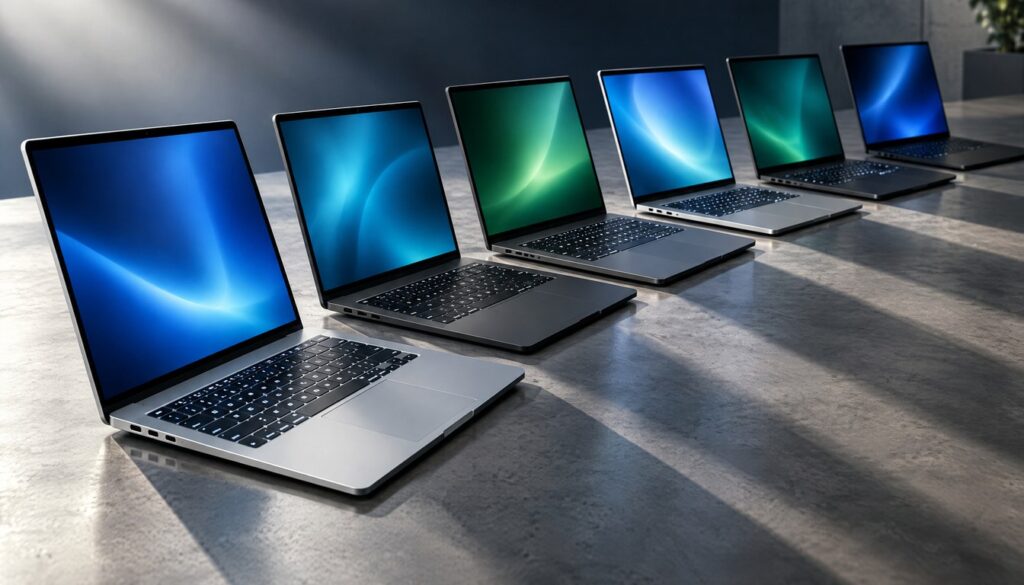
NVIDIA’s RTX Spark laptops went on sale October 16, 2026, putting six major PC makers into stores on the same day with Arm-based Windows machines built around a chip NVIDIA calls the N1X. The launch is the company’s clearest attempt yet to plant a flag on the Windows side of the AI laptop fight, a category Apple has largely owned since it moved the MacBook Pro to unified memory silicon. Pricing starts at $2,599 and climbs past $6,999 for the top configurations, according to NVIDIA’s own announcement and early retailer listings.
The six launch partners are ASUS, Dell, HP, Lenovo, Microsoft and MSI, NVIDIA confirmed in its launch-day announcement. That is a wider simultaneous rollout than most new Windows chip platforms get, and it lands at a moment when buyers who want to run large AI models locally have had exactly one mainstream option: Apple’s M-series Macs. Whether RTX Spark laptops actually close that gap, or simply give Windows shoppers a pricier way to try, is the question the first wave of reviews is already starting to answer, a question this site covered in detail ahead of launch.
RTX Spark Laptops Are Now Shipping From Six Major PC Makers
NVIDIA says RTX Spark laptops are Windows 11 PCs built to pair RTX graphics with its full AI software stack, covering creative work, gaming and on-device AI in a single machine. That framing matters because it tells you who NVIDIA thinks the buyer is: not a budget shopper, but someone who already spends money on a workstation or a high-end gaming laptop and wants one device that does both jobs plus local model inference.
Six brands shipped systems on day one. ASUS brought the ProArt P14 and ProArt P16. Dell contributed the XPS 16. HP has the OmniBook Ultra and OmniBook X 14. Lenovo’s entry is the Yoga Pro 9i. Microsoft used the platform for its own Surface Laptop Ultra, a system this site previously detailed spec by spec, and MSI rounded out the group with the Prestige N16 and Prestige N16 Flip AI+. That is a broader simultaneous launch roster than NVIDIA has managed with most new silicon platforms, and it signals the company wanted volume and shelf presence from day one rather than a staggered trickle of SKUs.
Street pricing split the lineup into two tiers almost immediately. Entry configurations, reported around an 18-core CPU, 24GB of unified memory and 512GB of storage, start near $2,599. Loaded configurations with the full 128GB memory pool and larger storage push well past $5,000, with the top-end ASUS ProArt P16 model listed at $6,999.99. That is a wide spread for a single chip platform, and it means the RTX Spark brand covers everything from a prosumer creator laptop to a near-workstation price tag.
Inside the N1X Chip: Specs That Actually Matter
The chip under all of this is the NVIDIA N1X, and its spec sheet reads more like a small AI accelerator than a typical laptop processor. NVIDIA lists a 6,144-core Blackwell RTX GPU paired with a 20-core Grace CPU, fourth-generation ray-tracing cores and fifth-generation Tensor Cores. Power draw is specified at 45 to 80 watts, a wide enough range that actual performance will depend heavily on how aggressively each OEM cools and clocks its own chassis.
Memory is the number that drives most of the AI-use-case coverage: up to 128GB of unified LPDDR5X, shared between CPU and GPU rather than split into separate VRAM and system RAM pools. That architecture is the same basic idea behind Apple’s unified memory Macs, and it is the reason NVIDIA can credibly market these laptops for running large local AI models rather than just gaming. NVIDIA also lists a second N1X configuration, seen in an HP laptop listing, with a smaller 5,120-core GPU, an 18-core CPU, 32GB of LPDDR5X-9400 and a 1TB PCIe Gen5 NVMe SSD, which appears to be the chip binned down for cheaper SKUs.
On the software side, NVIDIA is leaning on DLSS 5 and Reflex 2’s Low Latency Mode Frame Warp to carry the gaming half of the pitch, features this site examined in a launch-week deep dive. Those features ship across the RTX Spark lineup rather than being gated to premium SKUs, which is consistent with how NVIDIA has handled DLSS tiers on its desktop RTX cards.
RTX Spark Laptop Lineup and Pricing at Launch
Here is how the six launch partners break down by model and reported pricing, based on NVIDIA’s announcement and retailer listings cited in early coverage.
| Manufacturer | Model(s) | Starting Price | Max Memory | Notes |
|---|---|---|---|---|
| ASUS | ProArt P14, ProArt P16 | $2,599 | 128GB | P16 top config listed at $6,999.99 |
| Dell | XPS 16 | $2,599 (est.) | 128GB | Creator-focused chassis |
| HP | OmniBook Ultra, OmniBook X 14 | $2,599 | 128GB | Also lists a 32GB/5,120-core variant |
| Lenovo | Yoga Pro 9i | $2,599 (est.) | 128GB | First Lenovo RTX Spark system |
| Microsoft | Surface Laptop Ultra | $2,599 | 128GB | 6,144-core GPU, 20-core CPU |
| MSI | Prestige N16, Prestige N16 Flip AI+ | $2,599 (est.) | 128GB | Flip variant adds convertible hinge |
Every brand anchors its lineup near the same $2,599 entry point, which suggests NVIDIA set a reference price for OEMs rather than leaving it fully open. The real differentiation shows up at the top of each lineup, where ASUS’s ProArt P16, covered separately here when its 128GB configuration first surfaced, currently holds the highest confirmed price in the category.
What the First Reviews Are Actually Saying
Launch day coverage split cleanly into two camps: AI workstation enthusiasm and gaming-laptop skepticism. PCMag’s pre-review breakdown treats the N1X as a genuinely new category rather than a repackaged gaming chip, framing the 128GB unified memory ceiling as the headline feature for developers who want to run large models without a cloud GPU rental.
PC Gamer took the opposite angle on the gaming side. Its early testing found the Arm-based platform capable but not a laptop anyone should buy purely to play games, a verdict that matches the way NVIDIA itself is positioning the lineup, as an AI and creation machine that also games rather than a gaming machine first. The outlet’s review headline makes that distinction explicit, calling the machine impressive on an architectural level while stopping short of a gaming recommendation.
The pricing coverage carried its own skepticism. Both The Verge and PCWorld led their launch stories with the $6,999 ceiling rather than the $2,599 floor, a framing choice that tells you where the editorial attention landed. A near-$7,000 Windows laptop is a hard sell against a MacBook Pro, even a maxed-out one, unless the local-AI performance case is unusually strong, and neither outlet had independent benchmark numbers to back that case up at launch.
RTX Spark vs Apple Silicon: The Comparison Everyone Is Making, Carefully
It is easy to see why RTX Spark gets measured against Apple’s M5 Max and M5 Ultra Macs. Both platforms chase the same idea, a laptop or desktop with enough unified memory to hold a large language model entirely on-device, avoiding the latency and privacy tradeoffs of a cloud API call. NVIDIA’s 128GB ceiling sits in the same neighborhood as Apple’s higher-end configurations, and both companies now market unified memory as the feature that lets consumer hardware punch above its weight on local inference.
What nobody has published yet is a controlled, apples-to-apples benchmark of N1X against M5 Max or M5 Ultra on the same models, the same quantization and the same prompt set. The coverage available at launch confirms the specs on each side, not a head-to-head result. Readers should treat any claim that RTX Spark beats or loses to Apple Silicon on local AI performance as unverified until independent testing labs publish numbers, which typically takes a few weeks after a launch like this one.
That caveat does not make the comparison meaningless. It means the real competition right now is between two unverified promises, and the brand that ships believable third-party benchmarks first gets to set the narrative for the rest of the AI PC cycle. Apple’s own camp has not stood still either, with a pair of networked Mac Studios recently pitched as a $21,000 answer to exactly this kind of NVIDIA pressure.
Specs Side by Side: N1X Configurations
NVIDIA has disclosed two distinct N1X configurations so far, one aimed at the higher-memory flagship tier and one aimed at cheaper entry systems.
| Spec | N1X Flagship Config | N1X Entry Config |
|---|---|---|
| GPU cores | 6,144-core Blackwell RTX | 5,120-core Blackwell RTX |
| CPU | 20-core Grace | 18-core |
| Unified memory | Up to 128GB LPDDR5X | 32GB LPDDR5X-9400 |
| Storage | Up to 2TB PCIe Gen5 NVMe | 1TB PCIe Gen5 NVMe |
| Power range | 45-80W TDP | 45-80W TDP |
| Ray tracing / Tensor cores | 4th-gen RT / 5th-gen Tensor | 4th-gen RT / 5th-gen Tensor |
| DLSS / Reflex | DLSS 5, Reflex 2 Frame Warp | DLSS 5, Reflex 2 Frame Warp |
The gap between those two tiers explains why the lineup’s street prices spread so widely. A buyer paying $2,599 is getting a meaningfully smaller GPU and a quarter of the memory of the $6,999 configuration, not just a storage downgrade.
The AI PC Market RTX Spark Is Launching Into
RTX Spark laptops are not arriving in a vacuum. Gartner reported that worldwide PC shipments topped 63 million units in the second quarter of 2025, up 4.4% from the same quarter a year earlier, a sign the broader PC market had already pulled out of its post-pandemic slump before this launch. IDC’s separate forecast put full-year 2025 global PC volume at roughly 274 million units, projecting about 4.1% annual growth, according to its Worldwide Quarterly Personal Computing Device Tracker.
The AI-specific slice of that market is growing even faster on a relative basis. Gartner’s AI PC forecast projected that AI-capable PCs would represent 31% of the worldwide PC market by the end of 2025, a jump that set the stage for 2026 as the year AI PCs stopped being a niche SKU and started being a mainstream shelf category. IDC’s longer-range outlook, meanwhile, pegs the five-year compound annual growth rate for PC shipments overall at a more modest 1.5%, which means essentially all of the category’s near-term growth story is the AI PC segment, not the market as a whole.
That backdrop is exactly why NVIDIA wanted six OEMs launching on the same day instead of one or two. If AI PCs are the only part of the market growing, getting shelf space across ASUS, Dell, HP, Lenovo, Microsoft and MSI simultaneously is the fastest way to claim a meaningful share of that growth before Qualcomm, AMD or Apple lock in more of it first.
Why NVIDIA Needed a Beachhead on Windows
NVIDIA’s data center business runs on Windows, Linux and everything else equally, but its consumer AI story has had an obvious hole: Apple’s M-series Macs became the default recommendation for developers who wanted to run a 70-billion-parameter model locally, simply because unified memory made it possible on consumer hardware. NVIDIA controls the GPU side of nearly every AI workload that matters, yet it had no laptop of its own that could make that same local-inference pitch to a Windows buyer.
RTX Spark laptops close that hole, at least on paper. By putting a 128GB unified memory chip into six different chassis designs at once, NVIDIA is betting that Windows users who have been quietly buying Macs for AI work will switch back if a comparable local-inference laptop exists in their preferred operating system. That is a real market to fight for. Developers, researchers and small AI shops who do not want to pay for cloud GPU time on every test run are a growing, high-value segment, and NVIDIA has spent two years building the software stack, drivers, CUDA support and now DLSS 5 features, to make the pitch credible.
From DGX Spark to Laptop Shelves: The Fast Timeline
RTX Spark did not start life as a laptop chip. NVIDIA’s original Spark hardware launched as a desktop-class AI development box, a compact unit aimed at researchers who needed local model development power without a full data center rack. That box proved the N1X architecture and the unified memory approach worked outside of a traditional server environment.
Moving from a single desktop SKU to six simultaneous OEM laptop launches in roughly a year is an aggressive timeline by PC industry standards. Most new chip platforms stagger across OEMs over several quarters, giving each manufacturer time to validate thermals, drivers and chassis design independently. NVIDIA instead pushed ASUS, Dell, HP, Lenovo, Microsoft and MSI through validation on a shared schedule, which is part of why the pricing across brands looks so similar at launch. There was less time for each OEM to differentiate before the October 16 date locked in.
Competitive Landscape: Qualcomm, AMD, Intel and Apple All Want This Buyer
RTX Spark is not competing in an empty category. Qualcomm’s Snapdragon X Arm chips already pushed Windows laptop makers toward longer battery life and always-on AI features over the past two years, and AMD has its own Ryzen AI lineup positioned for the same Copilot+ PC wave Microsoft has pushed since 2024. Intel, meanwhile, is defending its traditional x86 laptop base while trying to build out its own AI PC story around Core Ultra silicon.
Apple remains the chip to beat on the specific use case NVIDIA is targeting: large local model inference on a laptop a creative professional or developer would actually want to carry. Apple’s advantage has always been vertical integration, it controls the chip, the operating system and the software stack end to end, which is the same playbook NVIDIA is now trying to replicate across six different Windows OEMs at once. Whether that fragmented approach can match Apple’s single-vendor consistency is the open question the next few months of reviews will answer.
What Developers and Creators Can Realistically Run Locally
The practical appeal of a 128GB unified memory laptop comes down to what fits in memory without heavy quantization. At that ceiling, a developer can load mid-size open-weight language models, run local diffusion image generation, or keep a coding assistant resident in memory alongside a full IDE and browser session, all without touching a cloud API. That is the pitch NVIDIA is making to the same audience that currently buys Mac Studios or maxed-out MacBook Pros specifically for this workflow.
The caveat is software maturity. CUDA has a long head start on macOS’s Metal framework for raw AI tooling support, which should theoretically favor RTX Spark once developers start optimizing for the N1X’s Blackwell architecture specifically. But that optimization work takes time, and at launch most of the tooling running on these laptops is the same general-purpose stack that already runs on desktop RTX cards, not something tuned for a 45 to 80 watt mobile power envelope. Early adopters should expect some rough edges before the software catches up to the hardware’s theoretical ceiling.
Market Impact: What a Six-OEM Launch Signals to the Industry
A simultaneous six-brand launch is itself a market signal, independent of how the laptops perform. It tells component suppliers, software partners and rival chipmakers that NVIDIA expects enough demand to justify spreading inventory across six supply chains at once rather than concentrating volume with one or two flagship partners. It also raises the stakes if the launch underperforms, because a stumble would be visible across six brands simultaneously rather than contained to a single OEM’s quarterly numbers.
For the OEMs themselves, RTX Spark gives each brand a flagship AI story to put next to their existing Copilot+ PC lineups built on Qualcomm and AMD silicon. Microsoft’s decision to use the platform for its own Surface Laptop Ultra is the clearest vote of confidence in the launch, since Microsoft had the option to stick exclusively with Qualcomm’s Arm chips for its flagship Surface line and chose not to. The ripple effects already reached competing chipmakers, with Intel shares dropping on RTX Spark-related coverage even though the two chips target different markets.
Predictions: Where RTX Spark Goes From Here
- Independent benchmark labs will publish N1X versus Apple M5 Max and M5 Ultra local-inference comparisons within four to eight weeks, and the results will likely be closer than either company’s marketing implies.
- Street prices on the entry $2,599 configurations will soften by 10 to 15% before the end of Q1 2027 as OEMs compete for the same buyer with nearly identical base specs.
- At least one additional OEM beyond the current six will announce an RTX Spark laptop before NVIDIA’s next major GPU generation reveal, extending the platform’s shelf presence further.
- Qualcomm and AMD will respond with their own higher-memory AI PC configurations aimed squarely at the 128GB unified memory tier RTX Spark just established as the category benchmark.
- The $6,999 flagship tier will remain a low-volume halo product, with the bulk of actual sales concentrated in the $2,599 to $3,500 range where RTX Spark competes most directly against premium Copilot+ PCs rather than against Apple.
The Bottom Line for Buyers Right Now
If you are shopping today, the honest read on RTX Spark laptops is that they are a real, shipping product with legitimate specs, not a paper launch. Six OEMs selling real SKUs at real prices is meaningfully different from a single reference design trickling out over months. But the laptops are also launching ahead of the independent benchmarks that would actually tell you whether the local-AI performance matches the marketing, and ahead of the software optimization that typically arrives a few months after a new architecture ships.
Buyers who need a Windows machine for AI development today, and who cannot wait for a software maturity cycle, have a genuine new option at $2,599 and up. Buyers who are primarily comparing against a MacBook Pro on performance per dollar should wait for the independent tests that are almost certainly coming before the end of the year.
Frequently Asked Questions
When did RTX Spark laptops officially launch?
NVIDIA RTX Spark laptops became available on October 16, 2026, with six manufacturers selling systems simultaneously.
Which companies are selling RTX Spark laptops at launch?
ASUS, Dell, HP, Lenovo, Microsoft and MSI are the six confirmed launch partners, covering models including the ASUS ProArt P14 and P16, the Dell XPS 16, the HP OmniBook Ultra and OmniBook X 14, the Lenovo Yoga Pro 9i, the Microsoft Surface Laptop Ultra, and the MSI Prestige N16 and N16 Flip AI+.
How much do RTX Spark laptops cost?
Pricing starts at $2,599 for entry configurations. The top-end ASUS ProArt P16 configuration is listed at $6,999.99, making it the most expensive confirmed model in the lineup.
What chip powers RTX Spark laptops?
The flagship configuration uses NVIDIA’s N1X chip, which pairs a 6,144-core Blackwell RTX GPU with a 20-core Grace CPU, up to 128GB of unified LPDDR5X memory, and a 45 to 80 watt power range. A cheaper configuration uses a smaller 5,120-core GPU, an 18-core CPU, and 32GB of memory.
Is RTX Spark better than a MacBook Pro for running AI models?
There is no independently verified benchmark comparing RTX Spark’s N1X chip against Apple’s M5 Max or M5 Ultra chips on local AI inference as of launch. Both platforms offer large unified memory pools in a similar range, but any claim of one beating the other should be treated as unverified until third-party testing is published.
Are RTX Spark laptops good for gaming?
Early hands-on coverage from PC Gamer described the platform as a capable Arm-based gaming laptop but not one reviewers recommended buying purely for gaming, since the chip and pricing are positioned primarily around AI and creative workloads.
Do RTX Spark laptops run Windows?
Yes. NVIDIA confirmed RTX Spark laptops run Windows 11, making them Arm-based Windows PCs rather than a new operating system or a Linux-only platform.
What is DLSS 5 and why does it matter for RTX Spark?
DLSS 5 is NVIDIA’s latest frame generation and upscaling technology, bundled with Reflex 2’s Low Latency Mode Frame Warp across the RTX Spark lineup. It is the main software feature NVIDIA is using to support the gaming side of the laptops’ pitch, alongside fourth-generation ray-tracing cores and fifth-generation Tensor Cores.