Konami’s next attempt to prove Silent Hill still has teeth arrived on review sites this week, and the verdict is split down the middle. Silent Hill: Townfall, the first-person psychological horror game built by Glasgow studio Screen Burn and published by Konami Digital Entertainment alongside Annapurna Interactive, ships on PlayStation 5 and PC on September 24, 2026. A review published by CBC on September 21, 2026, carried the headline “Psychological horror Silent Hill: Townfall ratchets up the scares – and frustrations,” and that tension between dread and irritation runs through nearly every early write-up.
Early scores range from a 7 out of 10 at Metro to an 8.25 out of 10 from Game Informer, with at least one 9-out-of-10 review already logged on aggregator OpenCritic. That is not a disaster by any measure, but it is also not the clean triumph Konami needed after years of trying to convince players the Silent Hill name still means something. Here is what the reviews actually say, how Townfall plays, what it costs, and what a mixed-but-mostly-positive reception means for the franchise going into launch week.
What Is Silent Hill: Townfall?
Silent Hill: Townfall is a psychological survival horror game and the newest entry in Konami’s long-running Silent Hill franchise. Unlike the over-the-shoulder camera Silent Hill fans have used since the PlayStation 2 era, Townfall is played entirely in first person, a perspective shift that reviewers say changes how threatening the game’s environments feel. The game is developed by Screen Burn, a Glasgow-based studio, and published jointly by Konami Digital Entertainment and Annapurna Interactive, the publisher behind narrative-driven titles that lean on atmosphere over spectacle.
That pairing matters. Konami owns the Silent Hill name and its history, while Annapurna has spent the last decade building a reputation for backing smaller, mood-heavy games rather than blockbuster action titles. Reviewers pointed to that combination as the reason Townfall feels closer to a slow-burn horror experience than a jump-scare theme park ride, even though jump scares are still part of the package according to multiple write-ups.
Release Date and Platforms: A September 24 Launch, With One Date in Question
Most outlets covering Silent Hill: Townfall list a release date of September 24, 2026, on PlayStation 5 and PC. That includes the majority of the review coverage circulating this week. One outlet, Radio Times, listed September 23 for PC and PS5 in its own coverage, a day earlier than the figure most other sites are using. Shattered.io was not able to independently confirm which date is correct at time of publication, so treat the one-day gap as an open question until Konami’s own storefront pages settle it. Either way, the window is days away, not weeks, which is why review copies are landing now.
No console generation split has been reported. There is no mention of a PlayStation 4 or Xbox version in the coverage reviewed for this piece, and nothing pointing to a Nintendo Switch 2 port at launch. That keeps Townfall in the same lane as several other recent horror titles that target current-generation hardware and PC first, then decide on ports later depending on how sales go. It also lands in a busy stretch for PlayStation’s own release calendar, just weeks after Sony used its September State of Play to close its show with Final Fantasy VII Revelation, another reminder of how packed the platform’s late-2026 lineup already is.
Price Breakdown: What Silent Hill: Townfall Costs by Region
Pricing for Silent Hill: Townfall varies slightly depending on which outlet’s review you read, likely reflecting regional storefront conversion rather than any real price difference. One review listed the UK price at £44.99. Tom’s Guide’s coverage listed $49 in the US, £44 in the UK, and AU$69 in Australia. Those numbers land Townfall a notch below full $70 blockbuster pricing, which fits Annapurna’s history of pricing its published titles under the top tier even when a bigger studio is attached.
| Region | Reported Price | Platforms |
|---|---|---|
| United Kingdom | £44.99 (one review) / £44 (Tom’s Guide) | PS5, PC |
| United States | $49 | PS5, PC |
| Australia | AU$69 | PS5, PC |
The small gap between the £44.99 figure and Tom’s Guide’s £44 is almost certainly rounding rather than a real discrepancy between reviewers. Shoppers comparing prices across stores ahead of the September 24 launch should expect to pay somewhere in that narrow band.
Screen Burn and Konami: Who Actually Made This Game
Screen Burn, also referred to in coverage as Screen Burn Interactive, is a Glasgow-based studio, and Silent Hill: Townfall marks one of its highest-profile projects to date. Handing a mainline-adjacent Silent Hill entry to a smaller UK studio rather than an established horror house is a departure from Konami’s recent pattern. Bloober Team, the Polish studio behind the psychological horror games Layers of Fear and Blair Witch, remade Silent Hill 2 a couple of years ago and has been the face of Konami’s franchise revival since. Screen Burn getting a fully original Silent Hill project, rather than a remake, signals Konami is willing to spread the license across more than one external partner.
Annapurna Interactive’s involvement as co-publisher is the other notable wrinkle. Annapurna typically works with smaller teams on original, atmosphere-first games rather than franchise revivals tied to a legacy publisher’s back catalog. Its name on the box suggests Konami wanted outside credibility with the kind of critics and players who associate Annapurna with quality over volume, rather than leaning purely on nostalgia for the Silent Hill name.
The Setting: St. Amelia, an Abandoned Scottish Fishing Village
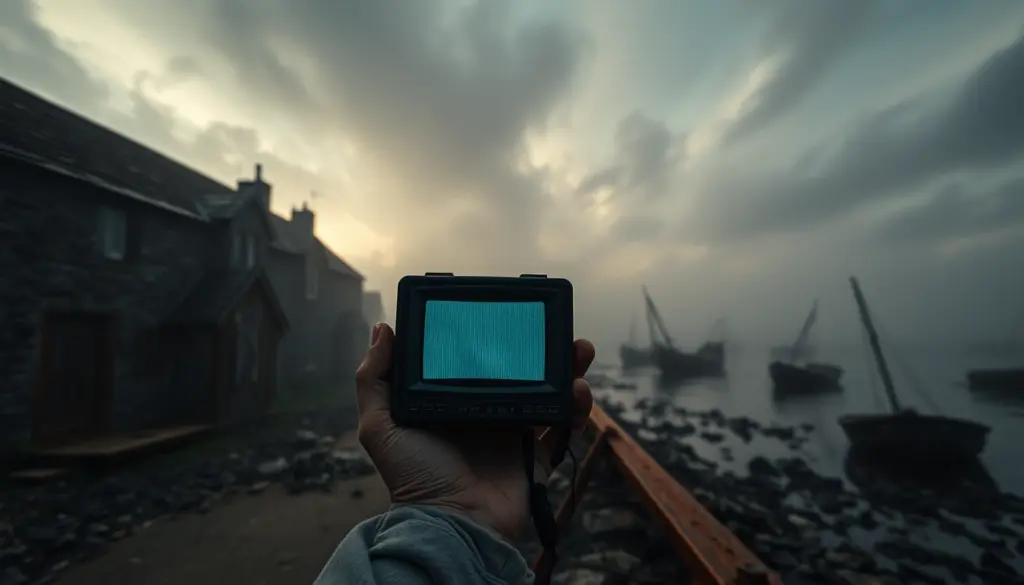
Townfall trades the American Rust Belt aesthetic of past Silent Hill games for St. Amelia, a fictional, abandoned fishing village on an island off the coast of Scotland. That’s a real departure for a franchise historically anchored to a fog-choked town in the northeastern United States. Reviewers describe St. Amelia as desolate and weather-beaten, the kind of place a British village might become if the fishing industry collapsed and nobody ever came back. Given Screen Burn’s Glasgow roots, the choice of a Scottish setting looks like a deliberate decision to bring some of the studio’s own geography and cultural texture into a franchise that has spent almost 30 years in America.
Several reviews describe exploring St. Amelia as a “puzzle-box” experience, meaning the island itself is structured like a series of interlocking areas and secrets rather than a straight line from start to finish. That structure echoes what longtime Silent Hill players expect: environmental storytelling that rewards backtracking and close attention over pure action.
Meet Simon, Townfall’s Protagonist
The player character is Simon, a former resident of St. Amelia who returns to the island as the story begins. Coverage reviewed for this piece does not detail why Simon left or what specifically draws him back, keeping those particulars appropriately vague ahead of launch. What is clear is that Simon’s history with the island is central to the game’s psychological angle, in keeping with a franchise built around characters confronting personal trauma rather than generic monster-hunters.
Core Gameplay: Stealth, a Handheld CRT Device, and Escape Planning
Townfall leans hard into stealth rather than combat. Reviews consistently describe a design built around hiding, scouting ahead, and planning escape routes instead of fighting monsters head-on. Simon carries a handheld CRT device that lets him detect threats through walls, a mechanic multiple outlets single out as the game’s signature gadget. It functions as both a navigation tool and a tension generator: knowing something dangerous is on the other side of a door changes how a player moves through a space, even when they cannot see the threat directly.
That CRT device fits a design lineage running back through horror games that use limited-information tools, like a flashlight with a dying battery, to create dread out of what the player cannot fully see. The twist here is that it is diegetic (an actual object Simon carries, with a period-appropriate CRT screen) rather than a heads-up-display overlay, which keeps players anchored in the game’s world instead of pulling their eyes to an abstract meter.
Pursuit Sequences and the Inconsistency Problem
Townfall also includes pursuit sequences featuring an unrelenting enemy, in the tradition of Resident Evil’s Mr. X or Alien: Isolation’s Xenomorph. These sections are where reviewers flagged the game’s biggest mechanical weakness: several write-ups describe stealth detection as inconsistent, meaning the game does not always behave predictably about when Simon has been spotted or successfully hidden. That inconsistency is very likely the “frustrations” referenced directly in CBC’s headline, since unpredictable stealth systems tend to feel unfair rather than tense when they misfire, breaking the exact mood a horror game depends on.
Puzzles and Pacing: How Townfall Structures Its Horror
Puzzles make up a significant part of the Townfall experience, according to multiple reviews, with the exploration of St. Amelia itself described as puzzle-box in nature. That places Townfall closer to classic Silent Hill design, where solving an environmental riddle to open a locked door was as core to the experience as running from a monster, and further from the more combat-forward direction some modern horror franchises have taken. Reviews also note the game leans on jump scares and is characterized as dark and disturbing in tone, so Townfall is not attempting to be a purely cerebral, scare-free thriller. It wants both the slow dread of exploration and the jolt of a well-timed scare, a combination that is difficult to balance and one where reception has clearly varied by reviewer.
Review Scores So Far: A 7-to-9 Split
The clearest data point available ahead of Townfall’s September 24 launch is the spread of numeric review scores already published. Metro gave the game a 7 out of 10. Game Informer scored it higher, at 8.25 out of 10. Insider Gaming rated it “Very Good” with a score of 7. On OpenCritic, the aggregator tracking multiple outlets’ scores, at least one review currently sits at a 9 out of 10. CBC’s review does not carry a numeric score in the coverage reviewed here, but its headline framing (scares paired directly with frustrations) puts it closer to the cautiously positive end of the spectrum than an outright pan.
| Outlet | Score | Verdict Style |
|---|---|---|
| Game Informer | 8.25 / 10 | Numeric score |
| OpenCritic (at least one listed review) | 9 / 10 | Numeric score |
| Metro | 7 / 10 | Numeric score |
| Insider Gaming | 7 (“Very Good”) | Numeric plus qualitative label |
| CBC | Not numerically scored | Qualitative: scares paired with frustrations |
A spread from 7 to 9 out of 10 is not a red flag on its own. Plenty of well-regarded games land in that range simply because critics weigh pacing, difficulty, and tone differently. What stands out here is how consistently reviewers single out the same specific issue (inconsistent stealth detection during pursuit sequences) as the drag on an otherwise strong atmosphere and puzzle design. That kind of repeated, specific complaint tends to matter more to how a game is remembered than a single low outlier score would.
What Critics Praised
Across the reviews referenced in this piece, three elements come up repeatedly as strengths. First, the St. Amelia setting itself, which reviewers describe as a well-realized, puzzle-box environment that rewards exploration. Second, the CRT detection device, which multiple outlets call out as a fresh mechanical hook that ties Simon’s tools directly into the horror rather than bolting a generic gadget onto the experience. Third, the game’s tone: the combination of jump scares with a slower, dread-based atmosphere earned praise for staying true to what longtime Silent Hill fans expect from the series, rather than chasing a more action-oriented horror format.
What Critics Flagged as Frustrating
The recurring criticism is mechanical rather than tonal. Reviewers pointed to inconsistent stealth detection during the game’s pursuit sequences as the clearest weak point, describing moments where it was unclear why Simon had been spotted, or unclear why hiding worked in one instance and failed in another. In a stealth-driven horror game, that kind of unpredictability undercuts the exact tension the CRT device and the St. Amelia setting are built to create. It is the kind of issue that a post-launch patch can meaningfully improve, which is worth watching in the weeks after release.
Silent Hill: Townfall vs Recent Survival Horror Releases
Townfall is landing into a survival horror market that has been unusually active. Capcom’s Resident Evil Requiem has already topped 7 million units sold and helped lift the publisher’s profit by double digits, a reminder that horror remains one of gaming’s more reliably profitable genres when executed well. Capcom has also been busy on older ground, with the Resident Evil 2, 3, and 4 remakes landing on Switch 2 this fall, extending that franchise’s reach into a new hardware generation Townfall is not currently targeting.
The comparison that matters most for Konami, though, is internal. Townfall is competing for attention against its own franchise’s recent history, following the Silent Hill 2 remake that Bloober Team shipped a couple of years ago and that reset expectations for what a modern Silent Hill game should look and feel like. A 7-to-9 review spread with one specific, repeated mechanical complaint is a reasonable outcome for a new IP within an established franchise, but it is not the kind of across-the-board acclaim that turns a single game into a system-seller. For context on how review scores translate into commercial outcomes, Marvel’s Wolverine’s more mixed Metacritic score of 77 is a recent reminder that even well-funded, well-known studios can land in that same cautiously-positive-but-not-triumphant zone.
Historical Context: Konami’s Multi-Year Silent Hill Revival
Silent Hill spent roughly a decade in commercial limbo after Konami shifted its broader business focus away from big-budget console games and toward pachinko machines and mobile titles. The franchise’s return began in earnest with Bloober Team’s remake of Silent Hill 2, which reintroduced the series to a generation of players who had only heard about the original through reputation. Townfall represents the next, more ambitious step: rather than remaking an existing story, Konami is betting on original horror built by a different external studio, in a different country, with a different visual perspective. That is a meaningfully bigger risk than a remake, since there is no built-in nostalgia to fall back on if the new mechanics do not land.
It also puts Townfall in a similar spot to other legacy franchises trying to prove they can produce new, original entries rather than living entirely off remasters and remakes. Konami’s willingness to hand the keys to Screen Burn, a comparatively small Glasgow studio, mirrors a broader industry pattern of established publishers turning to smaller, focused teams for horror specifically, since the genre tends to reward tight, atmospheric design over blockbuster scale. That pattern shows up across the wider gaming industry this year, including in original Japanese action titles like Onimusha: Way of the Sword, which crossed 1 million copies sold in a single day on the strength of a similarly tight, focused design rather than blockbuster marketing spend.
Market Impact: What a Split Reception Means for Konami and Annapurna
For Konami, a 7-to-9 spread with a fixable, clearly identified mechanical complaint is a defensible outcome heading into launch day. It is not the kind of universal acclaim that guarantees a sales spike on par with the biggest horror releases of the year, but it is also far from the kind of reception that would suggest the franchise’s revival is stalling. Annapurna’s brand, meanwhile, gets attached to a game with a real, if imperfect, identity rather than a rote sequel, which fits the publisher’s track record of backing titles that critics respect even when they are not chart-toppers.
The bigger commercial question is whether the stealth-detection criticism shows up consistently enough in player reviews after launch to affect word of mouth. Games with strong atmosphere and one clearly-named mechanical flaw often see a gap between critic scores and long-term player sentiment, especially on Steam, where user reviews accumulate over months rather than the first 48 hours. Konami and Screen Burn have roughly three days between this wave of critic reviews and the September 24 launch to decide whether a day-one patch addressing detection consistency is worth rushing out.
Predictions: What Happens Next for Silent Hill: Townfall
Based on the review pattern so far, a few outcomes look likely in the weeks after launch:
- Expect Konami or Screen Burn to address stealth-detection consistency in a post-launch patch within the first month, since it is the one specific, repeated complaint across multiple outlets rather than a matter of taste.
- Expect the one-day release date discrepancy between Radio Times and the rest of the coverage to resolve itself quietly once storefronts go live on the 24th, with no formal correction likely needed.
- Expect player review sentiment on PC storefronts to track close to the 7-to-9 critic spread rather than diverge sharply, since the praised elements (setting, CRT device, tone) and the criticized element (stealth inconsistency) are both experience-defining rather than niche complaints.
- Expect Konami to point to Townfall, alongside the earlier Silent Hill 2 remake, as evidence the franchise can support multiple concurrent projects with different external studios, likely teeing up further announcements tied to the series’ anniversary.
- Expect Annapurna’s involvement to be cited by other legacy publishers as a case study in pairing an atmosphere-focused indie publisher with a horror IP, regardless of how Townfall’s sales land.
Should You Buy Silent Hill: Townfall at Launch?
For players who prioritize atmosphere, puzzle-driven exploration, and a strong sense of place over flawless combat systems, the current review spread suggests Townfall delivers on the parts that matter most to longtime Silent Hill fans. For players who are more sensitive to mechanical inconsistency, particularly during high-tension pursuit sequences, it may be worth watching for a patch before jumping in at full price of $49 in the US or £44.99 in the UK. Either way, the September 24 launch (or September 23, per Radio Times’ still-unconfirmed date) gives players very little time to wait and see how post-launch player reviews settle before the game is already out.
Frequently Asked Questions
When does Silent Hill: Townfall release?
Most coverage lists September 24, 2026 as the release date for PlayStation 5 and PC. Radio Times listed September 23, 2026 in its own reporting, so treat the exact day as slightly unsettled until Konami’s storefront listings go live.
What platforms is Silent Hill: Townfall available on?
Silent Hill: Townfall is confirmed for PlayStation 5 and PC (Windows). No other platforms have been confirmed in the coverage reviewed for this article.
How much does Silent Hill: Townfall cost?
Reported pricing is £44.99 in the UK (with one outlet listing £44), $49 in the US, and AU$69 in Australia.
Who developed Silent Hill: Townfall?
The game is developed by Screen Burn, a Glasgow-based studio also referred to as Screen Burn Interactive, and published by Konami Digital Entertainment together with Annapurna Interactive.
What review scores has Silent Hill: Townfall received so far?
Early scores include 7 out of 10 from Metro, 8.25 out of 10 from Game Informer, a 7 (“Very Good”) from Insider Gaming, and at least one 9 out of 10 review listed on OpenCritic. CBC published a review without a numeric score attached.
Is Silent Hill: Townfall a remake or an original story?
It is an original story, not a remake. It follows Simon, a former resident of the fictional Scottish fishing village St. Amelia, and is not tied to the events of previous Silent Hill games covered in earlier reviews.
What is the main criticism reviewers have of Silent Hill: Townfall?
Multiple outlets flagged inconsistent stealth detection during the game’s pursuit sequences, where it is not always clear why the player has been spotted or successfully hidden from the game’s antagonist.
Does Silent Hill: Townfall have combat?
The game emphasizes stealth over combat, built around hiding, planning escape routes, and avoiding direct confrontation, according to multiple reviews of the game’s mechanics.
Sources: reviews and reporting from CBC, Game Informer, OpenCritic, Metro, Tom’s Guide, and Radio Times, alongside publisher information from Konami and Annapurna Interactive.