
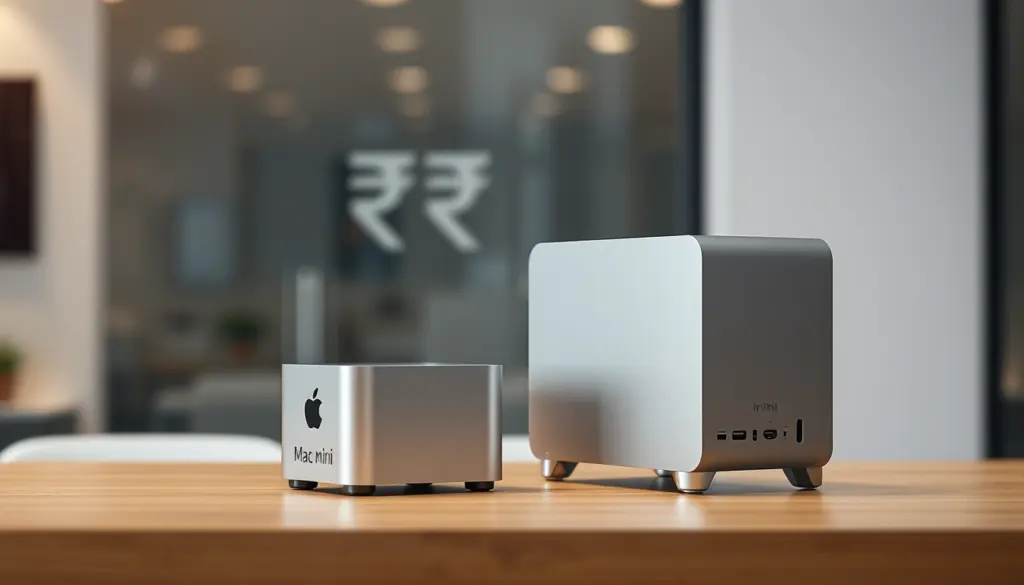
Apple pushed its Mac desktop lineup into a new chip generation in India on August 29, 2026, confirming that the Mac mini now ships with the M6 chip and that the Mac Studio tops out with a new M5 Ultra option. The announcement, reported across Indian and international tech outlets including Asianet Newsable, Forbes, Technology Org, stupidDOPE and Geeky Gadgets, sets starting prices, configuration details and a pre-order window that puts India in the same launch cycle as Apple’s other major markets.
The refresh touches four machines in total: a Mac mini with M6, a Mac mini with M5 Pro, a Mac Studio with M5 Max, and a Mac Studio with M5 Ultra. For a market where Apple’s desktop share has been slowly climbing against a Windows-dominated PC base, the pricing and timing decisions matter as much as the silicon itself. Below is what changed, what it costs, and why the numbers matter for buyers, developers and the broader India PC market heading into the 2026 festive shopping season.
What Apple Announced: M6 Mac Mini and M5 Ultra Mac Studio
Apple’s India lineup now splits into two product lines carrying three chip tiers between them. The Mac mini comes in M6 and M5 Pro variants, while the Mac Studio comes in M5 Max and M5 Ultra variants. That’s a generational jump for the mini (moving past the M4 generation) and a new ceiling for the Studio, which previously topped out at M3 Ultra in most reporting cycles. Apple’s own newsroom material, cited by multiple outlets covering the launch, frames the M6 and M5 Ultra as the headline upgrades for this cycle, targeting faster everyday performance on the mini and heavier AI and compute workloads on the high-end Studio.
The base M6 Mac mini ships with a 12-core CPU and a 12-core GPU, according to specs reported by outlets covering the announcement. The entry configuration includes 16GB of unified memory, with the M6 platform supporting configurations up to 32GB. Storage starts at a 256GB SSD, with higher-capacity configurations available at checkout for an added cost. None of the reporting so far has broken out clock speeds, neural engine core counts or exact GPU architecture changes versus the prior M4 mini, so those details remain open until Apple publishes a full technical spec sheet for the India store.
What is confirmed is the shape of the lineup itself: Apple is not consolidating around a single chip tier per product this cycle. Buyers choosing a Mac mini pick between M6 (positioned as the mainstream option) and M5 Pro (the higher-power tier for the same chassis), while Mac Studio buyers choose between M5 Max and M5 Ultra. That four-way split mirrors how Apple has structured desktop launches since the M-series transition began, keeping a clear price and performance ladder between “prosumer” and “workstation-class” buyers.
India Pricing: Mac Mini and Mac Studio Starting Costs
Pricing is where this launch gets concrete. According to the outlets covering the India rollout, general-customer MRP starting prices are as follows: the Mac mini with M6 starts at ₹99,900, the Mac mini with M5 Pro starts at ₹2,09,900, the Mac Studio with M5 Max starts at ₹2,79,900, and the Mac Studio with M5 Ultra starts at ₹6,29,900. That puts roughly a ₹5.3 lakh gap between the cheapest and most expensive machine in the refreshed lineup, a wider spread than Apple has typically run on its desktop line in India.
| Model | Chip | Starting Price (General) | Starting Price (Education) |
|---|---|---|---|
| Mac mini | M6 | ₹99,900 | ₹88,990 (reported, one outlet lists ₹88,900) |
| Mac mini | M5 Pro | ₹2,09,900 | ₹1,97,900 |
| Mac Studio | M5 Max | ₹2,79,900 | ₹2,56,900 |
| Mac Studio | M5 Ultra | ₹6,29,900 | ₹5,84,900 |
That education discrepancy is worth flagging rather than smoothing over. Some outlets list the M6 Mac mini’s education starting price at ₹88,990, while others report ₹88,900. The gap is small (₹90) but it’s unresolved across sources at the time of writing, and shattered.io was not able to confirm which figure is the final one Apple is charging through its education store. Everything else in the table lines up cleanly across the outlets that reported it.
For comparison, the entry M6 mini at ₹99,900 sits just under the psychological ₹1 lakh mark, a pricing decision that keeps Apple’s cheapest desktop accessible to prosumer and small-business buyers who might otherwise look at a high-end Windows mini PC. The top-end M5 Ultra Mac Studio at ₹6,29,900, by contrast, is priced well into workstation territory, competing more with professional rendering and AI-development rigs than with anything resembling a typical desktop purchase.
Pre-Order and Availability Timeline
Apple opened pre-orders for the Mac mini with M6 and the Mac Studio with M5 Max and M5 Ultra on August 25, 2026, in India, according to reporting on the announcement. The Times of India specifically noted that pre-orders for the Mac mini with M6 and Mac mini with M5 Pro began August 25, with retail availability starting September 22, 2026. That’s a four-week gap between pre-order and ship date, in line with how Apple has staged past Mac launches to let supply chains catch up with day-one demand.
One detail that remains genuinely unclear: whether September 22 is the confirmed ship date for every configuration across both product lines, or only for the specific models named in the Times of India report. Not every outlet covering the launch specified availability dates for each SKU, so treat September 22 as the best-supported date for the Mac mini line and the higher-end Mac Studio configurations, rather than as a blanket date guaranteed for every build-to-order variant.
Why the Timing Matters for India’s PC Market
India’s PC and Mac market has been a growth story Apple keeps returning to. A September 22 ship date lands the new Mac Studio and mini lineup roughly five weeks ahead of Diwali (which falls in late October 2026), putting the refreshed desktops in front of buyers during India’s biggest annual shopping season. That’s not a coincidence Apple usually leaves to chance: past Mac and iPhone launches in India have consistently been timed to land inventory before the festive quarter, when consumer electronics spending spikes across the country.
The desktop category itself is a smaller slice of Apple’s India business than iPhone, but it’s a strategically important one. Mac sales in India skew toward students, developers, video editors and small studios, exactly the buyer profile that cares about the jump from M4 to M6 on the mini, or from M3 Ultra-class performance to M5 Ultra on the Studio. Pricing the M6 mini just under ₹1 lakh keeps that entry point within reach of students and freelancers, while the education pricing tier (₹88,990 or ₹88,900, depending on the source) is aimed squarely at the same audience Apple has chased with campus pricing in prior cycles.
Mac Mini M6 vs Mac Mini M5 Pro: Which One to Buy
The gap between the two mini configurations is large: ₹99,900 for the M6 model versus ₹2,09,900 for the M5 Pro model, more than double the entry price. That’s a bigger price step than the spec sheet alone would suggest, based on what’s confirmed so far. The base M6 mini’s 12-core CPU, 12-core GPU, 16GB unified memory and 256GB SSD cover general productivity, web development and everyday creative work without much trouble. The M5 Pro tier exists for buyers who need more sustained compute (video editing, local AI inference, larger dev builds) and are willing to pay roughly double for it.
For most buyers researching this launch, the practical decision comes down to workload rather than brand loyalty. Casual users, students and light developers get everything they need from the M6 tier. Buyers running local large language models, doing 4K/8K video work, or compiling large codebases regularly are the ones for whom the M5 Pro step-up starts to pay for itself.
Mac Studio M5 Max vs M5 Ultra: The Workstation Tier
On the Mac Studio side, the price gap is even starker: ₹2,79,900 for M5 Max versus ₹6,29,900 for M5 Ultra, a jump of ₹3.5 lakh. That’s more than the cost of an entire second Mac mini. Apple has historically reserved the Ultra tier for buyers doing heavy 3D rendering, scientific computing, large-scale local AI model work, or professional audio and video production at scale. Nothing in the current reporting breaks out exact core counts or memory bandwidth figures for the M5 Ultra versus M5 Max, so buyers comparing the two on paper will need to wait for Apple’s full India spec pages to go live alongside the September 22 availability date.
Historical Context: How Apple Silicon Got Here
Apple’s shift away from Intel chips in the Mac lineup began in November 2020 with the original M1, and the company has run roughly annual or biannual chip refreshes since. The Mac mini and Mac Studio have followed a predictable pattern: a lower-cost “mini” chassis paired with mainstream chip tiers, and a “Studio” chassis reserved for the higher-wattage Max and Ultra dies that need more cooling headroom than the mini’s compact enclosure can provide. The jump to M6 on the mini and the introduction of M5 Ultra on the Studio continues that same structural split rather than breaking from it.
What’s notable about this cycle, based on what’s confirmed in the announcement, is that Apple is running two different chip generations across two product lines at once: M6 (newest) alongside M5 Pro on the mini, and M5 Max alongside M5 Ultra on the Studio. That’s consistent with how Apple has staggered its silicon roadmap in past years, where the highest-end “Ultra” die typically arrives on its own timeline, sometimes a generation behind the chip used in the mainstream product it’s paired with in marketing.
Market Impact: What This Means for Apple in India
Apple has spent the past few years building out its India retail and manufacturing presence, from opening its first India-based Apple Stores to expanding local iPhone assembly. A coordinated Mac mini and Mac Studio refresh, priced and timed for the festive season, fits that broader pattern of treating India as a priority market rather than an afterthought market that gets older hardware at a markup.
The pricing itself sends a signal too. Keeping the entry Mac mini under the ₹1 lakh mark, even as the top Mac Studio configuration clears ₹6 lakh, tells a two-track story: Apple wants a low-friction entry point for the mainstream buyer while still charging a premium for the workstation-class hardware that competes with professional PC towers rather than consumer desktops. Industry analysts who track India’s PC market, including researchers at firms like Counterpoint Research and IDC, have generally noted that Apple’s share of India’s PC shipments remains in the single digits by volume but skews toward higher average selling prices than the market overall, a pattern this launch does nothing to change.
Competitive Comparison: Mac Mini and Mac Studio vs the Field
Apple’s desktop refresh lands in a market where Windows mini PCs and workstation towers compete on raw price-per-core rather than on integrated design. A Windows-based mini PC with a comparable CPU core count is often available in India for well under the ₹99,900 starting price of the M6 Mac mini, though direct comparisons are messy: Apple’s unified memory architecture and integrated GPU don’t map cleanly onto discrete Windows CPU-plus-GPU configurations. On the high end, the ₹6,29,900 M5 Ultra Mac Studio competes less with consumer PCs and more with professional workstation towers built around Intel Xeon or AMD Threadripper chips paired with discrete Nvidia or AMD professional GPUs, a category where component-level pricing varies widely by configuration.
| Category | Apple Positioning | Typical Competing Category |
|---|---|---|
| Entry desktop | Mac mini M6, ₹99,900 | Windows mini PCs / entry towers |
| Prosumer desktop | Mac mini M5 Pro, ₹2,09,900 | Mid-range creator workstations |
| Creative workstation | Mac Studio M5 Max, ₹2,79,900 | Discrete-GPU editing/render rigs |
| Professional workstation | Mac Studio M5 Ultra, ₹6,29,900 | Xeon/Threadripper + pro GPU towers |
The comparison above is necessarily general since Apple has not published full benchmark data for the M6 or M5 Ultra chips as of this launch. Buyers weighing a Mac Studio M5 Ultra against a comparably priced Windows workstation will want to wait for independent benchmark testing once review units ship closer to the September 22 availability date, rather than relying on marketing claims from either side.
What’s Still Unconfirmed
Two details from this launch remain genuinely open questions rather than settled facts, and it’s worth being upfront about both rather than papering over them with a single confident number.
- The exact education price for the M6 Mac mini: some outlets report ₹88,990, others report ₹88,900. The ₹90 gap hasn’t been resolved across sources as of publication.
- Whether September 22, 2026 is the confirmed availability date for every configuration in the lineup, or specifically for the Mac mini line and the models the Times of India named. Not all outlets specified per-SKU ship dates.
Buyers placing pre-orders during the August 25 window should confirm exact configuration pricing and shipping dates directly on Apple’s India store before checkout, since regional store pages are the authoritative source once pre-orders go live.
What Developers and Power Users Should Watch
For software engineers and technical buyers, the two numbers that matter most from this launch are the unified memory ceiling and the base storage tier. The M6 mini’s support for up to 32GB of unified memory is a meaningful number for anyone running local AI models, containerized dev environments, or memory-heavy build pipelines, since unified memory on Apple Silicon is shared between CPU and GPU rather than split like traditional RAM and VRAM. The base 256GB SSD, meanwhile, is tight for anyone doing serious local development work. Expect most technical buyers to configure up past the base storage tier at checkout, which will push the effective price above the ₹99,900 headline figure.
Apple has not published detailed benchmark numbers, GPU core counts for the Ultra tier, or neural engine specifications for either M6 or M5 Ultra as part of this India announcement. Developers deciding between the M5 Pro mini and the M5 Max Studio for local AI workloads will need to wait for either an official spec sheet or independent third-party benchmarks before making a compute-per-rupee decision with confidence.
Predictions: Where This Goes Next
- Expect Apple to publish full technical spec pages (core counts, memory bandwidth, benchmark claims) for the India store closer to the September 22 availability date, resolving the current gaps in publicly reported detail.
- Expect the ₹88,990 vs ₹88,900 education pricing discrepancy to resolve itself once Apple’s India education store goes live with final checkout pricing, most likely settling at whichever figure Apple’s own store displays.
- Expect a wave of independent India-based reviews and benchmarks in the two to three weeks after September 22, once review units land with local outlets and YouTube channels.
- Expect Apple to lean on the M6 mini’s sub-₹1-lakh price point in festive-season marketing, given how it lands just ahead of Diwali 2026.
- Expect continued gradual growth in Apple’s share of India PC shipments by value (rather than by unit volume), consistent with the pattern researchers at firms like Counterpoint Research and IDC have tracked in prior years, though this single launch is unlikely to shift that trend dramatically on its own.
How to Pre-Order in India
Pre-orders opened August 25, 2026, through Apple’s official India online store and its retail partners. Buyers can configure memory, storage and chip tier directly at checkout, with final pricing varying based on the build-to-order options selected above the base configuration listed in the table earlier in this article. Apple’s India store pages for the Mac mini and Mac Studio are the authoritative source for real-time configuration pricing once pre-orders are live.
Frequently Asked Questions
When did Apple launch the M6 Mac mini and M5 Ultra Mac Studio in India?
Apple opened pre-orders on August 25, 2026, with retail availability reported for September 22, 2026, according to outlets covering the announcement, including the Times of India.
How much does the M6 Mac mini cost in India?
The M6 Mac mini starts at ₹99,900 for general customers and at either ₹88,990 or ₹88,900 (sources differ) for education pricing, based on the base configuration with 16GB unified memory and a 256GB SSD.
What is the starting price of the M5 Ultra Mac Studio?
The Mac Studio with M5 Ultra starts at ₹6,29,900 for general customers, with an education starting price of ₹5,84,900, according to reporting on the launch.
What’s the difference between the Mac mini M6 and Mac mini M5 Pro?
The M6 is the mainstream tier, priced at ₹99,900, while the M5 Pro is a higher-power option in the same chassis, priced at ₹2,09,900. Exact performance differences haven’t been published in detail yet, but the M5 Pro tier is aimed at buyers with heavier compute needs.
How much unified memory does the M6 Mac mini support?
The base configuration ships with 16GB of unified memory, and the M6 platform supports configurations up to 32GB, according to specs reported alongside the announcement.
Is the Mac Studio M5 Max different from the M5 Ultra?
Yes. The M5 Max is the lower tier of the two Mac Studio chips, starting at ₹2,79,900, while the M5 Ultra is the top-tier chip, starting at ₹6,29,900. Apple has not published detailed core-count or benchmark comparisons between the two as of this announcement.
Where can I pre-order the new Mac mini and Mac Studio in India?
Pre-orders are available through Apple’s official India online store and authorized retail partners. Apple’s newsroom is the best source for the official announcement text as it’s published.
Does the base storage on the M6 Mac mini need to be upgraded?
The base configuration ships with a 256GB SSD. Buyers doing serious development, video, or local AI work will likely want to configure up to a larger SSD at checkout, which raises the effective price above the ₹99,900 starting figure.
- HBM4 Memory Hits 80% Yield, Powers Nvidia Rubin [2026]
- Nvidia’s Biggest Customers Now Build 5 Rival Chips [2026]
- Fujitsu Monaka Stacks 2nm CPU on 5nm SRAM, Ships 2027
- HPE Stock Hits 52-Week High of $58.79 on Nvidia CPU [2026]
- Jalapeño Chip: OpenAI Targets Nvidia’s 75% Margin [2026]
- More Hardware & Chips coverage