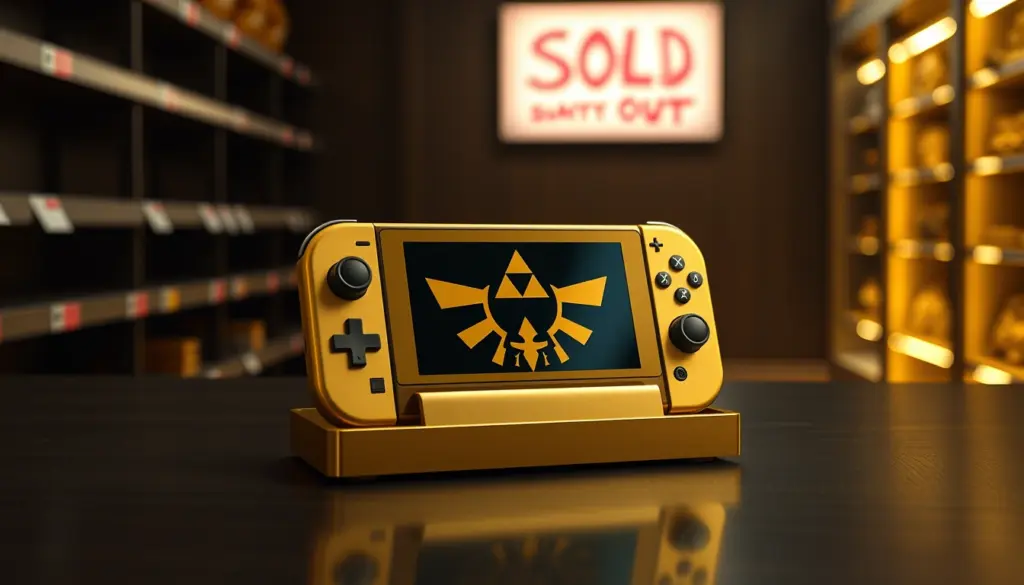
Nintendo’s Legend of Zelda 40th Anniversary Edition Switch 2 console vanished from preorder queues within hours of going live, and by the week of September 25, 2026, resellers were listing the $519.99 hardware for as much as $800 on secondary markets. The scramble caps a rough month for anyone trying to buy Nintendo hardware at retail price: the standard Switch 2 itself jumped to $499.99 on September 1, and now its most collectible variant is functionally unavailable at MSRP anywhere in the United States.
The story matters beyond Zelda fandom. It is a live case study in how a hardware company handles scarcity during a global memory-chip shortage, and it shows what happens when a beloved 40-year-old franchise collides with a console market already strained by rising component costs. Here is what actually happened, what Nintendo has and hasn’t said, and what it signals about the months ahead.
What Nintendo Announced on September 8
Nintendo revealed the Nintendo Switch 2 – The Legend of Zelda – 40th Anniversary Edition during a dedicated Nintendo Direct presentation on September 8-9, 2026, timed to the 40th anniversary of the original Legend of Zelda. The console carries a Triforce-themed design applied to both the system and its dock, and it ships with the same internal hardware as the standard Switch 2: two Joy-Con 2 controllers, a dock, an AC adapter, a USB-C cable, and the Joy-Con 2 grip and straps.
Pricing landed at $519.99 in the United States, ¥62,980 including tax in Japan, and AU$799.95 in Australia, according to Nintendo’s own product pages and confirmed by Tom’s Hardware. UK pricing varied by retailer, landing between roughly £429.99 and £499.99 depending on whether a bundled game was attached. Nintendo set the release date for October 29, 2026, and preorders went live within hours of the announcement through Nintendo’s own store plus Amazon, Best Buy, Walmart, and Target.
Price Breakdown: Standard Switch 2 vs. the 40th Anniversary Edition
The anniversary console is a cosmetic edition, not a spec bump. Storage stays at 256GB, the screen stays a 7.9-inch 1080p LCD in handheld mode, and output specs match the standard system. The only functional difference between the two SKUs is a $20 premium tied to the Triforce design and packaging.
| Spec / Detail | Standard Switch 2 | Zelda 40th Anniversary Edition |
|---|---|---|
| US price | $499.99 | $519.99 |
| Internal storage | 256GB | 256GB |
| Console design | Standard | Triforce-themed console and dock |
| Joy-Con 2 controllers included | Yes | Yes, standard design |
| Game included | No | No |
| Pro Controller included | No | No (sold separately at $99.99-$109.99) |
| Release date | Available now | October 29, 2026 |
| US availability as of Sept 25, 2026 | In stock at most retailers | Sold out at launch retailers |
That $20 gap is small on paper, yet it hasn’t stopped the anniversary unit from becoming the harder of the two to actually buy. Demand for a cosmetic variant outstripping demand for the base hardware is itself notable, and it says more about collector psychology and Zelda’s pull than it does about the console’s specs.
What’s Actually in the Box (and What Isn’t)
Buyers hoping the anniversary console bundles a game or extra accessories should temper expectations. The package does not include a Nintendo Switch 2 Pro Controller, a carrying case, a screen protector, or a copy of the upcoming Switch 2 version of The Legend of Zelda: Ocarina of Time, which ships separately on November 5, 2026, a week after the console. Some UK retailers created their own console-plus-game bundles, but those are retailer packages, not something Nintendo built into the official product.
A matching carrying case with a built-in screen protector exists as part of the wider anniversary merchandise line, but Nintendo sells it as a standalone accessory. Buyers who want the full themed setup are looking at three separate purchases: the console, the controller, and the case, on top of whatever games they plan to play.
Two Zelda-Themed Pro Controllers, Two Price Points
Nintendo split the Pro Controller into two configurations. The standard Zelda 40th Anniversary Pro Controller sells for $99.99, while a version bundled with a themed display stand runs $109.99. In Australia, those controllers list for AU$134.95 and AU$149.95 respectively, with the display-stand version restricted to Nintendo’s own retail channel in some regions. Both controller variants share the October 29 release date with the console itself, and both sold out at the same pace once preorders opened.
Sold Out Within Hours: The Preorder Rush
Preorders opened around 5 a.m. on September 9 following the Direct, and stock disappeared fast. Nintendo’s own US store listed the console as sold out within the same day, and Best Buy, Target, and other major retailers followed within 24 to 48 hours. The Pro Controller and its display-stand variant sold out on a similar timeline. None of this is unprecedented for a Zelda-branded product, but the speed underlines how tight Nintendo kept initial allocation for a console that, by spec, offers nothing beyond a paint job over the standard $499.99 unit.
The scale of the sellout is hard to separate from the broader hardware supply crunch running through 2026. Nintendo has been managing memory chip shortages that have pushed industry stockpiles below 10 days of supply, and that backdrop likely shaped how many anniversary units Nintendo was willing or able to produce for launch.
Scalpers Move In: Resale Prices Climb Toward $800
Within days of the sellout, resale listings appeared on secondary marketplaces well above the $519.99 retail price. Reporting from PCGuide documented resellers pricing the console at roughly $800, while other outlets tracked listings spanning $700 to nearly $1,000 depending on the platform and whether the Pro Controller was bundled in. That represents a markup of 35% to nearly double the original retail price for hardware that, again, carries the same internals as a console still selling at MSRP everywhere else.
The gap between the $519.99 sticker and $800-plus resale price puts the anniversary edition in the same bracket, proportionally, as scalped GPU launches during past supply squeezes. It also reflects how little inventory actually reached the general public before bots and resellers absorbed it.
Nintendo’s Muted Response to the Resale Surge
Nintendo has not issued a public statement specifically condemning the scalping of the 40th Anniversary Edition. Its response so far has been operational rather than rhetorical: UK and Ireland store listings marked the collection sold out and said Nintendo would announce restocks through the Nintendo Store app when new inventory becomes available. There is no indication of a broader anti-bot enforcement push tied to this specific launch, and no confirmed restock date has been announced for the US market as of September 25.
That silence is consistent with how Nintendo has generally handled scalping around its hardware. The company rarely comments on secondary-market pricing directly, preferring to let allocation and eventual restocks address demand rather than making public statements about resellers.
Why Nintendo Keeps Running Out of Stock
Three factors are converging here. First, Zelda-branded hardware has a track record of selling through fast, since the franchise carries collector demand well beyond people who plan to actually use the console differently from a standard unit. Second, Nintendo tends to run thin initial allocations on cosmetic special editions, treating them as a marketing moment rather than a mass-market SKU. Third, and increasingly important through 2026, memory and component costs have made every unit of console production more expensive, which discourages manufacturers from overbuilding limited runs.
None of those factors are new individually. What’s different this year is the third one. A cosmetic Switch 2 variant would normally be a low-risk way to milk extra revenue from a beloved franchise. In 2026, though, every additional unit competes for the same constrained memory and chip supply that’s already squeezing budget phones and laptops, which changes the calculus around how much stock Nintendo commits to a niche product.
The Bigger Price Story: Switch 2 Jumps From $449.99 to $499.99
The anniversary console’s scarcity sits on top of a separate, larger price story. Nintendo launched the standard Switch 2 in the US on June 5, 2025, at $449.99. Effective September 1, 2026, that price rose to $499.99, a $50 increase that Nintendo attributed broadly to shifting market conditions without naming a single cause such as tariffs or memory costs specifically. Shattered.io covered that price increase alongside Nintendo’s reported profit growth earlier this month, and it forms the backdrop against which the $519.99 anniversary console and its resale premium now look even steeper.
Put plainly: a buyer who wants the Zelda-themed console at retail is already paying $20 over an MSRP that itself rose $50 in the last month, and a buyer forced onto the resale market is paying up to $300 more than that on top. Few product stories this year illustrate the current console-pricing squeeze as clearly as this one console does across three separate price points.
Memory Chip Shortages Are Squeezing the Whole Industry
Nintendo isn’t alone in feeling this. Shattered.io has tracked how RAM now accounts for roughly 60% of the bill of materials on some budget phones and laptops, driven by the same memory-chip supply crunch that’s tightening console production across the board. Console makers aren’t as exposed to raw DRAM pricing as budget-phone makers are, since consoles typically use smaller memory footprints, but the broader component market being this tight raises costs and lengthens lead times for everyone building consumer electronics hardware in 2026.
That context helps explain why Nintendo would rather run a special edition too tight than too loose. Overproducing a cosmetic SKU during a component shortage ties up capacity that could go toward standard units, which are the actual volume driver for the platform. A sellout generates headlines and demand signals at a lower supply-chain cost than a fully stocked launch would.
40 Years of Zelda: From the Famicom Disk System to Switch 2
The anniversary being marked here isn’t a marketing invention. The original Legend of Zelda released in Japan in 1986 on the Famicom Disk System, then reached North America on the Nintendo Entertainment System in 1987. Forty years later, the franchise has become one of the few in gaming durable enough to sell hardware on branding alone, a fact this sellout demonstrates directly. Nintendo built its anniversary push around three pieces: the special-edition console and controllers, and the separately timed Switch 2 remake of Ocarina of Time landing November 5.
That three-week stretch between the anniversary console (October 29) and the Ocarina of Time remake (November 5) effectively gives Nintendo two separate purchase moments tied to the same anniversary, spreading consumer spending across two launches rather than compressing it into one.
Competitive Comparison: Limited Editions Across Gaming Hardware
Nintendo isn’t the only hardware maker leaning on premium and limited editions in 2026. Valve’s Steam Frame headset, which launched earlier this month, shows a similar pattern of scarcity shaping price perception, though at a very different price tier entirely.
| Product | US Price | Launch Status (Sept 25, 2026) |
|---|---|---|
| Nintendo Switch 2 (standard) | $499.99 | Widely in stock |
| Zelda 40th Anniversary Switch 2 | $519.99 | Sold out, reselling ~$700-$800+ |
| Zelda 40th Anniversary Pro Controller | $99.99 | Sold out at launch |
| Zelda Pro Controller w/ display stand | $109.99 | Sold out at launch |
| Valve Steam Frame (256GB) | $1,059 | Reservation-gated rollout |
| Valve Steam Frame (1TB) | $1,299 | Reservation-gated rollout |
The comparison shows two different scarcity strategies. Valve gated Steam Frame access through a reservation system before purchase, spreading demand out over weeks. Nintendo, by contrast, ran an open preorder that sold out almost immediately, generating a burst of scalper activity rather than a controlled rollout. Both approaches manage the same underlying problem, limited supply meeting high demand, but Nintendo’s method created the louder secondary-market spike.
Market Impact: What the Sellout Means for Nintendo’s Switch 2 Push
For Nintendo’s business, a fast sellout of a $519.99 cosmetic SKU is a low-risk win regardless of scalper activity. Every unit sold at $519.99 generates more margin than the equivalent standard unit at $499.99, and the sellout itself functions as free marketing heading into the holiday quarter. The reputational cost of visible scalping is real but historically hasn’t dented Nintendo hardware demand in any lasting way.
The bigger signal is about supply discipline during a component shortage. Nintendo appears willing to under-supply a high-demand limited edition rather than risk overcommitting scarce memory and chip capacity that the core Switch 2 line needs. That’s a meaningfully different posture than a company with slack manufacturing capacity would take, and it points to real constraints behind the scenes even as Nintendo’s headline profit numbers have looked strong this year following its record customer appreciation sale earlier in 2026.
Predictions: What Happens Next
- Nintendo will likely run at least one restock of the anniversary console before the October 29 release date, given the UK and Ireland store’s stated plan to notify buyers through the Nintendo Store app.
- Resale prices should cool somewhat once the console actually ships and a restock lands, though they’re unlikely to fall back to $519.99 before the holiday season ends.
- Expect the Ocarina of Time Switch 2 remake, launching November 5, to face its own smaller wave of bundle scalping tied to any physical special editions Nintendo announces for it.
- The standard Switch 2’s $499.99 price is unlikely to drop before 2027 given the memory-chip shortage context still playing out across the industry.
- Nintendo will probably repeat this exact playbook, tight allocation, no public scalping commentary, for future franchise anniversaries, since the approach costs Nintendo nothing while generating sustained media coverage.
Related
- Nintendo Sets 2 Directs Sept. 8-9, Zelda Turns 40
- Ocarina of Time Switch 2 Remake: Nov 5, $59.99
- Nintendo Switch 2 Price Hikes $50 as Profit Jumps 52%
- RAM Now 60% of Phone Cost, Sparks Fake-Chip Checks
- Memory Chip Shortage: Stockpiles Fall Below 10 Days
Frequently Asked Questions
Is the Zelda 40th Anniversary Switch 2 more powerful than the standard console?
No. The hardware inside is identical to the standard Switch 2, including the 256GB storage and display specs. The $20 price premium covers the Triforce-themed console and dock design, not any performance upgrade.
Does the console come with a game?
No. The package does not include The Legend of Zelda: Ocarina of Time or any other title. The Switch 2 version of Ocarina of Time ships separately on November 5, 2026, a week after the console’s October 29 release date.
Where can I still buy it at retail price?
As of September 25, 2026, the console and both Pro Controller variants are sold out at Nintendo’s own store and major US retailers including Best Buy, Target, and Walmart. Nintendo’s UK and Ireland stores have said restock notifications will go out through the Nintendo Store app, though no confirmed US restock date has been announced.
How much are scalpers charging for the console?
Reported resale prices range from roughly $700 to nearly $1,000, with $800 cited as a common listing price on secondary marketplaces, against a $519.99 retail price.
Why did the standard Switch 2 price go up too?
Nintendo raised the standard Switch 2’s US price from $449.99 to $499.99 effective September 1, 2026. The company attributed the change to shifting market conditions without naming tariffs or memory costs as the specific cause.
Is the Pro Controller sold separately from the console?
Yes. The Zelda 40th Anniversary Pro Controller costs $99.99, and a version with a themed display stand costs $109.99. Neither is bundled with the console purchase.
Has Nintendo commented on the scalping?
Not directly. Nintendo has not issued a statement specifically addressing resale pricing. Its public response has been limited to marking products sold out and pointing to future restock announcements through its store channels.
When was the original Legend of Zelda released?
The original game launched in Japan in 1986 on the Famicom Disk System, then arrived in North America on the Nintendo Entertainment System in 1987, making 2026 the franchise’s 40th anniversary.