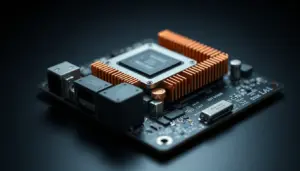

A two-billion-parameter AI model just got small enough to live inside a pair of glasses. On September 24, 2026, at Qualcomm’s Snapdragon Summit in Pasadena, California, Caltech spinout PrismML and Qualcomm Technologies showed off a 1-bit version of PrismML’s Bonsai language model running entirely on-device on the Snapdragon AR1 Gen 1 platform built for smart glasses. No cloud round-trip, no Wi-Fi dependency, no data leaving the frame. According to TechCrunch, the demo squeezed roughly four times as many parameters into the same memory footprint that previous glasses hardware could handle, while generating text more than twice as fast as a comparable 4-bit model.
It’s a small announcement by industry-event standards, tucked into a “Wednesday demos” slot rather than a keynote. But it lands at a moment when memory has become the single most expensive line item in consumer hardware (RAM now eats up to 60% of some phone bills of materials, per shattered.io’s coverage of the RAM shortage), and every major AI lab is racing to put a usable model directly on a chip instead of a data center. PrismML’s pitch is that 1-bit weights, not bigger batteries or better antennas, are the unlock that finally makes always-on AI glasses practical.
What PrismML and Qualcomm actually announced
The headline model is a 2-billion-parameter vision-language system built on top of PrismML’s existing Bonsai 1.7B language model, paired with a smaller vision encoder so the glasses can answer questions about what the wearer is looking at in real time. The language component runs at 1-bit precision; PrismML and Qualcomm describe the combined system as roughly four times smaller in memory than an equivalent 4-bit model, while matching that larger model’s scores on the benchmark suite PrismML tested against.
Qualcomm senior vice president Ziad Asghar framed the work, according to Android Headlines, around what bringing 1-bit models to the Snapdragon AR1 Gen 1 platform means for keeping visual context private and responsive on-device rather than shipped to a server. PrismML CEO Babak Hassibi made a similar point in the company’s own release material, arguing that compressing a model without losing its reasoning ability was the multi-year engineering problem PrismML was built to solve. Neither company named a shipping glasses product. This was a platform demo, aimed at hardware partners and developers, not a retail announcement.
The numbers behind the compression claim
PrismML’s language model weighs in at roughly 0.43GB at 1-bit precision, versus about 1.66GB for a comparable model quantized to 4 bits, according to the company’s own testing on the Snapdragon AR1 Gen 1. That’s close to a 4x reduction in the memory the model occupies. On generation speed, PrismML reported 15.36 tokens per second for the 1-bit version against 7.44 tokens per second for the 4-bit comparison, a roughly 2x speedup. Those are vendor-reported numbers from a specific test configuration (a 1,024-token context window, 4GB of system memory, and Qualcomm’s own QNN SDK with 1-bit kernel support), not independently reproduced results, and readers should treat them as such until a third party runs its own benchmark.
PrismML says it benchmarked its 1.7B 1-bit language model against a Qwen 3 1.7B model quantized to 4 bits across a stack of standard evaluations: BFCL v3, HumanEval+, MMLU Redux, IFEval, IFBench, MuSR, GSM8K, and GPQA Diamond. The company’s claim is that the two land in comparable territory on those tests. What’s missing from the public disclosure is a full per-benchmark score table, so outside researchers can’t yet check PrismML’s math benchmark by benchmark.
| Metric | 1-bit Bonsai (PrismML) | 4-bit comparison model | Reported change |
|---|---|---|---|
| Model file size | ~0.43 GB | ~1.66 GB | ~3.8-4x smaller |
| Generation speed | 15.36 tokens/sec | 7.44 tokens/sec | ~2.06x faster |
| Parameter count (language model) | 1.7B | 1.7B (Qwen 3 comparison) | Same parameter count |
| Total system size (with vision encoder) | 2B params (1.7B LM + 0.3B vision) | N/A | – |
| Context window in test | 1,024 tokens | 1,024 tokens | Matched |
| Test hardware | Snapdragon AR1 Gen 1, 4GB RAM | Snapdragon AR1 Gen 1, 4GB RAM | Matched |
Who is PrismML
PrismML was founded by a group of Caltech researchers and is led by founder and CEO Babak Hassibi, a Caltech professor whose academic work centers on compression theory. TechCrunch’s reporting notes the company is also advised by UC Berkeley’s Ion Stoica, a name well known in distributed-systems and AI-infrastructure circles as a co-founder of Databricks and Anyscale. PrismML has pointed to backing or support from Khosla Ventures, Cerberus Capital, Google compute grants, and Caltech, plus continuing support from Samsung. No total funding figure or valuation has been disclosed publicly.
The Bonsai family didn’t start with glasses. PrismML released an 8-billion-parameter 1-bit Bonsai model in March 2026, then followed it in mid-September with Bonsai 2 27B, a larger model the company pitched as proof that powerful AI doesn’t need to live exclusively in the cloud. The Snapdragon Summit demo compresses that same design philosophy down into a form factor with no fan, no battery pack, and barely any thermal headroom.
Why 1-bit, and why now
Most production language models still run at 16-bit or 8-bit precision, with 4-bit quantization treated as the aggressive end of the spectrum for consumer hardware. Going to 1-bit weights is a much bigger jump, and it’s not a new idea. Microsoft Research published the BitNet b1.58 architecture in 2024, describing a ternary weight scheme (each weight takes a value of -1, 0, or +1) that needs roughly 1.58 bits of information per weight rather than 16 or 32. Microsoft later shipped that work as an open model on Hugging Face and published the underlying research on arXiv. PrismML’s own materials describe Bonsai simply as “1-bit” rather than explicitly ternary, and the company hasn’t published enough architectural detail to say definitively whether its scheme is strictly binary, ternary like BitNet, or a different proprietary encoding.
What’s changed since 2024 isn’t just the research, it’s the hardware. Qualcomm’s willingness to build 1-bit kernel support directly into its QNN SDK for the Hexagon NPU is what turns a research paper into a token-per-second number on a real chip. That’s the same pattern that played out with 4-bit and 8-bit quantization a few years earlier: the math existed well before phone and PC chipmakers bothered to optimize silicon for it.
How this fits the on-device AI race
PrismML isn’t the only company chasing the “run it locally, keep it small” goal, and it isn’t even the first this year to publish a small model that beats expectations for its size. Shattered.io covered MiniCPM5-2B outscoring larger rivals by 2.8 points and Fastino’s 340-million-parameter model hitting 167ms latency on CPU, both signs that the small-model race has shifted from “can it run at all” to “how much can we shrink it without giving anything up.”
Google, Apple, and Microsoft all have their own compact on-device efforts: Google’s Gemini Nano models ship inside supported Android devices through Google’s own deployment stack, described on Google’s official Gemini blog. Apple runs a family of compact foundation models on-device as part of Apple Intelligence, detailed on Apple’s own product page, with heavier workloads offloaded to Apple’s Private Cloud Compute rather than run locally. Microsoft’s Phi family, hosted on Hugging Face, targets a similar small-and-efficient niche. None of those three have published a 1-bit deployment on a wearable NPU with the specific memory and speed figures PrismML and Qualcomm put out this week, which is the gap PrismML is trying to claim before a bigger player closes it.
| Model family | Maker | Deployment target | Distinguishing approach |
|---|---|---|---|
| Bonsai 1-bit (2B VLM) | PrismML + Qualcomm | Smart glasses (Snapdragon AR1 Gen 1) | 1-bit weights, hardware-specific NPU tuning |
| Gemini Nano | Supported Android phones | Proprietary on-device stack, tight OS integration | |
| On-device Apple Intelligence models | Apple | iPhone, iPad, Mac | Local model + Private Cloud Compute for heavier tasks |
| Phi-4 | Microsoft | Edge, local, resource-constrained devices | Small dense model, open weights on Hugging Face |
| MiniCPM5-2B | OpenBMB | Mobile / edge | 2B params beating larger rivals on benchmark score |
| GLiNER2.5-Decide | Fastino | CPU inference | 340M params, 167ms latency, no GPU required |
The hardware side: why Snapdragon AR1 Gen 1 matters
Qualcomm built the Snapdragon AR1 Gen 1 platform specifically for smart glasses and similar lightweight wearables, a category that has almost none of the thermal or battery headroom of a phone. That constraint is exactly why 1-bit weights matter more here than on a laptop: cutting model size by roughly 4x doesn’t just save storage, it cuts the memory bandwidth the chip has to move data across, which is one of the biggest drivers of power draw and heat in a device with no fan and barely any surface area to dissipate warmth. Meta’s own glasses push has run into the opposite problem at times, and shattered.io reported on Meta cutting its AI glasses price to $249 while adding 51 new styles, a move aimed at volume rather than raw on-device model capability. PrismML’s approach is a bet that the more durable competitive edge in wearables won’t be styles or price, it’ll be how much intelligence a chip can hold without a battery the size of a phone strapped to your face.
Qualcomm hasn’t disclosed a commercial licensing agreement, pricing, or a named glasses manufacturer shipping Bonsai in a retail product. The company also hasn’t said whether 1-bit kernel support in its QNN SDK will roll out beyond AR1 Gen 1 to phone-class Snapdragon chips, which would matter a great deal to developers weighing whether to build for PrismML’s stack versus a more established option like Gemini Nano or Phi-4.
What’s confirmed and what isn’t
It’s worth separating what PrismML and Qualcomm have actually shown from what’s still marketing language. Confirmed: the model exists, it ran live on Snapdragon AR1 Gen 1 hardware at the Snapdragon Summit, and PrismML published specific memory and speed figures from its own test configuration. Not yet confirmed: independent, third-party reproduction of those benchmark numbers; the exact bit-level weight scheme (binary versus ternary versus a proprietary mixed encoding); whether the model is open source or fully proprietary (PrismML describes its technology as built on proprietary Caltech intellectual property, which points toward a controlled license rather than an open one); and any named consumer glasses product that will actually ship with Bonsai inside it.
That gap between demo and shipping product is normal for a chip-summit announcement, but it’s also where these stories tend to quietly die. Plenty of reference-design AI hardware demos never make it into a retail SKU, and Qualcomm itself has shown concept silicon before that took years, or never arrived, in a device consumers could buy.
Market impact: memory costs are the real story underneath this
The timing lines up with a much bigger, less glamorous industry problem: memory is expensive and getting more so. Shattered.io has tracked RAM eating up to 80% of the bill of materials on some budget phones and laptops in 2026, driven by a DRAM and NAND shortage that Intel’s own leadership has said won’t ease before 2028. Against that backdrop, a technique that lets a device do the same AI work with a quarter of the memory isn’t just a performance trick, it’s a cost-avoidance strategy. A glasses maker that needs 1GB of RAM instead of 4GB to run a capable assistant is buying a cheaper, smaller, cooler chip package, at a moment when every gigabyte of memory has gotten measurably pricier.
That’s also the commercial logic behind Qualcomm’s interest. Snapdragon AR1 Gen 1 is a bet on a wearables category that, so far, has sold in far smaller volumes than smartphones, not the scale that typically justifies a bespoke high-end chip. Making 1-bit inference work well on already-shipping silicon is cheaper for Qualcomm than waiting for a next-generation, larger-memory chip that the wearables market may not be big enough to fund yet.
Historical context: quantization’s long march from research curiosity to shipping feature
Model quantization, the general technique of representing weights with fewer bits, has moved in stages. Early large language models shipped at 32-bit or 16-bit floating point. Int8 quantization became mainstream around 2022 and 2023 as a way to cut inference cost roughly in half without a meaningful quality hit. 4-bit quantization followed, popularized by open-source tooling that let hobbyists run multi-billion-parameter models on consumer GPUs. Microsoft’s BitNet b1.58 research pushed the frontier further in 2024, showing that ternary weights could, in principle, match full-precision performance on some tasks. PrismML’s Snapdragon Summit demo is best read as the point where that research line finally reached a shipping-adjacent hardware target: not a paper, not a hobbyist GPU hack, but a chip platform a wearables maker could buy off the shelf.
The pattern echoes what’s happened elsewhere in the industry: a technique proves itself in research, then hardware vendors build native support, then it becomes the default rather than the exception. Shattered.io has covered a similar dynamic play out in Kubernetes 1.37’s GPU scale-to-zero feature, where a cost-saving technique moved from niche workaround to a mainstream release feature once the underlying orchestration layer caught up.
Competitive comparison: PrismML’s narrow but real edge
PrismML’s advantage isn’t that Bonsai is smarter than Gemini Nano, Apple’s on-device models, or Phi-4. The available evidence doesn’t support that claim, and PrismML hasn’t made it. The company’s advantage, if it holds up under independent testing, is narrower and more specific: it has a model tuned to run at 1-bit precision on a named, shipping wearable chip, with a specific hardware partner (Qualcomm) publicly backing the integration work. Google, Apple, and Microsoft all have larger deployment footprints, more mature developer tooling, and, in Apple’s and Google’s cases, tighter operating-system integration. What none of them have shown publicly, as of this week, is a 1-bit deployment on a wearable-class NPU with published memory and throughput numbers. That’s a small, specific gap, and it’s the one PrismML is trying to occupy before a bigger competitor decides wearables are worth the same optimization effort they’ve already put into phones.
What developers and hardware makers should watch next
A few concrete signals will tell you whether this moves from demo to product. First, whether Qualcomm extends 1-bit kernel support in its QNN SDK beyond AR1 Gen 1 to its higher-volume mobile chips, which would make the technique relevant far beyond glasses. Second, whether a named glasses brand, not just Qualcomm’s reference platform, announces a product using Bonsai. Third, whether PrismML publishes a full benchmark table rather than a summary claim, which is the difference between a marketing number and something independent researchers can check. Fourth, whether PrismML clarifies its licensing terms; a proprietary, Caltech-IP-based model competing against increasingly capable open-weight alternatives from Microsoft and the open-source community is a much harder sell to developers than a permissively licensed one.
Predictions: where this goes next
Five things worth watching over the next two to three quarters:
- Qualcomm extends 1-bit kernel support from the AR1 Gen 1 wearables platform into a mainstream Snapdragon mobile chip within the next one to two product generations, since the memory savings matter just as much on phones facing the same DRAM cost pressure.
- At least one named consumer smart glasses maker announces a Bonsai-powered SKU within six to nine months, most likely a smaller player looking to differentiate against Meta’s glasses lineup on battery life rather than price.
- Google or Microsoft responds with its own 1-bit or near-1-bit variant of Gemini Nano or Phi within the next year, given how aggressively both companies have chased on-device efficiency gains in 2025 and 2026.
- Independent researchers publish a reproduction attempt of PrismML’s benchmark claims within a few months, given how much scrutiny quantization claims tend to attract from the open-source ML community.
- PrismML raises or discloses a funding round tied to this partnership, since Snapdragon Summit visibility is exactly the kind of proof point that tends to precede a startup’s next raise.
The bigger picture: efficiency is becoming AI’s main battlefield
For most of the last three years, AI headlines have been dominated by bigger models: more parameters, more training compute, more expensive chips. PrismML’s demo is part of a countervailing trend that’s gained real momentum in 2026, where the more interesting engineering problem has become how little compute and memory a model needs to do a useful job. That trend shows up across shattered.io’s recent coverage, from small models beating larger rivals on benchmark scores to open-weight models cutting agent costs by orders of magnitude with Abacus.AI’s Smaug models. A world where memory itself is the scarce, expensive resource rewards exactly this kind of compression work, and PrismML’s glasses demo is a reasonably clean example of why.
Whether Bonsai specifically wins that race is a separate question from whether the race itself is real. On the evidence available this week, the race is real. Qualcomm doesn’t build 1-bit kernel support into a production SDK for a demo that goes nowhere, and PrismML doesn’t get invited on stage at a Snapdragon Summit without Qualcomm believing there’s a commercial case behind it. The specifics, pricing, licensing, an actual product, are still unresolved. The direction isn’t.
Frequently asked questions
What is PrismML’s Bonsai model?
Bonsai is PrismML’s family of compressed AI language models. The version shown at Qualcomm’s Snapdragon Summit on September 24, 2026, is a 2-billion-parameter vision-language model built on PrismML’s earlier Bonsai 1.7B, with its language component quantized to 1-bit precision.
What does “1-bit” mean for an AI model?
It refers to how much data each weight in the neural network uses. Most production models use 16-bit or 8-bit precision; aggressive consumer quantization typically goes to 4-bit. A 1-bit model represents each weight with close to a single bit of information, similar in spirit to Microsoft’s BitNet b1.58 research, which used a ternary (three-value) weight scheme. PrismML hasn’t published enough detail to confirm whether Bonsai uses the same ternary approach or a different 1-bit scheme.
Is Bonsai available for smart glasses right now?
No. PrismML and Qualcomm demonstrated Bonsai running on the Snapdragon AR1 Gen 1 platform, but no consumer smart glasses product using the model has been announced.
Is Bonsai open source?
That’s unconfirmed. PrismML describes its technology as built on proprietary Caltech intellectual property, which suggests a controlled or proprietary license rather than an open one, but the company hasn’t published formal licensing terms for the glasses model.
How does Bonsai compare to Google’s Gemini Nano or Apple’s on-device models?
There’s no independent, apples-to-apples benchmark comparing them directly. Gemini Nano and Apple’s on-device Apple Intelligence models run inside their own companies’ broader software ecosystems, while Bonsai is a third-party model being co-optimized with Qualcomm hardware specifically for wearables. PrismML’s public claim is about memory and speed efficiency versus a 4-bit baseline, not superiority over Gemini Nano or Apple’s models.
Who founded PrismML?
PrismML was founded by a group of Caltech researchers and is led by CEO Babak Hassibi, a Caltech professor specializing in compression technologies. The company is also advised by UC Berkeley’s Ion Stoica.
What chip does the demo run on?
The Qualcomm Snapdragon AR1 Gen 1 platform, a chip built specifically for AI smart glasses and similar lightweight wearables, using its Hexagon NPU for on-device inference.
Why does model size matter so much for wearables specifically?
Smart glasses have almost no room for a large battery or active cooling, unlike phones or laptops. A smaller model needs less memory bandwidth, which directly reduces power draw and heat, two of the tightest constraints in a wearable device with no fan and very little surface area to dissipate warmth.