
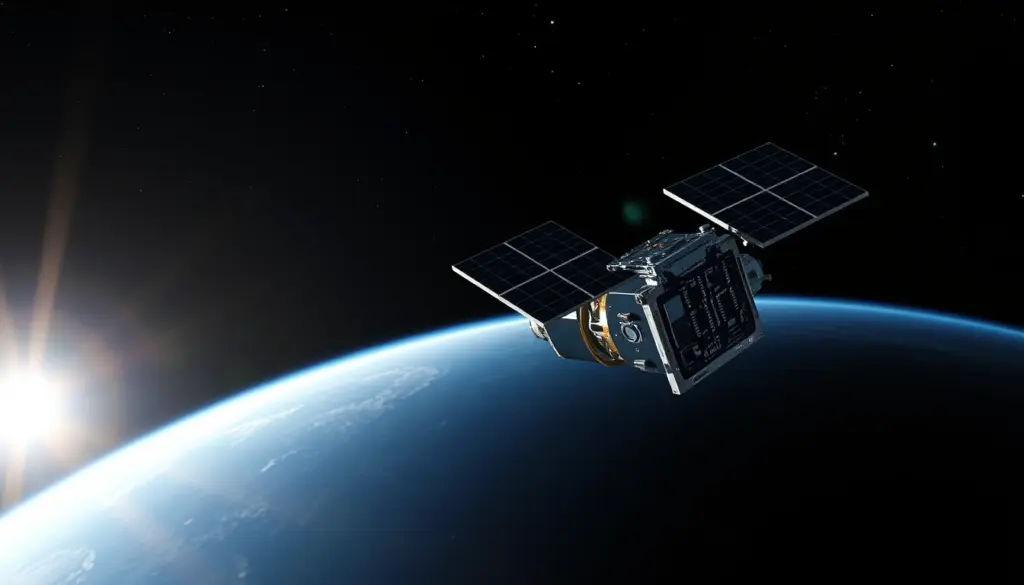
Google is about to find out whether an AI chip can survive a rocket launch, six months of radiation, and the vacuum of low Earth orbit – all while trying to answer a search query. On October 1, 2026, a satellite carrying four of Google’s custom Tensor Processing Units is scheduled to ride aboard SpaceX’s Transporter-18 rideshare mission, marking the first real-world hardware test for Project Suncatcher, Google’s research effort to find out whether space could one day host large-scale AI computing infrastructure.
The headline that’s been circulating this week – that your next Gemini answer might come from space – gets ahead of the facts. What Google has actually confirmed is narrower and, in some ways, more interesting: a single prototype satellite, built with Planet, is going up to test whether AI accelerators can take the punishment of launch forces, radiation, and extreme temperature swings. Nobody at Google is claiming Gemini queries will be served from orbit next month. But the fact that a company with the scale and cash of Google is willing to spend real engineering hours on the idea says something about where the AI infrastructure conversation is heading. We covered the launch specifics of the MVP satellite and its October 1 timeline separately; this piece looks at why the bet is being made at all, and what it would mean if it eventually pays off.
What Project Suncatcher actually is
Project Suncatcher is a Google Research initiative, not a product. The company describes it as a moonshot exploring whether solar-powered satellite constellations equipped with TPUs and free-space optical links could eventually scale machine learning compute beyond what’s practical on the ground. Google Research put it plainly in its own writeup: the project is “exploring a new frontier: equipping solar-powered satellite constellations with TPUs and free-space optical links to one day scale machine learning compute in space,” according to Google Research’s official blog.
That framing matters because it separates the current test from the eventual goal. The October mission is a single prototype, not a demonstration of a working orbital data center. Google has been explicit about this distinction: the first mission “is designed to gather in-orbit data and identify potential failure points, rather than demonstrate an operational orbital data center,” the company said, according to reporting from Asharq Al-Awsat. In other words, this is closer to a stress test than a launch of new infrastructure.
The prototype, known internally as MVP, will carry four Google TPUs and roughly one kilowatt of solar power, according to reporting on the mission. It’s expected to remain in orbit for as long as six years, though the planned AI-computing test window is just one year. Google’s next step beyond this first flight is already sketched out: a follow-on “learning mission” involving two prototype satellites, planned for launch by early 2027, working with Planet to refine the design. Google CEO Sundar Pichai framed the mission’s stakes simply: “Can our TPUs survive and operate in space? Well, we’re going to find out,” he said, according to a report from Times of Oman.
Why Google is even considering this
The obvious question is why a company that already operates some of the largest data centers on Earth would bother testing chips in orbit. The answer traces back to two problems that have become impossible to ignore in the AI industry over the past two years: power and land.
Training and running large AI models is an energy-intensive business, and terrestrial data centers are running into real constraints – grid capacity, water for cooling, permitting delays, and community pushback. We’ve tracked this strain closely, from cloud providers racing to cut compute latency and cost to chip and memory shortages driving up prices industry-wide. Space, at least in theory, sidesteps some of that. A satellite in the right orbit gets near-constant sunlight, meaning solar panels can generate power far more consistently than on the ground, where day-night cycles and weather cut into output. There’s also no land-use fight to win and no cooling water to source, since space itself is an effectively infinite heat sink once you solve the engineering problem of radiating heat away from hardware.
None of that makes orbital compute cheap or easy. Launch costs, radiation-hardening, repair logistics, and the sheer difficulty of networking satellites together at the bandwidth AI training demands are all unsolved at scale. That’s precisely why Google frames this as a research moonshot rather than a roadmap item. But the fact that the two biggest bottlenecks in AI infrastructure right now – power and physical space – are exactly the two problems space-based compute could address is why the idea keeps resurfacing across the industry, even if Google is currently the only major player putting hardware into orbit to test it.
The October 1 mission, in detail
The MVP satellite is scheduled to launch on SpaceX’s Transporter-18 rideshare mission, a Falcon 9 flight that bundles multiple satellites from different customers onto a single launch to cut costs. Pichai confirmed the arrangement directly, saying Project Suncatcher is “hitching a ride aboard SpaceX’s Transporter-18 mission, testing a prototype satellite built in partnership with Planet,” according to the same Times of Oman report. Rideshare missions like Transporter-18 have become the standard way smaller research payloads reach orbit affordably, since the customer doesn’t need to fund a dedicated launch.
Once in orbit, MVP’s job isn’t to process meaningful AI workloads. It’s to generate data. Google wants to know how the TPUs perform under three specific stresses: the mechanical shock of launch, the radiation environment of low Earth orbit, and the temperature extremes a satellite experiences as it moves between direct sunlight and Earth’s shadow. The mission will also test optical inter-satellite links – laser-based communication between spacecraft – which would be essential if Google ever tried to network multiple satellites together for distributed machine learning tasks. That’s a nontrivial technical hurdle on its own, since coordinating training workloads across satellites moving at orbital velocity is a very different networking problem than coordinating servers in a single data center building.
Importantly, the satellite is intended to process simple AI queries using Gemini as part of its testing, but that’s a validation exercise, not a production service. No user’s Gemini request is being routed to orbit today, and Google hasn’t set a date for when – or whether – that would change.
Suncatcher mission specs at a glance
| Detail | Reported figure |
|---|---|
| Launch date | October 1, 2026 |
| Launch vehicle / mission | SpaceX Falcon 9, Transporter-18 rideshare |
| Satellite name | MVP |
| TPUs on board | Four Google Tensor Processing Units |
| Solar power | Approximately 1 kilowatt |
| Planned compute test duration | Up to 1 year |
| Expected orbital lifespan | Up to 6 years |
| Development partner | Planet |
| Next milestone | Two-satellite learning mission, targeted early 2027 |
These are the figures currently confirmed through Google’s own statements and reporting on the mission. Details like the exact TPU generation, satellite mass, and orbital altitude have not been published, and any number beyond what’s listed above should be treated as unconfirmed until Google or its partners release additional specifications.
How this compares to the terrestrial AI buildout
To understand how unusual Suncatcher is, it helps to compare it against what every other major cloud and AI player is doing right now: building bigger, not going up. AWS, Microsoft Azure, and Google’s own Cloud division have all been racing to add ground-based GPU and TPU capacity throughout 2026, competing on power availability, chip supply, and pricing. We’ve reported on AWS’s push to cut compute cold-start times, on AMD’s climb toward a trillion-dollar valuation on the back of AI chip demand, and on Huawei’s competing exaflop-scale accelerator push in China. None of those efforts involve satellites. They involve more land, more turbines, more transformers, and more chips packed into buildings that already strain local power grids.
That’s the real context for Suncatcher: it’s not Google’s primary AI infrastructure strategy, it’s a hedge. The company is still pouring the overwhelming majority of its capital expenditure into terrestrial data centers and chip supply, the same as every other hyperscaler. Space-based compute is a long-horizon research bet running in parallel, not a replacement plan. Nvidia, Microsoft, and Amazon have not announced comparable orbital compute programs, which leaves Google, for now, as the only major cloud provider publicly testing AI hardware in space. Whether that stays a solo experiment or becomes a genuine competitive front depends entirely on what MVP’s data shows over the next year.
Terrestrial vs. orbital AI compute: the trade-offs
| Factor | Terrestrial data center | Orbital compute (Suncatcher concept) |
|---|---|---|
| Power source | Grid electricity, on-site solar/gas, subject to day-night cycles | Near-constant solar exposure in the right orbit |
| Land / siting constraints | Requires land, permitting, local grid capacity | No land-use conflict, but launch mass is tightly constrained |
| Cooling | Water or air cooling, a major operating cost and resource draw | Radiative cooling into space, no water required |
| Hardware durability risk | Well understood; decades of operational data | Unproven; radiation and thermal cycling effects still being tested |
| Deployment speed | Months to years to build and commission | Dependent on launch cadence and satellite production |
| Serviceability | Technicians can swap hardware on-site | No practical in-orbit repair for a failed chip today |
| Current maturity | Multi-billion-dollar established industry | Single prototype satellite, first flight October 2026 |
The table makes the current gap obvious. Terrestrial infrastructure wins on every dimension except power consistency and land footprint, and it wins by a wide margin because it’s a mature industry with decades of operational history behind it. Orbital compute’s advantages are real in theory, but they remain untested at any meaningful scale. That’s exactly what the October mission is designed to start closing.
A history longer than most people realize
The idea of putting energy-hungry infrastructure in orbit isn’t new. Space-based solar power – the concept of collecting solar energy in orbit and beaming it to Earth – has been studied by engineers and space agencies since the 1970s, largely as a way to generate constant, weather-independent electricity. It never reached commercial viability because launch costs made the economics impossible. What’s changed since then is the launch cost curve. Reusable rockets, led by SpaceX’s Falcon 9, have cut the price of getting mass to orbit dramatically compared to the expendable rockets of past decades, and rideshare missions like Transporter-18 have made it economical for research payloads that don’t need a dedicated launch to reach space at all.
Large satellite constellations have also gone from theoretical to routine over the past several years, proving that companies can manufacture, launch, and operate hundreds or thousands of satellites reliably. That operational track record is part of why an idea like Suncatcher is credible today in a way a similar pitch wouldn’t have been a decade ago. Google isn’t inventing space-based compute from nothing; it’s applying lessons from the broader drop in launch costs and the maturity of satellite manufacturing to a new category of payload: AI accelerators instead of communications transponders or Earth-imaging sensors.
Market and investor reaction
Suncatcher hasn’t triggered the kind of stock-moving reaction that a product launch or earnings surprise would. It’s a research announcement, not a revenue event, and investors have largely treated it that way. But it lands at a moment when the market is already hyper-focused on AI infrastructure spending and where the next wave of compute capacity will come from. Every hyperscaler’s capital expenditure guidance for 2026 has been scrutinized by analysts watching for signs of overbuilding or, conversely, capacity shortfalls that could cap AI product growth. Against that backdrop, a credible-sounding alternative to endless data center construction is the kind of story that gets attention even without a dollar figure attached, if only because it suggests Google is thinking several years past the current buildout cycle.
It’s also worth noting what Suncatcher is not: it’s not a signal that Google is pulling back from ground-based AI infrastructure investment. The company’s terrestrial data center spending continues on its existing trajectory. Suncatcher sits alongside that spending as a research line item, not a substitute for it, and Google has been careful in its own communications not to overstate the near-term significance of the October test.
What the experts and Google itself are saying
Google has kept its public framing of Suncatcher deliberately modest, which is notable given how much attention space-based AI compute has attracted online. In the company’s own announcement, Google described the effort as a long-horizon research project: “Today we’re announcing Project Suncatcher, our new research moonshot to one day scale machine learning in space,” the company said, according to its official blog post.
Pichai has echoed that same caution in public comments about the mission, emphasizing that the October flight is a test of survivability, not a deployment. “Can our TPUs survive and operate in space? Well, we’re going to find out,” he said, according to Times of Oman. That line captures the actual state of the project better than most of the coverage around it: this is an open engineering question, not a settled roadmap.
Google Research’s own technical writeup reinforces the same point at a system-design level, describing the project as “exploring a new frontier: equipping solar-powered satellite constellations with TPUs and free-space optical links to one day scale machine learning compute in space,” per the Google Research blog. And on the specific goal of the October mission, Google has said plainly that the first Suncatcher flight “is designed to gather in-orbit data and identify potential failure points, rather than demonstrate an operational orbital data center,” as reported by Asharq Al-Awsat.
The engineering problems nobody has solved yet
Even if MVP performs flawlessly, orbital AI compute faces a stack of unsolved problems before it could support anything resembling real-world Gemini traffic. Heat is the first. On Earth, data centers dump excess heat into air or water. In space, radiative cooling is the only option, and it’s far less efficient per unit of hardware, which puts a hard ceiling on how densely you can pack chips into a single spacecraft without them overheating.
Bandwidth is the second problem. Training modern AI models requires enormous data movement between chips, something today’s data centers solve with dense fiber interconnects measured in the terabits per second. Replicating that between satellites moving at orbital velocities, using free-space optical links, is a much harder engineering challenge, and it’s precisely why Suncatcher’s roadmap treats inter-satellite optical links as a core research question rather than a solved detail.
Serviceability is the third. A failed GPU in a ground data center gets swapped out in minutes. A failed TPU in orbit is, for all practical purposes, gone for good, and radiation-driven hardware degradation over a multi-year mission is exactly the kind of failure MVP is designed to help Google understand before committing to a larger constellation. Finally, there’s cost. Even with sharply lower launch prices than a decade ago, putting and keeping meaningful compute capacity in orbit is still far more expensive per chip than building on the ground, and that gap has to close substantially before space-based AI infrastructure could compete with terrestrial data centers on price.
What comes after October 1
Google has already outlined its next step. If MVP’s data comes back usable, the company plans a follow-on “learning mission” involving two prototype satellites, working again with Planet, targeted for launch by early 2027. That mission would presumably start testing the inter-satellite optical links that a single satellite can’t meaningfully validate on its own, since you need at least two spacecraft to test communication between them.
Beyond that two-satellite mission, Google hasn’t published a timeline for anything resembling a production constellation. That’s consistent with how the company has described Suncatcher throughout: a multi-year research program with sequential validation steps, not a fixed product roadmap with a launch date for commercial service. Anyone reporting a hard date for operational orbital AI data centers is getting ahead of what Google has actually confirmed.
Five predictions for where this goes next
- MVP’s data will shape, not confirm, the 2027 mission. Expect Google to publish at least partial results from the radiation and thermal tests before greenlighting the two-satellite follow-on, since the entire point of MVP is to catch failure modes early.
- Competitors will study the results closely without committing publicly. Don’t expect AWS, Microsoft, or Nvidia to announce their own orbital compute programs in the next year, but expect their research divisions to be watching Suncatcher’s public data closely.
- The “Gemini answers from space” narrative will keep outpacing reality. Expect continued headlines implying imminent orbital AI service well before Google has anything close to production hardware in orbit, simply because the idea is more compelling than the incremental engineering reality.
- Terrestrial data center investment stays the dominant story. Suncatcher will remain a small research line relative to Google’s overall AI infrastructure spending for years, not a pivot away from ground-based buildout.
- Optical inter-satellite links become the next headline metric. Once the 2027 two-satellite mission flies, expect the bandwidth and reliability of the laser link between the two spacecraft to become the number analysts and reporters fixate on, the same way TPU count is the headline figure for the October flight.
Why this matters even if it never scales
There’s a version of this story where Suncatcher never produces a commercially useful orbital data center, and it still matters. The AI industry’s power and land constraints aren’t going away, and the fact that one of the world’s largest cloud providers is willing to fund real hardware tests of an alternative, however speculative, tells you how seriously those constraints are being taken internally. It also generates real engineering data on how modern AI accelerators behave under radiation and thermal stress, data that has value for satellite and aerospace applications well beyond AI, including onboard processing for Earth observation and defense systems that already operate in similar environments.
The more useful way to read this week’s news, then, isn’t “Google is moving Gemini to space.” It’s that Google has enough confidence in the underlying idea to put real chips on a real rocket and find out what breaks. That’s a meaningfully different story than a product launch, and it’s one that will take years, not weeks, to resolve.
Frequently asked questions
Is Google actually running Gemini from space right now?
No. The October 1 mission tests hardware survivability with a single prototype satellite. Google has said explicitly that the goal is to gather in-orbit data and identify failure points, not to operate a working data center.
What is Project Suncatcher?
It’s a Google Research initiative studying whether solar-powered satellite constellations equipped with TPUs and optical inter-satellite links could eventually support large-scale machine learning compute in space.
When does the first Suncatcher satellite launch?
The prototype satellite, MVP, is scheduled to launch October 1, 2026, aboard SpaceX’s Transporter-18 rideshare mission.
How many TPUs are on the satellite?
Reporting on the mission indicates four Google Tensor Processing Units are on board, powered by roughly one kilowatt of solar energy.
Who is Google working with on this project?
Google is developing the prototype satellite with Planet, a satellite technology company, and launching via SpaceX’s rideshare program.
What happens after the first launch?
If the mission generates useful data, Google plans a follow-on learning mission involving two prototype satellites, targeted for launch by early 2027, to test inter-satellite optical communication.
Are other companies like Amazon or Microsoft doing this too?
Not that has been publicly announced. Google is currently the only major cloud provider testing AI accelerators in orbit; AWS, Microsoft, and Nvidia have not confirmed comparable programs.
Why does Google want to put data centers in space at all?
Orbit offers near-constant sunlight for solar power and no land-use constraints, two of the biggest bottlenecks facing terrestrial AI infrastructure. The trade-offs, including cooling, serviceability, and launch cost, remain largely unsolved.