
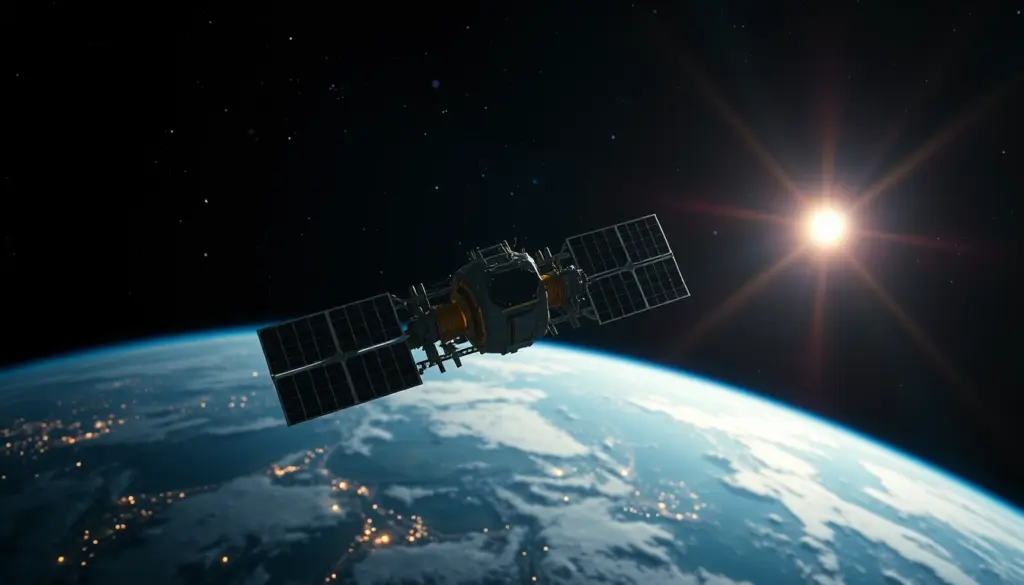
Google is about to find out whether an AI chip can survive space, and the honest answer right now is: only for a quarter of an hour. On October 1, 2026, a prototype satellite carrying four of Google’s Trillium Tensor Processing Units is set to launch aboard SpaceX‘s Transporter-18 rideshare mission, running Gemini workloads in short bursts before its cooling system forces a shutdown. The project is called Project Suncatcher, and its first real test isn’t about raw performance. It’s about heat.
Google confirmed the mission on September 24, and the detail that has stuck with engineers isn’t the launch date or the chip count. It’s the 15-minute ceiling on how long those TPUs can compute before the satellite has to power down and let its radiators catch up. That single number tells you more about the real bottleneck facing space-based AI than any spec sheet does, and it’s the reason this test matters well beyond Google’s own roadmap.
What Project Suncatcher Actually Is
Project Suncatcher is Google’s research effort to find out whether solar-powered satellite constellations, wired together with TPUs and free-space optical links, could eventually host large-scale machine learning compute in orbit. Google Research described it in its own words as a moonshot exploring “a new frontier: equipping solar-powered satellite constellations with TPUs and free-space optical links to one day scale machine learning compute in space,” according to Google Research’s technical blog.
The pitch is simple on paper. Solar panels in orbit can catch sunlight nearly around the clock in the right orbital plane, without weather, without a grid connection, and without competing with terrestrial power markets already strained by AI demand. Google has already published detailed coverage of the hardware manifest for the October 1 launch and the roughly one-kilowatt solar budget the MVP satellite will run on. What hasn’t gotten the same attention is what happens once those chips actually try to compute for more than a few minutes at a stretch.
Inside the MVP: Four TPUs and a Kilowatt of Sunlight
The test spacecraft, internally named MVP, carries four Google Trillium Tensor Processing Units and draws about one kilowatt of power from its solar arrays. That’s a modest power budget by data center standards. A single high-end AI accelerator on the ground can draw close to that much on its own, and a modern GPU cluster draws it by the megawatt. Google isn’t trying to prove that space can out-power a terrestrial facility. It’s trying to prove the chips can survive the trip and function at all.
The satellite will run Google’s Gemini models during its active windows, according to Google’s own announcement. That’s a deliberate choice. Gemini is the same model family Google is pushing across its cloud business, and testing it in orbit ties the experiment directly to the company’s broader AI ambitions rather than treating this as a pure hardware science project.
Why 15 Minutes? The Physics of Cooling in a Vacuum
On Earth, a data center cools itself by moving air or liquid past hot components and dumping that heat into the atmosphere or a chiller loop. In orbit, there’s no air to convect through and no ambient atmosphere to absorb waste heat. The only way to shed heat in a vacuum is to radiate it away as infrared light, and that process is far slower than blowing cold air across a heatsink.
That’s the constraint Suncatcher’s engineers ran into. Reporting on the mission’s design describes a thermal path built from thermal-interface material feeding aluminum and copper heat pipes, which carry heat out to external radiator panels. Those radiators can only reject so much heat per minute, and once a chip’s junction temperature climbs past a safe threshold, the system has to stop computing and wait for the radiators to catch up. Running the TPUs continuously would eventually cook them.
Travis Beals on the Chips’ Hard Limit
The clearest on-record explanation of the limit comes from Travis Beals, Google’s senior director of product management for Project Suncatcher, who told The New York Times that the chips can run for about 15 minutes before they have to shut down to cool off. That detail has since been repeated across multiple outlets covering the launch, including TechRadar, which reported that “because of this limitation, the TPUs will only run continuously for about fifteen minutes before requiring a shutdown period,” with the chips pausing completely while the radiator system catches up, according to TechRadar’s report on the launch.
Sundar Pichai, Google and Alphabet’s CEO, framed the test bluntly in a public post announcing the mission: “Can our TPUs survive and operate in space? Well, we’re going to find out,” according to Google’s official announcement. That’s not the language of a company confident it has already solved orbital cooling. It’s the language of a company running a controlled experiment to find the failure points before committing real capital.
Suncatcher MVP at a Glance
| Spec | Detail |
|---|---|
| Project name | Project Suncatcher |
| Test spacecraft | MVP (prototype) |
| Launch date | October 1, 2026 |
| Launch provider | SpaceX, Transporter-18 rideshare mission |
| TPU hardware | Four Google Trillium Tensor Processing Units |
| Power source | Solar panels, approximately 1 kilowatt |
| AI workload | Google Gemini models |
| Active compute window | Approximately 15 minutes, then forced shutdown to cool |
| Planned mission length | Roughly one year |
October 1: The Ride Google Chose
Google isn’t building its own rocket for this. The MVP satellite is riding to orbit as one payload among many on SpaceX’s Transporter-18, a rideshare mission that bundles dozens of small satellites from different customers onto a single Falcon 9 launch. That choice keeps costs down and keeps the experiment framed as exactly what it is: a prototype, not a flagship deployment.
Google built the MVP satellite bus with Planet, the Earth-imaging satellite company, rather than developing its own spacecraft platform from scratch. That partnership matters because it means Google is leaning on an established satellite manufacturer for the parts of the mission it doesn’t need to reinvent, and putting its own engineering effort into the TPU payload and thermal system instead. Teslarati reported that Google picked SpaceX for this first step into orbital AI after the company said the mission would fly on Transporter-18, with the launch confirmed for the following week.
Heat, Not Power, Is the Real Constraint
It’s tempting to read Suncatcher as a story about solar power, since the pitch of space compute has always leaned on abundant sunlight. But the 15-minute cycle flips that framing. The MVP satellite has enough solar power to run its TPUs. What it doesn’t have is a way to shed the heat those TPUs generate fast enough to run them indefinitely.
That distinction matters for anyone tracking the broader AI infrastructure buildout. Terrestrial data centers have spent the last two years fighting a supply crunch on memory and accelerator hardware, but cooling capacity has quietly become just as tight a constraint, with liquid cooling retrofits now standard for any facility running dense GPU or TPU racks. Suncatcher’s engineers face the same problem with none of the usual tools. No chillers, no cooling towers, no ambient air, just radiator area and time.
A Year in Orbit: What Google Wants to Learn
Google has said the MVP mission is designed to run for roughly one year, gathering data on how the TPUs hold up under the physical stress of spaceflight, radiation exposure, and thermal cycling. Google’s own blog post on the project states plainly that “after years of research, Project Suncatcher is scheduled to embark on its first test in orbit, launching a prototype satellite to evaluate how Google Tensor Processing Units (TPUs) perform in space,” according to Google’s official project page.
That framing is important because it tells you this isn’t a one-shot demo built for a press cycle. A year of operation, with the chips cycling through repeated 15-minute active windows and cooldown periods, will give Google’s hardware team a real degradation curve: how radiation exposure and thermal stress affect chip reliability over dozens or hundreds of duty cycles, not just one. Google described the broader vision in its original announcement of the project, saying it’s “exploring how an interconnected network of solar-powered satellites, equipped with our Tensor Processing Unit (TPU) AI chips, could harness the full power of the Sun,” according to Google’s initial Project Suncatcher announcement.
Space Computing’s Long Runway to This Moment
Putting computers in orbit isn’t new. Satellites have carried onboard processors for navigation, telemetry, and image processing for decades, and Earth-observation platforms like the ones Planet already operates process imagery in orbit before beaming compressed data down to ground stations. What’s different about Suncatcher is the class of hardware involved. Those earlier systems ran radiation-hardened, power-sipping chips built for reliability over decades in orbit, not data-center accelerators built to push as many floating-point operations as possible through a die in the shortest possible time.
Trillium TPUs were designed for the opposite environment: racks, chillers, and near-constant grid power. Putting that class of chip into a vacuum, running a foundation model instead of a navigation routine, is a genuinely different engineering problem than anything the satellite industry solved with earlier onboard computing. That’s the gap Suncatcher’s first flight is built to measure.
Who Else Is Racing to Put AI in Orbit
As of this test, Google stands alone among the major cloud and AI players with a publicly confirmed, near-term orbital AI chip demonstration. Industry analysis from Futurum Group frames the mission as an open question about whether Google is “ahead in the orbital AI race,” a framing that only makes sense because no rival has announced a comparable flight-ready payload. Amazon, Microsoft, and SpaceX all run extensive satellite and cloud infrastructure businesses, but none has a publicly disclosed plan to fly data-center-class AI accelerators in orbit on the timeline Google just committed to.
That gap is worth sitting with. The companies chasing AI infrastructure dominance on the ground, the same ones racing to lock up power contracts and GPU allocations for terrestrial facilities, have not matched Google’s move into orbit. It’s possible they’re working on something unannounced. It’s also possible they’ve concluded the economics don’t pencil out yet, and that a 15-minute duty cycle on four chips isn’t worth the launch cost until someone else proves the concept first. Google’s willingness to fly the experiment publicly, warts and all, suggests it’s comfortable being the one to find out.
Orbital AI Compute vs. Ground-Based Data Centers
| Factor | Orbital AI (Suncatcher MVP) | Terrestrial Data Center |
|---|---|---|
| Power source | Solar panels, ~1 kW on MVP | Grid power, often megawatts per facility |
| Cooling method | Heat pipes and radiators, radiating to space | Liquid cooling, chillers, cooling towers |
| Active duty cycle | ~15 minutes on, then forced shutdown | Near-continuous operation |
| Deployment cost | Launch costs plus satellite bus | Land, construction, grid interconnect |
| Maintenance access | None after launch | On-site technicians and hardware swaps |
| Current maturity | First prototype, untested in orbit | Mature, industrial-scale deployment |
What the 15-Minute Duty Cycle Means for the Math
Google hasn’t published the cooldown duration between active windows, so any full daily-throughput figure would be a guess. What’s confirmed is the active side of the equation: a 15-minute compute window before a mandatory shutdown. That single constraint reshapes how engineers have to think about scheduling workloads in orbit, closer to a batch-processing problem than the always-on inference serving that terrestrial clouds run today.
# Illustrative scheduling model, not Google's actual flight software
ACTIVE_WINDOW_MIN = 15   # confirmed by Google via NYT reporting
COOLDOWN_MIN = None      # not publicly disclosed

def can_run_workload(elapsed_since_last_shutdown_min):
    if elapsed_since_last_shutdown_min >= ACTIVE_WINDOW_MIN:
        return "shutdown_required"
    return "compute_allowed"
That kind of gating logic is a world away from how a GPU cluster on the ground gets scheduled through something like Kubernetes-managed autoscaling, where the constraint is usually cost, not physics. In orbit, the scheduler has to treat thermal budget as a hard resource limit right alongside compute and memory, which is a genuinely new class of infrastructure problem for a company like Google to solve.
Market Reaction and What Comes Next
Don’t expect Suncatcher to move Alphabet’s stock price this week, and it hasn’t. This is a four-chip prototype on a rideshare mission, not a revenue-generating product. The mission sits alongside Google’s much larger terrestrial AI infrastructure push, including its expanding Gemini enterprise deals like the one it recently signed with BNP Paribas and its continued build-out of cloud capacity to compete with the likes of AWS and Azure. Suncatcher won’t replace any of that. What it does is give Google a live data set on a question none of its terrestrial competitors, including those racing on next-generation data center silicon, currently need to answer: can AI-class chips survive and function outside a climate-controlled building.
If the year-long test goes well, the next logical step would be a larger constellation with more chips per satellite and optical links between spacecraft, the architecture Google Research described in its original system-design paper. If it goes poorly, the reported 15-minute duty cycle becomes an even harder ceiling, and Google will have to decide whether smarter radiator design or a fundamentally different chip architecture is worth chasing before flying a second-generation prototype. Either outcome produces useful engineering data, which is precisely why Google is running this as a research mission rather than a product launch.
Five Predictions for Space-Based AI Compute
- Google will publish a technical postmortem on the MVP mission within 12 to 18 months of launch, likely through Google Research, covering thermal performance data in far more detail than has been disclosed so far.
- The 15-minute duty cycle will shrink in future prototypes as Google iterates on radiator design, but a fully continuous orbital compute cycle remains unlikely before the end of the decade.
- At least one other major cloud provider will announce its own orbital AI chip experiment within 18 months, once Suncatcher’s early results are public, rather than risk ceding the narrative entirely to Google.
- Near-term commercial value from Suncatcher will come from applying it to satellite-side data processing, such as compressing Earth-observation imagery in orbit, rather than from replacing any terrestrial Gemini inference capacity.
- Expect skepticism from data center economists over the next year, arguing that launch costs and the short duty cycle make orbital AI compute uncompetitive with ground-based facilities for the foreseeable future, even as Google frames Suncatcher as a long-horizon research bet rather than a near-term product.
Frequently Asked Questions
What is Google’s Project Suncatcher?
Project Suncatcher is Google’s research effort exploring whether solar-powered satellites equipped with Tensor Processing Units and optical links could one day host large-scale machine learning compute in orbit. Its first orbital test launches October 1, 2026.
Why can the TPUs only run for 15 minutes at a time?
Because there’s no air in space for convective cooling, the satellite can only shed heat by radiating it away, a slower process than fans or liquid cooling on the ground. Travis Beals, Google’s senior director of product management for the project, told The New York Times the chips must shut down after about 15 minutes to let the radiator system cool them back down.
What hardware is on the MVP satellite?
The prototype carries four Google Trillium Tensor Processing Units, powered by solar panels generating approximately one kilowatt, and runs Google’s Gemini models during its active windows.
When and how is the satellite launching?
The MVP satellite is scheduled to launch October 1, 2026, aboard SpaceX’s Transporter-18 rideshare mission, a shared Falcon 9 launch carrying multiple satellite payloads from different customers.
How long will the test run?
Google has said the MVP mission is planned to operate for roughly one year, collecting data on how the TPUs handle launch stress, radiation, and repeated thermal cycling.
Is any other company planning a similar orbital AI test?
None has been publicly confirmed as of this test. Amazon, Microsoft, and SpaceX all operate large-scale satellite or cloud infrastructure, but none has disclosed a comparable plan to fly data-center-class AI accelerators in orbit on a near-term timeline.
Could space-based data centers replace terrestrial ones?
Not in the near term. The MVP test involves four chips on one prototype satellite with a 15-minute duty cycle, compared with terrestrial facilities running continuously at megawatt scale. Google has framed Suncatcher as a long-horizon research project rather than a near-term replacement for ground-based data centers.
Who built the satellite bus for the MVP mission?
Google developed the prototype in partnership with Planet, the Earth-imaging satellite company, which supplied the spacecraft platform for the mission.