
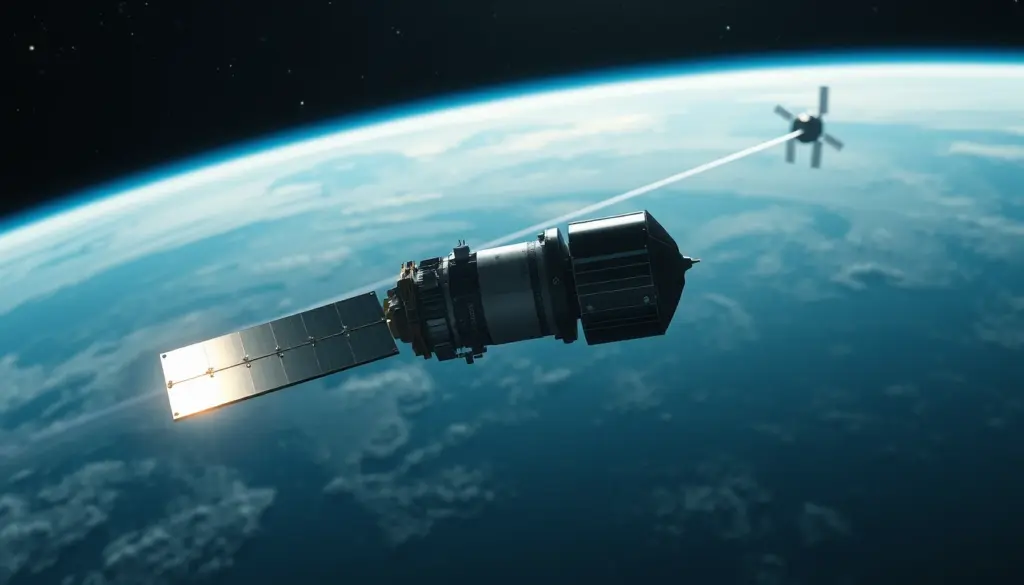
Google is about to find out whether a data center can survive in orbit. On October 1, 2026, a SpaceX Transporter-18 rideshare mission is scheduled to carry a test spacecraft called MVP into low Earth orbit, carrying four of Google’s Trillium Tensor Processing Units wired up to run the company’s Gemini models on solar power alone. It is the first real-world trial of Project Suncatcher, the research effort Google has been quietly building toward a future where machine-learning compute lives off-planet rather than in a warehouse outside Ashburn or The Dalles.
The number that has circulated since Google detailed the plan is stark: the TPUs can only run Gemini workloads for about 15 minutes at a stretch before they need to power down and let the spacecraft’s radiators shed heat. That constraint alone has been enough to generate skepticism about whether orbital AI compute is a serious infrastructure bet or a moonshot publicity exercise. But the 15-minute duty cycle is really a symptom of a bigger story: Google is testing whether space, with its unlimited solar exposure and total absence of zoning boards, could eventually solve a power problem that terrestrial data centers cannot solve on their own. This piece looks past the launch specs to what a year of orbital testing could mean for the economics of AI infrastructure, who else might follow, and what has to go right before any of this becomes more than an experiment.

Don't miss new tech stories on Google
Add Shattered once in the Google app and our stories show up in your news suggestions.
What Google Has Actually Confirmed So Far
Project Suncatcher is Google’s research program exploring solar-powered satellite constellations built around Tensor Processing Units and free-space optical links, designed to handle machine-learning computation away from Earth’s surface. The company has confirmed the first hardware test will fly aboard a spacecraft it calls MVP, launching on SpaceX’s Transporter-18 rideshare mission on October 1, 2026. The test payload carries four Trillium TPUs, Google’s current-generation AI accelerator chip, drawing roughly one kilowatt of power from onboard solar panels.
According to Google’s own announcements, the workload running on those chips will be Gemini, the company’s flagship AI model family that already powers everything from Search overviews to enterprise tools sold through Google Cloud. Google has said it plans to keep MVP operating for about one year, which would make it by far the longest-running attempt yet to keep general-purpose AI accelerators functioning in the harsh thermal and radiation environment of orbit. That one-year window is the detail that separates Suncatcher from a one-off publicity flight: Google is committing to sustained data collection, not a single demonstration pass.
Inside the MVP Satellite: Hardware and Mission Specs
The publicly confirmed technical picture of MVP is narrow but specific. Here is what Google has put on the record for the first flight:
| Parameter | Confirmed detail |
|---|---|
| Program name | Project Suncatcher |
| Test spacecraft | MVP |
| Launch date | October 1, 2026 |
| Launch provider | SpaceX, Transporter-18 rideshare mission |
| Onboard hardware | Four Google Trillium Tensor Processing Units |
| Power source | Solar panels, approximately 1 kilowatt |
| AI workload | Google Gemini models |
| Compute duty cycle | Roughly 15 minutes of active compute, then a cooldown period |
| Planned test duration | Approximately one year |
Travis Beals, Google’s senior director of product management for Project Suncatcher, described the thermal constraint to The New York Times in terms that make the challenge concrete: the chips can only run for around 15 minutes before they need to power down so the spacecraft’s radiators can dump the accumulated heat. That single design fact does most of the explanatory work here. A rack of TPUs on the ground sits next to chillers, cooling towers, and a grid connection that can supply power continuously. A satellite has none of that. It has surface area, a limited battery buffer, and the vacuum of space, which is actually a poor heat conductor compared to air or water. Getting heat off a chip in orbit is a radiative problem, not a convective one, and it is fundamentally slower.
Why 15 Minutes Is the Number That Matters Most
It is tempting to read the 15-minute duty cycle as a failure baked into the test. It is closer to the entire point of flying MVP in the first place. Google has not disclosed the exact thermal engineering behind the cutoff, but the pattern it describes, run hot for a short burst, then cool passively before resuming, is standard practice for any spacecraft carrying power-dense electronics. The question Project Suncatcher is actually trying to answer is whether that duty cycle can be extended through better radiator design, chip placement, or orbital mechanics that keep panels in more consistent sunlight.
This is also where the one-year test window matters more than the headline 15-minute figure. A single short demonstration would only prove the chips survive launch and briefly function. A year of repeated 15-minute compute bursts, through different orbital thermal cycles and, presumably, some degree of radiation exposure to memory and logic circuits, is what would actually tell Google’s engineers whether Trillium-class silicon can be trusted in orbit for years rather than weeks. If Google publishes performance data at the end of that year showing the duty cycle held steady, degraded, or improved through operational tuning, that dataset becomes the real deliverable of Suncatcher’s first phase, more than the launch itself.
The Economics: Orbit vs. the Terrestrial Data Center
To understand why Google is spending engineering resources on this instead of just building another terrestrial campus, it helps to lay the two environments side by side. Ground-based AI data centers are currently bottlenecked by three things that show up constantly in coverage of the sector: grid power availability, high-bandwidth memory supply, and physical land and water for cooling. Orbit removes some of those constraints entirely while introducing new ones that don’t exist on Earth.
| Factor | Terrestrial data center | Orbital compute (Suncatcher concept) |
|---|---|---|
| Power source | Grid connection, often capacity-constrained | Direct solar, largely unconstrained by local grid limits |
| Cooling method | Water or air-based active cooling | Passive radiative cooling into space |
| Duty cycle | Continuous, 24/7 operation | Intermittent bursts limited by heat buildup |
| Land and permitting | Zoning, water rights, community opposition | None; governed by launch and spectrum regulation instead |
| Hardware access for repair | On-site technicians | No physical access once deployed |
| Primary constraint today | Power and HBM memory supply | Thermal management and radiation hardening |
The power argument is the one Google keeps coming back to in its public framing of Suncatcher. Terrestrial AI buildouts are running into grid capacity limits severe enough that utilities and hyperscalers are now negotiating multi-year interconnection queues, a dynamic this site has tracked in reporting on AWS’s grid-queue backlog. A satellite in the right orbit gets close to constant sun exposure without negotiating with a single utility commission. That is a genuinely different cost structure, even before anyone factors in launch costs, which remain the single biggest unknown in any orbital-compute business case.
Historical Context: Space Computing Before Gemini
Putting processors in orbit is not new. Satellites have carried onboard computers for decades, handling telemetry, image compression, and basic signal processing long before anyone talked about machine learning in space. What has changed is the ambition. Earlier generations of space-based computing, the kind flown on NASA missions and commercial imaging satellites alike, were built around narrow, low-power tasks that could tolerate the intermittent, radiation-exposed environment of orbit because the workloads themselves were simple and forgiving of interruption.
Running a general-purpose large language model is a different category of problem. Gemini-class models depend on high memory bandwidth, dense matrix math, and, on the ground, uninterrupted power delivery across thousands of chips working in concert. Recent benchmark coverage of Nvidia’s Vera Rubin NVL72 platform and the broader race among Nvidia, AMD, and Google’s own TPU line make clear how much terrestrial AI infrastructure depends on scale and continuous operation to be cost-effective. Suncatcher inverts that assumption entirely: it accepts a fraction of the duty cycle in exchange for power that doesn’t compete with anyone else’s grid allocation. Whether that trade makes economic sense at scale is the multi-year question Google is now trying to answer empirically instead of on a whiteboard.
Market Impact: What This Means for Google Cloud
Even a successful Suncatcher test will not change what Google Cloud customers get access to this year or next. Gemini workloads for enterprise customers, including recent commercial commitments like BNP Paribas’s five-year Google Cloud agreement, will keep running on terrestrial TPU pods for the foreseeable future. What the test does is give Google a data point that its competitors, including Amazon and Microsoft, do not currently have: real operational experience with AI accelerators functioning outside Earth’s atmosphere.
That matters for market positioning as much as engineering. Google Cloud has been closing the market-share gap with AWS and Azure, a trend this site covered when Google Cloud hit a record 15% share while AWS slipped. Owning a credible, publicly documented orbital-compute research track, even one still years from commercial relevance, reinforces the narrative that Google controls the entire AI stack, from custom silicon like the Ironwood TPU line through to experimental infrastructure nobody else is flying yet. It is a long-horizon differentiator, not a near-term revenue driver, but in a market where investor attention increasingly tracks who looks most prepared for the next decade of AI infrastructure demand, that distinction carries real weight.
The Power Bottleneck Driving Big Tech Toward Orbit
Project Suncatcher does not exist in a vacuum, so to speak. It is a response to a power and memory crunch that has been building across the entire AI hardware sector through 2026. Coverage of Nvidia’s Rubin Ultra platform losing a third of its planned memory allocation to the ongoing HBM shortage, and Jensen Huang’s own forecast locking up more than a third of global HBM supply, point to an industry where the physical inputs to AI compute, chips, memory, and electricity, are becoming the binding constraint rather than model design or software.
Orbital compute is one of the more unconventional responses to that squeeze, but it is not the only one. Hyperscalers are simultaneously pursuing nuclear power agreements, custom low-power silicon, and aggressive efficiency gains in cooling design on the ground. Suncatcher fits into that portfolio as a long-shot bet rather than a primary strategy: Google is not proposing to replace its terrestrial data centers with satellites anytime soon. It is testing whether a meaningful slice of future compute demand, particularly for training runs that can tolerate interruption, could eventually be offloaded to an environment where power is effectively free and abundant, even if availability windows remain short.
Competitive Landscape: Is Anyone Else Racing to Orbit?
Google has been the most public about a dedicated orbital AI compute research program, and its scale, four TPUs on a single test spacecraft with a full year of planned operation, currently sets the pace for what any competitor would need to match to be taken seriously. Reports on the broader space and AI infrastructure sector have flagged growing interest across the industry in moving compute-heavy or power-heavy workloads off the terrestrial grid, but as of this test flight, no other major cloud provider has confirmed a comparable hardware-in-orbit AI program at this stage of development.
That head start is worth something, but it is fragile. Space infrastructure has a way of attracting fast followers once a first mover proves out the basic physics. If MVP performs well over its planned year in orbit, expect rival hyperscalers and satellite operators to accelerate their own orbital compute research rather than concede the category. The launch industry itself, increasingly dominated by SpaceX’s rideshare cadence, has also made this kind of experimental payload dramatically cheaper to fly than it would have been five years ago, a trend space industry outlets have tracked closely as launch prices keep falling, which lowers the bar for anyone else who wants to try.
Risks and Open Questions Google Hasn’t Answered
Several questions remain genuinely open, and Google has not published answers to most of them yet. Radiation hardening is one of the biggest unknowns: commercial TPUs were not originally designed to withstand the charged-particle environment of low Earth orbit over a full year, and it is not yet public how much shielding or error-correction overhead Google built into the MVP payload to compensate. Bandwidth is another. Getting Gemini model weights and inference results to and from a satellite requires reliable communication links, and the program’s longer-term vision references free-space optical links between spacecraft, though MVP’s specific communication architecture for this first flight has not been detailed publicly.
Cost is the least discussed variable and probably the most important one long-term. Google has not published what MVP cost to build and launch, nor has it offered any framework for what a future operational constellation would cost per unit of compute delivered, compared with an equivalent terrestrial TPU pod. Without that figure, it is impossible to know whether Suncatcher is a path to genuinely cheaper compute or an expensive hedge against grid constraints that only makes sense once terrestrial power becomes the more expensive option by comparison.
Predictions: Where Project Suncatcher Goes From Here
- Google will publish incremental data, not a single verdict. Expect periodic updates over the one-year test window rather than a single pass/fail announcement, similar to how the company has staged updates on other long-horizon infrastructure bets.
- The 15-minute duty cycle will become the benchmark rivals try to beat. If a competing program emerges, its first public claim will almost certainly target a longer active-compute window than Suncatcher’s initial figure.
- Commercial relevance stays years away. Nothing about this test changes Google Cloud’s product roadmap in the next 12 to 24 months; any orbital compute offering for paying customers is more plausible in the 2030s than before 2028.
- Expect follow-on test flights before any full constellation decision. A single MVP satellite is a proof of concept, not a commitment to a constellation; Google is more likely to fly a second, larger test payload than to greenlight mass production immediately.
- Launch cost trends will decide the program’s fate as much as the engineering does. Continued declines in rideshare launch pricing, driven largely by SpaceX’s cadence, will matter as much to Suncatcher’s future as any thermal or radiation breakthrough.
How Suncatcher Fits Google’s Broader AI Infrastructure Strategy
Project Suncatcher sits alongside, not in place of, Google’s much larger terrestrial buildout. The company continues to expand TPU capacity for Gemini and Google Cloud customers on the ground, and nothing in the public Suncatcher materials suggests that trajectory is slowing. What the orbital test signals instead is a hedge against a future in which grid power, land, and cooling water for AI data centers become scarcer and more politically contested than they already are in 2026. Google has faced its own version of infrastructure scrutiny domestically, including attention drawn to how much of the modern internet now depends on a small number of hyperscale cloud providers whenever one of them has an outage.
Framing Suncatcher as insurance rather than a near-term product plan also explains why Google is comfortable being public about a test with a fairly modest 15-minute compute window. A company trying to hide a failure would not publish the constraint; a company running a genuine multi-year research program would. That transparency, whatever else it says about the technology, is consistent with Google treating this as exploratory science rather than a rushed product announcement.
What It Means for Enterprise and Cloud Customers Today
For any organization currently evaluating Google Cloud, Gemini API pricing, or TPU access for its own AI workloads, Project Suncatcher changes nothing operationally in the near term. Decisions about where to run inference or training jobs should still be based on today’s available infrastructure, including the pricing and capacity dynamics covered in reporting on Google’s Ironwood TPU pricing against Nvidia and the specs Google publishes for its current Cloud TPU lineup. What the test is worth watching for, over its one-year run, is an early signal of whether Google believes terrestrial power constraints will eventually force even its largest customers toward alternative compute geographies, orbital or otherwise, sooner than most cloud buyers currently expect.
The safest read for now is that Suncatcher is a research line worth tracking rather than a purchasing consideration. If the MVP satellite is still returning useful thermal and performance data a year from launch, in October 2027, that would be the point at which enterprise infrastructure planning might reasonably start factoring an orbital option into long-range roadmaps.
Frequently Asked Questions
What is Google’s Project Suncatcher?
Project Suncatcher is Google’s research program studying whether solar-powered satellites equipped with Tensor Processing Units and optical links could run machine-learning workloads, including Gemini models, in orbit rather than on the ground.
When does the first Project Suncatcher test launch?
The test spacecraft, called MVP, is scheduled to launch on October 1, 2026, aboard SpaceX’s Transporter-18 rideshare mission.
Why can the TPUs only run for 15 minutes at a time?
Google has said the chips generate more heat than the spacecraft’s radiators can immediately reject, so they run in short bursts of roughly 15 minutes before shutting down to let the satellite cool passively, since there is no active liquid or air cooling available in orbit.
How long will the MVP satellite operate?
Google has said it plans to run the MVP test for approximately one year, which would make it one of the longest sustained trials of general-purpose AI accelerators operating in orbit.
Will Project Suncatcher change Google Cloud pricing or availability soon?
No. This is an early-stage research test with a single experimental satellite. It has no near-term impact on Google Cloud products, Gemini API access, or TPU pricing for existing customers.
Is Google the only company testing AI compute in space?
Google is currently the most publicly advanced with a dedicated program of this scale and duration. No other major cloud provider has confirmed a comparable hardware-in-orbit AI compute test at this stage.
What hardware is flying on the MVP satellite?
The test payload carries four of Google’s Trillium Tensor Processing Units, powered by roughly one kilowatt of onboard solar power, running Google’s Gemini AI models.
Why is Google interested in space-based data centers at all?
The core appeal is power. Orbit offers near-continuous solar exposure without competing for grid capacity, land, or cooling water, all of which have become significant constraints for terrestrial AI data center buildouts in 2026.