
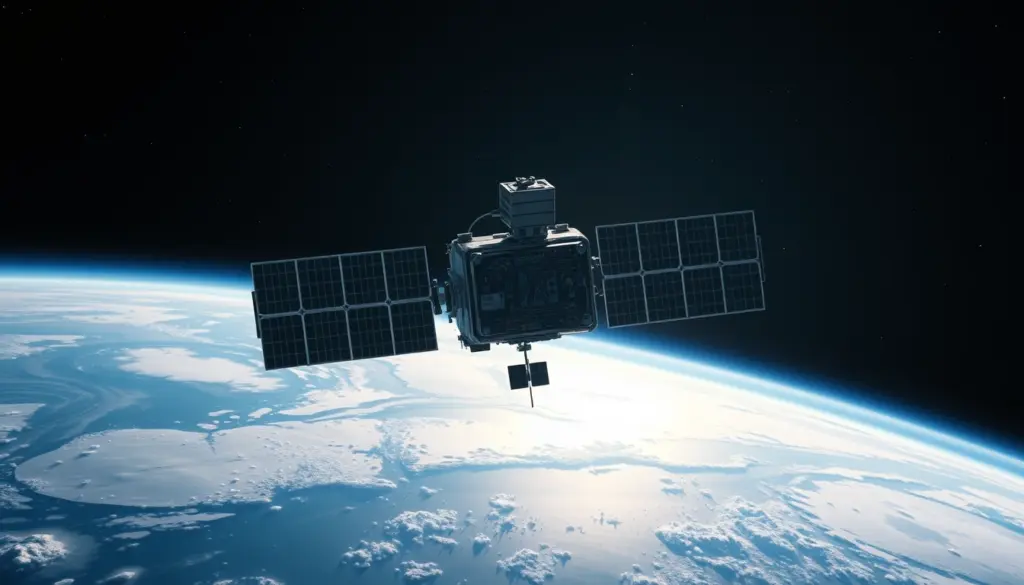
Google will launch its first orbital AI computing satellite on October 1, 2026, aboard a SpaceX Falcon 9 rocket flying out of Vandenberg Space Force Base. The refrigerator-sized craft, named MVP, carries four of Google’s custom Tensor Processing Units and marks the first hardware test of Project Suncatcher, the company’s plan to run machine learning workloads on solar-powered satellites in low Earth orbit. Reuters and The New York Times confirmed the launch window this week, moving a research idea that Google floated last November into something with an actual countdown clock.
Google Confirms October 1 Launch for Project Suncatcher’s First Satellite
The MVP satellite is riding as part of a SpaceX Transporter rideshare mission, sharing a rocket with dozens of other small payloads headed to sun-synchronous orbit. Google confirmed the flight details on its official research blog, where it describes Project Suncatcher as a moonshot exploring a new frontier: equipping solar-powered satellite constellations with TPUs and free-space optical links to eventually scale machine learning compute in space. That framing matters, because Google is careful not to call this a commercial launch. It is an engineering test, full stop.
Ars Technica and the New York Times both reported the same core detail this week: MVP is about the size of a household refrigerator and packs four TPUs inside its frame. Once in orbit, ground teams will spend weeks checking whether the chips survive launch vibration, radiation exposure and the extreme temperature swings of low Earth orbit. None of that is guaranteed. Consumer electronics are not built for space by default, and Google’s TPUs were designed for climate-controlled data center racks, not vacuum.
What Project Suncatcher Actually Is
Google first unveiled Project Suncatcher on November 4, 2025, in a research paper and companion blog post. The pitch: put AI chips on satellites that stay in near-constant sunlight, link them together with laser-based optical communication, and let the sun itself become the power plant. Google’s own description, published on its research blog announcing Project Suncatcher, calls it a research effort to explore whether space could eventually host large-scale AI computing infrastructure.
The plan calls for a specific type of low Earth orbit known as dawn-dusk sun-synchronous orbit. Satellites in that orbit trace a path along the boundary between day and night on Earth, which keeps them lit by the sun almost around the clock. Google says that configuration cuts the need for heavy batteries, since satellites do not spend much time in shadow. The company has also stated that satellites in low Earth orbit can generate up to eight times more solar power than solar panels do on the ground, thanks to the absence of atmosphere, clouds and nighttime.
None of this replaces terrestrial data centers anytime soon. Planet, the satellite imaging company partnering with Google on the learning mission, describes the long-term aim of Project Suncatcher as enabling AI compute to scale by putting TPUs into orbit and connecting them through high-bandwidth optical links, a goal it frames in decades rather than quarters.
Inside MVP: The Satellite Headed to Orbit
MVP is not the mission Google originally announced. The November 2025 plan centered on a two-satellite learning mission built and operated by Planet, targeted for early 2027, meant to test hardware survivability and, critically, the optical inter-satellite links that would let multiple satellites act as one distributed compute cluster. MVP appears to be an earlier, smaller step Google added on top of that plan: a single test satellite designed to get real flight data faster, before the more ambitious two-satellite mission flies.
That sequencing tells you something about how Google is managing risk. Rather than betting the whole learning mission on a single launch two years out, the company appears to have carved out a cheaper, faster test to catch failure points early. If MVP’s four TPUs cannot survive six months in orbit, Google finds that out in early 2027 instead of after a more expensive, multi-satellite mission has already launched.
Why Google Wants TPUs in Space, Not on Earth
Google CEO Sundar Pichai has talked about the motivation in fairly plain terms. “We want to put these data centers in space, closer to the sun,” Pichai said, according to comments reported by IBM’s technology news desk. The logic is straightforward even if the engineering is not: AI training runs are power-hungry, land for new data centers is contested, and grid connections in places like Virginia and Texas are already backed up for years. Orbit offers a power source that does not compete with anyone’s electric bill.
Pichai also described the pace Google plans to take. “We will send tiny, tiny racks of machines and have them in satellites, test them out, and then start scaling from there,” he said in the same interview. That is a deliberately conservative rollout plan for a company that has, in other parts of its AI business, moved with far more urgency. It suggests Google itself does not expect orbital compute to matter for its near-term AI roadmap, even as it invests in the research now.
The Physics Behind the Dawn-Dusk Orbit
The dawn-dusk sun-synchronous orbit Google picked sits at an altitude and inclination where a satellite’s orbital plane stays aligned with the terminator, the line separating day from night on Earth. Fly along that line and a satellite almost never passes into Earth’s shadow. That solves two problems at once. First, near-constant sunlight means near-constant solar power, so batteries can be smaller and lighter, which matters when every kilogram costs thousands of dollars to launch. Second, a stable thermal environment makes it easier to predict how hot or cold onboard electronics will get, since the satellite is not constantly swinging between sunlight and darkness.
The tradeoff is heat rejection. On Earth, data centers dump waste heat into air or water. In vacuum, there is no air to carry heat away, so satellites rely on radiators that shed heat as infrared radiation, a much slower process. This is the single biggest unsolved engineering problem for orbital compute, and it is also the exact point critics have zeroed in on.
From November Announcement to October Launch: A Timeline
Nov 4, 2025  – Google announces Project Suncatcher research paper
Nov 4, 2025  – Planet confirmed as satellite build-and-operate partner
Early 2027   – Original target for two-satellite Planet learning mission
Feb 25, 2026 – Gartner analyst calls orbital data centers a "pie-in-the-sky" bet
Aug 21, 2026 – Starcloud raises $250M Series A extension at $2.3B valuation
Sept 24, 2026 – Google confirms MVP satellite, four TPUs, launching Oct. 1
Oct 1, 2026  – MVP launch aboard SpaceX Falcon 9, Transporter rideshare
Eleven months separate the original announcement from a hardware launch. That is fast by aerospace standards, where satellite programs routinely slip by years, and it reflects how much pressure Google and its AI rivals are under to secure new sources of compute and power. It also lines up with a broader pattern this year: chipmakers and cloud providers racing to lock down power capacity, as seen in Emerald AI’s $150 million raise to help power Nvidia-backed data center capacity in Santa Clara.
Sundar Pichai and Google Research on the Moonshot
Google’s own language around Suncatcher leans hard on the word “moonshot,” and Pichai has echoed that framing directly. “Like any moonshot, it’s going to require us to solve a lot of complex engineering challenges,” Pichai said, in comments covered by Data Center Dynamics. That is corporate-speak for “this might not work,” and it is worth taking at face value. Google’s moonshot division, X, has killed far more projects than it has shipped, and Suncatcher currently sits closer to a research paper than a product line.
Google Research’s own announcement described the project as exploring a new frontier: equipping solar-powered satellite constellations with TPUs and optical links to one day scale machine learning compute in space. The phrase “one day” is doing real work there. Nothing in Google’s public materials commits to a production timeline, a satellite count, or a cost target.
The Skeptics: Why Gartner Calls This an “Orbital Data Center Bubble”
Not everyone is convinced this is money well spent. A Gartner analyst, writing earlier this year, argued that companies were pouring cash into what the analyst called an “orbital data center bubble,” in a piece covered by The Register. The analyst’s case rests on two points: launch costs remain prohibitive for hardware that will eventually fail or become obsolete, and cooling electronics in the vacuum of space is far harder than cooling them in a warehouse with outside air and water loops.
Google’s own research leadership seems to agree with the skeptics more than its marketing suggests. James Manyika, Google’s Senior Vice President for Research, put it bluntly in comments reported by The Motley Fool: “We don’t expect, to be perfectly frank, that we’ll have anything usefully operational in the next few years.” That is a striking admission to make the same week your company confirms a satellite launch. It reads less like hype management and more like an attempt to set expectations before reporters do it for them.
Starcloud, Axiom Space and the Race to Put Compute in Orbit
Google is not the only company chasing this idea, and in terms of dollars actually spent, it is arguably not even the leader. A handful of startups have moved faster on funding and, in some cases, on hardware already in orbit.
Starcloud’s $2.3 Billion Bet
Starcloud, formerly known as Lumen Orbit, has raised the most capital of any company chasing orbital compute. TechCrunch reported that Starcloud closed a $250 million Series A extension in August 2026, pushing its valuation to $2.3 billion. Investors in that round included Nvidia and Cisco Investments alongside Benchmark and EQT, according to the same report. That followed an earlier $170 million raise that had already made Starcloud a unicorn, as GeekWire detailed when the company hit a $1.1 billion valuation in March 2026. Starcloud has also signed a deal with SpaceX’s Starlink to integrate laser communication terminals and struck an earlier agreement with cloud provider Crusoe, according to the company’s Wikipedia entry, which cites public filings and press coverage.
Axiom, Kepler and the Smaller Players
Axiom Space, Kepler Communications and Lonestar Data Holdings round out the field, though the reporting on each is thinner than what exists for Starcloud or Google. Industry trackers describe Axiom as having launched orbital nodes tied to edge computing rather than large-scale AI training, and Kepler as running optical-relay satellites with some compute capability layered on top. Lonestar has focused on data storage and disaster recovery rather than AI workloads, with a commercial low Earth orbit service that industry sources had targeted for the fourth quarter of 2026. None of these claims carries the same weight of confirmation as Starcloud’s funding rounds or Google’s own launch announcement, so they are worth treating as directional rather than settled fact.
| Company | Reported Funding / Valuation | Mission Status | Key Partners |
|---|---|---|---|
| Google (Project Suncatcher) | Internally funded, no external round | MVP satellite launching Oct. 1, 2026; two-satellite Planet mission targeted for early 2027 | Planet, SpaceX (launch) |
| Starcloud | $250M Series A extension, Aug. 2026, $2.3B valuation | Prototype satellites flown; next-gen Starcloud-3 in manufacturing | Nvidia, Cisco Investments, SpaceX Starlink, Crusoe |
| Axiom Space | Not separately disclosed for orbital compute | Orbital edge-compute nodes reported by industry trackers | Kepler Communications (reported) |
| Kepler Communications | $233M+ reported cumulative funding | Optical-relay satellites operational; compute layer reported by trackers | Undisclosed |
| Lonestar Data Holdings | Not disclosed | Commercial LEO storage service targeted for Q4 2026 | Undisclosed |
Orbital vs Terrestrial AI Data Centers: A Side-by-Side Look
Strip away the marketing and the comparison between orbital and ground-based AI infrastructure comes down to a short list of tradeoffs. Space wins on power access and loses on nearly everything related to physical access, repair and cost predictability.
| Factor | Terrestrial Data Center | Orbital Data Center |
|---|---|---|
| Power source | Grid connection, often multi-year wait for capacity | Solar, up to 8x more output than ground panels in the right orbit |
| Cooling method | Air and water cooling, mature and well understood | Radiative cooling only; no atmosphere to carry heat away |
| Hardware access | Technicians can swap parts same-day | No physical access after launch; failures are permanent |
| Land and permitting | Zoning fights, water rights disputes, local opposition | No land use, but subject to orbital debris and spectrum rules |
| Deployment cost driver | Construction, land, power infrastructure | Launch cost per kilogram, radiation-hardened components |
| Current maturity | Decades of operational history | First hardware test flying October 2026 |
That last row matters more than any other. Terrestrial AI data centers are a known quantity, with predictable failure rates and repair playbooks built up over decades. Orbital compute has none of that history yet. Every claim about its long-term economics is, by definition, a forecast rather than a track record.
Market Impact: What This Means for Cloud, Chips and Investors
The immediate market impact is limited, and that is by design. MVP is a test satellite with four chips, not a service anyone can buy capacity on. But the announcement lands at a moment when AI infrastructure spending is already under scrutiny for its power demands, following the same pressures documented in reports of GPT-6 Astra’s 100,000-GPU training run and the broader chip supply crunch tracked in coverage of silicon wafer prices climbing on AI demand. Every major AI lab is fighting the same power and land constraints, and orbital compute is one of the more exotic proposed fixes.
For chipmakers, the signal is more interesting than the near-term revenue. Nvidia’s participation in Starcloud’s funding round, alongside its continued ramp of terrestrial GPU production detailed in coverage of the Vera Rubin platform entering full production this fall, shows the company hedging across both environments rather than betting on one. For investors, Starcloud’s jump from a $1.1 billion valuation in March to $2.3 billion in August shows real capital chasing a market that has, so far, produced no revenue and no completed commercial launch. That gap between valuation and proof is exactly what the Gartner analyst flagged as a bubble risk.
Historical Context: Data Centers Have Tried Space Before
The idea of putting computers or solar power collection in orbit is not new. Space-based solar power concepts date back to the 1970s, when researchers proposed giant orbiting panels beaming energy to Earth via microwave, an idea that never cleared the cost bar for launch and never will at current rocket prices. What has changed is the cost of getting mass to orbit. SpaceX’s reusable Falcon 9 has cut launch costs enough that companies are now willing to gamble on hardware that might only last a few years before radiation degrades it.
The AI boom adds a second ingredient that older space-power proposals lacked: a workload that is genuinely power-constrained on Earth right now, not hypothetically constrained decades from now. That is the real reason this idea is getting funded in 2026 when similar pitches went nowhere for fifty years. Google’s own AI ambitions, including the kind of long-horizon research described in coverage of DeepMind’s push toward self-improving AI systems, depend on compute capacity that terrestrial power grids are struggling to supply fast enough.
What Happens After October 1: The Road to 2027
Assuming MVP survives launch, Google’s near-term roadmap runs through the originally announced two-satellite Planet mission, still targeted for early 2027. That mission is designed to test something MVP cannot: whether optical links between separate satellites can coordinate a distributed training or inference workload across spacecraft that are moving relative to each other at orbital velocity. That is a harder problem than keeping one satellite’s chips alive, and it is the piece Google actually needs to prove before “scaling from there,” in Pichai’s words, means anything concrete.
Expect Google to stay quiet on cost figures and satellite counts for the foreseeable future. Manyika’s own comments this week suggest the company is bracing for a multi-year gap between this test flight and anything resembling production capacity.
Five Predictions for Orbital AI Compute
- MVP will produce more failure data than success stories. First-generation hardware tests in new environments typically surface problems nobody anticipated, and Google has already framed this flight as an engineering test rather than a demonstration.
- Starcloud’s valuation will face a reset if a launch slips. A $2.3 billion valuation built on future satellites, not revenue, is fragile the moment a scheduled mission is delayed.
- Cooling technology, not launch cost, becomes the real bottleneck. Radiative cooling in vacuum is the hardest unsolved problem across every company in this space, and whoever solves it first gains a real edge.
- Google’s two-satellite mission slips past early 2027. Aerospace programs routinely miss initial targets, and Google has already shown willingness to add interim tests like MVP rather than rush the harder mission.
- At least one competitor consolidates or shuts down within 18 months. A field with this many entrants and no proven revenue model rarely supports five separate well-funded players once investors start demanding results.
Frequently Asked Questions
What is Google’s Project Suncatcher?
It is a Google research program, announced November 4, 2025, that explores running AI computing hardware on solar-powered satellites in low Earth orbit, connected by laser-based optical links.
When does Google’s first orbital AI satellite launch?
Google’s MVP satellite is scheduled to launch October 1, 2026, aboard a SpaceX Falcon 9 as part of a Transporter rideshare mission from Vandenberg Space Force Base.
How many TPUs does the MVP satellite carry?
Reporting from Ars Technica and the New York Times indicates the satellite carries four of Google’s Tensor Processing Units.
Is Google’s orbital data center project commercial yet?
No. Google executives, including Senior Vice President for Research James Manyika, have said publicly that they do not expect anything usefully operational for several years.
Who else is building AI data centers in space?
Starcloud (formerly Lumen Orbit) is the best-funded competitor, having raised $250 million in August 2026 at a $2.3 billion valuation. Axiom Space, Kepler Communications and Lonestar Data Holdings are also active in related orbital computing and storage efforts.
Why does Google want data centers in orbit instead of on Earth?
Google says satellites in the right low Earth orbit can access up to eight times more solar power than ground-based panels, while avoiding land, permitting and grid-connection constraints that slow terrestrial data center construction.
What is the biggest technical obstacle to orbital AI computing?
Cooling. Without an atmosphere, satellites can only shed heat through radiative cooling, a much slower process than the air and water cooling used in ground-based data centers.
Are orbital data centers actually cheaper than terrestrial ones?
That remains unproven. A Gartner analyst has publicly argued the economics do not work yet, citing launch costs and cooling difficulty, and no company in this space has disclosed a completed cost comparison.